
Cisco Meraki MS150-48T-4G Tanzania
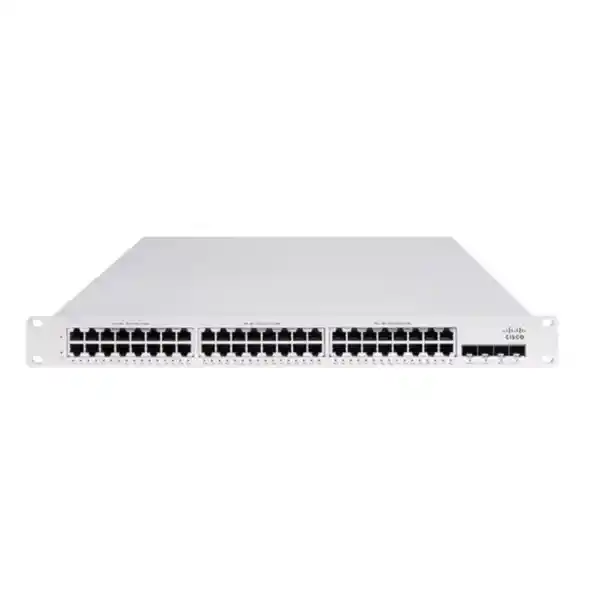
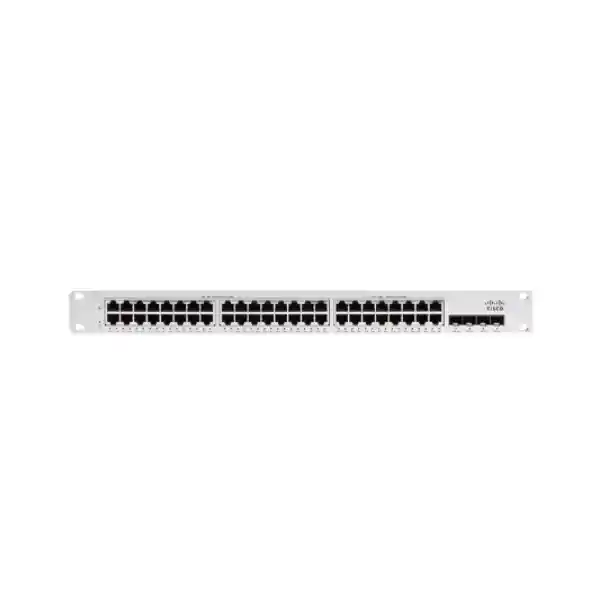
The Cisco Meraki MS150-48T-4G is a cloud-managed, stackable access switch built for organizations that want forty-eight 1 Gigabit Ethernet access ports, four fixed 1 Gigabit SFP uplinks, centralized visibility and a cleaner operating model across branch and campus networks. This model is specifically the data-only, non-PoE member of the MS150 48-port family. It is therefore well suited to environments where endpoint power is provided separately or where connected devices are primarily desktops, servers, printers, appliances, non-PoE access devices and other Ethernet equipment. For Tanzania buyers, the value of the platform is not only port count. The larger advantage is the ability to combine cloud-based configuration, monitoring, firmware lifecycle management and troubleshooting with a physically stackable access-layer design.
What the MS150-48T-4G is designed to solve
Many business networks reach a point where basic unmanaged or lightly managed switches are no longer enough. Teams need consistent VLANs, visibility into connected devices, predictable uplink design, faster troubleshooting and the ability to manage multiple locations without relying on a technician standing beside each rack. The MS150-48T-4G addresses that operational challenge by combining enterprise access switching with the Meraki Dashboard management model. Cisco positions the MS150 family for branch and campus use, and the 48T-4G variant gives organizations a high-density 1 GbE access layer without PoE hardware or 10 GbE uplinks they may not require.
This distinction matters during procurement. The MS150-48T-4G is not the same as the MS150-48LP-4G or MS150-48FP-4G, which add PoE capability, and it is not the MS150-48T-4X, which provides 10 GbE SFP+ uplinks. Selecting the 48T-4G makes the most sense when forty-eight copper access ports and 1 GbE fiber or copper SFP uplinks match the actual edge-network design. A correct choice avoids paying for power budgets or uplink speeds that are unnecessary while retaining physical stacking, cloud operations and Layer 2+ functions including static routing.
Access density
Forty-eight 1 GbE RJ45 ports support a dense wired access layer for business endpoints and infrastructure that do not require PoE from the switch.
Fiber-ready uplinks
Four fixed 1 GbE SFP uplink interfaces support compatible Meraki 1 GbE optical or copper SFP modules for structured inter-switch and distribution connectivity.
Physical stacking
Two dedicated stacking ports provide 80 Gbps stacking bandwidth and can be used to create resilient, easier-to-operate access-layer stacks.
Cloud operations
Meraki Dashboard supports centralized configuration, visibility, firmware management and remote troubleshooting across distributed sites.
Verified technical specification summary
| Specification | Cisco Meraki MS150-48T-4G |
|---|---|
| Access ports | 48 × 1 GbE RJ45 |
| Uplinks | 4 × 1 GbE SFP |
| PoE | No; data-only model |
| Dedicated management interface | 1 |
| Stacking | 2 dedicated ports, 80 Gbps stacking bandwidth |
| Switching capacity | 104 Gbps |
| Routing | Static routing |
| Power input | 100–240 VAC |
| Operating temperature | 0°C to 45°C |
| Mounting | Integrated 1U rack mount |
Specifications above are based on current Cisco Meraki MS150 documentation. Always validate the exact bill of materials, licensing term, optics, power cord and software requirements for the planned deployment before ordering.
Licensing and procurement guidance
Meraki switches are operated with Meraki licensing, so hardware selection should be planned together with the appropriate license model and term. Cisco documentation identifies MS150-48T-4G among the MS150 48-port licensing groups and notes that licensing choices can interact with the licensing tier already used in an organization. This is especially important when adding an MS150 to an existing Meraki estate rather than building a new organization from scratch. Buyers should confirm whether the deployment uses co-termination, per-device licensing or subscription licensing, and whether Enterprise/Essentials or Advanced/Advantage capabilities are required for the intended policy model.
Procurement should also include the correct regional power cord because Cisco notes that non-US orders do not automatically include the US power cord. If fiber uplinks are planned, supported 1 GbE SFP options listed for the MS150-48T-4G family include MA-SFP-1GB-SX, MA-SFP-1GB-LX10 and MA-SFP-1GB-TX. Stacking designs require supported stacking cables. A complete quotation is therefore more useful than a hardware-only price request because it can capture the switch, license term, optics, stacking cables, rack accessories, power requirements and deployment services together.
Cisco Meraki MS150-48T-4G Tanzania
Organizations evaluating the Cisco Meraki MS150-48T-4G in Tanzania are typically looking for a managed access switch that can simplify multi-site operations while preserving conventional enterprise switching features. The strongest fit is an environment where forty-eight wired Gigabit Ethernet connections are needed in one rack, but PoE power is not required from those ports. This can include administrative offices, finance departments, laboratories, server rooms, education facilities, hospitality back-office networks, retail headquarters and larger branch locations where endpoints already have independent power. In such settings, centralized cloud management can reduce the operational friction associated with maintaining separate switch configurations site by site.
For Tanzania deployments, planning should start with the network role rather than simply the port count. Determine whether the MS150-48T-4G will operate as an access switch below a distribution layer, as part of a physically stacked access block, or as a compact Layer 2+ platform using static routes for selected local segments. The four 1 GbE SFP uplinks make it suitable for fiber-connected closets where 1 GbE uplink capacity is sufficient. If the design requires 10 GbE uplinks, the 48T-4X variant deserves comparison. If phones, access points or cameras must receive power directly from the switch, one of the PoE variants is a better architectural match.
The Tanzania procurement process should also include licensing, compatible optics, stacking cables, rack depth, ventilation, power conditioning and future growth. A forty-eight-port switch may appear to have spare capacity today, but designers should reserve ports for uplinks, infrastructure, expansion and troubleshooting. Where sites experience power instability, the switch should be integrated into an appropriately sized UPS strategy rather than treated as an isolated appliance. FourTeck Tanzania’s broader networking and infrastructure approach is described on the FourTeck Tanzania technology solutions page, which is relevant when the switch forms part of a wider firewall, Wi-Fi, structured cabling, server or branch-network project.
Cisco Meraki MS150-48T-4G Dar es Salaam
In Dar es Salaam, the MS150-48T-4G is particularly relevant to organizations consolidating wired access in office towers, commercial facilities, headquarters, warehouses and multi-floor business sites. Dense business environments often have several network closets, shared fiber risers and a mix of old and new access switches. A cloud-managed design helps the IT team standardize VLANs, port profiles and firmware behavior across those closets while retaining remote visibility into port status and client connectivity. The model’s forty-eight 1 GbE ports provide practical density for conventional business endpoints, while the four 1 GbE SFP interfaces can connect to distribution switching or fiber runs where the available bandwidth and architecture are appropriate.
A Dar es Salaam network refresh should include an audit of what is actually connected today. If many ports feed wireless access points, IP phones, cameras or access-control devices that depend on PoE, the non-PoE 48T-4G may not be the best single-switch answer. It can still be valuable alongside PoE switches, separating user/data endpoints from powered devices, but the rack design should be deliberate. On the other hand, where most access ports serve desktops, printers, controllers, server interfaces or other separately powered devices, the 48T-4G can be a cost-conscious way to retain the MS150 platform without buying unused PoE capacity.
For larger Dar es Salaam sites, physical stacking can simplify management and resilience within the access layer. Designers should also validate uplink utilization, because 1 GbE SFP uplinks may be sufficient for many branch-style workloads but could become restrictive in high-throughput aggregation scenarios. A project quotation should therefore include expected traffic, application mix, current uplink speeds, rack availability, optical distances and licensing status. Where the switch is part of a broader national or regional deployment, centralized Meraki operations can help teams apply consistent configuration standards across locations rather than managing each site as an unrelated island.
Cisco Meraki MS150-48T-4G Mwanza
For businesses in Mwanza, the MS150-48T-4G can serve as a structured access-layer platform for offices, education sites, distribution operations, professional services and organizations that need reliable wired connectivity without local PoE requirements. The cloud-managed model is especially useful when the central IT team is located elsewhere, because day-to-day visibility and configuration do not depend on permanent specialist presence at the branch. Ports can be documented, monitored and organized consistently, which is valuable when remote troubleshooting needs to distinguish a physical cabling problem from a configuration or client issue.
A good Mwanza deployment should account for environmental and infrastructure conditions in the network room. Cisco specifies an operating range of 0°C to 45°C for the MS150 series, so airflow, rack placement and room temperature should be treated as design inputs. The switch is a 1U rack device, and sufficient clearance should be retained for airflow and cabling. Power resilience also matters: a rack containing switching, firewall and internet termination equipment should be protected by a properly sized UPS, with runtime expectations based on the full load rather than on the switch alone.
The four 1 GbE SFP uplinks create useful flexibility for fiber-connected buildings or longer internal runs, but transceiver selection should match fiber type, distance and the far-end device. Supported Meraki 1 GbE modules can be included in the bill of materials rather than purchased as an afterthought. If the Mwanza site is expected to expand significantly, planning should also compare the current 1 GbE uplink requirement against possible future needs. The MS150-48T-4G is strongest where 1 GbE uplinks remain appropriate; if the branch is expected to aggregate heavy server, storage or dense wireless traffic, 10 GbE uplink models may provide more headroom.
Cisco Meraki MS150-48T-4G Arusha
Arusha organizations often operate a mix of offices, hospitality environments, travel businesses, institutions and distributed facilities where network simplicity is a strong operational benefit. The Cisco Meraki MS150-48T-4G can fit projects that need forty-eight non-PoE Gigabit access ports with centralized cloud administration and stacking. A key design advantage is consistency: an IT team can standardize network naming, VLAN behavior and access policies across multiple locations while retaining remote diagnostics when users report that a wired device cannot connect.
In hospitality or mixed-use deployments, the 48T-4G should be positioned carefully because many modern edge devices—wireless access points, IP phones and surveillance cameras—consume PoE. The non-PoE model is better suited to separately powered endpoints or to a network architecture where powered devices are concentrated on dedicated PoE switches. Separating these roles can be valid and may simplify capacity planning, but the rack should be designed as a system. The access-layer mix, fiber uplinks, firewall throughput, wireless density and internet connectivity all influence real user experience.
When using the MS150-48T-4G in Arusha, procurement teams should request more than a bare switch price. The correct Meraki license, power cord, compatible SFPs, stacking cables and any rack accessories should be verified in the same proposal. If the network already uses Meraki switches, the licensing tier and organization model must also be checked for compatibility. For organizations expanding across East Africa, it can be useful to align standards with neighboring operations; the FourTeck Africa solutions site provides broader regional context for integrated networking and IT infrastructure projects that extend beyond one city or country.
Cisco Meraki MS150-48T-4G Dodoma
In Dodoma, the MS150-48T-4G is relevant to business, institutional and administrative networks that need a centrally managed wired access layer with predictable port capacity. Forty-eight 1 GbE RJ45 ports make the model practical for user floors, back-office areas, computer rooms and structured cabling deployments where most devices use separate power. Because Meraki management is cloud based, distributed IT teams can maintain visibility and configuration without treating every switch as a standalone device that must be accessed locally for routine administration.
For new buildings or office expansions in Dodoma, structured cabling design should be completed alongside switch selection. Port counts should map to actual outlets, spare capacity and future expansion rather than simply matching the number of current users. The four 1 GbE SFP uplinks can support fiber connections to distribution points or other buildings, but the design should confirm fiber type, optical budget, uplink redundancy and aggregate traffic demand. If bandwidth requirements are expected to grow materially, compare the 4G model with MS150 variants that provide 10 GbE SFP+ uplinks before finalizing the bill of materials.
Physical stacking can also help where multiple access switches occupy the same rack, giving the design dedicated stacking links rather than consuming front-panel uplinks for the stack itself. The two dedicated stacking ports provide 80 Gbps stacking bandwidth, which is useful for building a more coherent access block. Buyers should still plan failure domains, spare capacity and maintenance procedures. A reliable Dodoma deployment depends on more than the switch chassis: stable power, UPS protection, clean rack organization, ventilation, labeling, documented VLANs, licensing and change control all contribute to long-term serviceability.
Cisco Meraki MS150-48T-4G UAE
UAE buyers evaluating the Cisco Meraki MS150-48T-4G commonly prioritize centralized operations, predictable branch standards and rapid deployment across multiple offices. The model suits corporate access networks that need forty-eight Gigabit copper ports but do not require PoE on those ports. It can be deployed as part of a standardized branch template, using Meraki Dashboard for configuration and monitoring while physical stacking provides a practical path for higher port density in larger wiring closets. The four 1 GbE SFP uplinks are appropriate where the upstream architecture is also designed around Gigabit fiber links.
Procurement in the UAE should distinguish clearly between the MS150-48T-4G and nearby variants. A 48T-4X is preferable when 10 GbE SFP+ uplinks are required, while 48LP or 48FP variants are appropriate when access points, phones or cameras need switch-delivered power. The non-PoE 48T-4G remains attractive for data-only floors, server-access zones, lab networks and mixed racks where PoE is delivered by separate switching. A design review avoids the common mistake of selecting a model by port quantity while overlooking uplink speed and endpoint power requirements.
A complete UAE proposal should also cover licensing, optics, rack placement, power cords, stacking accessories and project services. Meraki licensing should be aligned with the organization’s existing model and feature tier. For organizations coordinating technology procurement between Tanzania and the Gulf, FourTeck UAE provides a regional reference point for broader IT, telecom and infrastructure requirements, while the Tanzania page can remain focused on deployment and purchasing needs for the local operation.
Cisco Meraki MS150-48T-4G Uganda
For Uganda deployments, the Cisco Meraki MS150-48T-4G offers a practical access-switch option where forty-eight wired Gigabit ports are needed and PoE is not a requirement. The cloud-managed operating model is particularly useful for organizations with branches spread across the country, because configuration and monitoring can be handled centrally rather than requiring site-by-site administration for routine tasks. This can simplify standardization across finance offices, education facilities, retail administration, logistics operations and other distributed environments.
Network designers should first classify connected endpoints. If the majority are PCs, printers, controllers, servers or other separately powered devices, the 48T-4G can be an efficient fit. If the rack is intended to power many access points, cameras or IP phones, a PoE-capable MS150 model is more suitable. The four 1 GbE SFP uplinks can support fiber aggregation for branch and campus layouts, but link capacity should be validated against expected traffic. Physical stacking allows multiple MS150 switches to operate with dedicated stack connections, which can reduce cabling complexity when higher access-port density is required.
Uganda projects should also include power, cooling and licensing in the design review. The switch operates from 100–240 VAC and should be supported by appropriate UPS protection where continuity is important. Cisco documents a 0°C to 45°C operating range, so enclosed or poorly ventilated racks need attention. Buyers planning a regional East African standard can reference the FourTeck Uganda IT and networking site for local solution context and coordinate hardware, licensing, optics and services as one bill of materials.
Cisco Meraki MS150-48T-4G Kampala
Kampala offices and commercial facilities frequently require dense wired access in buildings where multiple departments, floors or tenants share structured cabling infrastructure. The MS150-48T-4G can provide forty-eight 1 GbE access ports in a 1U form factor with four 1 GbE SFP uplinks and physical stacking. For IT teams responsible for several sites, Meraki Dashboard management can reduce the time spent visiting switches for routine configuration and diagnostics while improving consistency across VLANs and port settings.
The model should be chosen when the access layer is primarily data-only. Many Kampala network projects now include wireless access points, IP surveillance and VoIP, all of which may rely on PoE. In those designs, the 48T-4G is best used for non-PoE device groups or alongside PoE-capable switches. A mixed-switch approach can make good technical sense when it reflects the endpoint population, but it should be documented clearly so that future administrators understand which racks and ports provide power.
For fiber-connected floors, the four SFP uplinks support supported 1 GbE optics, and physical stacking provides dedicated bandwidth between stacked switches. Designers should confirm whether 1 GbE uplinks provide enough capacity for the expected user count and application profile. If the site hosts high-volume backups, local servers, dense Wi-Fi or large media workloads, a 10 GbE uplink variant may be more appropriate. Licensing must also be selected with the existing Meraki organization in mind. A well-prepared Kampala quotation therefore includes switch hardware, license term, optics, stacking cables, power accessories and deployment scope instead of treating each component as a separate late-stage purchase.
Cisco Meraki MS150-48T-4G Arua
In Arua, organizations with smaller local IT teams can benefit from a cloud-managed access platform that keeps configuration and monitoring centralized. The MS150-48T-4G provides forty-eight wired Gigabit ports for data endpoints and four SFP uplinks for suitable fiber or copper transceiver connections. This makes it useful for branch offices, institutions and operations that need a sizeable access layer but do not need PoE power from the switch itself. Remote visibility can be particularly valuable when troubleshooting travel is costly or when support is coordinated from another city.
Arua deployments should put resilience basics ahead of unnecessary complexity. Ensure the switch is mounted in a secure, ventilated rack, connected through dependable UPS protection and labeled so physical ports map clearly to outlets and devices. Where fiber is used, the transceiver and cable type must match both the local switch and the far-end equipment. If multiple MS150 units are installed in the same rack, dedicated stacking can simplify the design and provide higher-speed inter-switch connectivity without consuming the four SFP uplink ports.
Bandwidth expectations should also be realistic. The 48T-4G is a Gigabit access model with 1 GbE SFP uplinks, so it is well aligned with conventional branch workloads but may not be the best choice for a site expected to aggregate very high east-west traffic or dense high-speed wireless. Procurement planning should document user count, application mix, uplink topology, current Meraki licensing model and expected growth. That information makes it easier to decide whether the 48T-4G is the correct model or whether a 4X or PoE variant should be considered instead.
Cisco Meraki MS150-48T-4G Mbarara
Mbarara businesses and institutions looking for a centrally managed 48-port switch can use the MS150-48T-4G as a data-access platform in offices, administrative buildings and branch networks. The value proposition is strongest where many conventional Ethernet endpoints need stable Gigabit connectivity, while devices requiring PoE are limited or handled on separate switching. The Meraki cloud-management model helps standardize configuration and provides remote operational visibility, which can make distributed network support easier for organizations with IT resources concentrated in Kampala or another central office.
Switch placement should be planned together with the building’s structured cabling. Forty-eight ports can disappear quickly once user outlets, printers, servers, controllers, uplinks and spare capacity are counted. A sensible design reserves growth rather than running a new switch at near-full utilization immediately after installation. If the site needs more than forty-eight access ports, physical stacking allows multiple MS150 switches to be linked through their dedicated stack ports. The four 1 GbE SFP uplinks can then remain available for building or distribution connectivity.
Power quality, rack airflow and fiber design should be included in the Mbarara bill of materials. Cisco specifies 100–240 VAC input and a 0°C to 45°C operating range for the model. Appropriate UPS sizing should include the entire rack load, not just the switch. For fiber, supported SFP type must match distance and media. Licensing also requires attention: Meraki hardware and cloud operations are tied to licensing, and the chosen term or subscription should be aligned with the organization’s lifecycle plan. These details help turn a hardware purchase into a deployable, supportable network solution.
Cisco Meraki MS150-48T-4G Gulu
For Gulu networks, the MS150-48T-4G can provide a manageable foundation for wired business access where local endpoints do not require PoE. Forty-eight 1 GbE copper ports create enough density for a sizeable branch or institutional floor, while cloud management allows configuration and monitoring to be performed by a central IT function. That operating model can be valuable where onsite technical staff are limited, because port status, client visibility and selected troubleshooting tasks can be handled remotely before deciding whether physical intervention is required.
The model’s four 1 GbE SFP uplinks make it suitable for fiber-connected racks or links to an upstream distribution device, provided Gigabit uplink capacity matches the traffic requirement. For deployments with multiple MS150 switches in one rack, dedicated stacking ports provide 80 Gbps stacking bandwidth and avoid using regular uplink ports for the stack. This can create a cleaner access-layer design while keeping front-panel uplinks available for redundancy or distribution connections.
Gulu procurement should be based on a complete bill of materials. The switch itself is only one line item. The project may also require the correct Meraki license, regional power cord, supported SFPs, stacking cables, rack hardware, UPS capacity and configuration services. If wireless access points, cameras or IP phones need power, their requirements should be separated from the data-only role of the 48T-4G. Comparing the non-PoE and PoE MS150 variants during design is often worthwhile because it prevents later reliance on external injectors or unplanned switch additions.
Cisco Meraki MS150-48T-4G Kenya
The Cisco Meraki MS150-48T-4G is a strong candidate for Kenya organizations that want a standardized, cloud-managed wired access layer across offices and branches. The switch provides forty-eight 1 GbE access ports, four 1 GbE SFP uplinks and physical stacking, making it suitable for corporate floors, professional-services offices, education environments and branch locations where data endpoints dominate. Because the model is non-PoE, it should be selected intentionally for separately powered devices rather than substituted for a PoE model in wireless, voice or surveillance-heavy networks.
Kenya deployments often involve multi-floor buildings or branch networks connected over carrier or SD-WAN services. The access switch should therefore be evaluated as part of the whole LAN and WAN design. VLAN structure, uplink redundancy, firewall handoff, DHCP services, authentication and monitoring all influence the user experience. The MS150 supports static routing, but complex dynamic-routing requirements should be handled at the appropriate distribution, core or security layer rather than assumed from a Layer 2+ access platform.
For cross-border East African projects, standardizing on a consistent switch family can simplify documentation, training and spare planning. However, every site should still be sized on its own endpoint, PoE and bandwidth requirements. FourTeck’s Kenya IT solutions and networking site provides relevant regional context when the same project extends into Kenya. A proper quotation should include the switch, selected Meraki license, compatible optics, stack cables where needed, power accessories and deployment scope, with no assumption that a hardware-only line item represents the full operational cost.
Cisco Meraki MS150-48T-4G Kuwait
Kuwait organizations that operate distributed branches, corporate offices or managed facilities can use the MS150-48T-4G where a high-density non-PoE access layer is required. The switch offers forty-eight Gigabit copper ports, four 1 GbE SFP uplinks and dedicated stacking interfaces. Cloud-based Meraki operations can make it easier to maintain configuration consistency across multiple sites and to carry out remote monitoring without relying on local console access for routine work.
The model is particularly appropriate for user and device networks that do not draw power from Ethernet. Where access points, phones, cameras or sensors require PoE, planners should compare PoE-capable MS150 variants rather than adding a large number of power injectors after the fact. Likewise, organizations expecting high aggregation bandwidth should determine whether four 1 GbE SFP uplinks are sufficient or whether a 4X variant with 10 GbE SFP+ uplinks is a better long-term choice.
Environmental control is normally strong in enterprise facilities, but rack airflow and operating temperature still matter. The switch should be installed in a suitable 1U rack position with adequate space for cabling and cooling. Licensing must be planned as part of the purchase because the Meraki cloud-management experience depends on the chosen licensing model. Kuwait procurement teams should therefore request a solution quote that includes hardware, licensing, optics, stack cables, power cord requirements, configuration and lifecycle planning. This prevents cost comparisons from being distorted by offers that include only the chassis.
Cisco Meraki MS150-48T-4G Ghana
In Ghana, the Cisco Meraki MS150-48T-4G can be deployed as a cloud-managed access switch for offices, branch operations, institutions and distributed enterprises that need forty-eight Gigabit Ethernet access ports without PoE. Centralized management is helpful for organizations that support several sites from one IT team, allowing switch configuration and monitoring to follow common standards. The four SFP uplinks provide options for fiber-connected closets, while dedicated stacking ports support multi-switch access blocks where additional port density is required.
Ghana projects should be designed around actual endpoints and traffic. A non-PoE switch is a good fit for desktops, printers, server interfaces and other independently powered equipment. It is less suitable as the sole access switch for a site dominated by wireless access points, IP cameras or VoIP phones. In those cases, PoE-capable MS150 models may simplify deployment and reduce dependence on external power supplies. Similarly, 1 GbE uplinks should be evaluated against current and projected traffic rather than assumed to be sufficient for every site.
Operational resilience also depends on the supporting rack. UPS protection, ventilation, labeling and structured cable management should be part of the deployment plan. Meraki licensing must be selected for the intended organization and lifecycle, and supported SFPs should be matched to the fiber plant. For a regional procurement team comparing multiple African sites, maintaining a common switch family can simplify support while still allowing local variations in port count, uplink speed and PoE budget. The outcome should be a standardized architecture rather than a one-size-fits-all bill of materials.
Cisco Meraki MS150-48T-4G Nigeria
Nigeria enterprises frequently operate complex multi-site networks where centralized visibility and configuration consistency are valuable. The MS150-48T-4G fits access-layer roles requiring forty-eight 1 GbE copper connections, four 1 GbE SFP uplinks and physical stacking, provided endpoint power and aggregation requirements align with the model. Meraki Dashboard management can help a central network team apply repeatable standards and investigate connectivity issues across geographically dispersed branches without beginning every troubleshooting process with an onsite visit.
The non-PoE design should be treated as a deliberate advantage when powered Ethernet is unnecessary, not as a universal replacement for PoE access switching. Many Nigerian business sites support IP phones, Wi-Fi access points, cameras and access-control endpoints that depend on PoE. A mixed design can combine the 48T-4G for data-only devices with PoE-capable models for powered endpoints, but port allocation and uplink capacity should be documented carefully. The four 1 GbE SFP uplinks are appropriate for many access networks; sites with high traffic concentration should compare 10 GbE uplink variants before purchase.
Power continuity should receive explicit attention in the bill of materials. UPS sizing, surge protection strategy, generator transitions and rack cooling can affect network availability as much as the switch choice. Cisco specifies 100–240 VAC input and an operating range up to 45°C, so environmental management remains important. Licensing, supported optics, stacking cables and deployment services should be quoted together with the hardware. For multinational teams, consistent Meraki architecture can reduce operational variation, but licensing models and feature tiers must still be coordinated across the organization.
Cisco Meraki MS150-48T-4G Seychelles
Seychelles organizations can use the MS150-48T-4G for hotel back-office networks, corporate offices, institutions and other sites that need a dense data-only access layer with remote management. The switch’s forty-eight 1 GbE ports can consolidate many conventional Ethernet endpoints into a 1U rack position, while four 1 GbE SFP uplinks support appropriate fiber connections. Cloud management is useful in island or multi-site environments because central administrators can maintain configuration visibility without relying solely on local specialist resources.
For hospitality and resort environments, it is important to separate data-only switching from PoE demand. Guest Wi-Fi access points, IP phones, cameras and access-control systems often require power from the network. The 48T-4G should therefore be assigned to endpoints that do not need PoE, or deployed alongside MS150 PoE variants. This segmentation can be efficient when planned correctly, but it should not result from discovering after installation that powered endpoints have nowhere appropriate to connect.
The 1 GbE SFP uplinks also need to be considered in the context of site architecture. For conventional business and branch traffic they may be adequate, but environments aggregating dense wireless, media or server workloads should assess whether 10 GbE uplinks are more appropriate. Salt air, humidity and environmental exposure also reinforce the need for controlled indoor racks and sensible equipment-room practices, even though the switch itself is intended for standard enterprise environments. Procurement should include licensing, optics, power accessories, UPS planning and stacking components so the delivered system can be installed and operated without avoidable gaps.
Compatibility, optics and stack planning
Cisco lists MA-SFP-1GB-SX, MA-SFP-1GB-LX10 and MA-SFP-1GB-TX among supported SFP modules for the 4G MS150 models, including the MS150-48T-4G. The correct transceiver depends on the cable plant, distance and far-end interface. Multimode fiber, single-mode fiber and copper SFP use cases should therefore be identified before quoting. The switch also supports dedicated stacking cables such as MA-CBL-100G-50CM, MA-CBL-100G-1M and MA-CBL-100G-3M, allowing rack layouts to be planned around actual physical distance between units.
When integrating with firewalls, routers, servers or wireless infrastructure, designers should document VLANs, native VLAN behavior, trunking, link aggregation and IP addressing rather than relying on defaults. Static routing can be useful for limited Layer 3 requirements, but the overall architecture should preserve a clear boundary between access, distribution and security roles. Meraki cloud management can simplify operations, but it does not remove the need for sound network design.
How to decide between MS150-48T-4G and nearby MS150 models
Choose 48T-4G when
You need 48 × 1 GbE access ports, do not need PoE, and four 1 GbE SFP uplinks are sufficient for the planned access layer.
Consider 48T-4X when
You still need non-PoE 48-port access switching but expect 10 GbE SFP+ uplinks for higher aggregation capacity.
Consider LP/FP when
Access points, phones, cameras or other powered endpoints require PoE from the switch and the PoE budget must be included in sizing.
Related FourTeck regional resources
The FourTeck Tanzania business technology site covers networking, firewalls, Wi-Fi, servers, structured cabling and integrated IT infrastructure, which are directly relevant when an MS150 switch is part of a larger site design. For cross-border planning, the FourTeck Uganda networking and IT site and FourTeck Kenya solutions site support neighboring East African requirements. The FourTeck Africa portal is useful for broader regional project coordination, while FourTeck UAE provides a Gulf-region reference for IT, telecom and infrastructure projects. These links are intended to help regional teams coordinate related technology needs rather than treat switching as an isolated purchase.
Frequently asked questions
Does the Cisco Meraki MS150-48T-4G provide PoE?
No. The MS150-48T-4G is a data-only, non-PoE model. If your project needs the switch to power access points, IP phones, cameras or other PoE endpoints, compare the MS150-48LP-4G or MS150-48FP-4G and validate the required power budget.
How many ports does the MS150-48T-4G have?
It has 48 × 1 GbE RJ45 access ports and 4 × 1 GbE SFP uplink ports, plus a dedicated management interface and two dedicated physical stacking ports.
Can the MS150-48T-4G be stacked?
Yes. Cisco documents two dedicated stacking ports and 80 Gbps stacking bandwidth for the model. Supported stacking cables should be selected according to the physical layout of the rack.
Does it support Layer 3 routing?
Cisco documents static routing for the MS150-48T-4G. Organizations needing more complex dynamic-routing functions should evaluate the broader network architecture and place those requirements on the appropriate distribution, core or security platform.
Which SFPs can be used with the 4G model?
Cisco lists MA-SFP-1GB-SX, MA-SFP-1GB-LX10 and MA-SFP-1GB-TX among supported SFP options for MS150 4G models. The correct choice depends on fiber type, link distance and the far-end interface.
Is a Meraki license required?
Meraki switching is operated with Meraki licensing. The exact license model and term should be selected according to the organization’s licensing approach and feature needs. Existing Meraki estates should be checked for tier and organization compatibility before adding hardware.
Is the MS150-48T-4G suitable for Wi-Fi 7 deployments?
The MS150 family is positioned by Cisco for modern branch and campus networks, but the 48T-4G itself is non-PoE and provides 1 GbE access ports and 1 GbE SFP uplinks. Wi-Fi 7 access points may require PoE and multigigabit connectivity, so the specific AP requirements must be checked. Other MS150 variants provide multigigabit and higher-power PoE capabilities.
Quotation checklist
Decision recap
Choose the Cisco Meraki MS150-48T-4G when your network needs a high-density, cloud-managed access switch with forty-eight 1 GbE copper ports, four 1 GbE SFP uplinks, physical stacking and static routing, and when PoE is not required from the switch. Compare other MS150 variants when powered endpoints, multigigabit access or 10 GbE uplinks are part of the design. The most reliable procurement decision combines the switch model with licensing, optics, stack cables, power and the surrounding network architecture rather than evaluating the chassis in isolation.
Plan your Cisco Meraki switching deployment
FourTeck Tanzania can help translate port counts, uplink requirements, licensing, optics, stacking and deployment needs into a practical bill of materials for the MS150-48T-4G or an alternative MS150 model. Share the number of sites, current network topology, endpoint mix and expected growth so the quotation reflects the real project rather than only a single hardware line.



Reviews
There are no reviews yet.