
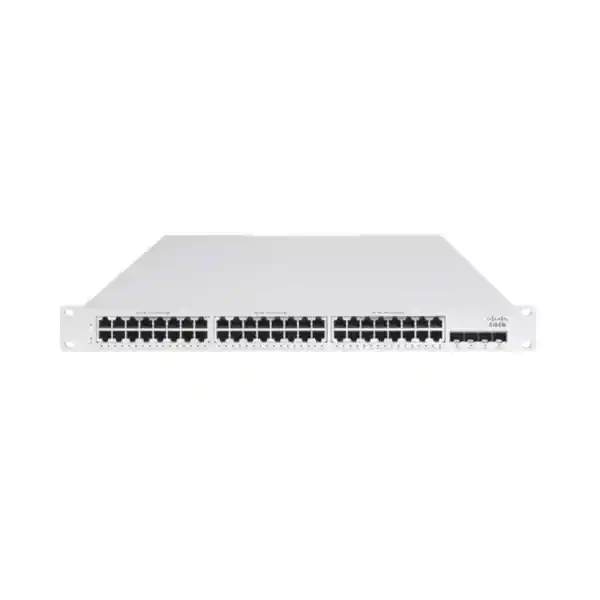
Cisco Meraki MS150-48LP-4X Tanzania
The Cisco Meraki MS150-48LP-4X is a cloud-managed, stackable access switch for organizations that need a high-density 48-port Gigabit Ethernet edge with PoE+ power, four fixed 10 Gigabit SFP+ uplinks and centralized Meraki Dashboard operations. It is designed for branch and campus environments where wired users, wireless access points, IP phones, cameras and other networked devices must be connected through a manageable switching platform. For Tanzanian businesses, the purchasing decision should consider much more than port count: PoE demand, fiber or DAC uplinks, rack layout, stack design, licensing model, power protection, VLAN architecture and the wider network standard all affect the correct bill of materials.
48 × 10/100/1000 Mbps RJ45 access ports, 4 × 10 GbE SFP+ uplinks, 370W total PoE switch budget, up to 30W PoE per access port, two dedicated physical stacking ports with 80 Gbps stacking bandwidth, static routing capability, a dedicated management interface and centralized Meraki cloud management.
What the Cisco Meraki MS150-48LP-4X is designed to solve
Modern access networks frequently carry several device classes over the same switching layer. Office workstations require stable wired access, access points need both data and PoE, IP telephones often need voice VLANs and quality-of-service planning, and surveillance devices can add sustained traffic and power demand. The MS150-48LP-4X provides a dense 48-port access platform with a 370W PoE budget and four 10GbE SFP+ uplinks, giving network planners room to consolidate edge connectivity while maintaining higher-capacity paths toward aggregation, servers or upstream infrastructure. Because it is managed through the Cisco Meraki Dashboard, routine administration can be centralized across sites rather than relying exclusively on local console work.
The model is particularly relevant when an organization values cloud-based visibility, remote troubleshooting, configuration consistency and physical switch stacking. It is not automatically the right choice for every 48-port project. A site that expects heavy PoE consumption across most ports may need a higher-PoE-budget model, while a deployment that needs multigigabit copper access should evaluate another MS150 variant. FourTeck therefore treats the model number as the start of the design conversation rather than the end of it.
48-port access density
Forty-eight 1GbE RJ45 ports make the switch suitable for dense office, branch, school, hospitality, retail and surveillance access layers where many endpoints terminate in the same rack or distribution point.
370W PoE budget
The LP model provides a 370W switch PoE budget with up to 30W per port, supporting compatible PoE-powered devices while making accurate power-budget calculation an important part of deployment planning.
10GbE SFP+ uplinks
Four SFP+ uplinks provide options for 10GbE fiber or supported direct-attach connectivity, useful when access traffic must be aggregated toward a core, distribution switch, server zone or inter-rack path.
Meraki Dashboard operations
Cloud management supports centralized configuration, monitoring, firmware management and remote troubleshooting. Licensing is therefore a procurement requirement that should be considered alongside hardware and accessories.
Cisco Meraki MS150-48LP-4X technical specifications
| Access ports | 48 × 10/100/1000 Mbps RJ45 |
|---|---|
| Uplinks | 4 × 10 GbE SFP+ |
| PoE capability | PoE model, up to 30W per port; 370W total switch PoE budget |
| Stacking | 2 dedicated stacking ports; 80 Gbps stacking bandwidth |
| Switching capacity | 176 Gbps |
| Routing | Static routing |
| Management | Cisco Meraki Dashboard; dedicated management interface |
| Power input | 100–240 VAC |
| Licensing | Meraki licensing required; available licensing structures and tiers should be matched to the organization design |
Specifications should be checked against the current Cisco Meraki documentation at the time of procurement, particularly licensing, accessory and transceiver selections. Region-specific power cords may need to be ordered separately depending on the ordering route.
Planning PoE, uplinks, stacking and licenses
A 370W PoE budget is substantial, but it should not be confused with the theoretical sum of 48 ports each drawing their maximum. The correct approach is to list every PoE endpoint, record its expected and maximum power class, allow a practical margin, and then compare the total against the available budget. A switch serving a mix of low-power phones and access points may fit comfortably; a deployment with many high-power wireless or specialist IoT devices may require a different PoE class or higher-budget switch. Procurement should also include suitable UPS capacity because the switch becomes a power source for connected endpoints.
The four SFP+ ports give flexibility for uplink architecture. Some sites may dedicate one or two 10GbE links upstream and reserve others for redundancy or inter-switch connectivity. Others may use link aggregation where the wider topology supports it. Fiber type, optic choice, connector type, distance and patching all need to be consistent. Unsupported optics or incorrect single-mode versus multimode selection can turn an otherwise straightforward project into a troubleshooting exercise.
Physical stacking is useful when adjacent switches are intended to operate as a coordinated access block. The MS150 family provides dedicated stack connections rather than consuming normal access ports. The stack design should include the correct supported stacking cables, rack position and maintenance access. Meraki licensing is equally important: hardware procurement should be aligned with the chosen licensing model, term and feature tier so the switch can be managed within the intended Meraki organization.
Related FourTeck networking resources
For a wider Tanzania infrastructure requirement, explore the FourTeck Tanzania technology portfolio, which covers network switching, wireless, firewalls, structured cabling, racks, UPS systems and supporting IT infrastructure. Projects that span multiple markets can also use the regional capabilities of FourTeck for broader integrated IT and telecom planning.
Organizations with East African branches can coordinate requirements through FourTeck Kenya and FourTeck Uganda, helping procurement teams keep switch, wireless and security standards consistent across countries. For projects extending beyond one national market, FourTeck Africa provides a regional reference point for broader infrastructure planning.
These links are most useful when the MS150-48LP-4X is one component of a larger architecture. A practical bill of materials may also include compatible optics, stacking cables, patching, rack accessories, UPS capacity, wireless access points, firewalls and licensing. The final combination should be selected from the actual site topology rather than assembled as an isolated shopping list.
Cisco Meraki MS150-48LP-4X Tanzania
For organizations buying the Cisco Meraki MS150-48LP-4X in Tanzania, the most important starting point is the access-layer role the switch will perform. The model suits sites that require many standard Gigabit Ethernet connections, central cloud administration and PoE for endpoint devices. Typical project discussions may involve office PCs, IP phones, access points, surveillance cameras, door controllers and other Ethernet-connected systems sharing the same switching infrastructure. The switch’s forty-eight copper access ports can simplify rack planning where endpoint density is high, while the four 10GbE SFP+ interfaces provide higher-speed uplink options toward distribution or core infrastructure. The 370W PoE budget is useful, but it must be planned from the actual connected load instead of assumed to cover every possible endpoint combination.
Tanzania deployments can vary greatly between head offices, branches, education sites, warehouses, hospitality venues and commercial buildings. A procurement team should therefore document port count, PoE classes, fiber distances, rack space, available power, UPS autonomy, uplink redundancy and VLAN requirements before requesting pricing. If the business already uses Meraki wireless, security or switching, the operational value can also come from keeping management within a common Dashboard environment. If the network is not already Meraki-based, licensing and operational workflow should be reviewed as part of the platform decision rather than treated as an afterthought.
For quotation preparation, FourTeck can work from a basic port schedule or from a more complete network design. Useful information includes the number and type of PoE devices, expected growth, existing switch models, uplink media, required transceiver distances, rack location and whether physical stacking is planned. This reduces the risk of ordering the correct switch chassis but omitting required licenses, optics, stack cables or power accessories. It also helps distinguish when the MS150-48LP-4X is a good fit from cases where a higher PoE budget, multigigabit access or another model would be more appropriate.
Cisco Meraki MS150-48LP-4X Dar es Salaam
In Dar es Salaam, business networks often need to support dense office floors, customer-facing branches, hotels, warehouses, professional services and distributed operational sites. The Cisco Meraki MS150-48LP-4X can serve as a high-density access switch where forty-eight Gigabit Ethernet ports and PoE+ are needed in one rack unit class of deployment. Rather than selecting it only because the port count matches an equipment list, planners should map each connection to a device type. A voice endpoint may have very different traffic and power behavior from a camera or wireless access point, and the 370W total PoE budget must be shared across all powered ports.
The four SFP+ interfaces are particularly relevant when a building uses fiber between floors, racks or network rooms. Before quotation, specify whether links are multimode or single-mode, approximate distance, connector type and whether the upstream device supports the intended 10GbE interface. When two or more MS150 switches are installed together, dedicated physical stacking can create a cleaner access-layer design, but it requires the correct supported stack cables and sensible rack placement. UPS sizing should also include the switch’s own load and the downstream PoE endpoints that depend on it during power events.
Dar es Salaam buyers should also include the Meraki license in commercial planning. The switch is cloud-managed, and the license structure is part of operating the platform. Organizations standardizing multiple sites can benefit from centralized monitoring and configuration because branch visibility is not limited to being physically in front of each device. A useful RFQ should state the number of units, desired licensing term, existing Meraki organization details if relevant, optic requirements, stack requirements and expected PoE devices. This creates a clearer path to an accurate bill of materials than asking for a bare switch price alone.
Cisco Meraki MS150-48LP-4X Mwanza
For Mwanza organizations planning a network refresh, the Cisco Meraki MS150-48LP-4X can be considered where centralized management and dense PoE access are priorities. A 48-port switch is often purchased for immediate capacity, but a more reliable design looks at the next expansion cycle as well. Count current wired users, wireless access points, phones, cameras and building systems, then reserve capacity for moves, additions and changes. The MS150-48LP-4X provides standard 1GbE copper access across all forty-eight RJ45 interfaces, so devices that specifically need multigigabit copper should be identified separately before the model is finalized.
The 370W PoE budget is a planning constraint as well as a feature. In a mixed environment, several low-demand devices may coexist comfortably with higher-demand access points, but the arithmetic needs to be based on real endpoint specifications. Networks supporting surveillance should also consider sustained camera traffic, uplink utilization and storage paths, while voice deployments should consider VLAN and quality-of-service policy. The Meraki Dashboard can centralize monitoring and troubleshooting, which is useful for organizations whose technical team manages more than one site.
Procurement in Mwanza should include practical deployment accessories in the same planning cycle: appropriate SFP/SFP+ optics or DACs, stacking cables if required, rack patching, cable management, UPS protection and the correct license. If the existing network uses a different vendor at the core or edge, interoperability should be reviewed at the Ethernet, VLAN, spanning-tree and uplink level. A quotation request that includes topology information and uplink distances allows the switch to be evaluated as part of the working network rather than as a standalone chassis, reducing the chance of installation-day surprises.
Cisco Meraki MS150-48LP-4X Arusha
Arusha businesses in hospitality, tourism, professional services, education and general commercial operations often rely on converged networks that carry user data, wireless access, IP telephony and surveillance. The Cisco Meraki MS150-48LP-4X is relevant to that kind of access-layer requirement because it combines forty-eight Gigabit Ethernet ports with a 370W PoE budget and four 10GbE SFP+ uplinks. A single switch can therefore connect many endpoints while providing higher-capacity paths to upstream equipment, but the design still needs clear segmentation and power planning.
For hotel or campus-style environments, wireless access points and cameras can consume a significant share of both PoE and bandwidth. Engineers should estimate total device power at maximum expected draw, then check that the 370W budget leaves a sensible operating margin. If multiple switch closets or floors are connected over fiber, optics must match cable type and distance. Where switches are mounted together in the same rack, the dedicated stacking ports can support a physical stack without sacrificing normal access interfaces. That can simplify expansion and operations when planned from the beginning.
Arusha procurement should also factor in the cloud-management model. Meraki Dashboard functionality, firmware handling and remote troubleshooting are part of the platform’s operational value, while licensing remains a recurring commercial consideration. When requesting a quote, include the number of switches, target license term, PoE endpoint list, uplink requirements and any existing Meraki estate. For new builds, add rack, UPS and cabling information. For upgrades, note the current switches and any existing VLAN or fiber layout. This gives a supplier enough context to confirm whether the MS150-48LP-4X is the correct variant or whether another MS150 model better matches the site.
Cisco Meraki MS150-48LP-4X Dodoma
In Dodoma, organizations planning office, institutional or campus networks can use the Cisco Meraki MS150-48LP-4X as a centrally managed access-layer option where forty-eight Gigabit Ethernet ports and PoE are required. The platform is well suited to structured deployments in which user ports, access points, IP phones and security devices are documented and segmented. Because it is a cloud-managed switch, administrators can monitor and configure the device through Meraki Dashboard rather than relying solely on local access to the switching closet.
The technical design should start with the upstream path. Four 10GbE SFP+ interfaces can support high-speed connections toward distribution equipment, but the correct optic, fiber type and redundancy model need to be determined. If the site uses copper-only uplinks today, planners should decide whether a 10GbE transition is part of the same project or a later phase. Likewise, the 370W PoE budget needs to be checked against the combined demand of all powered endpoints. A switch intended to power dozens of devices should not be quoted without a basic power schedule.
For Dodoma projects with multiple adjacent access switches, physical stacking can improve operational organization and preserve uplink ports for production traffic. The stack requires supported cables and deliberate rack placement. Licensing also belongs in the bill of materials from the beginning. Procurement teams should ask for a complete commercial response covering hardware, license term, optics, stack accessories and any required power cord or rack items. FourTeck can use the resulting information to prepare a more accurate solution scope and identify any compatibility issues before deployment rather than after equipment arrives on site.
Cisco Meraki MS150-48LP-4X UAE
For UAE organizations standardizing Cisco Meraki switching across offices, retail sites, hospitality properties, warehouses or branch networks, the MS150-48LP-4X offers a practical combination of high port density and cloud operations. The switch provides forty-eight 1GbE access ports, four 10GbE SFP+ uplinks and a 370W PoE budget, making it suitable for mixed endpoint environments where phones, cameras and wireless devices share the access layer. The key procurement question is whether that exact balance of port speed and power matches the planned device population.
Large distributed organizations can gain operational consistency from Meraki Dashboard because network teams can apply standardized configurations and troubleshoot remotely across many sites. That benefit should be weighed together with license planning. Existing Meraki organizations need the appropriate license structure and feature tier, and new deployments should choose terms that align with internal budgeting and lifecycle practices. Where physical stacking is required, the MS150 family provides dedicated stack connectivity; the design should include supported stacking cables and a rack layout that permits service access.
UAE deployments frequently use fiber uplinks between network rooms or buildings, so optics should be specified from actual distance and fiber type instead of guessed. A complete RFQ should state the number of switches, license duration, PoE endpoints, required uplink speeds, optic distances, stack design and any integration with existing Cisco or third-party infrastructure. For organizations that also operate in Tanzania, a common bill-of-materials approach can reduce model variation and simplify network documentation, while still allowing each site to be sized for its own power, port and uplink requirements.
Cisco Meraki MS150-48LP-4X Uganda
Organizations evaluating the Cisco Meraki MS150-48LP-4X in Uganda can use it as a cloud-managed access switch for branch, campus and commercial networks that need dense Gigabit connectivity. Its forty-eight RJ45 ports support standard 1GbE endpoint access, while four SFP+ uplinks provide higher-speed connectivity to upstream switching or server infrastructure. The 370W PoE budget makes the model relevant for mixed deployments with phones, cameras and wireless access points, provided the combined endpoint power has been calculated correctly.
For multi-site businesses, a major consideration is operational consistency. Meraki Dashboard can provide a common management plane across locations, making it easier to monitor devices and use remote troubleshooting tools. That does not eliminate the need for good local network design: VLANs, spanning tree, uplink redundancy, IP addressing and PoE capacity should still be documented. If the switch connects to an existing core from another vendor, interface standards and VLAN behavior should be validated before cutover.
Uganda procurement should also consider lifecycle items at the quotation stage. The switch requires Meraki licensing, and the selected model may need supported optics, stacking cables and a regional power cord depending on how it is ordered. UPS sizing should reflect both the switch and its powered endpoints. For cross-border organizations, FourTeck’s Uganda and Tanzania resources can support a more consistent requirements process without implying that every site should use an identical design. Each location should confirm its own user count, endpoint mix, fiber distances and growth expectations before the MS150-48LP-4X is finalized.
Cisco Meraki MS150-48LP-4X Kampala
Kampala offices and business campuses often combine dense user access with wireless, voice and physical-security devices. The Cisco Meraki MS150-48LP-4X can fit this requirement by providing forty-eight Gigabit copper ports and PoE within a centrally managed switching platform. A design should begin by assigning expected endpoints to ports and grouping them by traffic and power type. This helps determine whether the 370W PoE budget is sufficient and whether one switch or a small stack is the better physical layout.
The model’s four 10GbE SFP+ interfaces are useful for connections to aggregation switches, server networks or other high-bandwidth upstream resources. Fiber selection should be based on the installed cabling and link distance. Where two or more switches are co-located, dedicated physical stacking can provide an organized method of joining the access layer without consuming the SFP+ uplinks. Network teams should still plan redundancy, maintenance windows and failure domains according to the wider topology.
For Kampala buyers, licensing is inseparable from the hardware decision because Meraki cloud management depends on the appropriate license model. An RFQ should identify whether the switch is joining an existing Meraki organization, which license term is preferred, and whether advanced features are required. It should also include optics, stack cables, rack position and UPS requirements. When these details are known before purchase, the supplier can prepare a more accurate bill of materials and the deployment team can avoid discovering missing accessories or power constraints during installation.
Cisco Meraki MS150-48LP-4X Arua
For an Arua branch or institutional network, the Cisco Meraki MS150-48LP-4X is most compelling when centralized management and remote visibility matter as much as local port density. Forty-eight Gigabit access ports can accommodate a substantial endpoint population, and the 370W PoE budget can reduce the need for individual power adapters for compatible phones, access points, cameras and other powered devices. The design should still treat power as a finite shared resource and document expected consumption per endpoint.
Remote-site planning benefits from careful uplink and resilience choices. The four SFP+ interfaces can provide 10GbE options when the upstream network and fiber plant support them. If the site is smaller and upstream connectivity is below 10GbE, those ports still provide architectural headroom for later upgrades. Meraki cloud management can help a central IT team monitor and troubleshoot the switch without traveling for every routine task, although hands-on maintenance and physical cabling responsibilities remain local site considerations.
Arua procurement requests should describe the actual network rather than only state the switch model. Include internet or WAN handoff details, existing core equipment, VLAN count, expected PoE devices, fiber type, rack environment and desired license term. If the branch is part of a larger organization with Kampala or Tanzania operations, a common Meraki standard may simplify templates and documentation, but the branch should still be sized independently. This approach keeps the MS150-48LP-4X selection tied to business need, not just to a corporate model list.
Cisco Meraki MS150-48LP-4X Mbarara
Mbarara businesses considering a managed network upgrade can evaluate the Cisco Meraki MS150-48LP-4X where a single access switch needs to serve many wired and PoE endpoints. The forty-eight 1GbE ports suit conventional office devices and edge systems, while the four 10GbE SFP+ uplinks provide a path toward higher-capacity aggregation. This is useful when local access traffic is consolidated into a smaller number of upstream links, but the chosen optic and fiber infrastructure must match the intended design.
PoE planning is especially important when the network includes multiple access points or surveillance cameras. The LP model has a 370W total switch budget and up to 30W available per port. Instead of multiplying the number of devices by an arbitrary figure, planners should use manufacturer power data for each endpoint and allow operating margin. UPS selection should then reflect how long the business expects both the switch and its powered endpoints to remain available during power interruption.
Meraki Dashboard can simplify ongoing administration for businesses whose IT staff support more than one location, but licensing has to be included in the cost model. A complete Mbarara quotation request should therefore specify desired license term, number of units, physical stacking requirement, optics, rack accessories and endpoint profile. This information also helps determine whether the 48LP-4X is the correct balance of PoE and port speed or whether another variant is more suitable. Good procurement documentation shortens configuration work later because VLAN, uplink and power assumptions have already been discussed.
Cisco Meraki MS150-48LP-4X Gulu
In Gulu, a Cisco Meraki MS150-48LP-4X deployment can support organizations that want a centrally managed switch at the edge while retaining enough port density for growth. The model has forty-eight Gigabit Ethernet copper interfaces, which can serve user devices and network-connected infrastructure in the same rack. PoE is available with a 370W total budget, reducing separate power requirements for supported endpoints. Because the power budget is shared, the endpoint inventory should be reviewed before ordering.
The four 10GbE SFP+ interfaces can be used for upstream connectivity when high-bandwidth paths are required. This matters in locations where many camera streams, wireless users or server-bound workloads converge on the access switch. The switch also supports dedicated physical stacking, which is useful when multiple MS150 units are installed side by side. Stacking should be designed deliberately with supported cables, rack order and maintenance access rather than added as an improvised afterthought.
For Gulu buyers, the commercial scope should include licensing and accessories alongside the switch itself. Meraki licensing terms, optics, stack cables, regional power requirements and UPS protection can materially affect the final project cost. If a central IT team manages the site from another city or country, the cloud-managed architecture can improve visibility and reduce routine travel, but network documentation remains essential. A good RFQ describes port usage, PoE devices, uplink media, existing network equipment and expected expansion so the recommended bill of materials can be checked before procurement.
Cisco Meraki MS150-48LP-4X Kenya
Kenyan organizations with distributed offices, retail sites, campuses or hospitality environments may consider the Cisco Meraki MS150-48LP-4X when they need a cloud-managed 48-port access switch with PoE and 10GbE uplinks. The model’s combination of standard Gigabit copper access and four SFP+ interfaces makes it suitable for many conventional access-layer designs, while the 370W PoE budget can support a mixed population of compatible edge devices. Projects with very high PoE density or multigigabit access requirements should compare other variants before committing.
For regional businesses operating in both Kenya and Tanzania, a common Meraki switching standard can help with configuration templates, documentation and remote monitoring. That does not mean every branch should receive the same switch. Larger sites may need more PoE or multigigabit capacity, while smaller locations may not need forty-eight ports. The MS150-48LP-4X should therefore be selected where its capacity aligns with the specific access-layer load. Licensing terms should also be standardized where practical so renewals and lifecycle planning remain manageable.
A Kenya quotation request should include current network diagrams where available, or at minimum port count, powered endpoint list, uplink distance, fiber type and desired license duration. If the switch will be stacked, include the number of units and rack layout. If it connects to third-party core switching, specify relevant VLAN and link aggregation requirements. FourTeck Kenya and FourTeck Tanzania can be used as regional references when an organization wants consistency across East African projects while still sizing each local site correctly.
Cisco Meraki MS150-48LP-4X Kuwait
For Kuwait enterprises and branch networks, the Cisco Meraki MS150-48LP-4X is a cloud-managed access switching option with forty-eight 1GbE ports, four 10GbE SFP+ uplinks and a 370W PoE budget. Its role is most straightforward in structured networks where many standard-speed endpoints terminate at the same rack and upstream links need greater capacity than the access ports. The device mix should be reviewed carefully because not all modern wireless or specialist endpoints are limited to 1GbE, and high-power devices can alter the PoE calculation.
Meraki Dashboard provides centralized configuration and operational visibility, which can be useful for organizations managing multiple facilities or regional sites. The cloud model means licensing is part of the platform lifecycle, so procurement should compare the desired term, organizational licensing model and required feature tier before issuing a purchase order. If the switch is part of a physical stack, include supported stack cables from the start. If it will use 10GbE fiber, confirm transceiver type and fiber distance.
Kuwait buyers should also treat rack power and cooling as part of access-layer design. The switch powers downstream devices, so UPS capacity should include the PoE load that needs to remain operational. A complete request for quotation should state quantity, target license term, connected endpoint classes, uplink design, optics and any stack requirement. Organizations linking Kuwait and Tanzania operations can use a common technical standard where it makes operational sense, but should avoid copying one site’s bill of materials without validating the other site’s port, power and fiber requirements.
Cisco Meraki MS150-48LP-4X Ghana
Ghanaian businesses looking at cloud-managed switching can evaluate the Cisco Meraki MS150-48LP-4X for access networks that need substantial port density and PoE. The model offers forty-eight Gigabit RJ45 ports, making it suitable for large endpoint groups in offices, campuses and operational facilities. Four 10GbE SFP+ uplinks provide faster upstream connectivity, while the 370W PoE budget can support compatible wireless, voice and surveillance devices when their total power requirement is within budget.
A good design separates capacity questions into three categories: ports, bandwidth and power. Having enough physical ports does not guarantee sufficient PoE, and having sufficient PoE does not guarantee that uplinks are sized for aggregate traffic. Camera-heavy environments may place sustained load on upstream paths; wireless-heavy sites may need both PoE and careful VLAN architecture. The Meraki cloud platform can simplify monitoring, firmware operations and remote troubleshooting, but does not replace basic network engineering.
For Ghana procurement, include licensing, transceivers and stacking accessories in the bill of materials. Cisco documentation indicates Meraki licensing options for the MS150 family, and the appropriate structure should be confirmed for the organization. If physical stacking is planned, supported stack cables are required. If 10GbE uplinks use fiber, specify media type and distance. Businesses operating across West and East Africa may also want consistent switch standards for supportability, but every site should be validated independently. The most useful quotation request combines model preference with endpoint counts, PoE demand, rack details, uplink media and expected expansion.
Cisco Meraki MS150-48LP-4X Nigeria
In Nigeria, the Cisco Meraki MS150-48LP-4X can serve as a cloud-managed access switch for organizations with high endpoint density and a need for PoE. Forty-eight 1GbE ports accommodate conventional wired users and edge devices, while four 10GbE SFP+ uplinks allow the access layer to connect toward higher-speed distribution or core equipment. The model’s 370W PoE budget makes it practical for mixed endpoint populations, but large wireless or surveillance deployments should calculate maximum power demand rather than assume all devices can be powered simultaneously at their highest class.
For multi-branch organizations, Meraki Dashboard offers a centralized operating model that can reduce the number of routine tasks requiring direct access to each switch. Configuration standards, monitoring and remote troubleshooting can be handled consistently, which is valuable when IT teams support geographically separated locations. The same environment still needs robust local infrastructure: organized racks, reliable UPS, labeled patching, documented VLANs and correctly selected optics. Cloud management works best when the physical layer is well engineered.
A Nigeria RFQ should specify whether the MS150-48LP-4X will be deployed standalone or in a stack, the preferred license term, the number and type of powered devices and the intended uplink design. Where fiber is involved, provide approximate distance and fiber type. If the switch is replacing existing equipment, list current models and any VLAN or link aggregation requirements. This information helps validate the model choice, prevents omitted accessories and makes the commercial comparison more meaningful than comparing chassis prices alone.
Cisco Meraki MS150-48LP-4X Seychelles
For Seychelles hotels, offices, institutions and distributed facilities, the Cisco Meraki MS150-48LP-4X offers a centrally managed 48-port access platform with PoE and 10GbE uplinks. Cloud management can be especially useful where a network team supports multiple properties or sites and wants consistent visibility without relying on being physically present at every switch. The device provides forty-eight standard Gigabit Ethernet access ports and a 370W PoE budget, so it can consolidate many wired and powered endpoints in one access-layer location.
Hospitality and surveillance networks should pay particular attention to power and uplink capacity. Access points and cameras can create significant PoE demand, while their aggregate traffic may justify 10GbE uplinks. The four SFP+ interfaces give design flexibility, but optical modules must match installed fiber and link length. For multiple co-located switches, physical stacking can help create an organized access block and preserve SFP+ interfaces for upstream traffic. Rack airflow, UPS runtime and cable management should be included in the same planning exercise.
Seychelles procurement teams should request the switch together with the appropriate Meraki licensing and required accessories. If the environment includes existing Meraki devices, licensing structure and feature tier should be checked for compatibility with the organization. A complete RFQ should state quantity, PoE endpoint list, uplink topology, fiber type, stack requirement and desired licensing term. For organizations that also operate in Tanzania or other African markets, a shared architecture can make remote support easier, but local requirements such as rack size, power conditions and endpoint count should always drive the final bill of materials.
Buying guidance: when the MS150-48LP-4X is the right fit
Choose the MS150-48LP-4X when the site needs close to forty-eight standard Gigabit access ports, requires PoE for a moderate mixed endpoint load, benefits from four 10GbE SFP+ uplinks, and is aligned with Meraki cloud management. It is particularly suitable when switch stacking and centralized operations are important. Evaluate a different model if the deployment needs a substantially larger PoE budget, significant multigigabit copper access, or a different management architecture.
The most reliable selection method is a short design review. Document endpoint count, expected PoE consumption, uplink speed, fiber type, stack requirement, VLAN plan, rack environment and licensing preference. This produces a defensible model choice and a cleaner quote. It also makes comparisons more accurate because every vendor response is based on the same technical requirement rather than on a product name alone.
Cisco Meraki MS150-48LP-4X FAQ
How many ports does the MS150-48LP-4X have?
It has 48 standard 10/100/1000 Mbps RJ45 access ports plus four 10GbE SFP+ uplink interfaces. The model also has dedicated stacking connections and a dedicated management interface.
What is the PoE budget of the MS150-48LP-4X?
The switch provides a 370W total PoE switch budget, with up to 30W per supported access port. Actual deployment should be checked against the combined demand of all powered endpoints.
Does the Cisco Meraki MS150-48LP-4X require a license?
Yes. The MS150 family is managed through the Meraki platform and requires appropriate licensing. Cisco documents Enterprise and Advanced licensing options as well as subscription licensing structures. The correct term and model should be confirmed for the intended Meraki organization.
Can the MS150-48LP-4X be stacked?
Yes. The MS150-48LP-4X has two dedicated physical stacking ports, with Cisco documentation listing 80 Gbps stacking bandwidth. Supported stacking cables should be included when a physical stack is planned.
Which uplink optics should I order?
That depends on link distance, fiber type and the upstream device. Cisco lists supported SFP/SFP+ modules for the MS150 family. Provide the fiber type and approximate distance in the RFQ so the optic can be selected correctly.
Is 370W enough for 48 PoE devices?
It depends on the real power consumption of those devices. Forty-eight low-power endpoints may fit differently from a smaller number of high-power wireless or specialist devices. Add the expected maximum draw of the endpoints and maintain practical margin rather than relying only on port count.
What should I include in a quotation request?
Include switch quantity, desired license term, PoE endpoint types and counts, uplink speed, fiber type and distance, stack requirement, existing network equipment, rack location and expected growth. This helps produce a complete bill of materials instead of a bare switch-only quote.
Quotation checklist
Providing these details lets FourTeck review the model choice, identify likely accessories and prepare a quotation that better reflects the complete deployment. It also creates a useful record for installation planning and future expansion.
Decision recap
The Cisco Meraki MS150-48LP-4X is a strong candidate for a 48-port access layer when organizations want cloud management, 10GbE uplinks, physical stacking and a moderate PoE budget in one platform. Its verified hardware profile is straightforward: 48 Gigabit Ethernet access ports, four 10GbE SFP+ uplinks, 370W of PoE capacity, two dedicated stack ports and static routing capability. The operational layer adds Meraki Dashboard management, remote troubleshooting and centralized firmware handling.
The final buying decision should depend on the site rather than the specification sheet alone. If your endpoint inventory fits the 1GbE access profile and the 370W PoE envelope, the model can be a clean fit. If the network needs extensive multigigabit access or significantly more PoE, compare another variant before purchase. FourTeck can help translate the site requirement into a bill of materials that includes licensing, uplink optics, stacking, rack and power considerations.
Talk to FourTeck about your Meraki switching requirement
Share your user count, PoE endpoint list, current switches, fiber distances and target license term. FourTeck can use those details to assess whether the MS150-48LP-4X matches the access-layer requirement and to prepare a clearer commercial scope for Tanzania or a wider regional deployment.


Reviews
There are no reviews yet.