
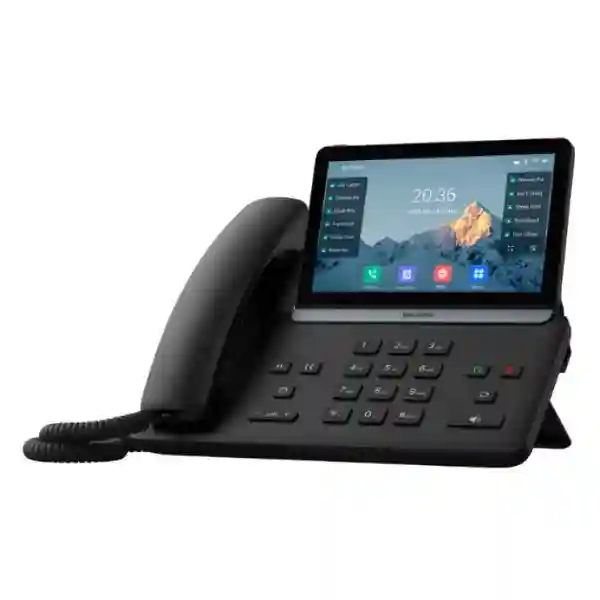
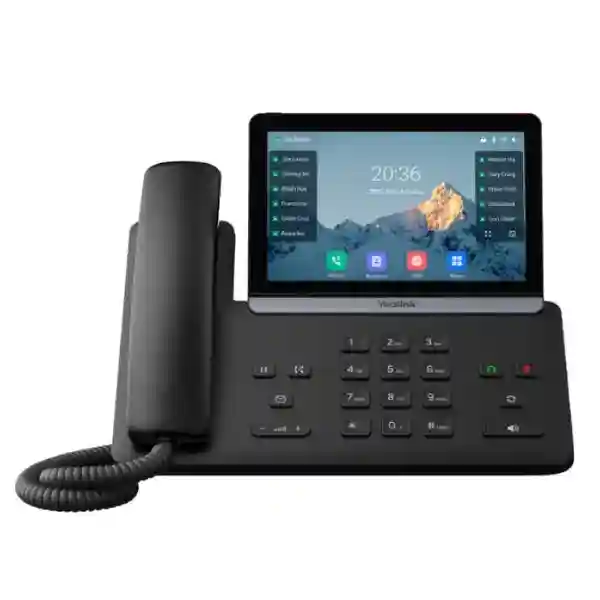
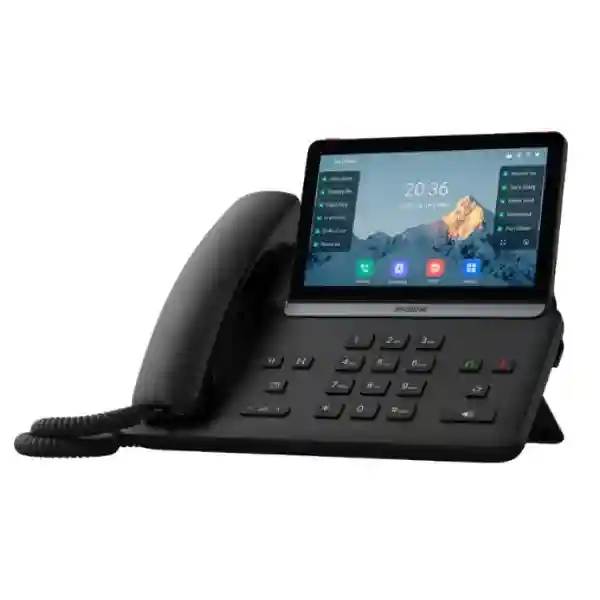
Yealink SIP-T87W Prime Business Phone
The Yealink SIP-T87W is an executive-class SIP business phone created for professionals who want a modern touch interface, flexible wired and wireless connectivity, high-quality voice performance and strong endpoint security in one desk device. Its adjustable 7-inch 800 × 480 capacitive touch display gives users a familiar visual workflow for calls, contacts, line status and programmable functions, while support for up to 16 SIP accounts makes it suitable for managers, senior administrators, reception-oriented users and teams handling several identities or call paths. Built-in dual-band Wi-Fi 6 and Bluetooth 5.0 add deployment flexibility, and dual-port Gigabit Ethernet with PoE allows organizations to keep conventional wired voice designs where predictable LAN performance is preferred.
What makes the Yealink SIP-T87W useful for business?
The practical value of the SIP-T87W is not one headline feature but the way its interface, connectivity and call-control options fit demanding office roles. Yealink specifies HD handset and speaker audio, Acoustic Shield, Smart Noise Filtering and AI noise-cancellation capabilities designed to improve call intelligibility when office background noise would otherwise distract the user. The phone supports full-duplex hands-free communication with acoustic echo cancellation and a broad set of codecs, including G.722 for wideband voice. For accessibility, Yealink also specifies a hearing-aid-compatible handset.
The phone offers 84 one-touch DSS keys across screen pages and can be expanded further through compatible color-screen expansion modules. This matters for users who monitor colleagues, shared lines, queues or speed-dial targets. Two USB ports, one USB-A and one USB-C, support several accessory workflows, including supported USB headsets, expansion modules and compatible Yealink headset accessories. Organizations should still validate the exact headset, EHS adapter and expansion-module combination for the required deployment because accessory compatibility can depend on model and firmware.
Security and manageability are equally important for a business endpoint. Yealink documents SRTP, TLS 1.3, HTTPS certificate management, WPA2/WPA3, 802.1X, secure boot, AES256 configuration-file encryption and a Trusted Execution Environment hardware encryption solution. For administration, the phone supports browser, handset and auto-provisioning methods, including FTP, TFTP, HTTP and HTTPS provisioning, along with PnP and Yealink device-management options. These capabilities make the T87W more appropriate for centrally managed deployments than a consumer-style desk handset that must be configured individually.
Executive usability
A large adjustable touch display, programmable DSS functions, call handling keys and visual line status help users move quickly between frequent communication tasks.
Flexible connectivity
Dual Gigabit Ethernet, PoE, Wi-Fi 6, Bluetooth 5.0 and USB-A/USB-C provide several practical ways to connect the phone, network and approved accessories.
Enterprise deployment
SIP support, auto-provisioning, VLAN/QoS functions and modern security controls suit organizations that want repeatable deployment and centralized administration.
Verified Yealink SIP-T87W specifications
| Display | 7-inch, 800 × 480 capacitive adjustable touch screen |
|---|---|
| SIP accounts | Up to 16 VoIP accounts |
| Ethernet | Dual-port Gigabit Ethernet with PoE support |
| Wireless | Built-in Wi-Fi 6, 2.4 GHz / 5 GHz, and Bluetooth 5.0 |
| USB | Two USB ports: USB-A and USB-C |
| Audio | HD handset and speaker, Acoustic Shield, Smart Noise Filtering, AI noise cancellation, full-duplex speakerphone |
| Programmable controls | Up to 84 one-touch DSS keys; supports compatible color-screen expansion modules |
| Security | SRTP, TLS 1.3, HTTPS certificate management, WPA2/WPA3, 802.1X, AES256 configuration encryption, secure boot and TEE hardware encryption |
Deployment and compatibility planning
Before purchasing a SIP-T87W fleet, confirm the selected IP PBX or hosted voice platform supports the SIP features your users actually need. Registration alone does not guarantee every BLF, shared-line, recording, directory or provisioning feature will behave identically across platforms. A deployment checklist should include SIP credentials, codecs, time synchronization, DNS, DHCP, voice VLAN design, QoS policy, PoE availability, firewall rules, provisioning URLs and emergency-calling requirements. The existing LAN should also be checked for packet loss, latency and congestion because premium phones cannot compensate for an unstable network path.
FourTeck Tanzania already presents integrated IT, telecom and networking solutions, including IP phones, IP PBX, switching, Wi-Fi and structured cabling. Buyers can also review the FourTeck Tanzania services page when a phone requirement is part of a broader office rollout, and use the FourTeck Tanzania shop for current product browsing. For project discussions, the verified Tanzania contact page is the appropriate quotation route. The about FourTeck Tanzania page provides additional company context. Only these verified same-domain pages are linked here; no unverified product URL is fabricated.
Yealink SIP-T87W Tanzania
For businesses in Tanzania, the Yealink SIP-T87W is best considered as part of a complete voice endpoint design rather than an isolated desk purchase. A head office, hotel group, professional-services firm, financial team, logistics company, healthcare administration office or multi-branch organization may select the T87W for users who handle many calls and need quick access to lines, contacts and programmable functions. Its 7-inch adjustable screen can simplify daily navigation, while up to 16 SIP accounts provide capacity for users who manage multiple extensions, departments or voice identities. The built-in Wi-Fi 6 option can be useful where cabling flexibility matters, but wired Gigabit Ethernet remains attractive for predictable voice traffic and PoE-based power.
A Tanzania deployment should begin with PBX and network readiness. Confirm SIP-platform support, DHCP and DNS behavior, voice VLAN settings, QoS, firewall policy and available PoE capacity before ordering a large quantity. Where the phone shares a network point with a workstation, switch-port configuration should be planned so voice and data can be separated cleanly. Branch offices that depend on cloud-hosted PBX services should also review internet resilience, because a high-end endpoint still relies on stable upstream connectivity. If internet continuity is critical, procurement teams may want to assess secondary connectivity and UPS-backed switching as part of the same project.
Tanzania buyers frequently need a quotation that covers more than the handset. State the number of phones, PBX platform, required headsets, desired expansion modules, PoE-switch availability and any provisioning requirements. Also identify whether the project is a new installation, migration from analog or digital telephony, or replacement of an existing SIP estate. This helps avoid a quotation that omits accessories or network work. FourTeck Tanzania’s broader IP telephony and networking context is useful for organizations that want phone selection coordinated with switching, Wi-Fi, structured cabling and firewall rules rather than handled as separate tasks.
The T87W is particularly compelling for executive and high-call-volume roles because it combines touch control, HD audio processing, AI noise cancellation, wireless connectivity and programmable DSS capacity. It is not automatically the right model for every desk; standard users may need fewer features. A role-based rollout can therefore be more economical: deploy the T87W where its screen, account capacity and programmable controls create real productivity value, while using simpler SIP models for common-area or basic extension requirements.
Yealink SIP-T87W Dar es Salaam
Organizations in Dar es Salaam often operate busy customer-facing offices, corporate headquarters, logistics operations, hospitality businesses and professional-service environments where voice communication must remain organized throughout the working day. In these settings the Yealink SIP-T87W can suit directors, reception supervisors, executive assistants, sales leaders and operations managers who need visibility across several lines or colleagues. The large touch display and programmable DSS capacity allow the interface to be tailored around common call actions instead of forcing users through long menu paths.
For a Dar es Salaam office, evaluate the physical network before deciding whether to use Ethernet or Wi-Fi. The phone’s built-in Wi-Fi 6 offers flexibility, especially in renovated offices where adding a new cable run may be disruptive, but voice traffic should still receive stable signal quality and appropriate wireless capacity. Where structured cabling exists, PoE over Gigabit Ethernet simplifies the desk by carrying network and power through the LAN connection. Check the switch PoE budget across all endpoints rather than assuming every port can power every connected device simultaneously.
A headquarters rollout should also standardize provisioning. If dozens of phones are configured manually, future changes become slow and inconsistent. The T87W supports auto-provisioning methods and Yealink management options, so an IT team can create repeatable settings for accounts, codecs, VLAN parameters, time servers, directories, keys and security. Confirm the exact PBX provisioning approach before deployment and test a pilot group first. Pilot testing should cover inbound and outbound calling, transfer, hold, conference, voicemail, BLF, directory lookup, headset behavior and failover expectations.
When requesting a Dar es Salaam quotation, provide seat count, floor or department distribution, PBX platform, existing switch models and whether UPS protection is present. For executive floors, identify users who need Bluetooth headsets, USB headsets or expansion modules. For reception and shared-service desks, define how many colleagues or lines need monitoring. This information lets a solution provider distinguish between a straightforward handset supply request and a deployment that also requires PoE switching, voice VLAN configuration, cabling, PBX changes or staff onboarding.
Yealink SIP-T87W Mwanza
In Mwanza, the Yealink SIP-T87W can support established businesses, regional offices, hospitality operations, healthcare administration, distribution companies and organizations coordinating teams across multiple locations. Its strength is especially clear when a senior user needs more than a basic SIP handset. The 7-inch touch display can present call information and programmable functions clearly, while up to 16 SIP accounts allow a user to work with multiple registrations where the PBX design supports them. Bluetooth 5.0 and USB connectivity can also simplify headset choices for users who spend long periods on calls.
Network quality deserves careful attention in any branch deployment. If a Mwanza office connects to a hosted PBX, test the WAN path during normal and peak business periods, not only during installation. Voice problems often arise from congestion, unstable routing or poorly prioritized traffic rather than from the handset itself. Managed switches can place phones in a dedicated voice VLAN and apply QoS policy, while a correctly sized firewall should pass SIP and media traffic according to the PBX provider’s design. Avoid ad-hoc port forwarding or exposed management interfaces when a more secure architecture is available.
The T87W’s built-in Wi-Fi 6 can help where temporary desks, executive rooms or difficult cable routes make wireless connectivity attractive. However, a wireless voice design should consider signal strength, interference, roaming behavior and access-point load. A phone located behind thick walls or far from an access point may be technically connected but still deliver inconsistent voice quality. For permanent workstations, Ethernet and PoE can remain the more deterministic option.
Mwanza procurement teams should also confirm the complete bill of materials. The phone supports PoE, and Yealink lists an external power adapter as optional, so buyers who do not have PoE must account for power separately. Wall mounting is also optional. If headsets or expansion modules are needed, list exact quantities and supported models in the quotation request. A precise bill of materials avoids mismatched accessories and makes branch standardization easier for future expansion.
Yealink SIP-T87W Arusha
Arusha businesses in tourism, hospitality, professional services, non-governmental organizations, education and regional administration may need desk communication that is polished for customer interaction yet manageable by an internal IT team. The Yealink SIP-T87W addresses that requirement with a modern touch interface, HD audio processing, programmable call controls and flexible connectivity. For senior front-office personnel or managers who move between calls frequently, the touch display and DSS keys can reduce the time required to reach colleagues, transfer callers or monitor selected extensions.
Hospitality and travel-related environments should think about call flow before handset selection. The T87W may be appropriate at management, reservations or supervisory desks, while guest rooms and basic extensions may require different endpoint types. Mapping user roles first prevents over-specifying every extension. The same principle applies to NGOs and multi-department offices: high-call-volume coordinators may benefit from the T87W, while standard administrative users can use simpler SIP devices under the same PBX architecture.
Arusha sites that rely on cloud communication should examine internet resilience and power continuity. PoE simplifies endpoint power, but the phone remains dependent on the switch, router, firewall and upstream connection. Connecting the voice network to an appropriately sized UPS can help maintain service during short interruptions. If the PBX is remote, a secondary internet path may also be relevant for critical operations. These are architecture decisions, not features of the handset, but they directly affect user experience.
For purchasing, share details about the existing PBX, SIP trunk or hosted service, number of users, call volumes and headset preferences. If the organization wants centralized directory services, BLF or automated provisioning, identify those requirements explicitly. The T87W supports enterprise-oriented management and security controls, but the deployment platform must be configured to use them. A structured pilot is therefore preferable to ordering a full fleet before testing the most important daily workflows.
Yealink SIP-T87W Dodoma
For organizations in Dodoma, including administrative offices, institutions, service companies and branch operations, the Yealink SIP-T87W can serve users who require a feature-rich desk endpoint with a professional interface. The adjustable touch screen makes it easier to view and operate the phone from different desk positions, while HD voice features and AI-assisted noise reduction can help preserve clarity in open offices. Built-in Bluetooth 5.0 supports compatible wireless accessories and mobile-phone integration functions, and Wi-Fi 6 provides an additional network option where a wired connection is not practical.
A well-planned Dodoma installation should define whether the phone will register directly to an on-premises IP PBX, a data-centre platform or a hosted cloud service. That decision affects firewall rules, DNS, provisioning and resilience. For an on-premises PBX, LAN design and server availability are critical. For a cloud PBX, WAN stability and security become more prominent. In either case, avoid treating voice as ordinary best-effort traffic if the network is busy; VLAN and QoS planning can help keep calling predictable when users are simultaneously accessing large files, video meetings or cloud applications.
The T87W’s programmable controls can be useful in executive offices where assistants monitor management lines, or in departments where staff regularly transfer calls to a stable set of colleagues. Up to three compatible color-screen expansion units can extend programmable capacity further, but buyers should confirm the exact operational need before adding accessories. The most effective design is the one that simplifies daily call handling rather than maximizing button count for its own sake.
When preparing a quotation, include endpoint count, PBX make and version, PoE-switch capacity, desired mounting method, headset models and whether phones must be preconfigured before rollout. If the office expects future branches, request a repeatable configuration standard covering naming, VLANs, provisioning and security. That makes later expansion easier and reduces differences between sites.
Yealink SIP-T87W UAE
Companies operating between Tanzania and the UAE may want a common desk-phone standard for executives and communication-intensive roles. The Yealink SIP-T87W is suitable for this type of regional standardization because it combines SIP interoperability, centralized provisioning options, Gigabit Ethernet, Wi-Fi 6 and Bluetooth in one platform. A consistent endpoint family can simplify training and support, but the underlying PBX, SIP trunk, numbering plan and emergency-calling requirements can differ by country, so those elements must be validated independently.
For UAE-related projects, organizations can also review FourTeck UAE integrated IT and telecom solutions and the broader FourTeck regional technology portfolio. These sites are relevant when a customer wants aligned telephony, networking or security planning across more than one geography. Regional standardization should focus on configuration principles—voice VLANs, secure provisioning, directory naming, headset standards and support documentation—while allowing country-specific telecom requirements to remain distinct.
The T87W’s built-in wireless functions can be useful in executive offices, meeting areas or retrofit environments, but corporate UAE offices with dense Wi-Fi usage should still plan voice wireless coverage carefully. Where desks have structured cabling, PoE-connected Ethernet often remains straightforward. Security teams should also incorporate endpoint certificates, TLS/SRTP policy, administrator credentials and firmware-management procedures into the same lifecycle process used for other network devices.
For a cross-border quotation, identify quantities by country, target PBX platforms, accessory needs and whether configuration templates must be standardized. Procurement should also distinguish between handset hardware, optional power adapters, wall-mount hardware, expansion modules, headset accessories and deployment services. This makes quotations easier to compare and avoids assuming every site has identical infrastructure.
Yealink SIP-T87W Uganda
Businesses with operations in Uganda can use the Yealink SIP-T87W as an executive or high-function SIP endpoint when users need more visual control than a basic desk phone provides. The combination of a 7-inch capacitive screen, up to 16 SIP accounts, programmable DSS functions and headset connectivity fits management, reception supervision, account teams and operational coordinators. For organizations with Tanzania and Uganda branches, selecting a common endpoint can make user onboarding and spare planning simpler while still allowing each office to maintain its own numbering and telecom service.
FourTeck’s Uganda technology solutions site provides a regional reference for customers planning broader IT, PBX and networking projects. The practical deployment questions remain the same: Is the PBX compatible? Is PoE available? Is the voice VLAN configured? Are QoS and firewall rules correct? Is the provisioning method repeatable? Are administrator passwords and management interfaces protected? Addressing these points before hardware rollout reduces troubleshooting later.
Where Ugandan branches use hosted PBX platforms, internet quality can become the limiting factor. Teams should test call quality under normal office load and consider how voice behaves when links are congested. If calls are business critical, investigate connection redundancy and UPS support for the network. The phone’s Wi-Fi 6 capability provides flexibility, but access points and RF conditions should be assessed rather than assuming every location can support reliable wireless voice.
Procurement teams should request a role-based bill of materials. T87W units may be reserved for senior and high-call-volume users, with simpler endpoints used elsewhere. Include headset requirements, expansion modules and power-adapter needs, and confirm whether phones should arrive pre-provisioned. For multi-site organizations, ask for a documented template that covers firmware, SIP registration, time settings, VLANs, codecs, security and DSS programming.
Yealink SIP-T87W Kampala
Kampala offices often combine management, sales, customer service and branch coordination in environments where users switch frequently between internal and external calls. The Yealink SIP-T87W can fit these roles because it gives users a large touch interface, many programmable DSS functions and multiple SIP registrations. Its built-in Bluetooth 5.0 is useful for compatible wireless headsets, while dual USB connectivity broadens accessory choices for people who spend significant time on calls.
For a Kampala headquarters, treat the T87W as part of the network design. Use managed switching where possible so voice devices can be placed in a defined VLAN, monitored and prioritized. Validate LLDP or DHCP-based VLAN behavior with the chosen PBX and switch configuration. If a workstation is connected through the phone’s second Gigabit port, make sure the intended voice/data separation remains correct. Documenting port profiles simplifies moves, additions and changes when teams relocate desks.
Security should also be standardized. Yealink provides modern endpoint controls including TLS, SRTP, WPA3, secure boot and certificate-management capabilities, but they only add value when administrators configure and maintain them appropriately. Disable unnecessary access, protect administrative credentials, keep firmware under change control and use encrypted provisioning where the platform supports it. For cloud-managed deployments, review who can access the device-management portal and how administrator roles are governed.
A Kampala quotation should identify user roles rather than only total phone count. List executive desks, reception or assistant positions, standard users and common areas separately. That makes it easier to decide where the T87W is justified and where another model may be more efficient. Also specify whether the project includes PBX configuration, SIP-trunk coordination, cabling, PoE switching, headset supply, user training or ongoing support.
Yealink SIP-T87W Arua
For an Arua branch or regional office, the Yealink SIP-T87W can give senior users a consistent communication experience even when the main PBX is hosted elsewhere. This can be valuable for organizations that centralize telephony across several locations. The phone’s SIP architecture, built-in Wi-Fi 6, Gigabit Ethernet and multiple account capacity provide flexibility, but branch connectivity becomes a central design concern when call control and media depend on remote infrastructure.
Before deployment, measure the branch internet connection during real operating hours. Check latency, jitter and packet loss, and confirm how traffic behaves when users are downloading files, joining video conferences or synchronizing cloud data. A voice VLAN and QoS policies can protect internal LAN handling, while WAN shaping or provider-side prioritization may also matter depending on the service. If the organization requires continuity during internet outages, discuss whether a secondary link or local survivability feature is available in the PBX design.
Power resilience is another practical consideration. PoE can simplify the desk installation, but the switch and upstream router must remain powered. A properly sized UPS can support those shared components through short interruptions. Where PoE is unavailable, remember that Yealink lists the external AC adapter as optional, so the quotation should state whether adapters are required. The same principle applies to wall-mount brackets and accessory hardware.
For Arua procurement, request a configuration and support plan as well as hardware pricing. Specify whether remote provisioning, centralized directory services, headset support and DSS templates are needed. If technicians are not based at the branch, standardized configuration and remote management become particularly valuable. A small pilot shipment can verify PBX interoperability and network behavior before a larger branch rollout.
Yealink SIP-T87W Mbarara
In Mbarara, organizations expanding branch operations may want a premium phone for managers, supervisors and staff who coordinate frequently with customers or other sites. The Yealink SIP-T87W provides a large visual interface and programmable controls that can shorten common actions such as calling monitored extensions, transferring callers or accessing frequently used functions. Its audio technologies are designed to improve clarity in active office environments, which can be useful where multiple conversations occur nearby.
Branch design should balance capability with simplicity. A T87W on every desk may not be necessary. Map each role according to line count, call volume, headset usage and need for programmable keys. Executive and supervisory users may benefit from the T87W, while general extensions can use simpler compatible SIP phones. Keeping the same vendor family can still simplify provisioning and support without forcing identical hardware for every employee.
Mbarara sites using Wi-Fi should validate 5 GHz coverage at the exact desk locations. Wi-Fi 6 support in the handset is useful, but the phone cannot create coverage where the access network is weak. Where possible, use managed access points, consistent security settings and sufficient capacity. Wired PoE remains a strong option when structured cabling is available because it reduces dependence on local power adapters and usually provides predictable network behavior.
When collecting quotations, include the PBX platform, number of endpoints, desired headset type, PoE availability and whether configuration is required before shipment. Ask whether the deployment should include voice-VLAN setup, firewall review or remote provisioning. These tasks may be more important to a successful outcome than simply comparing handset prices, because the quality of the user experience depends on the complete voice path.
Yealink SIP-T87W Gulu
For Gulu-based offices and institutional branches, the Yealink SIP-T87W offers a high-capability SIP endpoint for users who need a clear interface and access to multiple call functions throughout the day. The phone supports up to 16 SIP accounts and a large set of programmable DSS keys, so it can be tailored to departmental workflows. Managers can keep important contacts, monitored extensions or call functions close at hand rather than navigating through repeated menus.
Connectivity planning should match the site. If the branch has reliable structured cabling and PoE switching, Ethernet provides a clean deployment. If cabling limitations make wireless more practical, built-in dual-band Wi-Fi 6 is available, but an RF survey or at least basic coverage validation is advisable. Voice calls are sensitive to intermittent wireless problems that web browsing may hide, so test actual calls under busy conditions before standardizing the design.
For multi-site organizations, the T87W can be managed through repeatable provisioning rather than manual setup. A standard template should define firmware version, SIP server, authentication, codec order, time settings, VLAN information, directory sources and key layouts. Device names and extension labels should follow a consistent convention so remote support teams can identify phones quickly. If security policy requires encrypted provisioning, certificates or restricted web administration, include those requirements in the rollout plan.
Gulu buyers should also distinguish between hardware supply and complete service. A quotation may need handsets only, or it may include PoE switching, router/firewall changes, PBX setup, SIP-trunk coordination, structured cabling, headsets and user training. Defining the scope up front makes supplier comparisons more meaningful and reduces the chance of discovering missing dependencies during installation.
Yealink SIP-T87W Kenya
For customers with offices in Kenya and Tanzania, a shared Yealink SIP-T87W standard can reduce support complexity for executive users. The same phone interface, accessory approach and provisioning logic can be repeated across sites while each country maintains the telecom services and numbering plans appropriate to that location. FourTeck’s Kenya IT and VoIP solutions site offers a relevant regional reference for businesses planning branch communication projects.
A Kenya deployment should still verify platform interoperability. SIP registration is only the starting point; test BLF, transfer, conference, voicemail, directory, call recording integration and headset control with the actual PBX. If the organization uses different PBX platforms in Kenya and Tanzania, create separate tested templates instead of assuming one configuration can be copied unchanged. Unified device choice is useful, but service architecture remains local.
The T87W’s Wi-Fi 6 and Bluetooth 5.0 can support modern office layouts, while dual Gigabit Ethernet and PoE fit conventional corporate LANs. Network teams should verify voice VLAN and QoS policy, switch PoE budgets and WAN capacity. Headset users should identify whether they require USB, Bluetooth or EHS-supported workflows and confirm compatibility before buying in volume. Expansion modules should likewise be reserved for users who genuinely need additional monitored lines or programmable functions.
For procurement, build a cross-country equipment schedule showing quantity by location, accessories, mounting needs, PoE requirements and desired pre-configuration. Ask for serial-number or asset tracking if internal policy requires it. A consistent documentation package—including extension maps, provisioning references and user-role templates—can make future moves and replacements easier across East African branches.
Yealink SIP-T87W Kuwait
Companies coordinating operations between East Africa and Kuwait may consider the Yealink SIP-T87W for executive and management desks where a premium SIP endpoint is preferred. The phone’s 7-inch touch screen, multiple account capacity and built-in wireless connectivity provide a consistent user experience that can be standardized across offices. For Kuwait-specific technology projects, the FourTeck Kuwait solutions site is a relevant regional reference.
Cross-border standardization should concentrate on endpoint management while respecting local telecom requirements. Create a common baseline for firmware, security, headset use, user training and support procedures, then maintain country-specific SIP, numbering and emergency-calling settings. The T87W supports modern security protocols and auto-provisioning, allowing IT teams to implement controlled templates rather than relying on manual configuration at every desk.
Kuwait offices often have high-quality structured networks, but endpoint deployment should still confirm PoE switch capacity and voice VLAN policy. If the phone is used over Wi-Fi 6, test the corporate WLAN for voice-sensitive roaming and latency. Bluetooth can reduce cable clutter for supported headsets, although busy contact-center users may still prefer wired or dedicated DECT solutions depending on range and call-handling needs.
For quotation preparation, provide the desired number of T87W units, PBX platform, accessory list and installation scope. If phones must be pre-provisioned before delivery, include configuration data through a secure channel and define acceptance tests. For regional estates, establish spare-device and replacement procedures so a failed phone can be swapped without rebuilding configuration manually.
Yealink SIP-T87W Ghana
In Ghana, the Yealink SIP-T87W can support executive offices, customer-facing management teams and organizations that need an advanced SIP endpoint with visual call control. Its large touch display and programmable keys are particularly relevant to users who handle several simultaneous communication tasks. Businesses with operations in Tanzania and Ghana can standardize the phone model while maintaining separate telecom services and local configurations. The FourTeck Ghana technology site can support regional research for wider IT and telecom requirements.
A Ghana deployment should begin with PBX testing. Confirm registration, call transfer, hold, conference, BLF, voicemail and directory functions with the selected platform. When a hosted PBX is used, evaluate internet stability and firewall behavior. SIP and RTP traffic should follow the provider’s recommended design, and administrators should avoid insecure shortcuts that expose phone management or PBX services unnecessarily.
The T87W gives organizations both wired and wireless choices. Ethernet with PoE is well suited to fixed desks and centralized power protection, while Wi-Fi 6 can help in spaces where cabling is limited. Neither choice should be made solely on convenience; consider call reliability, access-point capacity, power continuity and supportability. Bluetooth 5.0 and USB ports add headset flexibility, but exact accessory compatibility should be checked against current Yealink documentation.
When requesting a Ghana quotation, state whether the requirement is supply-only or a full deployment. A complete project may include phone configuration, PoE switching, network segmentation, cabling, PBX work and user training. Separating these line items helps procurement teams compare offers accurately and understand which party is responsible for each part of the solution.
Yealink SIP-T87W Nigeria
Nigerian enterprises and multi-site companies may use the Yealink SIP-T87W for senior users, reception supervisors, sales leadership and operational teams that need extensive programmable call controls. The 7-inch screen provides a clear interface for frequent interactions, while up to 16 SIP accounts allow flexible identity and line arrangements where the PBX supports them. For organizations linking Tanzania and Nigeria operations, FourTeck’s Nigeria IT services site provides a regional reference for related network and communications planning.
Internet resilience can be important in Nigerian cloud-PBX deployments. If the T87W depends on a remote voice service, design the WAN with realistic business continuity expectations. A secondary connection may be appropriate for critical offices, and the firewall should handle failover without creating SIP registration problems. Internal QoS can protect calls from local congestion, but it cannot fix every upstream issue, so end-to-end testing remains important.
Power design also affects availability. PoE centralizes endpoint power at the switch, which can then be protected by a suitable UPS. This may be easier to manage than many individual power adapters. If the site does not use PoE, include optional external adapters in the procurement plan. For dense executive areas or call-handling teams, check headset requirements and whether expansion modules are useful before finalizing the bill of materials.
Nigeria procurement teams should ask for clear model identification, accessory lists and configuration scope. Do not rely only on a generic “IP phone” line item. Specify SIP-T87W, quantities, headset type, power method, mounting requirements and whether remote management or provisioning is needed. A detailed requirement makes it easier to compare technically equivalent quotations and reduces substitutions that may not meet the intended user role.
Yealink SIP-T87W Seychelles
For businesses and hospitality operations in Seychelles, the Yealink SIP-T87W can be a premium desk endpoint for management, reservations, administration and executive offices. Hotels and resorts often use several endpoint types across one property; the T87W is better suited to staff who need richer call control than to every guest-room extension. Its touch screen, programmable DSS keys and headset connectivity make it appropriate for users coordinating frequent internal and external calls.
Island and resort deployments should pay close attention to network architecture because voice, guest Wi-Fi, operational systems, cameras and administration may all share the same physical infrastructure. Managed VLAN separation and QoS can help keep voice predictable, while PoE switching simplifies endpoint power. If the phone is connected through Wi-Fi 6, verify coverage at the exact office location and consider the effect of dense guest-device usage on the WLAN.
For properties with a central PBX, integration should be tested with existing extensions, voicemail, call routing and any hospitality-specific workflow. The T87W is a standards-based SIP endpoint, but specialized hotel PBX features can vary. A pilot phone should therefore be tested before a larger purchase. Management users may also benefit from Bluetooth or USB headsets, while reception or supervisory desks may use programmable keys to monitor operational extensions.
Seychelles procurement requests should include location, user role, PBX platform and available PoE. If equipment must be shipped internationally, make the accessory and power requirements explicit so missing adapters or mounting hardware do not delay deployment. For organizations managing several islands or properties, remote provisioning and documented templates can reduce the need for manual on-site configuration and make replacement phones easier to deploy.
Related FourTeck resources for IP telephony projects
A business-phone rollout usually touches more than the handset. The FourTeck IP phone specialist site is relevant for broader desk-phone and VoIP planning, while FourTeck regional IT and telecom solutions covers connected infrastructure. East African branch customers can reference FourTeck Kenya and FourTeck Uganda, while multi-country buyers can also review FourTeck Ghana, FourTeck Nigeria and FourTeck Kuwait. These links are intended as regional project references, not claims of product stock or guaranteed local availability.
Quotation checklist for Yealink SIP-T87W
Frequently asked questions
How many SIP accounts does the Yealink SIP-T87W support?
Yealink specifies support for up to 16 VoIP accounts. The number you actually configure should match the PBX design and user role.
Does the SIP-T87W support Wi-Fi and Bluetooth?
Yes. Yealink specifies built-in dual-band Wi-Fi 6 and Bluetooth 5.0. Wireless deployment should still be validated against the office WLAN and accessory requirements.
Can the Yealink SIP-T87W use Power over Ethernet?
Yes. PoE is supported. The network switch must have sufficient PoE capacity for the planned number of phones and other powered devices.
Is the T87W suitable for reception or executive assistants?
It can be a strong fit because of its large display, programmable DSS keys and support for compatible expansion modules. The final choice should be based on the number of lines, monitored extensions and workflow.
Does it work with every IP PBX?
The phone uses SIP and Yealink describes broad compatibility with third-party SIP platforms, but organizations should test required features with their exact PBX version before a large rollout.
Is a power adapter included?
Yealink lists the external power adapter as optional. If PoE is not available, confirm adapter requirements in the quotation.
Decision recap
Choose the Yealink SIP-T87W when the user genuinely benefits from a large touch display, many programmable functions, multiple SIP accounts, premium audio processing, built-in Wi-Fi 6 and Bluetooth 5.0, flexible headset connectivity and enterprise provisioning. For a successful deployment, pair the phone with a compatible PBX, a voice-ready LAN, sufficient PoE, appropriate QoS and secure provisioning. For mixed-role offices, reserve the T87W for executives, managers, reception supervisors and other communication-heavy users while evaluating simpler endpoints for basic extensions.
Talk to FourTeck Tanzania about your SIP-T87W requirement
Share the number of users, current PBX or hosted platform, office locations, PoE status, preferred headsets and any reception or expansion-module requirements. FourTeck can then frame the discussion around the complete voice environment rather than only the handset model. Use the verified Tanzania contact page to request a quotation or discuss deployment planning.



Reviews
There are no reviews yet.