
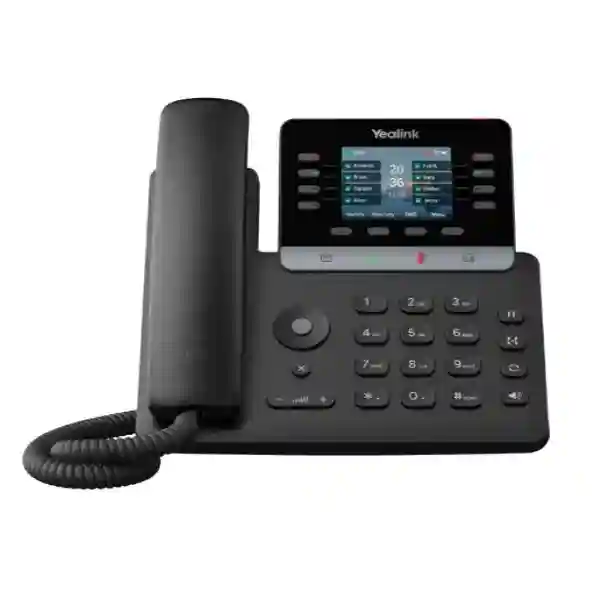
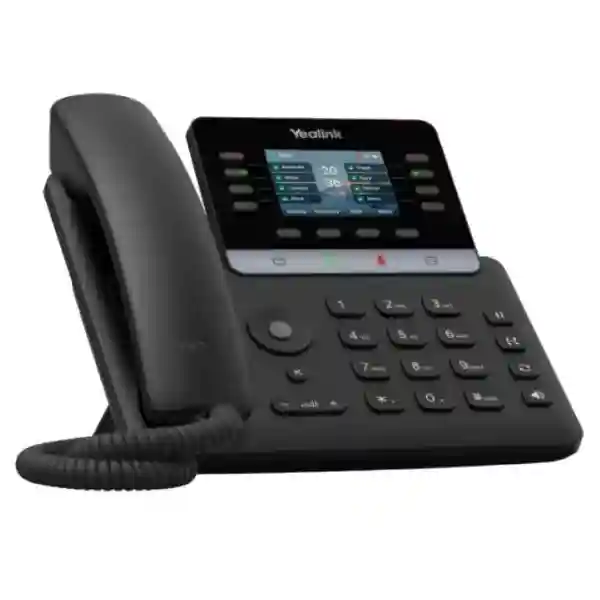
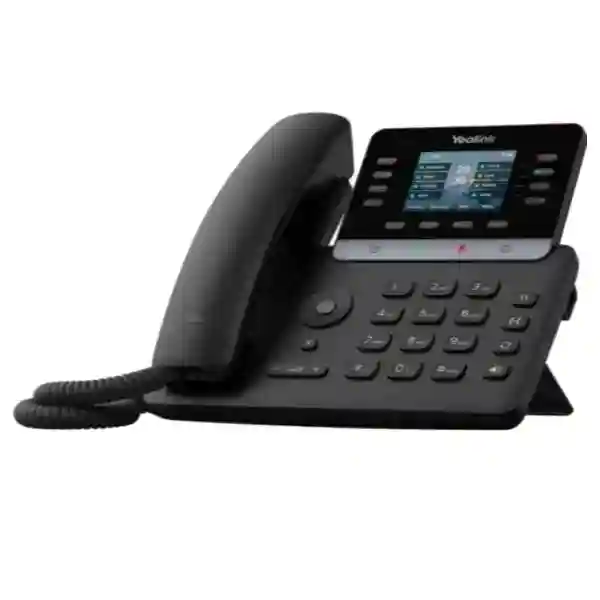
Yealink SIP-T73U Business Phone Tanzania
The Yealink SIP-T73U is an all-in-one business desk phone designed for professional voice communication, flexible SIP deployment and efficient day-to-day call handling. It combines a 2.8-inch 320 × 240 colour screen, up to 12 SIP accounts, dual-port Gigabit Ethernet, IEEE 802.3af Power over Ethernet, programmable keys, USB connectivity, headset support and optional EXP55 expansion modules. For Tanzanian organisations replacing legacy handsets or standardising a new IP telephony environment, the T73U provides a practical balance of user experience, administrative control and expansion capability.
What the Yealink SIP-T73U is built to do
The SIP-T73U is suited to users who need more than a basic two-line desk phone but do not necessarily need a large touch-screen executive terminal. Yealink positions the model inside its T7 family as a multifunctional SIP phone. In practical business terms, that means it can serve standard office users, supervisors, reception-oriented staff, managers and teams that need several registered lines, visible call states and programmable shortcuts without making the endpoint excessively complex.
The phone supports HD handset and speaker audio, Yealink Acoustic Shield, Smart Noise Filtering and a full-duplex speakerphone with acoustic echo cancellation. It also provides a hearing-aid-compatible handset. The purpose of these features is straightforward: business users need speech to remain intelligible when they are speaking from busy offices, shared workspaces or front-desk environments. Good voice performance still depends on the wider network, SIP platform, codec negotiation and internet quality, but the endpoint itself is designed with business-grade audio processing in mind.
For call handling, the T73U supports familiar functions such as hold, transfer, forwarding, waiting, redial, call return, auto answer, Do Not Disturb, call pickup, BLF, message waiting and conferencing. Yealink documents five-way conferencing, a local phonebook with up to 1,000 entries, LDAP/XML remote directory options, call history and custom DSS keys. These functions can be valuable when the phone is integrated with a compatible IP PBX or SIP service that exposes the corresponding features.
Clear business audio
HD voice, Acoustic Shield, Smart Noise Filtering and full-duplex hands-free calling are intended to keep conversations understandable and reduce distraction from surrounding office noise.
Flexible line handling
Up to 12 SIP accounts and multiple programmable DSS keys make the phone useful where users monitor several lines, shared extensions or feature shortcuts.
Network-ready deployment
Dual Gigabit Ethernet, PoE, VLAN, LLDP/CDP and centralized provisioning options support structured office rollouts when switching and voice-network design are prepared correctly.
Expandable workspace
The USB interface supports accessories including headsets and the EXP55 expansion module, allowing the endpoint to grow with reception, assistant or call-monitoring requirements.
Verified Yealink SIP-T73U specifications
| Display | 2.8-inch 320 × 240 colour LCD with backlight |
|---|---|
| SIP / VoIP accounts | Up to 12 VoIP accounts |
| Ethernet | Dual-port Gigabit Ethernet |
| Power | IEEE 802.3af PoE, Class 2; optional 5V/2A power adapter |
| Programmable keys | 8 line keys with LED; up to 40 DSS keys across 5 pages |
| USB | 1 × USB 2.0 interface for supported USB accessories, recording and expansion |
| Expansion | Supports EXP55 colour-screen expansion modules; Yealink documents up to 3 cascaded units |
| Security | TLS 1.3, SRTP, secure boot, HTTPS certificate management, AES256 encrypted configuration and TEE hardware encryption |
| Provisioning | Web/phone configuration, auto-provisioning via FTP/TFTP/HTTP/HTTPS, PnP, TR-069 and Yealink management platforms |
| Mounting | Two-angle stand; wall mounting supported with optional bracket |
Compatibility, IP PBX and deployment planning
A SIP phone purchase should be treated as part of a voice system rather than as an isolated handset. Before ordering the T73U, confirm the intended SIP platform, available provisioning method, codec policy, extension plan, call-flow requirements and network design. Yealink documents broad SIP standards support and compatibility with common softswitch environments, while actual feature behaviour can vary by PBX, hosted provider and software version. BLF, recording, directory integration, call park and similar features should therefore be validated against the platform being used.
For wired office deployment, the T73U can receive power from a compatible PoE switch, reducing dependence on individual power adapters at each desk. The network should have adequate PoE budget, suitable VLAN configuration and Quality of Service where required. A phone can technically register on a flat data LAN, but separating voice traffic and documenting switch ports often makes larger environments easier to troubleshoot and administer. The phone supports 802.1Q VLAN functions, Layer-3 DSCP, LLDP/CDP/DHCP VLAN methods and IPv4/IPv6.
Businesses planning wireless connectivity should note that the T73U is fundamentally a wired desk phone. Yealink documents Wi-Fi support through the compatible WF50(V1) accessory rather than built-in Wi-Fi. If native wireless connectivity is a core requirement, buyers should compare the T73U with models designed around integrated wireless features before finalising a standard. For headset users, check the preferred Yealink or compatible USB/RJ9/EHS workflow and any required adapter before deployment.
Why businesses choose a phone in the T73U class
The most important reason to choose a model like the Yealink SIP-T73U is not the number of specifications on the datasheet. It is the ability to give everyday users a consistent, manageable calling endpoint that fits the way the organisation handles voice. A smaller company may need a dependable phone for reception and managers. A multi-floor office may need tens or hundreds of endpoints that can be provisioned from templates. A customer-service desk may need BLF keys, headset operation and quick transfers. A branch network may want a common phone standard so user training and support procedures are easier to repeat.
The T73U is particularly interesting where call-handling capacity matters but the organisation still prefers a physical keypad and compact colour display. Eight line keys with multi-page DSS functions can cover frequently used extensions and shortcuts, while optional expansion modules can extend the interface for more demanding roles. This creates a path between a basic desk phone and a much larger console without forcing every user into the same accessory configuration.
Security and management also influence lifecycle value. Yealink lists secure boot, modern transport security, encrypted configuration files, authentication options and management-platform compatibility for the T73U. These controls do not remove the need for secure PBX configuration, strong administration, network segmentation and firmware governance, but they give IT teams a modern endpoint foundation to work with. Standardised firmware across the current T7 family can also simplify model-family administration where organisations use more than one T7 handset type.
FourTeck Tanzania telephony planning
FourTeck Tanzania approaches IP phones as part of the wider communication and network environment. A handset project may involve the IP PBX, SIP trunk, PoE switching, VLANs, structured cabling, firewall policy, internet resilience, user roles and headset requirements. Buyers can review the broader FourTeck Tanzania IT and telecom portfolio to understand how voice fits alongside networking, security and infrastructure. The FourTeck Tanzania technology shop is useful when a project also needs switches, wireless, firewalls, servers or other business equipment.
For regional organisations standardising branches outside Tanzania, FourTeck also operates market-specific sites such as FourTeck Kenya and FourTeck Uganda. For projects connected to the Gulf region, FourTeck UAE provides a broader regional technology reference. These links are useful for organisations that want comparable architecture and procurement conversations across multiple offices while still validating local requirements in each market.
Yealink SIP-T73U Business Phone Tanzania
For organisations buying the Yealink SIP-T73U in Tanzania, the decision should begin with the intended user profile and the existing voice architecture. A T73U on an executive desk may use only a few SIP accounts but benefit from clearer call handling, a headset and programmable shortcuts. A reception-oriented installation may use BLF keys, call pickup and an EXP55 module to monitor more extensions. A branch rollout may value standardised provisioning, PoE and repeatable templates more than any single front-panel feature. These are different buying cases even though the handset is the same.
Tanzania deployments can vary significantly by site. Dar es Salaam corporate offices may have structured LANs and managed PoE switching, while branch locations elsewhere may require more attention to available power, internet stability and remote administration. The phone supports a broad range of network and provisioning functions, but dependable operation still depends on the supporting LAN and SIP service. Procurement teams should therefore document switch compatibility, PoE capacity, VLAN configuration, SIP server details, firmware policy and whether the location needs UPS-backed network infrastructure.
When requesting a Tanzania quotation, include quantity, intended PBX or hosted platform, whether power adapters are required, headset requirements, any EXP55 expansion needs and whether configuration or deployment assistance is expected. If the organisation is replacing older phones, also provide the current model and the existing network topology. This allows the project to address both device selection and migration practicalities. FourTeck can help position the T73U within a wider business telephony design so the purchasing decision reflects how users actually answer, transfer, park and escalate calls.
Yealink SIP-T73U Business Phone Dar es Salaam
Dar es Salaam businesses often operate busy front desks, sales offices, service teams, professional practices, logistics operations and multi-floor corporate environments where desk telephony still plays an important operational role. In these settings, the Yealink SIP-T73U can be considered for users who need a physical phone with several programmable line keys, headset options and clear call-state visibility. The handset is especially relevant when an organisation wants to keep a familiar desktop workflow while moving to a modern SIP-based PBX or hosted calling platform.
Before deploying the T73U across a Dar es Salaam office, the LAN should be assessed as part of the voice project. Confirm whether edge switches provide 802.3af PoE, whether their total power budget can support the planned phone count and whether voice VLANs are already defined. Quality of Service can be important on links carrying cloud applications, video meetings, backups and SIP traffic simultaneously. For larger offices, standardised port profiles and central provisioning reduce the chance that each extension is configured differently.
Reception desks and shared call-handling teams should evaluate how many BLF or speed-dial destinations they need visible at once. The T73U provides 8 line keys and up to 40 DSS positions through page switching; optional EXP55 units can extend the available programmable interface further. Buyers should include these role-specific requirements in the quotation rather than ordering one configuration for every employee. The result is a more practical estate: standard users receive the core handset, while heavy call handlers receive the accessories they actually need.
Yealink SIP-T73U Business Phone Mwanza
Businesses in Mwanza considering the Yealink SIP-T73U should focus on repeatable deployment and supportability, particularly where a site connects back to a central office or shared SIP platform. A branch phone is most useful when its extension plan, provisioning method and network settings are consistent with the rest of the organisation. The T73U supports remote and automatic provisioning methods that can reduce manual setup, but those systems need to be prepared and tested by the administrator or service provider.
For a Mwanza branch, ask whether the site will operate entirely through an on-premises PBX, connect to a central PBX over VPN, or register directly to a hosted SIP service. Each architecture has different dependencies. A centralised design may need reliable WAN connectivity and well-defined firewall rules. A local PBX may provide more autonomy but requires its own maintenance. Hosted service can simplify some infrastructure but makes internet resilience especially important. The phone can fit any of these approaches when the SIP platform and network design support it.
Power planning should not be ignored. PoE can simplify desk installation, yet the switch itself must remain powered. Where voice availability is important during short outages, the network rack may need suitable UPS protection. Procurement teams should also decide whether optional AC adapters are necessary for non-PoE areas. For offices with several T73U units, recording extension number, MAC address, switch port, user assignment and firmware status in a deployment sheet makes future troubleshooting faster and reduces dependence on undocumented local knowledge.
Yealink SIP-T73U Business Phone Arusha
Arusha organisations in hospitality, professional services, tourism support, education, administration and branch operations may require desk phones that are simple for everyday users but still flexible enough for reception and supervisory roles. The Yealink SIP-T73U suits that middle ground because it combines a compact display and physical controls with multiple SIP accounts, programmable keys and accessory support. It can be deployed as a standard business handset while allowing selected users to add headsets or EXP55 expansion modules.
A hospitality or service-oriented operation should design call flows before assigning phones. Reception may need fast transfer to departments, reservation desks, finance, security or management. Offices may use ring groups, voicemail and after-hours routing. These functions are controlled primarily by the PBX, but the T73U provides the endpoint controls and BLF-style indicators users rely on to interact with those services. Testing actual PBX feature codes and key mappings before a broad rollout is therefore more useful than assuming every SIP feature behaves identically across platforms.
For Arusha sites with a mix of office buildings and remote facilities, administrators should also consider network consistency. Standard voice VLANs, DNS, NTP, provisioning URLs and security policies help make phones easier to replace or relocate. If a site uses VPN or centralised security controls, confirm how SIP signalling and media traverse that architecture. The T73U supports modern network-security capabilities, but good implementation still depends on correct configuration of certificates, credentials, firewall policies and management access. A planned rollout gives the phone a much better chance of delivering consistent service throughout its lifecycle.
Yealink SIP-T73U Business Phone Dodoma
In Dodoma, the Yealink SIP-T73U can be evaluated for administrative offices, service desks, professional organisations, institutional environments and companies that need structured internal calling. A phone project here should be assessed in terms of user roles, extension count, branch connectivity and support procedures. The T73U provides enough line and programmable-key capacity for many office users while keeping the interface familiar for staff moving from conventional desk telephones.
Where a Dodoma organisation is building or refreshing an office, combining the phone rollout with network planning can reduce later rework. Confirm cable routes, switch locations, PoE capacity, rack UPS, VLAN configuration and DHCP options before handsets arrive. The T73U includes a second Gigabit Ethernet port, which can be useful where a PC shares the desk network connection through the phone, subject to the organisation’s security and performance design. Network teams should document the chosen topology rather than rely on ad hoc desk-by-desk connections.
Public-facing and administrative teams may also value consistent directories and function keys. The phone supports local and remote directory methods such as LDAP and XML, depending on the wider system. Centralised directory design can reduce the need for employees to maintain personal lists of internal numbers. When seeking a quotation for Dodoma, include whether directory integration, BLF programming, extension labelling and user handover are part of the expected scope. That allows the device purchase to be translated into a usable working environment rather than a box-only transaction.
Yealink SIP-T73U Business Phone UAE
UAE organisations evaluating the Yealink SIP-T73U often operate in environments where multiple branches, call queues, reception points and hybrid cloud services need consistent endpoint standards. The T73U can fit such estates because it supports multiple SIP registrations, Gigabit networking, PoE, USB accessories and centralized management methods. For companies with offices in both the UAE and Tanzania, using a common handset family can also simplify training, template design and spares planning, provided each location’s telecom and platform requirements are validated separately.
In a UAE deployment, buyers should define whether the phone will register to an enterprise PBX, a hosted communications platform, a service-provider offering or a private SIP environment. Feature mapping should be tested for BLF, transfer, conferencing, voicemail indication, call recording workflows and directory access. Security policies may also require certificate handling, encrypted signalling and media, management restrictions or segmented voice networks. The T73U supports modern security features, but administrators still need to align device configuration with the organisation’s own control framework.
Large office rollouts benefit from pre-staging and automatic provisioning. A consistent profile can define firmware, accounts, DSS keys, time settings, language, VLAN parameters and security options. That reduces manual work and helps keep endpoints aligned after future changes. For cross-border organisations, the useful procurement question is not only whether the T73U is available in each country, but whether the same configuration standard can be applied sensibly across the network while respecting local SIP service, numbering and support arrangements.
Yealink SIP-T73U Business Phone Uganda
For Uganda deployments, the Yealink SIP-T73U is a practical candidate for businesses replacing analogue extensions, expanding an existing SIP estate or standardising desk phones across multiple sites. Organisations should confirm the PBX or hosted platform first, then map user roles to phone features. The T73U is suitable where users need multiple accounts, programmable line keys and headset support without requiring a touch-screen endpoint. Heavy reception roles can be augmented with EXP55 expansion modules instead of giving every user the same accessory set.
Branch connectivity is an important planning factor. If Uganda offices register to a PBX hosted in another city or country, WAN quality, latency, packet loss, DNS and firewall traversal become part of the voice experience. The T73U supports SIP-standard networking and call-server redundancy features, but the site network must still provide a dependable path. If voice traffic shares links with cloud backups, video collaboration and large file transfers, Quality of Service and bandwidth management should be reviewed rather than waiting for call complaints after deployment.
For organisations operating in both Uganda and Tanzania, consistent extension naming, provisioning and key layouts can make support easier across borders. The hardware standard can be common even when SIP trunks or PBX instances differ. Document each site’s server addresses, VLANs, firmware versions and local support contacts so a replacement handset can be introduced methodically. This is particularly useful for companies whose IT teams support multiple offices from a central location and need predictable endpoint behaviour.
Yealink SIP-T73U Business Phone Kampala
Kampala offices often have dense user populations, shared reception functions and mixed data, voice and video traffic on the same switching infrastructure. The Yealink SIP-T73U can support these environments when the underlying LAN is prepared for business voice. Its dual Gigabit ports can fit desk layouts where a user PC connects through the phone, while PoE can reduce the need for desk power adapters. Network teams should still verify switch PoE budgets, port security settings and voice VLAN policy before mass deployment.
Receptionists and assistants in Kampala may make more use of the T73U’s programmable interface than ordinary users. Eight line keys with multiple DSS pages provide a compact way to access extensions, BLF, transfer shortcuts or other PBX functions. Where that is not enough, EXP55 expansion modules can provide a larger set of visible programmable keys. The best approach is to interview call-handling staff before procurement so the final configuration reflects the number of departments and extensions they actually monitor.
Headset choice is another useful buying consideration. Users who spend long periods on calls may benefit more from a compatible wired, USB or EHS-supported headset workflow than from changing the phone model itself. Check the specific headset and any required adapter against current compatibility documentation. For offices with many units, include central provisioning, user labelling and configuration backup in the deployment plan. These tasks make a larger difference to long-term support than manually programming every handset one by one.
Yealink SIP-T73U Business Phone Arua
Arua businesses considering the Yealink SIP-T73U should pay particular attention to remote administration and site resilience. Where local IT presence is limited, a phone that can be centrally provisioned and monitored is easier to support than one that depends on desk-side configuration. The T73U supports automatic provisioning methods and Yealink management platforms, giving administrators several options for lifecycle control when those systems are available and properly configured.
Connectivity design matters just as much as handset choice. A remote branch may use a hosted PBX, a VPN to headquarters or a local call server. Each design should be tested for registration stability, codec behaviour, inbound and outbound calling, emergency procedures, failover and voicemail. The T73U includes call-server redundancy capabilities, but redundancy is only effective when the wider server and network architecture has been deliberately built for it.
When preparing an Arua order, separate the core phone quantity from optional items such as AC power adapters, wall-mount brackets, headsets, EHS accessories or EXP55 modules. This prevents accessory assumptions from creating installation delays. If phones will be installed in areas with limited desk space, confirm the stand angle or wall-mount plan in advance. A small amount of physical-site planning can make a rollout cleaner, especially when cabling, power and furniture were not originally designed for IP phones.
Yealink SIP-T73U Business Phone Mbarara
For Mbarara organisations, the Yealink SIP-T73U can support administrative, professional, healthcare, education, retail-support and branch-office communication where a dependable desk endpoint is still the most efficient way to handle calls. The 12-account capacity is useful for multi-line scenarios, but buyers should not assume every user needs that many registrations. What matters is whether the phone has enough line flexibility and programmable controls for the role assigned to it.
A site with an existing PBX should confirm interoperability before replacing a large number of handsets. Test registration, caller ID, transfer, hold, conferencing, voicemail indication, BLF and directory behaviour using the same firmware planned for production. This pilot is more valuable than relying only on generic SIP compatibility. Where the PBX supports central provisioning, create a template for extension settings, keys and network parameters so future replacements can inherit the standard without manual re-entry.
Mbarara deployments should also consider maintenance records. Keep a simple inventory linking handset model, MAC address, extension, user and physical location. Record which devices have optional adapters or expansion modules. When users move desks, update the record rather than allowing the environment to drift. This approach helps support teams distinguish an endpoint issue from a switch-port, PBX-account or cabling problem and reduces the time spent tracing configuration during troubleshooting.
Yealink SIP-T73U Business Phone Gulu
Gulu businesses and institutions can evaluate the Yealink SIP-T73U where desk-based SIP communication is needed for offices, service counters, management and branch coordination. The model’s combination of physical keypad, colour screen and programmable keys can make it easy for staff to learn compared with more complex touch-screen endpoints. It also supports standard business functions such as hold, transfer, forward, DND, pickup and voicemail indication through compatible PBX systems.
For sites where power conditions or network interruptions are operational concerns, it is important to understand the dependency chain. A PoE-powered phone stops working if the PoE switch loses power unless the network rack is protected. A hosted PBX phone may also lose service if the internet path fails. These are not weaknesses unique to the T73U; they are normal characteristics of IP telephony. Planning UPS capacity, internet resilience and emergency communication procedures can therefore be as important as selecting the handset.
Gulu procurement teams should request a clear bill of materials. The Yealink package includes the phone, handset, handset cord, Ethernet cable, stand and quick-start documentation, while the power adapter and wall-mount bracket are listed by Yealink as optional. Depending on the use case, headsets or expansion modules may also be separate items. Confirming the required accessories before approval prevents assumptions about what is included and makes quotation comparison more accurate.
Yealink SIP-T73U Business Phone Kenya
Kenya-based organisations often manage multiple branches, shared services and regional teams, making endpoint standardisation valuable. The Yealink SIP-T73U can be used as a common desk-phone standard where the organisation wants Gigabit Ethernet, PoE, multiple SIP registrations, programmable DSS controls and accessory flexibility. It is particularly suitable for users who still prefer direct hardware keys and predictable call handling over a large touch interface.
When a company operates in both Kenya and Tanzania, a shared T7-family standard can simplify administrator training, spare-unit planning and configuration templates. However, the SIP service, numbering plan and regulatory context may differ by country, so the phone should be treated as the common endpoint rather than evidence that the entire voice design can be duplicated unchanged. Validate local trunking, emergency calling, caller-ID behaviour and provider requirements in each market.
For Kenyan branch rollouts, define a deployment checklist covering firmware, NTP, language, VLAN, SIP credentials, DSS keys, directory settings, headset requirements and user assignment. Automatic provisioning can make these settings repeatable. A staged pilot with several user roles is recommended before a large rollout because it exposes practical issues such as key labelling, transfer workflows and reception call handling that may not be obvious from a datasheet alone.
Yealink SIP-T73U Business Phone Kuwait
Kuwait businesses evaluating the Yealink SIP-T73U may use the handset for conventional office extensions, reception support, professional services, retail administration and multi-site corporate deployments. The device offers enough programmable capacity for many business users while remaining compact. PoE and Gigabit Ethernet simplify integration with modern managed switching, and centralized provisioning helps reduce manual configuration in larger estates.
In cross-region projects involving Kuwait and Tanzania, procurement teams should separate global standards from local service dependencies. The handset model, firmware baseline, key template and security policy can often be standardised, while SIP trunk details, number plans, emergency procedures and carrier settings remain location-specific. Documenting this distinction prevents teams from assuming that a working branch configuration can simply be copied to another country without validation.
Security-focused organisations should review how device management is restricted. Use HTTPS where supported, protect administrative credentials, limit management exposure and keep firmware under controlled change. The T73U provides TLS 1.3, SRTP, secure boot and encrypted configuration capabilities, but these controls achieve the most value when the PBX and network follow the same security discipline. An endpoint should be one component of a layered voice-security design, not the only protected element.
Yealink SIP-T73U Business Phone Ghana
Ghanaian organisations looking for a business SIP phone may consider the Yealink SIP-T73U for office users who need a reliable physical endpoint with several line options, HD audio and programmable controls. The phone can support both straightforward single-extension use and more demanding multi-account roles. A reception or coordinator position can make use of DSS keys and optional expansion, while ordinary users can operate the same model with a simpler configuration.
The purchasing process should begin with PBX and network compatibility. Confirm the phone’s SIP features against the chosen call platform and review whether PoE is available at the desk. If the local switching estate is older, a voice rollout may reveal the need for PoE upgrades or clearer VLAN policy. It is better to identify those dependencies during design than after handsets have been delivered. Organisations using hosted voice should also assess internet resilience and firewall settings for SIP and media.
For larger Ghana deployments, centralized provisioning is a major administrative advantage. Templates can keep display language, time settings, SIP accounts, key assignments and security parameters consistent. A controlled configuration also makes support easier when users change roles. Instead of rebuilding each phone manually, administrators can reassign the extension and profile. The T73U is therefore best viewed not just as a handset but as a managed endpoint inside a wider voice platform.
Yealink SIP-T73U Business Phone Nigeria
Nigeria’s large and diverse business market includes enterprises with complex branch networks, call-intensive teams and rapidly changing user counts. The Yealink SIP-T73U can fit such environments where users need a familiar desk phone that can be centrally managed and scaled through programmable keys and optional expansion. Up to 12 SIP accounts provide flexibility for multi-line roles, although careful call-flow design remains more important than simply maximising account count.
Network quality deserves specific attention in multi-site Nigerian deployments. Voice traffic is sensitive to delay, jitter and packet loss, especially when calls traverse wide-area or internet links. Managed switching, QoS, suitable firewall policy and resilient connectivity should be part of the voice architecture. The T73U supports voice VLAN and standard QoS mechanisms, but no handset can compensate for a persistently congested or unstable WAN. Monitoring the network before and after rollout can reveal where improvements are needed.
Procurement teams should also compare lifecycle factors, not only initial unit price. Ask how phones will be provisioned, who owns configuration backups, how firmware updates are tested, which accessories are required and how replacements will be staged. If a business uses several countries or branches, maintaining a small approved model list can simplify operations. The T73U can serve as one of those standards when its feature set matches the user groups and the selected SIP ecosystem.
Yealink SIP-T73U Business Phone Seychelles
Seychelles organisations in hospitality, professional services, administration and multi-site operations may find the Yealink SIP-T73U useful where reliable desk-based SIP calling remains important. Hotels and service businesses, for example, often need straightforward front-desk transfers, departmental extensions and predictable call handling. The T73U’s programmable keys and optional expansion modules can support these workflows when the PBX is configured around the actual operational call flow.
Island or distributed-site environments also make remote management valuable. Automatic provisioning can reduce the need to configure each handset manually and makes it easier to replace a unit while preserving the standard profile. If a business has more than one site, consistent extension naming and key layouts can help staff move between locations. The network team should document which settings are global and which are site-specific, including SIP servers, VLANs, DNS and emergency procedures.
Before purchasing, confirm whether the locations use PoE and whether network racks have appropriate UPS protection. Decide whether the deployment needs wall mounts, headsets or expansion modules, and validate those accessories against the chosen configuration. A well-prepared quotation should show the core phone and optional accessories separately so buyers can see exactly what is being supplied. This is particularly useful for hospitality projects where front desk, back office and management users may require different endpoint configurations.
Selection and quotation checklist
Frequently asked questions
How many SIP accounts does the Yealink SIP-T73U support?
Yealink specifies up to 12 VoIP/SIP accounts on the T73U. The number a user actually needs depends on the PBX design and whether the phone represents one extension, several line identities or shared calling roles.
Does the T73U support Power over Ethernet?
Yes. Yealink lists IEEE 802.3af PoE Class 2 support. The connected network switch must provide compatible PoE and sufficient total power budget for all connected devices.
Does the Yealink SIP-T73U have Wi-Fi?
The T73U is primarily a wired Gigabit Ethernet phone. Yealink documents Wi-Fi support through the compatible WF50(V1) accessory rather than built-in Wi-Fi.
Can the T73U use an expansion module?
Yes. Yealink documents support for the EXP55 colour-screen expansion module, including cascaded use of up to three units. This can be useful for reception or assistant roles that need many visible programmable keys.
Is the T73U suitable for centralized deployment?
Yes. Yealink provides multiple auto-provisioning and management options. The exact method depends on the PBX, provisioning server or Yealink management platform selected by the organisation.
What should I confirm before buying the SIP-T73U?
Confirm PBX or hosted-platform compatibility, required SIP features, PoE availability, network VLAN and QoS design, headset needs, expansion-module requirements, optional power adapters or wall mounts, provisioning method and deployment scope.
Decision recap
Choose the Yealink SIP-T73U when you need a modern wired business SIP phone with a compact colour display, up to 12 SIP accounts, Gigabit Ethernet, PoE, programmable DSS keys, USB accessory support, enterprise security features and an expansion path through EXP55 modules. It is a strong fit for standard office users, managers, supervisors and selected reception roles when the PBX and network are prepared correctly. If native built-in wireless is a primary requirement, or if the user needs a substantially larger display and more advanced touch interaction, compare other models before standardising.
Talk to FourTeck about your SIP-T73U requirement
For a useful quotation, send the required quantity, deployment location, PBX or hosted-SIP platform, user roles, PoE status, headset requirements and any EXP55 needs. If the phones are part of a larger IP telephony refresh, include the existing handset models and network-switch details so compatibility and migration dependencies can be reviewed together.



Reviews
There are no reviews yet.