
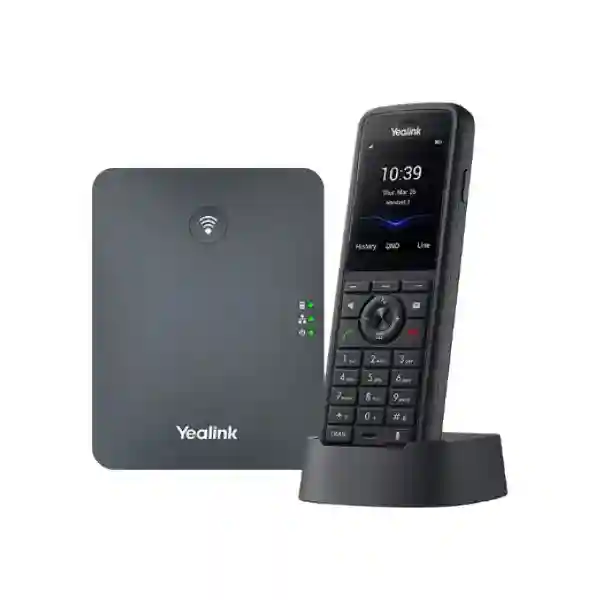
Yealink W79P Rugged DECT Phone System
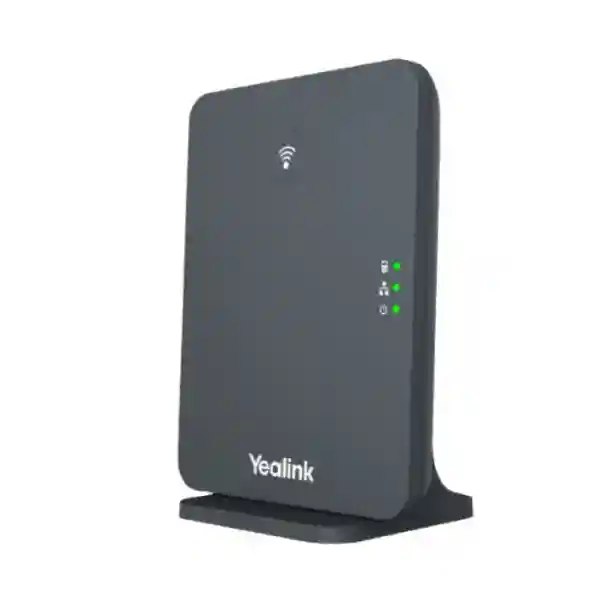
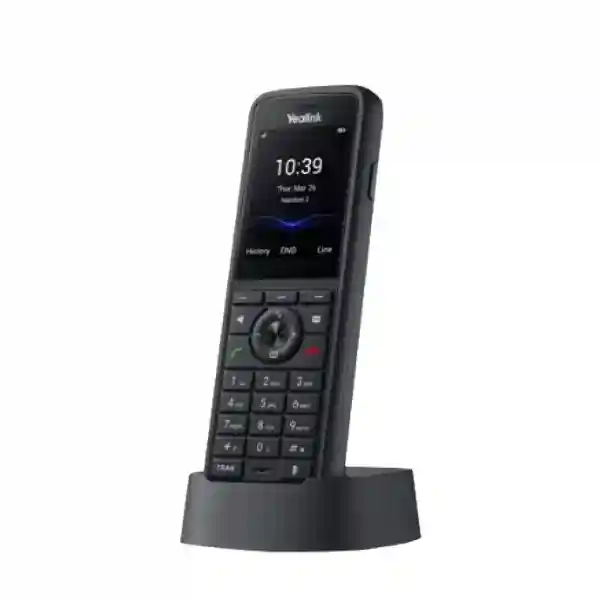
The Yealink W79P is a professional SIP cordless phone system built for organizations that need staff to move freely while staying reachable in demanding work areas. The system pairs the Yealink W70B DECT base station with the rugged W59R handset, giving businesses a practical route to wireless voice mobility without relying on consumer cordless phones. The W59R carries an IP67 protection rating and adds Bluetooth, vibration alerts, noise reduction and worker-safety alarm functions, while the W70B provides the SIP registration, call capacity and provisioning layer required for business telephony.
A single W70B base can register up to ten supported Yealink DECT handsets, allowing a small or medium site to grow beyond the handset supplied in the starter system.
The platform supports up to twenty simultaneous calls and up to ten SIP accounts, subject to the connected telephony platform and deployment design.
The W59R rugged handset is intended for difficult workplaces where dust, moisture and day-to-day knocks make a conventional office handset a poor operational fit.
Yealink specifies coverage of up to 50 metres indoors and 300 metres outdoors in ideal conditions, with actual coverage dependent on site layout and radio conditions.
What the Yealink W79P solves
Many organizations need voice communication beyond a desk. Warehouse supervisors walk between aisles, hospitality teams move between service areas, technicians cross workshops and maintenance zones, clinical staff move between rooms, and retail teams may need to answer internal or external calls while staying on the floor. The W79P addresses this by combining SIP telephony with a purpose-built DECT radio layer. Instead of tying a user to an Ethernet desk phone, the handset remains portable while still participating in a business calling environment.
The rugged W59R handset adds a practical layer for difficult workplaces. Its IP67 rating, rubberized construction, vibration alert and dedicated alarm capabilities are especially relevant where users may work around noise, dust, humidity or movement. Alarm functions include push-button, no-movement, man-down and running alarms. These functions can help form part of an occupational communication workflow, but they should be configured and tested as part of the site’s wider safety procedures rather than treated as a replacement for formal safety systems.
For IT teams, the W70B base supports common provisioning methods including TFTP, FTP, HTTP, HTTPS and Yealink RPS, as well as browser, phone and auto-provision configuration. This makes the W79P more suitable for managed business deployment than unmanaged consumer cordless systems. The base provides one 10/100 Mbps Ethernet port and supports IEEE 802.3af Class 1 Power over Ethernet, allowing deployment around a suitable PoE network design.
Verified technical highlights
| Area | Verified W79P capability |
|---|---|
| System capacity | Up to 10 DECT handsets, 10 SIP accounts and 20 simultaneous calls |
| Handset | Yealink W59R ruggedized DECT handset with IP67 protection |
| Display | 1.8-inch 128 × 160 TFT color display |
| Audio | HD voice, full-duplex speakerphone, FNR/noise cancellation, G.722 and additional narrowband codecs |
| Mobility | Up to 50 m indoor and 300 m outdoor range in ideal conditions; optional RT30 repeaters supported |
| Battery | Up to 28 hours talk time and 360 hours standby in ideal conditions; Bluetooth use reduces these figures |
| Security | TLS, HTTPS, SRTP, digest authentication, secure configuration file encryption and supported SHA algorithms |
| Network | SIP, VLAN, 802.1X, LLDP, STUN, static/DHCP addressing and outbound proxy backup support |
Compatibility, sizing and deployment guidance
The W79P should be selected as part of an IP telephony design, not as an isolated cordless handset purchase. Before ordering, confirm the SIP platform or IP PBX, the number of extensions, expected concurrent calls, the physical coverage area and whether users require dedicated handsets or shared devices. The W79P system is based on Yealink DECT technology and the manufacturer explicitly notes that Yealink DECT devices are not designed for third-party DECT base/handset interoperability. Buyers should therefore plan around compatible Yealink endpoints rather than assuming any generic DECT handset can be registered.
Coverage figures are laboratory or ideal-condition references, not guaranteed building dimensions. Reinforced concrete, metal shelving, machinery, cold-room construction, multiple floors and RF obstacles can materially affect usable DECT coverage. A warehouse with open aisles may behave very differently from a hospital, hotel or multi-storey office. For larger or more complex environments, a site survey and consideration of repeaters or a Yealink multi-cell architecture may be more appropriate than adding a single base and hoping it covers the complete property.
Businesses comparing wireless voice approaches can also review the Yealink solutions page for Tanzania, which explains how DECT mobility, SIP desk phones and collaboration devices fit different user roles. For an alternative DECT architecture, the Grandstream DP752 DECT base station provides a useful comparison point where procurement teams are evaluating different SIP cordless ecosystems. Organizations modernizing mixed legacy and SIP environments may also find the Dinstar VoIP solutions overview useful for understanding gateways, PBX and SIP-edge options. Teams already using Yeastar can review Yeastar Linkus deployment guidance when deciding which users need physical DECT handsets and which are better served by mobile or desktop softphone access.
Yealink W79P Rugged DECT Phone System Tanzania
Organizations searching for the Yealink W79P Rugged DECT Phone System in Tanzania are typically trying to solve a mobility problem rather than simply replace a desk phone. Warehouses, factories, hospitality sites, clinics, service centres, retail operations, logistics businesses and technical facilities often have employees who must remain reachable while moving through areas where a fixed handset is impractical. The W79P is designed around that requirement: a W70B SIP DECT base connected to the IP network and a W59R rugged handset carried by the user. For Tanzanian deployments, the important planning questions are the SIP platform, user count, building layout, voice network design, power availability, expected radio coverage and whether the workforce needs alarm functions as part of its communication process.
Procurement teams should specify the exact W79P generation because Yealink now also markets a W79P Pro. The legacy W79P described here uses the W59R handset with a 1.8-inch 128 × 160 display, Bluetooth 4.2, IP67 protection and the published battery figures associated with that model. Mixing specifications from the Pro version can create errors in quotations and deployment expectations. A request for quotation should therefore state “Yealink W79P with W70B and W59R” when that is the intended system, along with quantity and any additional compatible handsets, repeaters or accessories required.
For Tanzania, network readiness matters as much as the cordless radio layer. The W70B uses Ethernet and can be powered through suitable PoE infrastructure, while voice quality depends on the LAN, VLAN design, switching, IP addressing, SIP service and upstream connectivity. Businesses using hosted VoIP should confirm how the provider registers the base and how remote provisioning is handled. Businesses using an on-premises IP PBX should confirm SIP extension credentials, codec policy, dial plan and call routing. If sites include metal racks, thick masonry, cold rooms, plant areas or multiple floors, a DECT coverage assessment should be completed before determining the final number and placement of bases or repeaters.
A strong Tanzania quotation request should include the number of mobile users, approximate concurrent call demand, site type, floor count, rough dimensions, PBX or cloud platform, existing PoE switches and any safety-alarm requirement. This turns a model enquiry into an implementable design brief and helps avoid purchasing a single-base cordless system for a site that would be better served by a multi-cell design.
Yealink W79P Rugged DECT Phone System Dar es Salaam
For businesses in Dar es Salaam, the Yealink W79P can suit operational sites where employees need to move between work areas while remaining connected to the organization’s SIP calling platform. Distribution businesses, hotels, medical facilities, workshops, retail premises, warehouses and service operations may all have roles where staff cannot stay at a desk. The W59R handset is designed for mobility and challenging environments, while the W70B connects that mobile user into the IP telephony system. The result is a business communication endpoint that can be integrated into extension plans, hunt groups, transfer workflows and other SIP calling arrangements supported by the organization’s PBX or hosted platform.
Dar es Salaam deployments should pay particular attention to building construction and operational layout. A compact office and a large warehouse can require very different RF planning even when both need only a few handsets. The manufacturer’s ideal-condition DECT range should not be used as a guaranteed coverage promise. Metal structures, equipment, multiple rooms, reinforced walls and vertical separation between floors can reduce usable range. Where mobility extends beyond the practical footprint of a single base, planners should evaluate compatible repeaters or a multi-cell DECT architecture rather than relying on trial-and-error placement.
The network side should also be checked before purchase. The W70B provides a 10/100 Ethernet interface and supports IEEE 802.3af Class 1 PoE. If the building uses managed switches, voice VLAN design, QoS policy, LLDP, DHCP, DNS, firewall rules and SIP traversal requirements should be reviewed with the PBX or service provider. For hosted deployments, confirm account provisioning and whether the provider supports the intended Yealink firmware and remote management process. For local PBX deployments, document the extension count, credentials, codecs, routing and survivability expectations.
A Dar es Salaam buyer comparing quotations should ask suppliers to separate the core W79P kit from expansion handsets, repeaters, network switching, PBX licensing and installation services. That makes it easier to compare like for like. Where worker-safety alarms are planned, request configuration, testing and operational procedures as part of the project scope. The alarm feature is valuable only when the organization knows who receives the alert, how it is escalated and how the workflow is tested.
Yealink W79P Rugged DECT Phone System Mwanza
The Yealink W79P Rugged DECT Phone System in Mwanza is relevant to organizations that want cordless business telephony for people who work away from desks. A rugged handset can be useful in stores, stock areas, workshops, hospitality operations, healthcare environments and technical facilities where staff move continuously between tasks. The W59R’s IP67 design and vibration alert are particularly useful when a typical desktop handset or consumer cordless phone is not appropriate. The W70B base brings those mobile users into a SIP environment with support for up to ten SIP accounts and twenty simultaneous calls across the system.
For Mwanza sites, procurement should begin with a workflow map. Identify which employees need their own extension, which roles can share a handset, where calls originate, where users must be reachable and which areas are critical for coverage. A service desk may need a fixed SIP phone while maintenance staff require the W59R, so the complete solution can mix endpoint types. The W79P is most valuable when it is deployed deliberately for mobile roles rather than used as a universal phone for every desk and room.
Coverage planning should be treated as an engineering task. The published indoor and outdoor ranges are ideal-condition figures. Actual Mwanza installations may contain dense shelving, masonry, machinery, separate buildings or yard areas that alter the radio environment. If a single W70B does not provide the required footprint, optional RT30 repeaters can extend coverage in suitable designs, while larger estates may justify a multi-cell approach. Buyers should therefore share a simple floor plan or site sketch when requesting a solution instead of ordering repeaters based only on distance.
The quotation should also identify how the W79P will connect to the organization’s telephony platform. State whether the site uses an IP PBX, hosted VoIP or another SIP service, and include existing switch and PoE information. If call recording, queues, paging or emergency procedures are required, these should be documented because they may depend on the PBX rather than the handset itself. A well-scoped Mwanza deployment aligns handset durability, DECT coverage, network readiness and call-control features instead of evaluating the phone in isolation.
Yealink W79P Rugged DECT Phone System Arusha
In Arusha, businesses evaluating the Yealink W79P often need portable voice communication across hospitality, tourism support, retail, healthcare, logistics, workshops or distributed operational spaces. The W79P allows users to carry a business handset while still using SIP extensions and call features. Its W59R handset combines a rugged IP67 enclosure with Bluetooth, vibration, HD voice and alarm functions, while the W70B provides the DECT base and SIP interface. That makes the system particularly useful where staff move between front-of-house and back-of-house areas or between customer-facing and technical zones.
Hospitality environments are a good example of why design matters. A property may need reception staff on fixed phones, supervisors on DECT handsets and mobile application users in management roles. The correct endpoint mix reduces unnecessary hardware and gives each role the right mobility. The W79P can participate in that mixed model, but the physical coverage area must be checked. Guest-room walls, service corridors, kitchens, plant rooms and separate buildings can all influence DECT signal propagation, so a range figure alone should not determine base placement.
Arusha buyers should also clarify the PBX and trunk environment early. The W79P is a SIP endpoint system, not a complete telephone exchange. Features such as external line access, extension numbering, call queues, IVR, recording and branch routing normally depend on the connected platform. The base supports common network and provisioning capabilities, including VLAN, 802.1X, LLDP, DHCP/static addressing, TLS, SRTP and HTTPS, but these features need to be aligned with the site’s network policy and the PBX or hosted provider’s configuration.
When requesting a quotation in Arusha, include handset quantity, shift patterns, site layout, expected call concurrency, current PBX or hosted service, PoE availability and any requirements for alarms, Bluetooth headsets or extended coverage. If the organization anticipates growth into multiple buildings or a much larger handset fleet, ask whether a multi-cell design is more appropriate from the start. Planning for future mobility can be more cost effective than repeatedly extending a single-cell system after coverage or capacity limits have been reached.
Yealink W79P Rugged DECT Phone System Dodoma
The Yealink W79P Rugged DECT Phone System in Dodoma can support organizations that require mobile SIP extensions for operational staff, facilities teams, warehouses, clinics, service departments, hospitality properties or offices with users who frequently leave their desks. Its value comes from combining business call control with cordless movement. The W70B base integrates with the IP network and SIP service, while the W59R handset gives the user a rugged mobile endpoint with IP67 protection, noise cancellation, vibration and configurable alarm functions.
A Dodoma deployment should be sized by people, calls and space. Start by counting the users who genuinely need cordless handsets, then estimate simultaneous call activity and identify the physical zones that require coverage. The W79P can support up to ten handsets and twenty simultaneous calls at the system level, but capacity alone does not confirm radio coverage. A building with fewer users can still require more careful RF design if the site is divided by thick walls, floors, secure rooms or outdoor work areas.
Network design is equally important. The W70B can use PoE, which is convenient when a base must be placed where there is no nearby power socket, but the switch must provide compatible power and the Ethernet path must reach the correct voice network. Where VLANs or 802.1X are used, the W79P should be integrated into the existing access-control and network-management approach. Secure SIP deployments can make use of supported TLS and SRTP capabilities when the PBX or service is configured accordingly.
For procurement, avoid comparing only the headline price of the starter kit. A complete Dodoma project may also need extra W59R handsets, chargers, repeaters, PoE switching, PBX licenses, SIP trunks, configuration and user training. If alarm functions are part of the requirement, define the alert destination and escalation process before commissioning. Buyers should also confirm exact model generation and firmware requirements, especially because current Yealink catalogues include both W79P and W79P Pro products with different handset characteristics.
Yealink W79P Rugged DECT Phone System UAE
For organizations sourcing the Yealink W79P Rugged DECT Phone System in the UAE, the core buying question is whether a single-cell rugged DECT platform fits the site and user workflow. The W79P is designed for mobile SIP users and combines the W70B base with the W59R IP67 handset. This combination is well suited to warehouses, service facilities, hospitality properties, clinics, retail operations and industrial support areas where users need voice mobility but still require business PBX features. Up to ten supported DECT handsets can be registered to the base, with up to ten SIP accounts and twenty simultaneous calls across the system.
UAE projects often include large floor plates, high-bay warehouses, concrete structures, multiple units or outdoor operational zones. These environments make RF planning important. The published DECT range is an ideal-condition reference; it should not be interpreted as guaranteed coverage through metal racking, fire doors, reinforced structures or separate buildings. For distribution centres and industrial premises, placing the base centrally and testing real coverage is generally more reliable than positioning it beside the PBX or network rack purely for convenience.
Organizations operating across the UAE and Africa should also standardize the configuration process. The W79P supports remote provisioning methods and Yealink RPS, which can simplify repeat deployments where the same PBX templates and handset policies are used across sites. However, SIP trunking, emergency calling, dial plans and local carrier arrangements can differ by market, so endpoint standardization does not remove the need for country-specific telephony design. Security settings such as TLS, SRTP and HTTPS should be coordinated with the service provider and enterprise network policy.
A useful UAE request for quotation should include the exact W79P model, number of W59R handsets, site dimensions, base/repeater expectations, PBX platform, number of extensions, concurrent-call estimate, headset requirements and whether worker-safety alarms are needed. If the workforce is very large or users roam across multiple buildings, a Yealink multi-cell system may be a better architectural fit than stretching a single W70B beyond its intended role.
Yealink W79P Rugged DECT Phone System Uganda
The Yealink W79P Rugged DECT Phone System in Uganda provides a structured option for businesses that need cordless SIP communication in operational environments. The system is particularly relevant where workers move continuously and a conventional desk handset would reduce responsiveness. The W59R handset is IP67 rated and adds Bluetooth, vibration, noise cancellation and worker-safety alarms. The W70B base supports business SIP registration and can handle up to ten compatible handsets, ten SIP accounts and twenty simultaneous calls, making the platform suitable for small and medium single-site deployments when its coverage footprint matches the property.
Ugandan procurement teams should evaluate the W79P as part of the wider telephony stack. Confirm the IP PBX or hosted voice platform, SIP extension licensing, trunking, local numbering, firewall policy and switch infrastructure. The base supports PoE, which can simplify installation, but only where the network switch and cabling are ready. Voice VLANs and QoS should be considered where the LAN carries business data and voice together, especially on busy sites where congestion could affect call quality.
Physical layout remains a major factor. Open office space, warehouse racking, clinics, hotels and workshop environments all affect DECT propagation differently. A site that appears small on a floor plan can contain radio obstacles that create weak areas. Businesses should therefore define critical calling zones and test coverage rather than relying only on ideal-condition range figures. Repeaters can help in suitable cases, while larger deployments may require a multi-cell design that supports broader roaming and scale.
For a Uganda quotation, provide user quantity, handset quantity, number of shifts, site layout, PBX details, current network switches and any areas where users must receive calls without interruption. If alarm functions will be used, describe the operational escalation route. If the requirement includes multiple branches, decide whether every branch needs local DECT infrastructure or whether some users are better served by desk phones or softphones. This role-based approach often produces a more coherent communications design than specifying one endpoint type for every employee.
Yealink W79P Rugged DECT Phone System Kampala
Businesses in Kampala may consider the Yealink W79P when they need staff to answer and transfer business calls while moving across an office, warehouse, hotel, clinic, shop floor or service facility. The W79P’s architecture separates the network connection from the user’s handset: the W70B base connects to the Ethernet/SIP environment, while the W59R handset communicates over DECT. This can be more predictable for voice mobility than trying to use general-purpose Wi-Fi for every cordless calling role, especially when the business wants a dedicated voice endpoint with long standby time and physical call-control keys.
The W59R also suits roles exposed to harsher day-to-day use. Its IP67 rating, vibration alert and ruggedized design make it more appropriate than a standard office cordless handset for maintenance, logistics and workshop teams. Noise cancellation and HD voice help users communicate in busy surroundings, although call clarity will still depend on the PBX, codecs, network and radio environment. Bluetooth support allows compatible headset use, but published talk and standby times are lower when Bluetooth is active, which should be considered for long shifts.
Kampala deployments should be planned around real coverage zones. The maximum ideal-condition figures are useful for initial planning, but walls, steel, lifts, racks and multiple floors can reduce range substantially. If the handset must roam through several departments, stairwells or external yards, the project should include coverage testing. The W79P supports optional RT30 repeaters, but repeaters should be positioned to solve measured coverage needs rather than added without a radio plan.
For procurement, ask the supplier to clarify what is included in the quoted kit and whether extra handsets, chargers, repeater hardware, PBX licenses, configuration and installation are separate. Also specify whether the handset alarm functions need to be enabled and who receives those alerts. A clear Kampala scope should combine endpoint quantity, DECT coverage, SIP integration and support requirements so that the finished system works as one communications service rather than a collection of disconnected products.
Yealink W79P Rugged DECT Phone System Arua
The Yealink W79P Rugged DECT Phone System in Arua is a practical consideration for facilities where workers need a reliable business handset while moving between rooms, storage areas, workshops, counters or operational zones. The system’s W59R handset is built for tougher environments than a typical cordless office phone, and the W70B base provides the SIP interface required to connect those users to an IP PBX or hosted voice platform. For organizations with a modest number of mobile users, the capacity of up to ten handsets and ten SIP accounts can offer room to expand within a single-site design.
Before buying, map the intended call flow. Identify whether users need direct inward dial numbers, internal extensions only, hunt-group membership, call transfer, voicemail or other PBX features. The W79P itself provides endpoint functions, but many business calling features originate from the PBX or cloud service. Confirming this distinction prevents the handset from being blamed for capabilities that actually depend on the telephony platform or license tier.
Arua buyers should also assess infrastructure readiness. The W70B requires a network connection and can be powered through compatible PoE. If the site has unmanaged switching or limited cabling, network upgrades may be part of the project. For secure deployments, TLS and SRTP can be used where the server side supports and is configured for them. Remote provisioning can reduce manual setup effort when multiple devices are installed, but credentials and configuration templates should still be managed carefully.
Coverage planning remains essential. A handset may work well in an open service area and lose signal behind dense structures or at the far end of a separate block. Use the manufacturer’s ideal-condition range only as a starting reference. If the required footprint extends beyond one base, consider repeaters or a different DECT topology. A useful Arua quotation request should include site dimensions, wall or building type, handset count, PBX platform, PoE availability, concurrency expectations and whether the safety alarms are part of the operational requirement.
Yealink W79P Rugged DECT Phone System Mbarara
For businesses in Mbarara, the Yealink W79P can serve mobile personnel who need enterprise calling features without carrying a smartphone as their primary work extension. The W59R handset gives users dedicated call keys, speakerphone, vibration and alarm functions in a rugged IP67 enclosure, while the W70B base handles SIP registration and connectivity. This combination can suit hospitality operations, warehouses, clinics, service centres, workshops and other workplaces where a user may be away from a desk for much of the shift.
The main design task is to decide where DECT mobility adds value. Receptionists or finance staff may be better served by fixed desk phones with larger displays and programmable keys, while supervisors, technicians and floor staff benefit from cordless movement. Mixing endpoint types according to role can reduce cost and make the system easier to support. The W79P then becomes the mobility layer within the larger PBX design rather than the only type of telephone in the organization.
Mbarara sites should validate coverage before finalizing quantity. The W70B’s ideal-condition indoor and outdoor figures provide a useful planning reference, but the real building can behave differently because of concrete, metal roofing, shelves, machinery and separate structures. Optional repeaters can extend coverage in suitable circumstances, though a complex campus may justify moving directly to a multi-cell solution. If users must roam without losing calls between many zones, that requirement should be stated explicitly so the architecture can be selected correctly.
A complete quotation should identify the W79P kit, additional handsets, chargers, repeaters, network switches, PBX requirements, SIP service and configuration scope. Businesses should also define how handset alarms will be monitored if they plan to use them. The technology can generate alarm events, but the organization still needs a response process. Providing these details at the quotation stage produces a more accurate Mbarara solution and reduces the risk of unexpected accessories or integration work appearing after purchase.
Yealink W79P Rugged DECT Phone System Gulu
The Yealink W79P Rugged DECT Phone System in Gulu can fit organizations that need a small or medium-scale cordless SIP platform for operational teams. The system supports up to ten compatible handsets and ten SIP accounts, making it useful when several employees need mobile extensions around the same site. The W59R handset’s IP67 rating, vibration alert and worker-safety alarm features distinguish it from conventional office DECT handsets, while the W70B base provides the Ethernet and SIP connection required for centralized business calling.
Use-case planning should come before device quantity. A business might have thirty employees but only six who genuinely need cordless handsets because the remaining users work at desks or use mobile applications. Conversely, a smaller workforce spread across a workshop and storage compound may need more extensive coverage than its headcount suggests. For Gulu projects, list mobile roles, call volumes and required zones rather than using employee count alone to size the system.
Voice quality depends on both radio and IP network conditions. The W79P supports HD voice and noise cancellation, but congestion, packet loss or a poorly configured SIP path can still degrade calls. Managed switching, voice VLANs, appropriate QoS and stable upstream connectivity should be considered when the telephony system shares the LAN with other applications. The base can use PoE, which can help installers place it for better radio coverage instead of being constrained by the location of a mains socket.
Gulu buyers should request a configuration that reflects the actual PBX or hosted service. Ask for confirmation of registration method, codecs, dial plan, voicemail, transfer behavior and any group calling requirements. If repeaters are proposed, request the coverage rationale. If the organization expects to grow beyond one base or needs seamless movement across a much larger property, compare the W79P single-cell approach with Yealink’s multi-cell systems before committing. The best choice is the one that matches the long-term mobility footprint, not simply the lowest initial hardware count.
Yealink W79P Rugged DECT Phone System Kenya
Organizations evaluating the Yealink W79P Rugged DECT Phone System in Kenya can use it as a rugged mobility endpoint for SIP-based business communications. The platform is designed around the W70B base station and W59R handset, supporting up to ten handsets and twenty simultaneous calls. That capacity can work well for warehouses, logistics operations, hotels, clinics, manufacturing support teams and other sites where staff need to answer calls while moving through the workplace. The W59R’s IP67 rating, Bluetooth and alarm functions add capabilities that are relevant to operational rather than purely office use.
Kenyan buyers should compare the W79P with both ordinary DECT systems and larger multi-cell platforms. A single W70B is attractive when the workforce is concentrated in one manageable coverage area, but a campus, factory or multi-building property can exceed the practical limits of a single-cell system even when handset count remains low. The published range values are measured in ideal conditions, so actual deployment should consider walls, racking, machinery, floor levels and outdoor movement.
PBX integration should also be documented. The W79P supports SIP, secure signaling/media options, VLAN features and remote provisioning, but the exact calling experience depends on the connected service. If the organization uses a hosted PBX, verify provider support, provisioning method and firmware expectations. If it uses an on-premises PBX, confirm extension allocation, trunks, failover, call groups and network security. Businesses with multiple branches can standardize handset models while still adapting dial plans and connectivity to each site.
A Kenya quotation should list starter kits separately from extra W59R handsets, repeaters and installation. Include the number of mobile users, approximate simultaneous calls, site layout and any Bluetooth or alarm requirements. Also state whether the project needs a new PBX, integration with an existing one or endpoints only. This clarity lets procurement compare proposals on the same scope and helps technical teams verify that the final design covers radio, network and telephony requirements together.
Yealink W79P Rugged DECT Phone System Kuwait
The Yealink W79P Rugged DECT Phone System in Kuwait can support organizations that require durable cordless SIP extensions across warehouses, service environments, hospitality sites, workshops and other facilities where fixed desk phones limit staff mobility. The W79P pairs the W70B base with the W59R IP67 handset and supports up to ten handsets, ten SIP accounts and twenty simultaneous calls. Bluetooth, vibration alerts and alarm functions make the handset particularly suitable for employees who work in noisy or movement-intensive settings.
Kuwait deployments should consider both indoor construction and operational heat exposure. The manufacturer’s published operating specifications should be followed, and handset or base equipment should not be positioned in environments outside the stated temperature limits. Outdoor coverage figures are not an invitation to install indoor-oriented network equipment in unprotected areas. The design should use suitable mounting locations, protected cabling and environmental controls while still positioning the base where its DECT radio can reach the users.
SIP integration should be planned around the organization’s existing calling platform. The W70B supports standard network functions, provisioning and security capabilities, but external numbers, trunks, queues, recordings and enterprise call policies normally live on the PBX or hosted service. Procurement should therefore include the telephony platform in compatibility discussions. If multiple branches are involved, standardized provisioning can reduce support effort, but each site’s network, numbering and local carrier setup must still be validated.
For a Kuwait RFQ, include handset quantity, site type, indoor/outdoor movement expectations, expected concurrent calls, PBX platform, network switch model if known, PoE availability, required accessories and whether safety alarms will be configured. If the site is a large industrial or logistics property, ask for a coverage design rather than a simple product quote. A low-cost hardware-only purchase can become expensive if weak coverage later requires unplanned repeaters, additional cabling or migration to a different DECT architecture.
Yealink W79P Rugged DECT Phone System Ghana
Businesses considering the Yealink W79P Rugged DECT Phone System in Ghana are often looking for a reliable way to keep mobile personnel connected to the company’s SIP telephony system. The W79P is useful where users move through warehouses, healthcare facilities, hotels, workshops, retail spaces or service areas and need a dedicated work handset. The W59R’s rugged IP67 construction, vibration and alarm features make it suitable for roles where a normal office cordless device may be too fragile or too easy to miss in a noisy environment.
The system can scale within a single W70B base to ten compatible handsets, ten SIP accounts and twenty simultaneous calls, but scale must be considered alongside physical coverage. A relatively small user group may occupy a large property. In that case, the radio design rather than call capacity becomes the limiting factor. Ghanaian deployments should identify all required coverage zones and assess obstacles before hardware quantity is finalized. Repeaters can solve some extension problems, while a larger multi-cell solution may be more appropriate for broad or complex estates.
Network preparation is part of the voice solution. The W70B’s Ethernet and PoE support can simplify installation when the LAN is properly designed. VLANs, QoS, addressing and firewall rules should be aligned with the PBX. Secure signaling and media features such as TLS and SRTP are available, but both endpoint and server configuration must support them. Businesses should also confirm remote provisioning if they want consistent templates across multiple devices or branches.
A Ghana request for quotation should describe the number of handsets, user roles, site layout, PBX or hosted platform, expected call concurrency, network infrastructure and accessory needs. If the W59R alarm functions are important, include testing and response procedures in the project scope. If Bluetooth headsets will be used, account for the reduced published battery endurance compared with handset-only operation. These details help turn a product inquiry into a deployment plan that reflects actual operating conditions.
Yealink W79P Rugged DECT Phone System Nigeria
The Yealink W79P Rugged DECT Phone System in Nigeria can serve businesses that need wireless voice mobility without abandoning SIP-based enterprise calling. The platform combines a W70B base station with a W59R rugged handset and is suited to warehouses, manufacturing support areas, hospitality operations, clinics, retail environments and other facilities where users need to stay reachable while moving. The system supports up to ten handsets and ten SIP accounts with up to twenty simultaneous calls, giving small and medium sites a reasonable capacity envelope when a single-cell DECT design is appropriate.
Nigeria deployments should separate three planning layers: handset durability, DECT coverage and IP telephony integration. The W59R addresses the first layer with IP67 protection, vibration, Bluetooth and alarm features. The W70B and optional repeaters address the radio layer. The LAN, internet connectivity and PBX address the final layer. Weakness in any one of these can affect the overall user experience, so procurement should not judge the system solely by handset specifications.
Power and network continuity may also be important design considerations for business voice. The W70B can use PoE, which allows it to be powered from network infrastructure that may already be protected by UPS. That can simplify resilience planning compared with separate local power adapters, although the complete voice path—including switches, routers, PBX and WAN where relevant—must remain available. Organizations using hosted voice should consider how calls behave during internet outages, while on-premises systems should consider trunk and power resilience.
For a Nigeria RFQ, include the exact product generation, handset count, expected growth, building layout, PBX or cloud service, PoE availability, concurrency needs and whether repeaters are expected. If the business spans several branches, state whether users need a common dial plan or centralized PBX. If the site is large enough to require broad roaming, compare multi-cell options before committing to multiple isolated single-cell deployments. This ensures the selected architecture supports both today’s requirements and reasonable future expansion.
Yealink W79P Rugged DECT Phone System Seychelles
The Yealink W79P Rugged DECT Phone System in Seychelles can be considered by hotels, resorts, clinics, warehouses, service operations and other businesses where employees move across the property but still need a managed business extension. The W59R rugged handset is designed for challenging environments and includes IP67 protection, Bluetooth, vibration and alarm functions. Connected through the W70B base, it becomes part of a SIP telephony environment that can support up to ten compatible handsets, ten SIP accounts and twenty simultaneous calls.
Island and hospitality-style properties can present distinctive coverage challenges. Guest-room construction, service corridors, plant rooms, landscaped areas and separate buildings may all influence DECT performance. The manufacturer’s ideal-condition range should be used only for preliminary planning. A resort or multi-building site should define the areas in which calls must continue and test those zones. Where users move across a broad property, a Yealink multi-cell system may offer a better architecture than attempting to extend one base too far.
Environmental placement also matters. The W59R is the rugged element of the W79P bundle, but the base station and network infrastructure still need suitable indoor or protected installation. Network cabling, PoE switching and UPS design should be coordinated so that the base can be mounted where radio coverage is useful without compromising equipment protection. If the telephony service is hosted, the internet path becomes part of the call chain and should be considered in continuity planning.
A Seychelles quotation request should state the number of mobile users, site or property layout, PBX or hosted voice platform, expected concurrent calls, network infrastructure and any safety or headset requirements. Hospitality buyers should also identify whether users need direct extensions, service groups, reception transfer, voicemail or other PBX workflows. With these details, the W79P can be evaluated as part of a complete communications design rather than as a standalone cordless device, reducing the risk of coverage gaps or missing telephony features after installation.
Industries and practical W79P use cases
Warehousing and logistics
Supervisors and pick/dispatch staff can carry a rugged extension while moving through storage and loading areas. Radio coverage should be tested around metal racks and loading zones.
Hospitality
Housekeeping, maintenance and service supervisors can use cordless extensions while reception and administration retain desk phones. Guest-room construction makes coverage planning important.
Healthcare and clinics
Mobile teams can remain reachable across treatment, support and administrative areas. Network, privacy and operational policies should be aligned with the organization’s broader communications requirements.
Workshops and facilities
Maintenance and technical personnel benefit from a rugged handset, vibration alert and alarm functions where movement, equipment noise and hands-on work are part of the daily environment.
Quotation checklist
For a useful W79P quotation, provide the exact model name, number of W59R handsets, number of users, expected simultaneous calls, site dimensions, number of floors or buildings, current PBX or hosted VoIP platform, SIP account requirements, existing switch and PoE capability, expected DECT coverage zones, need for repeaters, Bluetooth headset requirements, alarm-function requirements, preferred provisioning method and any planned growth. If the deployment replaces an existing cordless system, also include the current base locations and coverage problems so the new design can address them rather than reproduce them.
Frequently asked questions
Is the Yealink W79P waterproof?
The included W59R handset carries an IP67 protection rating. That rating applies to the rugged handset, not automatically to every component of the system. The W70B base and network equipment should be installed in appropriate protected locations.
How many handsets can the W79P support?
The W70B-based W79P system supports registration of up to ten compatible Yealink DECT handsets, up to ten SIP accounts and up to twenty simultaneous calls.
What is the range of the Yealink W79P?
Yealink publishes up to 50 metres indoors and 300 metres outdoors in ideal conditions. Real range depends on walls, floors, metal, machinery, interference, base placement and other site-specific factors, so coverage should be validated in the actual environment.
Does the W79P support Bluetooth?
Yes. The W59R handset has built-in Bluetooth for compatible headset use. Yealink’s published talk and standby figures are lower when Bluetooth is active, so heavy headset users should consider charging routines during long shifts.
Can I use a third-party DECT handset with the W70B?
Yealink states that its DECT technology is not compatible with third-party DECT base stations or handsets. Buyers should use compatible Yealink endpoints and verify current compatibility for the intended model and firmware.
Does the W79P replace an IP PBX?
No. The W79P is a SIP DECT endpoint system. Business functions such as external trunks, IVR, queues, extension policy and centralized call routing typically depend on the connected IP PBX or hosted voice service.
Decision recap
Choose the Yealink W79P when the requirement is a rugged single-cell DECT SIP system for a manageable site with up to ten supported handsets and a workforce that benefits from IP67 protection, Bluetooth, vibration and alarm capabilities. Confirm the exact model generation, map real coverage zones, verify PBX compatibility and include network readiness in the scope. Consider a multi-cell Yealink design when the property is larger, distributed across buildings or requires broader seamless roaming than one W70B base and repeaters can comfortably provide.
Plan the W79P around your site, not only the handset count
For an accurate proposal, share the number of mobile users, building layout, existing PBX or hosted service, network and PoE details, expected call load and the areas that must have cordless coverage. This information makes it possible to decide whether the W79P single-cell system is appropriate, whether repeaters are justified or whether a larger DECT architecture should be considered.


Reviews
There are no reviews yet.