
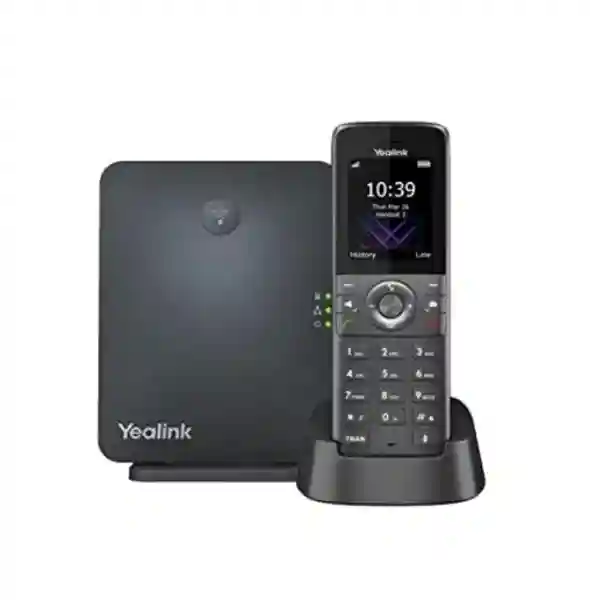
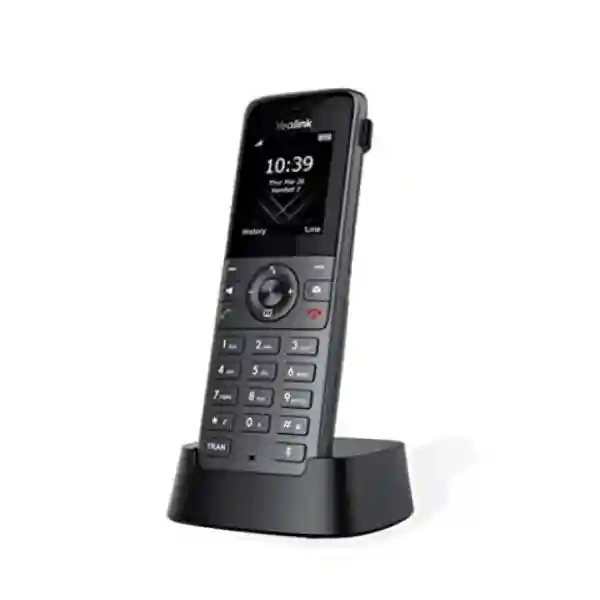
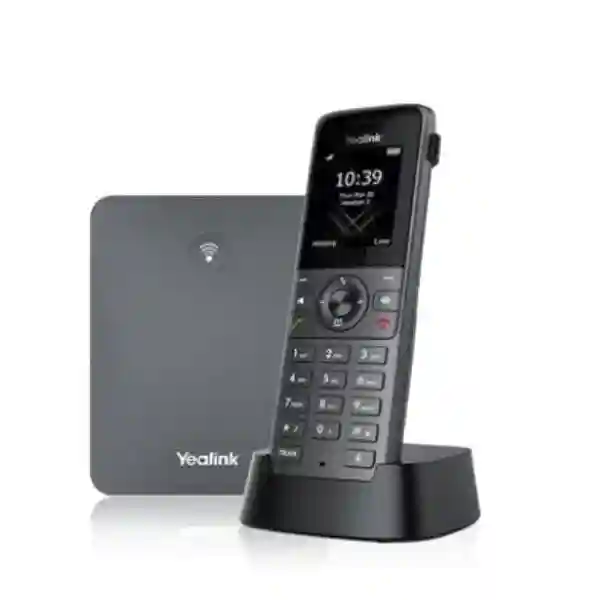
Yealink W73P DECT Phone System
The Yealink W73P is a business SIP cordless phone system built around the W70B DECT base station and W73H handset. It is designed for organisations that want staff to move around an office, shop floor, warehouse, clinic, hospitality property or operational area without giving up the call-control functions of an IP PBX. Yealink specifies support for up to 10 SIP accounts, up to 10 compatible DECT handsets or endpoints and up to 20 simultaneous calls on the W70B platform.
Verified W73P capabilities
The W73P bundle combines one W70B base with one W73H handset. The W70B provides SIP registration, Ethernet connectivity, DECT radio, VLAN, LLDP, 802.1X, DHCP or static addressing, TLS and SRTP support. It includes one 10/100M Ethernet port and supports IEEE 802.3af PoE Class 1. The W73H provides a 1.8-inch 128 × 160 TFT colour display, full-duplex speakerphone, 3.5 mm headset jack, HD audio features and business call controls. Yealink specifies up to 35 hours talk time and up to 400 hours standby time in ideal conditions, with quick charging that can provide up to two hours of talk time from a ten-minute charge.
The platform supports up to 10 SIP accounts, up to 10 compatible DECT endpoints, up to 20 simultaneous calls and up to two simultaneous calls per handset. Yealink lists a nominal range of up to 50 metres indoors and up to 300 metres outdoors in ideal conditions, while actual range varies with construction, interference, metal structures and base placement. Up to six RT30 repeaters per base can be used for selected coverage-extension designs.
Business use and deployment planning
The W73P is well suited to compact offices, retail locations, clinics, hotels, restaurants, schools, warehouses and service businesses where users move between desks, counters, rooms, aisles or work areas. The cordless architecture can reduce the need to place a fixed desk phone at every point where an employee may need to answer a call. A buyer should still treat the phone as one part of a complete SIP solution: PBX compatibility, SIP trunk capacity, internet quality, network switching, VLANs, QoS, PoE and power continuity all influence the final user experience.
For broader telephony and network planning, buyers can review the FourTeck Tanzania services overview, explore the FourTeck Tanzania technology shop, learn about the company through FourTeck Tanzania, and use the Tanzania contact page when preparing a quotation request. Cross-border organisations can also reference FourTeck Kenya, FourTeck Uganda, FourTeck Ghana, FourTeck Nigeria, FourTeck Kuwait and the broader FourTeck Africa technology portal.
Yealink W73P Tanzania
For organisations evaluating the Yealink W73P in Tanzania, the key decision is whether a compact single-cell DECT system matches how employees move through the workplace. The W73P allows a SIP extension to follow the user inside the effective DECT coverage area, which can be valuable in offices, hospitality sites, retail locations, clinics, schools, stores and warehouses. With up to 10 compatible DECT endpoints and up to 10 SIP accounts on the W70B, a business can start with a small team and expand within the base capacity. Procurement should begin with user count, call concurrency, PBX platform and coverage zones rather than device quantity alone.
A Tanzania deployment should also evaluate network readiness. The W70B supports PoE, allowing a suitable PoE switch to deliver power and data on one Ethernet cable. When that switch is protected by UPS, the base can remain powered through short interruptions as long as the wider voice path remains available. Voice VLANs, QoS and secure SIP configuration can help keep calls predictable on networks shared with computers, cameras, Wi-Fi and cloud applications. Buyers should document SIP account ownership, firmware, credentials and provisioning methods before deployment.
Coverage should be validated against the actual building. Yealink’s ideal-condition range figures are useful planning references, not guarantees. Thick walls, metal shelving, machinery, lifts, glass and multiple floors can reduce performance. A quotation request should include town, building type, handset quantity, expected simultaneous calls, PBX or SIP provider, PoE availability and required movement zones. If the site is large or complex, repeaters or a multi-cell DECT platform may be more appropriate than forcing a single-base design.
Yealink W73P DECT Phone System Dar es Salaam
Dar es Salaam businesses often combine reception, administration, retail, logistics, hospitality and warehouse workflows where employees cannot remain at one desk. The W73P can keep those users connected to a business SIP extension while they move inside a defined coverage area. One W70B base supports up to 10 compatible endpoints and up to 20 simultaneous calls, which can fit many small and medium teams.
Base placement should follow the floor plan rather than router location alone. A communications room at one end of a building may be convenient for cabling but poor for radio coverage. A central PoE network point can allow the base to be positioned more effectively. Because Dar es Salaam sites can include concrete partitions, warehouses and multi-floor offices, coverage testing is recommended before relying on headline distance figures.
For procurement, state the number of users, departments, PBX platform, network switch type and whether repeaters or headsets are expected. Reception staff, warehouse staff and supervisors may need different call-routing behavior, so defining roles makes it easier to plan SIP accounts, ring groups and extension assignments correctly.
Yealink W73P DECT Phone System Mwanza
In Mwanza, the W73P can support offices, hospitality properties, clinics, schools, service businesses and warehouses where staff need cordless access to a SIP extension. The W73H provides a compact handset with colour display, speakerphone and headset connection, while the W70B centralises the network connection and SIP registrations.
Mwanza buyers should size the system from call patterns rather than employee count. Ten users do not always require ten simultaneous external calls, and a smaller team can still experience busy call peaks. SIP trunk channels, hosted PBX subscriptions and on-premises PBX limitations must be considered separately from the W70B hardware capacity.
Coverage should be validated in the intended environment. Warehouses, compounds and multi-room facilities may weaken radio propagation. A useful quotation should identify the PBX platform, handset count, required movement zones, PoE availability and whether RT30 repeaters might be needed. This reduces the risk of receiving correct hardware but an incomplete deployment package.
Yealink W73P DECT Phone System Arusha
Arusha organisations frequently combine office administration with hospitality, tourism, retail and operational workflows. The W73P can be useful when reception, supervisors or service staff need to move between desks, guest-service areas, stores or other work zones while retaining a consistent business extension.
User roles should be mapped before assigning handsets. Front-office staff may need group ringing, supervisors may need individual extensions and shared service handsets may need departmental identities rather than personal voicemail. The W73P supports common business call functions, but the PBX determines how these features are ultimately delivered.
Hotels, lodges and larger offices should treat radio design seriously because corridors, thick walls and multiple buildings can reduce single-base coverage. Buyers should describe the physical area, handset count, PBX, PoE availability and expected roaming when requesting a quote. Larger properties may be better suited to a multi-cell platform rather than several independent single-cell systems.
Yealink W73P DECT Phone System Dodoma
Dodoma businesses, institutions and professional offices can use the W73P to provide controlled cordless business communication without relying entirely on personal mobile phones. Administrators, supervisors, reception staff and service teams can carry a business extension as they move within a site.
Institutional deployments should define whether each handset represents a named person, department, duty function or shared role. This affects voicemail, directory naming, ring groups and accountability. The W70B’s support for multiple SIP accounts and endpoints gives flexibility, but extension policy should be decided before configuration begins.
Power and network design are also important. PoE can simplify installation, and a UPS-backed switch can support continuity during brief power events. Buyers should provide site layout, handset quantity, SIP provider or PBX, accessory needs and required movement zones when requesting a quotation.
Yealink W73P DECT Phone System UAE
In the UAE, the W73P suits offices, retail, hospitality, clinics and warehouses that need a compact cordless SIP platform. The system supports up to 10 compatible endpoints, 10 SIP accounts and 20 simultaneous calls, making it a strong option for small and medium teams that need mobility without a full multi-cell system.
UAE procurement teams should confirm compatibility with the existing cloud voice, PBX or SIP trunk environment. SIP support alone does not guarantee every advanced feature will behave identically on every platform. Provisioning, codecs, security, directories and call features should be validated before a large rollout.
Multi-country companies can standardise endpoint families for easier support, but exact regional versions and deployment requirements should still be checked. A useful quote request includes handset count, base count, office layout, PBX platform, PoE availability, destination emirate and any requirement for repeaters or headsets.
Yealink W73P DECT Phone System Uganda
Ugandan businesses can use the W73P where employees need to move inside offices, retail sites, schools, clinics, warehouses and hospitality properties while staying connected to a business extension. The W70B handles the Ethernet and SIP connection while W73H handsets provide DECT mobility.
A Uganda deployment should map the PBX or hosted voice platform first, then confirm SIP registration, codecs, VLAN, security and provisioning requirements. TLS and SRTP support can be used where the broader voice platform is configured accordingly. Central provisioning can simplify multi-branch support.
Coverage planning is important for warehouses, lodges and institutional buildings. Metal structures and physical separation can reduce practical range. Up to six RT30 repeaters are listed per base, but broad roaming requirements can justify a multi-cell design. Quote requests should include the city, site type, handset quantity, PBX, PoE and movement zones.
Yealink W73P DECT Phone System Kampala
Kampala offices and service businesses can use the W73P when customer calls need to follow employees away from fixed workstations. Reception, retail supervision and warehouse management are typical examples. A single W70B can support up to 10 compatible endpoints, giving compact teams room to grow.
Physical layout is often more important than user count. Multi-floor buildings, reinforced walls and metal partitions can reduce coverage. A central PoE position can help place the base for better radio performance while still using structured cabling and central power.
Call quality also depends on the network. Packet loss, jitter, congestion and poor SIP trunk configuration can undermine HD audio. A Kampala quotation should therefore state user count, PBX, site layout, PoE availability, call peaks and any accessory requirements.
Yealink W73P DECT Phone System Arua
For Arua businesses and institutions, the W73P can bring SIP calling to users who move around offices, schools, clinics, hospitality sites and storage areas. The cordless handset keeps the user connected to a business extension while the base remains linked to the network.
Deployment completeness is important. The base requires Ethernet, SIP registration and power, while each handset needs a charging routine. Sites with unstable power should consider how the switch, router and PBX are protected, because a charged handset cannot place SIP calls if the network is unavailable.
Coverage and call workflows should be validated before purchase. Provide required movement areas, floor count, handset quantity and PBX platform when requesting a quote. This helps determine whether one base, repeaters or a different DECT architecture is appropriate.
Yealink W73P DECT Phone System Mbarara
In Mbarara, the W73P is relevant to professional services, hospitality, healthcare, education, retail and logistics environments where employees regularly leave a desk but still need a business extension. The W73H offers mobility while the W70B connects the system to the SIP network.
Capacity should be compared with actual call behavior. Up to 20 simultaneous calls at base level does not automatically mean the SIP trunk or hosted service has the same external-call capacity. Licensing and provider limits should be checked separately.
PoE, VLAN and secure provisioning can make the system easier to operate on a managed network. Buyers should also describe walls, floors and movement zones because coverage can vary substantially. Include PBX, handset count, PoE and growth plans in the quotation request.
Yealink W73P DECT Phone System Gulu
Gulu businesses and institutions can consider the W73P when they need cordless access to a SIP business phone system. Offices, schools, clinics, hospitality venues, retail operations and storage facilities are practical use cases where staff move through a defined site.
The W73H’s battery is specified for up to 35 hours talk time and 400 hours standby in ideal conditions. Shared handsets should still have a clear charging routine because real battery performance varies with use, battery age and signal conditions.
The network side should be documented carefully, including VLANs, firewall rules, provisioning and firmware. A Gulu quotation should also identify required coverage areas, number of users, simultaneous-call expectations and whether future growth could justify a multi-cell system.
Yealink W73P DECT Phone System Kenya
Kenyan businesses can compare the W73P against fixed desk phones and larger multi-cell DECT platforms. It is strongest when a small or medium group needs cordless SIP mobility inside a site that can be served by one base with limited coverage extension.
Offers should be compared by exact bundle contents and complete design, not only hardware price. Additional handsets, chargers, repeaters, PoE switches, PBX configuration and SIP service may all form part of the final requirement. Confirm exact product version and commercial terms before purchase.
A Kenya quote request should include city, site type, cordless user count, call concurrency, PBX, movement zones and whether the deployment is new or an expansion. This helps avoid under-specifying either network capacity or radio coverage.
Yealink W73P DECT Phone System Kuwait
Kuwait organisations can use the W73P for offices, retail, hospitality, clinics and compact operational facilities. The W70B’s VLAN, LLDP, 802.1X, TLS and SRTP capabilities allow it to fit into managed business networks where telephony is controlled as part of IT infrastructure.
IT teams should plan switchport settings, QoS, firewall rules, provisioning and secure credentials rather than expecting these functions to configure themselves. Hosted PBX users should confirm support for advanced features with their provider before deployment.
Coverage must also be assessed against concrete walls, basements, service corridors or metal storage. A quotation should identify location, handset count, PBX platform, PoE, call peaks and accessory requirements so the proposed system reflects real operating conditions.
Yealink W73P DECT Phone System Ghana
Ghanaian businesses can use the W73P for cordless SIP calling in offices, shops, hospitality sites, clinics, schools and warehouses. It allows users to keep a business extension while moving within the effective DECT coverage area.
Hardware capacity should be interpreted together with SIP trunk and PBX limits. The W70B may support up to 20 simultaneous calls, but the external service may be licensed for fewer. Extension roles, ring groups, voicemail and shared handsets should be planned before deployment.
PoE and UPS-backed switching can simplify power design, while VLANs and QoS can support call quality. Quote requests should include city, site layout, handset count, PBX and future growth so the buyer can decide between a single-cell system, repeaters or a multi-cell platform.
Yealink W73P DECT Phone System Nigeria
In Nigeria, the W73P can serve offices, hotels, retail locations, clinics, schools and warehouses that need cordless SIP calling without deploying a large enterprise mobility platform. The W70B provides the network link while W73H handsets give users portable call access.
Buyers should define the phone-system architecture before selecting quantity. Existing IP PBX users should confirm features and provisioning, while cloud-PBX users should confirm provider support and security settings. Internet resilience can also matter when the SIP service is hosted remotely.
PoE can simplify installation and centralise power protection. Coverage should still be assessed against the site layout. A Nigeria quote request should include city, handset quantity, PBX, PoE availability, expected concurrency and required movement zones.
Yealink W73P DECT Phone System Seychelles
The W73P can serve Seychelles hospitality, offices, retail, clinics and service operations where staff need a cordless business extension. Hospitality is a natural fit because supervisors and service personnel often move between front desk, back office and operational areas.
Island and multi-building properties should pay particular attention to radio design. Resort construction, landscaped separation, service areas and multiple structures can reduce single-base coverage. Repeaters may extend selected zones, but broad roaming can justify a multi-cell platform.
PoE, VLANs, QoS and stable SIP connectivity support a controlled deployment. Buyers should provide island, site type, handset count, coverage zones, PBX or SIP service and network topology when requesting a quotation.
Quotation checklist
Include the delivery country and city, number of W73P kits, number of additional W73H handsets, expected simultaneous calls, current PBX or hosted SIP platform, required SIP accounts, coverage areas, number of floors, PoE availability, voice VLAN status, UPS availability, headset needs, provisioning method and whether repeaters may be required. If replacing an existing cordless system, include the current model and reason for replacement.
Frequently asked questions
How many handsets can the Yealink W73P support?
The W70B base supports up to 10 compatible Yealink DECT endpoints and up to 10 SIP accounts. The standard W73P bundle includes one W73H handset, so additional handsets are added separately.
How many simultaneous calls can it handle?
Yealink specifies up to 20 simultaneous calls at system level and up to two simultaneous calls per handset. External call limits may depend on your PBX or SIP service.
Does W70B support PoE?
Yes. The W70B supports IEEE 802.3af PoE Class 1 through its 10/100M Ethernet port.
What range should I expect?
Yealink publishes up to 50 metres indoors and 300 metres outdoors in ideal conditions. Actual coverage depends on walls, floors, metal structures and base placement.
Can third-party DECT handsets be used?
Yealink states that its DECT technology is not compatible with third-party DECT base stations or handsets, so supported Yealink endpoints should be selected.
Decision recap
Choose the Yealink W73P when you need a scalable single-cell SIP cordless system with up to 10 compatible endpoints, up to 10 SIP accounts, up to 20 simultaneous calls, PoE on the base, managed-network features and a modern W73H handset. Confirm PBX compatibility, coverage, network readiness and growth requirements before ordering.



Reviews
There are no reviews yet.