
Yealink RCH80 Managed PoE AV Switch Tanzania
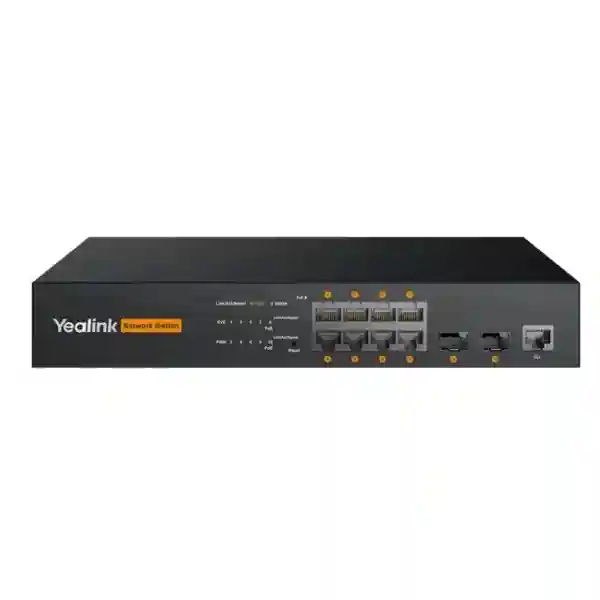
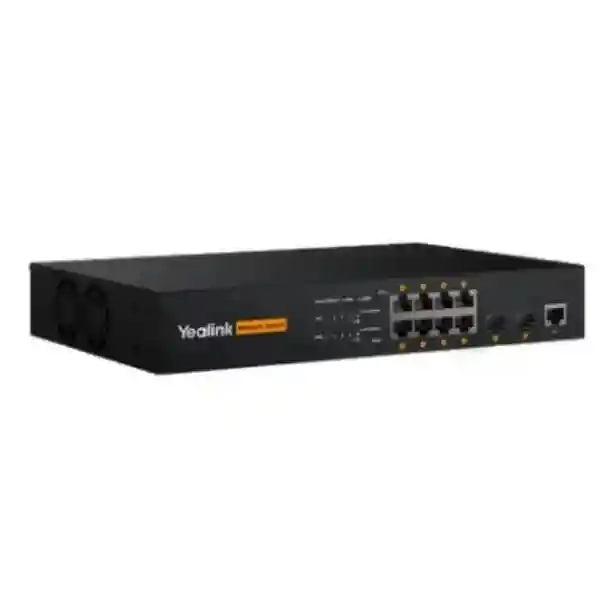
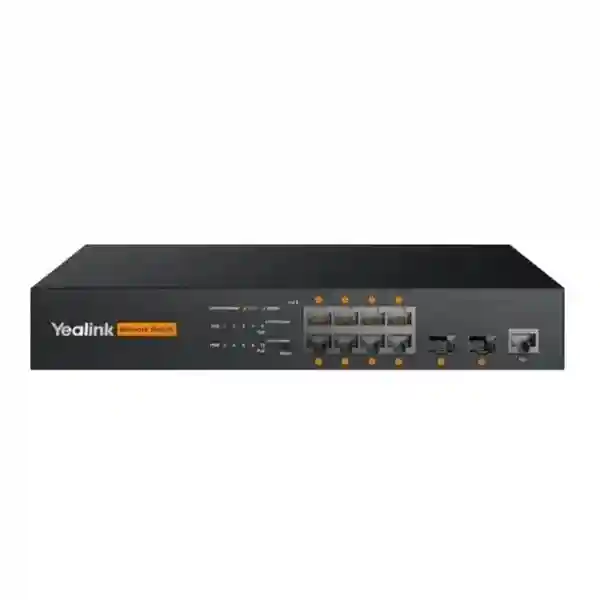
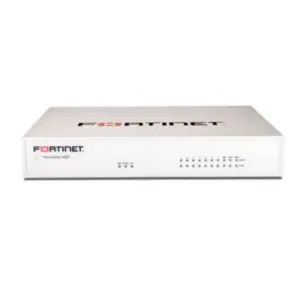
The Yealink RCH80 Managed PoE AV Switch is designed for professional meeting-room and AV-over-IP networks that need predictable multicast behavior, Power over Ethernet for room devices, web-based management and dedicated AV-oriented switching features. It combines eight Gigabit PoE ports, two Gigabit SFP fiber uplinks, a 130W PoE power budget and L2+ network controls in a compact fanless chassis. For Tanzanian organizations planning Yealink Microsoft Teams Rooms, pro-audio systems, networked microphones, speakers, cameras, encoders or decoders, the RCH80 provides a purpose-built switching layer rather than treating time-sensitive AV traffic like ordinary office data.
Yealink RCH80 Overview and Verified Technical Positioning
Yealink positions the RCH80 as an 8-port L2+ web-based managed AV switch created for professional AV over IP. The switch supports Yealink audio and video protocols together with Dante and AES67, making it suitable for networked meeting-room and pro-audio designs where multicast behavior and power delivery must be considered together. Its eight copper ports are Gigabit Ethernet PoE ports, while two Gigabit SFP ports provide fiber uplink options for longer building links, rack-to-rack connections or separation between the room AV network and upstream infrastructure.
The official specification lists a 130W PoE budget with IEEE 802.3af/at support. This matters because professional collaboration environments often place several powered devices on the same switch: ceiling microphones, network speakers, cameras, controllers and AV-over-IP endpoints may all compete for the same PoE capacity. The correct procurement decision is therefore not simply to count eight ports. Buyers should list every powered endpoint, check each device’s power requirement, allow sensible headroom and confirm whether the final design is better served by the RCH80 or a larger AV switch such as the RCH240.
Yealink also configures the switch with Energy Efficient Ethernet disabled by default and IGMP Snooping enabled by default for AV-over-IP use. These settings address common issues in real-time audio and video environments, where multicast traffic must be controlled and power-saving behavior on Ethernet links can be undesirable. The RCH80 supports IGMP v2/v3, IGMP Snooping, IGMP Fast Leave, VLAN features, QoS, loop-protection mechanisms, web-based management and other L2+ controls. Its fanless design is particularly useful in meeting rooms, equipment credenzas and quiet collaboration spaces where additional fan noise would be unwelcome.
AV-Optimized Multicast
IGMP Snooping, IGMP querying support and Fast Leave help manage multicast distribution for networked audio and video endpoints.
PoE+ for Room Devices
Eight Gigabit PoE ports share a 130W power budget, reducing separate power supplies for compatible AV devices.
Dante and AES67
Support for widely used networked-audio standards helps the RCH80 fit professional audio and collaboration environments.
Flexible Uplinks
Two Gigabit SFP interfaces create options for fiber connections when copper distance, electrical isolation or rack placement makes fiber preferable.
Yealink RCH80 Specifications
| Product type | L2+ web-based managed AV switch |
| Copper ports | 8 × Gigabit Ethernet PoE ports |
| Fiber ports | 2 × Gigabit SFP ports |
| PoE standards | IEEE 802.3af/at |
| PoE budget | 130W |
| Switching capacity | 20Gbps |
| Packet forwarding rate | 28Mpps |
| Protocols / AV interoperability | Yealink AV protocols, Dante, AES67 |
| Multicast | IGMP v2/v3, IGMP Snooping, IGMP Fast Leave and querying features |
| VLAN / QoS | 4K VLAN entries, GVRP, QinQ, Private VLAN, Voice VLAN; 802.1P/DSCP mapping and multiple queue scheduling methods |
| Management | Web-based browser management and CLI access |
| Cooling | Fanless |
| Dimensions | 280 × 180 × 44 mm |
| Installation | Rack-mounted or desktop installation |
| Power input | AC 100–240V, 50Hz ±10% |
Planning the RCH80 for Yealink AV Systems
A professional AV switch should be selected from a room-device schedule rather than from a generic Ethernet port count. Start with the devices that require PoE, note the rated or recommended power demand for each one, then separate endpoints that only need data from endpoints that need both data and PoE. The RCH80’s 130W budget can support many typical room designs, but the correct number of devices depends on the actual endpoint mix. A room with several high-power PoE+ speakers or cameras can reach the power ceiling earlier than a room dominated by lower-power microphones or controllers.
Network topology is equally important. For a single-room design, the switch may sit in a local AV rack or cabinet and connect directly to the room’s networked devices. Where the room is distant from the main equipment location, the two SFP ports can support fiber uplink designs using suitable transceivers and cabling. For larger AV environments, Yealink documents support for cascading multiple RCH80/RCH240 switches, but such designs require proper switch management. Duplicate default management addresses must be changed, and the IGMP Auto Query role must be planned so that only the intended primary switch performs that function in a cascaded multicast topology.
For a broader collaboration project, FourTeck can help place the RCH80 inside the complete room architecture: Yealink cameras, ceiling microphones, network speakers, AV bridges, AV-over-IP endpoints, touch controllers and the upstream enterprise network should all be considered as one design. Buyers can also review Yealink solutions and related communication infrastructure through FourTeck UAE technology solutions, FourTeck Kenya, FourTeck Uganda, and FourTeck Africa when regional project coordination or cross-border procurement is relevant.
Yealink RCH80 Managed PoE AV Switch Tanzania
Organizations evaluating the Yealink RCH80 Managed PoE AV Switch in Tanzania are usually solving a specific infrastructure problem: they need an AV network that can carry real-time audio and video traffic without relying on an ordinary access switch that was selected for PCs, printers and general office traffic. The RCH80 is relevant for boardrooms, training rooms, higher-education spaces, command environments, enterprise meeting suites and other installations where Yealink AV endpoints or Dante/AES67 devices need stable multicast handling and centralized PoE power. The product’s eight Gigabit PoE ports create a compact room-scale switching layer, while its two SFP uplinks can help when the AV rack must connect over fiber to a distant communications room or another switch.
For Tanzanian procurement teams, the most useful buying exercise is to prepare a room bill of materials before requesting a quotation. List each Yealink microphone, speaker, camera, encoder, decoder, controller or bridge that will connect to the RCH80. Record which devices require PoE or PoE+, estimate the combined power draw against the 130W budget and reserve capacity for reasonable future changes. An eight-port switch can appear sufficient on a simple drawing, yet a room that already uses seven or eight ports on day one leaves little expansion space. If the project includes multiple rooms or a dense AV endpoint count, the larger RCH240 may be worth evaluating rather than forcing an undersized design.
Tanzania projects should also consider cabling quality, grounding, rack ventilation, fiber-transceiver selection and how the AV switch connects to the corporate LAN. Yealink recommends Cat5e or higher for Gigabit copper connectivity, while the installation guide supports both rack and desktop placement. The fanless RCH80 can work well inside quiet meeting environments, but physical installation should still protect the device from heat, moisture, dust and accidental cable strain. Where AV traffic is isolated on VLANs, the switch’s VLAN and QoS capabilities can help align the room with the organization’s network policy.
FourTeck Tanzania buyers can use the RCH80 discussion to validate endpoint compatibility, PoE budget, uplink media and network design before ordering. The purchase request should include the number of rooms, each room’s endpoint list, whether fiber is required, whether Dante or AES67 devices are present, the expected connection to the existing LAN and any need for staged expansion. This approach produces a more reliable quotation than asking only for a switch price because it addresses the engineering decisions that determine whether an AV-over-IP installation works predictably after deployment.
Yealink RCH80 Managed PoE AV Switch Dar es Salaam
Dar es Salaam businesses considering the Yealink RCH80 often operate in environments where meeting technology must support frequent customer calls, regional management sessions and hybrid collaboration across offices. Corporate headquarters, banks, professional-service firms, hotels, universities and larger commercial organizations may have boardrooms or presentation rooms where audio, camera and control devices are increasingly network connected. In those rooms, a purpose-built AV switch becomes part of the meeting-system design rather than a generic IT accessory. The RCH80’s eight Gigabit PoE ports can consolidate data and power for compatible endpoints, while its multicast-oriented defaults reduce the amount of switch tuning required for a basic Yealink AV-over-IP deployment.
A Dar es Salaam project should begin by separating room-level requirements from building-network requirements. Inside the room, determine how many AV endpoints connect to the switch and how much PoE each endpoint consumes. Outside the room, determine where the nearest network rack is located, whether copper distance is practical and whether one of the RCH80’s SFP uplinks should be used for fiber. In high-rise offices or sites with distributed communications rooms, fiber can be useful for distance and electrical-separation reasons, but the correct optical modules and fiber type need to be selected as part of the project rather than assumed.
IT teams should also decide who owns switch administration after handover. The RCH80 is web managed, so the deployment should include a management-address plan, administrative password change, configuration documentation and a clear record of uplink ports, VLANs and connected AV devices. If more than one AV switch is cascaded, the management IP addressing and IGMP query role require attention to avoid conflicts. That detail matters in larger Dar es Salaam meeting environments because a room can be commissioned successfully in isolation yet behave differently when connected to the production network.
When requesting a FourTeck quotation in Dar es Salaam, include the meeting platform, room size, number of Yealink devices, any Dante/AES67 equipment, required switch location, planned fiber links and expected future expansion. Buyers should avoid purchasing purely on the basis of eight available ports; power budget and topology are equally important. A design that leaves spare PoE capacity and at least some room for additional endpoints is easier to maintain when the business later adds microphones, speakers, control devices or AV-over-IP components.
Yealink RCH80 Managed PoE AV Switch Mwanza
For Mwanza organizations, the Yealink RCH80 is a practical option when a meeting room, training environment or institutional AV system needs a compact managed switch with PoE and AV-aware multicast features. The product is especially relevant where the network carries more than basic laptop traffic and must support microphones, cameras, speakers or other Yealink AV devices as coordinated components of a room. Eight Gigabit PoE ports give the system integrator a clear connection point for powered AV endpoints, and two SFP ports provide flexibility where fiber is more suitable than copper for the uplink path.
Procurement teams in Mwanza can reduce deployment risk by requesting a simple port-and-power schedule before approval. The schedule should show each device, its connection type, PoE requirement, expected switch port and cable route. This makes the 130W budget visible during planning and prevents the project from reaching the site with enough physical Ethernet sockets but insufficient power headroom. It also identifies whether an endpoint needs a separate power source or whether the larger RCH240 should be considered for a denser room design. Such planning is particularly useful for educational, healthcare and enterprise environments where the room may later be expanded.
The RCH80’s fanless chassis is useful in rooms where background noise matters, but physical conditions should still be considered. Keep the switch in a secure, clean and appropriately ventilated location, protect power and data cabling from accidental movement, and ensure proper grounding. Yealink supports rack or desktop placement, giving Mwanza deployments some freedom when a full AV rack is not available. When desktop-installed, the unit should remain accessible for service while avoiding areas where liquids, heat or heavy objects can affect it.
A strong Mwanza quotation request should describe the operational goal rather than only naming the switch. State whether the project is a Microsoft Teams Room, a training-room AV system, a Dante audio network, a multi-camera meeting room or a broader Yealink AVONE deployment. Include the number of current endpoints and the expected growth path. With that information, FourTeck can help buyers judge whether the RCH80 provides the right balance of port count, PoE capacity, uplink flexibility and management features for the intended room.
Yealink RCH80 Managed PoE AV Switch Arusha
Arusha has a wide mix of conference venues, hospitality operations, NGOs, training facilities, schools and corporate offices where hybrid meetings and presentation systems may be used by both local teams and international visitors. In these environments, the Yealink RCH80 can form a dedicated network layer for professional meeting-room AV. Rather than placing microphones, cameras and networked speakers onto an unmanaged desktop switch, the RCH80 provides web management, multicast controls, VLAN and QoS functions plus PoE delivery in a chassis designed specifically around AV-over-IP requirements.
Room designers in Arusha should pay particular attention to user expectations. A hotel conference room may be reconfigured for different events, while an NGO boardroom may have a fixed Microsoft Teams Rooms layout. A training facility may need several microphones and speakers, while a smaller executive room may use only a few powered endpoints. Those differences change port usage and PoE demand. The RCH80’s 130W budget is shared across its PoE ports, so each design should verify the device mix instead of assuming every possible eight-port combination is equally practical.
Network segmentation can also improve maintainability. Using appropriate VLANs can keep AV devices logically organized, while QoS controls can help preserve treatment of real-time traffic within the local switching environment. The RCH80 supports Voice VLAN and other VLAN functions as well as 802.1P/DSCP priority features. These capabilities should be configured in line with the wider network policy, especially when the room connects to a managed enterprise LAN. Avoid introducing conflicting IGMP behavior at upstream switches; multicast planning should cover the complete path rather than only the AV switch.
Arusha customers requesting a quotation should provide a room drawing or at least a written endpoint list, cable distances, the expected location of the RCH80 and any requirement for fiber uplinks. For projects serving events or frequently reconfigured rooms, spare capacity is valuable because temporary devices may be added. For fixed boardrooms, the priority may instead be neat installation, quiet operation and documented configuration. In either case, FourTeck can frame the RCH80 as part of a complete AV network rather than an isolated switch purchase.
Yealink RCH80 Managed PoE AV Switch Dodoma
Dodoma organizations evaluating the Yealink RCH80 may include government offices, institutions, education environments and businesses that need reliable meeting-room connectivity for formal collaboration spaces. These deployments often benefit from clear documentation and standardized installation because rooms may be supported by central IT teams rather than by the users who operate them each day. The RCH80’s web-based management, structured VLAN options, multicast controls and visible PoE architecture make it easier to treat the AV network as a managed infrastructure component.
For formal procurement, technical specifications should be linked to the room requirement. Eight Gigabit PoE ports and two Gigabit SFP ports are useful only when they match the endpoint count and uplink design. The 130W total PoE budget should be compared with the power demand of the actual devices, and any transceiver or fiber requirements should be listed separately in the bill of materials. This avoids ambiguity between the switch itself and the accessories needed to connect it into the building network.
Operational planning should include switch credentials, management addressing, backup of configuration details and labeling of every AV connection. When devices are replaced or rooms are upgraded, clear documentation helps support teams identify which port powers which endpoint and whether the original PoE plan still has enough headroom. The RCH80 also supports loop protection technologies such as STP, RSTP and MSTP, but resilient network design should still be intentional. Connecting cables indiscriminately can create topology problems even on a managed switch.
Dodoma buyers can strengthen a quotation request by specifying room purpose, user capacity, conferencing platform, number of AV endpoints, fiber requirements, preferred rack location and any compliance or internal IT standards that the installation must follow. FourTeck can then help position the RCH80 against alternatives based on actual design needs. This is particularly important for projects where procurement and technical approval are handled by different teams: the selected switch should satisfy both the commercial request and the engineering requirement.
Yealink RCH80 Managed PoE AV Switch UAE
UAE meeting-room projects often combine dense office networks, structured AV racks and enterprise collaboration platforms, making the Yealink RCH80 relevant for boardrooms, executive suites, training centers and professional AV deployments that need eight PoE ports in a compact managed format. Its fanless design is suitable for quiet rooms, while the two SFP uplinks can help when equipment is distributed across racks or when fiber is preferred for longer in-building links. Organizations using Dante or AES67 networked audio can also evaluate the RCH80 within the broader audio topology instead of deploying a switch that lacks AV-oriented multicast defaults.
The UAE market frequently includes fast office fit-outs, but speed should not replace design validation. Integrators should confirm port allocation, PoE requirements, VLAN architecture and multicast behavior before installation. A meeting room with high-end cameras, ceiling audio and control devices may use the available ports quickly. The 130W budget needs to be reviewed against the actual powered-device list, and projects approaching either the port ceiling or the PoE ceiling should evaluate the RCH240 or a different architecture before equipment is ordered.
For multi-room deployments in Dubai, Abu Dhabi or other Emirates, standardization can reduce support overhead. Using the same switch model in similarly sized rooms makes spare strategy, configuration templates and troubleshooting more predictable. However, cascading multiple RCH80/RCH240 switches requires appropriate IP management and IGMP Auto Query configuration. Yealink advises changing duplicate management addresses and keeping IGMP Auto Query enabled only where appropriate in the cascaded topology. That operational detail should be captured in handover documentation.
UAE customers can review broader collaboration and infrastructure options through FourTeck UAE. A useful RCH80 enquiry should include the room count, device schedule, PoE load, fiber-link requirement, upstream network information and whether Dante/AES67 equipment is part of the system. These inputs allow a quotation to reflect the complete deployment rather than only the hardware line item.
Yealink RCH80 Managed PoE AV Switch Uganda
Ugandan enterprises and institutions can use the Yealink RCH80 where professional AV endpoints need a managed network foundation with PoE power and multicast optimization. The switch is designed around AV over IP, supporting Yealink protocols together with Dante and AES67. This makes it a better fit for networked microphones, speakers, cameras and AV devices than an unmanaged switch selected only on port count. Eight Gigabit PoE ports allow a compact room design, while two Gigabit SFP interfaces create options for fiber uplinks where the AV rack is separated from the core network.
Uganda procurement teams should consider whether the room will remain static or expand. A small boardroom may comfortably fit within eight ports, while a training or multipurpose room may add endpoints later. The RCH80’s 130W PoE budget is shared, so designers should total the expected powered-device demand and keep reserve capacity. If the design is already near the limit at commissioning, future additions can force an unplanned switch replacement or a fragmented network architecture.
The switch supports VLAN functions, QoS, access control and 802.1x authentication, allowing enterprise administrators to integrate it with broader network policies. These features are valuable when a room is connected to a managed campus network rather than an isolated AV island. Multicast planning should remain coordinated with upstream infrastructure, particularly where multiple switches carry Dante, AES67 or AV-over-IP streams across buildings. A local configuration that looks correct can still be affected by upstream IGMP or VLAN behavior.
For regional purchasing and project coordination, customers can also reference FourTeck Uganda. The most productive request includes location, room count, current Yealink devices, third-party Dante/AES67 endpoints, expected PoE load, fiber requirement and timeline. That information helps determine whether the RCH80 is sufficient or whether a larger managed AV switch is more appropriate.
Yealink RCH80 Managed PoE AV Switch Kampala
Kampala offices, financial institutions, hotels, universities, development organizations and service businesses may use the Yealink RCH80 in meeting rooms where audio and video traffic needs more deliberate network handling than ordinary endpoint connectivity. The switch’s AV-oriented configuration helps simplify a basic Yealink deployment because Energy Efficient Ethernet is disabled by default and IGMP Snooping is enabled by default. That does not remove the need for network design, but it gives integrators a more suitable baseline for multicast AV than a typical unmanaged access switch.
A Kampala room should be planned around actual endpoints. Cameras, ceiling microphones, speakers, touch devices and AV-over-IP encoders/decoders should be mapped to ports and their PoE demand should be assessed. With a 130W shared budget, the switch can power multiple compatible devices, but high-demand PoE+ endpoints can consume capacity quickly. The correct approach is to verify the powered-device schedule and preserve headroom rather than assuming the eight available ports can always be filled regardless of device type.
The two SFP uplinks can be useful in commercial buildings where the meeting room is on a different floor from the network core. Fiber design should specify the transceiver type, fiber type and termination method; those components are not interchangeable details. Where copper is practical, Cat5e or higher cabling is appropriate for Gigabit endpoints, but cable testing and labeling are still important for support. The switch can be mounted in a rack or placed on a desktop, giving integrators options when room furniture and equipment space are limited.
Kampala buyers should request a quotation that includes not only the RCH80 but also any necessary SFP modules, patching, rack accessories and compatible endpoint requirements. If several similar rooms are being deployed, ask for a repeatable configuration and port-labeling standard. This makes later troubleshooting more consistent and helps central IT teams support rooms without relying on undocumented installer knowledge.
Yealink RCH80 Managed PoE AV Switch Arua
Arua deployments may prioritize dependable room infrastructure, straightforward maintenance and efficient use of available network resources. The Yealink RCH80 can suit professional meeting or training spaces where several AV devices need centralized PoE and Gigabit connectivity. Its eight PoE ports provide a compact endpoint layer, while the fanless chassis avoids adding mechanical noise close to microphones. For organizations using Yealink AV systems, the switch’s default multicast-oriented behavior can simplify initial commissioning compared with a generic unmanaged device.
When a technical team is not permanently located at the site, documentation becomes even more important. The installer should record the switch management IP, connected endpoint names, port numbers, uplink path, VLAN details and the PoE allocation. If remote support is later required, this basic information can help technicians diagnose whether a problem relates to an endpoint, a port, an uplink or the wider network. A clean handover is often more valuable than adding unnecessary configuration complexity.
Arua customers should also think about physical resilience. Install the switch in a secure location with proper grounding and stable power arrangements appropriate to the broader site design. Cable runs should be labeled and protected, especially in multipurpose rooms where furniture may move. If a long connection to another building area is required, the two SFP ports can support a fiber-oriented design when suitable modules are selected. This can be preferable to stretching copper beyond recommended Ethernet distances.
Before ordering, prepare a short system description with the room purpose, user capacity, AV devices, PoE requirements and expected uplink. FourTeck can use that information to identify whether the RCH80 has sufficient capacity and whether any accessories or higher-capacity switching should be considered. A technically complete request makes pricing more meaningful because it reduces the risk of missing components during procurement.
Yealink RCH80 Managed PoE AV Switch Mbarara
Mbarara organizations planning upgraded boardrooms, teaching spaces, telemedicine rooms or collaborative meeting environments can consider the Yealink RCH80 when the AV network requires managed Gigabit connectivity and PoE. Its purpose-built position is important: AV-over-IP traffic can use multicast extensively, and networked audio is sensitive to delay and inconsistent Ethernet behavior. The RCH80 includes IGMP Snooping and Fast Leave support and is designed with EEE disabled by default, providing an AV-focused starting point.
The practical buying question is whether eight ports and 130W of PoE match the room’s current and future endpoint plan. A design with four or five powered devices may have comfortable expansion space, whereas a room that already needs eight endpoints has no spare copper ports. Similarly, total PoE load matters independently from port count. Organizations should calculate both limits before approving the bill of materials. If either is tight, selecting a larger switch during the initial project can be simpler than retrofitting later.
For sites with centralized server or network rooms, the two SFP ports provide useful uplink options. Fiber can support longer connections and help isolate the room switch from electrical conditions across building segments, but the complete link must be engineered with matching optics and fiber. Where the switch remains close to the corporate access network, a copper-based uplink architecture may be simpler. The right choice depends on building layout and existing infrastructure rather than on the switch alone.
Mbarara buyers can improve project outcomes by asking for a documented topology with port assignments and management details. Include any Dante or AES67 devices in the discussion, because interoperability may affect how streams are routed and controlled. The RCH80 supports those protocols, but successful system performance still depends on the wider AV design, endpoint configuration and upstream network behavior.
Yealink RCH80 Managed PoE AV Switch Gulu
Gulu buyers looking at the Yealink RCH80 are typically planning a professional meeting, training or communications room where reliable endpoint connectivity is more important than generic switching capacity. The device combines eight Gigabit PoE ports with two Gigabit SFP uplinks and web-based management in a fanless chassis. Those attributes suit rooms where AV endpoints are concentrated in one location but the main IT network may be elsewhere in the building.
The RCH80’s strongest value appears when its AV features are used deliberately. IGMP Snooping and related multicast controls help constrain multicast traffic to the ports that need it. QoS and VLAN features allow the switch to be integrated into a structured enterprise policy. Dante and AES67 support makes it relevant to networked-audio environments. None of these features replace proper design, so the deployment should document VLAN IDs, management addressing, uplink behavior and the role of any upstream multicast querier.
Power planning should be included in every Gulu quotation. Eight PoE ports do not imply unlimited power across all ports; the total published budget is 130W. Buyers should therefore identify the expected PoE class or rated consumption of each connected device and leave practical reserve. This is especially important in rooms where cameras, speakers and other PoE+ endpoints are combined. A spreadsheet or simple port schedule can make the calculation transparent for procurement and IT teams.
For a maintainable installation, use tested structured cabling, label every port and cable, change default administrative credentials, and record the final switch configuration. If local support staff need to troubleshoot the room later, these basics reduce uncertainty. FourTeck can help frame the RCH80 purchase around room requirements, switch capacity and associated AV components rather than treating it as an isolated network item.
Yealink RCH80 Managed PoE AV Switch Kenya
Kenyan organizations deploying Yealink collaboration systems can evaluate the RCH80 as a room-scale AV switch for boardrooms, conference facilities, training centers and hybrid-work environments. With eight Gigabit PoE ports, a 130W PoE budget and two SFP uplinks, the device provides a compact architecture for connecting and powering compatible AV endpoints while retaining managed-switch controls. Its Dante and AES67 support is also relevant where networked audio is part of the design.
In Nairobi and other commercial centers, meeting-room projects often connect into mature enterprise networks with established VLAN, security and monitoring standards. The RCH80 supports VLAN features, QoS, access control, DHCP functions and 802.1x authentication, giving IT teams more control than a simple unmanaged switch. The final configuration should still align with the customer’s standards. If the room uses an isolated AV VLAN, upstream routing and multicast behavior must be planned so that necessary services remain reachable without flooding unrelated network segments.
Port density should be checked early. Eight PoE ports can be ideal for a medium room, but larger Yealink systems may need more interfaces or more PoE headroom. Projects that begin close to the RCH80 ceiling should compare the RCH240’s larger capacity rather than rely on ad-hoc secondary switches. This is particularly important where a design includes multiple networked speakers, ceiling microphones and AV-over-IP encoders or decoders in addition to cameras and control devices.
Regional buyers can explore related infrastructure through FourTeck Kenya. A clear quotation request should identify room count, endpoint models, PoE demand, fiber needs and management requirements. That allows equipment selection to be based on the complete collaboration architecture and reduces the risk of discovering capacity issues during installation.
Yealink RCH80 Managed PoE AV Switch Kuwait
Kuwait enterprises and institutions can use the Yealink RCH80 where meeting-room AV requires a dedicated managed switch with PoE and multicast controls. The fanless enclosure suits quiet executive and conferencing environments, while rack or desktop installation supports different room layouts. Two SFP uplinks are valuable when the AV switch needs fiber connectivity back to a central network rack, and the eight Gigabit PoE ports can power compatible room endpoints from a shared 130W budget.
Thermal and physical placement should be considered as part of Kuwait project design. Although the RCH80 is fanless, the installation location still needs appropriate ventilation and protection from dust accumulation. Equipment cabinets should be sized for cable bend radius, power access and serviceability. If the room has a compact credenza, leave enough space for patch leads and avoid placing heavy equipment directly on the switch. Yealink’s installation documentation supports rack and desktop use, giving integrators flexibility.
From a network perspective, the RCH80 is useful because its AV baseline is deliberate. EEE is disabled by default, and IGMP Snooping is enabled by default. Those settings align with the needs of many real-time AV systems. The switch also supports IGMP v2/v3, Fast Leave, VLAN features and QoS. In larger enterprise networks, administrators should confirm how these functions interact with upstream switching and routing so multicast queries, VLAN tagging and prioritization remain consistent from the room to the relevant services.
Kuwait buyers can reference FourTeck Kuwait for regional project discussion. Before requesting pricing, prepare the endpoint list and PoE calculation. Include any required SFP modules, patching and room accessories in the scope so the commercial offer reflects what is needed for deployment rather than only the base switch.
Yealink RCH80 Managed PoE AV Switch Ghana
Ghanaian businesses, universities, financial institutions, hospitality operators and public-sector organizations can consider the Yealink RCH80 for professional collaboration spaces that require a managed AV network. Eight Gigabit PoE ports and a 130W budget can support a focused room design, while the two SFP interfaces provide a path toward fiber-based uplinks. The switch’s support for Dante and AES67 is useful where audio endpoints need standards-based network interoperability in addition to Yealink-specific AV protocols.
For Accra and other business locations, the buying process should begin with a system drawing. A diagram does not need to be complex: it should show the RCH80, every connected endpoint, uplink destination and the expected VLAN or network segment. Add PoE figures to each powered endpoint and compare the total with 130W. This exposes constraints before equipment arrives and gives procurement teams a defensible reason for choosing the RCH80 or stepping up to a higher-capacity model.
The web management interface supports ongoing administration, so projects should establish a secure management password and record the final management IP. Where several AV switches are installed, assign unique addresses and keep an inventory linking each switch to its room. If switches are cascaded, follow appropriate IGMP query design rather than allowing multiple automatic queriers to operate unintentionally. These practices help prevent multicast problems that can otherwise appear intermittent and difficult to diagnose.
For regional sourcing context, customers can review FourTeck Ghana. A useful enquiry should include room type, endpoint count, existing Yealink equipment, any Dante/AES67 requirements, current network topology and deployment schedule. With that information, the RCH80 can be evaluated as part of an end-to-end room design rather than simply compared by price.
Yealink RCH80 Managed PoE AV Switch Nigeria
Nigeria has a broad market for enterprise conferencing, training, education and professional AV, and the Yealink RCH80 fits projects that need a compact AV-focused managed switch rather than a conventional office switch. Its eight Gigabit PoE ports, 130W shared power budget and two SFP uplinks make it suitable for many single-room or small-rack deployments. The RCH80 also supports Dante and AES67, allowing networked audio designs to coexist with Yealink AV components when the wider system is engineered correctly.
In Lagos, Abuja and other major business locations, room systems can be part of larger corporate networks with strict IT controls. The RCH80’s VLAN, QoS, access-control and 802.1x capabilities give network teams a path to apply enterprise policy, but responsibilities should be agreed between AV integrators and IT administrators. The AV team should define endpoint and multicast requirements, while the network team confirms VLAN, uplink, routing and security behavior. Treating either side in isolation can lead to difficult commissioning issues.
Power resilience should also be planned at system level. The switch has an internal AC supply and accepts 100–240V input, but the broader room design may require appropriate UPS protection, grounding and surge-management practices depending on the site. PoE centralizes device power at the switch, which can simplify backup planning because several endpoints can remain powered if the switch itself is protected. The exact backup duration depends on the full load and the selected power system.
Nigeria buyers should provide endpoint models and quantity when asking for a quotation, not only the phrase “eight-port PoE switch.” The RCH80 is differentiated by its AV orientation, multicast functions and protocol support. If the room will use most ports or most of the 130W budget at launch, compare larger options before purchasing. This creates a cleaner path for growth and reduces the chance of adding unmanaged switches later.
Yealink RCH80 Managed PoE AV Switch Seychelles
Seychelles deployments often place a premium on compact, quiet and maintainable technology, particularly in hotels, resorts, government facilities and professional offices where equipment may be installed close to occupied spaces. The Yealink RCH80’s fanless chassis is helpful in such environments because there is no switch fan adding mechanical noise to a meeting room. Eight Gigabit PoE ports can support a focused set of room endpoints, while two SFP uplinks provide flexibility for fiber-based building connections.
A remote-island procurement environment also rewards careful bill-of-materials planning. Missing an SFP module, patch lead or power-related accessory can delay commissioning more than it would in a market with immediate local substitution. Buyers should therefore verify the complete network path: endpoint to copper port, switch to uplink, required optical module, fiber type, rack hardware and any upstream network configuration. The base RCH80 should be quoted alongside these project-specific items where they are required.
PoE planning deserves the same attention. The published total budget is 130W, and each powered device contributes to that total. A room designer should calculate the load from the actual Yealink or compatible endpoints and preserve reserve capacity for startup conditions and future changes. If an installation uses multiple PoE+ speakers, cameras or other higher-demand devices, the power limit may be reached before all eight ports are occupied. A larger AV switch can be a better design even when physical port count alone suggests the RCH80 is sufficient.
Seychelles buyers should also request configuration documentation and remote-support readiness. Record management credentials securely, use a unique management IP, label every port and document VLAN and multicast settings. These steps make later troubleshooting far easier when technical assistance is remote. The RCH80’s web management capability supports that operational model, provided the network is designed to permit secure administrative access.
RCH80 Buying and Sizing Guidance
Choose the RCH80 when the room design fits comfortably within eight Gigabit PoE ports and the 130W PoE budget, while benefiting from managed AV features, Dante/AES67 support and two SFP uplinks. Consider a larger switch if the design uses nearly every port, if the combined PoE requirement approaches the available budget, if the room is expected to expand significantly, or if several room systems need to be consolidated into one rack. Spare capacity is not wasted capacity in an AV network; it gives the project room to accommodate later endpoints, temporary equipment and replacement devices with different power requirements.
The switch should not be selected solely because it is “PoE.” Professional AV needs stable multicast handling and predictable Ethernet behavior. The RCH80’s AV-oriented defaults, managed controls and protocol support are the reasons it belongs in the design. If an existing enterprise switch is being considered instead, verify that it can disable EEE where required, handle IGMP correctly, provide suitable QoS and deliver enough PoE to the specific endpoints.
Quotation Checklist
Yealink RCH80 FAQ
How many PoE ports does the Yealink RCH80 have?
The RCH80 has eight Gigabit Ethernet PoE ports. It also has two Gigabit SFP fiber ports for uplink connectivity.
What is the RCH80 PoE budget?
Yealink specifies a total 130W PoE budget with IEEE 802.3af/at support. The power requirement of every connected endpoint should be checked before deployment.
Does the RCH80 support Dante and AES67?
Yes. Yealink lists support for Dante and AES67 in addition to Yealink audio and video protocols.
Is the Yealink RCH80 managed?
Yes. It is an L2+ web-based managed AV switch and also provides a CLI interface for monitoring and configuration.
Is it suitable for quiet meeting rooms?
The RCH80 is fanless, which avoids fan noise from the switch itself. Proper ventilation and placement are still required.
Can RCH80 switches be cascaded?
Yealink documents cascading for RCH80/RCH240 switches, including guidance to use unique management IP addresses and manage the IGMP Auto Query role carefully in cascaded networks.
Decision Recap
The Yealink RCH80 is a strong fit when a professional AV room needs eight Gigabit PoE ports, two SFP uplinks, a 130W shared PoE budget, web-based L2+ management and AV-oriented multicast behavior in a compact fanless chassis. Its support for Yealink AV protocols, Dante and AES67 makes it particularly relevant to modern meeting-room and networked-audio systems.
Before purchasing, validate endpoint count, total PoE consumption, fiber requirements, VLAN architecture, multicast design and growth expectations. FourTeck can use those details to help structure the quotation and identify whether the RCH80 or a higher-capacity alternative better suits the room.
Consult FourTeck for Your Yealink RCH80 Project
Share your room count, endpoint list, PoE load, fiber distance and conferencing platform. FourTeck can help turn those requirements into a clearer bill of materials and quotation for Tanzania or a coordinated regional deployment. For broader African requirements, FourTeck Africa provides an additional regional reference point.


Reviews
There are no reviews yet.