
Yealink UH34 Lite USB Headset
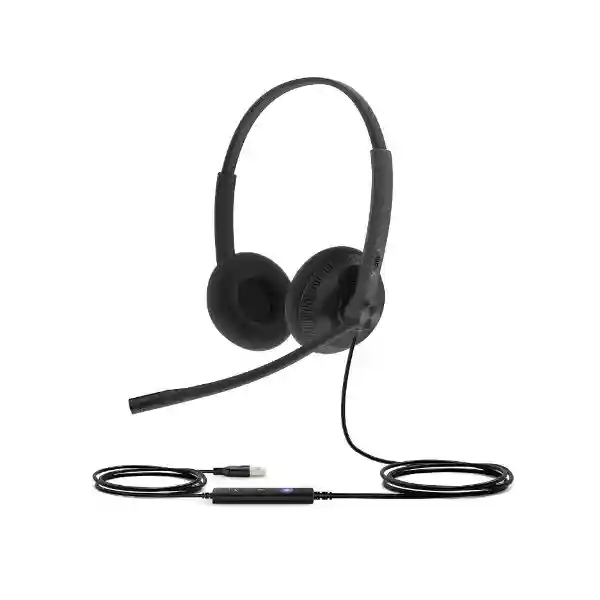
The Yealink UH34 Lite is designed for people who spend a significant part of the working day on calls and online meetings. It is a professional USB wired headset family offered in Mono and Dual configurations, with Teams and UC variants, combining straightforward USB connectivity, lightweight construction, foam ear cushions, a noise-canceling microphone, passive noise reduction and an inline controller for everyday call handling. For Tanzanian businesses, the practical value is consistency: a wired USB endpoint can be easier to standardize across call-center seats, service desks, finance teams, support desks and office users than a mixed fleet of consumer audio accessories.
FourTeck can prepare a quotation around the exact UH34 Lite variant required, user quantity, soft-client environment, Yealink phone compatibility and any wider IP telephony or collaboration requirement. Buyers should specify Mono or Dual and Teams or UC when requesting a quote because Yealink lists these as distinct product variants rather than one universal SKU.
What the Yealink UH34 Lite is built to solve
Many organizations need a headset that can be deployed repeatedly without creating a complicated accessory ecosystem. The UH34 Lite addresses that requirement with a wired USB design intended for daily office and call-center use. Yealink positions the family for long periods of voice communication and combines plug-and-play operation with software support through Yealink USB Connect and Yealink Device Management Platform or Cloud Service. That management capability matters for organizations with multiple headsets because administrators can inspect device information and manage firmware rather than treating every headset as an unmanaged personal accessory.
The Lite designation specifically refers to foam ear cushions, while the standard UH34 uses leather ear cushions. Buyers can choose a monaural model when users need to keep one ear open to the surrounding workplace or a binaural model when greater acoustic focus is preferred. Teams and UC variants are also listed by Yealink, so procurement teams should align the selected version with the organization’s collaboration platform and call-control expectations. Where a user connects to an uncertified communications platform, Yealink notes that basic audio operation may still be available even when advanced call-control integration is not.
For a broader procurement view, the FourTeck Tanzania technology shop helps buyers consider headsets alongside IP phones, IP PBX, conferencing equipment and workplace endpoints, while the FourTeck Tanzania solutions overview explains how voice and collaboration products fit into the wider IT environment. This is useful when the UH34 Lite is part of a new call-center seat, a telephony refresh or a Microsoft Teams standardization rather than a stand-alone accessory purchase.
Verified UH34 Lite capabilities that matter in business use
Plug-and-play USB
The headset is designed for direct USB connection to a computer and is intended to work with soft clients without a complex setup process. Yealink also lists USB connectivity with a range of compatible Yealink IP phones, subject to model and firmware requirements.
Call-focused microphone
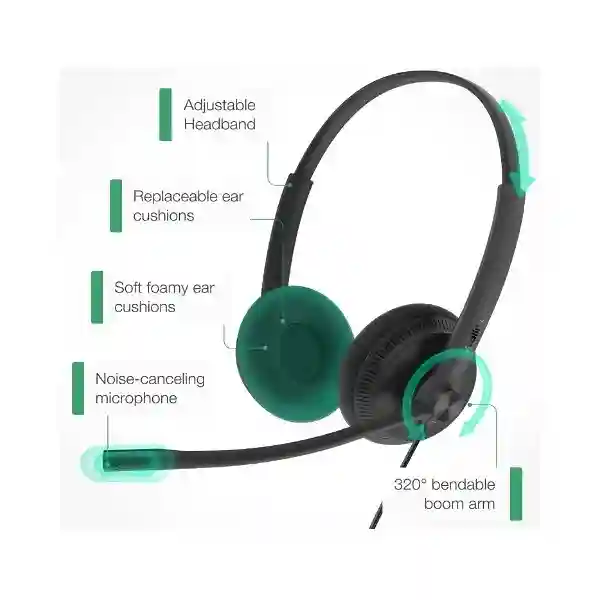
A unidirectional ECM microphone and passive noise reduction are designed to improve voice intelligibility in routine office conditions. The adjustable boom can be positioned close to the user’s mouth for a more consistent microphone distance.
Inline controls
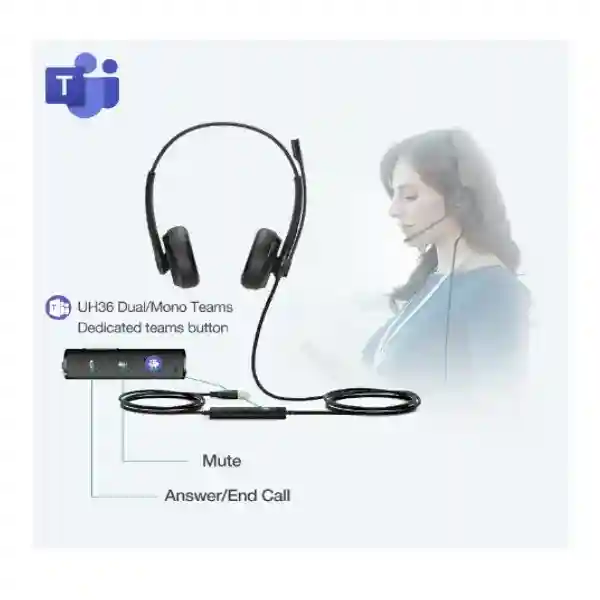
The handheld controller supports core call actions including answer, end, reject, hold, volume adjustment, microphone mute and redial functions. Actual call-control behavior can depend on the connected platform and certification status.
Lightweight options
Yealink lists the UH34 Lite Mono at 84 g and the UH34 Lite Dual at 110 g. The family is presented as an all-day professional headset, with the Lite versions using foam cushions rather than the leather cushions of the standard UH34.
Wideband audio
The family uses a 28 mm speaker with a 20 Hz–20 kHz speaker frequency response and wideband audio support. This makes the headset suitable for voice calls while also supporting general computer audio and media use.
Hearing protection
Yealink identifies Peak Block Protection, Australian G616 Protection and Daily Noise Exposure Protection among the headset family’s hearing-protection functions, supporting safer operation for users who spend long periods wearing a headset.
Yealink UH34 Lite technical specification reference
| Product family | Yealink UH34 / UH34 Lite USB wired headset |
|---|---|
| UH34 Lite variants | UH34 Lite Mono Teams, UH34 Lite Mono UC, UH34 Lite Dual Teams, UH34 Lite Dual UC |
| Cushions | Foam ear cushions on UH34 Lite |
| Weight | UH34 Lite Mono: 84 g; UH34 Lite Dual: 110 g |
| Speaker | 28 mm; 32 ohm at 1 kHz; 20 Hz–20 kHz response; wideband |
| Microphone | Unidirectional ECM; wideband; 100 Hz–10 kHz standard microphone response |
| Boom arm | 320° bendable boom arm |
| Cable lengths | 1.2 m headset to call-control unit; 0.9 m call-control unit to USB plug |
| Management | Yealink USB Connect and Yealink Device Management Platform/Cloud Service support |
| Primary use cases | Daily office communication and call-center use |
Procurement note: exact call-control behavior, connector configuration, Teams/UC designation and compatibility should be confirmed against the specific model code on the quotation. A product-family description should not be used as a substitute for selecting the required UH34 Lite variant.
Mono, Dual, Teams or UC: choosing the right UH34 Lite
Choose Mono when awareness matters
A monaural headset leaves one ear uncovered. This can suit reception desks, supervisors, retail back-office staff and operational teams who must communicate on a call while still hearing nearby colleagues or workplace announcements.
Choose Dual for concentration
A binaural headset covers both ears and can help users focus more strongly on the conversation. It can be useful for contact centers, remote support, inside sales, finance and other call-intensive roles where surrounding office sound is distracting.
Teams versus UC
Specify the user’s primary collaboration client. Yealink lists dedicated Teams and UC model designations, and the chosen version should match the organization’s intended workflow. For mixed estates, standardize one variant only after testing the required call controls.
If the headset is part of a wider voice project, review FourTeck Tanzania’s technology services and deployment support so headset selection can be coordinated with soft clients, IP phones, PBX configuration, device rollout and user support. Organizations evaluating a long-term supplier relationship can also review About FourTeck Tanzania for the broader business-technology scope.
Deployment and compatibility planning
A USB headset is simple compared with a full communications platform, but fleet deployments still benefit from planning. Start by recording the endpoint type for each user: Windows PC, Mac, Linux workstation where applicable, or a supported Yealink IP phone. Then record the soft client or collaboration platform, because audio can work even when advanced call controls do not map identically. If users are moving between desk phones and computers, test the intended workflow before placing a large order. For Yealink IP-phone deployments, firmware versions can affect USB-headset support, so IT teams should validate phone models and current firmware rather than assuming every older handset behaves the same way.
For call centers, standardization should also include physical handling. The boom should be positioned consistently, users should know how to mute correctly, and supervisors should understand how inline controls interact with the selected soft client. A small pilot can reveal whether Mono or Dual better fits the environment. Noise level, desk spacing, user preference and the need to hear colleagues all influence that decision. USB port availability should also be checked on laptops that rely heavily on docking stations or adapters.
For organizations buying many units, device management is a useful differentiator. Yealink USB Connect and its device-management platform can help administrators inspect and maintain supported headsets. Establish a simple asset process recording model, Teams or UC designation, assigned department and firmware status. This creates a cleaner support environment when the headset estate grows across departments or sites.
Regional procurement guidance for the Yealink UH34 Lite USB Headset
The following regional sections are written around different procurement, user-profile and deployment considerations rather than repeating the same location language. Availability, pricing, warranty terms, lead times and delivery scope should always be confirmed on the current quotation.
Yealink UH34 Lite USB Headset Tanzania
For organizations in Tanzania, the Yealink UH34 Lite is most relevant where voice communication is a daily operational task rather than an occasional convenience. Customer-care teams, reservations desks, internal help desks, finance departments, procurement offices, schools, clinics, NGOs, service providers and distributed businesses can use a wired USB headset to create a consistent audio standard across many seats. The product’s lightweight Mono and Dual options let buyers match the headset to the working environment: Mono can suit desks where the user still needs awareness of nearby staff, while Dual can be preferable for roles that require deeper focus during sustained calls.
Tanzania buyers should start with the application, not only the unit price. Identify whether users primarily call through Microsoft Teams, another UC client, browser-based customer systems, a Yealink IP phone or a mixture of devices. Then specify the required variant and quantity. A pilot group is particularly useful in call-heavy environments because it validates microphone positioning, comfort, USB-port availability and call-control behavior before wider rollout. Where computers are shared across shifts, organizations should also define hygiene and assignment procedures because foam cushions and boom microphones are touched frequently.
Procurement teams may also want the quotation to separate hardware from supporting services. A headset deployment can be tied to a wider IP telephony refresh, an IP PBX implementation, a Microsoft Teams adoption project or a new contact-center seating plan. In those cases, include user count, branch count, endpoint type, current phone models, soft-client platform and whether staging or configuration assistance is required. This gives the supplier enough context to confirm the correct Teams or UC model and avoid mixing variants unintentionally.
For national rollouts, consider spares and standardization from the beginning. Keeping one approved Mono model and one approved Dual model can simplify replacement and user support. Record exact model codes on purchase orders, and confirm warranty, lead time and delivery terms for the current batch rather than assuming they remain constant. Tanzania organizations can use the FourTeck Tanzania shop and services pages linked above to coordinate headset purchasing with IP phones, PBX, conferencing and workplace IT requirements.
Yealink UH34 Lite USB Headset Dar es Salaam
In Dar es Salaam, the UH34 Lite fits especially well in high-volume commercial environments where teams handle customer calls, supplier coordination, bookings, logistics, finance queries and remote meetings throughout the day. Businesses in busy offices often face a practical audio problem: open-plan conversation and movement can make laptop microphones inconsistent, while consumer earbuds may not provide repeatable microphone placement. A dedicated wired boom headset gives every user a more defined speaking position and avoids dependence on charging cycles or Bluetooth pairing.
Call centers and service desks should compare Mono and Dual deliberately. In an operation where supervisors speak to agents across the floor, Mono may preserve useful awareness. In a denser office where concentration is harder, Dual can help isolate the user from some ambient sound through the ear coverage and passive noise reduction. The correct choice depends on seating layout and operating style rather than a simple assumption that one configuration is always better. Trialing both with representative users can produce a stronger standard than choosing from a specification sheet alone.
Dar es Salaam procurement teams should also document workstation connectivity. Modern laptops may have limited USB-A ports or rely on docks, while some corporate desks combine an IP phone with a PC. Confirm the exact connector and endpoint path for the chosen model. If users connect to compatible Yealink IP phones, verify handset model and firmware level as part of the quote request. For PC users, test call-control buttons with the organization’s soft client, especially when the environment is not one of the platform combinations specifically certified by the manufacturer.
For multi-floor offices or branches coordinated from Dar es Salaam, manage the headset as part of endpoint policy. Keep spare units, record Teams versus UC designation, maintain firmware where appropriate and provide a short user guide on boom position, mute status and inline controls. When requesting commercial terms, specify quantity, delivery destination, required date, user roles and whether the order is part of a larger telephony or collaboration project.
Yealink UH34 Lite USB Headset Mwanza
For Mwanza organizations, the UH34 Lite can support branch communications where staff need a dependable, easy-to-understand audio device for daily calls with customers, suppliers, head offices and remote colleagues. Banks, distribution businesses, education providers, healthcare administration teams, hospitality offices and regional service operations often have mixed communication workflows. A wired USB headset can reduce support complexity because users do not need to pair a wireless device or monitor battery status before joining a meeting.
When a Mwanza branch reports that calls are difficult to hear, the headset should be evaluated together with the application and network. A better microphone cannot correct a congested internet link, poor Wi-Fi, an overloaded soft client or an incorrectly configured VoIP environment. Procurement and IT teams should therefore separate endpoint quality from network quality during troubleshooting. Pilot the headset on known-good connections, compare the results with the existing device and confirm that the selected soft client recognizes the inline controls expected by users.
Branch offices can also benefit from an explicit spare policy. Headsets are high-touch devices and can be damaged by cable strain, chair wheels or repeated movement between desks. Keeping a small pool of identical spare units reduces downtime and avoids introducing a different headset each time a replacement is needed. For shared desks, assign cushions or complete units according to the organization’s hygiene policy. Document the exact model designation so replacement orders remain consistent with the original Teams or UC and Mono or Dual choice.
A good quotation request for Mwanza should include the number of users, whether they sit in open-plan or private offices, primary communications platform, computer or Yealink phone model, preferred Mono or Dual format and any rollout schedule. If the order is part of a larger branch technology refresh, include IP phone, network and collaboration requirements so compatibility questions can be reviewed together rather than after the equipment arrives.
Yealink UH34 Lite USB Headset Arusha
Arusha businesses often combine local operations with international communication, making clear voice quality important for reservations, tour operations, conference coordination, development organizations, education, professional services and regional management. The UH34 Lite can be a practical standard for staff who join frequent online meetings or handle customer calls from a desktop environment. Its wired design reduces the chance that a meeting starts with a depleted battery or a user troubleshooting Bluetooth pairing.
For hospitality, travel and service organizations, role-based selection is useful. A reservations agent who needs to stay focused on telephone or online booking conversations may prefer a Dual configuration. A supervisor who must hear both the call and the surrounding team may prefer Mono. Managers who spend part of the day in Teams meetings and part on normal computer audio can use the headset as a consistent endpoint, while administrators can maintain firmware and device information through Yealink’s supported software tools.
Arusha buyers should also consider physical desk design. The UH34 Lite has a cable path from headset to controller and from controller to USB plug, so the workstation should allow the cable to reach the computer or dock without being stretched across a walkway. Cable clips or under-desk routing can reduce snagging. When laptops are frequently removed from desks, standardizing the connection point through an approved docking arrangement may create a more predictable user experience.
For procurement, do not rely on a generic description such as “UH34 Lite” when the business requires a specific configuration. State Mono or Dual, Teams or UC, quantity and primary endpoint. Confirm the commercial quotation for current lead time, warranty and delivery scope. If the organization operates several Tanzanian branches, use the Arusha requirement as part of a consolidated headset standard so replacements, user guidance and support procedures can be shared across sites.
Yealink UH34 Lite USB Headset Dodoma
In Dodoma, the UH34 Lite can serve public-sector offices, associations, education institutions, professional organizations, administrative teams and businesses that need repeatable headset performance for meetings and voice communications. Standardization is particularly valuable where equipment is purchased through formal procurement because a clearly defined model family, user role and compatibility requirement can be documented before quotations are compared.
Tender and procurement teams should avoid specifying only a marketing name. Yealink lists four main UH34 Lite combinations across Mono or Dual and Teams or UC. The tender schedule should identify the required configuration, quantity and whether alternative variants are acceptable. If the organization uses Yealink IP phones, include handset models and firmware expectations in the technical review. If the headset is for computers, identify the supported operating environment and primary unified-communications application. This reduces ambiguity between bids that appear similar but contain different headset variants.
For large departments, technical evaluation should include a small acceptance test. Confirm microphone clarity, fit, inline mute behavior, answer/end controls and operation on the intended workstation image. Check how the headset behaves after computers resume from sleep, after soft-client updates and when users switch between meeting and telephony applications. These checks are simple but can reveal integration details that are not obvious from headline specifications.
Dodoma organizations should also define asset ownership and replacement procedures. Headsets may be assigned to named users, departments or shared workstations, and each approach has different hygiene and tracking implications. Record serial or asset identifiers when required by internal policy, retain purchase documents and confirm warranty process at the time of order. A consolidated request can combine headsets with IP phones, conferencing endpoints or other workplace technology where a broader communication upgrade is planned.
Yealink UH34 Lite USB Headset UAE
For UAE organizations, the UH34 Lite is relevant to multilingual service environments, corporate offices, call centers, hospitality operations and shared-services teams where consistent voice equipment is required across many desks. The wired USB format can be particularly useful in managed workplaces because it avoids radio-pairing policies and charging routines. Users can connect the headset to the intended workstation and begin with a predictable physical audio endpoint.
Multi-site Gulf organizations should treat variant control as part of procurement governance. If one office buys Dual Teams while another buys Mono UC under the same generic product name, support documentation and user expectations can diverge. Define an approved standard per user role and include exact model descriptions in purchase orders. A contact-center profile might specify Dual for concentration, while reception or front-office profiles may specify Mono so users remain aware of nearby activity. These role definitions make future expansions easier to quote.
When the UAE office is part of a group that also operates in Tanzania, Kenya, Uganda or other regions, align the headset specification across the organization where practical. Standardized endpoints simplify onboarding materials, spare allocation and troubleshooting. However, regional commercial terms, warranty channels and availability may differ, so each quotation should confirm the local supply conditions rather than assuming they are identical across markets.
IT teams should test the selected UH34 Lite variant with the organization’s image, docking stations, Teams or UC environment and any Yealink IP phones in use. Confirm USB-port planning on compact laptops, and avoid relying on unapproved chains of adapters for call-critical users. Where the deployment is part of a wider unified-communications project, document soft-client versions, call-control requirements and user counts so the headset is evaluated as one component of the complete communications architecture.
Yealink UH34 Lite USB Headset Uganda
Ugandan organizations can use the UH34 Lite as a practical wired endpoint for customer service, branch operations, education, NGOs, professional services and internal support teams. Where businesses operate across Kampala and regional cities, headset standardization can reduce small but recurring support problems caused by many different consumer models. The UH34 Lite family provides clearly defined Mono and Dual choices and platform-oriented Teams or UC versions, allowing procurement teams to establish role-based standards.
Before a large rollout, identify which users need environmental awareness. Branch supervisors and reception staff may benefit from Mono, while agents handling consecutive customer calls may prefer Dual. This decision should be based on workplace design and user duties. The microphone’s unidirectional pattern and boom positioning support consistent voice pickup, but organizations should still manage room noise, desk spacing and soft-client configuration to improve the complete call experience.
For distributed branch estates, consider how replacement units will be handled. Shipping a different headset each time one fails increases variability. A small central stock of the same approved variant can simplify support, while an asset register can record where each unit is assigned. If the organization uses Yealink IP phones, verify model and firmware compatibility in advance. If computers are the primary endpoint, validate inline controls in the actual UC client used by staff.
Regional projects can also coordinate communications hardware through the wider FourTeck network. Buyers comparing requirements between Tanzania and Uganda can reference FourTeck’s regional presence while keeping the commercial scope for each destination clearly separated. Provide quantities by site, user role, preferred variant and target delivery schedule so the quotation can address the real deployment rather than only a single-unit price.
Yealink UH34 Lite USB Headset Kampala
Kampala offices often combine head-office staff, support teams, sales desks and remote meeting activity in the same workplace. The UH34 Lite can serve as a standardized audio endpoint for these mixed roles, especially where IT teams want a device that does not depend on wireless pairing. The inline controller gives users direct access to everyday call functions, while the lightweight frame and foam cushions are intended for prolonged professional use.
For a Kampala contact center, headset selection should be connected to workforce layout. Seat density, shift duration, supervisor interaction and background conversation all influence whether Mono or Dual is the better default. A Dual model may increase focus for agents, while Mono can remain valuable for teams that rely heavily on floor communication. Rather than choosing one for every role, define a base standard and a controlled exception process.
IT administrators should also include software maintenance in the endpoint plan. Yealink provides USB Connect and device-management capabilities that can help with information and firmware handling. For organizations with many users, central visibility is preferable to troubleshooting each headset as an unknown accessory. Test new firmware or client updates with a small group before applying changes broadly, particularly when call-control behavior is business critical.
Kampala procurement requests should list exact quantities, variant preference, delivery site, user platform and whether the headset must work with Yealink phones, PCs or both. Include any requirement for staging, asset labeling or deployment support. If the organization operates across East Africa, maintain a common technical specification while allowing each country quotation to confirm local commercial terms. This approach provides consistency without making unsupported assumptions about regional stock or delivery timing.
Yealink UH34 Lite USB Headset Arua
For organizations in Arua, a robust headset standard can be valuable where local teams depend on remote coordination with Kampala, neighboring countries, suppliers or international offices. NGOs, field-service organizations, education teams, healthcare administration and regional businesses may use computer-based calling to reduce travel and keep dispersed staff connected. The UH34 Lite’s wired USB approach is straightforward for fixed desks and removes the need to keep a wireless headset charged.
Arua deployments should pay particular attention to the complete workstation. Check whether the computer has an accessible USB port, whether a dock is used and whether the headset cable can be routed safely. If power or network interruptions are common in the broader environment, remember that the headset itself cannot solve those dependencies. UPS planning for networking equipment, stable internet connectivity and a reliable PC remain part of the call-quality chain.
Organizations with staff moving between shared desks should define how headsets are assigned. Personal assignment can improve hygiene and reduce cable wear from repeated plugging and unplugging, while shared equipment may require cleaning processes and clearer asset tracking. Foam cushions are replaceable components in the wider UH34 accessory ecosystem, but exact accessory requirements should be confirmed before purchase rather than assumed.
When requesting a quotation for Arua, include the number of users, department, call platform, Mono or Dual preference and target deployment date. If the requirement supports field operations, specify whether headsets remain at a fixed office or are carried with laptops, because cable management and storage become more important for mobile staff. For multi-site organizations, place the Arua quantity within a consolidated bill of materials so the same approved variant can be maintained across the wider estate.
Yealink UH34 Lite USB Headset Mbarara
Mbarara businesses and institutions can use the UH34 Lite for customer-facing and internal communications where staff spend long periods on a computer or Yealink phone. Typical user groups include support teams, university administration, finance, sales, healthcare administration, branch operations and professional services. The main benefit of a standardized wired headset is operational predictability: users know where the controls are, IT can document one connection method and replacements can match the approved model.
For training and education environments, Mono and Dual choices can support different roles. An administrator who answers calls while interacting with colleagues may need Mono, while a remote-learning coordinator or support agent may prefer Dual. Avoid deciding purely from price. Comfort, surrounding noise and the need for situational awareness have a direct impact on whether users actually keep the headset on during calls.
If Mbarara offices use softphones over business internet, test the full path before attributing every audio problem to the headset. Packet loss, Wi-Fi congestion, overloaded PCs and incorrect audio-device selection can all affect call quality. The UH34 Lite provides the local microphone and speaker endpoint; network and application quality remain separate dependencies. A small troubleshooting checklist should therefore include headset selection in the operating system, soft-client device settings, mute state, USB connection and network condition.
Procurement teams should request exact variant names and keep them on the purchase order. State whether Teams integration is required, whether users need Mono or Dual and whether Yealink IP-phone support is expected. Confirm current commercial conditions, warranty and delivery with the supplier. For branches connected to a larger corporate standard, use the same technical profile wherever practical and reserve exceptions for roles with genuinely different working requirements.
Yealink UH34 Lite USB Headset Gulu
In Gulu, the UH34 Lite can support regional administration, development organizations, education, healthcare, customer service and branch offices that rely on voice and video collaboration with teams elsewhere. A wired USB headset is often a sensible option for a fixed workstation because it provides a direct connection and avoids charging management. For organizations with limited local IT support, reducing the number of headset connection methods can also make troubleshooting easier.
Deployment planning should begin with the roles that place the most calls. Identify heavy users, occasional users and shared desks. Heavy users deserve a comfort test because they may wear the headset for hours. The Lite model uses foam cushions and is offered in two weights depending on Mono or Dual configuration. Users with high environmental-awareness needs may prefer Mono, while staff working in a busier room can evaluate Dual for increased focus.
For remote collaboration, the headset should be tested with the actual application and meeting workflow. Confirm microphone selection, inline mute behavior, answer/end controls and speaker volume. If the organization changes from one UC client to another, re-test the controls because platform integration may differ even when basic audio remains available. Administrators using Yealink management tools can include headset firmware and device information in their normal endpoint-maintenance process.
A Gulu quotation request should include quantities, user profiles, platform, endpoint type and any delivery or deployment constraints. If the requirement is part of a donor-funded or formally approved project, ask for clear line-item descriptions so the exact Teams or UC and Mono or Dual configuration is recorded. Multi-branch organizations can combine requirements to improve standardization, while still confirming destination-specific logistics in the final commercial proposal.
Yealink UH34 Lite USB Headset Kenya
Kenyan organizations evaluating the UH34 Lite can use the same structured selection process: define user role, choose Mono or Dual, identify Teams or UC requirements and verify the endpoint environment. The headset is well suited to business desks where reliable wired audio is preferred over a wireless accessory. Call centers, shared-services organizations, professional firms, education institutions, support teams and distributed enterprises can standardize the product family across user groups with different levels of ambient-noise exposure.
For Nairobi headquarters or national branch networks, asset consistency is especially useful. A central IT team can maintain a small number of approved headset profiles and issue them according to role. Documentation can cover USB connection, soft-client audio selection, microphone position, mute behavior and basic troubleshooting. This reduces the time spent supporting dozens of unrelated headset designs, drivers and control layouts.
Cross-border businesses operating in both Kenya and Tanzania should distinguish technical standardization from commercial assumptions. The same model may be specified in both countries, but availability, warranty route, tax treatment, lead time and delivery terms should be confirmed separately. The technology standard can still remain common, which supports shared training and simplifies spare planning across the group.
For Kenya-specific purchasing, provide the exact required model description and quantity and verify current supply through the appropriate regional channel. Organizations coordinating East African projects can also review FourTeck Kenya for country-specific enquiries. When comparing quotations, check whether they describe the same Mono or Dual and Teams or UC variant, because a generic “UH34 Lite” line item may not provide enough detail for a fair technical comparison.
Yealink UH34 Lite USB Headset Kuwait
Kuwait businesses can position the UH34 Lite as a standard wired communications headset for service desks, sales teams, corporate users and contact centers. In environments where users have assigned workstations, the USB cable provides a simple connection model with no battery lifecycle to manage. The Teams and UC options allow procurement to align the chosen model with the organization’s primary collaboration platform, while Mono and Dual formats address different workplace-awareness needs.
Call-intensive teams should evaluate comfort and workstation ergonomics. Cable routing should keep the controller accessible without leaving excess cable where chairs or drawers can catch it. The boom microphone should be positioned consistently, and users should be trained to recognize the inline mute state. These small operational practices can improve the practical experience more than buying a headset and leaving every employee to discover the controls independently.
For enterprises with centralized IT, Yealink’s device-management support can be incorporated into endpoint standards. Record the headset model, user group and firmware baseline where appropriate, and test major soft-client updates before broad deployment. If the organization uses Yealink desk phones, validate phone-model compatibility and required firmware versions during the technical review. Avoid assuming that every USB-capable phone offers identical call-control behavior.
Kuwait procurement teams should request current regional pricing, delivery and warranty details rather than relying on another market’s terms. Where the organization also operates in Tanzania, the same headset standard may be reused to simplify user training, but each regional quote should remain commercially independent. Include quantities by department and the expected platform so the supplier can confirm the right variant and any supporting requirements.
Yealink UH34 Lite USB Headset Ghana
For organizations in Ghana, the Yealink UH34 Lite can provide a controlled headset standard for office telephony, softphone calling and online meetings. Banks, professional services, customer-support operations, education, logistics and corporate teams often have users who spend enough time on calls that a dedicated boom headset is more appropriate than relying on a laptop microphone. The Lite version’s foam cushions and low headset weight are intended for extended business use.
Ghanaian buyers should map the headset to user roles before ordering. A call-center agent may need Dual, a branch supervisor may need Mono and a Teams-heavy corporate user may need a Teams-designated version. Establishing these profiles in advance prevents inconsistent purchasing and makes future additions easier. Where possible, conduct a small pilot with representative staff and gather feedback on comfort, audio clarity, awareness of colleagues and control behavior.
IT teams should include the headset in their standard support checklist. Confirm the USB connection, operating-system audio device, soft-client settings and physical mute control before escalating audio problems. Where centralized management is used, maintain device information and firmware in accordance with the organization’s change procedures. This is particularly helpful for large estates where unmanaged peripherals can otherwise become difficult to inventory.
For procurement, specify quantity, exact variant, delivery city, platform and whether the order is linked to IP phones or a wider UC deployment. Regional pricing, warranty and lead time should be validated on the current quotation. Organizations managing several African offices can keep the same technical standard while allowing country-specific commercial processes. This creates a balance between consistent user experience and realistic local procurement.
Yealink UH34 Lite USB Headset Nigeria
Nigeria has many large service, finance, technology and customer-contact environments where headset standardization can have an outsized operational effect. The UH34 Lite offers a professional wired USB approach for teams that prefer a direct connection and want to avoid the charging and pairing requirements of wireless models. For large offices, the ability to define Mono and Dual user profiles is useful because not every employee works in the same acoustic environment.
A contact-center deployment should assess density, shift pattern and supervisor interaction. Dual units may suit agents who need greater concentration, while Mono can remain useful for supervisors and team members who must remain aware of nearby conversations. The unidirectional boom microphone helps establish a consistent speaking position, but good call quality still depends on network performance, application configuration and workplace noise. Organizations should test the complete system rather than treating the headset as the only audio variable.
For large quantities, procurement accuracy becomes critical. Record the full variant name, not only “UH34 Lite,” and confirm that quotations refer to the same Teams or UC and Mono or Dual model. Establish a spare ratio based on the business’s own risk tolerance and replacement process. If the headset is deployed across several cities, centralize technical standards while allowing regional teams to report local logistics and support needs.
IT operations can incorporate supported Yealink device-management tools into the endpoint process, especially for firmware and inventory visibility. Test client updates with a representative group, document known-good settings and train users on mute and control functions. For organizations that also operate in Tanzania, keeping one common headset family can simplify shared training materials and remote support, while country-specific quotations continue to confirm local commercial conditions.
Yealink UH34 Lite USB Headset Seychelles
For Seychelles organizations, the UH34 Lite is a practical option for hospitality administration, reservations, government offices, professional services, education and businesses that depend on clear remote communication. Island operations frequently coordinate with suppliers, guests, regional offices and international partners, so a dedicated headset can provide more consistent microphone placement than relying on open laptop audio in shared offices.
Hospitality and reservations teams should evaluate Mono versus Dual according to the role. A reservation agent handling back-to-back calls may value a Dual headset for focus, while a front-office coordinator who must also hear nearby colleagues may prefer Mono. Teams and UC versions should be aligned with the platform in use. If multiple properties or offices are involved, standardize the chosen model to simplify replacement and onboarding.
Because regional logistics can affect replacement speed, buyers may place greater emphasis on spare planning. A small set of identical spare units can reduce downtime when a cable or headset is damaged. Store spares in a controlled location and keep model labels visible so the replacement matches the original platform designation. For shared-use environments, include cleaning and cushion-handling procedures in the operating policy.
A Seychelles quotation request should specify exact quantity, destination, user role, Mono or Dual preference, Teams or UC platform and whether the headset must connect to Yealink IP phones as well as PCs. Confirm current shipping, warranty and lead-time terms on the quotation rather than assuming another market’s conditions apply. If the purchase forms part of a wider communications modernization project, include the associated phone, PBX or collaboration requirements so the headset can be reviewed in the correct context.
Yealink UH34 Lite USB Headset Uganda regional rollout note
For Uganda-wide rollouts that include Kampala, Arua, Mbarara, Gulu and other cities, the strongest purchasing model is to separate technical standardization from site logistics. Define the approved UH34 Lite variants centrally, then collect quantities, user roles and endpoint details by location. This approach prevents each branch from selecting a different model based on short-term availability and makes future replacements easier to manage.
A national standard can include one Mono profile for reception, supervisors and coordination roles, plus one Dual profile for contact-center, finance and support users who need greater focus. Decide whether Teams or UC is the default and document any exceptions. If Yealink IP phones are present, maintain a compatibility list that records phone model and firmware. For PC deployments, standardize the soft-client audio configuration and test inline controls before rollout.
Central IT should also determine how firmware and replacements are managed. Yealink’s supported management tools can help administrators inspect device information and maintain firmware, while a spare pool can reduce interruption when a headset is physically damaged. For branch offices, ship clearly labeled variants and keep purchase records so local staff do not substitute an apparently similar but different model during replacement.
Organizations coordinating Uganda with Tanzania or Kenya can maintain a shared regional headset policy while requesting country-specific commercial proposals. FourTeck’s regional ecosystem can support these discussions, including FourTeck Uganda for Uganda-specific project enquiries. Always confirm price, stock, warranty, delivery and service terms on the current quotation rather than inferring them from another location.
Yealink UH34 Lite USB Headset Tanzania multi-site standardization
For Tanzanian organizations with offices in Dar es Salaam, Mwanza, Arusha, Dodoma and additional locations, a multi-site headset standard can reduce support cost and user confusion. Rather than allowing every branch to buy whichever USB headset is available locally, define approved UH34 Lite profiles and a consistent replacement process. The policy can distinguish Mono users from Dual users and state the organization’s default Teams or UC version.
The technical standard should include more than the product name. Record the expected connection method, supported endpoint classes, soft-client environment, call-control expectations and any Yealink IP phone models in use. Add a short acceptance test covering microphone pickup, speaker output, mute, volume and answer/end behavior. This turns a small accessory into a managed endpoint with repeatable support outcomes.
From a procurement perspective, aggregate demand where practical. A consolidated annual or project quantity can help the organization plan spares and reduce the risk of variant drift between branches. However, do not treat a forecast as a guarantee of stock or delivery timing. Each commercial order should still confirm current availability, warranty, pricing and delivery scope. Keep exact model descriptions on purchase documents and receiving records.
User training can remain simple: show correct boom placement, how to identify mute status, how to set the headset as the selected audio device and how to report a fault. For shared desks, add hygiene procedures. For managers and mobile staff, decide whether a wired headset remains the best fit or whether a different Yealink product class is more suitable. Standardization should simplify the environment without forcing one device onto roles that genuinely require another form factor.
Best-fit business use cases
Contact centers
Standardized wired headsets for agents, with Mono or Dual selected according to floor communication and concentration requirements.
Help desks
A predictable USB endpoint for IT support and customer service staff who switch frequently between calls, tickets and remote sessions.
Hybrid offices
Useful for Teams and UC users who need a dedicated microphone and speaker path at a fixed desk without wireless charging routines.
IP phone users
Suitable for supported Yealink phone environments when model and firmware compatibility are verified as part of deployment planning.
Quotation checklist for Yealink UH34 Lite
Yealink UH34 Lite frequently asked questions
What is the difference between UH34 and UH34 Lite?
Yealink distinguishes them primarily by ear cushions: UH34 uses leather ear cushions, while UH34 Lite uses foam ear cushions. Both are part of the professional USB wired headset family and are available in Mono and Dual configurations.
Is the UH34 Lite available in Mono and Dual?
Yes. Yealink lists UH34 Lite Mono and UH34 Lite Dual versions. Mono leaves one ear open for greater workplace awareness, while Dual covers both ears and can suit users who want more concentration during calls.
Does Yealink offer Teams and UC versions?
Yes. The UH34 Lite family is listed in Teams and UC model variants. Buyers should specify the intended platform and exact required model when requesting a quotation rather than assuming all versions have identical integration behavior.
How heavy is the UH34 Lite?
Yealink lists the UH34 Lite Mono at 84 g and the UH34 Lite Dual at 110 g. Weight is one reason the product is positioned for extended professional use.
Can I use the UH34 Lite with a Yealink IP phone?
Yealink documents USB compatibility with a range of its IP phones, with firmware conditions for some models. Confirm the exact phone model and firmware before ordering for phone-connected use.
Does it have a noise-canceling microphone?
Yealink specifies a unidirectional ECM microphone and describes the family as having a noise-canceling microphone plus passive noise cancellation. The actual call experience will still depend on room noise, microphone position, the soft client and network conditions.
Can the headset be centrally managed?
Yealink supports the family with Yealink USB Connect and Yealink Device Management Platform or Cloud Service for device information and firmware-management workflows. This is useful for organizations deploying many supported units.
What should I include in a Tanzania quotation request?
Include quantity, Mono or Dual preference, Teams or UC requirement, user platform, endpoint type, delivery location and any rollout or support needs. If the headset will connect to Yealink phones, also provide the phone models so compatibility can be reviewed.
Decision recap
Choose the Yealink UH34 Lite when the requirement is a professional, lightweight wired USB headset for routine office, contact-center or unified-communications use. Select Mono for users who need greater awareness of nearby activity and Dual for users who benefit from covering both ears. Specify Teams or UC according to the primary communication environment, and verify exact endpoint compatibility before large-scale purchasing.
For a clean procurement record, request the exact model variant, quantity, commercial warranty terms and delivery scope. If the headset is part of a wider telephony or collaboration project, include IP phones, PBX, soft-client and network context so the complete user experience can be considered rather than treating the headset as an isolated accessory.
Plan your Yealink headset rollout with FourTeck Tanzania
Share your user count, preferred Mono or Dual configuration, Teams or UC platform, computer or Yealink phone environment and delivery location. FourTeck can use these details to prepare a clearer quotation and help reduce variant or compatibility mistakes before deployment.
For organizations planning a broader workplace-communications refresh, the same discussion can include IP phones, IP PBX, conferencing equipment and supporting IT services so the headset standard fits the wider voice environment.



Reviews
There are no reviews yet.