
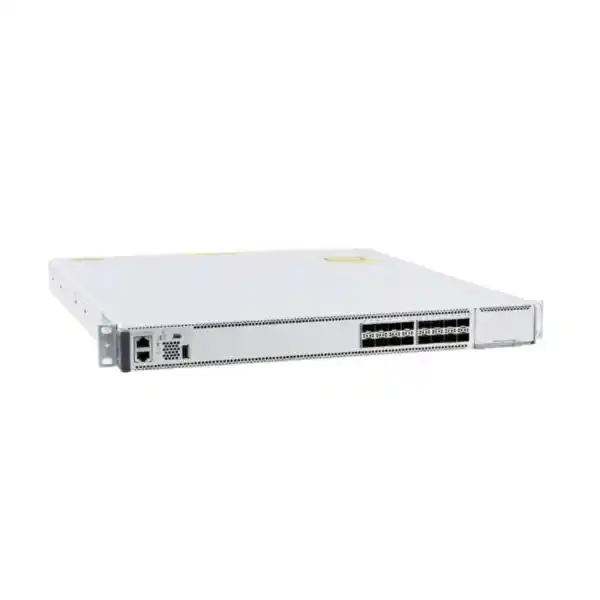
Cisco Catalyst C9500-16X Network Switch
The Cisco Catalyst C9500-16X is a 1RU enterprise core and aggregation switch built around sixteen native 1/10 Gigabit Ethernet SFP/SFP+ ports, with optional expansion through either an eight-port 1/10GbE network module or a two-port 40GbE QSFP+ network module. It is designed for organizations that need fiber-based Layer 2 and Layer 3 switching, resilient campus-core architecture, advanced routing, network segmentation, encryption and Cisco IOS XE operational capabilities in a fixed-form-factor platform.
Lifecycle notice for buyers in Tanzania
Cisco has ended sale of the C9500-16X. Cisco’s published lifecycle schedule lists April 30, 2026 as the end-of-sale date and July 30, 2026 as the last ship date. The same notice lists April 30, 2027 as the end of software maintenance releases, July 29, 2030 as the last date for service-contract renewal, and April 30, 2031 as the last date of support, subject to the terms of an active eligible support contract. This means the C9500-16X should now be evaluated mainly for existing-estate expansion, spares strategy, replacement planning, migration projects or specifically sourced legacy requirements rather than as the default choice for a brand-new long-life core design. Cisco identifies the C9500-24Y4C as the replacement product for the affected C9500-16X hardware part numbers. Availability, support entitlement, licensing and condition should therefore be verified before purchase.
Where the C9500-16X fits
The C9500-16X is aimed at enterprise campus core and aggregation roles where dense copper access switching is not required and the network is built around fiber uplinks, distribution layers, routed links and high-speed server or infrastructure connections. Its sixteen SFP/SFP+ interfaces can operate at 1GbE or 10GbE, allowing a network team to mix compatible optics and link speeds according to the design. The platform is based on Cisco’s UADP 2.0 architecture and runs Cisco IOS XE, giving it a familiar operational model for organizations already standardized on Cisco Catalyst infrastructure.
In a typical Tanzanian enterprise deployment, the practical question is not simply whether the switch is powerful enough. Buyers should consider the age and lifecycle of the wider network, the optics already installed, software and license requirements, redundancy objectives, available rack power, environmental conditions, support-contract status and the expected remaining life of the solution. A C9500-16X can still make sense when an organization must match an installed Catalyst 9500 environment, retain a tested configuration, replace like-for-like equipment, maintain a StackWise Virtual design, or add capacity to a supported legacy architecture. For greenfield projects, however, the end-of-sale status makes migration planning and successor-platform evaluation part of the buying decision from the start.
Key technical specifications
| Model | Cisco Catalyst C9500-16X |
|---|---|
| Primary interfaces | 16 × 1/10 Gigabit Ethernet SFP/SFP+ |
| Optional network modules | C9500-NM-8X: 8 × 1/10GbE SFP/SFP+; C9500-NM-2Q: 2 × 40GbE QSFP+ |
| Switching capacity | Up to 480 Gbps |
| Forwarding rate | Up to 360 Mpps |
| ASIC | Cisco UADP 2.0 |
| System memory | 16 GB DRAM and 16 GB flash |
| MAC address scale | Up to 64,000, subject to platform templates and configuration |
| IPv4 route scale | Up to 64,000 indirect routes; host-route scale depends on template and configuration |
| Rack size | 1 rack unit |
| Weight | 23.6 lb (10.7 kg) with two power supplies and built-in fan configuration as specified by Cisco |
| Dimensions | 1.73 × 17.5 × 21.52 in. (4.39 × 44.45 × 54.66 cm) |
| AC input range | 90 to 264 VAC for the applicable AC power-supply configuration |
| Operating temperature | 0°C to 40°C up to 10,000 ft under Cisco’s stated operating conditions; deployment design should account for altitude, airflow and room cooling |
Specifications can vary by software release, license, SDM template, transceiver choice and installed network module. Confirm the exact bill of materials and software compatibility for the intended deployment before ordering replacement or expansion equipment.
16-port 10GbE fiber connectivity with modular uplink choices
The defining characteristic of the C9500-16X is its sixteen native SFP/SFP+ interfaces. Each supports 1GbE or 10GbE operation with appropriate Cisco-supported transceivers and cabling. This makes the platform suitable for fiber-centric aggregation environments where links arrive from distribution switches, building blocks, server infrastructure, security appliances or routed edge devices. Because the ports are not fixed copper RJ45 interfaces, the optical design must be planned together with the switch. Fiber type, reach, connector type, wavelength, supported transceiver model and patching infrastructure are part of the solution rather than afterthoughts.
For expansion, the C9500-16X supports two optional network-module families. The C9500-NM-8X adds eight 1/10GbE SFP/SFP+ interfaces, allowing a standalone switch to reach up to twenty-four 1/10GbE ports. The C9500-NM-2Q provides two 40GbE QSFP+ interfaces for designs that need higher-speed uplinks or StackWise Virtual connectivity. Cisco’s lifecycle notice also covers these two network modules, so buyers should not assume they remain normally orderable simply because a chassis is already installed. When maintaining an existing network, verify the exact module already fitted, whether a spare is required, and whether the intended software release supports the planned use of those module ports.
This modular approach is useful when the installed estate was designed around a predictable 10GbE core but still needs a choice between more 10GbE density and a smaller number of 40GbE links. It is less attractive for a new design that expects rapid growth into 25GbE, 100GbE or beyond. That distinction is important in lifecycle planning: replacing a failed C9500-16X like-for-like can preserve operational consistency, while expanding a new campus around the same port-speed ceiling may create an avoidable migration step later.
Good fit for
- Like-for-like replacement in an installed C9500-16X environment.
- Existing 1/10GbE fiber aggregation designs with known optics and topology.
- Campus core or distribution roles where Cisco IOS XE consistency is required.
- Legacy expansion where software, licensing and support status are already validated.
- Migration projects that need a controlled transition period before moving to a newer platform.
Reconsider for
- Brand-new long-life cores where procurement runway after 2026 matters.
- Projects that require native 25GbE or 100GbE access/uplinks.
- Deployments with no existing C9500-16X operational dependency.
- Designs requiring many years of new feature development after software-maintenance end.
- Purchases where condition, entitlement, serial ownership or licensing cannot be independently verified.
Core performance for established enterprise designs
Cisco specifies the C9500-16X at up to 480 Gbps of switching capacity and up to 360 million packets per second of forwarding performance. Those figures place the switch comfortably within the needs of many established 10GbE campus-core and aggregation designs, particularly when the traffic pattern is dominated by east-west or north-south flows that fit within the platform’s port mix. Performance planning should still be based on the actual topology, oversubscription, routing features, ACL use, telemetry, multicast requirements and resiliency design rather than a single headline figure.
The UADP 2.0 forwarding architecture supports configurable hardware resource templates so that a network can emphasize different forwarding-table requirements. Cisco documents substantial Layer 2 and Layer 3 scale for the platform, including up to 64,000 MAC addresses and routing-table capacities that vary by template and function. This flexibility matters in larger enterprises because a campus core may need to balance endpoint scale, route scale, access-control entries, multicast, NAT, policy and telemetry. The correct template should be chosen deliberately, tested in the intended IOS XE release and documented as part of the deployment standard.
The switch includes 16 GB of DRAM and 16 GB of flash according to Cisco’s current Catalyst 9500 data sheet. From an operational perspective, this supports the IOS XE software platform and its management model, but buyers should not interpret memory figures alone as an indicator of application capacity. Software-image requirements, feature compatibility and upgrade paths must be checked against the exact release that will be used in production. Since the C9500-16X is already past end of sale and is approaching the end of software maintenance releases in Cisco’s published timeline, software-version strategy is now a lifecycle-control issue as much as a feature decision.
High availability with StackWise Virtual
The Catalyst 9500 family supports Cisco StackWise Virtual, and Cisco’s configuration guidance specifically lists the C9500-16X as a supported model. StackWise Virtual allows two physical switches to operate as a single logical system for key control-plane and forwarding functions, simplifying the way downstream devices connect to a resilient pair. Multichassis EtherChannel can span the two members, reducing dependence on classic spanning-tree failover for many dual-attached connections and providing a cleaner high-availability architecture for core and distribution environments.
For the C9500-16X, Cisco documentation supports StackWise Virtual links using 10GbE or 40GbE connections, depending on the selected ports and module. Current configuration guidance notes that the C9500-16X can establish StackWise Virtual Links and dual-active-detection links using fixed downlink ports and supported network-module ports. Operational teams should still follow the restrictions for the specific IOS XE release, because support details have evolved across releases. Two members in a virtual pair should be kept at compatible software, license and configuration levels, and the physical links used for the virtual domain should be treated as critical infrastructure.
High availability also depends on power and cooling. Cisco states that Catalyst 9500 switches support dual 1+1 redundant power supplies, although a switch can ship with a single power supply depending on the configuration. If a deployment requires power redundancy, the second compatible power supply, separate upstream power path and suitable rack-power design must be included in the bill of materials. The C9500-16X uses field-replaceable fans with front-to-back airflow. In data rooms where cooling is limited or ambient temperatures can rise, airflow direction, rack spacing, dust management, UPS capacity and generator-backed continuity should be planned as part of the switch deployment rather than assumed.
Routing, segmentation and campus services
The C9500-16X is more than a high-speed Layer 2 switch. The Catalyst 9500 platform is positioned for enterprise core and aggregation use and supports a broad set of Layer 3 functions under Cisco IOS XE. Cisco lists routing protocol support including OSPF, EIGRP, IS-IS and BGP, along with IPv4, IPv6 and multicast capabilities. The exact protocol and advanced feature set available to an organization depends on the network license tier and software release, so the intended control-plane design should be mapped to licensing before a replacement or expansion unit is acquired.
Network segmentation is particularly important in campus cores that serve offices, guest networks, voice, Wi-Fi, surveillance, data-center access, operational technology or partner connections. The platform supports VRF-based separation and Cisco security and policy features that can be used to keep traffic domains distinct. In more automated campus environments, Catalyst 9500 capabilities can participate in Cisco Software-Defined Access architectures, but these designs require careful alignment of software, licenses, controllers and the rest of the access network. A buyer maintaining a legacy C9500-16X should verify whether the current deployment uses traditional VLAN and routing design, policy-driven segmentation or an SD-Access fabric, because that affects replacement testing and migration complexity.
Quality of Service is another practical consideration. Cisco documents Modular QoS CLI, priority queuing, class-aware queuing, policing, shaping and hierarchical QoS capabilities for Catalyst 9500 models. These functions can help protect latency-sensitive applications, voice, video and critical business traffic when links are congested. The value comes from a correct end-to-end QoS policy rather than from switch capability alone. Trust boundaries, marking, queue allocation and WAN handoff behavior should be consistent across the campus and upstream services.
Security capabilities to protect the switching infrastructure
Cisco documents enterprise security functions across the Catalyst 9500 family, including Secure Boot, image signing, the Cisco Trust Anchor Module, access-control capabilities and 256-bit AES-GCM MACsec support. MACsec can protect Ethernet traffic on supported links by encrypting frames between compatible endpoints. For organizations connecting campus buildings, secure zones or other critical network segments, link-layer encryption can reduce the exposure of traffic traversing physical fiber paths. Successful deployment requires compatible peers, correct key management, software support and attention to operational visibility.
The value of these controls is strongest when they form part of a broader hardening standard. Administrative access should be restricted, management traffic segmented, AAA integrated where appropriate, unused services disabled, configuration backups protected and software vulnerabilities tracked against Cisco advisories. Because the C9500-16X is in its lifecycle wind-down, vulnerability management needs an explicit timeline. Cisco’s published notice lists planned vulnerability and security support through April 30, 2031, but software-maintenance milestones and contract entitlement remain separate considerations. Security planning should therefore include both near-term patch management and the date by which the platform should be replaced.
Used or secondary-market equipment deserves additional scrutiny. Buyers should validate the origin and condition of the unit, confirm that serial and support information are legitimate, ensure that licensing can be used lawfully in the intended environment, erase inherited configurations, reset credentials and perform a controlled software-installation process before production deployment. A low acquisition cost does not compensate for unclear entitlement or an inability to obtain required software and support.
Cisco IOS XE operations, automation and visibility
The C9500-16X runs Cisco IOS XE, which gives network teams a modern operating environment with model-driven programmability, telemetry and automation capabilities alongside the familiar Cisco switching and routing command structure. Cisco highlights support for model-driven interfaces, streaming telemetry and on-box programmability across the Catalyst 9500 platform. These capabilities can help organizations move away from purely manual configuration toward repeatable provisioning, compliance checks, performance monitoring and integration with network-management platforms.
For an installed C9500-16X estate, automation can be especially useful during lifecycle transition. Teams can collect inventory, interface utilization, routing state, optical diagnostics and configuration data to determine whether the replacement really needs the same port density and speed. This prevents a simple like-for-like procurement habit from dictating the future architecture. A migration project may discover that some 10GbE links can be consolidated, while other links should move to 25GbE or 100GbE on a successor platform. Telemetry and historical utilization provide evidence for that decision.
Licensing should be reviewed at the same time. Cisco documents Network Essentials and Network Advantage tiers, and current Catalyst 9500 licensing information also describes unified subscription options and Cisco DNA licensing for supported combinations. Essentials provides foundational Layer 2/Layer 3 switching, automation, visibility and security capabilities, while Advantage adds more advanced routing, segmentation, multicast, scale and security functions. Do not assume that a replacement chassis automatically carries the same software rights as an existing unit. The hardware part number, software subscription, Smart Account state and intended feature set should be verified together.
Planning optics and fiber for a Tanzania deployment
A fiber switch is only one component of the link budget. Before deploying or replacing the C9500-16X, document every connected circuit: speed, fiber type, distance, connector, optical module, patch panel path and remote endpoint. Existing 1GbE links may use different optics from 10GbE links, and 40GbE uplinks introduce their own QSFP+ requirements. Compatibility should be checked against Cisco’s transceiver guidance for the intended IOS XE release rather than assumed from connector appearance alone.
For multi-building campuses, fiber condition can have as much impact on reliability as switch hardware. Dirty connectors, poor splices, excessive loss, incorrect multimode grade or undocumented patching can create intermittent errors that are easily misdiagnosed as switch problems. During replacement work, record transmit and receive optical levels where available, inspect and clean connectors, confirm polarity and label both ends of each circuit. If a link is close to its optical budget, a migration is an opportunity to correct the cabling path instead of recreating the same weakness on new equipment.
Transceiver procurement also requires lifecycle awareness. A compatible module must meet the technical requirement, but organizations should also consider support policy, authenticity and spares availability. Critical core links deserve documented spare optics and patch leads so a failed component does not become a long outage. If a future platform will introduce 25GbE or 100GbE, choose new fiber infrastructure with that migration path in mind even when the current C9500-16X link still operates at 10GbE.
Power, cooling and physical deployment checks
The C9500-16X occupies one rack unit and Cisco lists the chassis at 23.6 lb (10.7 kg) in the specified two-power-supply configuration. The chassis depth is approximately 21.52 inches (54.66 cm), so cabinet depth, rear cable clearance and airflow space should be checked before installation. Cisco specifies front-to-back airflow for the relevant fan design. A rack containing firewalls, servers, UPS equipment or switches with the opposite airflow direction can create localized hot zones, even when the room temperature appears acceptable.
Cisco lists an AC input range of 90 to 264 VAC for the applicable supply. That broad range does not eliminate the need for stable power. In sites where utility quality is variable, use appropriately sized UPS and surge-protection architecture, separate redundant supply feeds where the design requires high availability, and verify generator transfer behavior. Redundant power supplies protect against a single power-supply failure only when the upstream power path is also designed to avoid a common failure. Two supplies connected to the same failed PDU do not provide full power-path resilience.
Cisco specifies operating conditions for Catalyst 9500 models that include 0°C to 40°C up to 10,000 feet, with related altitude conditions documented in the data sheet. Actual equipment-room design should maintain margin below maximum conditions. Dust, blocked filters in nearby equipment, poor hot-aisle separation and overloaded UPS systems can shorten equipment life. Before reusing an older C9500-16X, inspect the chassis, fans, power supplies and rack environment and verify that environmental alarms are included in monitoring.
Buying an end-of-sale C9500-16X: what to verify
Because the C9500-16X is no longer in Cisco’s normal sales window, procurement should start with verification rather than price comparison. Identify whether the requirement is for a base chassis, a specific Network Essentials or Network Advantage bundle, a spare unit, or a chassis with a particular network module. The model name alone does not define the full configuration. Power supplies, fan assemblies, rack accessories, optics, licenses and network modules all affect whether the unit can replace the device already in service.
For mission-critical deployments, also consider the difference between new old stock, refurbished equipment and previously deployed units. Condition affects risk, but provenance and entitlement are equally important. Any supplied configuration should be treated as untrusted until reviewed, and any previous organization’s data should be securely removed. Hardware should be inspected and tested before it becomes a production core component.
Migration path: Cisco points to the C9500-24Y4C
Cisco’s end-of-sale notice identifies the C9500-24Y4C as the replacement product for C9500-16X hardware part numbers. This is not a like-for-like port map. The C9500-24Y4C is a higher-performance Catalyst 9500 model with twenty-four 1/10/25GbE SFP28 ports and four 40/100GbE uplink ports. That difference creates an opportunity to modernize the core, but it also means the migration should be engineered rather than handled as a simple chassis swap.
Start by mapping every current C9500-16X interface and its function. Identify which links are 1GbE, which are 10GbE, whether an 8×10GbE or 2×40GbE network module is installed, and which links participate in StackWise Virtual, EtherChannel or routed adjacencies. Then decide whether the replacement should preserve those speeds initially or upgrade selected links. The C9500-24Y4C can support 25GbE on its access-facing SFP28 interfaces and 100GbE on its higher-speed ports, but optics, remote endpoints and cabling must support the target speed.
Software and feature parity must also be validated. Do not assume every command or hardware resource profile will behave identically across UADP generations and platform variants. Build a tested configuration for the successor, verify routing and segmentation features, confirm high-availability design, stage optics and licenses, and plan rollback. Where the existing C9500-16X is part of a two-switch virtual pair, the migration sequence deserves particular care to avoid turning a redundancy design into a shared outage.
A well-planned lifecycle project also uses the migration to remove technical debt. Retire unused VLANs and interfaces, review routing summaries, clean obsolete ACL entries, standardize interface descriptions, validate monitoring and update diagrams. The goal is not merely to replace a chassis but to leave the network easier to operate after the change.
C9500-16X versus the migration option
| Decision point | C9500-16X | C9500-24Y4C |
|---|---|---|
| Lifecycle position | End of sale; best evaluated for installed-base needs | Cisco-listed replacement for affected C9500-16X part numbers |
| Native lower-speed ports | 16 × 1/10GbE SFP/SFP+ | 24 × 1/10/25GbE SFP28 |
| Higher-speed options | Optional 2 × 40GbE module | 4 × 40/100GbE ports |
| Architecture | UADP 2.0 | Higher-performance Catalyst 9500 platform generation |
| Best decision lens | Compatibility with an existing legacy estate | Capacity growth and longer-term modernization |
The replacement should be selected only after confirming current Cisco ordering, software, licensing, optics and support requirements. A migration recommendation is not the same as a guarantee that one model can replace another without design changes.
Deployment scenarios
Existing campus core replacement
An organization already using a C9500-16X may need a replacement to restore redundancy after hardware failure. In this situation, a like-for-like unit can reduce immediate configuration and optics changes, provided the hardware source, software level, license rights and support position are acceptable. The replacement should be staged offline, upgraded to the intended software release, loaded with a reviewed configuration, tested with spare optics where possible and introduced through a documented maintenance procedure. The longer-term migration date should still be recorded so the emergency replacement does not silently extend the legacy platform indefinitely.
Aggregation for an established 10GbE environment
A stable network with known 10GbE fiber links may use the C9500-16X as an aggregation point for distribution switches or infrastructure devices. The switch’s native port density and optional eight-port 10GbE module can suit this design technically. The commercial decision is different now that the product is end of sale. The project should compare the cost and risk of extending the current architecture with the cost of moving the aggregation layer to a current-generation platform.
Temporary bridge during a phased migration
Large campus refreshes are often executed in phases. A C9500-16X may remain useful as an interoperability bridge while access layers, optics or building fiber are upgraded. In that role, its value is the compatibility it provides during transition rather than its long-term roadmap. Define an exit date, document which links depend on the legacy switch and avoid adding new services that make eventual retirement harder.
Lab, test or spare infrastructure
Organizations with production Catalyst 9500 environments may keep a C9500-16X for software testing, configuration validation or emergency spares. This can reduce risk when testing upgrade procedures and automation before production changes. A spare strategy should include periodic power-on testing, known-good software images, compatible optics and power supplies, configuration recovery procedures and clear ownership of support and licensing status.
Pre-deployment checklist
- Confirm the exact hardware requirement. Record the chassis product number and any required C9500-NM-8X or C9500-NM-2Q network module.
- Audit optics and cabling. Match each SFP, SFP+ or QSFP+ link to its distance, fiber type, remote endpoint and desired speed.
- Check the software plan. Validate the intended Cisco IOS XE release against platform support, features and organizational security policy.
- Review licensing. Determine whether the configuration depends on Network Essentials, Network Advantage or related subscription capabilities.
- Plan high availability. If using StackWise Virtual, document link placement, dual-active detection, software alignment and failure procedures.
- Design redundant power correctly. Include the second supported power supply and independent upstream feeds when the availability target requires them.
- Verify rack environment. Check cabinet depth, front-to-back airflow, cooling margin, dust conditions and cable-management clearance.
- Validate support status. Confirm whether the exact unit can be covered under an eligible service arrangement and how that aligns with Cisco’s lifecycle dates.
- Back up and sanitize configurations. Save the existing production configuration securely and ensure replacement hardware does not retain data from a previous deployment.
- Set the migration horizon. Define when the organization will move from the C9500-16X to a current platform, especially if this purchase is a temporary extension.
Frequently asked questions
Is the Cisco C9500-16X still a current-sale switch?
No. Cisco lists April 30, 2026 as the end-of-sale date for the C9500-16X and July 30, 2026 as the last ship date. It can still exist in installed networks and may be available through secondary, refurbished or remaining-stock channels, but availability should never be assumed. Buyers should verify source, condition, licensing and support status for the exact unit.
How many 10GbE ports does the C9500-16X provide?
The base chassis provides sixteen 1/10GbE SFP/SFP+ ports. With the optional C9500-NM-8X network module, the standalone switch can add eight more 1/10GbE ports. Cisco also offered the C9500-NM-2Q module with two 40GbE QSFP+ ports. Both network modules are included in Cisco’s end-of-sale lifecycle notice.
What is the switching capacity of the C9500-16X?
Cisco specifies up to 480 Gbps switching capacity and up to 360 Mpps forwarding performance for the C9500-16X. Actual network performance depends on topology, traffic profile, features, configuration and link design.
Does the C9500-16X support StackWise Virtual?
Yes. Cisco lists the C9500-16X as a StackWise Virtual capable model. Cisco configuration guidance supports 10GbE or 40GbE virtual links depending on the port and module design, and current guides describe use of supported fixed and network-module ports. Follow the exact restrictions for the IOS XE release in service.
Does it support redundant power supplies?
The Catalyst 9500 platform supports dual 1+1 redundant power supplies. A second supply must be included and connected to an appropriately resilient upstream power design if power redundancy is required. Verify the correct AC or DC supply model for the exact chassis configuration.
What licensing should I check?
The required license depends on the network features in use. Cisco describes Network Essentials and Network Advantage tiers, with Advantage adding advanced routing, segmentation, multicast, scale and security functions. Subscription and Smart Account requirements should be reviewed for the intended software and support model. Do not assume an existing license automatically transfers to replacement hardware.
What product does Cisco recommend as a replacement?
Cisco’s lifecycle announcement identifies the C9500-24Y4C as the replacement product for affected C9500-16X hardware part numbers. The newer model provides a different and faster port mix, so migration requires optics, cabling, configuration, licensing and high-availability review rather than a blind one-for-one swap.
Should a new network in Tanzania be designed around the C9500-16X?
For a new long-life design, the end-of-sale status is a strong reason to evaluate current-generation Cisco alternatives first. The C9500-16X is more defensible when compatibility with an installed estate is the primary requirement. The final choice should consider expected service life, port-speed growth, support horizon, optics investment, software strategy and migration cost.
Request a configuration and lifecycle review
If you need a Cisco Catalyst C9500-16X for an existing environment, prepare the current chassis product number, network-module details, software release, license tier, power-supply configuration, optic types and a short description of the role the switch performs. That information makes it possible to determine whether a like-for-like replacement is technically sensible or whether the requirement should be migrated to a current Catalyst platform.
Next step: request a technical and commercial review before ordering. Availability, condition, licensing, service eligibility, support timeline and migration options should be verified for the exact requirement. No stock level, delivery date, warranty term or local price is implied by this page.
Product summary
The Cisco Catalyst C9500-16X remains a capable enterprise 1/10GbE fiber switch for supported installed environments, offering sixteen native SFP/SFP+ ports, optional 10GbE or 40GbE expansion, up to 480 Gbps switching capacity, Cisco IOS XE, StackWise Virtual, enterprise routing, security features and redundant-power capability. Its buying context has changed, however: Cisco ended sale in 2026 and has published a support wind-down schedule through 2031. For Tanzanian organizations maintaining an existing Catalyst 9500 network, it can still serve as a controlled replacement, spare or transition platform when entitlement and compatibility are verified. For new deployments, lifecycle, higher-speed growth and Cisco’s C9500-24Y4C migration path should be evaluated before committing to the C9500-16X.

Reviews
There are no reviews yet.