
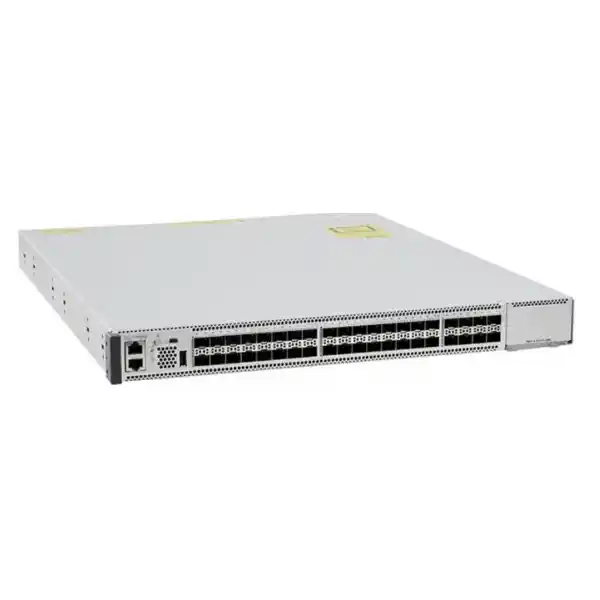
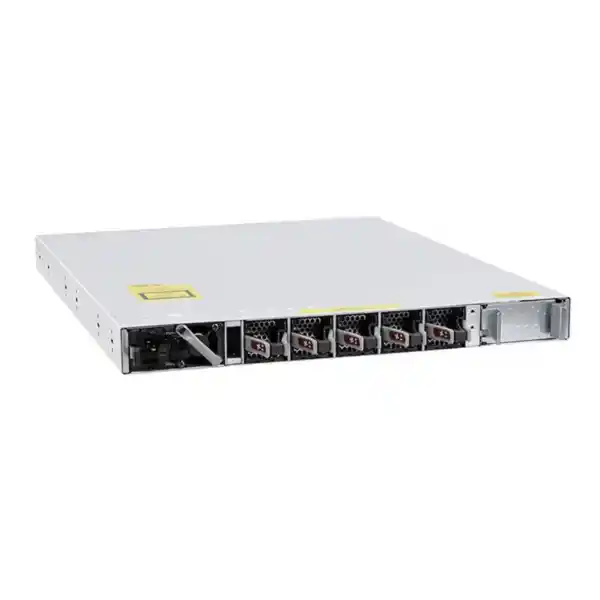
1RU fixed core / distribution platform
Cisco end-of-sale: 30 April 2024
Cisco Catalyst C9500-40X Network Switch
The Cisco Catalyst C9500-40X is a fixed enterprise core and distribution switch built around forty 1/10 Gigabit Ethernet SFP/SFP+ ports, with an optional network-module bay for either eight additional 1/10G ports or two 40G QSFP+ ports. It is most relevant today for organisations maintaining an installed Catalyst 9500 environment, matching an existing high-availability pair, standardising spares, or planning a controlled migration from an established 10G campus core.
Buying guidance for Tanzania: this model is no longer a current-production Cisco switch. Cisco ended sales on 30 April 2024 and lists 30 April 2029 as the last date of support, subject to the applicable support entitlement. For a new network design, ask for a current-platform comparison before committing to C9500-40X hardware. For an existing deployment, confirm the exact license variant, power supplies, uplink module, optics, software release, support status, and condition of the unit before purchase.
At a glance
Who should consider the C9500-40X now?
The strongest use case for the Cisco C9500-40X in 2026 is not a greenfield purchase. It is continuity. If your organisation already operates this exact platform, another C9500-40X may help maintain hardware consistency while a broader refresh is planned. A matching model can reduce operational variation in a campus core or distribution layer, preserve a known optics and cabling design, and make it easier for the network team to work with familiar interfaces and configuration patterns. That can matter in environments where replacing both sides of a redundant design at once would introduce unnecessary project risk.
The switch can also be relevant when a failed unit must be replaced like-for-like, when a laboratory needs to reproduce production behaviour, or when a branch of a larger organisation is standardised on first-generation Catalyst 9500 hardware. In these situations, the purchase decision is less about obtaining the newest feature set and more about preserving compatibility with an existing design. Even then, buyers should compare the cost and remaining service horizon of the older platform against a planned migration to a current Catalyst 9500 model.
For new campus cores, new distribution blocks, long-life infrastructure projects, and deployments expected to remain in service well beyond 2029, a current-generation alternative will usually be the more defensible direction. Cisco identifies the C9500-48Y4C as the replacement family member for the C9500-40X. That does not mean every existing configuration can be swapped one-for-one without design work: interface speeds, optics, cabling, licensing, software features, redundancy design, and power requirements still need to be checked against the target network.
Lifecycle status: important before you buy
Cisco announced end-of-life for selected Catalyst 9500 models including the C9500-40X. The last day to order the affected hardware through Cisco point-of-sale mechanisms was 30 April 2024, and the last ship date was 30 July 2024. Cisco also states that the end of software maintenance releases was 30 April 2025. Vulnerability and security support, service-contract renewal milestones, and the final support date extend further, with the published last date of support on 30 April 2029.
This lifecycle position changes the way the product should be evaluated. A quote should identify whether the equipment is new-old-stock, Cisco Certified Refurbished where available, independently refurbished, or used. It should also state what accessories are included and what support entitlement, if any, is available. Do not assume that a unit advertised as “new” is still eligible for a new Cisco service attachment, because Cisco’s published milestone for new service attachment has already passed. For critical networks, verify serial-number status and support options through the appropriate commercial channel before deploying the hardware.
Port layout and connectivity
The C9500-40X provides forty fixed 1/10 Gigabit Ethernet SFP/SFP+ ports. That port layout makes the platform suitable for fibre-heavy aggregation and core designs where many 10G links converge into a fixed 1RU switch. Depending on the optics selected and the network design, the fixed interfaces can connect distribution blocks, access-layer uplinks, servers, security appliances, routers, or other switches. The important purchasing point is that the chassis provides SFP/SFP+ interfaces rather than copper RJ45 access ports, so transceivers or compatible direct-attach solutions form part of the complete bill of materials.
Optics should be selected against the required fibre type, distance, connector standard, link speed, and Cisco compatibility matrix. Do not assume that any SFP or SFP+ module will be supported simply because it fits physically. In an existing network, record the exact transceiver part numbers already installed at both ends of each link and verify that the intended Cisco IOS XE release supports them. For new fibre runs, the design should also account for patch-panel losses, connector count, and whether the path is single-mode or multimode.
The C9500-40X additionally accepts one optional network module. Cisco documents two compatible choices: the C9500-NM-8X, which provides eight 1/10G SFP/SFP+ interfaces, and the C9500-NM-2Q, which provides two 40G QSFP+ interfaces. These are alternatives for the same network-module position, not additive modules that are installed simultaneously. A buyer matching an existing chassis should therefore confirm whether the unit is being supplied with a network module, which module it is, and whether the design requires that module for uplinks or StackWise Virtual links.
The modular uplink choice is one reason the C9500-40X can still fit established 10G networks: a deployment can preserve high-density 10G connectivity while using either additional 10G interfaces or a pair of 40G interfaces for higher-speed aggregation. However, this should also be considered a migration signal. Modern campus designs may benefit from 25G server or distribution connectivity and 40/100G uplinks, which are available on newer Catalyst 9500 models. If your traffic growth, storage replication, Wi-Fi aggregation, or inter-building backbone is already approaching 10G limits, replacing an end-of-sale switch with another identical chassis may only postpone the necessary capacity upgrade.
Physical design, rack planning and power
| Item | Verified C9500-40X detail | Buyer check |
|---|---|---|
| Rack height | 1RU | Confirm suitable rails, rack depth and service clearance. |
| Dimensions | Approx. 1.73 × 17.5 × 21.5 in. / 4.4 × 44.5 × 56.7 cm | Check cabinet depth and front/rear cable management. |
| Chassis weight | Approx. 25.75 lb / 11.68 kg with two power supplies and built-in fan configuration | Use appropriate rack support and safe handling practice. |
| Power bays | Two power-supply slots | Confirm PSU part numbers, quantity, input source and redundancy design. |
| Cooling | Field-replaceable fan architecture for the platform | Confirm airflow direction and keep rack intake/exhaust paths clear. |
A network-core purchase should include more than the switch chassis. Confirm the rack kit, power cords, installed power supplies, fan condition, network module or blank, optics, direct-attach cables where used, console requirements, and any spare components required by the operating model. For a redundant core, the two switches should be reviewed as a system: power supplies should be distributed across independent UPS or power paths where the site design provides them, and the physical cable routes for peer links and uplinks should avoid a single accidental-disconnection point.
High availability with StackWise Virtual
Cisco supports StackWise Virtual on the C9500-40X. In a StackWise Virtual design, two compatible switches operate with a virtualised control and management relationship so that downstream and upstream devices can connect redundantly across the pair. The feature is commonly used to simplify resilient campus-core and distribution designs, but it is not simply a cable-and-go function. The software release, peer-link design, Dual-Active Detection method, interface selection, and operational procedures all need to be planned and tested.
Cisco’s current configuration documentation states that StackWise Virtual links and Dual-Active Detection links on the C9500-40X can use supported interfaces including the platform’s modular uplink options, and that 10G or 40G Ethernet links can be used for StackWise Virtual on Catalyst 9500 Series models. When replacing one member of an existing pair, match the model, review software compatibility, verify the network module and transceivers, and preserve a controlled change plan. A replacement chassis should not be introduced into a production virtual pair solely because its model number matches; configuration state, software, licensing, boot variables, and physical peer-link connectivity should also be validated.
For Tanzania deployments where power events or upstream circuit interruptions are a practical concern, physical resilience matters as much as the logical high-availability feature. The two switches should ideally not share every dependency. Where the facility permits, separate power feeds, UPS paths, fibre routes, and upstream devices reduce the chance that a single fault defeats both members. The appropriate level of redundancy depends on the business impact of an outage and the facility design, so it should be treated as an architecture decision rather than an automatic checkbox.
Licensing: confirm the exact variant before ordering
The name “C9500-40X” describes the base platform, but Cisco sold multiple orderable variants around that hardware. Examples in Cisco’s lifecycle documentation include C9500-40X-E with Network Essentials, C9500-40X-A with Network Advantage, and bundle variants that include an uplink module. Because the user-facing model name alone does not tell you which license level or accessory package is attached to a particular unit, the commercial quote should identify the full part number rather than stopping at “C9500-40X.”
This distinction matters when an organisation expects advanced routing, segmentation, automation, or other IOS XE features. Feature availability can depend on the network license tier, subscription entitlement, software release, and the specific deployment architecture. A used chassis may also have a different commercial history from a new-old-stock unit. Before ordering, the network team should list the required features and protocols, then have the proposed license and software combination checked against Cisco documentation for the exact release being deployed.
If the switch will join an existing C9500-40X pair, do not assume that any C9500-40X license variant is operationally interchangeable without review. Record the license state of the installed switch, current IOS XE version, feature use, and configuration. That information gives the supplier or integrator a concrete target and reduces the chance of receiving hardware that is physically compatible but unsuitable for the intended feature set.
Common deployment scenarios
Existing campus core expansion
An organisation already running C9500-40X switches may need a matching spare, a replacement for a failed chassis, or additional capacity within the same operational standard. The benefit is consistency, but the remaining lifecycle should be weighed against the expected life of the expansion.
Distribution-layer aggregation
Forty 1/10G interfaces can aggregate fibre uplinks from access or distribution blocks in an established campus. The design should account for oversubscription, uplink capacity, redundancy, optical distances, and whether future growth requires faster 25G or 100G connectivity.
Data-centre or server aggregation
The 10G SFP+ density can suit legacy server or appliance aggregation where the existing architecture is already built around 10GbE. For new server fabrics or storage-heavy environments, compare current higher-speed platforms before extending a 10G-only design.
Migration staging
A C9500-40X can be retained during a phased refresh while a newer core is introduced, allowing services to move in controlled stages. This can reduce change scope per maintenance window, provided the temporary architecture and support horizon are documented.
Tanzania deployment considerations
A switch specification is only one part of a reliable deployment. For organisations in Tanzania, site readiness should be reviewed alongside the hardware. Start with the rack and power environment: confirm cabinet depth, earthing, UPS capacity, power distribution, airflow, ambient conditions, and safe maintenance access. If the switch is part of a critical core, calculate the effect of a power-supply or UPS-path failure rather than relying only on dual PSU bays as a guarantee of resilience.
Next, document the fibre plant. Record which links are multimode or single-mode, their approximate distances, patch-panel paths, connector types, and the optical modules on the remote devices. This is especially important for a replacement purchase, because a switch that is correct at the chassis level can still fail a migration if the wrong optics are ordered. Where multiple buildings are connected, verify whether the fibre path and transceiver selection provide the required distance and optical budget.
For internet-facing or wide-area services, keep carrier requirements separate from the campus-switch decision. The C9500-40X can participate in enterprise routing designs, but the exact handoff type, BGP or other routing requirements, public-addressing arrangement, and customer-premises equipment remain service-specific. Do not assume compatibility with a provider or a particular access circuit from the switch model alone. Obtain the carrier handoff specification and map it to the intended interface, optics, VLAN, routing, and redundancy design.
Finally, plan for operational support. Keep configuration backups, software images, license records, serial numbers, optics inventories, and a tested rollback procedure. Because the C9500-40X is already past end of sale and software-maintenance end date, organisations should maintain a documented migration path rather than treating each replacement as an indefinite extension of the platform. The closer the network gets to the 30 April 2029 last-support date, the more important it becomes to have the replacement architecture, budget, and change windows agreed in advance.
C9500-40X versus the Cisco-recommended replacement direction
Cisco’s end-of-life bulletin points C9500-40X customers toward the C9500-48Y4C family as the replacement. The newer platform provides a different interface profile: Cisco documents the C9500-48Y4C with forty-eight 1/10/25G SFP28 ports and four fixed 40/100G QSFP28 uplinks. That gives a migration project room to move beyond 10G access or aggregation links and introduces higher-speed uplinks without depending on the removable network module used by the older C9500-40X.
The replacement choice should still be driven by the network requirement rather than by model succession alone. If your existing environment uses forty 10G links and two 40G uplinks, the physical interface count may be easy to map, but the optics may not all carry forward automatically. Check supported transceivers, cabling, link distances, port-speed configuration, power, software features, and high-availability design. If the existing network uses the C9500-40X as a StackWise Virtual pair, validate the target pair design separately rather than assuming an identical configuration syntax and operational behaviour.
A migration is also an opportunity to challenge old assumptions. Some links that were historically 10G may now justify 25G. Inter-switch links that were 40G may justify 100G. Redundancy may be improved by changing fibre paths or power distribution. The replacement may also allow the organisation to simplify optics types, reduce the number of special uplink modules, or align software across a wider Catalyst estate. Those gains can make a planned refresh more valuable than a straight like-for-like replacement, especially for a network expected to serve several more years of growth.
What to verify in a quotation
Because “C9500-40X” can describe the base chassis while commercial bundles include different license and uplink combinations, a useful quote should be specific enough that the network team can validate the exact unit before purchase. Ask the supplier to state the complete product identifier and the physical contents of the shipment, not only a marketing description.
- Exact Cisco part number, including any -E, -A, -2Q or other bundle suffix.
- Condition of the unit: new-old-stock, Cisco Certified Refurbished where applicable, independently refurbished, or used.
- Installed network module, if any: C9500-NM-8X, C9500-NM-2Q, or blank.
- Power-supply part numbers and quantity; do not assume a redundant pair is included.
- Fan and airflow condition, rack-mount hardware, power cords, console accessories and other included components.
- Required SFP/SFP+/QSFP+ optics or direct-attach cables as separate bill-of-material items.
- License state and whether the proposed configuration supports the required routing, segmentation and management features.
- Current Cisco IOS XE release planned for deployment and the supportability of that release on this model.
- Serial-number and support-entitlement verification where support is required.
- Testing, return, warranty or replacement terms offered by the seller; these are seller-specific and should be written into the quote.
Migration and replacement planning checklist
If the purchase is intended to replace an existing C9500-40X, capture the current state before the maintenance window. A disciplined inventory reduces avoidable surprises and gives the implementation team a reliable rollback reference. The following checklist can be adapted to the organisation’s change-control process.
1. Record the installed hardware
Capture the full PID, serial number, network module, both power supplies, fan state, transceiver part numbers, cable types, rack position, and connected interfaces. Photograph or diagram the front and rear cabling if that is permitted by the site’s operational policy.
2. Capture software and license state
Record the IOS XE version, boot variables, license information, configuration register where relevant, and the active feature set. Export the running and startup configuration and store them in the approved configuration-backup system.
3. Map dependencies
Identify routing neighbors, port channels, VLAN trunks, first-hop redundancy, StackWise Virtual links, Dual-Active Detection, management access, monitoring, AAA, logging, time synchronisation, automation systems, and any application dependencies tied to the switch.
4. Validate optics and peer devices
Check the remote-end device, interface speed, optical module, fibre type, and link budget. For port-channel members, verify that every member is accounted for and that the cutover sequence will not create an unexpected forwarding condition.
5. Build rollback criteria
Define what constitutes a successful cutover and the conditions that trigger rollback. Include reachability, routing adjacency, application checks, redundancy state, monitoring, and performance indicators rather than relying only on interface LEDs.
6. Plan the next-generation exit
If the replacement is another C9500-40X, document when and how the environment will move to a supported current platform. Align that plan with the 2029 support horizon, budget cycles, fibre upgrades and application growth.
Why the lifecycle dates matter operationally
End of sale and end of support are different milestones. End of sale means Cisco no longer sells the affected product through its normal point-of-sale mechanisms. It does not mean every installed switch stops functioning, nor does it mean all support ends on that date. Cisco’s published timeline for the C9500-40X continues through later milestones, including the final support date in 2029 for eligible service and warranty conditions.
The important operational consequence is that the window for normal lifecycle activities narrows as the final date approaches. New service attachment is already past. Software maintenance ended in 2025, so organisations should not expect the same ongoing engineering cadence associated with a current platform. Security support remains on the published timeline through 2029, but that does not remove the need to run an appropriate supported software release and to monitor Cisco advisories relevant to the deployment.
A sensible policy is to classify the C9500-40X as a transition platform: acceptable where it is required to sustain an existing network for a defined period, but accompanied by a documented replacement plan. This avoids the common pattern in which a temporary like-for-like purchase silently resets expectations and leaves the organisation facing a rushed replacement as the last-support date approaches.
Operational readiness after installation
After installation, validate the switch as part of the network rather than as an isolated chassis. Check interface error counters, transceiver diagnostics where supported, routing and neighbor state, spanning-tree or routed-access behaviour as applicable, link aggregation, gateway redundancy, StackWise Virtual status if used, management reachability, monitoring, logging, authentication, and configuration backup. Baseline CPU, memory, interface utilisation and environmental readings so later changes can be compared against a known healthy state.
Keep spare strategy proportional to the business requirement. An organisation with a redundant pair may choose a different spare approach from a site with one critical standalone unit. Because the platform is end of sale, lead time and condition for replacement units can become less predictable over time. If the organisation intends to rely on this model until close to 2029, decide in advance whether the contingency is a shelf spare, a support contract, a rapid-sourcing arrangement, or an accelerated migration to the current platform.
Configuration governance is equally important. Maintain version-controlled backups, document approved software images, and record why any temporary workaround exists. When a switch is replaced, update network diagrams and asset records immediately. Good documentation turns a legacy platform from an opaque risk into a managed component with a clear operating boundary and replacement path.
Decision framework: replace like-for-like or modernise?
A useful purchasing decision starts by separating an emergency continuity need from a strategic network investment. If a production C9500-40X has failed and the immediate priority is restoring a known topology with minimum redesign, a correctly matched replacement can be reasonable. The team should still identify how long that replacement is expected to remain in service and whether it buys enough time to complete a planned refresh. A low purchase price alone does not make an end-of-sale platform inexpensive if the organisation later faces repeated sourcing, support, or compatibility issues.
If the requirement comes from capacity growth rather than failure, compare the proposed C9500-40X purchase against the cost of moving the affected block to a current switch. Include more than chassis price in the comparison. Account for optics that can or cannot be reused, rack and power changes, engineering effort, maintenance windows, licensing, support, staff familiarity, future interface-speed needs, and the expected service life of the new design. A current platform may cost more initially but avoid another mandatory migration near the C9500-40X last-support date.
For a redundant pair, think in terms of the pair rather than individual boxes. Replacing one failed member with another C9500-40X may preserve operational symmetry. Replacing both members with a newer platform may create a cleaner long-term state. Mixing old and new platforms inside the same redundancy design should only be done where Cisco documentation explicitly supports the intended architecture; do not infer compatibility from similar interface counts.
Also consider the organisation’s change capacity. A business with a narrow maintenance window, limited spare fibre, or complex application dependencies may prefer a staged approach: restore stability first, then migrate deliberately. Another organisation may have a scheduled refresh window and already-approved budget, making immediate modernisation the lower-risk option. The right answer depends on service impact and project constraints, not on whether the C9500-40X is technically capable of carrying the present traffic.
Whichever path is chosen, document the decision. Record why the older platform is being retained or why the migration is being accelerated, the expected retirement date, who owns the replacement plan, and which dependencies must be addressed before cutover. This turns lifecycle management into an explicit operational decision rather than an assumption embedded in the network.
Frequently asked questions
Is the Cisco C9500-40X still a current model?
No. Cisco ended sales of the C9500-40X and selected related Catalyst 9500 models on 30 April 2024. Cisco’s published lifecycle notice lists the last date of support as 30 April 2029, subject to applicable support entitlement. It should therefore be evaluated as an end-of-sale platform rather than a current-production choice.
How many ports does the C9500-40X have?
The base C9500-40X has forty fixed 1/10 Gigabit Ethernet SFP/SFP+ ports. It also supports an optional network module: either the C9500-NM-8X with eight 1/10G SFP/SFP+ ports or the C9500-NM-2Q with two 40G QSFP+ ports.
Does the C9500-40X support StackWise Virtual?
Yes. Cisco documents StackWise Virtual support for the C9500-40X. The exact design should be validated against the IOS XE release, peer-link and Dual-Active Detection requirements, interface selection, and the configuration of the partner switch.
Are power supplies included?
Do not assume they are. Cisco has multiple orderable and spare configurations, and secondary-market or refurbished listings can vary widely. Ask the quotation to state the exact PSU part number and quantity, as well as power cords and any redundancy arrangement.
What is the difference between C9500-40X, C9500-40X-E and C9500-40X-A?
C9500-40X identifies the base hardware family. Cisco sold variants such as C9500-40X-E with Network Essentials and C9500-40X-A with Network Advantage, along with bundle versions. The correct choice depends on the required features and the license state of the deployment, so the full part number should be specified on the quote.
What replaces the C9500-40X?
Cisco’s lifecycle bulletin identifies the C9500-48Y4C as the replacement direction. It offers forty-eight 1/10/25G SFP28 ports and four fixed 40/100G QSFP28 uplinks. A migration still requires design validation for optics, cabling, licensing, software features, power and redundancy.
Should I buy a C9500-40X for a new network in Tanzania?
For a new long-life design, a current Catalyst platform is generally the stronger starting point because the C9500-40X is already end of sale and has a defined final support date in 2029. The older model can still make sense for an existing estate, a controlled spare strategy, or a transitional requirement where compatibility is more important than adopting the latest interface speeds.
Can I reuse my existing 10G optics?
Possibly, but reuse should be verified rather than assumed. Record the exact optical module part numbers, fibre type and remote-end equipment, then check Cisco’s compatibility information for the intended IOS XE release and interface. Physical fit alone is not enough to establish support.
Is a used or refurbished C9500-40X suitable for production?
That depends on the organisation’s risk tolerance, support requirements, supplier testing process and the criticality of the network. For production use, obtain the unit’s condition, serial-number status, included components, test evidence, seller warranty or return terms, and support eligibility in writing. For a critical core, compare that risk and cost with moving directly to a current supported platform.
Request a configuration review for your C9500-40X requirement
For a useful quotation, provide the full existing part number if this is a replacement, the required number of 10G and 40G links, preferred uplink module, optic types and distances, power-supply redundancy requirement, current IOS XE version, license tier, and whether the switch will operate standalone or as part of a StackWise Virtual pair. If the requirement is for a new network rather than an existing estate, ask for a side-by-side comparison with a current Catalyst 9500 model before finalising the bill of materials.
FourTeck Tanzania can use those details to prepare the appropriate product configuration for review. Availability, condition, pricing, support eligibility and delivery should be confirmed on the formal quotation for the exact unit offered.



Reviews
There are no reviews yet.