
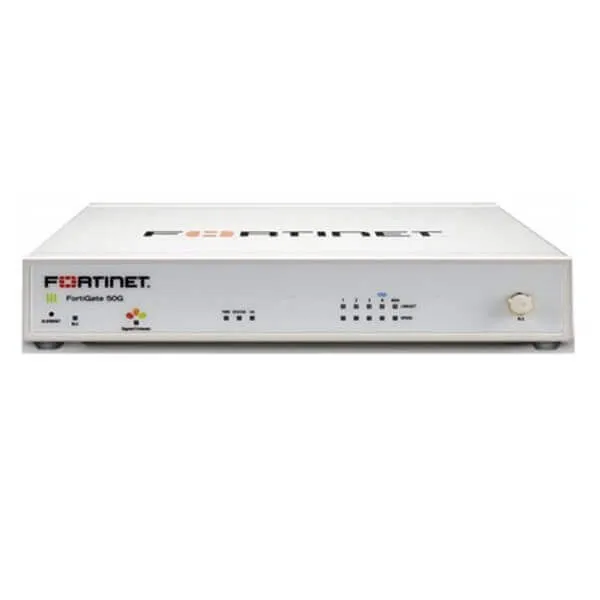
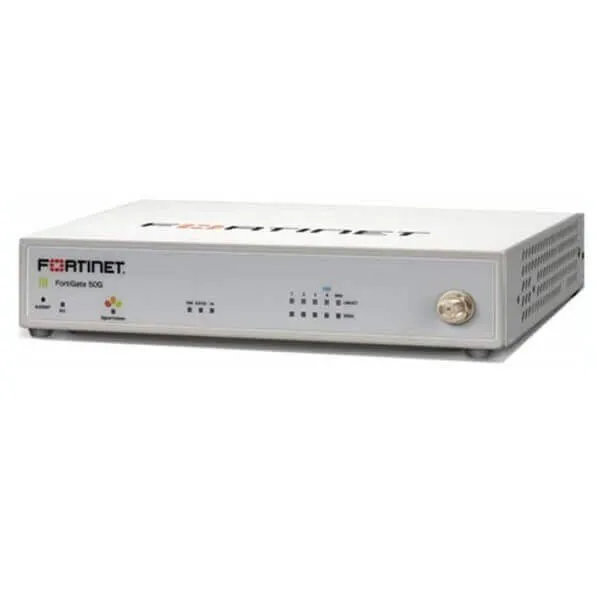
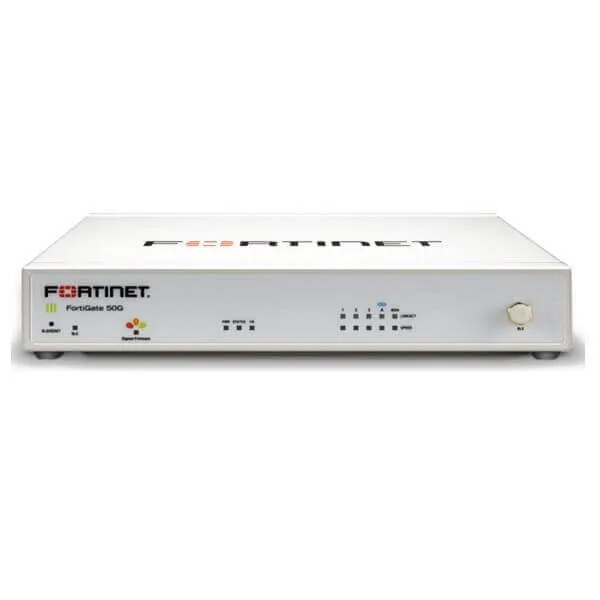
FortiGate 50G (FG-50G) Tanzania
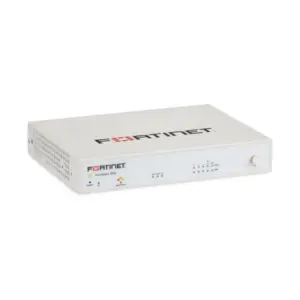
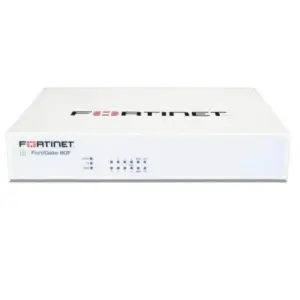
FortiGate 50G is a compact next-generation firewall designed for distributed enterprise sites and branch networks. It brings Fortinet secure networking, threat inspection and SD-WAN capabilities into one desktop platform, giving Tanzanian businesses a practical way to protect internet access, segment users, connect sites and apply consistent security policy without deploying separate appliances for every function.
FortiGate 50G Overview and Verified Highlights
The base FG-50G orderable model is listed by Fortinet with five Gigabit Ethernet RJ45 ports, comprising four internal ports and one WAN port. Fortinet positions the broader FortiGate/FortiWiFi 50G family as a converged next-generation firewall and SD-WAN platform for distributed enterprise sites. Published 50G-series performance highlights include 2.25 Gbps IPS throughput, 1.25 Gbps NGFW throughput and 1.1 Gbps threat-protection throughput. These published figures are laboratory performance references, not a promise that every production network will achieve the same rate; real throughput depends on enabled inspection, traffic mix, packet size, configuration and other operating conditions.
Published 50G-series IPS throughput reference.
Published 50G-series NGFW throughput reference.
Published threat-protection throughput reference.
Base FG-50G: four internal and one WAN port.
For a buyer, those numbers are only the start of sizing. A firewall should be selected around the traffic that will actually be inspected, not only the speed printed on an ISP contract. Teams should consider simultaneous users, cloud applications, encrypted traffic, site-to-site tunnels, security profiles, guest networks, voice and video, backups, software updates and expected growth. FourTeck can use those inputs to help determine whether FG-50G is appropriately sized or whether another FortiGate model should be evaluated.
What FG-50G Can Solve
Secure Internet Edge
Replace a connectivity-only router approach with policy-driven firewalling and security inspection. Organizations can design rules around departments, services and approved application flows, then layer subscribed FortiGuard capabilities where required.
Branch Connectivity
FortiOS integrates networking and security functions, including secure SD-WAN capabilities. This is useful when branches need controlled paths to head-office, cloud or internet resources and the design must account for more than one WAN service.
Segmentation and Visibility
Separate business systems, staff devices, guest access, cameras, voice endpoints and other network zones so that unnecessary lateral access is reduced. Policy planning should follow actual operational requirements rather than generic rule templates.
Deployment, Licensing and Integration Guidance
A productive FG-50G project starts with a network inventory. Document the ISP handoff, public addressing, current router or firewall, switches, VLANs, wireless infrastructure, servers, cloud services, remote users, branch links and systems that must remain reachable during migration. The base FG-50G has one dedicated WAN RJ45 port in Fortinet ordering information, so designs requiring additional physical WAN interfaces, SFP connectivity, PoE or embedded cellular should be checked against the other 50G-family variants rather than assuming the base appliance contains those interfaces.
Security subscriptions also need deliberate selection. FortiGuard services and FortiCare support are commercial components whose contents and terms vary by bundle and contract. A quotation should therefore state the exact appliance, service bundle, subscription duration and implementation scope. Buyers comparing a low hardware-only price with a security bundle should not treat them as equivalent offers. The security profiles required by the organization, support expectations and renewal plan all affect the useful lifecycle of the deployment.
For integration, map which traffic needs internet access, which systems accept inbound connections, which users require remote access and which branches require private connectivity. Define administrative access separately from ordinary user traffic. Plan DNS, DHCP, NAT, VLAN gateways, routing, logging, authentication and configuration backup before cutover. Where the network uses FortiSwitch, FortiAP, FortiManager, FortiAnalyzer or other Fortinet components, verify version and design compatibility for the intended architecture instead of assuming every feature is automatic.
FortiGate 50G (FG-50G) Tanzania
For Tanzania organizations, FortiGate 50G is relevant to the common requirement of securing a growing office without turning the network edge into an oversized infrastructure project. Businesses increasingly depend on cloud accounting, collaboration suites, online banking, supplier portals, hosted ERP, customer platforms, IP telephony and remote administration. The firewall therefore needs to do more than translate addresses between a LAN and the internet. It needs to give administrators a controlled point where traffic policy, security inspection, branch connectivity and operational visibility can be designed together.
A Tanzania FG-50G procurement discussion should begin with bandwidth and workload rather than a simple user-count rule. A small team transferring large cloud backups can create a different inspection load from a larger office using mostly web and email. Likewise, a branch running encrypted tunnels, guest Wi-Fi, cameras and SaaS applications has different policy needs from a quiet administrative office. Share current and planned ISP speeds, approximate devices, VLAN requirements, VPN topology, critical applications and the security services you intend to enable. This gives the quotation and technical recommendation a defensible basis.
Power quality and physical placement are also practical considerations. Put the appliance in a controlled, ventilated network location, protect it with suitable power conditioning or UPS equipment where required, and label WAN and internal connections clearly. Keep an approved configuration backup after commissioning and after material policy changes. For businesses with multiple Tanzanian sites, establish naming standards for interfaces, objects, VPNs and policies so that support does not become dependent on one administrator’s memory.
FourTeck can prepare a Tanzania quotation around hardware, the required FortiGuard/FortiCare term and the agreed deployment scope. Current price, availability and delivery arrangements should be confirmed at quotation time rather than inferred from overseas listings. For related regional security projects, organizations can also review FourTeck Africa solutions, while the Tanzania sales request should remain anchored to the local contact workflow.
FortiGate 50G (FG-50G) Dar es Salaam
Dar es Salaam businesses often operate in environments where internet connectivity directly supports finance, logistics, customer service, hospitality, retail, professional services and regional coordination. An FG-50G project in the city can therefore be framed around protecting business workflows rather than simply replacing a router. Start by identifying which applications cannot tolerate disruption, which user groups need different access rules and which devices should be isolated from ordinary staff traffic. This can include point-of-sale terminals, CCTV equipment, voice systems, guest devices, printers and administrative servers.
Organizations using more than one connectivity service should document how each circuit is presented and what outcome is expected during an outage. Secure SD-WAN is useful as a design capability, but resilient connectivity still depends on the physical services, addressing, routing, health checks and policy choices around them. The base FG-50G interface layout should be reviewed against that topology. If the project specifically requires SFP, PoE or integrated cellular features, select the correct 50G-family variant rather than assuming those options are part of FG-50G.
For a head office, segmentation deserves particular attention. Finance, administration, guest access, voice, cameras and server networks may have very different trust levels. Firewall policies can be built around required communication paths, with logging and inspection aligned to business risk. A branch or shop can use a simpler model, but it should still avoid a flat network where every connected device can reach every other device. This is especially important when third-party devices or visitor access share the same physical site.
When requesting an FG-50G Dar es Salaam quotation, include the expected subscription term, whether configuration or migration is needed, and any branch VPN requirements. A clear scope makes competing offers easier to compare because it separates appliance cost from security services and engineering work. Use the FourTeck Tanzania contact page to submit the deployment requirements and request current commercial information.
FortiGate 50G (FG-50G) Mwanza
Mwanza buyers evaluating FG-50G may be planning security for a standalone office, a regional branch, a healthcare or education environment, retail operations, distribution activity or a site that connects back to systems hosted elsewhere. The important sizing question is not simply whether the device is called a small-branch firewall. It is whether its inspected performance, physical interfaces and service bundle match the traffic and security policy the site will actually run. Fortinet’s published 50G-series IPS, NGFW and threat-protection references provide useful comparison points, but production design should retain headroom.
For a regional branch, define what should continue working if the connection to head office is unavailable. Some applications may depend entirely on a central system, while others can use direct internet access. This distinction affects routing, SD-WAN policy, DNS behavior and VPN design. It also helps determine what should be logged locally or centrally. If the organization has several branches, a consistent template for object names, address groups, policy order and change records can reduce troubleshooting time and make future expansion easier.
Mwanza deployments should also account for physical operating conditions. Network equipment belongs in a secure, clean and ventilated area with dependable power protection. Cabling should be labelled, and configuration backups should be controlled as sensitive operational records. Before migration, record the existing public IP details, NAT rules, VPN peers, internal subnets and any services that partners or remote systems access. That information prevents a security upgrade from unexpectedly breaking a business dependency that was never documented.
Procurement teams should ask vendors to identify the exact FG-50G order code and service term on the quote. If an offer includes a FortiGuard bundle or FortiCare service, the duration and bundle type should be explicit. This avoids comparing unlike offers and makes future renewal planning more predictable. FourTeck can use the site profile to prepare an appropriate commercial and deployment scope rather than presenting an unqualified hardware price as the whole solution.
FortiGate 50G (FG-50G) Arusha
Arusha organizations in hospitality, travel, professional services, education, NGOs and general commerce can use a compact firewall project to bring structure to networks that have grown organically. A typical site may have staff systems, guest wireless, booking or accounting applications, IP phones, cameras and third-party devices connected through the same internet service. The security objective should be to define appropriate trust boundaries, permit required business traffic and reduce unnecessary communication between zones.
FG-50G can serve as the policy enforcement point in that design. FortiOS combines firewall and networking capabilities, while subscribed security services can add inspection and threat-intelligence functions according to the selected package. The exact policy set should be tailored to the organization. A hospitality environment, for example, may prioritize separation of guest access from operational systems. A professional office may focus more on SaaS access, remote work and controlled administration. An NGO branch may need reliable encrypted connectivity to another office or cloud-hosted services.
Before ordering in Arusha, check port requirements carefully. The base FG-50G is listed with four internal GE RJ45 ports and one WAN GE RJ45 port. Fortinet also has other 50G-family variants with different connectivity options. This matters when a project calls for fiber handoff, PoE, cellular or other physical capabilities. Choosing the variant from the actual topology is safer than trying to retrofit an assumption after the appliance arrives.
A useful quotation request should include the ISP connection type, bandwidth, user/device estimate, branch count, remote-access requirement, desired security services and any existing Fortinet equipment. Also state whether the project requires only supply or includes migration, policy creation, VPN configuration, testing and handover. This creates a cleaner procurement record and helps the technical team plan downtime, backups and rollback before the production cutover.
FortiGate 50G (FG-50G) Dodoma
Dodoma offices considering FortiGate 50G may need a secure edge for administrative teams, project offices, education environments, professional services or distributed organizations. The strongest use case is not based on a city label but on the need to control how users and systems reach the internet and other networks. FG-50G gives the project a FortiOS-based platform where firewall policy, segmentation, VPN and secure networking functions can be planned together, with FortiGuard services added according to the selected subscription.
Start with an access map. Identify departments and systems, then document which flows are genuinely required. A finance workstation may need approved cloud services and internal applications but no direct access to a camera network. Guest devices should generally remain separate from corporate resources. Management interfaces should be limited to authorized administrators. These design decisions provide more value than simply enabling every security feature with default settings.
For branch-to-head-office connectivity, record the remote peer, subnets, authentication method, routing expectation and failover behavior before configuration begins. If the site has multiple ISP options, define what constitutes a healthy path and which applications should prefer each circuit. Secure SD-WAN can support policy-based link use, but it does not replace careful carrier and network planning. The physical interfaces of the selected 50G variant must also match the intended topology.
Dodoma procurement teams can reduce lifecycle surprises by requesting a quote that separates appliance, subscription, support and implementation. Record the subscription renewal date as part of the asset register. Keep configuration backups after major changes and maintain a basic change log. These operational practices help preserve the value of the firewall after installation and make support more efficient when administrators, providers or business requirements change.
FortiGate 50G (FG-50G) UAE
UAE procurement teams may evaluate FG-50G for branch offices, retail sites, professional firms and distributed operations that need standardized Fortinet security across multiple locations. For organizations that also operate in Tanzania, using a common firewall family can simplify policy concepts, administrator training, subscription planning and configuration standards. Standardization should still allow each site to have its own bandwidth, interface and regulatory requirements; identical hardware is not automatically the right answer for every branch.
A cross-region design should define naming conventions, VPN topology, logging destinations, administrator roles and firmware/change procedures before appliances are deployed. If a UAE head office connects to Tanzanian branches, document which applications traverse private tunnels and which can use local internet breakout. This determines routing and inspection policy and can prevent expensive backhaul of traffic that does not need to cross regions. Conversely, sensitive systems may require centralized access paths according to company policy.
Commercial comparisons should use like-for-like Fortinet bundles. Hardware-only pricing, one-year security packages and multi-year support bundles cannot be compared only by headline price. Ask for the exact orderable items, service duration and implementation scope. Organizations seeking UAE-focused Fortinet information can review FourTeck Fortinet UAE and FourTeck firewall solutions in Dubai for regional procurement context.
For Tanzania-bound projects coordinated from the UAE, include destination, required power accessories, subscription ownership details and deployment responsibility in the purchase plan. Avoid assuming that stock, price or delivery terms visible in one country apply to another. A project-specific quotation provides the correct basis for commercial approval and allows engineering tasks such as VPN coordination and migration windows to be included explicitly.
FortiGate 50G (FG-50G) Uganda
Uganda organizations can consider FG-50G when a branch or growing office needs a current Fortinet platform for firewalling, secure networking and inspected internet access. The product is particularly relevant where the organization wants consistent security between Uganda and Tanzania sites. A shared platform can make it easier to document policy standards, VPN objects, administrative roles and subscription renewals, while each branch retains settings appropriate to its local ISP and business applications.
The base appliance’s four internal GE RJ45 ports and single WAN GE RJ45 port should be mapped to the actual branch topology before purchase. If the Uganda site requires additional physical connectivity, SFP, PoE or integrated cellular capabilities, evaluate the relevant 50G-family variant. Interface planning matters because an otherwise suitable firewall can become awkward to deploy when the physical handoff was never included in the specification.
Security sizing should include inspection rather than only raw routing. Fortinet publishes 2.25 Gbps IPS, 1.25 Gbps NGFW and 1.1 Gbps threat-protection figures for the 50G series. These references help compare platforms, but a production design should account for traffic patterns, encrypted sessions, security profiles and future growth. Businesses can review the existing FortiGate 50G Uganda product guidance for Uganda-specific procurement context.
For a multi-country rollout, create a repeatable commissioning checklist: verify serial and entitlement records, confirm approved FortiOS, back up the initial configuration, apply administrator hardening, configure interfaces and routes, test security policy, validate VPNs, confirm logging and record the final state. This gives operations teams a consistent handover package and reduces the chance that one branch becomes a unique configuration nobody can support later.
FortiGate 50G (FG-50G) Kampala
Kampala branch and head-office environments can place significant demands on a compact firewall because staff may simultaneously use cloud platforms, voice/video, remote support, business portals and branch connectivity. An FG-50G assessment should therefore profile peak traffic and inspection needs, not rely on a generic statement that a model is suitable for a certain number of users. The applications, security profiles and WAN design usually tell a more accurate sizing story than headcount alone.
If the site has guest wireless, cameras, IP phones and corporate endpoints, use network segmentation to separate those roles. Define only the communication paths required for operation and monitor exceptions. This limits unnecessary lateral exposure and makes troubleshooting clearer. For organizations with a Tanzania office, a site-to-site design can provide controlled access between selected subnets while allowing other internet traffic to follow local policy.
Kampala buyers should also plan renewals at purchase time. The useful security posture of a FortiGate deployment depends on the services the organization chooses to maintain and the operational discipline around updates and configuration. Record contract terms and renewal dates, and identify who owns technical and commercial follow-up. This is preferable to discovering an expired service during a security incident or planned change.
FourTeck’s Uganda product page provides a regional reference for FG-50G procurement, licensing and deployment discussions. For a Tanzania-led project with Kampala branches, use one requirements sheet for all sites, then note the differences in bandwidth, local ISP handoff, addressing and critical applications. That approach makes it easier to determine where FG-50G is a common fit and where a different FortiGate model or variant is justified.
FortiGate 50G (FG-50G) Arua
For an Arua branch, FG-50G can be evaluated as a compact security gateway where the business needs protected internet access and controlled connectivity to another office or cloud environment. Regional sites often benefit from designs that are simple to support remotely. That means minimizing undocumented exceptions, using clear object and policy names, maintaining configuration backups and ensuring local staff can identify basic cabling and power conditions without needing administrative access to the firewall.
Connectivity resilience should be designed around what is actually available at the site. If more than one ISP service is used, document each handoff, addressing method and desired failover behavior. The base FG-50G has one WAN-designated GE RJ45 port, so any multi-link physical design needs to be validated against FortiOS interface use and the required topology or another 50G variant. Never purchase on the assumption that a family feature automatically means the base SKU has every connector shown across the family.
For security policy, prioritize the systems that keep the branch productive: business applications, approved web services, DNS, updates, communications and any tunnel to central resources. Separate guest or unmanaged devices from corporate endpoints. Limit firewall administration to trusted paths and authorized personnel. If third-party support vendors need access, use a controlled process rather than permanent broad rules.
An Arua quotation request should specify whether the appliance will be preconfigured, configured on site or integrated remotely after installation. Include the license term and required FortiGuard services, plus any VPN or migration tasks. This turns procurement into a complete deployment scope instead of leaving critical engineering work undefined after the hardware purchase.
FortiGate 50G (FG-50G) Mbarara
Mbarara businesses and regional offices can evaluate FortiGate 50G when they need more structured security than a standard broadband router provides. The firewall can sit at the boundary between internal networks and external connectivity while enforcing policies that reflect business roles. This is useful for offices that combine staff endpoints with guest wireless, CCTV, IP telephony, point-of-sale or specialized operational devices and want to avoid placing all of them in one unrestricted network.
A practical deployment begins with VLAN and address planning. Decide which systems belong together, what each zone can reach and how administrators will troubleshoot traffic when a rule blocks something legitimate. Good segmentation is not about creating the maximum number of networks; it is about creating meaningful trust boundaries that can be documented and supported. Logging should be configured so that security and operational events can be investigated without overwhelming the team with unusable data.
For branches connecting to Kampala, Tanzania or cloud-hosted systems, define the VPN and routing model before installation. Record local and remote subnets, overlap risks, DNS behavior and failover expectations. Where multiple sites share common policy requirements, templates and centralized management may become useful as the estate grows. The right management approach depends on the number of appliances and the organization’s operational model.
Procurement should also account for the complete subscription lifecycle. Ask for a clearly identified FG-50G appliance and the exact service bundle and term. Include configuration, testing and documentation if those services are required. Price and stock should be confirmed for the specific project rather than copied from an unrelated market. This keeps the business case accurate and avoids surprises at renewal or deployment time.
FortiGate 50G (FG-50G) Gulu
Gulu organizations can use the FG-50G selection process as an opportunity to document and simplify the network edge. Before replacing an existing router or firewall, capture current ISP settings, internal subnets, static routes, published services, VPN peers and any special rules used by business applications. Many migration problems occur because an old configuration contains an undocumented dependency that only becomes visible after cutover.
Once the dependencies are known, rebuild policy around current business needs rather than blindly copying every legacy rule. Staff internet access, guest connectivity, server access, cameras and branch tunnels can each have distinct controls. Apply the principle that traffic should be allowed because there is a documented requirement, not merely because the old router allowed everything. This produces a cleaner baseline for future support and auditing.
FG-50G’s compact base interface set should be matched to the Gulu site. If the ISP delivers Ethernet and the LAN design fits the available ports, the base appliance may align well. If the requirement includes SFP, PoE or cellular integration, Fortinet’s 50G family includes variants that should be evaluated separately. Confirm the exact SKU in the quote so the delivered hardware matches the planned design.
After commissioning, store an approved configuration backup and a simple network diagram. Record administrator ownership, support contacts, subscription dates and the procedure for requesting policy changes. For a distributed organization, these operational details often matter as much as initial installation because they determine whether the firewall remains manageable as staff, providers and applications change.
FortiGate 50G (FG-50G) Kenya
Kenya businesses with Tanzanian operations may use FG-50G as part of a common branch-security standard. The benefit of a standard is consistency in policy design, training, documentation and lifecycle management, but each location still needs independent sizing. Nairobi or Mombasa sites with higher bandwidth and heavier inspection may require different capacity from a smaller branch, even when both use the same applications. Treat the 50G as a candidate that must pass the workload and interface assessment.
For cross-border connectivity, identify which resources need private site-to-site access and which can be reached directly through the internet. Centralizing every flow through one country can add complexity and latency, while uncontrolled local breakout can conflict with security policy. A deliberate SD-WAN and VPN architecture can balance those requirements, with firewall inspection applied according to the organization’s risk model.
Kenya-focused buyers can review FourTeck FortiGate Firewall Kenya for broader model-selection guidance and Fortinet Kenya solutions for ecosystem context. These regional resources are useful when a Tanzania organization is coordinating a common security approach across East African branches.
For procurement, use a standardized bill-of-material template that identifies hardware, subscription term, implementation tasks and support responsibilities per site. This makes cross-country quotations easier to review without assuming identical tax, stock or delivery conditions. It also gives the IT team a clear record of what security services should be active at each branch and when renewal action is required.
FortiGate 50G (FG-50G) Kuwait
Kuwait organizations coordinating branches in Tanzania can evaluate FG-50G for compact sites that need consistent Fortinet policy and secure connectivity. Cross-region operations benefit from clear standards: define how administrators authenticate, how VPNs are named, where logs are retained, how configuration changes are approved and which FortiGuard services are required. The standard should describe outcomes rather than forcing one appliance size on every location.
The physical network design still matters. FG-50G base hardware is listed with five GE RJ45 ports, including one WAN and four internal interfaces. If a Kuwait or Tanzania site needs SFP connectivity, PoE or embedded cellular, select and quote the corresponding family variant after verifying its exact specification. This distinction is important in regional procurement because shorthand such as “50G” can hide meaningful differences between orderable models.
Security performance should be evaluated against inspected traffic. The published 50G-series figures are useful for comparing candidates, but a project should retain capacity for encryption, IPS, application control and other enabled services, as well as growth. Include planned internet upgrades in the sizing discussion so that a firewall purchased today does not immediately become the constraint after a carrier upgrade.
Commercial teams should request project-specific availability and pricing rather than relying on another country’s web price. Clarify subscription duration, FortiCare level, deployment responsibility and renewal ownership. For regional coordination, the approved FourTeck network includes FourTeck Kuwait, while Tanzania requirements can be submitted through the Tanzania contact workflow for a locally scoped response.
FortiGate 50G (FG-50G) Ghana
Ghana organizations with East African branches may use Fortinet standardization to reduce variation in firewall operations. FG-50G can be considered for smaller business sites that need next-generation firewall functions and secure networking in a compact form. A standard deployment pattern can include interface naming, segmentation principles, administrator controls, backup procedure and logging requirements, while bandwidth and application-specific settings remain tailored to each site.
The selection process should distinguish between firewall throughput and security-inspected throughput. Fortinet publishes dedicated IPS, NGFW and threat-protection figures for the 50G series, which are more relevant to a security-enabled deployment than a raw forwarding number alone. Estimate the traffic that will actually pass through inspection and allow for peaks and future growth. If requirements exceed the practical design envelope, compare a larger model rather than disabling important controls simply to preserve speed.
For organizations using SaaS, cloud storage and video collaboration, internet policy should support productivity without creating a broad allow-all posture. Application-aware controls, web security services and segmentation can be applied according to the chosen FortiGuard package and organizational policy. VPN design should separately cover branch-to-branch or branch-to-head-office access and remote-user requirements.
FourTeck’s Ghana IT solutions site provides regional context for firewall and infrastructure projects. A Ghana-Tanzania organization should prepare a shared requirements matrix showing site bandwidth, users, applications, ISP details, local subnets and subscription term. This makes it easier to create consistent procurement while respecting differences between locations.
FortiGate 50G (FG-50G) Nigeria
Nigeria enterprises and growing companies with regional offices can consider FG-50G for compact branches that require policy-controlled internet access and secure connectivity. In a multi-country network, the main operational advantage comes from consistency: administrators can work with familiar FortiOS concepts, shared naming standards and repeatable deployment checklists. That consistency should be paired with proper site sizing rather than assuming one appliance automatically fits every branch.
Document application dependencies before designing VPN and SD-WAN behavior. A branch may use local cloud access for Microsoft 365 or other SaaS platforms while sending ERP or file-service traffic through a private tunnel. The routing and security policy should reflect those paths. If internet circuits differ in quality, define link health and failover objectives based on business applications instead of simply balancing traffic without priorities.
Subscription planning is equally important. The appliance, FortiGuard services and FortiCare support should be identified separately in procurement records. Security services vary by bundle, and renewal dates should be tracked centrally where several countries are involved. Avoid making purchasing decisions from an isolated hardware price when the intended design depends on licensed threat-prevention capabilities.
For Nigeria-side coordination, organizations can consult FourTeck Nigeria IT services. For a Tanzania deployment managed by a Nigerian regional team, provide FourTeck with the Tanzania site details, intended security bundle, branch topology and desired implementation scope. This enables a quote based on the destination and actual project instead of assumptions transferred from another market.
FortiGate 50G (FG-50G) Seychelles
Seychelles organizations with tourism, professional, retail or distributed business operations can evaluate FG-50G for compact sites where secure internet access and manageable policy are priorities. A smaller physical site can still have a complex network: guest access, payment systems, cameras, voice, staff devices and cloud applications may all share the same connectivity. Firewall design should separate these roles where appropriate and permit only the traffic needed for operation.
Connectivity planning is especially important for any location where the organization wants resilience across more than one service. Document the ISP handoff and addressing for each circuit, then verify that the selected 50G-family hardware has the required physical interfaces. The base FG-50G is not the same as SFP, PoE or cellular variants. Exact SKU validation before ordering prevents a deployment delay caused by an interface mismatch.
For remote support, keep the configuration understandable. Use descriptive policy names, controlled administrator accounts, configuration backups and a simple network diagram. Avoid permanent broad management exposure merely for convenience. If a support provider requires access, define an approved method and review it periodically. Operational discipline helps a compact firewall remain supportable even when the local site has limited IT staffing.
Seychelles buyers coordinating procurement through Tanzania or another FourTeck region should request current availability, shipping terms and subscription details for the actual destination. Include the expected license duration and whether configuration will be performed before shipment, remotely or on site. This creates a clear handover and reduces ambiguity over who is responsible for activation, policy creation, testing and ongoing changes.
Related Fortinet and FourTeck Resources
Regional organizations often need more than one firewall page. Use these verified FourTeck resources to compare wider requirements: FortiGate 50G Uganda for the same model in Uganda; FortiGate 30G Uganda when evaluating a smaller compact branch option; FortiGate 60F Uganda for an established F-series branch comparison; FortiGate Firewall Kenya for broader model-selection guidance; and Fortinet Kenya for wider ecosystem planning.
For multi-country projects, FourTeck Africa, FourTeck Ghana, FourTeck Nigeria, FourTeck Fortinet UAE and FourTeck Firewall Dubai provide regional pathways for security and infrastructure discussions. Tanzania buyers should use the Tanzania contact page for the final local quotation and scope.
FG-50G Quotation Checklist
✓ Site and city
✓ Current and planned ISP bandwidth
✓ ISP handoff type and public IP details
✓ Approximate users and devices
✓ VLANs and internal subnets
✓ Number of branches and VPN peers
✓ Required FortiGuard services
✓ Preferred subscription term
✓ Existing firewall/router model
✓ SFP, PoE or cellular requirement
✓ Migration/configuration scope
✓ Logging, management and support needs
Providing these details allows a supplier to quote the correct appliance and services and gives the engineer enough information to identify obvious design questions before installation. It also creates a procurement record that can be revisited when the organization upgrades bandwidth or renews subscriptions.
FortiGate 50G FAQ
What ports are on the base FG-50G?
Fortinet ordering information lists the FG-50G with five GE RJ45 ports: four internal ports and one WAN port. Other 50G-family variants have different connectivity, so verify the exact SKU when SFP, PoE, DSL, wireless or cellular capability is required.
What are the published 50G-series security performance figures?
Fortinet publishes 2.25 Gbps IPS, 1.25 Gbps NGFW and 1.1 Gbps threat-protection throughput for the 50G series. Treat these as vendor test references. Real deployment performance depends on configuration, enabled services and traffic characteristics.
Is FortiGate 50G suitable for a Tanzania branch office?
It is designed for distributed enterprise and branch use, but suitability for a specific branch should be established from inspected bandwidth, applications, users, VPN requirements, interfaces and growth. A sizing review is preferable to choosing by user count alone.
Does FG-50G include every FortiGuard security service automatically?
No assumption should be made from the hardware name alone. FortiGuard and FortiCare entitlements depend on the bundle and subscription purchased. Request a quotation that identifies the exact services and term.
Can FG-50G be used for SD-WAN?
Fortinet positions the 50G series as a converged NGFW and SD-WAN platform. The final SD-WAN design depends on the available links, physical interfaces, routing, health checks and application policy.
What should I send for a FortiGate 50G Tanzania quote?
Send the site location, bandwidth, ISP handoff, users/devices, branch and VPN requirements, desired subscription term, interface requirements, existing firewall and whether installation or migration is needed.
Decision Recap and Consultation
FG-50G is a compact Fortinet branch-security platform with a verified base configuration of five GE RJ45 interfaces and 50G-series performance references of 2.25 Gbps IPS, 1.25 Gbps NGFW and 1.1 Gbps threat protection. The buying decision should still be based on inspected workload, interfaces, subscriptions, VPN design and growth. FourTeck can review those inputs and prepare a project-specific Tanzania quotation without relying on unverified stock, price or delivery assumptions.

Reviews
There are no reviews yet.