
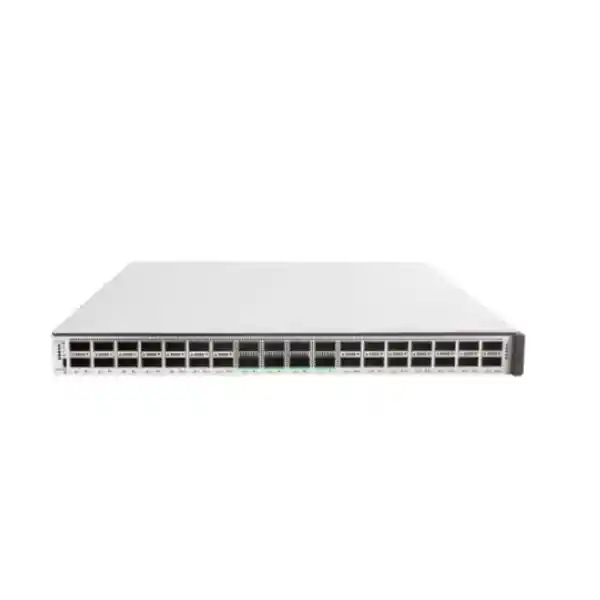
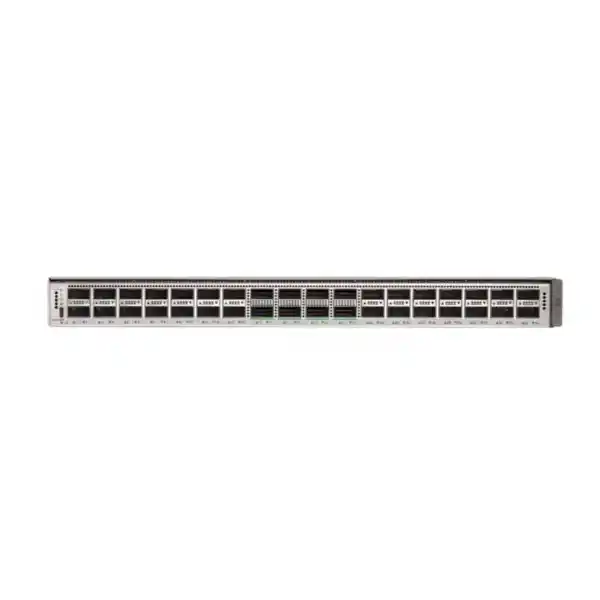
8 × 40/100/200/400G QSFP-DD
1RU Core / Distribution
Cisco Silicon One Q200
Cisco Catalyst C9500X-28C8D Network Switch
For organisations designing a high-capacity campus core, enterprise aggregation layer, data-centre-facing backbone, or resilient distribution architecture, the Cisco Catalyst C9500X-28C8D provides a dense combination of 100 Gigabit Ethernet and 400 Gigabit Ethernet in a fixed 1RU platform. Its port layout is designed for environments where many high-speed fiber links need to converge without moving to a larger modular chassis, while Cisco IOS XE, advanced routing, segmentation, automation, security, and high-availability features support the operational requirements of a modern enterprise network.
This model is best evaluated as part of a complete design rather than as a standalone switch purchase. The final configuration depends on the required Network Essentials or Network Advantage software entitlement, Cisco software release, optics, breakout requirements, airflow direction, redundant power strategy, rack depth, fiber distances, and the speeds used on connected devices. Buyers in Tanzania can use this page to understand where the C9500X-28C8D fits, what it can support, and which details should be confirmed before requesting a quote.
Quick fit: who should consider the C9500X-28C8D?
Campus core refresh
Suitable when an existing enterprise core is approaching 10G, 40G, or 100G capacity limits and the design needs higher-density 100G links plus a path to 400G interconnects.
High-speed aggregation
Useful for aggregating multiple distribution switches, server fabrics, network services, or high-bandwidth buildings where substantial east-west and north-south traffic converges.
Resilient enterprise backbone
A strong candidate for paired core designs that need redundant power, field-replaceable cooling, StackWise Virtual, multichassis EtherChannel, and routed resiliency options.
Advanced segmentation and routing
Designed for enterprises using dynamic routing, MPLS, EVPN/VXLAN, SD-Access roles, programmable interfaces, or security controls that go beyond basic Layer 2 switching.
Port architecture and bandwidth options
The defining characteristic of the C9500X-28C8D is its high-speed fiber density. Cisco specifies 28 native QSFP28 ports that operate at 40G or 100G and 8 QSFP-DD ports that support 40G, 100G, 200G, or 400G operation. This makes the switch practical for designs where 100G is the standard backbone speed while 400G is reserved for inter-core links, high-capacity aggregation, data-centre connections, or future growth.
| Interface group | Native count | Supported native speeds | Typical design role |
|---|---|---|---|
| QSFP28 | 28 ports | 40G / 100G | Distribution uplinks, core links, high-speed services |
| QSFP-DD | 8 ports | 40G / 100G / 200G / 400G | 400G backbone, high-capacity aggregation, growth headroom |
Breakout support gives the platform additional flexibility, but it should be planned carefully rather than treated as an unlimited conversion of every port. Cisco documents breakout on all QSFP-DD ports and on the odd-numbered QSFP28 ports of the C9500X-28C8D. Depending on the intended breakout mode, compatible transceivers, direct-attach cables, active optical cables, or breakout assemblies are required. The resulting logical-port count, supported speed, reach, and software requirements need to be checked against the current Cisco optics and configuration guidance before the bill of materials is finalised.
For migration projects, this flexibility is valuable because a network does not always move from one speed to another in a single step. A business may initially use 40G or 100G toward existing distribution infrastructure, use selected 400G links between core devices, and gradually introduce additional 100G or lower-speed breakout connections as adjacent switches are replaced. A well-planned breakout strategy can reduce unnecessary intermediate hardware, but it must still respect Cisco’s port mapping and supported optic combinations.
The C9500X-28C8D does not support the optional C9500 network modules used by some other Catalyst 9500 models. Its front-panel high-speed interfaces are therefore the central connectivity resource, which makes accurate port budgeting important. Before ordering, map every intended physical and logical connection, reserve ports for redundant paths, identify any breakout ports, and include spare capacity for realistic growth.
Performance for high-capacity enterprise networks
Cisco lists the C9500X-28C8D with up to 12 Tbps of switch performance and an 8 billion-packets-per-second forwarding rate. The Catalyst 9500X family uses the Cisco Silicon One Q200 ASIC, a programmable network silicon architecture designed for high-speed routing and switching. For a buyer, the practical benefit is not simply a large headline number; it is the ability to build a dense 100G/400G core where multiple high-bandwidth links can operate concurrently without choosing a larger modular chassis solely to obtain interface capacity.
The platform also provides flexible forwarding resources. Cisco documents custom SDM templates for Catalyst 9500X that allow administrators to allocate hardware resources to suit requirements such as MAC scale, IPv4 and IPv6 host routes, MPLS labels, security or object-group entries, ACLs, NetFlow, tunnels, and other functions. This is relevant when the switch is used in environments that are route-heavy, segmentation-heavy, telemetry-heavy, or need large policy tables. The correct template should be selected based on the real network design, because a maximum scale value in one category may depend on how resources are allocated elsewhere.
Cisco also describes dedicated low-latency buffering and deeper HBM buffering for the Catalyst 9500X architecture. Buffer design matters in high-speed aggregation because bursts can appear when traffic from several lower-speed or equal-speed sources converges on fewer egress links. Buffering does not replace proper capacity planning, quality of service, or congestion management, but it is an important architectural characteristic for a core switch expected to handle demanding traffic patterns.
Up to 12 Tbps for the C9500X-28C8D.
8 Bpps as specified by Cisco.
32 GB DRAM and 32 GB flash listed for Catalyst 9500X.
Up to 9,216 bytes on Catalyst 9500X.
High availability and core resiliency
Core switches sit on critical traffic paths, so redundancy should be designed at device, link, power, and control-plane levels. The C9500X-28C8D supports two power-supply slots and Cisco documents dual 1+1 redundant power operation when two supported power supplies are installed. A single power supply is the default shipment configuration, so organisations that require power redundancy should make sure the second supported supply is explicitly included in the order and connected to an appropriately designed power source.
Cisco StackWise Virtual can combine two compatible switches into a single logical network system for operational simplicity and resilient forwarding. Multichassis EtherChannel can then span the StackWise Virtual members, allowing downstream or upstream devices to use port-channel connectivity across both physical switches. This is useful for reducing dependence on a single chassis and for building active resilient designs, but it requires the correct software version and a carefully engineered StackWise Virtual link and dual-active detection strategy.
Cisco also lists Stateful Switchover support with StackWise Virtual and ISSU support for Catalyst 9500X from qualifying software releases. These features should be considered together with software lifecycle policy, maintenance windows, redundancy design, and the feature set actually in use. A capability being supported by the platform does not mean every upgrade can be performed without operational impact; release notes and upgrade paths should be reviewed before each maintenance event.
For a Tanzania deployment, the physical design should also account for power quality and continuity. Where network availability is business-critical, use independent power feeds where available, suitable UPS capacity, surge and grounding practices appropriate to the site, monitored environmental conditions, and redundant fiber paths that do not share the same physical failure point. These are design considerations rather than product guarantees, but they often determine whether a redundant switch pair delivers the intended business resilience.
Security, segmentation, and encrypted links
The Catalyst 9500X platform includes hardware capabilities intended for secure enterprise core designs. Cisco lists trustworthy system functions such as image signing, Secure Boot, and the Cisco Trust Anchor Module, helping establish confidence in the platform’s boot and software integrity. These capabilities form part of a broader security architecture and should be combined with secure administration, access control, logging, authentication, configuration management, and network segmentation policies.
For link encryption, Cisco documents 256-bit AES-GCM MACsec support on Catalyst 9500X, including WAN MACsec support subject to feature and ordering requirements. MACsec can be valuable when high-speed Ethernet links cross shared facilities, inter-building paths, service-provider transport, or other areas where encryption at Layer 2 is required. Compatibility must be verified at both ends of the link, and Cisco notes that some WAN MACsec capabilities require an HSEC key. Do not assume that every optic, topology, license, or software release automatically enables every encryption mode.
The switch also supports access-control lists, quality-of-service policy, routing policy, VRF-based segmentation, and Cisco TrustSec-related capabilities depending on software and license choices. In a large enterprise, these functions can help separate departments, operational technology, servers, guest services, management networks, and other security zones while still maintaining a consolidated high-speed core.
When the security requirement is compliance-driven, the network design should start with the required control objective rather than a feature name. Define which traffic must be isolated or encrypted, where policy should be enforced, what logs and telemetry are required, how administrator access will be protected, and how keys and certificates will be managed. The C9500X-28C8D can provide a powerful enforcement point, but secure outcomes depend on the surrounding architecture and configuration.
Routing, EVPN/VXLAN, MPLS, and programmable operations
The C9500X family is built for more than Layer 2 aggregation. Cisco lists support for enterprise routing protocols including OSPF, EIGRP, IS-IS, BGP, IPv6 routing, and multicast functions, along with MPLS capabilities. Exact features and scale can depend on the license tier, software release, and hardware resource template, so the routing design should be matched to the selected entitlement before purchase.
For modern fabric architectures, Catalyst 9500X supports BGP EVPN with VXLAN functions including spine, leaf, and border roles, Layer 2 and Layer 3 VNIs, symmetric integrated routing and bridging, and selected border handoff functions from qualifying software releases. It can also participate in Cisco Software-Defined Access roles such as control plane and border. These capabilities make the platform relevant where the core is expected to carry overlay networks, scalable segmentation, or fabric traffic rather than operate as a conventional routed core only.
Programmability is another important consideration for organisations standardising network operations. Cisco lists NETCONF, RESTCONF, gNMI/gNOI, YANG models, zero-touch provisioning and plug-and-play capabilities for Catalyst 9500X. These interfaces can support configuration automation, telemetry collection, compliance workflows, and integration with orchestration systems. Teams adopting automation should treat the network configuration as controlled infrastructure: use versioned templates, change review, validation, staged rollouts, credential protection, and rollback procedures instead of simply replacing manual CLI work with scripts.
Flexible NetFlow support can provide traffic visibility for capacity analysis, security investigations, and application monitoring. Because telemetry and flow collection consume hardware or software resources depending on the feature and release, monitoring requirements should be included in the initial design. A core platform is easier to operate when routing, segmentation, telemetry, management, and automation requirements are planned together rather than added independently after deployment.
Cisco IOS XE software and licensing choices
The C9500X-28C8D was introduced with Cisco IOS XE 17.7.1 as its minimum platform software requirement. Individual capabilities may require later releases: for example, Cisco documents additional Catalyst 9500X functions that begin with 17.8.1, 17.10.1, or later, while ISSU support is listed from 17.12.1. In a production design, choose a release based on the features required, Cisco support guidance, lifecycle policy, interoperability, and the organisation’s standard software train rather than using the oldest release the hardware can boot.
Ordering also requires a licensing decision. Cisco lists C9500X-28C8D-E with Network Essentials and C9500X-28C8D-A with Network Advantage. Network Essentials covers foundational switching, routing, automation, visibility, and security capabilities, while Network Advantage adds more advanced routing, segmentation, multicast, scale, and security functions. The right choice depends on the protocols, fabric roles, segmentation model, resiliency design, and operational tooling required by the network.
| Orderable platform variant | Base network license | When to consider it |
|---|---|---|
| C9500X-28C8D-E | Network Essentials | When foundational enterprise switching and routing features meet the design requirements. |
| C9500X-28C8D-A | Network Advantage | When the design requires advanced routing, segmentation, scale, multicast, or related capabilities. |
Cisco’s current licensing framework also includes unified switching licenses through Cisco Networking Subscription, while Cisco DNA licensing continues to be documented for the Catalyst 9500 Series with Essentials and Advantage tiers. The exact subscription, term, management platform, and entitlement available for a new order can change over the product lifecycle. For that reason, a quote should state the exact hardware variant, base entitlement, subscription SKU and term, support coverage, and any feature-specific requirements rather than referring only to “a C9500X-28C8D switch.”
Cisco Smart Licensing is used to manage eligible software entitlements. Organisations should identify who owns the Cisco Smart Account, which virtual account will contain the device, who has administrative access, and how licenses will be assigned before deployment. Treat software and account preparation as part of implementation planning so that hardware installation is not delayed by unresolved entitlement or account ownership issues.
Physical, power, and environmental planning
The C9500X-28C8D is a 1RU switch measuring approximately 4.39 cm high, 44.45 cm wide, and 55.37 cm deep including fan and tray handles. Cisco lists the chassis with two power supplies and built-in fan components at about 13.28 kg. Rack depth, rail position, rear clearance, cable-management space, and the bend radius of high-speed fiber or copper assemblies should all be checked before installation. Dense QSFP cabling can become difficult to service if patching and labeling are not planned from the start.
Catalyst 9500X supports 1500W AC or DC power-supply options, with Cisco documenting 90 to 264 VAC for the AC supply and -40 to -72 VDC for the DC option. The C9500X family uses a different AC connector than some other Catalyst 9500 models, so do not assume that an existing rack power cable from another switch will be correct. Confirm the required power-supply type, quantity, connector, power distribution unit receptacle, feed capacity, and redundancy arrangement in the bill of materials.
Airflow direction also matters. Cisco provides fan options for different system airflow directions, and the allowed operating temperature varies with the fan configuration and altitude. At sea level, the published operating range reaches up to 45°C with one airflow configuration and up to 35°C with the other. This is especially important in warm equipment rooms: the switch’s environmental specification should not be used as a substitute for good cooling. Design for stable inlet temperature, unobstructed front and rear airflow, clean filtration practices where appropriate, and sufficient rack spacing for service access.
Before installation in Tanzania, verify the site’s actual power and cooling conditions rather than relying on nominal building specifications. Check UPS runtime, generator transfer behaviour if applicable, grounding, rack power distribution, ambient temperature during peak heat, and whether both redundant supplies truly connect to independent protected sources. A resilient network core depends on infrastructure around the switch as much as on the switch itself.
Optics, cabling, and migration planning
High-speed switches are often selected before the optical design is fully resolved, but the transceiver and fiber plan can determine whether the proposed topology is practical and cost-effective. For each C9500X-28C8D link, identify the target speed, distance, fiber type, connector type, number of fiber strands, patch-panel path, redundancy requirement, and the interface at the remote end. Then select only transceivers and cables supported for the platform and software release.
A 100G link to a nearby distribution switch has different requirements from a 100G inter-building connection or a 400G link between core devices. Multimode, single-mode, parallel-fiber, wavelength-based, and direct-attach options can differ in reach and fiber consumption. Existing fiber plant should be tested and documented, particularly when a migration depends on reusing older multimode links or patching through several intermediate panels.
Breakout connections need even more attention because one physical port becomes multiple logical interfaces. The remote devices must support the corresponding lane speeds, the cable assembly must match the optics, and operations teams need clear labeling so a fault on one physical connector can be traced to its logical interfaces. Build the intended breakout mapping into network diagrams and configuration templates before the maintenance window.
For phased upgrades, preserve a rollback path. Document the existing topology, validate new optics in advance where possible, pre-stage the approved IOS XE release and configuration, confirm management reachability, and decide how traffic will be moved between old and new core paths. A high-performance switch can simplify capacity planning, but migration success still depends on disciplined physical and logical change control.
Common deployment scenarios
Pair of campus core switches
Two C9500X-28C8D switches can form a resilient high-speed core, with redundant 100G distribution links and 400G connectivity reserved for inter-core or high-capacity services. StackWise Virtual may be used where the design and software requirements support it.
Large-building aggregation
Multiple distribution layers can be aggregated into a high-density fiber platform when 40G or 100G uplinks are needed from several buildings, floors, or network zones and spare capacity must remain for expansion.
Data-centre-facing enterprise core
The switch can provide high-bandwidth routed connections between the campus and data-centre or private-cloud edge, especially where 100G and 400G links are required and advanced routing or segmentation is part of the design.
EVPN/VXLAN or SD-Access border role
For organisations adopting fabric architectures, the platform can support selected EVPN/VXLAN, SD-Access control-plane, and border functions when the correct software release and license are used.
High-speed network-services aggregation
Firewalls, routers, service appliances, monitoring platforms, and other high-throughput systems can be attached through suitably supported 40G, 100G, or 400G interfaces, subject to the design and interoperability requirements.
Backbone growth from 100G to 400G
Organisations standardising on 100G today can use the QSFP-DD ports to introduce 400G where traffic demand justifies it, reducing the need to replace the core simply to obtain a higher-speed backbone interface.
What to confirm before requesting a quotation
A complete C9500X-28C8D solution usually involves more than the chassis. Providing the design details below helps reduce quotation revisions, incompatible accessories, and delays during installation.
Buying guidance for organisations in Tanzania
When a Tanzanian organisation is upgrading a core network, the most important buying question is not simply whether the C9500X-28C8D is powerful enough. It is whether its interface mix, licensing, power, environmental limits, and operational model align with the real site and migration plan. A detailed bill of materials should therefore be built from the network design rather than from the chassis model alone.
Start by documenting current and forecast traffic. Identify which access or distribution blocks genuinely need 100G, where 40G will remain during transition, and which paths could justify 400G now or within the expected lifecycle. Reserve ports for redundancy and growth instead of consuming every interface in the initial design. If existing fiber is being reused, confirm its type, route, available strands, connector condition, and measured performance before selecting optics.
Power and cooling deserve equal attention. Core devices may operate continuously for years, and a design that depends on a single UPS outlet, an overloaded rack PDU, or marginal room cooling can undermine the value of redundant switching hardware. Verify actual site conditions, including equipment-room temperature during the hottest operating periods, generator or UPS behaviour during outages, and whether the two switch power feeds are truly independent.
Operational readiness is also part of the purchase. Confirm that administrators are comfortable with IOS XE, that configuration backups and logging are in place, that monitoring platforms can collect the required telemetry, and that the organisation has an upgrade and vulnerability-management process. If the design uses EVPN/VXLAN, StackWise Virtual, MACsec, MPLS, or other advanced functions, include implementation and testing time instead of treating them as checkbox features.
Finally, request a quote that clearly identifies each hardware and software line item. This should separate the switch variant, power supplies, fan direction, transceivers, adapters, breakout cables, software subscriptions, support coverage, and implementation services where required. Clear line-item scope makes it easier to compare proposals and helps prevent a low initial chassis price from hiding missing components needed for deployment.
Frequently asked questions
How many ports does the Cisco C9500X-28C8D have?
Cisco specifies 28 QSFP28 ports for native 40G/100G connectivity and 8 QSFP-DD ports for 40G/100G/200G/400G connectivity. The switch can also support breakout configurations, which can increase the number of logical lower-speed interfaces. Breakout availability depends on the physical port: Cisco documents breakout on all QSFP-DD ports and on odd-numbered QSFP28 ports. Always verify the proposed optic, cable, remote interface, and IOS XE support before finalising a breakout design.
Is the C9500X-28C8D a 400G switch?
Yes. Eight QSFP-DD ports support speeds up to 400G, while the remaining 28 QSFP28 ports are designed for 40G/100G. This mixed architecture makes the switch useful when an enterprise needs a dense 100G core with selected 400G links for interconnection, aggregation, or future capacity. The actual 400G optic or cable must be selected for the required reach and supported configuration.
What is the switching capacity of the C9500X-28C8D?
Cisco lists up to 12 Tbps of switching capacity for the C9500X-28C8D and an 8 Bpps forwarding rate. The underlying Catalyst 9500X architecture uses Cisco Silicon One Q200. Performance figures should be read together with the intended packet sizes, feature configuration, software release, and overall network design rather than treated as the only sizing criterion.
Does the switch include redundant power supplies?
The chassis has two power-supply slots and supports 1+1 redundant power when two supported supplies are installed. Cisco states that Catalyst 9500 switches ship with one power supply by default, so a second supply should be included explicitly when redundant power is required. Confirm AC or DC type, connector, PDU compatibility, and independent protected feeds as part of the order.
What license does the C9500X-28C8D require?
Cisco lists two primary orderable variants for this platform: C9500X-28C8D-E with Network Essentials and C9500X-28C8D-A with Network Advantage. The correct option depends on the required routing, segmentation, multicast, scale, automation, security, and fabric features. Cisco’s current licensing model can also involve subscription entitlements, so the exact software line items and term should be confirmed in the quotation.
Can the C9500X-28C8D be used with StackWise Virtual?
Yes, Cisco lists StackWise Virtual support for Catalyst 9500X. It can be used to create a resilient logical system from two switches and to support multichassis EtherChannel designs. Software requirements apply, and the StackWise Virtual link, dual-active detection, failure domains, upgrade strategy, and downstream port channels should be engineered carefully. It is a high-availability design feature, not a substitute for complete redundancy planning.
Does the C9500X-28C8D support EVPN and VXLAN?
Cisco documents BGP EVPN with VXLAN capabilities on Catalyst 9500X, including selected spine, leaf, border, VNI, and integrated routing and bridging functions. Some of these capabilities require qualifying IOS XE releases, and the required license should be verified. If EVPN/VXLAN is a core requirement, define the intended role and control-plane design before selecting the software and license combination.
Does it support MACsec encryption?
Catalyst 9500X supports hardware-based 256-bit MACsec capabilities, and Cisco also documents WAN MACsec support subject to software and ordering requirements. Some WAN MACsec functions require an HSEC key. Both ends of the encrypted link must support the intended mode, and the required license, software, optics, key management, and operational policy should be confirmed before deployment.
Can I connect 10G or 25G devices to this switch?
The platform can support lower-speed connectivity through supported breakout methods and adapters in specific port combinations. Cisco’s interface guidance includes 10G operation with an appropriate QSFP-to-SFP adapter and breakout options for selected QSFP ports. Do not assume every front-panel port can become four lower-speed ports. Build the exact port map first and verify the current Cisco transceiver and breakout support for the desired configuration.
Is this suitable as an access switch for user devices?
Usually not. The C9500X-28C8D is a high-density fiber core and distribution platform intended for high-speed infrastructure links. It is not designed as a conventional PoE access switch for directly connecting large numbers of phones, wireless access points, cameras, and desktop endpoints. In a typical campus architecture, access switches serve those devices while the C9500X aggregates upstream high-speed links.
What should be checked for installation in a warm equipment room?
Confirm the fan airflow direction, actual rack inlet temperature, altitude, cooling capacity, and cable clearance. Cisco publishes different maximum operating temperatures for the two Catalyst 9500X fan orientations. Keep the switch within the appropriate environmental limits with stable airflow and monitored cooling. UPS and generator systems should also be tested as part of the resilience plan rather than assumed to behave correctly during an outage.
What information should I send for a C9500X-28C8D quote in Tanzania?
Provide the required switch quantity, whether Network Essentials or Network Advantage is needed, required software or fabric features, 40G/100G/200G/400G port counts, fiber distances, optic types if already standardised, breakout requirements, AC or DC power preference, need for a second power supply, airflow direction, support term, and any implementation requirements. If these details are not yet known, share the current topology and target capacity so the configuration can be scoped before pricing.
Request a Cisco C9500X-28C8D configuration and quote
For an accurate proposal, specify the number of switches, preferred Network Essentials or Network Advantage variant, high-speed port plan, optics and distances, redundancy requirements, power type, airflow direction, software features, and any migration or configuration services required. If the design is still being developed, provide the existing core topology and expected growth so the chassis, licenses, transceivers, breakout components, and power options can be reviewed as one solution.
Ask FourTeck Tanzania for a solution review before ordering so the final bill of materials matches the intended network design.




Reviews
There are no reviews yet.