
Hanwha Vision • Industrial Security • Tanzania
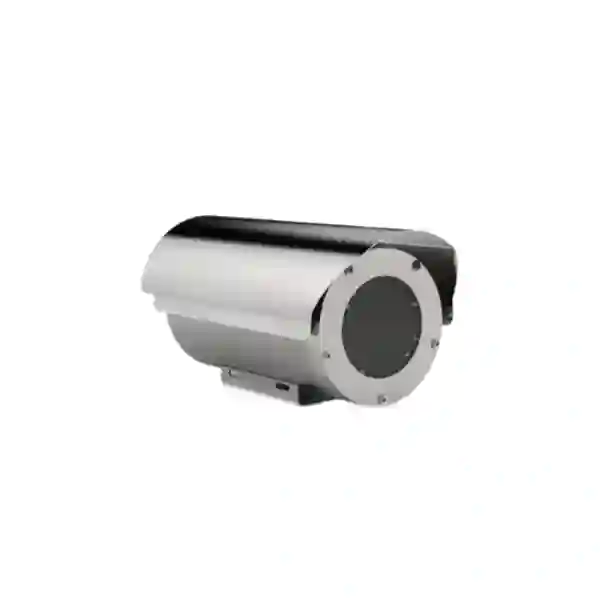
Hanwha TNO-6070EP-Z Explosion-Proof Camera
2MP fixed IP surveillance, 2.8–9mm varifocal lens and PoE for carefully assessed hazardous-area installations.
Overview and availability guidance
The Hanwha TNO-6070EP-Z explosion-proof camera is a legacy fixed IP surveillance solution for industrial sites that require both a useful Full HD image and a carefully selected hazardous-area enclosure. Its 2MP sensor, 2.8–9mm varifocal lens, PoE input and day/night imaging give engineers a defined starting point for a camera specification. It should be considered in the context of a site’s hazardous-area classification, rather than chosen solely because it is described as explosion-proof.
Important lifecycle notice: Hanwha Vision America’s February 2026 end-of-life register lists TNO-6070EP-Z with an end-of-life date of 1 December 2020 and names TNO-X6072EPT1-Z as a replacement reference. This page describes the specified legacy model for identification, comparison and support planning; it does not imply that new units, service parts or firmware are currently available in Tanzania. Request a review of current options before specifying the camera for a new installation.
Next step: Contact FourTeck Tanzania with the hazardous-area classification, required viewing distance, power/network arrangement and quantity to request a model suitability and supply review.
Technical specifications at a glance
| Imaging | 1920 × 1080 (2MP) at up to 60fps |
|---|---|
| Lens | 2.8–9mm varifocal; simple focus and P-iris |
| Exposure | 120dB WDR at up to 30fps in 2MP mode |
| Night imaging | True Day/Night (ICR); lighting still requires assessment |
| Power | PoE; historical family data specifies Class 3, maximum 12W |
| Housing | Explosion-proof camera station; historical 316L stainless steel family construction |
| Environmental | Published family protection IP66/IP67/IP68; -10°C to +55°C for PoE version |
| Storage | Built-in SD/SDHC/SDXC card slot |
| Network | H.264 / MJPEG and ONVIF Profile S referenced in family data |
| Lifecycle | End of life from 1 December 2020 per Hanwha Vision America’s 2026 record |
Figures are manufacturer-published specifications for this model or its documented TNO-6070EP family. Verify the actual unit, certification variant and installation documents before procurement or installation.
Who this industrial camera is designed for
An industrial security manager may need a view of a process boundary, restricted doorway, plant access road or protected equipment area, while a project engineer must also assess whether the proposed electrical equipment can be installed in a classified hazardous location. Those are separate requirements. Image quality helps an operator see a scene; the selected enclosure and its installation method must satisfy the site’s safety design. The TNO-6070EP-Z was developed for this overlap, offering conventional visible-light surveillance in a purpose-built explosion-proof camera station rather than a standard office or commercial CCTV housing.
For facilities in Tanzania, the first discussion should be about the actual area being monitored: the hazardous-zone or division classification, applicable site engineering standard, exposure to weather, available network, and required level of visual detail. The camera may be relevant to oil and gas facilities, chemical-process boundaries or industrial utilities where the classification and certification align. Such examples describe possible needs, not a blanket claim of approval for every plant. A written equipment schedule, classified-area drawing and certificate review are more useful than relying on marketing labels alone.
What the -Z version means
Model suffixes matter in this product family. The TNO-6070EP-Z is not interchangeable on paper with every TNO-6070EP variant. The historical family documentation identifies the -Z ordering variant with cLCus Class I, Division 1 certification. Other suffixes were associated with different certification programs. The selected marking, approved ambient range, gas or dust grouping, temperature class and installation conditions must all be matched against the required location; a certificate for another suffix should not automatically be treated as evidence for this exact unit.
This version is a fixed-view camera station powered over Ethernet and described without an integral window wiper. It is not a motorized pan-tilt-zoom camera, does not provide a 32× optical zoom mechanism, and is not a thermal imager or radiometric temperature sensor. The distinction affects system design: the installer sets the viewing direction and lens during commissioning, while any subsequent change of coverage may require physical access under the facility’s safety procedures. Confirm the precise model plate and certificate pack whenever purchasing second-hand, replacement or legacy stock.
Image resolution: what Full HD actually gives you
The maximum published image resolution is 1920 by 1080 pixels, commonly called 2MP or Full HD. It can be appropriate for general situational awareness across a defined scene when the camera is mounted at a suitable distance and the lens is adjusted correctly. It is not automatically sufficient for every requirement to identify a face, read a registration number or examine a small instrument. Those outcomes depend on the number of pixels placed on the subject, subject movement, lighting and the recording settings.
Determine the intended task before choosing a location: detect activity, observe actions, recognize a familiar person or identify an unknown person. Each demands a different image scale. A wide scene may show several process assets but leave individuals very small; a tighter view can reveal more detail while excluding nearby approaches. Consider a marked-up site plan and sample images from the intended mounting position. For new installations with demanding forensic requirements, review modern higher-resolution alternatives, but do not assume that higher megapixels alone solve low light, glare or a poor camera angle.
Using the 2.8–9mm varifocal lens
The 2.8–9mm varifocal lens provides a practical trade-off between scene width and subject size. At the shorter focal-length end it can capture a broader part of a room entrance, fence line or service area. Toward the longer end it narrows the view so that a selected doorway or item occupies more of the image. This is optical framing set during installation; it is not the same as a remotely steerable camera or a continuously tracking PTZ unit.
Ask the installer to calculate the target scene width at the real mounting distance and compare it with the desired pixel density. Allow for nearby structures, handrails, pipework and vehicle routes that could obscure an otherwise good angle. The lens adjustment should be finalized only after checking focus at the intended day and night conditions, because reflective surfaces and bright luminaires can change how useful the image looks. A site acceptance test should capture real examples, not merely show that a live stream is connected. Document the final lens setting for future maintenance.
High frame rate and WDR are different choices
Hanwha specifies up to 60 frames per second at Full HD resolution, which may be helpful where vehicles, moving equipment or walking personnel cross the image quickly. A higher frame rate can make motion sequences easier to review, but it also increases processing, storage and network demands when other settings remain similar. The correct frame rate is determined by the operational use, not by the highest number in a specification sheet. Many industrial scenes can be adequately documented using a lower configured rate.
The product also advertises 120dB wide dynamic range, with Hanwha explicitly associating the 120dB WDR mode with 30fps at 2MP. Do not promise simultaneous 60fps and maximum WDR performance. WDR is useful when a bright outdoor background and a shaded foreground appear in one image, such as at a bay entrance or a doorway facing daylight. Commissioning should compare the available exposure and WDR modes in the actual scene, including changes through the day, before choosing a recording profile. Image detail, noise and bandwidth should be assessed together.
True Day/Night, defog and stabilization
The true Day/Night mechanism uses an infrared-cut filter arrangement that changes the camera’s imaging behavior between brighter and darker scenes. It can improve the usefulness of an existing light source and help the camera operate with suitable near-infrared illumination, but it should not be presented as a promise of usable pictures in complete darkness. The published description does not establish an integrated infrared illuminator for this exact camera station, so any external lighting arrangement must be designed and approved separately for the location.
Defog image processing can help when visibility is reduced by atmospheric haze, although no digital feature can remove physical obstructions or guarantee detail through dense mist, steam or smoke. Digital image stabilization can reduce some apparent movement in the picture; it cannot substitute for a rigid, correctly rated bracket or a sound mounting structure. At a Tanzanian outdoor industrial site, the better approach is to plan lighting, mechanical stability, protective viewing angles and periodic window inspection first, then use image settings to fine-tune the result.
Understanding the 120dB WDR setting
Wide dynamic range matters in industrial surveillance because the lighting can be uneven even when a facility has generous illumination. A camera watching personnel enter from outside may see bright sky, reflective stainless steel or headlights behind a much darker walkway. The advertised 120dB WDR capability is intended to preserve more useful information across such differences. It remains a camera-processing feature, not a guarantee that every backlit face or reflective instrument will be readable.
Use a repeatable image test. Record a person approaching from both directions, check the darkest relevant object and inspect the highlights where lamps or vehicle headlights enter the frame. Repeat at different times, because a satisfactory morning picture may be poor at sunset. Look for moving-subject artifacts if the selected WDR technique combines exposures. If fast movement is the principal threat, consider whether an alternative exposure profile offers a better compromise. Store representative sample captures with the commissioning report so future operators understand the intended performance and engineers can detect deterioration.
Compression, network streams and recording plans
The documented TNO-6070EP family supports H.264 and MJPEG video compression with multiple streaming profiles. H.264 is commonly useful for balancing recorded video quality against bandwidth and disk consumption, while MJPEG may be appropriate for specific integrations that require separately encoded frames. The original model should not be advertised as an H.265 camera, and no storage-saving percentage should be assumed without testing. Actual traffic depends on scene activity, image quality, frame rate, resolution and compression configuration.
Create separate profiles only when they support a defined purpose, such as a high-quality archive stream and a lower-bandwidth operator preview. Where a plant network crosses unreliable links, assess whether recordings remain continuous during a communication interruption and how operators will know a feed has failed. Estimate aggregate network load using the number of cameras, expected bit rate and peak-use conditions. Record retention must be calculated with measured or realistically modeled data rather than generic days-per-terabyte claims. A surveillance design should identify the recorder, video management system, time source and recovery method together.
Local SD card storage and its limits
Hanwha identifies an integrated SD, SDHC and SDXC memory-card slot. Edge storage can be a useful part of a recording design where the network connection is interrupted or a local event clip is needed, provided the chosen card, firmware and recording configuration are supported. It should not be treated as a substitute for a verified, maintained recording system without examining the operating limits. The exact maximum memory-card capacity and approved card models must be confirmed against current documentation for the installed firmware.
Industrial locations also change the maintenance equation. Accessing the card or enclosure can involve safety authorization, isolation and specialist procedures, so frequent manual retrieval is not an ideal operational assumption. Assess retention, write endurance, loss-of-power behavior and event handling before deploying local storage. If a recorder is required for an investigation, test whether the expected pre-event and post-event footage is actually preserved. Apply a documented clock synchronization policy so clips from different cameras can be correlated. Avoid presenting the existence of a card slot as a guarantee that footage cannot be lost.
Motion and event analytics in context
The TNO-6070EP family materials describe functions including motion detection, tampering-related events and other video or audio analytics. These are useful ways to call operator attention to a scene, but analytics performance depends on the configured feature, firmware, image quality and environment. In an active plant, swaying vegetation, changing shadows, rain and moving machinery can create nuisance events. Motion zones and schedules should be tuned around the actual operating task.
Decide in advance what an alert should cause: a live view for a control-room operator, an archived event, a dispatch decision or a supervised alarm workflow. A camera alert is not necessarily a safety instrument and should not be used as the sole basis for an emergency shutdown or a hazardous-process protection function. Where recording or analytics involves identifiable people, follow the organization’s privacy and retention requirements. Include operators in commissioning so that alert labels, camera names and event priorities are meaningful. A system that generates fewer relevant, reviewable events is often more useful than one configured to alarm on everything.
Interoperability and an existing VMS
Historical TNO-6070EP family information lists ONVIF Profile S along with conventional IP-video protocols such as RTSP. This offers a route to integration with compatible network video recorders and video management software, but a profile statement alone does not verify every feature in every third-party platform. Video preview, event metadata, card control, user provisioning and firmware management may have different support levels. Compare the exact firmware version against the recorder or VMS integration matrix before declaring a successful match.
For a retrofit, test the camera first on a controlled network segment. Verify that video survives a recorder restart, time is accurate, selected streams retain their settings and authorized users receive the expected permissions. If an organization plans to migrate to newer Hanwha equipment, identify the exact features that the existing VMS depends upon so the replacement decision does not focus on lens and resolution alone. For critical facilities, define the maintenance owner and software patch responsibilities. An old IP camera without a workable support and security plan may be a poor choice even when its image is otherwise adequate.
PoE power planning and cable design
This -Z model is identified as PoE-powered. The historical family specification gives a maximum power consumption of 12W and PoE Class 3, but the installer should verify the installed unit’s labeling and the approved power arrangement before energizing equipment in a hazardous area. A compatible PoE source does not remove the need to design the entire cable route correctly. Cable glands, seals, conduit entry and grounding arrangements must satisfy the enclosure certificate and the installation standard specified for the site.
Calculate the power budget at the switch, allowing for every attached device and any planned redundancy. Check the physical cable length, environmental exposure, surge arrangements and electrical separation from power systems. A remote switch in an unprotected cabinet may still be a single point of failure. Where an enclosure is placed outdoors, consider the route through the classified boundary and the consequences of maintenance access. Do not improvise adapters or substitute a different power method just because the connector fits. Obtain approval of the electrical drawings from the responsible engineer before installation.
Environmental protection and operating temperature
The family datasheet describes IP66, IP67 and IP68 ingress protection, with the IP68 declaration tied to a specified immersion test condition rather than unlimited underwater use. It also specifies an operating temperature from -10°C to +55°C for the PoE version. These are valuable design references but must be interpreted together with the actual enclosure, cable entry, seal condition and approved ambient markings. A high IP rating on a product does not make a damaged gland, open cover or unapproved cable termination weatherproof.
Tanzania contains varied climatic and industrial conditions. Coastal humidity, airborne salts, windblown dust, high solar exposure and washdown procedures can each affect the installation. Rather than assigning a generic national environmental rating, use local site readings and maintenance experience. A weather-exposed camera may experience a higher enclosure temperature in direct sun than the shaded ambient thermometer reports. Inspect the sunshield provision, mounting orientation and exposure to hot process equipment. Match operating temperature, humidity, corrosion resistance and cleaning method to the actual duty and confirm any environmental restrictions in the certificate package.
Explosion-proof marking and safety interpretation
The -Z suffix in the historical documentation corresponds to cLCus Class I, Division 1 certification, with referenced gas and dust group details in the applicable certification documentation. This is a particular hazardous-location approval context. It should not be converted into a general assertion that the camera is approved under every international explosion-protection scheme, or that it satisfies all applicable requirements in Tanzania. An authorized engineer must confirm the relevant certificate, product marking, site area classification, ambient temperature and installed configuration.
The term explosion-proof does not mean the unit is fireproof, can extinguish a fire or guarantees safety if installed incorrectly. Hazardous-area equipment is designed around defined protective concepts and conditions. A wrong gland, damaged flamepath, inappropriate fastener, altered window or unapproved repair can defeat the protection concept. Include installation and maintenance instructions from the actual certificate holder in the project documentation. Where the plant uses IEC-style zone classification rather than North American division terminology, establish the correct equivalence or choose equipment with a clearly applicable approval; never assume that labels can be exchanged without engineering review.
Stainless steel construction and enclosure integrity
The TNO-6070EP family literature describes electro-polished 316L stainless steel in the welded housing assemblies and a toughened glass viewing window. This industrial construction is relevant where ordinary painted housings may struggle with corrosion or mechanical exposure, but material selection alone does not prove suitability for every chemical, cleaning agent or seawater condition. Confirm any special corrosion requirements with the site materials engineer, especially where aggressive vapors or cleaning processes may reach the camera station.
The most important maintenance principle is to preserve the enclosure in its certified condition. Do not drill extra holes, replace bolts with convenient substitutes or machine the housing to suit a bracket. Inspect fittings, seals, the glass window and exterior surfaces through a documented procedure suited to the hazardous environment. A transparent but scratched or dirty window can also reduce the evidence value of the picture long before the camera electronics fail. Correct positioning can reduce splash, reflected glare and accidental impact. Treat both the safety function of the housing and the usefulness of the video image as routine inspection items.
Mounting, fixed field of view and access
Because this is a fixed camera station, mounting height and direction have unusually strong consequences for operational coverage. A high position can protect the unit from casual interference while reducing facial and object detail. A low position can improve the angle on a doorway but expose the camera to vehicles, equipment movement or maintenance activity. The correct location depends on hazards, line-of-sight drawings, image requirements and structural support. The bracket and all its fasteners must be selected for the actual load and installation environment.
Historical accessory documentation identifies stainless-steel mounting solutions for the camera family, but availability and compatibility should be confirmed rather than assumed for a current procurement. This PoE -Z version is described without a wiper, so the viewing window must remain usable under the expected cleaning and weather conditions. Consider a safe route for periodic inspection without requiring unnecessary entries into a hazardous work area. Confirm that mounting choices do not obstruct ventilation, access to instrumentation or emergency egress. After installation, record the actual direction, focal setting and safe maintenance approach in the asset register.
Selecting a camera position in a process plant
Begin with the operational question: which event must be visible, and what decision should an operator make from the video? For a valve manifold, the useful view might show authorized access and nearby activity rather than attempt to read a tiny gauge from far away. For a loading lane, the camera may need to show the entire approach while a separate device captures vehicle identification. At a controlled entry, a close view of the gate may be more useful than a broad perimeter image. A single camera should not be expected to serve incompatible objectives.
Mark the proposed camera position, direction of view and expected subject distances on a site drawing. Test for blind spots created by tanks, temporary materials, parked machinery and tall pipework. Check flare glare, steam plumes, reflections and night lighting before finalizing the lens. If more than one camera is proposed, design overlap so a person or vehicle does not disappear between views at a critical transition. Coordinate with mechanical, electrical, process-safety and physical-security teams; a mounting point that looks ideal from a security perspective may be unacceptable for maintenance or hazardous-area compliance.
Tanzania industrial network considerations
For a site in Tanzania, a dependable video system should be planned from the facility’s actual infrastructure rather than from assumptions about national network availability. Confirm whether the plant uses local fiber, copper Ethernet, point-to-point wireless or a combination. Check which routes cross classified zones, what equipment must remain in protected cabinets and how the surveillance network connects to the control room. Remote access should use the organization’s approved security architecture, not an unreviewed direct internet exposure.
Power stability matters even when each camera consumes relatively little energy. Verify protected power for switches, recorders and supporting network nodes, together with safe shutdown and recovery behavior. Consider surge protection where specified by the electrical designer and evaluate site-specific grounding requirements. If a remote plant depends on a shared communications link, calculate what happens when that link becomes unavailable: can operators still see local views, will footage be retained, and who is notified? These questions are particularly useful when comparing an older camera to a current model with different codec, security and recording capabilities.
Example: restricted industrial access point
Imagine a facility that needs to review movement at a restricted access gate adjacent to a classified processing area. The goal is to document the approach and the time of entry, not to perform an automated safety interlock. First establish the location’s area classification and the required approval markings. Next choose a mounting place that sees incoming and outgoing traffic without looking directly into headlights or a bright sunset. Use the adjustable lens to balance coverage of the access point against sufficient detail on a person or vehicle.
During testing, record representative daytime and night-time activity, including an operator walking through the gate and a vehicle stopping nearby. Check that timestamps match the central recorder, and verify that the camera remains reachable after a power or network interruption. If a registration plate must be read, arrange a separate evidence test or specialist camera rather than treating Full HD as automatic proof of plate capture. The result should be a clear acceptance record showing what can be seen, under which conditions, with which recording settings. If the legacy model is unavailable, apply the same objectives to a suitable current alternative.
Example: utility equipment perimeter
A second scenario is a utility compound in which the security team wants to confirm that service personnel reached a designated equipment enclosure and that no one entered a restricted section during unattended periods. The proposed camera might overlook a small gate, a cable route and nearby maintenance access. The choice of explosion-proof equipment is justified only if the actual location classification requires it. Otherwise, a conventional appropriately rated industrial camera could offer a simpler and less expensive engineering route.
Determine whether the evidence needs to show an entire person, a distinctive action or small equipment labels. Identify moving vegetation and changing shadows that could trigger false alarms. Test the field of view during routine maintenance because opened panels, parked vehicles and temporary scaffolding often alter a scene. Decide whether continuous recording is required or event recording is acceptable. Finally, check how the operator responds when the network becomes unavailable. This example demonstrates why a model name should follow a documented operational requirement, not lead it.
Example: corrosive outdoor industrial environment
A third possible use is monitoring a selected access path or service platform in a corrosive outdoor environment. The stainless steel camera housing and stated ingress ratings make the TNO-6070EP family worth investigating, but the right decision depends on exact chemicals, exposure concentration, cleaning practice and maintenance frequency. A facility near salt-laden air, for instance, should still inspect every bracket, gland, fastener and nearby cable termination for compatibility. A stainless enclosure is only one element in the installed assembly.
Position the window to reduce direct splash where feasible, and make its inspection possible without unsafe work. Define the cleaning agents and methods that maintenance staff may use, and verify that they are permitted for the enclosure and viewing glass. Lighting is equally important: wet metal and floodlights can produce intense reflections, making 120dB WDR useful but not infallible. Use before-and-after test images to show how window condition and viewing direction affect the usable result. A long-term maintenance plan should be agreed upon before the purchase decision.
Commissioning checks before handover
A disciplined acceptance test starts before the unit is energized. Verify that the delivered part number is TNO-6070EP-Z, the markings and certification documents match the site requirement, and the unit has not been modified. Confirm the selected mount, cable-entry accessories, grounding and installation procedures with the responsible hazardous-area engineer. Test the supply and network design from approved locations. Physical inspection should look for shipping damage, glass defects, missing hardware and evidence of enclosure tampering.
Once authorized to operate, check the image at the defined target distances. Capture the widest and tightest useful lens settings, set final focus, and compare frame rate with WDR requirements. Test day/night transitions, any approved illumination, recording, event alerts and clock synchronization. Verify that the VMS reconnects after a network interruption and that only designated users can change settings. Save configuration details and representative images for support. The final handover should include an as-built diagram, asset identifier, approved access method, inspection schedule and a clear list of any unresolved limitations.
Cybersecurity and long-term system support
An IP camera is also a network endpoint. It needs controlled accounts, appropriate authentication, segmented connectivity, clock synchronization and a documented patch or replacement strategy. This is particularly important for end-of-life equipment because support status may limit the availability of modern security updates. Do not assume that a still-functioning video stream proves the device meets current cybersecurity requirements. A security review should consider exposure to external networks, user accounts, services that are enabled, logging and password handling.
For a legacy replacement project, inventory the current camera configuration before switching hardware. Document which VMS features are required and which event rules operators depend on. Test the replacement camera in a staging environment before installation in a classified location. Retired devices should have recording media and credentials handled according to the organization’s policy. A procurement recommendation should balance immediate image requirements with the expected operational life, future support and the ability to integrate into existing cybersecurity controls. A newer camera may be preferable even where the older model once met the imaging requirement.
Product lifecycle and procurement status
This model must be handled as a legacy product. Hanwha Vision America’s February 2026 documentation places TNO-6070EP-Z on its end-of-life list with the effective date 1 December 2020. A product page, marketplace listing or historical price does not confirm that FourTeck Tanzania can supply a new unit. Nor does an end-of-life date prove that all existing installed cameras have stopped functioning. It establishes a critical procurement question: whether the site is replacing a like-for-like installed unit, evaluating remaining stock or planning a new system.
Before requesting a quotation, identify whether the project needs exact-model continuity for an approved installation or whether an engineering-approved successor is acceptable. Ask for confirmation of actual supply status, certificate documentation, firmware and software support, accessories and any applicable warranty terms in the specific offer. Do not assume that older advertised lead times, prices or dealer claims apply in Tanzania. When selecting a successor, require a fresh technical assessment of hazardous-area certification, optics, power, mounting, networking and recording. A successor part number on a manufacturer list is a starting point for evaluation, not permission to substitute equipment without formal approval.
Comparing a named successor and current alternatives
The manufacturer’s 2026 end-of-life record names TNO-X6072EPT1-Z as the replacement reference for this exact legacy model. That model should be assessed with its own current datasheet and certificate documents. A successor could change enclosure materials, temperature limits, security capabilities, video compression, mounting accessories or configuration processes. A matching 2MP label and similar lens range do not establish mechanical, electrical or regulatory equivalence. Retain the original operational requirements and compare each important dimension explicitly.
Hanwha Vision also lists newer explosion-proof camera families, so a buyer planning a fresh system should ask whether a currently supported model better serves the facility. For every candidate, check hazardous-area certification first, then camera angle and detail, network protocols, power needs, environmental limits, accessories, software support and lifecycle. The final selection may be the named successor, a more recent model or a different architecture depending on the site. No alternative should be described as available locally until its supply and engineering suitability are confirmed for the specific Tanzanian project.
What to include in a Tanzania quote request
A useful inquiry specifies the exact camera model, quantity and whether the requirement is for replacement, expansion or a new installation. Attach the hazardous-area designation, applicable project standard and any approved product list that the engineering department uses. State the site’s expected ambient conditions, washdown exposure, corrosion concerns and preferred mounting arrangement. Include the drawing or photo showing where the camera must point, with approximate target distances and the expected surveillance outcome.
Next, provide the existing network topology, PoE arrangements, VMS or recorder details and the desired recording and retention approach. Explain whether a fixed view is acceptable and whether a wiper, integrated illumination or motorized control is necessary, because these may require a different model. Request confirmation of certificate availability, lifecycle status, compatible accessories, delivery feasibility and the quotation’s applicable support terms. This information enables a more accurate technical response while preventing a visually similar but unsuitable part from being selected. Contact FourTeck Tanzania with the specification for an availability and replacement-options review.
Frequently asked questions
Is TNO-6070EP-Z a thermal camera?
No. It is an explosion-proof fixed visible-light IP camera, using a conventional CMOS imaging sensor. It is not described by Hanwha as a thermal imager, heat-measurement instrument or radiometric camera. An explosion-proof enclosure is related to hazardous-location equipment protection, not to the sensing technology. If the requirement is to monitor temperature or visualize thermal contrast, specify that task separately and select a model with independently verified thermal or radiometric capability.
Is the camera still current?
Hanwha Vision America’s February 2026 end-of-life documentation lists TNO-6070EP-Z as end of life from 1 December 2020. This page is therefore useful for identifying installed devices, reviewing legacy specifications or evaluating replacements. It does not confirm that new inventory is available. Ask for a current technical and commercial review before purchasing or specifying an exact-model replacement.
Which replacement should I evaluate?
The named replacement reference in the manufacturer’s end-of-life record is TNO-X6072EPT1-Z. It is a reference for engineering evaluation rather than a guarantee of drop-in compatibility. Confirm the candidate’s current status and compare the complete hazardous-area approval, environmental rating, lens, power method, mounts, network integration, software support and project standards. Newer alternatives may also deserve evaluation for new installations.
Does it have a wiper or integrated IR?
The TNO-6070EP-Z PoE configuration is described as a no-wiper version, and the manufacturer’s key-feature summary does not establish built-in infrared illumination. True Day/Night operation is not itself an infrared lighting system. If window cleaning under spray or dust, or nighttime illumination, is essential, address those requirements explicitly rather than assuming they are included.
Can it record to a memory card?
Hanwha lists a built-in SD, SDHC and SDXC memory-card slot. Actual supported media, recording modes, maintenance procedures and any capacity limits should be checked against the installed device and firmware. Edge storage should be included in a tested recording design, with clearly defined response to card failure, power interruption and network outage.
Does 60fps mean 120dB WDR is available at the same time?
No such combination should be promised. Hanwha specifies up to 60fps at 1080p, and its key-feature listing gives 120dB WDR at 30fps for 2MP. Choose settings according to whether high motion detail or difficult contrast is the principal scene requirement. Validate the chosen combination with real site footage.
Is the explosion-proof certification automatically valid for my Tanzanian facility?
No. The -Z variant’s historical documentation refers to cLCus Class I, Division 1 approval, but a project must match the actual label and certificate against its own hazardous-area classification, installation standard and local approval requirements. Engage a qualified hazardous-area engineer. Do not treat the product name, an IP weather rating or a different suffix’s certificate as sufficient authorization.
Can I connect it to an existing NVR or VMS?
The model family documentation references ONVIF Profile S and IP video streaming, offering potential for integration. Actual compatibility depends on firmware, supported profiles and the features your recorder needs. Test live video, recording, events, time synchronization and reconnection with the intended system rather than assuming all functions will work because both products mention ONVIF.
What does IP68 mean for maintenance?
The family documentation states an IP68 rating with a particular immersion-test condition. It does not authorize indefinite submersion, opening the enclosure in a hazardous area or neglecting cable seals. The installed system’s rating depends on the specified fittings and correct assembly. Follow certified maintenance instructions, especially when cleaning the window or inspecting glands.
What information should I send to request an industrial CCTV quote?
Provide the exact model or desired replacement, the site’s area classification, required certificates, quantity, mounting distance, environment, preferred power and network architecture, recorder or VMS, and the main task the video must support. Ask for confirmation of current supply status, applicable accessories, engineering documentation and offer-specific terms. Do not presume a Tanzanian price or delivery date without a verified quotation.
Request a model and replacement review
Need to maintain an installed TNO-6070EP-Z, identify a supported successor or select explosion-proof surveillance for an industrial project in Tanzania? Send FourTeck Tanzania your camera quantity, site classification, intended view, environmental conditions and existing VMS details. A correct recommendation depends on engineering confirmation and actual supply, not on a historical online listing.
Contact FourTeck Tanzania to request a technical review and quotation. Stock, price, lead time, certification acceptability, installation arrangements and warranty require confirmation for the exact offer.




Reviews
There are no reviews yet.