
Industrial network video • Tanzania
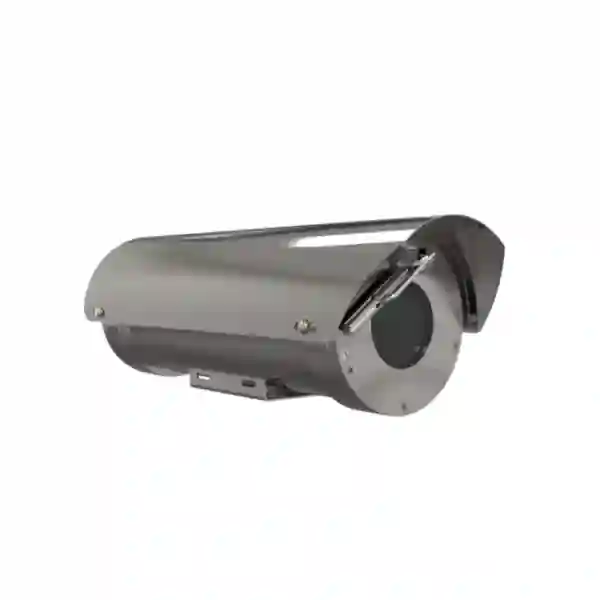
Hanwha TNO-6320E1W-Z Explosion-Proof Zoom Camera
A fixed-position 2MP industrial network camera with 32x optical zoom, integrated wiper, 120 dB WDR and 24V AC input. Choose it by the observation task and documented hazardous-area requirements, not by zoom specification alone.
Key verified specifications
| Feature | TNO-6320E1W-Z |
|---|---|
| Manufacturer and type | Hanwha Vision, explosion-proof fixed-position zoom camera |
| Video resolution | 1920 × 1080 (2MP Full HD) |
| Maximum stated frame rate | Up to 60 fps at 1080p |
| Optical zoom | 32x with autofocus |
| Wide dynamic range | 120 dB |
| Stream support | Multiple video streams |
| Event functions | Intelligent video analytics; confirm required events |
| Window care | Integrated wiper |
| Edge storage | Built-in microSD / microSDHC / microSDXC slot |
| Electrical input | 24V AC |
| Hazardous-area acceptance | Verify exact variant certification against the site classification |
| Commercial status | Price, stock, lead time and local approval not verified |
Specifications are based on Hanwha Vision’s exact-model information; any additional mechanical or certification detail should be confirmed against the final supplied variant documentation.
Where this camera fits
The Hanwha Vision TNO-6320E1W-Z is an explosion-proof fixed-position network zoom camera for a surveillance point where ordinary commercial CCTV equipment may not be appropriate. Its 2MP Full HD imaging, 32x optical zoom, 120 dB wide dynamic range, built-in wiper and 24V AC input make it a specialist candidate for process facilities, industrial perimeters and selected hazardous-area observation tasks. The first purchasing question is not simply how far the camera can see. It is whether the exact camera variant, enclosure certification, installed accessories and electrical design satisfy the documented classification of the proposed position.
For Tanzania-based project teams, this means the product should be evaluated against the site drawings, hazardous-area assessment, operating procedures, environmental conditions and recording requirements before any order is placed. Explosion-proof is a technical equipment designation, not a universal permission to install the camera in every gas or dust hazard. A competent designer should review the equipment marking and supporting documents for the exact unit to be supplied. Ask FourTeck Tanzania for a model-specific quotation and confirmation of documentation rather than relying on a generic hazardous-area label.
An immediate, practical specification overview
This model records up to 1920 × 1080 pixels at up to 60 frames per second. The manufacturer identifies a 32x optical zoom with autofocus, multiple video streams, intelligent video analytics, integrated wiper, 120 dB wide dynamic range and a built-in microSD, microSDHC or microSDXC memory-card slot. Its listed input is 24V AC. These figures help a buyer establish the broad visual and infrastructure fit, but actual recording frame rates, retention, network usage and image usability still depend on configuration, lighting, subject motion, viewing distance and the connected system.
The TNO designation matters. This is described by Hanwha Vision as an explosion-proof zoom camera, not a remotely panning and tilting positioning head. A powerful zoom lens changes framing and apparent subject size inside the camera’s mounted line of sight; it does not turn a fixed station into a PTZ. If operators need the camera to track around a tank farm or move between several directions, a separately specified hazardous-area PTZ or positioning camera should be assessed instead.
The industrial surveillance problem it addresses
A hazardous industrial location often combines two distinct requirements. The camera needs enough visual detail to show an event, and every item of electrical equipment placed in the classified location must be selected and installed appropriately. Conventional outdoor protection against rain is not the same as hazardous-area explosion protection. The camera station is intended to bridge those needs through an explosion-proof equipment configuration paired with Full HD network video. Whether it is acceptable for a particular plant depends on site classification, equipment markings and professional review.
Think about what operators genuinely need to observe: a gate at the boundary of a process area, vehicle activity approaching a loading bay, a remote equipment status indication or a defined section of a pipeline installation. These are observation objectives, not promised detection distances. A site survey should establish where the camera can be mounted, what the field of view covers at wide and telephoto settings, how lighting changes across the day and whether safety procedures allow maintenance access. The purchasing specification should state the observation target before it states the camera brand.
2MP Full HD image quality in context
At its maximum stated resolution, the TNO-6320E1W-Z produces a 1920 × 1080 image. This can support useful visual review when the target occupies enough pixels, but resolution alone cannot guarantee facial recognition, instrument reading or reliable identification at an arbitrary distance. Lens setting, scene contrast, atmospheric conditions and vibration all influence the outcome. A narrow telephoto view can show more detail in a smaller area, while a wider view offers situational awareness with less detail on a distant object.
Define the required outcome in ordinary operational language. Is the objective to verify that a vehicle has entered a monitored lane, observe a valve platform, read a large status indicator or distinguish activity at a boundary? Then perform a site-specific pixel-density and field-of-view assessment, ideally with representative lighting and an example target. This approach prevents the costly assumption that a camera described as Full HD automatically meets every forensic or process-monitoring requirement.
What 32x optical zoom really provides
The 32x optical zoom is a central reason to consider this camera. Optical zoom changes the lens configuration rather than merely enlarging an existing digital image. It is useful when a fixed surveillance position must offer both a broader context view and a closer view of an object along the same general direction. The manufacturer’s associated technical literature for this model family gives a focal-length range of 4.44 to 142.6 mm, although the exact supplied documentation should be checked during procurement.
Zoom needs a disciplined operating plan. When the view narrows, nearby areas fall outside the image; an operator who zooms into one piece of equipment can lose sight of activity elsewhere. Autofocus assists with finding a sharp image, but it cannot remove every effect of haze, dirt, low illumination or vibration. Decide whether a permanent wide view, a permanent detailed view or occasional remote zoom adjustment suits the monitoring objective. Where simultaneous wide and detailed coverage is essential, multiple viewpoints may be better than a single highly zoomed camera.
High frame rates and moving subjects
Hanwha Vision specifies 1080p operation at up to 60 fps. A higher capture rate may help produce smoother footage of fast-moving vehicles, machinery and personnel than a much lower frame rate, provided the video pipeline is configured to support it. The maximum published figure is a capability ceiling, not a promise that every recording server, archive or viewing connection will continuously preserve 60 fps.
During design, agree the frame rate actually needed for each recording profile. Many stationary surveillance scenes do not require the same temporal detail as a loading or vehicle movement area. Higher frame rates can increase storage, recording throughput and monitoring workload. Check motion blur and shutter behavior as well: additional frames cannot recover details lost because the image was exposed too long or the subject was poorly lit. Commission the installed system against real activity rather than a specification-sheet number alone.
Managing backlight and uneven brightness
The camera’s 120 dB wide dynamic range is relevant where bright and shaded regions appear together. Examples include a doorway opening onto a sunlit yard, a loading area shaded by a large roof or a scene with equipment silhouette against a bright sky. WDR processing is designed to balance challenging contrasts so important scene content is less likely to be lost in extremes of light and shadow.
However, WDR does not replace thoughtful placement and lighting. Strong reflections from polished equipment, intense floodlights, a low sun or a dirty camera window can still compromise the picture. Review representative images at different times, including after dark, before treating the selected viewpoint as final. The 120 dB figure belongs to this specific legacy model: do not substitute the 150 dB specification sometimes advertised for newer Hanwha X-series explosion-proof cameras.
Day and night planning
Industrial operations often continue outside daylight hours. The camera family documentation describes day-and-night operation, while the current model summary emphasizes Full HD video, zoom and wide dynamic range. Those capabilities can be useful in variable illumination, but they should not be read as a guarantee of useful footage in complete darkness. A camera needs sufficient light, appropriate shutter settings and a suitable scene to deliver usable visible-light imagery.
Ask the design team to specify measured or expected illumination at the subject, not only at the camera pole. Where light is insufficient, assess suitable area lighting that is independently approved for its installation location and operational purpose. Do not assume this camera includes an infrared illuminator, thermal sensor or intrinsically safe lighting package. Those are different functional requirements. Test the final day, dusk and night scenes with actual operational targets before accepting the installation.
Why the integrated wiper matters
An integrated wiper is part of Hanwha Vision’s stated feature set for the TNO-6320E1W-Z. In an outdoor industrial location, rainwater, fine spray and deposits on a viewing window can reduce contrast and obscure details precisely when operators want a clear picture. A wiper provides a practical means of clearing certain surface obstructions without immediately visiting the mounting position.
A wiper is not a complete self-cleaning system. Dust buildup, oil film, salt deposits, hardened contamination or a worn blade may still require inspection and approved cleaning procedures. Before commissioning, check operating controls, coverage across the viewing window, blade condition and any site restrictions on cleaning chemicals. If a washer system is needed, treat it as a separate accessory and compatibility exercise; do not assume a tank, pump or hazardous-area washer assembly is included in the base product.
Intelligent analytics as operational assistance
The manufacturer lists intelligent video analytics for this camera. Analytics can support event awareness by helping a monitoring team focus on selected changes or activity, but a purchasing specification must describe which exact event types, firmware behavior and integrations are needed. Do not treat a general analytics label as evidence that every advanced detection function, object classification or modern AI capability is built in.
A sensible pilot begins with one measurable goal, such as reducing unnecessary operator review of a defined scene. Check how shadows, rain, animals, glare, swaying vegetation and process movement affect event reliability. Agree who receives an alert, what the operator should do and how recordings can be retrieved. Analytics should support trained personnel and documented safety processes; it should not substitute for a plant safety instrumented system, emergency shutdown mechanism or legally required hazardous-area protection.
Multiple streams and system design
The camera supports multiple streaming, allowing an integrator to consider different video profiles for recording and live monitoring. For example, the central recording profile might prioritize detail while a remote viewing profile is chosen for lower bandwidth. The exact available configuration and codec choices must be verified against the supplied firmware, recorder and camera documentation rather than copied from a different Hanwha model.
A useful specification names both the high-quality recording path and the lower-bandwidth viewing path. It also defines the number of simultaneous viewers, desired latency, operating hours, network resilience and storage policy. Trial these assumptions under representative network load. If several users watch the same scene, the system design should avoid multiplying traffic unexpectedly. A camera that performs well on a laboratory switch can behave differently after installation across a long industrial network.
Local edge recording and retention
Hanwha Vision lists a built-in microSD, microSDHC or microSDXC card slot. Edge storage can be useful as part of a resilience or local recording strategy, subject to the supported card types, capacities, firmware settings and recording modes. It should not be confused with a guaranteed long-duration archive or an automatically synchronized replacement for a central video management system.
Decide what footage must be preserved, for how long and who may access it. Then calculate retention from resolution, frame rate, compression, scene motion, operating schedule and available capacity. Protect evidence through appropriate access controls and retrieval procedures. A memory card has endurance and environmental limits; replacement and health monitoring may be necessary. If uninterrupted recording through a network outage is critical, verify exactly how the chosen recorder and camera handle disconnection, recovery and any required gap filling.
Compatibility with NVR and VMS platforms
Network-video compatibility should be treated as a tested integration, not assumed from an Ethernet connector or a recognizable brand. The older model-family material references common network-video protocols and ONVIF Profile S, but the buyer should ask for the exact current documentation and validate the intended NVR or VMS combination. Some integrations expose live video while limiting analytics events, wiper controls, storage management or detailed settings.
Before purchase, record the target recording platform, supported camera firmware, intended video stream parameters and features the operator actually needs. If a third-party recorder is proposed, obtain an integration test or supported-camera confirmation for this precise model where possible. A compatibility list for a successor model or a similarly named PTZ unit is not conclusive evidence for the TNO-6320E1W-Z. Include basic event playback and user-permission tests in commissioning, not only a successful live image.
Network security and access design
An industrial camera is also a network endpoint. The security plan should cover account roles, password controls, firmware management, network segmentation, permitted management paths, secure time synchronization and auditable access to video. Segregate operational surveillance traffic appropriately from general office devices and public internet exposure. The precise security features available must be checked in the documentation for the installed firmware.
Assign responsibility for commissioning credentials, backup configuration and subsequent changes. Avoid leaving default credentials, broad administrator access or unnecessary inbound services enabled. If remote viewing is needed, use a centrally approved secure design rather than exposing camera management directly. Review the life-cycle status of the exact model as part of cybersecurity assessment, including the availability of supported firmware and relevant security guidance. These checks are particularly important where surveillance equipment is connected to an industrial operations network.
Power requirements: 24V AC is significant
The official product summary specifies 24V AC input. Buyers should treat this as an essential infrastructure requirement: it is not equivalent to saying the camera is powered by ordinary Ethernet PoE. The power distribution design needs a suitable source, appropriate cabling, voltage-drop assessment, protective devices and compliant hazardous-area installation practices. Exact consumption and accessory load should be confirmed from the final datasheet for the ordered variant.
Plan what happens during a short power interruption and what the camera must do when power returns. The rest of the system, including switches, recorder, storage and network links, may need coordinated backup power. A backup supply is only useful if every necessary component on the viewing and recording path remains available. The electrical designer should verify earthing, isolation and permissible equipment placement without improvising power conversion inside a classified area.
Explosion protection is a system decision
This camera is marketed as explosion-proof, and the earlier manufacturer model-family technical sheet describes an explosion-protected camera station with a specialist metal enclosure and approval variants. That is useful context, but certification applies to particular equipment configurations and conditions, not merely to a marketing name. The exact marking, certificate number, temperature class, gas or dust grouping, permissible ambient range and installation conditions for the requested -Z unit should be reviewed before selection.
Ask the responsible engineer to compare those documents against the site’s hazardous-area classification and any applicable Tanzanian legal or project requirements. Enclosure openings, glands, seals, conduit methods, terminations, cable protection, fasteners and approved accessories all matter. Do not infer that a North American class or division marking automatically satisfies another project standard. Neither an IP water-ingress rating nor a stainless-steel finish independently establishes explosion protection. A correct camera can become an unsuitable installation if the surrounding equipment or installation method is wrong.
Housing construction and exposure
The model-family documentation describes electro-polished 316L stainless steel in the enclosure construction and a toughened-glass camera window. This combination is relevant for facilities that need mechanically robust, corrosion-conscious equipment, but it should never be translated into a blanket promise of immunity to seawater, acid, process chemicals or abrasion. Corrosion behavior depends on concentration, temperature, deposits, cleaning methods and maintenance.
The industrial environment survey should record likely exposure to rain, salt-laden air, airborne dust, chemical vapor, washdown and vibration. Compare those conditions with the exact product operating limits and installed enclosure rating. Check mounting components and fasteners as a complete assembly: a resilient camera housing does not compensate for a bracket that loosens, corrodes or vibrates. If a coastal or chemically aggressive site is involved, document the exposure rather than relying solely on a generic outdoor-camera category.
Mounting and field-of-view planning
An explosion-proof camera station is a substantial mechanical installation rather than a small office CCTV camera. The earlier family sheet describes a unit weight of up to about 15 kg, but final mounting loads and dimensions must be confirmed from the exact supplied drawing. A structural engineer or qualified installer should assess the bracket, foundation, wind exposure, vibration, maintenance access and any location-specific safety requirements.
Position the camera so that critical views are not blocked by pipework, tanks, parked vehicles or seasonal vegetation. Document the desired wide and narrow views and check reflections from lighting and nearby surfaces. Ensure personnel can safely inspect the wiper and window when needed. Mounting arrangements and accessories should be specifically approved for the camera station and its classified-area installation. Do not select a bracket simply because its catalog photo resembles a compatible part.
Cable routing and gland selection
Cable routing can determine whether an apparently suitable camera is practical at a real plant. The model-family documentation shows dedicated cable entries for the explosion-proof station. The final project drawing should establish entry sizes, permitted cable types, glands, sealing components, mechanical protection and the route between camera, network equipment and power distribution. These choices require qualified hazardous-area design and installation.
Do not modify the enclosure, enlarge a cable opening or substitute a convenient gland without checking the manufacturer’s instructions and applicable equipment certification. Plan cable separation, bend radius, termination access and the impact of water ingress or mechanical damage. At commissioning, retain a record of the installed components and inspection results. The documentation is valuable later when an accessory is replaced, a cable is repaired or the monitored area is modified.
A practical five-stage project workflow
Start with the observation objective and hazard assessment. The site team should identify the location, classification, what must be seen and what action an operator will take after seeing it. Second, establish optical suitability using camera placement, field of view, lighting and zoom requirements. Third, check the exact model documentation for certification, power, environmental limits and accessory compatibility.
Fourth, design the complete video path: mounting, cable route, network segmentation, NVR or VMS integration, user roles, storage and backup power. Fifth, conduct controlled acceptance tests with representative daytime and nighttime footage, zoom operation, wiper behavior, recording playback and communication recovery. Record exceptions and responsibilities instead of assuming that an illuminated power indicator means commissioning is complete. This workflow makes technical procurement decisions reviewable by security, engineering, operations and maintenance teams.
Applications worth evaluating in Tanzania
Potential applications include controlled viewpoints within energy facilities, oil and gas infrastructure, chemical-processing settings, tank or pipework areas and other locations where a formal hazard assessment may call for specially protected surveillance equipment. These are examples for suitability assessment, not a claim that every such site has the same hazard classification or that this model is automatically accepted by any authority.
In a fuel-handling environment, operators may need a documented view of vehicle approach and loading procedures. In a process plant, the goal could be visual confirmation of activity around a defined unit. At an industrial perimeter, zoom may help inspect an assigned sector from a fixed station. In each case, the actual need may be ordinary weatherproof CCTV outside the classified zone, a hazardous-area fixed zoom camera, a certified PTZ unit or a different type of instrumentation. A proper requirements study decides which category is appropriate.
Tanzania procurement and project considerations
For projects in Tanzania, procurement teams should confirm import and supply arrangements, exact equipment variant, required documentation, support arrangements and site access logistics directly with the supplier. No stock position, delivery time, local certification, installation coverage, warranty length or Tanzania shilling price is asserted here. These details need a current listing-specific confirmation before they appear in a purchase order or project schedule.
Project conditions can vary widely between inland industrial sites and exposed coastal installations. Instead of assuming a standard environment, provide expected ambient temperatures, potential corrosion sources, available power quality, lightning or surge exposure and network topology to the designer. Coordinate the surveillance plan with workplace safety procedures and the site’s electrical and hazardous-area specialists. The camera should be one documented part of a compliant project rather than an isolated equipment purchase.
Choosing fixed zoom versus a PTZ camera
The TNO-6320E1W-Z is a fixed-position zoom camera. Its viewing direction is determined by its mounting position, even though its focal length can be adjusted. That makes it suitable when a defined corridor, gate, loading point or piece of equipment is the primary observation target. Operators can request more detail in that direction but cannot use the product as a continuously rotating surveillance head.
A hazardous-area PTZ or positioning model has a different operational role: it may allow the viewing direction to move between sectors. Such equipment can carry different mounting loads, power requirements, maintenance demands and certification conditions. The similarly named Hanwha TNP and TNU families should not be confused with this TNO unit. If a requirement document calls for pan, tilt, auto tours or full azimuth coverage, ask for an appropriately certified PTZ solution rather than changing the fixed-camera description.
Avoiding specification confusion with newer models
Hanwha markets several generations and variants of explosion-proof equipment with very similar names. A successor X-series zoom model may advertise newer compression options, different WDR performance or additional memory-card slots. Those features must not be silently transferred to the TNO-6320E1W-Z merely because the product bodies or naming conventions appear related.
Purchase orders should reproduce the complete model string, including its suffix, and ask for a final manufacturer datasheet. Check any proposed substitution on five independent points: hazardous-area marking, power input, video and storage features, mounting geometry and recording-platform compatibility. If the originally requested model is unavailable, a technically better-looking replacement is not automatically an authorized replacement for the classified location. Changes require design review and approval by the project’s responsible people.
How to create a useful recording specification
A meaningful surveillance specification goes beyond megapixels. Define the monitored scene, expected lighting, minimum image usefulness, required operating hours, nominal frame rate, recording resolution, storage period, evidence export method and remote-access rules. Add requirements for loss-of-video alerts, user administration, clock accuracy, retrieval time and resilience after network outages. Each should be testable.
Where the camera has an operational safety-adjacent role, clarify that a video image assists observation but does not independently certify process conditions. The agreed procedure should state which events are monitored visually and which require dedicated instrumentation, alarms or an operator site visit. This separation helps prevent surveillance equipment from taking on responsibilities outside its intended function.
Installation acceptance checks
Before handover, verify the supplied model label against the order and record the exact hazardous-area documentation applicable to the installed unit. Inspect installation records for the enclosure, entries, glands, bracket and power connection. Test communication from the designated recording network rather than from an ad hoc laptop connection. Confirm camera time and user access permissions.
Capture sample footage at wide and telephoto settings; inspect images in strong sunlight, darkness and any relevant artificial lighting. Test focus recovery, wiper operation, stream selection, recording continuity and retrieval of an event clip. Simulate a controlled network or power recovery when permitted by the site’s procedures. Record outstanding actions with an owner and completion criteria. Keeping this acceptance evidence can make future troubleshooting far more efficient.
Maintenance after commissioning
Plan routine inspection around the risk profile and permitted maintenance access for the installation. Possible activities include examining the viewing window, checking the wiper, reviewing image quality, inspecting mounting stability, verifying recording and reviewing camera event logs. Any opening or intervention in a hazardous-area enclosure must follow the manufacturer’s instructions and the site’s authorization procedures.
An image-quality review can catch problems that ordinary network monitoring cannot: a shifted viewpoint, persistent dirt, lighting changes or a new obstruction. Confirm backup and recovery procedures for camera configuration, and document firmware decisions. Some service activities may require isolating equipment or using qualified personnel with specific permissions. A low price for an incomplete maintenance plan can become expensive when a critical view is unavailable during an incident.
Common purchasing mistakes to avoid
One common error is choosing this unit because it is called explosion-proof without examining the exact approval marking. Another is equating 32x zoom with remote pan and tilt. A third is assuming 24V AC can be replaced by PoE from a convenient network switch. Each mistake can cause redesign, procurement delays or inappropriate installation.
Other pitfalls include ordering a bracket or washer assembly without confirmed compatibility, relying on the newest X-series specifications for an older model, underestimating storage and bandwidth, or accepting a live preview as proof that the entire recording workflow works. Buyers can reduce these risks by asking for a model-specific submittal package and tying acceptance to the actual scene and system outcomes.
Documents to request before an order
Ask for the current model-specific datasheet, complete manufacturer identifier, environmental and electrical ratings, relevant certification documents, installation instructions and compatible accessory information. Also request written clarification of the product’s support or lifecycle position and the supplier’s proposal for the intended project. If a modern alternative is proposed, obtain a side-by-side technical comparison rather than an informal statement that it is equivalent.
The enquiry should include enough design context to receive a useful answer: hazardous-area classification, observation distance and field of view, lighting, power availability, preferred recording software, network arrangement, mounting situation and required documentation. State any non-negotiable project standard explicitly. FourTeck Tanzania can then be asked to prepare a quotation and identify what further evidence is needed before approval; no claim about current stock or authorized distributorship is implied.
A clear buying checklist for technical evaluators
Confirm the full TNO-6320E1W-Z model string and whether a substitute is permitted. Identify the site classification and have the project engineer assess the exact certification. Define the target scene, required detail, wide and zoomed views and realistic lighting. Validate the 24V AC power source, cable paths, mechanical support, network topology and recorder compatibility. Agree a retention period and a practical test procedure.
Record who will review the datasheet and certification documents, who owns IT security, who approves hazardous-area works and who accepts the final video performance. Seek a current written quotation only after those questions are sufficiently defined. This disciplined sequence protects both the purchasing team and the people who will depend on the footage during operations.
Frequently asked questions
Is the Hanwha TNO-6320E1W-Z a PTZ camera?
No. Hanwha Vision calls it an explosion-proof zoom camera. It has a 32x optical zoom, but it should not be described as a motorized pan-and-tilt camera. If a location requires changing the viewing direction remotely, assess a suitable hazardous-area PTZ or positioning model.
Does the camera capture 1080p video at 60 fps?
The manufacturer lists Full HD 1080p operation at up to 60 frames per second. Actual recorded results depend on the selected stream, connected recorder, bandwidth and operating configuration. Confirm the required setting during system acceptance.
What does 32x optical zoom mean for operators?
It means the lens can adjust from a comparatively wide view to a much narrower detailed view. It does not guarantee a particular identification distance or provide movement around the camera. Calculate field of view and image detail for the intended mounting position.
Does the camera include a wiper?
Yes. An integrated wiper is one of the manufacturer’s listed features. It may help keep the viewing window clear in rain or spray, but it does not remove every contaminant and does not prove that a washer tank or cleaning solution is supplied.
Is it powered by PoE?
The stated power input for the TNO-6320E1W-Z is 24V AC. A purchaser should not assume that a normal PoE switch can power the camera. Confirm the complete electrical design, consumption and any optional equipment from current model-specific documentation.
Can it operate in any hazardous area?
No such universal conclusion can be drawn from the product name. Suitability depends on the installed equipment’s exact certification, temperature rating, gas or dust classification, installation conditions and the project’s accepted requirements. Obtain review from a qualified hazardous-area professional.
Can it store footage without a central NVR?
Hanwha Vision lists an internal microSD-family memory-card slot. Whether local recording meets the project’s retention, event recovery and resilience needs depends on supported cards, settings and integration. A slot alone should not be used as proof of archive capacity.
Does the camera support AI analytics or facial recognition?
The model summary lists intelligent video analytics, but it does not establish every modern AI function or a guaranteed facial-recognition capability. Ask for the actual supported event list and test any required analytics using the intended firmware and recording platform.
Is this the same as the newer TNO-X6320E1WT1-Z?
No. It is a different full model designation. Hanwha’s newer X-series documentation describes different capabilities, including higher WDR figures. Do not transfer those features to the TNO-6320E1W-Z without explicit supporting evidence.
Can it be used in outdoor facilities in Tanzania?
It is intended for industrial surveillance and may be considered for suitable sites, subject to a detailed environment and hazardous-area assessment. Check exposure, corrosion, actual operating limits, installation rules, project approvals and local supply details before selection.
What information should I provide to request a quotation?
Provide the complete model number, desired quantity, classified-area documentation, required mounting position, viewing objective, available power, recorder or VMS platform, site environmental conditions and any project standards. Ask for current price, availability and model-specific technical documents in writing.
Will the camera replace a process safety instrument?
No. A surveillance camera can help operators observe defined conditions, but it should not be represented as a substitute for certified alarms, protection systems, emergency controls or required inspections. Design safety functions separately and follow site procedures.
Request a model-specific industrial camera quotation
Discuss the Hanwha TNO-6320E1W-Z with FourTeck Tanzania and share your location requirements, hazard classification, quantity, power arrangement and intended NVR or VMS. Request the exact technical documents, certification evidence and commercial terms for review before procurement.
Next step: Ask FourTeck Tanzania for a quotation and documentation review.




Reviews
There are no reviews yet.