
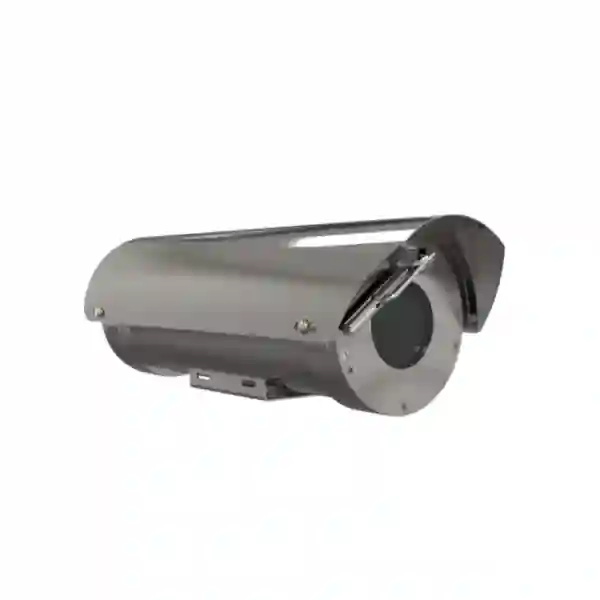
Industrial security | Hazardous-area camera station
Hanwha TNO-6320E2F-Z explosion-proof camera
A fixed, 2 MP network camera station with 32x optical zoom, integrated single-mode fiber, 110 V AC input and a stainless-steel enclosure. Built for engineered surveillance projects in classified industrial environments, subject to site-specific approval.
Key verified specifications at a glance
| Model | TNO-6320E2F-Z (fixed explosion-proof zoom camera station) |
|---|---|
| Image | Up to 2 MP, 1920 × 1080; up to 60 fps in supported settings |
| Lens | 4.44–142.6 mm; 32x optical zoom; 16x digital zoom |
| Imaging features | Day-night ICR; WDR 120 dB; autofocus-related functions; defog |
| Compression | H.264 and MJPEG; multiple streaming |
| Data connection | Integrated simplex single-mode 9/125 μm fiber |
| Power | 110 V AC; approximately 37 W maximum |
| Enclosure | Electro-polished 316L stainless steel; toughened-glass window |
| Ingress rating | IP66/IP67/IP68 family specification; observe stated test conditions |
| Environment | Approximately −40 °C to +60 °C operating range |
| Hazardous-area variant | Z suffix: documented cLCus Class I, Division 1 configuration; exact certification must be verified |
| Wiper and movement | No integral wiper; fixed-view housing, not motorized PTZ |
Specifications are based on documented legacy TNO-6320E2F family information. Confirm exact delivered-unit labeling, supported firmware and applicable certificates before a hazardous-area installation.
What this industrial camera is designed to solve
Security teams responsible for hazardous industrial locations need more than a sharp picture. They need a camera assembly selected for the actual classified area, a practical way to carry video back to the control room, and a lens that lets an operator inspect equipment without placing a person close to the process. The Hanwha TNO-6320E2F-Z explosion-proof camera addresses that type of requirement with a fixed camera station, full-HD imaging, a long-range optical zoom, a stainless-steel enclosure, and an integrated single-mode fiber connection. It is intended for deliberate camera positions where the monitoring direction is known before installation.
The product is relevant to industrial security and operational observation around selected refinery, petrochemical, gas-handling, process-manufacturing, and similar sites. Those examples describe potential uses, not a declaration that every location within those facilities is compatible. A hazardous-site camera is chosen from the site’s area-classification drawings, gas or dust grouping, ambient conditions, and applicable safety rules. The location might demand a different certificate, temperature class, protection concept, or mounting method. A qualified project engineer should approve the final selection before a purchase order or installation plan is issued.
Buyers evaluating this model in Tanzania should begin with three simple decisions: does the nameplate approval match the installation location, can the project provide the specified 110 V AC supply and fiber infrastructure, and will one fixed camera direction with remotely adjustable zoom deliver the needed observation? A yes to those questions makes a detailed design review worthwhile. A no means it is better to refine the camera specification than to force a technically attractive device into an unsuitable application. FourTeck Tanzania can be asked to review the exact model requirement and prepare a quote subject to verification.
Exact model identity: avoid ordering the wrong variant
The requested part number is TNO-6320E2F-Z. The letters and suffix matter because closely related camera stations use different enclosure options, electrical arrangements, and approval variants. In the documented TNO-6320E2F family, the F designates the integrated fiber arrangement, while the version without the additional wiper designation is supplied without an integral window wiper. The Z suffix corresponds to the cLCus Class I, Division 1 configuration in the model-family documentation. Always reproduce the complete part number on the request for quotation, drawings, technical submittal, and order acknowledgement.
This is a fixed camera station with a zoom lens, not a remotely rotating pan-tilt-zoom head. The lens can change field of view through its 32x optical zoom, but that does not let it look around a pipe rack or turn to follow a moving target in every direction. Its housing points where the installer aims it. If an operator needs to scan several directions continuously, the design may require multiple fixed cameras or an appropriately approved hazardous-area PTZ assembly. The distinction affects coverage, mounting position, cabling, maintenance effort, and total project cost.
It is equally important not to copy specifications from a newer TNO-X series device onto this older TNO model. Hanwha’s more recent industrial lineup includes differently named explosion-proof camera stations, and product generations can differ in image processing, power arrangements, electronics, supported functions, and certifications. A comparison should be made using two exact model-number datasheets rather than a shared family name. For this requested model, the documented baseline is a 2-megapixel SNZ-6320-based fixed station, 110 V AC power, and single-mode fiber, with no integral wiper.
32x optical zoom and coverage planning
The 4.44 to 142.6 mm lens provides 32x optical zoom. At its wide end the camera sees a comparatively broad scene, while the telephoto end narrows the view to inspect a smaller part of a distant asset. The family datasheet states an approximately 62.8-degree horizontal view at wide angle and 2.23 degrees at telephoto. That range can be useful when operators need to move between a broad overview and a valve bank, access gate, gauge enclosure, or equipment label. Optical zoom changes framing without relying solely on digital enlargement of the recorded pixels.
Zoom capability does not eliminate the need for an engineering coverage study. At a narrow field of view, small changes in aim become significant, and vibration or movement of the mounting structure may make a distant target harder to keep centered. The designer should establish the approximate target distance, expected horizontal scene width, required pixel detail, physical obstructions, daylight direction, and whether the operator needs continuous observation or occasional inspection. A practical design tests wide and telephoto views against actual tasks rather than assuming that maximum zoom provides useful detail in every condition.
The camera offers autofocus-related capability in the source documentation, but focus performance will still depend on light, scene contrast, atmospheric conditions, and the geometry of the enclosure window. Heat shimmer, rain on the window, dust, smoke, and long standoff distances may limit what can be recognized in the final image. Record the intended reference targets during site acceptance testing. If the real objective is to read a small instrument from a very long distance or verify a specific process indication, require a field-of-view demonstration before treating the camera as sufficient.
Image quality, day-night operation and recorded evidence
The documented camera resolution is up to 1920 by 1080 pixels, with a maximum frame rate of 60 frames per second in supported settings. Full-HD video can provide a useful balance between scene detail and recording demands for industrial observation. The sensor is described as a 1/2.8-inch CMOS device within the SNZ-6320-based assembly. This camera is a conventional visible-light network camera; it is not a thermal imager and should not be marketed as one. It cannot directly measure surface temperature or detect invisible gas leaks simply because its housing is explosion-proof.
Day-night switching with an infrared-cut filter, digital noise reduction, defog processing, and 120 dB wide dynamic range are documented features. They can help when a scene includes strong highlights, shaded equipment, changing daylight, or atmospheric haze. They do not guarantee a readable image through opaque smoke, thick dust, a dirty glass window, or total darkness. Where night-time monitoring is necessary, the project must separately evaluate available lighting and whether any added lighting or illumination equipment is suitable for the classified location. Do not assume an integrated infrared illuminator is included.
The source documentation lists H.264 and MJPEG video compression with multiple streaming. Those formats can support different monitoring and recording profiles, but the chosen settings determine bandwidth, storage consumption, latency, and image quality. A 60-frame-per-second maximum is not a promise that every combination of codec, analytics, resolution, and network conditions will maintain that rate. During design, agree on the actual recording frame rate and quality needed for the security objective, then prove the result with representative motion and lighting before commissioning the system.
Single-mode fiber networking for an industrial site
The E2F camera station includes an integrated fiber module described for simplex single-mode 9/125-micrometre fiber. Fiber can be attractive for long industrial cable routes and can reduce some of the electromagnetic-interference concerns associated with copper video links. However, the fact that the assembly has fiber does not establish the connector style, transceiver wavelength, maximum reach, optical budget, or compatibility with an existing switch. Those parameters need confirmation from the applicable installation documentation and the selected receiving equipment before the fiber schedule and bill of materials are finalized.
A reliable system design maps the complete path from camera enclosure to termination hardware, network switch, recorder, and operator workstation. Identify the fiber type already installed, splice and patch arrangements, cable protection, port speed, optical loss allowance, and service access. If the location uses a hazardous-area boundary, routing and gland selection must comply with the approved electrical design. Fiber does not remove the need to manage electrical power at the camera, nor does it make the network inherently secure. Video access still needs authentication, monitoring, segmentation, and a sensible maintenance process.
Plan the recording workload separately from the physical fiber link. Multiple streams are useful when the control room needs a live view at one quality level while the recording platform uses another, yet concurrent profiles can consume processing and network resources. Confirm whether the intended video management system can accept the exact model through the relevant supported protocol or tested driver. The legacy datasheet lists ONVIF Profile S and RTSP-related protocols, but a current software platform should be tested against the firmware installed in the delivered unit before integration is described as confirmed.
110 V AC input: an essential purchasing checkpoint
The documented TNO-6320E2F-Z configuration requires a 110 V AC supply, with a listed maximum consumption of approximately 37 watts. That electrical requirement is unusually important during a Tanzania project because the camera must not be connected directly to an unverified local supply merely because its enclosure is suitable for demanding environments. Have a qualified electrical designer specify the appropriate protected circuit and any approved voltage-conversion arrangement necessary for the site. Record the voltage and frequency requirements on the final equipment submittal and confirm them against the delivered nameplate.
Power distribution in a classified industrial area cannot be treated as an ordinary office CCTV installation. Examine circuit protection, isolation, earthing and bonding, cable entry components, gland certification, conductor sizing, maintenance isolation, surge protection, and the interface with the site’s emergency or uninterruptible supply philosophy. Each accessory and method must be suitable for its location and approval conditions. A certified camera alone does not certify the entire cable path, junction box, transformer, support structure, or field-installed assembly.
The camera is not a Power over Ethernet substitute simply because it produces IP video. The model-family documents identify 110 V AC input and a fiber video path. A procurement sheet that says only IP camera may therefore cause a serious design mistake if installers expect a single network cable to carry both video and power. Distinguish electrical supply, optical data, mounting hardware, and any local connection accessories as separate line items. Complete the design review before final cable ordering or site mobilization so the supplied unit fits the planned infrastructure.
Explosion-proof selection and hazardous-area approvals
The documented Z variant is associated with a cLCus Class I, Division 1 approval configuration. The family datasheet identifies Class I, Division 1, Groups B, C, and D, and also gives a Class II, Division 1 dust-group configuration. These details are meaningful only alongside the complete certificate, equipment marking, allowable ambient range, temperature classification, special installation conditions, and project jurisdiction. A label such as explosion-proof is not a universal safety approval for any gas, dust, zone, or country. The competent hazardous-area engineer must determine whether the exact delivered configuration is acceptable.
International industrial projects may use different hazardous-area systems, including zone-based and division-based classifications. Their terminology and approval pathways are not interchangeable without technical review. It would be unsafe to infer ATEX or IECEx approval for this Z suffix from another product in the Hanwha T series or from an alternative suffix in the family table. For a Tanzanian project, the required approval basis should be stated by the client, regulator, or responsible engineering authority. Obtain the full certificate and nameplate evidence for the quoted item before purchase authorization.
Temperature classification is as important as the electrical approval label. The expected ambient temperature around a process line may differ from the regional weather forecast because hot equipment, solar radiation, enclosed spaces, and inadequate ventilation change local conditions. Confirm the gas or dust group, ignition-temperature requirements, environmental exposure, and maximum surface-temperature designation. An IP ingress rating addresses dust and water entry under a different test regime; it is not proof that equipment may be installed in a flammable atmosphere. Treat the two requirements as separate and mandatory.
316L stainless steel enclosure and environmental protection
The assembly is described with electro-polished 316L stainless steel on its welded enclosure components, A4 stainless-steel fixings, and a toughened-glass camera window. These materials are relevant to facilities where corrosion, cleaning, salt-laden air, and industrial contamination can shorten equipment life. They still require appropriate material selection for the chemicals actually present. Stainless steel is not universally resistant to every process chemical, and exposure at the site may involve deposits or cleaning agents that deserve a materials-compatibility check from the plant engineering team.
The TNO-6320E2F family documentation lists IP66, IP67, and an IP68 test condition described as 1.5 metres for 24 hours. That is useful evidence of ingress-protection design, but it should not be translated into an unlimited underwater operating claim. Actual resistance depends on intact seals, correctly selected cable glands, proper assembly, and maintenance practices. Repeated high-pressure washdowns, abrasive dust, chemical spray, salt deposits, or damage to the window can introduce challenges not solved by an enclosure marking alone. Use the manufacturer’s applicable installation and maintenance guidance.
The family specification gives an operating temperature range of approximately minus 40 to plus 60 degrees Celsius and a weight of up to 21 kilograms, depending on configuration. Both values affect mounting design. The support should be assessed for dead load, vibration, wind, nearby mechanical movement, corrosion, and the additional mass of approved brackets or accessories. Engineers should also consider safe access for window inspection, seal maintenance, and any future replacement. Avoid selecting a bracket merely because the bolt pattern appears to fit; its rating and suitability must be verified.
No integral wiper: plan for window cleanliness
A defining detail of this requested model is the absence of an integral wiper. That can be acceptable where the window remains comparatively clean and the enclosure is positioned for safe inspection. It can be a poor fit where rain, mud, chemical mist, persistent dust deposits, or sea spray frequently obscure the glass. Once the image is blurred by contamination on the window, 32x optical zoom and electronic defog processing cannot physically remove the obstruction. Account for window condition in the risk assessment before choosing this no-wiper variant.
If regular window clearing is essential, request a comparison with an exact wiper-equipped model that has the correct hazardous-area approval and power architecture. Do not assume that a wiper can be added to the non-wiper camera after delivery or that the suffix change is cosmetically minor. The manufacturer documents wiper versions separately. Accessories on an explosion-proof enclosure may affect its certification, wiring, dimensions, controls, and maintenance requirements. The safest approach is to specify the required feature in the initial equipment schedule and have the manufacturer or authorized supply channel confirm the exact part number.
For a no-wiper installation, develop a realistic cleaning procedure before handover. Define the inspection interval according to the actual environmental exposure; establish who may access the camera and under what isolation conditions; and use only cleaning methods compatible with the window and enclosure. Include safe working at height if the mounting point is elevated. Record image checks after heavy rain, dusty maintenance operations, or nearby process incidents. A maintenance plan is not an optional finishing touch when the camera view supports important operations or security decisions.
Choosing the best fixed mounting position
A fixed camera station performs best when the monitoring objective is narrow enough to define precisely. Begin with a site drawing showing the asset, access route, security boundary, or process equipment to be seen. Mark the expected camera position, mounting elevation, line-of-sight obstructions, light sources, and main traffic directions. Determine whether the operator needs an overview for awareness, an enlarged view for occasional inspection, or identifiable recorded detail for incident review. Those are different tasks, and one viewpoint may not satisfy all three at the same time.
At 32x zoom the field of view is much narrower than at the wide setting, so even a strong stainless-steel enclosure cannot compensate for a moving pipe support or vibrating steelwork. Consider a foundation or structural member with sufficient stiffness, and avoid positions affected by heat plumes, strong direct sunlight into the lens, exhaust, or routine loading activities. Test mounting height against expected maintenance access and the view through adjacent handrails or cable trays. Account for future equipment additions that could block the original viewing corridor.
A project requiring repeated coverage of multiple widely separated targets may benefit from two or more fixed camera stations rather than relying on digital zoom and hoping one frame covers everything. Conversely, where a single protected process corridor is the priority, the zoom lens may reduce the need for different fixed focal lengths. The selection depends on what must remain visible while the operator zooms into a detail. Discuss simultaneous observation requirements with the control-room team, not just the site security contractor, before approving the final camera count.
Video management, retention and cybersecurity
The documented platform supports network video, multiple streams, H.264 and MJPEG encoding, and standard networking functions. Those capabilities make integration with an appropriately compatible recorder or video management system a reasonable design objective, not a guarantee of plug-and-play operation with every current product. Ask the integrator to validate live video, zoom control, time synchronization, event handling, user permissions, and archive playback in a test environment. Confirm the exact firmware version, supported protocols, and any software-side licensing needed for the selected recorder.
Recording design should be driven by the number of cameras, expected bit rate, resolution, frame rate, motion complexity, operating hours, redundancy target, and required retention period. It is misleading to give a fixed number of recording days based on the camera’s 2 MP resolution alone. Set the retention and retrieval requirements with the owner and then calculate storage with margin for scene variation and operational overhead. If video supports post-incident review, test the export process, timestamp accuracy, auditability, and the ability to retrieve footage during an actual network or power interruption.
Security hardening is part of making an industrial camera useful. Review default credentials, role-based access, secure management paths, available firmware updates, network segmentation, time-service configuration, remote access approvals, and backup procedures. Legacy platforms deserve particular scrutiny because software support and newly disclosed vulnerabilities can change over time. The purchaser should request an explicit firmware and support-status check for the exact model rather than assuming current support from the brand name. Cybersecurity planning should be coordinated with the facility’s operational technology policies.
Procurement and installation documents to request
Before confirming an order, issue an equipment schedule with the complete model TNO-6320E2F-Z, intended mounting location, hazardous-area classification, fiber connection requirement, 110 V AC supply, no-wiper condition, operating environment, and control-system interface. Ask for the current manufacturer-supported product documentation applicable to that exact configuration. Because newer alternatives exist within the product family, request confirmation of whether the requested legacy model can still be supplied, and whether any replacement is technically and commercially acceptable to the project.
A proper technical submission should include the model datasheet, dimensional and weight information, certificate and marking evidence, installation instructions, electrical and cable-entry requirements, proposed mounting accessories, fiber interface details, and a supported software integration path. Compare every returned line item to the design rather than checking only the product photograph or the general explosion-proof description. Certificates and accessories must match the quoted suffix. If a supplier offers a substitution, ask for a side-by-side deviation list identifying every changed specification that could affect the installation.
Commercial questions should be handled separately from engineering suitability. Request a current quotation in the agreed currency, with the confirmed item, necessary accessories, applicable delivery terms, warranty terms, commissioning responsibilities, and any exclusions. Do not assume that historical prices or lead times from another country represent Tanzania availability. The correct buying step is to validate both the technical offer and the commercial offer for the actual project. A request for quotation should not be mistaken for confirmation of stock, immediate shipment, local approvals, or a fixed turnaround time.
Commissioning and practical acceptance testing
A factory or site acceptance checklist helps prevent a technically suitable camera from becoming an unreliable installation. Start by matching the delivered label and serial information to the approved submittal, checking visible enclosure condition, confirming the supplied accessories, and reviewing the installation instructions with the responsible electrical and hazardous-area personnel. Inspect gland and cable arrangements under the approved site procedure before energizing. The installer should not improvise drilling, adapters, enclosure alterations, or substitute fasteners on certified equipment without the appropriate approval.
Once the approved electrical and fiber connections are complete, verify network reachability, authenticated access, video streaming, lens zoom travel, autofocus behavior, day-night changeover, wide dynamic range, and event functions required by the project. Check optical performance at the actual farthest and closest reference targets during both daylight and the lighting conditions expected at night. Confirm that the 110 V AC supply remains within the approved input requirements during operating conditions. Any unstable image, unexpected restart, or repeated network drop should be investigated before sign-off.
Finally, test recording rather than just the live picture. Verify stream settings, video-management compatibility, time stamps, alarm routing where configured, playback, export, storage alerts, and authorized user access. Photograph the completed installation and retain as-built wiring, fiber test results, configuration records, inspection certificates, and a maintenance handover. Assign responsibility for future firmware decisions and cleaning the exposed window. The final acceptance outcome should state which monitoring objectives were actually demonstrated and which remain subject to operational review or later modifications.
How to compare alternatives without losing the requirements
Not every industrial surveillance application needs the same camera station. A conventional protected-area camera may cost less to deploy but cannot be substituted for equipment required to meet the location’s hazardous-area rules. A thermal model can assist with certain visibility or temperature-related applications, but it should not be confused with this visible-light 2 MP zoom unit. A fixed wide-angle industrial camera covers a larger area at once, while a motorized hazardous-area PTZ can provide directional flexibility if correctly specified. Evaluate the actual monitoring task before comparing price tags.
Within the Hanwha industrial family, the easiest error is to treat all suffixes as interchangeable. A wiper-equipped version changes window-maintenance capability. A PoE-oriented model changes electrical design. A different region or certification suffix changes the approval evidence that the engineer must review. Newer-generation X-series cameras may also change imaging, analytics, firmware, or optical specifications. The correct comparison table should list the exact model, power input, data connection, wiper, optics, certified classification, temperature range, ingress protection, support status, and delivered accessories.
For a buyer in Tanzania, a supplier should help resolve the decision with a model-specific quotation and a documented technical review. If the no-wiper single-mode-fiber 110 V AC configuration meets the project’s requirements, the TNO-6320E2F-Z specification provides a clear starting point. If not, identify the failed requirement explicitly and ask for a fully documented alternative. That method is more useful than replacing the requested model with a vaguely similar explosion-proof camera or making assumptions based on generic product-category descriptions.
Tanzania project checklist before requesting a quote
Local project suitability must be established from the site and the responsible engineering authority, not inferred from an international marketing page. Provide a concise description of the facility, whether the camera is inside or outside a classified area, and which gases or dusts are present if applicable. Include the site’s area-classification drawing or the exact required equipment marking, the maximum expected local ambient temperature, exposure to corrosive or saline conditions, and the intended mounting location. Do not send confidential site diagrams through an unapproved channel; use the purchaser’s approved quotation process.
Also provide information about the camera-to-control-room route. Confirm whether suitable single-mode fiber already exists or must be installed, the termination equipment, available power, preferred video management platform, and expected recording policy. Specify whether the window can be maintained safely without a wiper. These details determine whether the original model is a practical fit and which additional components should appear in the technical offer. They can also reveal a need for a different lens coverage plan, an alternative mount, or a compatible replacement camera.
There is no verified Tanzania selling price, current stock position, delivery commitment, or local approval outcome included in this product description. Those items must be confirmed for the exact order and destination. Use the request-for-quotation step to obtain a model-specific technical and commercial response before committing installation resources. Ask for any deviations to be highlighted explicitly so the project engineer can approve them. The goal is a defensible industrial surveillance purchase that works with the plant’s safety rules, power, optics, network, and maintenance arrangements.
Frequently asked questions
Is the TNO-6320E2F-Z a PTZ camera?
No. It is documented as a fixed explosion-proof camera station with a 32x optical zoom lens. The camera’s field of view can be changed, but the fixed enclosure is not a motorized pan-and-tilt head. The installer chooses the viewing direction at mounting time. If the project needs remote sweeping coverage over several directions, request a comparison with a correctly certified PTZ product rather than describing the zoom feature as pan-tilt control.
Does this exact model include a window wiper?
No. The TNO-6320E2F-Z is the non-wiper configuration of the documented family. Separate models are offered with an integral wiper, so the choice should be made at the equipment-selection stage. In dusty, wet, or chemically contaminated areas, consider the frequency and safety of manual window cleaning. Electronic image improvements cannot clean an obscured glass surface, and field modification of an explosion-proof enclosure should not be assumed permissible.
What are the main camera resolution and zoom specifications?
The camera-family documentation identifies a maximum 1920 by 1080 pixel image, up to 60 frames per second in supported settings, and a 4.44 to 142.6 mm lens providing 32x optical zoom. Its visible-light image system offers day-night functions and 120 dB wide dynamic range. Confirm the actual recording profile with the selected network video platform and remember that the highest frame rate may depend on configuration.
Can it operate over single-mode fiber?
The documented E2F version has an integrated fiber module for simplex single-mode 9/125-micrometre fiber. Verify the optical interface and receiving equipment rather than assuming compatibility from the cable type alone. The project must still design power, isolation, protective cable routing, terminations, network security, and recording. An integrated fiber module does not establish a particular connector, fiber distance, or software compatibility without additional evidence.
Does it work with standard PoE switches?
The specified model uses 110 V AC electrical input and a fiber data path. It should not be ordered on the assumption that an ordinary PoE switch will power it. Ask the electrical designer to establish the correct protected supply, and confirm all voltage details against the delivered unit. Different members of the broader camera family use different power arrangements, making the exact part number important for cable schedules and purchasing.
Is IP68 enough to use the camera in a hazardous area?
No. IP68 concerns ingress protection under defined test conditions and does not replace approval for a potentially explosive atmosphere. The relevant hazardous-area certificate, equipment marking, gas or dust group, temperature classification, and installation conditions must be checked separately. The exact Z-suffix product documents refer to cLCus Class I, Division 1 configurations; a competent engineer must decide whether the evidence matches the project’s classification and jurisdiction.
Can this camera see in total darkness?
The camera supports day-night imaging and related image-processing functions, but that does not establish self-contained infrared illumination or thermal imaging. Performance in darkness depends on suitable light in the observed area and the implemented camera configuration. Any extra illuminator placed in a hazardous zone must be selected for that environment. Ask for a night-time field demonstration when low-light identification is a critical project requirement.
Is the enclosure suitable for outdoor industrial installations?
The family documentation describes a 316L stainless-steel enclosure, toughened-glass window, IP66/IP67/IP68-related ingress ratings, and a documented temperature range of approximately minus 40 to plus 60 degrees Celsius. Actual site suitability still depends on chemical exposure, weather, cable-entry integrity, structural support, cleaning, and approved installation practice. Engineering review should assess corrosion, vibration, solar heat, safe access, and conditions attached to the certificate.
How much storage will the video need?
There is no reliable universal storage figure from the model number alone. Storage depends on actual bit rate, codec, resolution, frame rate, scene movement, recording schedule, and retention requirements. Calculate capacity using the proposed video profile, then test recording quality and retrieval. The camera’s ability to transmit multiple streams does not remove the need for a correctly sized network video recorder or video management system.
Can it be integrated with an existing video management system?
The product-family documentation includes standard IP video protocols such as ONVIF Profile S and RTSP, along with multiple streaming. They provide a starting point for an integration check, not a guarantee for every modern recorder or management application. Ask the integrator to test live view, zoom, events, security permissions, time synchronization, recording, and playback with the exact firmware and software versions the project will use.
Is the TNO-6320E2F-Z currently available in Tanzania?
Current local stock, pricing, delivery, manufacturer lifecycle status, and warranty terms have not been verified for this listing. The model appears in historical Hanwha material, while newer related camera stations are documented separately. Request a written quote that either confirms the exact part number or identifies a proposed alternative with a transparent technical comparison. Historical prices or foreign distributor listings should not be presented as a local commercial offer.
What should I send when requesting a quotation?
Provide the complete model number, required number of cameras, hazardous-area classification, environmental conditions, power and fiber arrangements, mounting requirement, viewing distances, desired video-management system, and whether a wiper is necessary. Ask for the applicable datasheet, certificate evidence, accessories, lifecycle confirmation, availability, commercial terms, and any substitutions. These details help produce a quote the project’s safety, electrical, networking, and procurement teams can review together.
Request a technical quotation for Tanzania
Ask FourTeck Tanzania to review the Hanwha TNO-6320E2F-Z requirement for your facility. Include the hazardous-area designation, target viewing distance, fiber route, available power, mounting arrangements, and recorder details. Request confirmation of the exact variant, supply status, compliance evidence, accessories, and any proposed alternative.
Next step: Request a model-specific quote and engineering compatibility review.




Reviews
There are no reviews yet.