
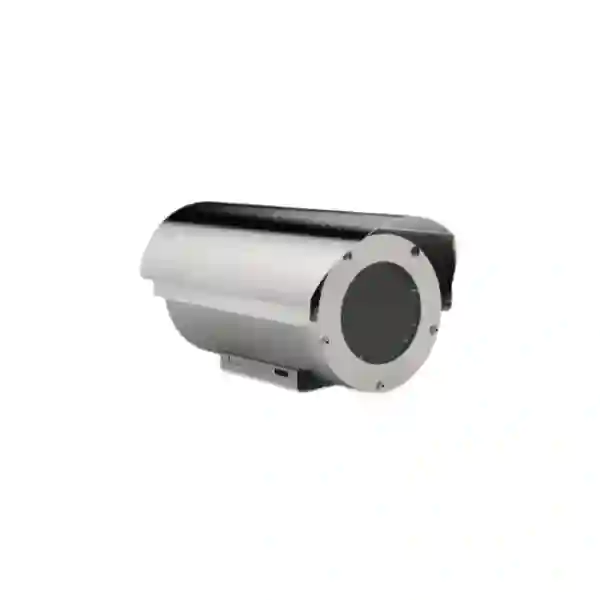
Hanwha TNO-6320EP-Z Explosion-Proof Zoom Camera
Need a camera for a fixed sightline in a potentially hazardous industrial area? The Hanwha TNO-6320EP-Z explosion-proof camera combines 2MP network video, 32x optical zoom, 120 dB wide dynamic range and a stainless-steel explosion-proof station. Confirm the site’s certification and integration requirements before deciding whether this exact configuration is suitable.
Next step: Request a technical specification review and quotation, including verification of current product status and the exact hazardous-area documents. No local price, stock level or delivery date is asserted here.
Technical overview at a glance
| Brand / model | Hanwha Vision / TNO-6320EP-Z |
|---|---|
| Camera type | Fixed-position explosion-proof network zoom camera |
| Maximum recorded image | 1920 × 1080 (2MP Full HD), up to 60 fps |
| Optical range | 4.44–142.6 mm lens, 32x optical zoom, autofocus |
| Contrast enhancement | 120 dB WDR |
| Video formats in original literature | H.264 and MJPEG; multiple streams |
| Connectivity | IP network video; ONVIF Profile S in original literature |
| Power | Power over Ethernet |
| Enclosure | Electro-polished 316L stainless steel in original literature |
| Ingress information | IP66 / IP67 / IP68 listed in historic family documents |
| Environment | Historic operating range: approximately −10°C to +55°C |
| Hazardous-area variant | -Z associated with cLCus Class I, Division 1; validate certificate |
| Movement | Optical zoom, but no motorised pan and tilt |
Specifications are drawn from the manufacturer product summary and historic model-family documents. A current exact-unit datasheet, label and certificate should govern engineering approval and ordering.
Before you specify an explosion-proof camera
Explosion-proof is not a blanket approval for all hazardous locations. Match the exact certification variant, gas or dust group, temperature classification, ambient limits, cable entries and installation conditions to the site. The presence of a North American certification variant does not establish automatic acceptance for a Tanzanian project.
Start with the surveillance requirement
Selecting a camera for a hazardous process area is not the same exercise as selecting a general outdoor CCTV unit. The project must address the picture operators need, the distance to critical objects, the atmosphere in which the camera will be installed and the way its enclosure and cabling fit the site’s engineering rules. The Hanwha TNO-6320EP-Z explosion-proof camera is intended to bring Full HD zoom surveillance into this more demanding purchasing discussion, while retaining the familiar management capabilities of a network camera.
Its headline capabilities are straightforward: 1920 by 1080 video at up to 60 frames per second, a 32x optical zoom with autofocus, 120 dB wide dynamic range, multiple streams, intelligent video analytics and Power over Ethernet. Those features can help an operations or security team watch a fixed area with more flexibility than a basic fixed-focal-length camera. They do not, by themselves, establish whether the installation is legally or technically suitable for a particular hazardous location.
For a sensible buying decision, bring the security integrator, electrical engineer, site safety specialist and eventual camera operator into the same review. Record the hazardous-area classification and environmental conditions first, then the required field of view, recording approach, available power and communication links. This method reduces the risk of purchasing an impressive specification that cannot be safely installed or cannot deliver useful evidence when a real incident occurs.
What makes this model different from ordinary outdoor CCTV?
The unusual part of this model is the combination of a specialist explosion-proof camera station and an optical zoom imaging system. Ordinary outdoor cameras may be weather-resistant, but a weather seal is not equivalent to a hazardous-location equipment approval. In an industrial environment where flammable gases, vapours or combustible dust may be present, the enclosure design, certification markings and installation method become project-critical facts rather than optional product marketing details.
The original TNO-6320EP family documentation describes electro-polished 316L stainless steel on welded enclosure assemblies, stainless-steel fixings and a toughened-glass camera window. These construction features are relevant when assessing corrosion exposure, physical durability and maintenance access. However, stainless steel alone does not guarantee resistance to every chemical or wash-down process. The relevant atmosphere, cleaning agents and mechanical exposure should be recorded and reviewed by an appropriately qualified specialist.
The camera is described as a fixed explosion-proof zoom station, not a moving pan-tilt-zoom head. It offers optical zoom to change the framing within the direction in which it is mounted, while its physical aiming direction remains fixed after installation. That distinction matters especially at loading areas, process vessels and long fence lines, where a buyer may otherwise assume the ability to sweep a wide area remotely without moving the camera housing.
Hazardous-area approval: check the exact -Z suffix
The suffix on a hazardous-area camera can identify a specific certification variant. In the historic TNO-6320EP product literature, the -Z configuration is associated with cLCus Class I, Division 1 documentation. It would be unsafe to infer that every variation bearing a similar body shape has the same approvals, gas or dust groups, temperature class or ambient-temperature conditions. Request the exact unit nameplate and matching certificate documentation for any camera that is actually offered.
A hazardous-area engineer should compare the site’s zone or division classification, atmosphere, equipment group, temperature limits and installation instructions against the supplied model’s markings. Standards frameworks and local acceptance practices may differ. A certification associated with one classification system should not be presented as automatic approval under another, and a historic datasheet is not a substitute for confirming the current certificate, model configuration and conditions of use.
In Tanzania, a project team should also identify the requirements imposed by its own facility, insurer, responsible professionals and applicable authorities before approving the design. The page does not claim a Tanzania-specific regulatory approval for this model. If the documentation does not match the intended area, stop the procurement decision and ask for an appropriate certified configuration rather than compensating with mounting changes or informal assurances from a reseller.
Camera sensor and Full HD performance
The published design uses a 1/2.8-inch class CMOS sensor and produces video up to 1920 by 1080 pixels. Full HD can be a practical resolution for routine area observation and review of a known target, especially where the operator can adjust the optical zoom to the scene. It should not be treated as a universal guarantee of identification at every distance. What can be seen depends on the angle of view, subject size, lighting, compression and actual image quality.
The manufacturer’s headline maximum of 60 frames per second can help capture smoother motion than a lower-frame-rate setting. Whether that setting is useful depends on the site. A moving vehicle at an access lane may benefit more than a largely static tank or pipework view. Higher frame rates also increase recording, network and storage demands, so the best configuration may deliberately use a lower rate on selected streams to support retention requirements.
Before approval, create a small scene schedule: each camera location, the important target, the distance to that target, the expected lighting and what the reviewer must be able to establish from video. This prevents the team from using resolution alone as a purchasing shortcut. Where a site needs recognition of fine text, small indicators or distant people, confirm the result through optical calculations and a representative image test.
32x optical zoom and lens planning
A defining feature of this unit is its 4.44–142.6 mm lens range, described in the original literature as 32x optical zoom. At the wider end, the lens can frame a relatively broad scene; at the longer end, it can narrow attention onto a more distant object. The published horizontal field-of-view figures run approximately from 62.8 degrees to 2.23 degrees. Such a large change in framing is useful, but it also means a zoomed-in view covers much less surrounding context.
Optical zoom changes what the sensor sees through its lens. Digital enlargement, where available, cannot create image detail that the sensor did not capture. Buyers should therefore ask for an example at the actual working distance rather than selecting purely by the numeric zoom multiplier. The long end of the lens also magnifies the effects of camera vibration, wind movement, heat shimmer and imperfect mounting alignment, which can compromise the apparent benefit of a powerful zoom.
Autofocus helps when changing zoom positions, yet it is not a substitute for a proper installation and commissioning process. Confirm focus performance on the real target under the site’s lighting and atmospheric conditions. Where operators alternate between a wide overview and a tight inspection view, document the preferred framing and any required operating procedure so that critical areas are not accidentally left outside the recorded scene.
A fixed station, not a pan-tilt camera
The TNO-6320EP-Z is best planned around a defined line of sight. Its zoom lens can change the size of objects in the frame, but the unit does not provide a motorised pan-and-tilt mechanism to redirect the housing across a large area. This matters for designs that require continuous monitoring of several points located in different directions. A single fixed zoom camera may be the wrong choice even if its telephoto reach appears sufficient on paper.
If the objective is to watch a gate, a particular pump, a pipe rack or a vehicle approach from a known position, a stationary sightline can simplify operation. It can also provide a consistent view for incident comparison. Where one control-room operator must follow moving activity around equipment, consider a suitable hazardous-area PTZ alternative or multiple appropriately placed fixed cameras, with the site’s risk and coverage studies driving the decision.
The absence of built-in pan-and-tilt movement should be clearly specified in tender documents. Ask whether a potential replacement or alternative is a fixed zoom camera, a fully moving PTZ camera or a fixed camera with an unrelated digital crop feature. These categories solve different surveillance problems. Do not treat similar product names as proof of equivalent coverage, mechanical movement, power demand or hazardous-area certification.
120 dB wide dynamic range for difficult contrast
Industrial surveillance often confronts challenging changes in brightness. A doorway can open from a shaded room toward strong daylight, a reflective vessel can sit next to dark structural steel, and a vehicle can move between bright and covered areas. The camera’s published 120 dB wide dynamic range is intended to help preserve useful visible information when both bright and dark regions appear in a scene.
Wide dynamic range is not a promise that every part of a picture will remain perfectly exposed. Motion, reflective surfaces, scene contrast, window contamination and the selected camera profile can affect the outcome. During testing, point the camera toward the actual operational view and inspect representative still frames and recordings during the most difficult lighting periods. Adjust settings based on the target that matters, not merely on whether the overall image looks pleasing.
For procurement, describe the visual problem precisely. Examples include recognising vehicle movement while an entrance is backlit, observing equipment beneath a bright roof opening, or maintaining usable contrast across a partly shaded loading platform. These scenarios give the commissioning team a measurable task. They are much more useful than writing only that a camera must have WDR and assuming the feature will automatically solve the deployment.
Day and night surveillance needs a lighting plan
The published feature set includes day-and-night operation using an infrared-cut filter mechanism. This allows the camera’s imaging mode to adapt to changes in available light, but it does not mean the unit can see without illumination. Night-time results depend on the actual ambient lighting, the lens position, exposure settings and the reflective characteristics of the objects being watched. A distant subject at the long end of the zoom needs particular attention.
Do not assume that an integrated infrared illuminator or separate lighting hardware is included with the requested configuration. Lighting equipment in a hazardous location may itself require appropriate certification, electrical protection and design approval. A site should compare the advantages of existing area lighting, carefully engineered additional light and an alternative camera technology where darkness is persistent. Thermal imaging is a different capability and should not be confused with this visible-light zoom model.
Plan a night demonstration when night incidents are part of the buying requirement. Check the widest and narrowest practical lens settings, observe moving subjects, and review recorded material rather than relying only on the live monitor. Where illumination varies during an outage or after shutdown, include that condition in the test plan. The result may influence camera placement, supplementary lighting or the selection of a different surveillance approach.
Intelligent analytics as operational assistance
Hanwha lists intelligent video analytics among the camera’s principal features, and historic technical materials describe detection functions such as motion-related events and scene monitoring. Such capabilities can help a site identify footage worth reviewing or prompt operators to examine an area more closely. They should be understood as aids to a broader surveillance workflow rather than fail-safe instruments for personal safety, gas detection or industrial process protection.
Analytics performance depends on configuration, lighting, camera stability, target movement, background activity and the software environment receiving the events. Steam, insects, rain, moving foliage or changing reflections may create unwanted alerts in a real installation. A site should define what event is useful, establish acceptable false-alarm behaviour and confirm whether its recorder or management platform can receive and display the relevant event notifications.
Design the response before switching on alerts. Identify who sees an alert, how the operator verifies the scene, what video must be retained and how an incident is escalated. Where there is no capacity to investigate the events, additional alarms may create distraction rather than value. Operational trials with actual site conditions are therefore as important as the camera’s feature list.
Video codecs, bandwidth and multiple streams
Original documents for the TNO-6320EP family describe H.264 and MJPEG encoding and multiple video streams. These are useful building blocks for delivering one viewing profile to an operator and another suitable profile to a recorder or remote monitoring station. They also provide a basis for selecting frame rate, resolution and bit rate according to the real operational requirement. Do not assume that features of newer Hanwha X-series cameras automatically apply to this older model.
Bandwidth planning should begin with the number of cameras, selected recording profiles, continuous or event-based recording periods and the number of simultaneous viewers. The 60 fps headline is a maximum imaging capability, not an instruction to run every stream at full rate. An engineering design should calculate network capacity with margin for other traffic and should test under busy operating conditions, including the effect of live viewing while recording continues.
For procurement, ask the supplier and integrator to confirm firmware-supported codecs, stream limits and the exact features exposed to the chosen management platform. Interoperability often works at the basic-video level before every optional control or analytic function is supported. A short integration test can prevent expensive surprises when the camera is connected to an established VMS or NVR environment.
Recording, retrieval and local storage
The manufacturer identifies a built-in micro SD, SDHC or SDXC memory slot in its product summary. Local card recording can be useful as one element of an evidence strategy, but a card should not be treated as an unlimited or inherently resilient archive. Capacity, card endurance, applicable recording features, network outages, data retrieval and the risks of damage to the camera must all be reviewed when designing retention.
Many industrial sites will prefer central recording through an NVR or video management system, possibly with a suitably engineered secondary recording mechanism. The right approach depends on incident response time, site network topology, operational governance and how quickly video must be available for investigation. Storage calculations should include recording schedule, expected bit rate, retention days and contingency space, rather than relying on a single generic capacity estimate.
Agree on the evidence workflow before deployment. Determine who can view or export recordings, what timestamps and logs are required, how access is audited and how footage is preserved after a safety or security event. Also ensure that recording equipment and storage locations are suitable for the site’s infrastructure. These steps are often more important to the eventual value of a camera than selecting the highest possible frame rate.
Environmental protection and enclosure construction
Original family datasheets list IP66, IP67 and IP68 ingress-protection information for the explosion-proof station, with the IP68 test condition specified in historic literature. These ratings are useful when evaluating exposure to dust and water, but they do not cover every industrial hazard. Corrosion, chemical attack, mechanical impact, ultraviolet exposure, high-pressure cleaning, salt deposition and poor cable-entry practice may still affect equipment performance or service life.
The reported electro-polished 316L stainless-steel construction is relevant for installations facing challenging weather or certain corrosive environments. It is not an all-purpose guarantee for every chemical atmosphere. A site near the Tanzanian coast, for example, should assess airborne salt and maintenance procedures; another site may face process chemicals or wash-down regimes that demand a different materials review. Treat these as engineering questions, not assumptions about a product’s universal durability.
Specify the exact mounting bracket, fixing material, cable glands, sealing method and any protective accessories that form part of the approved installation. A strong enclosure can be compromised by an unsuitable cable entry or unreviewed field modification. Confirm the installation manual, current certificate conditions and approved accessories for the exact supplied unit before placing a final procurement order.
Operating temperature and practical climate checks
Historic product documents describe an operating temperature range of approximately minus 10 to plus 55 degrees Celsius for the PoE variant. The temperature at the camera position is what matters, not merely the day’s reported outdoor air temperature. A camera installed near a hot process surface, below a metal roof or in direct sun may experience different conditions from a sensor measuring the general weather a short distance away.
For Tanzania projects, consider local daytime heat, seasonal rainfall, humidity, site dust and the possibility of salt-laden air where relevant. These are design inputs, not claims that any particular site or region has been approved for this equipment. The site engineer should identify the maximum and minimum temperatures at the enclosure, the available shade, the likely cleaning routine and any physical heat sources in the field of view.
Check whether the installation requires sun shielding, additional maintenance access or a change in mounting position. Also confirm the exact production unit’s environmental limits; a later successor with a similar name may have different ratings. If recorded site conditions exceed the permissible range, choose an appropriately rated solution instead of relying on a general impression that an industrial-looking camera can withstand anything.
Power over Ethernet and cable-route design
Power over Ethernet can simplify the infrastructure by carrying network traffic and operating power over an Ethernet connection. This feature is included in the TNO-6320EP-Z product summary. It should not lead to casual assumptions about the allowed connection arrangement in a hazardous location. The power source, cable route, glands, isolations, protection and installation method must be engineered together with the site’s electrical classification and manufacturer instructions.
Ask the installer to confirm the PoE standard and available switch budget for the exact hardware. The historic literature describes a PoE Class 3 power arrangement, but a project should use the manufacturer’s current unit-specific instructions for final sizing. Also account for cable distance, voltage drop, surge exposure, lightning protection where applicable and the continuity requirement when the main electricity supply fails. A network switch that works in a laboratory may be unsuitable for an industrial cabinet without additional protection.
Plan the network path from camera to recording point as carefully as the optical line of sight. Document cable entries, approved conduits and glands, equipment grounding, isolation practices, surge measures and maintenance access. If the desired location makes a safe and supportable cable route impossible, move the camera or redesign the infrastructure rather than improvising an unapproved entry into the enclosure.
Mounting weight, brackets and mechanical stability
The original family technical literature gives a mass of approximately 8.54 kilograms for the camera station. The mechanical design must allow for the complete assembly, mounting bracket, fixings, wind effects and maintenance activities. A substantial stainless-steel enclosure can place greater demands on a post, wall or existing structure than a compact standard CCTV camera, particularly when the long focal length makes even small vibrations visible in the recorded image.
A mounting survey should address structural condition, fixing geometry, corrosion, permitted drilling locations and access for safe installation. If the camera must overlook machinery or operate near a vehicle lane, its mount must also avoid interference with process operation and normal traffic. Select the exact bracket and any pole or wall adaptation only after verifying accessory compatibility and the manufacturer’s approved installation arrangement.
At commissioning, view a distant reference object with the lens zoomed toward its longer setting. Observe whether wind, passing equipment or nearby mechanical vibration causes the image to shake. This practical test reveals problems that may not be obvious in a short wide-angle demonstration. Recheck positioning after all mounting and cabling work has been completed, because small movements can alter the sightline at longer focal lengths.
Integration into a CCTV or VMS system
The original model literature identifies ONVIF Profile S among supported network interoperability features. This can provide a basis for common live-video integration, but it is not a blanket guarantee that all control functions, event analytics or recording options work with every manufacturer and software version. An existing video management system should be evaluated against the exact camera firmware, licence arrangement and required features before procurement is finalized.
An effective integration trial should confirm that the platform can discover the camera, display the requested streams, record continuously, retrieve historical video and manage user permissions. If remote zoom, focus, alerts or local-card functions are important, test them independently. Some platforms provide broad support for generic video but more limited support for vendor-specific functions, especially for older devices. Written proof of the needed behaviour is preferable to a simple compatibility logo.
Consider operational continuity as well as feature support. Establish what happens after an unexpected network interruption, a recorder restart or a change in the device’s assigned network address. Record recovery steps and the responsible support team. The goal is a usable surveillance system, not merely a camera that can be opened in a browser during initial installation.
Security and network-hardening considerations
Industrial video surveillance becomes part of the site’s connected infrastructure. Place the camera within an approved network architecture, give it only the access it needs and plan how its settings and recorded streams will be protected. The presence of network-security functions in historic documentation does not remove the need to validate firmware support, maintain configuration control and assess the current cybersecurity posture of the model before connecting it to a production network.
Work with the IT or operational-technology security team to decide on credentials, network segmentation, remote access, time synchronisation, logging and maintenance responsibilities. Check whether the device can be maintained under the site’s security policy and whether manufacturer updates and support remain available for the exact model. These questions are particularly important when considering older equipment or a replacement model with different firmware and platform requirements.
Avoid exposing a camera directly to the public internet simply to make remote viewing convenient. Use the organisation’s approved secure-access pattern and verify the recording system’s permissions. Before handover, document the configuration baseline, service account ownership, camera address, recovery procedure and evidence-retention policy. A camera that provides strong optical images still needs a secure and supportable operational environment.
Industrial use cases worth evaluating
A petroleum, chemical or industrial-processing facility may want a steady view of a defined approach, a pump installation, a vessel area or an access gate where equipment classification is a primary concern. In these scenarios, the fixed station’s enclosure and adjustable optical framing may be relevant. The site must still determine whether the exact camera approval applies to the planned hazardous area and whether video surveillance is an appropriate complement to, rather than a substitute for, dedicated process safeguards.
Logistics yards and loading points may require visibility of vehicles, access routines and personnel movement around industrial equipment. The wider lens setting can establish scene context while a narrower setting can make selected distant objects easier to inspect. However, the camera cannot automatically cover several unrelated directions as a motorised PTZ would. Multiple fixed views may be required where coverage cannot be interrupted by an operator changing zoom.
At ports, plants or other demanding outdoor sites, equipment selection also involves salt, humidity, vibration, mounting structure and network resilience. These are potential environmental considerations, not a statement that the model has been approved for every marine or industrial deployment. The purchasing team should tie each proposed camera position to a specific security question and confirm that the observed scene will still be useful at night and during difficult weather.
Important limitations to understand before ordering
This camera is not a thermal imager, a process-control sensor or a general-purpose explosion detector. It produces visible-light surveillance footage through an optical zoom lens. If an application requires temperature measurement, detection through total darkness or automated safety shutdown, an appropriately specified system must address those objectives separately. Likewise, the camera’s intelligent video analytics should not be treated as certified protection against a gas-release or fire event.
The fixed-position housing is another important distinction. Optical zoom gives useful framing options but cannot change the direction of the entire camera station. The original configuration is also described as a PoE model without a wiper in certain historical manufacturer lists. Buyers should not assume that accessories, heating arrangements, cleaning mechanisms or power choices from other versions are included. Confirm the exact configuration in the written quotation and current technical documentation.
Finally, do not equate a published product page with guaranteed availability. Some independent sellers describe the original model as discontinued or no longer available, and a more recent Hanwha Vision America model list names a successor. This makes lifecycle confirmation part of the buying decision. Request the exact manufacturer part, support status, applicable hazardous-area certificate and available sourcing route before budgeting installation activities.
Choosing between the legacy model and a newer alternative
The TNO-6320EP-Z may arise in a project because it appears in an older design, bill of materials, maintenance register or installed camera schedule. In that situation, the first question is whether the need is an identical spare, a functional replacement or a new installation. Each answer leads to a different specification process. Maintaining a legacy network may favour familiar integration, while a new project may benefit from comparing currently supported alternatives.
A Hanwha Vision America product list dated February 2026 names TNO-X6320EPT0-Z as a replacement reference for TNO-6320EP-Z. This is a useful starting point for technical enquiry, not proof that the two models are identical or interchangeable in every respect. Recheck the successor’s imaging characteristics, certification markings, ambient limits, power, mounts, network protocols, management integration and regional sourcing status before changing any approved design.
Where a project is replacing an existing hazardous-area camera, document the currently installed exact suffix and approval label, the original design basis and any site modifications. Obtain the proposed replacement’s complete supporting documentation and have the responsible engineer confirm suitability. A matching mounting appearance or similar zoom multiplier is not enough. A replacement decision should preserve the actual safety and operational requirements, not merely the general shape of the old product.
A practical pre-quotation specification checklist
Prepare a brief written requirement that states the exact model being considered and the reason it is needed. Include camera quantity, current installation details if replacing a unit, site classification, environmental exposure, mounting position and the required observation task. Attach a simple sketch or annotated site photograph when permitted by the organisation’s security policy. This allows the supplier to identify whether the proposed model is a credible match before moving into price discussions.
Next, state the technical requirements that affect the integrated system: target distances, preferred wide and telephoto framing, required recorded detail, lighting conditions, anticipated frame rate, recorder or VMS version, storage policy and available network power. Note whether the project expects a fixed viewing direction or needs genuine pan-and-tilt movement. Ask for a sample system drawing where the safe cable route or network architecture requires additional design work.
The commercial request should ask for documented model identity, certification evidence, approved accessories, lead-time confirmation, lifecycle status, technical documents and an itemised quote if the product can be sourced. Because no current FourTeck Tanzania price or stock level has been verified for this exact listing, this page intentionally does not show a price, delivery promise, warranty term or local inventory statement.
Commissioning tests that create usable evidence
After the mechanical and electrical work has been approved and completed, commission the camera against an agreed acceptance checklist. Begin with enclosure condition, fitting integrity and the installation records required by the hazardous-area design. Then confirm correct network discovery, secure access, time configuration, recording connection and power recovery. These checks should be documented rather than left as informal observations by the last engineer on site.
The imaging test should include the actual target at representative distance and at more than one lens position. Check focus, contrast, moving subjects, day and night lighting and scene framing. Record a short sample and retrieve it from the planned evidence system, because a strong-looking live image can hide recording-profile or compression problems. Verify that the operator can understand what the camera is showing without specialist knowledge of the lens settings.
Finish with operational checks: incident review, alert routing where configured, user access, network interruption recovery, storage retention assumptions and the maintenance process. Have the facility owner or authorised representative approve the result. A clear acceptance record makes future troubleshooting and replacement planning easier, and gives the buyer confidence that the camera addresses the intended surveillance problem rather than merely passing an initial power-on test.
Maintenance and ongoing inspection
Industrial cameras require a maintenance plan even when their enclosure is robust. The plan should follow the current manufacturer instructions and the site’s hazardous-area inspection programme. Visual checks may include mounting stability, fasteners, external damage, window clarity, permitted cable-entry condition and any signs of corrosion or moisture. Maintenance procedures must also respect the requirements for isolation, access, competent personnel and opening certified equipment where applicable.
Image quality can decline gradually because of dirt, salt deposits, surface films or small changes in alignment. Include periodic comparisons against a commissioning reference image at both wide and narrow zoom positions. Confirm that video timestamps remain correct and that recorded material can still be retrieved. Where events or analytics are used, review false alarms and missed detections as operating conditions change across seasons and production schedules.
Keep a record of the exact device model, serial information in the site’s private asset register, firmware revision, certificate records, mounting details and responsible support team. Do not publish serial numbers or private network details on a public product page. This information helps the facility plan compatible spares and make informed decisions if the legacy model becomes difficult to source or support.
Total project cost beyond the camera price
A specialist hazardous-area camera should be evaluated as part of a system, not as an isolated item on a purchase order. Cost drivers can include certified accessories, brackets, cable-routing work, network switching, surge protection, video recording, storage, engineering review, safety documentation and commissioning. Some sites may also require access equipment, controlled work windows or additional permits before any installation can proceed.
The operational cost picture includes inspection, cleaning, cybersecurity maintenance, recording capacity, network operation and the time required to investigate video incidents. A comparatively inexpensive camera that needs unplanned infrastructure changes may become a costly solution. Conversely, buying more imaging capability than the scene requires can increase infrastructure and storage needs without improving the outcome. A good tender compares whole-system fit and lifecycle support.
For a replacement project, include the possibility of adapting mounts, updating management software or revalidating the hazardous-area design. Do not assume that a newer model will fit the old bracket or use exactly the same configuration. Ask suppliers to identify the exclusions from their quote so the buyer can compare complete alternatives. This page avoids invented Tanzania shilling amounts or foreign-currency conversions because no verified offer for the target listing is available.
What to ask FourTeck Tanzania
Start the enquiry with the exact product reference, Hanwha TNO-6320EP-Z, and explain whether the camera is for a new design or an existing installation. Add the location type, desired observation distance and the reason a hazardous-area unit is required. If you already have an equipment certificate or approved technical schedule, identify its key requirements in the request without sharing confidential facility information publicly.
Ask for confirmation of sourcing options for the specified unit and whether a current successor should be evaluated. A suitable quotation review should establish the model and suffix, applicable certificates, supported recording integration, mounting and cabling provisions, expected configuration and the status of any optional accessories. It should not present unverified stock, approval or delivery figures as settled facts.
The aim is a camera choice that can be installed lawfully and competently, covers the right scene and remains supportable as part of the security system. Send the engineering requirement for technical review and request a quotation based on the confirmed configuration. If the stated surveillance requirement calls for PTZ movement, thermal imaging or a different hazardous-area classification, ask for an alternative that addresses that specific need instead of forcing this product into the wrong role.
Frequently asked questions
These answers address the questions that most directly affect product selection, technical evaluation, procurement and safe installation. Confirm exact-unit documentation and current sourcing arrangements before making a purchase.
Is the Hanwha TNO-6320EP-Z a thermal camera?
No. It is a visible-light Full HD explosion-proof network zoom camera. Its optical lens and day-and-night imaging features do not turn it into a thermal sensor. Projects that require thermal detection or temperature measurement need to specify an appropriate separate technology and confirm whether that technology is suitable for the intended environment.
Does 32x optical zoom mean the camera can rotate?
No. The lens can change from a wider view to a narrower distant view, but the TNO-6320EP-Z is a fixed camera station rather than a motorised pan-tilt unit. If you need to track subjects across different directions, evaluate a properly rated PTZ alternative or more than one fixed camera.
What does the -Z model suffix mean?
The original product family’s model table associates -Z with a cLCus Class I, Division 1 certification variant. That marking is relevant to hazard classification, but it does not establish approval for every country or every site. Check the actual unit label, certificate conditions and the facility’s approved design with a qualified specialist.
Can this camera be used in Tanzania?
Its potential suitability in a Tanzanian project depends on the specific site classification, environmental conditions, applicable requirements, certification documentation, available infrastructure and competent installation. The published product features alone are not proof of a Tanzania-specific approval. Local sourcing and support also need confirmation for the exact model.
Does it record 1080p at 60 frames per second?
The manufacturer’s headline specification lists Full HD at up to 60 frames per second. The configured and recorded performance depends on video settings, network bandwidth, recording equipment and system design. Ask the integrator to demonstrate the chosen profile and to verify storage and retention calculations under representative conditions.
Does the TNO-6320EP-Z support Power over Ethernet?
Yes, the official feature summary includes PoE. The final installation still needs an appropriately sized power source and an approved hazardous-area wiring and cable-entry design. Confirm switch capacity and the exact unit’s technical instructions; do not assume that ordinary office CCTV wiring practices are suitable for an industrial hazardous location.
Can it work with an existing NVR or video management system?
Original documents identify ONVIF Profile S and standard network video functions, which can assist integration. The exact recorder or VMS version must nevertheless be tested with the camera’s firmware. Validate live viewing, recording, playback, permissions and any desired zoom or analytics controls before making a procurement commitment.
Is an infrared illuminator or wiper included?
Do not assume either accessory is included. Historical descriptions of the PoE version identify a no-wiper configuration, while the available features establish day-and-night imaging but do not establish an integrated IR lamp. Obtain the exact parts list and accessory details for the offered unit and design appropriate lighting for the site.
What enclosure features are documented?
Historic family literature describes an electro-polished 316L stainless-steel body, toughened glass window and published IP66, IP67 and IP68 ingress ratings. Suitability still depends on chemical exposure, mounting, temperature, approved cable entries and the actual supplied configuration. Review the current manual and installation certificate before applying those ratings to a project.
Is the TNO-6320EP-Z still available?
Availability has not been established for FourTeck Tanzania. Some independent catalogues describe this older model as discontinued or no longer available. A February 2026 Hanwha Vision America list names TNO-X6320EPT0-Z as a successor reference, but local availability and interchangeability must be separately confirmed before ordering or changing an approved design.
What should I include when requesting a quote?
Provide the exact requested model, quantity, whether it is a replacement, hazardous-area classification, distance and field-of-view goals, mounting conditions, power arrangement, recorder platform and any required certification documents. Ask for confirmation of the offered model, accessories, lifecycle status and current availability instead of assuming any particular stock or price.
Can video analytics replace industrial safety systems?
No. Video analytics may assist surveillance operators, but this camera is not a substitute for certified gas detection, process shutdown equipment, fire protection or other safety-critical systems. Design and maintain those functions separately according to the facility’s risk assessment and applicable engineering requirements.
Request a product and installation-fit review
For an informed quotation, provide the requested model, quantity, site classification, working distance, mounting and power arrangements, and the NVR or VMS platform. Ask FourTeck Tanzania to confirm whether the legacy TNO-6320EP-Z can be sourced or whether a documented alternative should be assessed.
Request a technical quotation. Product availability, pricing, delivery timing and site-specific certification acceptance require confirmation; none are guaranteed by this page.




Reviews
There are no reviews yet.