
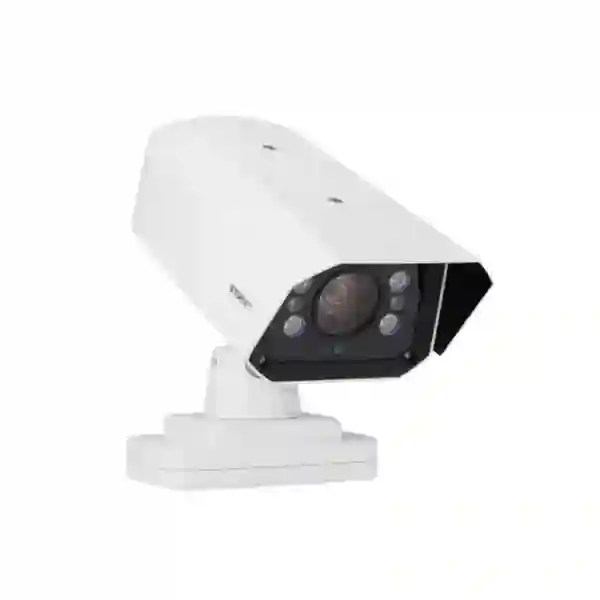
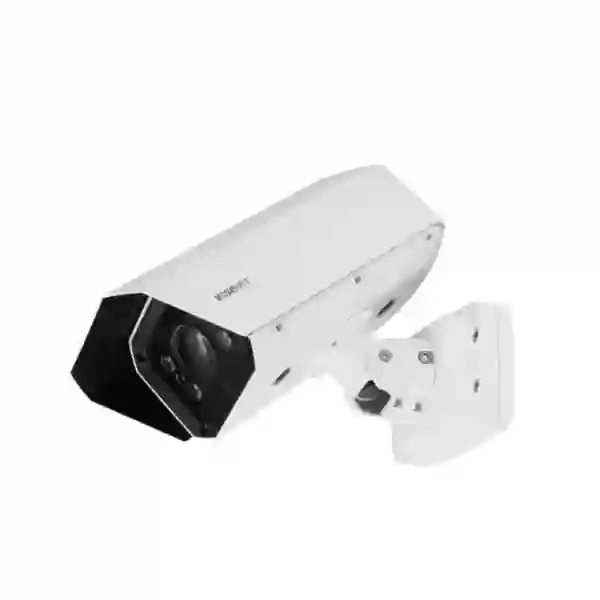
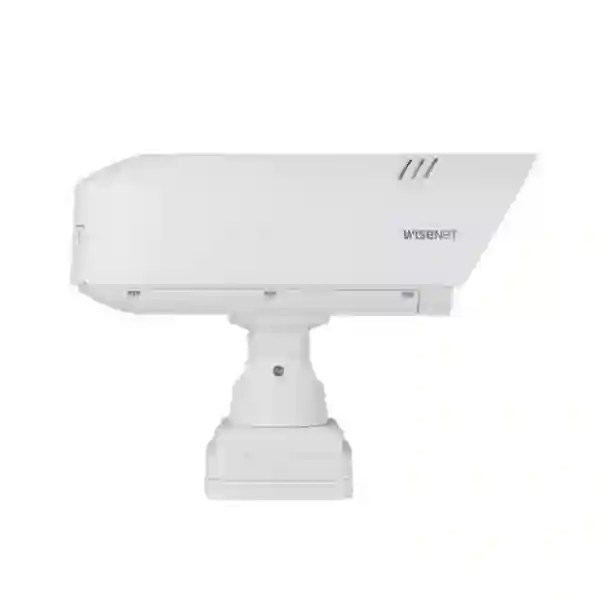
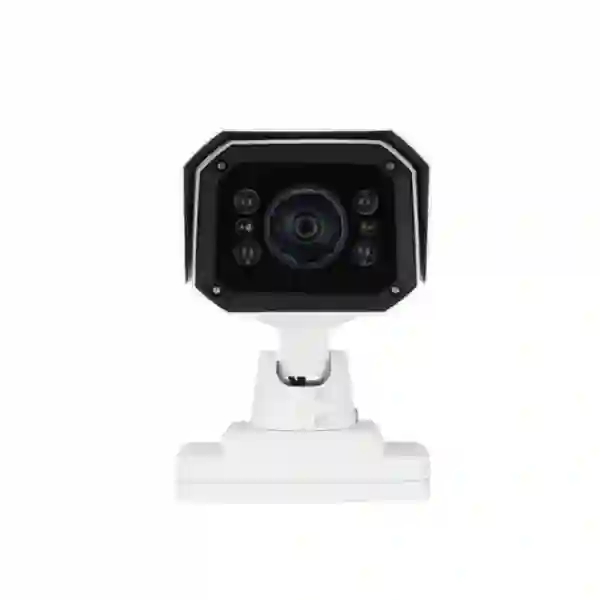
Hanwha TNO-7180R High-Speed License Plate Capture Camera
Capture clear evidence of moving vehicle plates with a dedicated 3MP global-shutter network camera, 18× motorized optical zoom and infrared illumination. For Tanzania projects, evaluate the camera with the real lane geometry, traffic speeds, night conditions and any separate ANPR software requirement.
Verified technical specification at a glance
| Model | Hanwha Vision TNO-7180R (not the TNO-7180RLP) |
|---|---|
| Camera type | High-speed license plate capture network camera |
| Sensor / maximum image | 1/1.8-inch CMOS, global shutter / 2048 × 1536 (3MP) |
| Lens / zoom | 6.8–120mm motorized varifocal / 18× optical |
| Horizontal / vertical view | 54.5°–3.4° horizontal / 42.3°–2.5° vertical |
| Frame rates (detailed datasheet) | H.265/H.264 up to 55fps at 3MP (55Hz setting); up to 60fps at 2MP (60Hz setting) |
| Video codecs | H.265, H.264 and MJPEG; WiseStream II |
| Infrared illumination | WiseIR, viewable range up to 50m; not a guaranteed recognition distance |
| Networking / integration | RJ-45 10/100/1000BASE-T; ONVIF S/G/T; SUNAPI |
| Local storage | One microSD/SDHC/SDXC slot; up to 256GB supported |
| Power | IEEE 802.3bt Type 3 Class 6 HPoE or 12V DC |
| Maximum power | 50W via PoE; 47.5W via 12V DC |
| Protection | IP66, IK10, NEMA 4X; NEMA TS 2 references per datasheet |
| Published size / mass | 186.9 × 293.7 × 259.3mm (W × D × H); about 4.8kg |
| Automated recognition | Not confirmed as pre-installed/licensed on the TNO-7180R; verify external solution |
Values are based on the manufacturer-issued TNO-7180R datasheet; detailed and overview frame-rate statements differ, so verify the intended operating mode. Final specifications are subject to manufacturer revision.
What the Hanwha TNO-7180R is designed to do
The Hanwha TNO-7180R is a specialized network camera for capturing images of vehicle number plates in moving-traffic environments. Its purpose is different from that of a general-purpose wide-angle surveillance camera: it concentrates optical reach, shutter control, illumination and video delivery on a relatively narrow target area. Buyers assessing a road entrance, transport corridor or controlled access lane in Tanzania can use this model as the imaging component of a properly designed vehicle-observation system. The camera is not a substitute for planning capture geometry or validating the software that will interpret the resulting images.
A 3-megapixel global-shutter CMOS sensor, 6.8–120mm motorized varifocal lens and integrated infrared illumination are the central hardware features. The lens allows a qualified installer to narrow the scene to an appropriate lane or detection region. High frame rates and shutter settings help manage motion, while outdoor housing protection supports exposed installations. The specification also includes network streaming, security functions, alarm input/output and a microSD memory-card slot. These are building blocks for a solution, not a guarantee that every passing plate will be readable under every condition.
The buying decision should begin with a simple question: does the project need readable plate footage, automated plate-to-text data, or both? Image capture and automated number plate recognition are separate requirements. The TNO-7180R datasheet establishes the camera’s capture hardware and interfaces; it does not establish that the TNO-7180R includes the licensed, pre-installed Wisenet Road AI recognition application advertised for the different TNO-7180RLP variant. Confirm any proposed OCR/ANPR engine, country support, integration and licensing separately before issuing a purchase order.
For procurement, request the exact model designation, hardware condition, required mounts and accessories, power method, software scope and documented acceptance criteria. This approach makes quotes easier to compare and helps prevent a technically capable camera from being installed in a way that cannot deliver the image evidence the project needs.
Why a global shutter matters for moving vehicles
Vehicle plates are difficult subjects. A moving car can shift significantly during image exposure, and the camera may view the plate at an angle. With many rolling-shutter sensors, different rows of the image are exposed at slightly different moments. That timing can distort a rapidly moving subject. The global-shutter design of the TNO-7180R captures the frame at a common instant, making it a relevant option for photographing vehicles where motion distortion is a concern. It is an imaging advantage, not a promise of perfect recognition.
Motion blur still depends on exposure duration, available light, vehicle speed and lens selection. A global shutter cannot compensate for a shutter speed that is too slow or for an image in which the plate occupies too few pixels. During commissioning, test representative vehicle speeds in both directions where applicable. Review sharpness on still frames rather than relying solely on what looks acceptable in a live video player. An image may appear clear when paused at a wide view yet lack enough detail for an operator or OCR engine to distinguish similar characters.
The TNO-7180R datasheet lists electronic shutter modes and a shutter-speed range reaching 1/12,000 second. This provides adjustment headroom, but the appropriate setting is a site-dependent compromise: a faster shutter reduces motion blur while admitting less light. In darkness, infrared output, exposure configuration, reflective plate materials and oncoming headlights all influence the result. Do not use an arbitrary fastest setting and assume it solves capture problems. Instead, begin with a defined pass/fail test and tune exposure around the vehicles and viewing angle the site actually presents.
It is also important to read frame-rate specifications in context. The detailed TNO-7180R datasheet differentiates 3MP and 2MP modes: H.265/H.264 can reach up to 55fps at 3MP under the stated 55Hz condition, or up to 60fps at 2MP under the stated 60Hz condition. A headline that simply says 60fps at every resolution may not describe the selected operating mode. Specify resolution, frame rate, shutter and codec together in the commissioning record.
Lens reach, framing and plate visibility
The 6.8–120mm motorized varifocal lens provides 18× optical zoom, spanning a much wider view at the short end and a tightly focused view at the long end. Hanwha’s published horizontal field-of-view values extend from about 54.5 degrees to 3.4 degrees; the vertical range is approximately 42.3 to 2.5 degrees. This flexibility matters when a camera must be placed on an existing pole or building while observing a specific lane. It does not mean the longest zoom is always preferable. A narrow image makes a plate larger but also leaves less tolerance for lane changes, positioning errors and vibration.
Before choosing the final focal length, identify where a vehicle should be captured, how far that point is from the camera, and how much horizontal movement is expected. Consider whether the target is a stopped vehicle at a barrier or traffic passing without stopping. The required image width is very different for a single checkpoint lane compared with an open road where vehicles can occupy multiple positions. Do not infer a fixed recognition distance from the lens specification alone. The usable distance depends on plate dimensions, pixel coverage, camera angle, atmosphere, speed and software requirements.
The published minimum object distance is two metres, but this is a lens focusing limit, not an instruction to mount the camera two metres from the roadway. Actual standoff and mounting height should be determined by the site’s safety requirements and capture geometry. Record the horizontal and vertical angle to the expected plate position. Sharp, front-facing plates are generally easier to interpret than plates seen at a strong oblique angle, especially at night when retroreflective material can respond unevenly to illumination.
When designing a lane system, reserve enough image area to see the complete plate through the required travel zone. Include a little margin for differing vehicle heights and plate locations. A single frame should not cut off the first or last character as a vehicle turns. On commissioning day, test passenger cars, commercial vehicles and motorcycles if those vehicle classes form part of the requirement, rather than assuming one successful car test represents the entire fleet.
Day, night and difficult lighting conditions
Nighttime vehicle capture is more demanding than general nighttime security video. In a parking area, an operator might accept a grainy monochrome view so long as the vehicle itself is visible. Plate capture needs a sharper and more controlled image of a small reflective target. The TNO-7180R includes day/night operation with an automatic infrared-cut filter and WiseIR illumination specified for a viewable length of up to 50 metres. That quoted infrared range is not a guaranteed plate-reading or OCR distance. Performance must be tested at the actual target distance and under real traffic conditions.
Oncoming headlights can overpower portions of the frame and change the camera’s exposure behaviour. Rear plates may reflect light differently from front plates. Dust, rain, fog, spray and dirty camera windows further reduce clarity. A well-positioned camera can reduce some of these difficulties through sensible aiming and exposure tuning, but the datasheet expressly lists no dedicated defog feature and no digital image stabilization for this model. Avoid implying that the device can computationally remove any kind of weather obstruction or structural vibration.
Consider the effect of lighting transitions. A vehicle approaching from bright daylight into a shaded gate, or leaving a floodlit yard into darkness, creates a changing background. Test these transitions rather than merely capturing one daytime screenshot and one static nighttime screenshot. Save examples of readable and unreadable frames, noting speed, direction, distance and lighting. This evidence helps installers refine the view and helps buyers understand the operating envelope before the system is accepted.
For Tanzanian sites, do not assume a single climate or installation setting. Coastal humidity, dust around busy roads, wind exposure and intense sun can influence installation details, but site-specific engineering is still necessary. Keep the front window clean, avoid locations where water can drip onto the optics, and protect network connections. Plan a maintenance inspection interval appropriate to the environment instead of treating the outdoor enclosure rating as a guarantee that no maintenance will be necessary.
Plate capture versus ANPR: define the software requirement
A successful deployment may have two very different outputs. In a capture-only workflow, the network camera supplies video or images; an operator reviews the footage and manually reads a vehicle’s number plate. In an ANPR workflow, software attempts to turn the plate image into structured characters and may create events, searches, access decisions or reports. Recognition accuracy depends on the software model, supported plate formats, camera configuration and image quality. The physical camera alone should never be sold as proof of an end-to-end recognition result.
The distinction between the TNO-7180R and TNO-7180RLP matters. Hanwha’s TNO-7180RLP information describes a Road AI application with license-plate recognition and vehicle make/model/colour functions. Those application features cannot automatically be assumed to be supplied, activated or licensed on the TNO-7180R. Although the hardware families are related, procurement must identify which product and software entitlement are actually included. An installer can confirm application availability, firmware compatibility, subscription or license requirements and integration method for the offered configuration.
If automated recognition is required in Tanzania, demand evidence that the chosen ANPR solution supports the plate designs and character formats encountered at the project site. Request trial captures under representative day and night conditions, including the types of vehicles that matter to operations. Ask how the application handles unreadable plates, duplicate events, incomplete records and human review. Do not assume a vendor’s plate-recognition country list includes Tanzania simply because the device is marketed internationally.
Also establish who will operate the result. A security guard who needs to locate a vehicle after an incident requires different reporting and search functions from a logistics operator reconciling scheduled deliveries or an estate manager opening a gate. Define retention, operator permissions, audit requirements and available integration interfaces. This prevents a quote from focusing only on camera hardware while leaving the workflow that creates the business value unspecified.
Practical applications for Tanzanian buyers
Commercial and industrial entrances are natural evaluation points for high-speed plate capture, particularly where a basic overview camera does not retain readable details of passing vehicles. A logistics yard may need to associate vehicle arrival times with dispatch paperwork; a facility security team may need clear stills during an incident review. The camera can act as a dedicated plate-observation view alongside a separate wide-angle context camera. The correct system design should preserve both identification detail and the surrounding scene without expecting one tightly zoomed camera to perform every task.
For car parks and controlled compounds, establish whether vehicles stop at a gate, creep through an access lane or travel continuously. A slower, constrained checkpoint may have different equipment needs from a fast-moving approach road. The TNO-7180R’s specialized shutter and zoom capability may be valuable, but only when the imaging objective justifies it. Where the requirement is merely to monitor general activity or count people, a standard surveillance camera may be more appropriate and economically efficient.
A road or transport corridor presents additional constraints. Public-road mounting permissions, safe maintenance access, pole integrity and operator visibility have to be assessed by responsible site stakeholders. The device’s specification does not confer legal authority to monitor a road, capture personal data or operate an automatic enforcement system. Establish a lawful purpose, suitable notices, access controls and approved data-handling procedures before deployment. Do not advertise the camera as a certified traffic-enforcement device in Tanzania without project-specific confirmation.
For campuses, estates and transport depots, consider how existing network infrastructure, equipment rooms and power distribution will support the camera. A technically valid camera may still be unsuitable if the installation has unreliable uplinks or no safe access for maintenance. Use the application scenario to determine what footage must be captured, where it will be stored, who may retrieve it and how its quality will be evaluated. A good proposal makes these operational decisions visible rather than presenting a feature list as a finished system.
Site survey: information to collect before requesting a quote
The most valuable early activity is usually a small site survey. Identify the required capture point on a simple sketch and mark traffic direction, approximate lane width, expected vehicle speed and proposed camera location. Photograph the approach in daylight and after dark, if safe and permitted. Note obstacles such as signs, trees, barriers, parked vehicles and overhead structures. These details help the engineer choose a mount and field of view, and they reduce the chance that a quotation omits an essential accessory.
The survey should distinguish must-have requirements from optional capabilities. A facility may absolutely require readable images of every scheduled truck entering one lane, while vehicle colour analytics or automatic alerts may be optional. Define whether one lane or several lanes must be observed, whether vehicles reverse or change lanes, whether motorcycles matter, and whether the project requires rear plates, front plates or both. These constraints make the evaluation specific enough that a vendor can recommend an appropriate configuration.
The network survey should identify switch location, cable pathway, available port capacity, uplink speed, segmentation and where the recorder or video management system is hosted. The power survey should clarify whether a suitable IEEE 802.3bt Type 3 Class 6 high-power PoE source is available or whether a 12V DC installation is intended. Check that the proposed supply meets the camera’s specified peak power need, not merely typical consumption. The outdoor survey should cover earthing, surge protection, cable gland protection and safe service access under the site’s electrical standards.
Ask the installer to document acceptance criteria in advance: example frames at representative speeds, a minimum useful plate image at the intended capture point, verified nighttime performance, successful recording, and a repeatable retrieval procedure. If OCR is in scope, add an agreed demonstration protocol for the selected software. Capture evidence with the same codec and compression that will be used in production. A daytime promotional image or a best-case laboratory demonstration is not an adequate substitute for a site test.
Power, wiring and environmental durability
The manufacturer lists two supply methods for the TNO-7180R: high-power Power over Ethernet conforming to IEEE 802.3bt Type 3 Class 6, or 12V DC. The specified maximum draw is approximately 50W on the PoE path and 47.5W on the DC path; typical values are lower. Plan power budgets around the maximum requirement plus relevant system overhead. Do not assume that an ordinary low-power PoE port can operate the camera, and confirm the suitability of any injector, switch, cable run and external power accessory before installation.
The white aluminium housing is rated IP66 for ingress protection, IK10 for impact resistance, and NEMA 4X, with specified NEMA TS 2 references. Those properties make it appropriate to evaluate for exposed outdoor positions, but installation quality remains critical. A poorly sealed termination box or unsupported cable can become the weak point of an otherwise robust camera. Use proper weatherproof junctions and mounting hardware, check the condition of seals, and follow the manufacturer’s mounting instructions.
Published operating conditions include normal use across approximately -40°C to +55°C, subject to the specification’s qualifications, with intermittent higher-temperature provision. Temperature figures describe the camera’s tested operating envelope, not the ambient conditions at every proposed Tanzanian installation. Direct sun on an enclosure, stagnant air in a box or heat from adjacent equipment may affect local conditions. Allow ventilation and service clearance where needed, and avoid enclosing the product in an improvised box that interferes with thermal management.
The unit weighs approximately 4.8kg and occupies a substantial mounting envelope. The bracket, pole and fixings therefore deserve the same attention as the camera. Assess wind exposure, vibration and possible vehicle impact. If a camera is mounted on a structure that shakes when heavy trucks pass, a high-quality sensor cannot always recover lost image sharpness. Document cable protection, power backup arrangements and the process for safely cleaning or replacing components at height.
Recording, streaming and integration planning
The TNO-7180R supplies H.265, H.264 and MJPEG encoding options, plus WiseStream II and configurable streaming profiles. Different recording and live-view systems may need different profile settings. A security desk could display a lighter viewing stream while an evidence recorder retains a higher-quality stream, provided the configuration is supported and bandwidth has been planned. Compression is not automatically good or bad: it is a trade-off among picture detail, storage consumption, link capacity and decoding compatibility.
The published interface set includes a Gigabit RJ-45 Ethernet port, ONVIF Profiles S, G and T, and the SUNAPI interface. These features provide integration starting points, but they do not guarantee that every vendor’s NVR or video management software supports every camera function. Verify discovery, authentication, timestamps, stream selection, event reception and recording on the exact software version to be deployed. Where third-party integration is important, perform a demonstration rather than relying on a generic ‘ONVIF compatible’ label.
A microSD/SDHC/SDXC slot with published capacity support up to 256GB is useful for appropriately designed edge-recording arrangements. Treat memory cards as a storage component that must be sized, specified and maintained, not as unlimited evidence storage. The TNO-7180R datasheet does not state that a 32GB card is supplied as standard in the base R model. Do not copy the TNO-7180RLP’s pre-installed 32GB memory-card claim onto this listing. Confirm card inclusion and recording behaviour on the exact offer.
Storage capacity cannot be estimated accurately from camera resolution alone. Video bit rate changes with frame rate, compression mode, scene movement, exposure noise and configuration. Build the retention calculation using a measured or conservative test stream and include the intended evidence period, recording schedule, available disk space and backup policy. For an investigation workflow, agree how footage will be exported with timestamps and who can authorise release. A camera’s capture capability has little operational value if the organization cannot find and preserve the relevant image.
Cybersecurity, credentials and operational access
Network cameras are computing devices that form part of an organisation’s security infrastructure. The TNO-7180R datasheet lists security provisions including HTTPS authentication, address filtering, user access logging, 802.1X options, secure-boot-related features and TPM-based protection. These capabilities should inform the system design, but administrators must still configure them correctly. A secure feature that remains disabled or unmaintained does not protect footage merely because it appears in a specification.
Before commissioning, establish a unique administrator credential, a controlled method for storing credentials and a procedure for authorised support access. Place cameras on an appropriate network segment, restrict inbound access, and avoid exposing a camera’s administrative interface directly to the public internet. Enable encrypted services supported by the complete recorder-to-camera workflow. Confirm NTP or another authorised time source so that captured events correlate with logs from barriers, access systems and incident reports.
Firmware selection requires care. Record the device’s exact model and firmware version before applying updates, and use the appropriate vendor documentation to understand supported upgrade paths. The product name on a shared hardware-family certification report does not mean that firmware or Road AI packages intended for the RLP variant are interchangeable with the R variant. Schedule maintenance and backup configuration where possible. After a change, verify that recording, events, imaging and time synchronisation continue to work.
Set operator roles based on need. A guard may require live viewing and incident retrieval but not camera-level administration. An investigator may need export permission, while a system integrator needs a time-limited maintenance route. Document how access is approved and revoked, and how exported images are handled. Such procedures matter particularly when number-plate imagery can be associated with individuals and vehicle movements. Legal and organisational data-protection requirements should be reviewed independently for the actual use case.
Commissioning checklist for reliable capture
Commissioning begins with physical inspection. Confirm that the mount is stable, the enclosure and connectors are properly secured, and the camera’s viewing window is clean. Verify that the planned power source supports the maximum specified demand and that the camera remains operational when infrared illumination and required features are active. Check the network link, recorder connection and camera time before fine-tuning the image. A failed connection can otherwise look like a camera imaging problem.
Next, tune the optical view. Set the motorized zoom to include the full expected plate path while leaving appropriate framing tolerance. Adjust focus at the actual capture distance, preferably using real vehicles rather than an object at a convenient nearby position. Verify both sides of the intended movement range. A sharply focused road sign does not necessarily prove that a moving plate will be sharp at the desired instant. Record the final lens position and image profile so that settings can be restored.
Then test the exposure and recording workflow. Collect sample clips at the lowest, usual and highest relevant vehicle speeds. Include daylight, dusk and night whenever those operating periods matter to the site. Review individual frames for motion blur, clipped characters, reflected glare and changes in sharpness. Confirm that configured frame rate, resolution, codec and recording quality match the requirements in the quote. Compare the result against acceptance criteria agreed before the work began.
Finally, simulate normal operational retrieval: identify a test vehicle, locate the appropriate recording, export it through the authorised interface and confirm that its date and time are meaningful. If integration with a gate, access platform or recognition engine is planned, test the complete event path including failures and exceptions. Sign-off should list what was tested, what was not tested and which limitations remain. The result is a reproducible system assessment, not an unsupported claim of perfect plate capture.
Common causes of unreadable plate images
A camera can be powered and streaming perfectly while producing unusable evidence. The most common categories of problems involve framing, motion, lighting, obstruction and recording configuration. Small plates in a wide scene do not contain enough image detail. A shutter tuned for brightness may blur a fast-moving target. Glare from headlights or nearby lamps may obscure the characters. Rain on the front window may distort the plate. Aggressive compression may remove fine edges that matter for human inspection or OCR.
When troubleshooting, change one variable at a time and save comparison images. First determine whether the optical image is sharp when the vehicle is stationary. If not, review focus, camera vibration, viewing angle and lens coverage. If static images are good but moving images are not, review shutter and available illumination. If live video is clear while recorded footage is not, investigate the recording stream, bit rate, network behaviour and playback conditions before replacing the camera.
Avoid diagnosing everything as a recognition-software failure. An OCR engine cannot reliably reconstruct characters that are absent from the source image. Equally, a clear still image does not prove the recognition application is configured for the correct plate format. Separate visual readability tests from machine-recognition tests and retain both result sets. This allows suppliers to identify whether the required improvement is optical, mechanical, network-related or software-related.
An especially important issue is lane geometry. If vehicles pass far from the planned capture point, cross the image at unpredictable angles or are partly blocked by other traffic, the operator may see many poor frames even with a good camera. The remedy may be a different mounting location, a second camera or a more controlled capture lane. The engineering objective is not the longest possible specification list; it is a repeatable image of the actual plate under the site’s defined conditions.
How to compare TNO-7180R with other camera options
Start by comparing the purpose of each proposed device. A general outdoor bullet camera may deliver a broader scene, higher nominal resolution or lower equipment cost, yet may not offer the same combination of global shutter and long motorized optical zoom. A dedicated plate-capture camera should be judged primarily by usable plate detail at the target location, not by pixel count alone. A higher-resolution camera configured poorly can perform worse than a lower-resolution device positioned correctly.
Compare the TNO-7180R with the TNO-7180RLP carefully. The base R model’s published datasheet focuses on high-speed plate capture hardware and standard video analytics. The RLP documentation specifically advertises pre-installed Road AI with number-plate and vehicle-attribute recognition. Purchasing teams should not treat the extra letters as a cosmetic distinction. If plate-to-text automation is central to the business case, require confirmation of the application, licensed region, supported plates and software versions on the exact item offered.
A newer model with integrated ANPR may also be worth evaluating where the project demands a complete recognition workflow. However, replacement recommendations and availability can change, and a manufacturer’s replacement for one variant is not necessarily a verified direct replacement for another. Compare the sensor, field of view, low-light behaviour, illumination, mounting limits, environmental conditions, integration and licensing against the site survey. The right choice is the one that demonstrably meets the acceptance test, not simply the one with the most features.
When reviewing quotations, separate hardware, mounting parts, power accessories, recording infrastructure, recognition software, installation and ongoing maintenance. Ask whether price includes system design, onsite testing, configuration documentation and operator training. A quote that seems inexpensive because it excludes a required power source or ANPR licence may not represent the least expensive complete deployment. Conversely, do not pay for automated analytics when the real requirement is only a reliable evidence image.
Evaluation criteria for procurement teams
Procurement review should begin with model identity. Request the seller’s description of the exact hardware, firmware family, accessories and commercial condition. A box labelled TNO-7180R should not be described in the same quote as a TNO-7180RLP with its Road AI application unless those differences are explicitly reconciled. Ask for a written statement of what software is included, whether any additional licence is needed and which functions are excluded. Retain the response with the purchase record.
Review operational requirements in measurable terms. Define the vehicles in scope, the lane geometry, the target capture area, expected speeds, day/night schedule and evidence-retention period. If an installer proposes guaranteed plate readability, require the test method and environmental boundaries in writing. A realistic acceptance plan should identify situations outside scope, such as obstructed plates, extreme glare, nonstandard fonts or excessive viewing angles. These exclusions make the agreement understandable rather than weakening it.
Review infrastructure responsibilities. Establish who supplies the high-power PoE switch or injector, mounting bracket, weatherproof termination, surge protection, network configuration, storage and UPS. Confirm whether an existing recorder can ingest the required stream and whether support covers alarm or API integration. There should be a named party responsible for each interface between systems. Handover documentation should contain camera settings, network addressing, authorised access procedures and sample evidence.
Finally, verify commercial terms separately. Ask for an up-to-date Tanzania quotation, delivery or sourcing position, tax treatment, warranty terms and service scope from the responsible seller. No particular price, stock level or installation schedule is established by the product specifications alone. A technically accurate product description should not pretend to prove local inventory or manufacturer-authorised status. These commercial matters belong in a confirmed quotation associated with the exact product and project location.
A useful project specification to send with your enquiry
A good enquiry can fit on a single page if the details are specific. State the site type, number of approach lanes, whether vehicles stop or move continuously, the approximate viewing distance and the preferred mounting location. Include the expected vehicle categories and whether images of front plates, rear plates or both are required. Describe day, night and weather conditions that the operator expects to handle. Where possible, add non-sensitive photographs or a sketch of the proposed location.
Describe the desired output separately from the imaging hardware. For example, an incident-review installation might require a searchable video recording containing clear still frames of plates, while a warehouse access workflow might require OCR output connected to an existing vehicle database. These are different deliverables. State whether automated plate text extraction, barrier control, alarms, reports or third-party integrations are in scope, and ask the integrator to identify compatible software and its licensing.
For infrastructure, specify the available power and network location, expected cable route, video recorder or VMS, desired retention period, and whether internet connectivity is stable or intermittent. Explain which party will manage security credentials, data access and routine camera maintenance. The TNO-7180R supports standard network interfaces, but details of third-party software and field equipment should be validated on the actual deployed versions. Include those validation tasks in the quotation.
Ask for a response that separates mandatory equipment from optional upgrades. The minimum proposal should identify the camera, appropriate power supply, mount, network/storage components, installation labour, configuration and acceptance testing. Optional items might include additional context cameras, recognition software, backup power or integration work. Request a list of assumptions and exclusions. This gives decision-makers a clear basis for comparing suppliers without confusing a camera unit price with an installed, functioning vehicle-capture system.
Frequently asked questions
Is the Hanwha TNO-7180R an ANPR camera?
It is a high-speed license plate capture network camera. The model’s published hardware specifications make it suitable to evaluate as the image source for an ANPR deployment, but an automatic plate-to-text result must be verified with an appropriate recognition application. Do not assume that the licensed Wisenet Road AI features marketed for TNO-7180RLP come pre-installed on TNO-7180R. Ask the solution provider to demonstrate the exact combination that will be supplied.
Can the TNO-7180R record a number plate at night?
It includes day/night switching and infrared illumination with a published viewable range up to 50 metres. Whether a plate is actually readable depends on placement, zoom, focus, speed, exposure, plate surface and environmental conditions. The infrared range is not a certified recognition distance. Require sample frames from the intended camera position at night before accepting the installation, especially where glare, dark vehicles or mixed illumination are present.
Does the camera support 60fps at full 3MP resolution?
The model’s detailed datasheet provides mode-dependent figures: up to 55fps at 3MP with the stated 55Hz setting for H.265/H.264, and up to 60fps at 2MP with the stated 60Hz setting. Marketing summaries may use a broader maximum-frame-rate statement. When the exact frame rate matters, specify the active resolution, power-frequency configuration, codec and firmware, then confirm the actual stream during commissioning.
How far away can the camera read a plate?
There is no one distance that can responsibly be promised from the lens and infrared specifications alone. Its 6.8–120mm 18× lens offers considerable framing flexibility, but usable plate detail depends on the plate’s pixel size, the chosen view, motion, lighting and required recognition method. Agree on a target capture distance and test it with actual traffic. Do not present the 50m infrared specification as a guaranteed plate-reading range.
What power source should be provided?
The manufacturer specifies IEEE 802.3bt Type 3 Class 6 high-power PoE or 12V DC, with maximum consumption figures of approximately 50W and 47.5W respectively. A basic low-power PoE port may not be suitable. The installer should confirm power budget, injector or switch specification, cabling, protective measures and backup power requirements. Verify whether the quoted equipment includes the necessary power accessory.
Can it connect to an existing NVR or VMS?
The published specification lists H.265, H.264, MJPEG, ONVIF Profiles S/G/T and SUNAPI. These offer integration routes, but exact NVR compatibility and supported features depend on the recorder and software version. Test discovery, live streams, recording, event interfaces and export before declaring the system compatible. Where ANPR is required, test the OCR engine and data integration separately from normal network-video compatibility.
Does the camera include a memory card?
The TNO-7180R specification lists a microSD/SDHC/SDXC slot supporting cards up to 256GB. It does not establish that a card is included with the base model in the quoted package. A 32GB pre-installed card is described for the TNO-7180RLP variant, which is a different offering. Confirm memory-card supply and its recording suitability explicitly, and do not rely on edge storage as the only evidence-retention strategy without a recovery plan.
Is the device suitable for outdoor use in Tanzania?
It carries published IP66, IK10 and NEMA 4X ratings, plus an outdoor operating-temperature specification. These make it a credible candidate for an exposed camera position, subject to correct installation and evaluation of local conditions. The ratings do not replace proper pole engineering, protected connections, lightning and surge protection, cleaning or maintenance. A site assessment should consider rain, dust, humidity, sun exposure and service access.
Will it recognise Tanzanian plate formats automatically?
Do not assume so. Plate recognition depends on the separately selected software, its supported countries and its training and configuration. The TNO-7180R camera’s imaging capabilities are distinct from any OCR engine. Before a production purchase, request written confirmation of relevant plate support and a controlled trial with representative local plates, including the vehicle types and nighttime conditions that matter to the project.
What information is needed to request the right quotation?
Provide the exact model TNO-7180R, lane count, distance, speeds, capture direction, daytime and nighttime requirements, proposed mount location, available power, recorder type and retention objective. Say clearly whether the requirement is plate footage, automated recognition or both. Ask the provider to itemise accessories, software, installation, configuration, testing and support, along with project-specific commercial terms. This helps avoid omissions and variant confusion.
Request a TNO-7180R configuration and quotation
If your project needs reliable images of vehicle registration plates, request an assessment of the Hanwha TNO-7180R based on your actual road or access-lane conditions. Share a site sketch, target distance, likely speeds, day/night operation and current recording platform. State whether the outcome should be clear image evidence or automated ANPR data. This allows a proposal to address camera geometry, network design and software requirements together instead of treating the camera body as a complete traffic solution.
Ask the FourTeck Tanzania team to confirm the exact model and any suitable alternatives, accessory requirements, current sourcing position, technical suitability and project-specific quotation. If automated recognition is essential, request a documented compatibility review and demonstration for the selected solution and applicable plate formats. No stock, price, response time or installation eligibility is implied by this page. The goal is a properly scoped proposal with clear assumptions and an agreed acceptance test.
Request a technical review and quotation for Hanwha TNO-7180R in Tanzania.
Please provide your intended use, lane layout, speed range, capture distance and required video or recognition integrations.




Reviews
There are no reviews yet.