
HANWHA VISION | NETWORK THERMAL SURVEILLANCE
Hanwha TNO-C3042T AI Thermal Camera
The Hanwha TNO-C3042T thermal camera combines a QVGA thermal detector, 13 mm fixed lens and AI-based person and vehicle classification for perimeter awareness in darkness and difficult lighting. Its role is to help a security team identify relevant movement, generate defined alerts and coordinate a response. It is not a substitute for visible-light identification or calibrated temperature measurement. For projects in Tanzania, confirm the observation distances, software integration and operational requirements before selecting the camera.
Verified specifications at a glance
| Thermal sensor | 384 × 288 uncooled microbolometer; 17 μm pixel size |
|---|---|
| Video output | 384 × 288 or 768 × 576; up to 8 fps |
| Lens | 13 mm F1.0, fixed focus, 28.5° horizontal field of view |
| Sensitivity | NETD ≤20 mK at 25°C, F1.0 |
| Analytics | Person and vehicle classification; line and area events |
| Networking | Ethernet; H.265, H.264, MJPEG; ONVIF S/G/T/M |
| Power | PoE IEEE 802.3af Class 3 or 12 V DC |
| Storage | One microSD/SDHC/SDXC slot, maximum 1 TB |
| Environmental | IP66/IP67, IK10, -40°C to +60°C |
Manufacturer specifications are subject to change. Confirm exact configuration and regional availability in the quotation.
What this camera is designed to solve
A security team does not always need facial detail to know that someone has entered a protected area. Sometimes the urgent question is whether a person or vehicle is moving through a restricted boundary, crossing a virtual line, or remaining where access is not expected. The TNO-C3042T addresses that category of problem by combining thermal imagery with on-camera object classification. It gives operators a different kind of evidence from a conventional daylight camera: an image built from thermal contrast rather than reflected visible light.
That distinction matters for warehouses, utilities, yards and other sites that may be monitored around the clock. A visible camera remains important where faces, vehicle markings, colours or documentary evidence are required. This thermal model is better considered a detection layer, with alarms routed to a control room or another camera when further assessment is needed. The right design begins with the action the customer wants an operator to take, not simply the number of cameras requested.
Understanding the thermal image
The camera uses an uncooled microbolometer to sense infrared energy in the 8–14 micrometre spectral band. It converts differences in thermal radiation across a scene into a displayed image. A person can therefore stand out against cooler surroundings even when there is no streetlight, floodlight or infrared illuminator. The resulting picture can be shown in palettes such as white-hot, black-hot, rainbow, sepia, red or iron, allowing operators to select an easier presentation for particular scenes.
Thermal video also has limitations. It does not show the scene in ordinary natural colour and will not provide the same kind of fine visual identification as an appropriate high-resolution optical camera. Objects at similar apparent temperatures may have weak contrast, while heated roofs, sun-warmed surfaces and reflective materials can complicate interpretation. Glass and other materials can obstruct or alter the long-wave infrared picture. Treat thermal imaging as a useful specialist sensing method, not an all-purpose replacement for every surveillance camera.
Native resolution and displayed output
The thermal detector has 384 × 288 sensing elements, a QVGA-class resolution. The manufacturer also lists 768 × 576 among available video resolutions. Buyers should understand the distinction: a larger encoded output is not evidence of a higher native thermal detector pixel count. If an integrator compares two products based only on the largest output number, the resulting purchase decision may exaggerate the level of detail actually collected at the sensor.
When reviewing sample footage, examine people and vehicles at the expected site distances, not only a close-up image on a product page. Ask whether the alarm target occupies enough meaningful pixels for the required detection or classification task. Review the effect of the selected palette and compression settings on the VMS display. A sensible acceptance test looks at the source detector, the expected scene geometry, live monitoring conditions and recorded playback together. The 384 × 288 specification should remain visible in every technical comparison.
Thermal sensitivity and practical contrast
Hanwha Vision specifies a noise-equivalent temperature difference, or NETD, of 20 mK or better at 25°C with an F1.0 lens. NETD describes the camera’s ability to distinguish small thermal differences under stated measurement conditions. Lower NETD values can be helpful when a target and its surroundings have limited thermal contrast. This is a valuable specification for scenes in which object edges could otherwise be hard to separate.
NETD is not a promise that every target will be detected in all weather or at every distance. Atmospheric conditions, ambient temperature, background complexity, object orientation, mounting height and analytics settings all influence usable results. A camera that produces an impressive laboratory image may behave differently over warm asphalt, hot industrial roofs or near a reflective wall. For purchasing, use sensitivity as one criterion alongside lens angle, pixel coverage, event accuracy and site testing. Avoid translating a millikelvin figure into a claimed alarm range without evidence from the intended installation.
The 13 mm lens and coverage geometry
The fixed athermalized 13 mm lens has an F1.0 aperture and a stated horizontal field of view of 28.5 degrees, vertical view of 21.4 degrees and diagonal view of 35.5 degrees. Its minimum object distance is 5 metres. These values help designers decide where to mount the camera and how much of a fence, roadway or gate it might observe. The coverage footprint grows with distance, but the number of thermal pixels assigned to a target becomes smaller as the target moves farther away.
This is why a field-of-view drawing should be included in a professional proposal. A 13 mm lens may be suitable for a defined corridor or perimeter segment, but a broad open yard may need multiple viewpoints, and a very distant objective may justify a different lens model. Because focus is fixed, buyers should not assume installers can compensate for an unsuitable mounting position by changing optical zoom. Match the view to a measured zone rather than choosing a lens solely because it is described as telephoto.
Interpreting detection and identification distances
Hanwha’s published Johnson-criteria figures for this exact model list person detection at 454 metres, recognition at 113 metres and identification at 57 metres. Vehicle values are 1,159 metres, 290 metres and 145 metres respectively. These are theoretical image-detail criteria with specific target assumptions; they are not guaranteed AI alarm distances, nor do they imply reliable visual identity or number-plate recognition. The model’s separate published AI detection distances are up to 87 metres for a person and 115 metres for a vehicle under the manufacturer’s stated conditions.
The difference is crucial to a buyer evaluating a perimeter. A long theoretical detection distance should not be sold as an equally long person-classification distance. Real-world performance must be evaluated against target direction, speed, partial obstruction, thermal contrast and camera elevation. A vehicle seen from the side occupies a different image shape than a vehicle approaching head-on. Request the intended alarm range in metres, identify the target type, and have an integrator document which manufacturer metric is relevant to that exact objective.
AI classification: people and vehicles
The built-in AI engine classifies two stated object types: person and vehicle. This can help prioritize events by whether an object belongs to a relevant security category. For example, a site may consider a vehicle entering a service road after hours more significant than general movement in nearby vegetation. Intelligent classification is especially useful when the operations team cannot continuously watch every screen and wants alarms to surface situations worth reviewing.
AI classification still needs careful configuration. A crowded gate, heavy equipment, overlapping targets, animal movement, unusual body postures or extreme background conditions can challenge recognition. The existence of AI does not mean there will be no missed events or false alerts. Good practice is to define target minimum sizes, test scenarios at both ends of the protected zone, tune event rules and record the results. Classification should be part of a layered security workflow that allows operators to verify a detected event before making consequential decisions.
Virtual lines, areas and dwell-time events
Supported AI-based events include object detection, crossing or direction at a virtual line, and virtual-area rules for loitering, intrusion, entry and exit. Motion detection is also available. These functions can turn a passive image into a more focused alarm source. A line across a vehicle access road may answer whether traffic is travelling in an unexpected direction, while a virtual area around a restricted doorway may be configured to notify personnel when someone enters.
Event placement is not simply drawing shapes until the software allows them. Avoid putting rules on moving tree branches or on parts of a scene where passing activity is acceptable. Consider how people approach the boundary, where vehicles stop, whether legitimate traffic needs exceptions and which operator will receive an alert. Start with a small number of high-value rules, check real event clips, then expand coverage. For every alarm, specify the response procedure and the evidence required before escalation.
Where this model can fit
Potential uses include restricted perimeters, controlled vehicle approaches, outdoor storage boundaries and utility compounds where an early indication of movement matters. In each case, the product is only one element of a system. Fencing, lighting, conventional cameras, access-control rules, network reliability and monitoring procedures all affect the outcome. Thermal sensing can be especially useful in portions of a site that receive little ambient light, provided the lens sees the intended route clearly.
Rather than describe the product as universally suitable for ports, airports, factories or power stations, define the actual observation task. Is the camera intended to detect a walking person, distinguish a vehicle, trigger a secondary PTZ camera, or monitor a gate after normal hours? Is the critical area 20 metres away or 200 metres away? Are there multiple approach paths and blind spots? These questions determine whether this 13 mm, 8 fps model is an efficient fit or whether another lens, frame rate or sensor combination is needed.
Fence-line monitoring workflow
A perimeter design can divide a long boundary into individually surveyed camera sectors. For each sector, planners mark likely approach paths, fence corners, vegetation, changes in ground elevation and the maximum distance at which a person must be detected. Thermal views should be evaluated across the whole strip, not only at its midpoint. A person near the edge of the image may present a smaller or less useful target than one centred directly in front of the lens.
Operators may choose a line-crossing rule for an approach path and a separate intrusion zone on the protected side. However, these rules should not compensate for gaps in physical protection or poor camera positioning. If the fence has lighting that supports colour images, a paired optical view can assist alarm verification. Document each thermal sector with a reference image and a test walk, so future maintenance staff know whether vegetation growth, construction or changed access patterns have reduced useful coverage.
Vehicle approaches and service roads
Vehicle monitoring needs its own design criteria because a vehicle’s thermal footprint, speed and direction differ from a walking person’s. A camera covering a service-road entrance may be configured to detect and classify the vehicle first, then create an event when it enters a restricted region. With the 13 mm lens, the best installation point depends on road width, approach angle and the need to see vehicles before they reach a barrier or gate.
This camera is not a dedicated automatic number-plate recognition device, and thermal imagery should not be relied upon to read vehicle registration plates. If the security procedure requires plate capture, driver identification or colour evidence, add suitable visible-light equipment and confirm that the recording platform can associate the relevant events. Also consider ordinary site movements such as delivery vehicles, maintenance machinery and authorized nighttime traffic. A useful alarm plan distinguishes unauthorized entry from expected operational activity without suppressing meaningful incidents.
Industrial yards and outdoor assets
An outdoor storage site may have high shelving, stacked materials, loading equipment and shifting vehicle routes. All of these can obstruct thermal sightlines. Before selecting the TNO-C3042T, identify what must be monitored after operating hours and whether the camera can see the spaces between stored objects. Evaluate mounting on a stable structure with a clear path toward the protected area, rather than placing the unit wherever a spare network point already exists.
Thermal surveillance is useful for presence and movement awareness but should not be described as automatic stock reconciliation, material identification or a calibrated thermal inspection service. The model’s documented radiometry features include condition monitoring options for regions of interest, but those controls do not establish a general-purpose, calibrated temperature-measurement capability. For overheating detection, equipment diagnostics or fire-prevention temperature thresholds, request an appropriately specified radiometric camera and validate the exact measurement requirements instead of assuming this surveillance model can fulfil them.
Remote compounds and unattended facilities
A remote equipment compound may be visited infrequently while still requiring an event record when someone approaches. In such environments, an edge-capable thermal camera can provide an additional sensing layer, with recording and alarm delivery determined by the wider network design. The TNO-C3042T offers a microSD card slot and network notification mechanisms, giving integrators options for event evidence when used in a supported configuration.
Remote deployment requires special attention to electrical protection, network uptime and physical access for maintenance. A successful camera installation is not a successful monitoring service if alerts never reach the responsible team. Identify who owns the network connection, how outages are reported, whether storage continues during a network interruption and how the site will be inspected after severe weather. Where an unreliable data link is expected, test recovery behaviour and event retrieval rather than relying on a feature list.
Day, night and difficult light
Because the imager reads thermal radiation, it does not need visible light to produce a scene image. This makes it a useful complement to cameras affected by headlight glare, backlighting or darkness. In appropriate conditions, people and vehicles can remain detectable when a conventional image is too dark to interpret. The thermal channel can remain consistent across major lighting changes, reducing dependence on floodlights for the initial detection task.
There is an important distinction between working without visible light and working through every obstruction. Dense fog, heavy rain, steam, smoke, hot surfaces or close obstacles can still reduce useful detail or contrast. The appropriate test is not simply to show that the screen contains an image at night, but to demonstrate that the relevant person or vehicle is recognized by the alarm rules at the required location. Use live night trials where the project’s risk level warrants them and preserve both successes and misses in the commissioning report.
Weather and scene limitations
The camera enclosure is rated for harsh outdoor conditions, but enclosure protection should not be confused with unlimited imaging performance. Rain can reduce thermal contrast across an extended view, and hot backgrounds may approach a person’s apparent temperature. Reflections, atmospheric absorption and seasonal changes can make a scene easier at one time of day and harder at another. Changes in surrounding buildings or vegetation may also create new blind spots after installation.
Good risk management begins with a realistic test plan. Review daytime and nighttime images, the busiest operating periods and the weather conditions that are common at the actual site. If a target disappears behind a parked vehicle, no analytics configuration can restore a direct line of sight. If the chosen camera is too far away for reliable person classification, move it closer or reconsider the lens selection. Never promise all-weather detection without a measured acceptance threshold that the installation can demonstrate.
Why the 8 fps limit matters
The maximum frame rate for the TNO-C3042T is 8 frames per second for H.265, H.264 and MJPEG. This is a defining feature of the exact model and should not be replaced with the 30 fps specification of another camera in Hanwha’s thermal lineup. Eight frames per second may be acceptable for many security detection tasks, but it gives fewer time samples than a higher-frame-rate camera when a small or fast-moving target passes through a narrow zone.
For fast vehicle approaches, short exposure windows and detailed movement analysis, the integrator should assess whether an 8 fps recording meets the use case. It is also important to inspect what the VMS actually records during events. A good demonstration includes live viewing, an exported clip, event timestamps and playback on the control room’s real hardware. This avoids purchasing based on still images while overlooking motion characteristics that matter when investigating an incident.
Video compression and bandwidth planning
The product supports H.265, H.264 and MJPEG, with WiseStream II and WiseStream III options and configurable streaming profiles. H.265 can be useful for reducing network traffic compared with less efficient encoding under comparable conditions, but actual savings depend on scene complexity, bitrate control, recorder support and the selected stream profile. Manufacturers’ codec support should not be mistaken for a fixed number of megabits per second in every installation.
Build the network budget from measured or conservatively configured bitrates, the number of cameras, concurrent viewers, retention objectives and available upstream bandwidth. A site with a narrow remote link may need a different stream for live monitoring than for recording. Consider unicast versus multicast behaviour and whether the proposed switches and VMS can support the chosen architecture. Set an alarm-stream policy before deployment so a high-priority event does not become inaccessible because bandwidth planning was deferred.
VMS integration and ONVIF support
Hanwha Vision lists ONVIF profiles S, G, T and M, along with SUNAPI and network streaming protocols including RTSP. This creates useful integration possibilities for recording, events and management, subject to the features actually implemented by the chosen third-party application. A product claiming ONVIF support and a recorder claiming ONVIF support do not, by themselves, prove that every analytic event or metadata type will transfer correctly.
For procurement, request a compatibility test that includes adding the camera, viewing the main and secondary streams, setting time synchronization, receiving the intended AI event, storing the associated recording and retrieving it after an alarm. Where a project relies on a named VMS edition or software version, obtain confirmation for that exact combination. Also test user permissions and audio or I/O functions if they are required. Treat interoperability as a demonstrated end-to-end workflow rather than a logo comparison.
Power over Ethernet and alternative supply
The camera supports PoE to IEEE 802.3af Class 3 or a 12 V DC input. Manufacturer figures list PoE consumption of up to 10.8 W, typically 9 W; for 12 V DC, maximum consumption is 9.4 W and typical consumption is 7.7 W. These numbers help select a suitable switch port, power supply and backup system. The correct system power budget must also include network switches, wireless bridges, recording equipment and any additional site hardware.
For outdoor installations, check cable length, conductor quality, earthing arrangements, surge protection and the condition of the switch cabinet. Do not assume the camera’s weather rating extends automatically to an exposed connector or unsuitable power adapter. A UPS may be justified when the alarm system must remain available during local power interruptions, but its actual autonomy must be calculated from measured load and battery condition. The camera and the receiving network need to remain powered together if events are to be delivered reliably.
Edge storage, recording and evidence
One microSD, SDHC or SDXC slot supports media up to 1 TB according to the manufacturer. Edge recording can be helpful as part of an evidence strategy, but the presence of a card slot does not establish the retention period. Capacity requirements depend on encoding, frame rate, stream profile, recorded hours, event frequency and card management. Network-attached or central recording options should be chosen around the monitoring workflow and the site’s resilience requirements.
A practical evidence policy answers several questions before installation: what triggers recording, how long footage must be kept, who can retrieve it, and what happens when storage is full. Test file retrieval and timestamp consistency rather than merely checking that the camera recognizes a memory card. The specification also lists AES-256 SD-card partition encryption and security controls; verify configuration and access procedures in the intended software environment. Use suitable endurance-rated media where recommended by the chosen storage design, and document replacement procedures.
Alarms, handover and event responses
Supported event actions include notifications, file transfers, card or NAS recording, alarm outputs, a PTZ preset handover and MQTT publication. The camera also has two configurable alarm I/O ports, with expansion options through a separate accessory. This range is useful when a security system must do more than display video. A virtual-line alarm may initiate a control-room notification, start a recording clip and direct a separate PTZ camera toward the relevant location.
The response chain must still be engineered. Decide whether emails, automation messages or network interfaces are allowed by the site’s security rules, and test what happens if a recipient service is unavailable. Avoid building an unverified chain of software automations around a critical perimeter without acknowledging failure modes. A security operator needs a concise event description, an associated image or clip, and a clear response decision. Each alarm rule should have a named owner, an escalation method and a periodic test schedule.
Network security and user control
The documented security architecture includes encrypted and signed firmware, secure boot, device certificates, digest authentication, brute-force protection, IEEE 802.1X options, HTTPS, secure streaming and IP-based access control. A secure element is listed with FIPS 140-3 Level 3 and CC EAL6+ certifications. These are meaningful component and device features, but should not be represented as certification of a complete customer network or as proof that any deployment is automatically secure.
Operational controls remain essential. Place cameras on an appropriately segmented network, change default credentials, restrict administrative access, apply approved firmware updates and retain audit logs according to policy. Review which protocols must be enabled, and avoid unnecessary internet exposure. Confirm how password recovery, certificate lifecycle and incident response will be handled by the maintenance team. For a Tanzanian installation or any other market, follow the customer’s own information-security, privacy and procurement requirements rather than assuming that a manufacturer specification settles local governance questions.
Outdoor durability and operating limits
The TNO-C3042T carries IP66 and IP67 ingress-protection ratings and an IK10 impact-resistance rating. Hanwha Vision also lists NEMA 4X, NEMA TS 2 and relevant MIL-STD-810H environmental testing. The stated operating temperature range is from -40°C to +60°C, with non-condensing relative humidity from 0 to 95 percent. The housing is aluminium and the product weight is approximately 1.73 kilograms. These are product-level specifications, not a guarantee that every mounting arrangement or junction box has the same protections.
Choose compatible brackets, properly sealed cable entries and suitable structural fixings. Consider direct solar exposure, water runoff, vibration and the ability of maintenance staff to access the unit safely. Document external surge and lightning protection when the site design requires it, especially for exposed routes and tall structures. The final environmental suitability of an installation depends on all exposed components, cable routing, enclosures and installation practices, not just the camera body.
Installation planning and camera placement
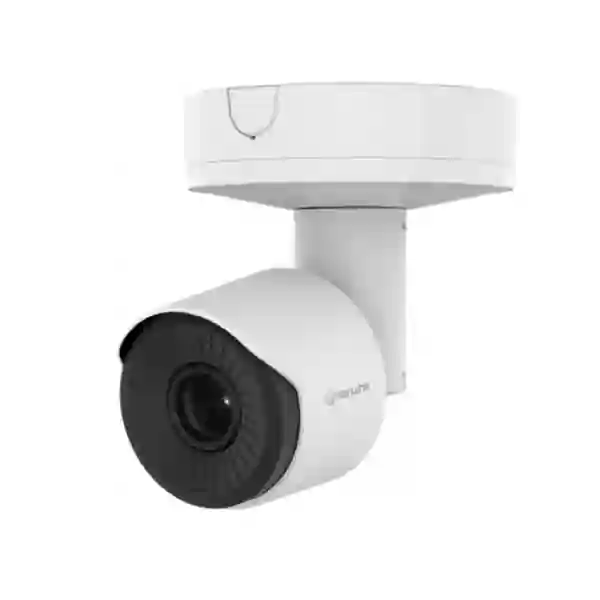
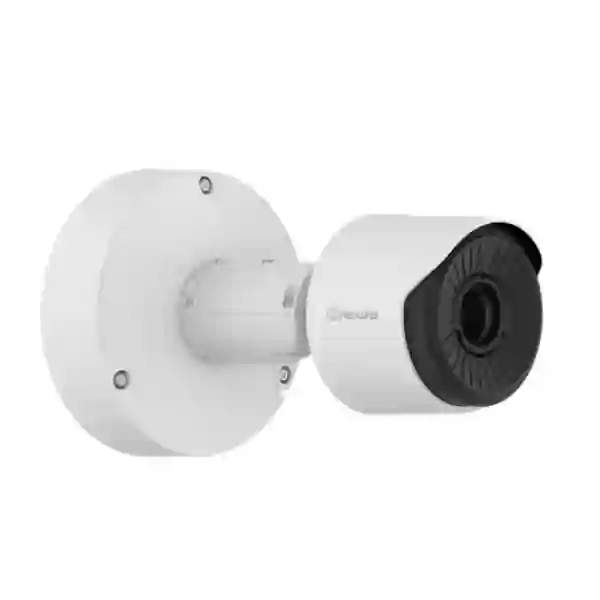
Before ordering, survey the intended mounting height, orientation, clearances and available power and network routes. The camera body measures approximately 93.8 mm in diameter by 233.5 mm in length. Manufacturer mounting adjustments include pan, tilt and rotation ranges, but these represent installation positioning rather than a motorized PTZ viewing function. A fixed camera should be aimed at the correct scene during installation and then secured so vibration and routine access do not change the view.
Draw a simple site plan showing the target boundary, camera angle and relevant distances. Note gates that may open into the scene, lighting poles that could obscure a target, and nearby heat sources. Test whether expected people and vehicles remain inside the useful frame as they move. Check for cable strain, weatherproof sealing and adequate working space around the camera. Where optional adapters or conduit interfaces are needed, verify the exact accessory compatibility before making a final bill of materials.
Commissioning and acceptance testing
Commissioning should prove the security objective, not merely confirm that a network address responds. Create a repeatable set of tests covering authorized and unauthorized approaches, a person walking at typical speed, a vehicle travelling in the required direction, and a target near the planned maximum useful distance. Include scenarios where a person enters and leaves a virtual area, stops briefly or approaches from an angle. Capture evidence of both successful detections and any conditions that require retuning.
Next, verify event timestamps, user permissions, VMS recordings, alarm output and the available monitoring method. Recheck the installed camera after nightfall if nighttime protection is an important requirement. Where heavy rain or difficult heat contrast is a foreseeable risk, set a documented follow-up test. Ask the customer to sign off on an agreed acceptance standard rather than a vague promise of accurate detection. Retain configuration backups and a reference image so later troubleshooting can distinguish a camera defect from a changed scene.
Ongoing care after deployment
Thermal cameras require operational ownership like any other network-connected security device. Establish a routine that checks image quality, mounting stability, enclosure condition, clock accuracy, recording retention and alarm delivery. Vegetation may grow into the scene, stored materials may be relocated and new structures may block an approach route. These changes can reduce protection without creating an obvious hardware fault. A periodic reference-image comparison is a useful way to identify such shifts.
Firmware should be reviewed against official Hanwha Vision support information and the customer’s change-management process. Test compatibility and preserve configuration details before a controlled upgrade. Monitor storage health and replace failed media according to the planned maintenance approach. Train operators to distinguish a thermal detection from confirmed identification and to use the paired visual systems when necessary. A well-maintained deployment is one in which rules, response procedures and evidence handling remain aligned with actual site operations.
Buying criteria beyond the specification sheet
A responsible quotation should state the quantity and exact model, the intended observation distances, network and storage requirements, mounting accessories, backup power assumptions and the required VMS functionality. It should also document whether a field test, installation service or ongoing maintenance is part of the commercial scope. The TNO-C3042T’s 13 mm lens and 8 fps video rate should be visible in the comparison so a similar-looking but different Hanwha model is not accidentally substituted.
When evaluating competing quotations, compare the full security outcome rather than only the unit price. A cheaper camera with a poorly matched field of view may demand more units or create gaps; an expensive long-range model may be unnecessary for a short corridor. Confirm delivery terms, local taxes, warranty scope and product availability separately through the eventual supplier’s written quotation. No price or stock status should be assumed from this informational description.
Planning a Tanzania security project
For a project in Tanzania, site conditions should shape the equipment schedule. Review the actual facility layout, the customer’s approach to night monitoring, reliability of the available power supply, network connection between the camera and control room, and the intended process for responding to events. These considerations are relevant whether the camera will observe a private compound, an industrial site or a controlled vehicle gate. Use verified project requirements rather than generic claims about climate or local coverage.
It is also worth defining how the installation will be supported once commissioned. Who receives a device fault alert? Who may access recordings? Is a remote link available, and what happens if it is interrupted? Does the customer’s procurement policy require specific documentation or approvals? Any location-specific regulatory, import, certification, supply or commercial question should be confirmed for the actual project. Request a written, project-specific recommendation rather than relying on assumed stock, delivery dates or service-area claims.
Thermal, optical and dual-camera choices
A conventional optical camera provides visible scene detail that may help an operator identify clothing colours, faces or vehicle markings under suitable illumination. A thermal camera instead emphasizes temperature-related contrast and can support detection in darkness without ordinary lighting. Neither is automatically superior. The TNO-C3042T may add particular value when an optical image is poorly lit, while an optical or multisensor system may be necessary for the evidence requirements of the site’s investigation process.
A combined solution can assign a clear role to each device. The thermal unit detects a person entering a protected zone; a visible camera supplies contextual footage; a recorder stores synchronized evidence; and a control room applies an agreed escalation procedure. If a project mainly needs temperature measurements rather than perimeter protection, evaluate a purpose-built radiometric instrument instead. If the project depends on fast-moving targets, assess whether the 8 fps model is sufficient or whether a different frame-rate option is warranted.
What to confirm before requesting the quote
To obtain a useful proposal, provide the type of site, the number of areas to cover, approximate widths and distances, current camera or VMS models, available network switch ports, power conditions and whether monitoring is staffed or remote. Explain whether the priority is people, vehicles or both, and whether the system needs intrusion, direction or loitering alarms. If the project has a target response time, identify the team and communication system responsible for that response.
Ask the supplier to specify what is included and excluded: the thermal cameras, mounting accessories, cabling, surge protection, storage, VMS licensing, configuration, commissioning and after-sales arrangements. An accurate specification should also distinguish the exact model from related variants in the thermal range. Finally, agree how alarm performance will be tested on the installed site. This gives stakeholders a consistent basis for evaluating technical quality, implementation cost and operational suitability before authorizing a purchase.
Buyer questions about the TNO-C3042T
Does the TNO-C3042T work in complete darkness?
Yes. It forms an image from long-wave thermal radiation rather than ordinary visible light, so it does not need a conventional light source for basic imaging. That does not mean every dark scene gives perfect detection: target size, thermal contrast, weather and obstructions still matter. Test the actual person or vehicle alarm task at the site’s intended range, especially where the background changes temperature after sunset.
Is the native thermal resolution 768 × 576?
No. The documented uncooled detector is 384 × 288. The product also lists a 768 × 576 video output, which must not be confused with a detector containing that many independent thermal sensing pixels. For imaging comparisons and coverage calculations, begin with the native 384 × 288 array, the 13 mm lens and the object size at the expected distance.
Can this camera identify a person’s face or read a number plate?
It should not be purchased for either task. The thermal picture is designed primarily to reveal differences in heat and support relevant classification and analytics, not to reproduce the visible detail needed for facial identification or license-plate reading. Use an appropriately designed visible-light camera and matching optics when those are essential evidence requirements, and verify the combined workflow during commissioning.
What is the maximum frame rate?
The exact TNO-C3042T model supports up to 8 frames per second. Other related Hanwha thermal cameras may offer a different frame rate, so verify the ordered suffix and product model. For a fast-moving vehicle or event requiring detailed motion review, assess actual recorded footage to make sure 8 fps satisfies the project’s objective.
What kinds of AI alarms are supported?
The manufacturer lists person and vehicle classification plus object detection, virtual-line crossing and direction, virtual-area loitering, intrusion, entry and exit, and motion detection. The camera also has other conventional alarm triggers. Which events are visible to a specific VMS depends on integration and configuration, so ask for a demonstrated event-to-recording test before treating the complete alarm workflow as confirmed.
How far can a person be detected?
Hanwha lists up to 87 metres for AI person detection under its specified conditions. It separately publishes a theoretical Johnson-criteria person detection figure of 454 metres; these measurements describe different concepts and must not be interchanged. Real site results vary with image position, target size, angle, background and weather. Specify the distance and alarm outcome required before choosing the camera.
Can it measure precise equipment temperature?
It is principally a thermal surveillance and analytics camera. Although the manufacturer lists region-of-interest condition monitoring settings, those details do not justify assuming calibrated spot-temperature measurement or industrial thermography performance. For a project involving overheating thresholds, diagnostic temperature values or a measurement accuracy requirement, request documentation for a suitable radiometric model instead.
Does it support PoE and an SD card?
Yes. Documented power choices are IEEE 802.3af Class 3 PoE or 12 V DC. There is one microSD/SDHC/SDXC slot with support up to 1 TB. Select suitable power, cabling and storage media for the installation, and calculate retention and backup requirements from the configured recording profile rather than the maximum card capacity alone.
Is the model suitable for outdoor use?
The manufacturer lists IP66 and IP67 ingress ratings, IK10 impact protection and an operating range of -40°C to +60°C. These ratings support outdoor consideration but do not eliminate the need for sealed connectors, appropriate mounting, surge protection and proper installation practice. Weather can still affect image contrast, so enclosure durability and surveillance performance should be assessed independently.
Can it connect to third-party recording software?
The camera supports ONVIF profiles S, G, T and M, RTSP and manufacturer interfaces. These are useful integration options, not an unconditional guarantee of full analytics and metadata compatibility with every VMS version. Test live streaming, event receipt, timestamps, playback, security permissions and any required I/O features in the actual software stack.
What information is needed for a Tanzania quotation?
Share site drawings or measurements, required person and vehicle detection distances, the desired field of view, current VMS and network arrangements, power details, installation environment and acceptance criteria. Request confirmation of exact accessories, delivery terms, applicable taxes, warranty and local project responsibilities in the written quotation. This page does not make any claims of current stock, a fixed local price or guaranteed installation coverage.
Request a project-specific quotation
Ask FourTeck Tanzania to review the required camera quantity, coverage geometry, VMS integration, networking, mounting and commissioning scope. A written quotation should confirm product availability, accessories, commercial terms and any applicable project services. Include measured distances and alarm objectives for a more useful technical proposal.
Next step: Request a TNO-C3042T security system quote.




Reviews
There are no reviews yet.