
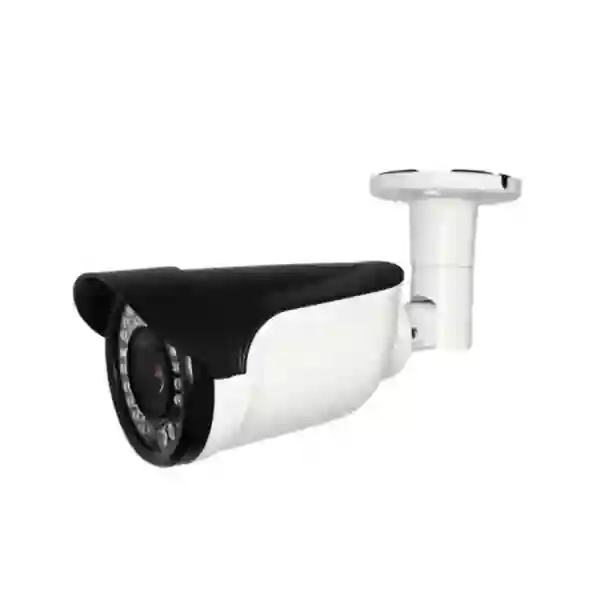
Hanwha Vision | Flame-event awareness
2MP flame sensing with visual context
The Hanwha TNO-F6022R flame detection camera is intended for facilities that want a dedicated flame-related event signal together with video of the area. Hanwha Vision describes it as a 2MP IR bullet network camera with a nominal 30-metre detection range and 100-degree detection angle. For a buyer considering workshops, storage areas or other identified risk points, the essential task is to check whether the device can actually see the hazard and whether a useful alert reaches the responsible team. A site assessment is therefore more important than treating the published detection figure as guaranteed coverage.
Quick specification and buying snapshot
Specifications below are selected manufacturer-listed highlights, not a substitute for the complete current data sheet or a project survey. Detection range depends on test conditions; suitability for a particular environment must be confirmed before ordering.
| Camera type | 2MP network IR bullet camera with dedicated flame detection |
|---|---|
| Nominal flame sensing | Up to 30 m; 100° detection angle under defined conditions |
| Day and night | True Day & Night; noise and backlight management |
| Integration | ONVIF support; verify specialist alarm delivery |
| Power | Power over Ethernet supported; confirm exact installation budget |
| Video codecs | H.265, H.264, MJPEG |
| Network security | HTTPS capability; configure and maintain securely |
| Best starting point | Site survey, hazard review and integration test |
What this camera is designed to do
The Hanwha TNO-F6022R flame detection camera combines ordinary network video with a specialised infrared flame-detection function. For a buyer, that means the product is not merely a CCTV camera pointed at a risky area and neither is it a stand-alone, complete fire-safety installation. Its role is to observe a defined scene, identify a flame-related event using its dedicated sensing hardware and provide useful visual context for the people or systems handling an alert. This combination can be valuable wherever an operator needs to understand both that an event was detected and what is happening at the monitored location.
A suitable project starts by defining the hazard and the action required, rather than selecting a camera by resolution alone. Consider where an open flame might appear, how quickly it must be noticed, who should receive an alert and which existing protective measures will remain in service. The device can contribute an additional detection layer, but it should sit within a broader risk assessment that considers appropriate fire detectors, alarms, evacuation planning and emergency response. The camera’s event output and any integrations should be proven against the actual monitoring platform before operational use.
Verified highlights at a glance
The manufacturer identifies this model as a 2MP flame-detection IR bullet camera. Its published highlights include a dedicated flame sensing arrangement, nominal detection distance of 30 metres, 100-degree flame-detection angle, True Day & Night using an infrared-cut filter, noise reduction and backlight handling. Network characteristics highlighted by Hanwha Vision include ONVIF support, Power over Ethernet, HTTPS and the H.265, H.264 and MJPEG compression formats. Those are relevant starting points for the specification review, but they do not describe every setting or promise a particular result in every environment.
For quotation purposes, keep the video and safety functions separate on your checklist. Confirm the exact equipment model and current firmware, the lens view from the proposed mounting point, flame-detection settings, recorder interoperability, power source and alert-handling method. A specification such as 2MP explains the image category; it does not establish flame-detection reliability by itself. Likewise, ONVIF describes a family of interoperability standards rather than proof that a specific recorder will expose every special alarm. Ask for a practical compatibility demonstration when integration is important.
Understanding the 30-metre flame-detection figure
The advertised 30-metre flame-detection distance is a manufacturer specification for the sensing function, not an unconditional guarantee that every small flame can be detected from that range. Hanwha Vision’s technical lineup material associates this figure with specified fire-source size and sensitivity conditions. A smaller flame, an obstructed scene, a different sensitivity setting or environmental interference may change what is detected. Buyers should therefore treat 30 metres as a design reference requiring a site-specific check rather than drawing a perfect 30-metre circle around every proposed installation position.
For example, a small flame partly hidden behind a machine guard presents a very different task from a visible flame in an open area. Stock racks, partitions, vehicles, temporary equipment and personnel can all create blind spots. The commissioning team should mark the relevant hazard points on a plan, examine each camera’s sightline and confirm what a valid test demonstrates. The design should also cover places outside the expected sensing zone and consider alternative detection methods where a camera does not have dependable visibility.
What the 100-degree detection angle means
Hanwha Vision states a 100-degree flame-detection angle, which helps explain the breadth of the sensing area. A wide angle can cover multiple potential event locations within a single scene, provided they are visible and fall within the effective range. It does not remove the need to understand geometry. At increasing distance the coverage area widens, but a source may occupy less of the camera image. An apparent wide field can also include open doors, reflective surfaces or unrelated activity that deserves attention during risk review.
When preparing a camera layout, distinguish the published flame-detection angle from the dimensions of the video image and from the exact working area that must be supervised. Orient the bullet housing toward identified hazards rather than a convenient wall position alone. Use the site drawing to record horizontal and vertical sightlines, mounting height and the nearest and farthest relevant points. A mock-up or controlled site survey is often more informative than assuming that a single number represents usable coverage over the entire floor.
Why the 2MP video channel matters
The camera’s 2MP image is useful for viewing the area associated with an event. When an alarm occurs, operators may need to identify which process, shelf, workbench or section of a yard is affected. Video can help them assess surrounding movement and decide whether to escalate according to the site’s emergency plan. However, video is not a substitute for direct assessment where personal safety is involved, and a remote picture should not be treated as proof that an area is safe to enter.
Recording design should match the purpose of the installation. A site that needs incident review will have different retention, access and evidence-handling needs from one that needs only live alarms. Ask whether the proposed recorder can capture pre-event and post-event footage, associate an alarm with the correct camera and preserve timestamps consistently. The exact recording options depend on the recorder and software selected, so they should be checked during integration instead of being assumed from the sensor’s specification.
Day-and-night observation and lighting
Hanwha Vision lists True Day & Night operation, infrared-related camera functionality, noise reduction and backlight handling. These features matter when a monitored area has changing lighting, a dark loading zone or strong light coming through an entrance. Clearer supporting images may help operators review the scene around a detected flame event. They do not make a blocked sensing path visible, nor should they be interpreted as a promise that the camera will perform equally in every nighttime or high-glare condition.
Before installation, inspect lighting across the actual operating cycle. A location that looks straightforward in daylight can change after machinery is parked, security lamps switch on or shutters close. Review whether direct sunlight, reflective metal, vehicle lamps or maintenance lighting can complicate interpretation. If a night-viewing distance or illuminator setting is material to the procurement, verify it from the latest model-specific documentation and test it in the intended position rather than extrapolating from another Hanwha product.
Flame detection versus thermal temperature measurement
This product should be described accurately as a flame-detection camera. A thermal temperature-measurement camera is selected for a different question: how hot a surface or monitored region is, sometimes with numerical radiometric measurements. A visible-light camera provides scene imagery but may not have a dedicated flame sensor. The TNO-F6022R’s specific proposition is a dedicated flame-related sensing function paired with network video; it should not be advertised as a calibrated instrument that reports exact object temperatures.
That distinction changes how buyers compare alternatives. If the main concern is a gradually overheating motor, an appropriately specified temperature-monitoring system may be the more relevant technology. If the concern is a flame becoming visible in a defined sightline, dedicated flame sensing can be worth assessing. If early smoke or heat is a priority, a suitable approved detector may be essential. Many industrial sites need several complementary technologies, with responsibilities and response actions established through a fire-safety design rather than a single camera purchase.
How it should relate to a fire-alarm system
A surveillance camera with flame detection is not a complete substitute for fire-alarm engineering, statutory protection measures, trained personnel or emergency procedures. The correct relationship depends on the building use, hazard assessment, local requirements and any applicable insurer or safety authority conditions. A project may use camera-generated events as supplementary information for security or operations staff while retaining independently specified fire detection and alarm equipment. That approach avoids turning an optional video integration into an unsupported safety guarantee.
Define responsibility before selecting integrations. Who verifies the event, what qualifies for immediate evacuation, how does the alert reach an occupied control point and what happens when power or network service is lost? The answers should exist in written procedures. If an external system is expected to respond automatically, the project team must confirm the supported event interface and obtain appropriate engineering approval. Do not connect an untested surveillance event directly to life-safety actions simply because the software can display an alarm.
Network video, ONVIF and platform compatibility
The published ONVIF support can help the TNO-F6022R fit into a standards-aware video environment, while HTTPS supports encrypted administrative access when correctly configured. For buyers working with an existing network video recorder or video management system, the first question is whether standard video can be viewed and recorded. The next question is different and often more important: will the platform receive, label and act on the model’s dedicated flame event in the way the operating procedure requires?
These two levels of compatibility should be verified separately. Request the recording software version, supported ONVIF profile or vendor integration details, any license dependencies, notification options and a test of the actual event path. A camera may stream successfully yet require additional configuration for specialist alarms. Where existing infrastructure includes several manufacturers, test a sample unit before finalising the whole bill of materials. Capture the results in the acceptance documentation so later software updates can be assessed against a known working configuration.
Compression, bandwidth and recording choices
Hanwha Vision lists H.265, H.264 and MJPEG support for the model. Those formats give a system designer options when matching video streams to network capacity, recorder support and picture requirements. They are not three interchangeable promises of identical storage consumption. Actual bandwidth depends on encoding configuration, image content, frame rate and other settings. A busy workshop scene or night image may behave differently from a quiet corridor, so estimates should be confirmed with representative footage.
Plan the network for normal recording as well as alarm conditions. Decide whether a live operator requires an additional stream, how recordings are stored and what happens if the connection between the site and the viewing station fails. Ensure that alarm visibility is not dependent on a heavily congested general office network. A design that documents the expected streams, storage retention and link utilisation will be easier to support than a deployment that assumes the camera’s listed compression formats will automatically solve every capacity constraint.
Power and cable planning
Power over Ethernet is one of the model’s stated features, which can simplify the physical design by delivering network access and power through suitable Ethernet infrastructure. The site still needs correctly rated switching equipment, an appropriate cabling route and a power-continuity strategy that reflects the criticality of the observation point. Check the exact power budget in the current manufacturer’s technical documentation before choosing a switch or injector, and include headroom for the entire installation rather than assessing each camera in isolation.
A practical installation drawing should show cable lengths, containment, wall penetrations, mounting accessories, the relevant network cabinet and the route back to the recorder or control room. For installations vulnerable to outages, review UPS coverage for the switches, recorders and monitoring equipment, not just the camera endpoint. Where storms, long outdoor runs or electrical noise are concerns, assess protective measures with a competent installer. Network connectivity during normal operation is only one part of maintaining a useful alarm workflow.
Placement survey: the most important buying step
Choosing a camera location is a risk-mapping exercise. Start with where flames could originate, then identify obstructions, operational changes and the people or assets needing protection. A bullet form factor offers a clear way to orient the camera toward a defined area, but a convenient mounting location may not provide the right sensing geometry. Document the potential sources, required response zones, mounting structure, ambient light and any routine movement that could change the view during production or storage activities.
A site survey should also account for cleaning access and future rearrangement. Warehouse racking may be moved; a new machine may block a former sightline; vehicle movements can temporarily conceal the area of concern. Discuss what happens when the camera must be taken offline for maintenance or when a blind spot is introduced. Designing for these foreseeable changes helps buyers avoid relying on a nominal coverage diagram that no longer matches the workplace after the first operational modification.
Avoiding unnecessary alerts and missed events
Any detection technology requires appropriate tuning and review. Hanwha’s technical material identifies adjustable flame-sensing parameters, but the right values depend on the hazard, scene and verified model-specific configuration. Avoid promising that a fixed setting will eliminate nuisance alarms or detect every incident. A poor configuration can undermine operator confidence, while an overly restrictive configuration may make the system less useful. The project team should commission settings against realistic, safely designed scenarios and document the reasons for each decision.
Review the scene for competing infrared sources, changing reflections, controlled hot work, welding activity and other conditions relevant to the manufacturer’s detection guidance. The aim is not to suppress all alerts at any cost; it is to create an operating method in which meaningful events are noticed, assessed and handled consistently. Track recurring alarms by location and time, identify what changed in the environment and revise the installation only through controlled engineering review. A log of outcomes is more valuable than an unsupported accuracy percentage.
Tanzania installation considerations
For a buyer in Tanzania, the local climate and the condition of the actual installation space deserve deliberate assessment. Some projects involve heat, dust, rain, humidity, outdoor exposure or unstable utility power. The suitability of this exact camera for each location must be checked against the current manufacturer environmental limits and any required enclosure, sealing or installation guidance. A bullet shape alone is not proof of a particular ingress-protection rating, and a general catalogue photograph should never replace the model-specific specification.
Local project planning should also consider who will maintain the installation, where monitoring occurs and whether communications can be kept reliable when the site is busy or power supply is interrupted. Do not assume that stock, delivery lead time, installation coverage or local approvals are available without confirmation. When requesting a quote, provide photographs, mounting dimensions and a basic plan showing hazardous areas. That information helps distinguish a suitable project proposal from a generic box-only price comparison.
Scenario: warehouses and storage rooms
Warehouses may contain shelving, packaging materials, processing equipment and a layout that changes with deliveries. A flame-detection camera may be considered for open sightlines facing defined risk points where visual context would help an operator investigate an incident. The relevant question is whether flames in the hazard area would actually be visible from the chosen position. Tall racks and stacked goods can hide critical areas, so multiple observation points or different detection technologies may be necessary.
A warehouse assessment should record rack height, aisle changes, staff access, forklift routes, lighting and the expected location of combustible materials. Do not assume the camera replaces mandated smoke or heat detection, sprinkler coverage or other fire protection. If the warehouse also uses CCTV for general security, check how alerts will be distinguished from ordinary motion events and whether night shifts receive the same response as daytime operations. A good design produces a clear response path, not merely another video tile on a wall.
Scenario: workshops, machinery and process areas
Industrial workshops are often visually challenging because equipment, guards, workbenches and moving staff break up the scene. Where a defined process carries a flame-related risk, the camera may add useful visual awareness if the area can be monitored without obstruction. The presence of welding, cutting, furnaces or other intentional flame and heat sources demands special attention. Their activity should not be treated as an ordinary background detail when designing detection logic and alarm procedures.
For such sites, map normal production activity before deciding on camera positioning and sensitivity. Ask whether hot work occurs by schedule, whether operators can distinguish a permitted process from a hazardous event and whether alternative or supplementary detection is required. Keep the camera outside unsuitable environmental conditions and verify safe mounting with the engineering team. The acceptance test should represent normal operations as well as the specific risk scenario, without creating an unsafe test fire or disrupting required protective systems.
Scenario: loading bays and operational yards
Loading bays and selected yard areas may benefit from a camera that gives operators context when an event occurs near goods, vehicles or handling equipment. These environments also contain moving obstructions. Trucks may occupy a bay for hours, doors may change the lighting and seasonal weather may alter visibility. The nominal flame-detection range should therefore be evaluated as part of a practical view study rather than as an invitation to monitor a whole yard from one arbitrary pole.
A location review should identify where the camera can see across activity lanes without depending on a permanently clear line of sight. Consider how staff will locate an incident after receiving an alert and whether a video image identifies the correct bay. Outdoor applications require explicit confirmation of the device’s environmental rating, permitted temperature range and mounting accessories. If the current source information does not establish those details for the exact model, obtain written confirmation before the device becomes part of the project specification.
Bullet camera versus the dome alternative
Hanwha Vision also identifies the TND-F6022R as a 2MP flame-detection IR dome model. The headline sensing figures presented for the two models are similar, but shape and mounting arrangements can change the practical installation decision. A bullet housing can be straightforward to point toward a defined distant area, while a dome housing may be preferred in particular ceiling locations or where the physical appearance of the installation matters. Neither choice should be based on appearance alone.
Before choosing between the TNO-F6022R and a dome alternative, compare the exact current data sheets, mounting geometry, access for maintenance, environmental suitability and available accessories. Review whether the intended sensing direction can be achieved without awkward brackets or blocked views. The apparent convenience of a particular housing does not establish equivalent performance at every proposed point. If one area requires a different mounting style, a mixed deployment may be better than forcing the same physical camera type everywhere.
Designing an alert and response workflow
Detection is only useful when the responsible person receives a clear message and knows what to do next. Define which team monitors the system, whether alarms are displayed locally or centrally, what visual information is supplied and how escalation is recorded. Event naming should distinguish flame-related alerts from ordinary motion or video loss. If a site operates multiple shifts, assign responsibilities for each shift and make sure an unattended workstation does not become the sole point of notification.
The written procedure should cover validation and urgent response without delaying action where a life-safety plan requires it. Record who confirms an event, who contacts emergency personnel, when the location is evacuated and how the incident is logged. Consider how the team reacts if the camera is offline, the network path fails or the viewing platform is unavailable. A tabletop exercise can reveal missing contact details and unclear authority before a real incident occurs. Camera procurement should include this operational design work.
Commissioning and acceptance testing
Commissioning should be a documented handover, not just a demonstration that an image appears on the screen. Confirm the correct model, firmware version, stable power, network access, camera orientation, video quality, event settings, monitoring display and the agreed response action. An installer should verify that the proposed scene matches the hazards marked during the survey. Where detection tests are needed, they must follow the manufacturer’s guidance and an approved safe test method; improvising open flames is not acceptable.
An acceptance record can include a marked-up site plan, configuration backup, software and firmware details, authorised users, alarm screenshots, time synchronisation results and evidence that the required monitoring team can respond. Record any areas not covered by the camera and the controls used to address them. If third-party video management software is involved, verify both video recording and the specialised alarm path. This provides a clear baseline against which maintenance teams can compare future changes or investigate unexpected events.
Cybersecurity, access and privacy
Because the TNO-F6022R is a networked camera, its operational value also depends on responsible cybersecurity practices. Hanwha lists HTTPS support, which is useful when incorporated into a properly configured security design. Change default credentials where applicable, use unique strong administrator access, restrict remote exposure and review current firmware guidance. Segment camera traffic where appropriate, limit administrative privileges and avoid unnecessarily exposing the management interface to the public internet.
Video can also reveal working routines, staff movement and sensitive operational details. Set clear rules for who may watch, export or retain recordings, and align retention periods with the facility’s lawful and documented needs. Keep access logs and evaluate any remote monitoring arrangement before deployment. A camera that technically streams is not automatically secure or privacy-appropriate. The acceptance process should verify the ownership of accounts and the method for retiring access when contractors or personnel leave the site.
Maintenance after installation
A camera installed for flame-event awareness requires planned maintenance and periodic review. Check that the field of view remains unobstructed, the mount is stable, the housing and viewing surfaces are clean according to manufacturer instructions and the network reports the device as healthy. Revisit the site whenever storage layouts, machines, walls or operating processes change. A previously successful acceptance test cannot guarantee that the same sensing geometry remains valid months later.
Include monitoring software, power backup, alert routing and incident records in the maintenance scope. A camera may be online while the specialist event is no longer reaching the person who needs it, particularly after software updates or changes to network permissions. Test relevant alerts by an approved method at agreed intervals, maintain a change log and preserve a clear escalation route for faults. Maintenance intervals and test procedures should be determined by the responsible engineer and current manufacturer guidance.
What to ask before requesting a quotation
For an accurate proposal, identify the facility type, intended indoor or outdoor location, approximate floor plan, principal fire hazards, possible viewing distance and existing CCTV equipment. Share which recorder or monitoring application is already in use, whether Power over Ethernet is available and who should receive an alert. Mention any site-specific environmental concerns or physical constraints. These details allow a supplier to assess whether the camera is likely to fit the project rather than responding with an isolated hardware description.
Ask for a quotation that separates equipment, suitable mounting components, network work, recording or software licenses if required, commissioning and any subsequent maintenance. Seek written confirmation of the latest model-specific environment limits, supported integration route, commercial availability and applicable terms. Do not compare prices solely on the camera body if one proposal includes event integration and another does not. The value of this type of system depends heavily on dependable coverage, responsible configuration and a functioning response process.
A practical decision checklist
The TNO-F6022R is most relevant when the buyer wants a dedicated flame-related detection function and accompanying video across defined, visible hazard points. It is less appropriate when the main requirement is numerical temperature measurement, the hazard is hidden behind obstacles or a code-compliant fire-alarm system must be provided as the primary protection. A design should never rely on an advertised sensing distance without considering target size, geometry, conditions and validated system response.
Before approval, confirm the precise application, essential safety requirements, current manufacturer data, number of viewpoints, recorder compatibility and maintenance arrangements. Then compare the proposed solution with other detection methods and camera forms using the same site assumptions. If the monitoring requirement remains uncertain, commission a documented site survey before ordering. That approach is especially important for industrial or storage facilities where small layout changes can materially affect the view and where an alarm must lead to a clear, safe operational decision.
Frequently asked questions
Is this a thermal camera that measures equipment temperature?
No. The TNO-F6022R is described by Hanwha Vision as a flame-detection IR bullet camera. Its published purpose is identifying flame-related events while providing network video, not producing calibrated temperature measurements for machinery or stock. If a project needs numerical temperature thresholds, trending or hotspot measurement, ask for a separately specified radiometric thermal system and evaluate its accuracy and operating range. Camera categories can be confusing, so the technical objective should always be written down before models are compared.
Can the TNO-F6022R detect every small flame within 30 metres?
No such unconditional guarantee should be inferred from the headline figure. The manufacturer states a nominal maximum flame-detection distance, and the published technical material ties performance to specified test circumstances. Flame size, sensing configuration, line of sight and environmental factors matter. A small or hidden event may present a different challenge. The installer must evaluate the specific hazard and validate coverage under an approved test method. Other protective systems may still be required for risks beyond the camera’s useful view.
What does the 100-degree figure describe?
It is the published flame-detection viewing angle, an indication of the area the dedicated sensing function can cover from a given position. It should not be confused with a promise that every point across a wide room will be detected equally or with a guaranteed CCTV identification distance. Mounting position, distance to a potential flame source and physical obstructions all affect the usable area. A properly marked site drawing and practical observation are the best way to turn that specification into a deployment plan.
Can I use an existing ONVIF recorder?
The camera is listed with ONVIF support, but a recorder must be checked for the actual functions required. Basic video display and recording may be easier to arrange than reliable recognition of a dedicated flame-detection event. Ask the installer or system integrator to verify the recorder model, software version, any extra licensing and how a flame alarm is displayed, recorded and escalated. A successful test with a sample device provides stronger evidence than a general ONVIF logo on two separate products.
Does it support Power over Ethernet?
Yes. Hanwha Vision lists Power over Ethernet among the model’s capabilities. That can reduce the need for a separate power route at the camera location, provided the network equipment and cabling are selected correctly. The installer should confirm the exact current power specification, overall switch budget, cable length and protection arrangements. A power-backed camera also needs functioning network and monitoring equipment if its alerts are to remain useful during an electrical outage. Plan the full path rather than the endpoint alone.
Can it work at night?
The model includes True Day & Night imaging features and infrared-related camera capabilities. These support observation across changing lighting conditions, but actual image usefulness and flame-event sensing must be validated for the proposed scene. Bright reflections, obstacles or an unexpected lighting arrangement may affect an operator’s interpretation. Ask for a nighttime site assessment where darkness is part of normal operation. Do not assume that a stated sensing distance, image resolution or day-and-night feature removes the need for suitable placement and commissioning.
Can this camera replace smoke detectors or a fire-alarm installation?
It should not be specified as a replacement on that basis. A flame-detection camera may add valuable situational awareness, yet the building’s fire-safety obligations and hazard controls have to be established independently by qualified professionals. Smoke and heat detectors, manual alarms, suppression systems and emergency procedures address different risks and may be mandatory. Define the camera as a complementary observation and detection component unless the relevant fire-safety design and authority requirements explicitly establish otherwise.
Where might the bullet design be useful?
The bullet form factor can suit installations aimed at an identifiable area, such as a particular part of a warehouse, workshop or loading operation. It provides a visibly directional camera arrangement, but that does not automatically make it suitable outdoors or for every mounting structure. Consider accessibility, bracket stability, protected cabling, line of sight and environmental limits. A dome alternative may be more convenient in another position. Choose the housing that supports verified coverage and safe long-term maintenance.
Does the camera automatically notify emergency services?
Do not assume that it does. The manufacturer lists network and sensing capabilities, but the complete event-delivery workflow depends on the connected platform, configuration and project design. A site should establish who receives alerts, how urgently they are handled and what action follows a suspected flame event. Any external notification or automatic control must be designed and tested for the exact installation. Emergency procedures should not rely on an unverified assumption about what a general-purpose video management application will do.
What happens when the network or power fails?
A disrupted network or power supply can make monitoring or alert delivery unavailable even if the camera was correctly positioned earlier. A project should therefore include suitable power continuity, communications resilience, fault monitoring and an alternative safety response for outages. Ask whether the monitoring platform can report a lost camera or disconnected event path, and test how staff become aware of such failures. A life-safety plan should not depend solely on the continued operation of one network-connected observation point.
Is this suitable for outdoor use in Tanzania?
Outdoor suitability must be confirmed from the exact current datasheet and installation guidance for the TNO-F6022R, including ingress protection, temperature, humidity and permitted accessories. Do not infer a weather rating merely from the bullet design or from another Hanwha model with a similar name. Consider rain, dust, heat, sunlight, lightning-related protection and safe access for maintenance. Provide installation photographs and environmental information with the quotation request so the proposed position can be assessed accurately.
How do sensitivity settings affect detection?
Hanwha’s technical material identifies adjustable sensing parameters. Their purpose is to let commissioning reflect the intended scene, but no single universal setting can be promised as ideal for all facilities. Real flames, normal process activity, viewing geometry and potential nuisance sources may differ substantially between sites. Adjustments should follow current manufacturer instructions and be validated with an approved safe test method. Record the final configuration so future changes are deliberate, reviewable and reversible when an operating condition changes.
What information should be included in a quote request?
Provide the exact model, intended quantity, plan or photographs of hazard areas, approximate distances, mounting locations, power and network availability, existing recording software and the site’s alert-response requirements. Note environmental exposure, access restrictions and any compulsory fire-safety specifications. Ask for confirmation of local supply terms, installation suitability, compatible accessories and the level of commissioning included. Do not treat a reseller’s unrelated currency price or stock indicator as proof of current Tanzania pricing or availability.
How should this camera be compared with other Hanwha solutions?
First decide what the system must detect. A dedicated flame-sensing bullet camera, a dome model with similar sensing purposes and a temperature-monitoring thermal solution may solve quite different problems. Compare the exact published detection method, scene geometry, mounting conditions, environmental limits and integration method. Then assess who will act on the information, what evidence must be recorded and which fire-protection measures remain essential. A credible comparison is built around the workplace hazard, not just the largest number in a feature table.
Request a site-specific TNO-F6022R proposal
Ask FourTeck Tanzania to review your intended locations, the hazards to observe, existing camera network and the required alert workflow. Provide a floor plan, approximate viewing distances and the installation conditions. A meaningful proposal should confirm the exact Hanwha TNO-F6022R model, applicable specifications, suitable mounting and power equipment, integration testing and current commercial availability before a purchase decision.
This product is a potential supplementary flame-event monitoring component. It is not represented here as a replacement for required fire protection, a guarantee of detection in all circumstances or a calibrated temperature-measurement device. Request technical and fire-safety review for any safety-critical application.




Reviews
There are no reviews yet.