
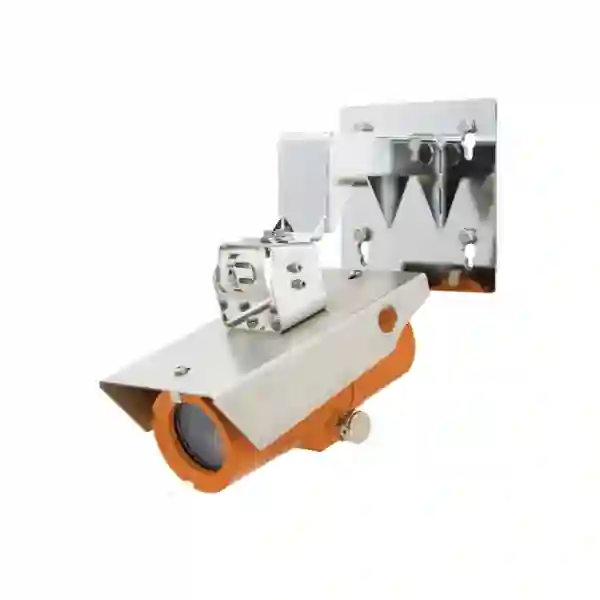
Hanwha TNO-X6072EPT1-Z 2MP Explosion-Proof Fixed IP Camera
Need an explosion-proof fixed network camera for a classified industrial location? The Hanwha TNO-X6072EPT1-Z combines Full HD video, a 2.8–9 mm varifocal lens, network integration and a purpose-built hazardous-area enclosure. It is suited to a carefully chosen observation point when its exact certification and the complete installation design match the project.
For a Tanzania project, request a technical quotation that covers the current certificates, appropriate mounts, safe cable-entry method, power, recording and commissioning. No local stock, installation availability, price or project approval is asserted by this page.
Technical summary
| Manufacturer | Hanwha Vision |
|---|---|
| Model | TNO-X6072EPT1-Z |
| Product type | Fixed explosion-proof network camera |
| Sensor | 1/2.8-inch CMOS |
| Resolution | 1920 × 1080 (2 MP) |
| Maximum H.265/H.264 frame rate | 60 fps (60 Hz) / 50 fps (50 Hz) |
| Lens | 2.8–9 mm varifocal, approx. 3.2× focal adjustment |
| Horizontal field of view | Approx. 98°–39° |
| Wide dynamic range | 150 dB |
| Compression | H.265, H.264, MJPEG |
| Environmental protection | IP66; NEMA Type 4X |
| Network | RJ-45 10/100BASE-T; ONVIF S/G; SUNAPI |
| Power | IEEE 802.3af Class 3 PoE for camera; auxiliary needs to be confirmed |
| Housing | Powder-coated aluminium |
| Weight | Approx. 6.35 kg |
| Dimensions | Approx. 182.9 × 151.6 × 351.8 mm |
Review the latest exact-model installation and certification documents before ordering. Operating limits, included accessories and site-specific hazardous-area approval must be confirmed for the intended assembly.
Why select the Hanwha TNO-X6072EPT1-Z?
A hazardous-location surveillance project needs more than an ordinary outdoor camera. It needs a clearly defined observation task, correctly selected protection equipment, a planned wiring route and a recording system that operators can use. The Hanwha TNO-X6072EPT1-Z is a fixed 2 MP network camera housed for specified explosion-proof applications. Its core value is continuous monitoring of one carefully selected scene, not autonomous inspection of an entire industrial complex. This makes it a candidate for fixed views of access points, process approaches and equipment areas where its exact certified conditions match the proposed site.
The specification includes Full HD recording, an adjustable 2.8–9 mm lens, up to 60 fps with supported H.265 or H.264 streams, 150 dB wide dynamic range, day/night switching, image stabilisation and analytics. Those features can support reliable observation when a designer selects the right vantage point and light conditions. For a Tanzania quotation, describe the site environment and required evidence detail so the complete installation—not only the camera body—can be evaluated. Every claim about local stock, delivery, pricing or site certification must be confirmed separately.
What explosion-proof protection actually means
An explosion-proof camera is not a device that removes dangerous gas or dust, detects all ignition hazards or replaces a facility’s emergency protection systems. The protection concept concerns equipment construction and its documented suitability for specific hazardous atmospheres and operating conditions. The product carries manufacturer-listed hazardous-area approvals, but the correct interpretation depends on classification, equipment group, temperature marking, ambient limits and conditions attached to the certificate. A plant can have several differently classified locations even within one processing unit.
Weather protection and explosion protection are separate matters. IP66 can help establish resistance to dust and strong water jets, but it cannot prove that an enclosure is approved for a particular flammable atmosphere. Equally, a camera with certification appropriate for one industrial area may not be acceptable for another. The responsible engineer should compare the exact model and full assembled installation with the facility’s area-classification drawings and applicable project standards. A purchasing description should never replace that comparison or imply that all installations are automatically permitted.
Hazardous-location markings and approval review
Hanwha lists cFMus hazardous-location references for Class I, II and III Division 1 groups, together with ATEX and IECEx explosion-protection information for the model. These are meaningful selection criteria because they describe more than an informal ‘industrial-grade’ claim. Still, classifications are not interchangeable labels. The project documentation may refer to gas groups, combustible dust groups, zones, divisions or maximum surface temperatures. Each term has a role, and a complete suitability decision must consider them together.
Request the latest certificate, applicable schedules, installation manual and any special conditions of use before approving the bill of materials. Verify that the certificate applies to TNO-X6072EPT1-Z itself, with the correct installed configuration. Ask the site’s safety and electrical teams to examine cable glands, conduit seals, earthing, power supply and mounting method. This process is particularly important in industrial procurement because the most expensive specification error is often a small overlooked entry or accessory rather than the camera’s picture quality.
Choose the view before choosing the hardware
Begin by writing down what the operator must see. A security officer may need to understand activity at a gate, while a process operator may need to observe a selected equipment approach. A safety or investigation team may require an intelligible record of an incident. These are related but different objectives. A camera position that provides a useful overview may not capture readable details of a distant instrument, and a tighter image may miss important peripheral activity.
Mark the proposed camera position and target areas on a simple plan. Record distances, installation height, structural obstructions, expected vehicle or person movement, and the times when footage will matter most. Compare the number of available image pixels with the width of the scene. If the lens cannot meet the desired overview and identification tasks at once, specify a second camera or change the layout. Clear scene requirements make quotations more comparable and provide measurable criteria for commissioning.
The 2 MP image and frame-rate decision
The camera’s maximum Full HD video resolution is 1920 by 1080 pixels. Hanwha lists video operation at up to 60 frames per second for supported H.265 and H.264 modes, with different rates for other formats. Smooth motion is valuable when reviewing movement at a selected process point, but a high frame rate is not a substitute for sufficient light, appropriate shutter settings or a well-framed scene. The right recording profile is the one that produces usable evidence without consuming unnecessary network and storage resources.
A fixed number of pixels has to represent every object in the picture. Distant people, gauges or small fittings occupy fewer pixels when a camera sees a broad area. Before accepting the installation, view recorded clips from the actual target distance and confirm that operators can recognise the event or object required by the specification. Do not rely exclusively on the stated megapixel count or a close-up demonstration. The distinction between watching an operation and identifying fine details should drive the design.
The 2.8–9 mm varifocal lens
The varifocal lens gives the installer an adjustable field of view. Hanwha lists an approximate horizontal angle of 98 degrees at the wide setting and 39 degrees at the narrow setting. The wider view is useful when context matters across a platform or gate; the narrower view can concentrate image detail on a selected point. This adjustment is approximately 3.2 times across the focal-length range, and its practical benefit is flexible framing during setup.
Choosing the focal length is an engineering decision, not a marketing competition over zoom numbers. An excessively wide scene may be hard to investigate because important objects become too small. An excessively narrow scene can omit the circumstances surrounding an event. Review lens settings under actual lighting, confirm the focus and document the accepted image. If future equipment changes block the planned view, reassess placement instead of assuming that digital cropping will restore information that was never captured.
Fixed camera, not a motorised PTZ
This exact model is identified by Hanwha Vision as an explosion-proof fixed varifocal network camera. It must not be confused with a hazardous-rated pan-tilt-zoom product. Some older third-party material contains inconsistent PTZ naming or zoom wording, but that is not a sound reason to promise an optical 32-times tracking capability. A buyer who expects live remote pan and tilt would need a different appropriately specified camera.
The fixed configuration has a practical advantage: a critical scene remains covered continuously rather than being left unobserved when an operator steers a PTZ elsewhere. This can benefit routine incident recording and carefully tuned scene-based analytics. Its limitation is equally important: the camera will not patrol several directions or follow moving activity across a large yard. Determine whether permanent observation of one defined area or interactive inspection of multiple positions is the primary requirement before deciding on a camera category.
Day and night performance
Hanwha publishes low-light sensitivity values and automatic day/night operation with an infrared-cut filter. Those features make the model suitable for consideration in scenes where illumination changes, but they do not guarantee useful footage in total darkness. Published sensitivity is measured under defined conditions, whereas industrial sites introduce moving subjects, reflections, steam, dirt, shadows and uneven artificial lighting. A technically bright still frame can still contain severe motion blur.
The manufacturer’s highlighted features do not establish that this model includes a built-in infrared illuminator. Do not assume integrated IR illumination, and do not add an ordinary light fixture inside a classified area without an independent suitability assessment. Instead, survey light levels during the least favourable operating period. Commission the camera using moving people or equipment at the real viewing distance, and check that the chosen shutter, noise reduction and focus settings preserve the detail the operator needs.
Wide dynamic range and difficult lighting
A 150 dB wide dynamic range specification can help when bright sunlight and dark process structures appear in the same picture. Other listed tools include backlight compensation, highlight compensation, digital noise reduction and defog processing. This combination can be relevant near an open doorway, reflective piping or an outdoor platform with deep shadows. Their benefit depends on correct configuration and on the scene’s actual light behaviour.
An installer should examine the recorded image through changing daylight rather than assuming that a feature label solves glare automatically. Strong reflections, dirty viewing windows and abrupt lighting changes can still defeat image quality. Set exposure to favour the observation objective; this might mean preserving the detail of a person’s movement instead of maximising overall scene brightness. Keep comparison footage before and after configuration so the site team can see whether adjustments make evidence clearer or simply make the live display appear more attractive.
Stabilisation and vibration management
Hanwha lists digital image stabilisation supported by a built-in gyro sensor. It may help maintain a readable image when the camera experiences limited vibration, such as vibration transmitted through nearby machinery or a supporting structure. The presence of digital stabilisation does not eliminate the need for a structurally sound mounting system. Excessive movement can still create blurred images, loosen components or shorten service life.
A practical vibration assessment should look at the camera position, bracket geometry, mounting surface and expected operating conditions. Test the picture during normal machine cycles, not only when the facility is quiet. Where the image shifts or shakes, address the mechanical cause before relying on software compensation. In hazardous-area installations, any changes to mounting equipment must also follow the approved mechanical and certification requirements rather than introducing an unreviewed accessory.
Video analytics and event rules
The feature set includes motion and tampering detection, defocus-related alerts and virtual area or line events such as entering, leaving, intrusion and crossing direction. These functions can draw operator attention to a defined occurrence and make recorded footage easier to review. Their value is highest when a camera covers a stable and specific scene. A generic motion alarm directed at an active industrial platform can be less useful than a carefully limited rule for a restricted approach.
Decide in advance which events require action, when they are relevant and who should receive each alert. Test for nuisance triggers caused by vegetation, insects, weather, shadows, vapour and equipment movement. Analytics should support a human response procedure, not be treated as a certified gas detector, fire system, emergency stop or other independent safety control. Review false alarms and missed incidents during acceptance and after normal operating patterns have been observed.
Local recording and microSD options
The product includes two microSD/SDHC/SDXC slots. Hanwha’s current web specifications show support for up to 512 GB per slot, although earlier published material lists lower values. Confirm supported cards and maximum capacity for the precise hardware and firmware before specifying storage media. Edge recording can serve useful roles for event capture and certain temporary network conditions, but a memory card alone may not satisfy an industrial facility’s evidence-management and retention requirements.
Specify who will access recordings, how long clips must be retained, how storage faults will be detected and how footage will be exported. Cards are consumable components subject to wear and should have a replacement policy. If the selected recorder or management system is expected to recover edge recordings after an outage, test that capability rather than assuming it works. For audit-sensitive sites, document retention settings, time synchronisation and chain-of-custody procedures from the beginning.
H.265, H.264 and bandwidth planning
The camera supports H.265, H.264 and MJPEG streaming with multiple profiles and Hanwha’s WiseStream II technology. Compression can reduce bandwidth and storage needs, but actual results depend on frame rate, scene activity, image noise and quality targets. A still corridor may produce substantially less data than an active yard or vibrating industrial platform. Avoid assuming that one catalogue bitrate applies to all installations.
Choose a high-quality recording profile and, where supported, a separate lower-bandwidth live-view profile. Assess the capacity of the access switch, uplink, recorder and any remote connection used by operators. Where several cameras share a long-distance link, calculate the combined load and test normal peak activity. Network interruptions and packet loss can damage evidence continuity even when the camera itself functions correctly. Make bandwidth and recorded-picture quality explicit acceptance items.
Video management system integration
Hanwha lists ONVIF Profiles S and G, along with SUNAPI and standard video networking capabilities. These features provide routes to integrate the device with compatible video management systems and network recorders. However, interoperability is not identical to complete feature support. A recorder may display live video while failing to support a selected analytic event, audio channel, alarm output, recording mode or configuration function.
Before ordering, identify the current VMS software, firmware version, channel licensing, desired alarm workflow and retention policy. Test live video, playback, search, export, camera-health monitoring and any event functions that operators actually need. Document which features are managed through the VMS and which must be configured through the camera itself. This prevents a common procurement gap in which the hardware is technically network-compatible but the control-room workflow remains incomplete.
Secure network deployment
A network camera should be treated as an operational technology or security-network asset with controlled access. Hanwha lists HTTPS, signed or protected firmware, secure boot, authentication options, device logging and other cybersecurity controls. These features need to be enabled and managed; they do not provide security simply because they appear on a specification sheet. An exposed camera with weak credentials can still put surveillance records and wider networks at risk.
Use strong unique credentials, designated administrative roles and appropriate network segmentation. Limit inbound management access and avoid unnecessary internet port forwarding. Establish a process for approved firmware updates, settings backups and recovery. Confirm how the VMS handles authentication, encrypted transport and device certificates. Assign responsibility for reviewing logs, checking time synchronisation and responding to security notices throughout the device’s operational life. Industrial owners benefit from documented configuration more than a collection of unused security settings.
PoE and auxiliary electrical requirements
The network camera electronics use IEEE 802.3af Class 3 PoE, and Hanwha lists a camera PoE consumption of approximately 7.5 W. Published documentation also contains auxiliary or DC electrical information associated with the assembly’s environmental requirements. It would be unsafe to assume that every camera and enclosure function needs only an ordinary PoE connection without consulting the current approved installation instructions.
Check the switch power budget, cable length, voltage drop, network protection, possible heating requirements and equipment arrangement. Keep standard network accessories outside classified areas unless they are independently suitable for their installation location. Verify bonding and earthing requirements through the site electrical design. If the installation requires continued recording during outages, consider the whole chain of power supplies, network equipment and recorder storage. A camera connected to a battery-backed switch will not deliver continuous evidence if the upstream recorder or connection fails.
Housing and weather exposure
The camera uses a powder-coated aluminium housing with manufacturer-listed IP66 and NEMA Type 4X environmental ratings. This supports consideration in demanding outdoor or dusty industrial environments, but no ingress rating removes the need for correct cable entries, intact seals and suitable maintenance. IP66 does not imply that the unit is designed for immersion or unlimited high-pressure cleaning. Any chemical exposure or unusual cleaning regime should be reviewed against the exact enclosure instructions.
Conditions across Tanzania projects may differ in heat, humidity, dust, rainfall, coastal corrosion and chemical contamination. Rather than making general location-based promises, record the conditions at the proposed mounting point. Confirm the effective operating-temperature and humidity limits against the latest manufacturer documentation, including any distinction between internal camera electronics and a complete certified housing. Avoid combining values from different data-sheet revisions into one claimed rating. Coatings, brackets, fasteners and inspection intervals all affect long-term usability.
Mounting size, load and access
Hanwha lists approximate overall dimensions of 182.9 by 151.6 by 351.8 mm and a product weight near 6.35 kg. This is not a lightweight indoor camera that can be installed on any convenient bracket. The supporting structure, wind conditions, operational vibration and access for inspection need to be considered. Hanwha also identifies an optional wall-mount requirement, so the purchase order should state clearly what mounting equipment is included.
A mounting survey should identify the wall or pole condition, available working space, direction of view, likely obstructions and the approach for bringing certified cabling to the unit. Avoid unapproved drilling, modifications to the enclosure or improvised fixings. A good mount allows installers to commission the chosen field of view while keeping the hazardous-area protection intact. Record the final orientation and fastening details in the as-built documentation.
Cable routing and certified connections
Cable entries are part of the hazardous-location design, not just a way to make the installation neat. The project engineer must specify permitted glands, conduit systems, seals, bonding and termination methods according to the exact certificate and instructions. The fact that network video uses Ethernet does not make standard office-network connectors suitable everywhere on the site. Equipment outside the camera housing must be judged for its own installation location.
Plan the route before ordering, particularly when access is difficult, cable lengths are substantial or plant shutdown windows are limited. Identify where the transition to a safe area occurs and where standard switches or protection equipment can be placed. Verify cable performance, environmental exposure, surge protection and mechanical security. At handover, preserve drawings and photographs that identify the installed arrangement. Future maintenance teams should not have to guess how a safety-critical entry was assembled.
Oil, gas and chemical process applications
A fixed explosion-proof camera may be considered for a deliberately selected observation point near process equipment, controlled approaches or other classified industrial locations. In oil, gas or chemical facilities, the exact gas group, temperature class and zone or division must be checked before the product is approved. It is inappropriate to suggest that the camera automatically meets every refinery, terminal or storage-facility requirement merely because these industries may contain hazardous areas.
Decide whether the video serves physical security, operational awareness or incident investigation. Keep the purpose specific. A camera might show a restricted approach or provide visual context around an equipment operation, but video cannot substitute for process instrumentation or certified hazard detection. Design teams should choose the lens setting, camera height and light conditions to support that purpose, then validate footage in a representative operating environment.
Fuel transfer and controlled loading areas
Fuel-handling projects often require careful observation of access, vehicle movement or defined transfer activities. A fixed scene can give operators contextual footage when something happens, but an image covering a broad loading area may not capture small details such as distant connection points. If those details are essential, use a narrower dedicated view or another camera position rather than promising to recover them from a wide overview.
The actual classification of the proposed mounting location must be determined by the responsible facility team. Choose accessories and electrical equipment under the same approved design process. Confirm the treatment of traffic lighting, vehicle glare, operating schedules and temporary obstructions during testing. Event detection may assist with security workflows, but a camera alert should never be presented as proof that a fuel transfer operation is intrinsically safe.
Dust-handling and manufacturing scenarios
Some industrial areas are classified because of combustible dust rather than flammable gas, and the relevant equipment marking may be different. The product’s broad hazardous-location headline does not replace verification of the dust group and operating conditions at a manufacturing, bulk handling or storage facility. Dust accumulation on a viewing surface may also affect picture quality, even when the enclosure meets its rated ingress protection test.
At a manufacturing process point, decide whether the camera should observe machinery approaches, restricted access, material movement or a specific operational action. Moving equipment, vibration and process vapour can make motion analytics difficult to tune. Testing under real production conditions is therefore more informative than a demonstration in an empty workshop. Document the camera’s limits and establish cleaning and inspection routines appropriate to the hazardous-area procedures.
Recording retention and evidence quality
Footage is only useful if it can be found and interpreted when needed. Specify a retention period, authorised viewers, export procedure and time-synchronisation method. Calculate storage using measured average bitrate and peak scene activity rather than relying on a generic claim about how much a hard drive can hold. Continuous recording may preserve essential context, while motion-triggered recording can reduce volume but risks missing events when detection rules are imperfect.
Check recorded video, not merely the live stream, during commissioning. Review scenes under daytime, night-time and ordinary operational conditions. Confirm that recorded timestamps agree across the system and that exported files are usable by authorised investigators. If local recording is expected to provide outage resilience, test how the selected VMS retrieves that footage. Establish a documented process for protecting evidence and restricting deletion or uncontrolled copying.
Commissioning and acceptance tests
Before installation, confirm the supplied model, device markings, certification documents, accessories and enclosure condition. Verify that the proposed mounting and power arrangement are the ones approved in the engineering design. Once the equipment is installed by qualified personnel under appropriate site procedures, check network connectivity, user credentials, firmware version, time settings, video streams and alarm integration. Preserve the approved starting configuration.
Carry out viewing tests at the actual target distance. Use moving subjects, ordinary process activity and the least favourable expected lighting. Evaluate focus, field of view, compression, stabilisation, recorded clarity and alarm behaviour. Test how operators recognise a camera failure, how footage is recovered and how a recording is exported. Finish with a signed record of what passed and what remains unresolved. A camera that shows live video is not necessarily an accepted industrial surveillance system.
Routine operation and maintenance
Establish responsibility for image quality, recording health, analytics alerts and network security. Inspect the view periodically, because process changes, new structures and dirt can make a once-useful camera ineffective. Review storage warnings, network interruptions, clock accuracy and recorded clip quality. A scheduled camera-check routine should include retrieving actual evidence rather than simply observing a green status indicator.
Hazardous-area maintenance requires procedures appropriate to the installation, including permits and qualified personnel when applicable. Do not improvise an enclosure opening or change sealing arrangements to perform routine cleaning. Document component replacements, firmware changes, inspection findings and any altered camera view. If a bracket, light or connection method needs modification, return the proposal to the responsible engineering process before work proceeds.
Tanzania installation and procurement considerations
A Tanzania-based industrial project should begin with the site’s own classification, operational needs and installation plan. No assumption should be made about local stock, service coverage or regulatory acceptance from the existence of a product description. Ask the supplier to provide a written offer identifying the exact model, quantity, supported accessories, installation responsibilities, intended delivery arrangements and any exclusions. Confirm prices, taxes, import arrangements and warranty terms for the proposed transaction rather than converting overseas catalogue amounts.
Consider site-specific access, weather exposure, stable power, uplink capacity, replacement-parts planning and scheduled maintenance. These factors can strongly affect overall cost. Projects with long cable routes or isolated locations may need a different network architecture from a compact industrial facility. Share an approved plan of the target view and required video retention with the quotation request. The more precise the brief, the easier it is to distinguish a complete solution from a camera-only offer.
What the buyer should request in a technical proposal
Ask for the current exact-model data sheet, installation manual, relevant hazardous-location certification documentation and any special conditions of use. Provide the facility classification drawing and ask the responsible engineer to confirm the marking against the installation point. Request the proposed mounting accessory, cable-entry method, electrical arrangement and recording integration details. If a seller cannot identify the parts assumed in the quote, the offer is not yet a complete installation specification.
The proposal should explain the expected field of view, approximate viewing distance, lighting assumptions, frame rate and retention policy. Ask for written confirmation of the VMS compatibility and any required licences. Include acceptance testing, handover documents, warranty conditions, service terms and named responsibilities for any engineering approvals. Comparing suppliers on this complete scope is more defensible than comparing camera body prices without knowing what installation equipment and support are excluded.
When to consider an alternative model
Choose another camera category if operators must remotely pan or tilt to inspect several locations, because this is a fixed-view device. Consider a higher-resolution option when a broad scene must retain more fine detail, or a different lens and position if the required target cannot be framed suitably. Where the hazardous-area classification does not match the model’s approved marking, select appropriately certified equipment instead of attempting to compensate through wording or an improvised enclosure.
Also compare lifecycle issues: maintenance access, firmware support, replacement accessories, network security and video management interoperability. A product with impressive camera specifications can still be unsuitable if the mounting arrangement is impractical or the site cannot support its operating conditions. An appropriate specification is the one that balances observable detail, certified suitability, installability, usable recordings and long-term service obligations.
Frequently asked: Is this a PTZ or a 32x zoom camera?
No. Hanwha identifies TNO-X6072EPT1-Z as a fixed explosion-proof varifocal network camera. Its 2.8–9 mm lens provides a focal-length adjustment of approximately 3.2 times, not motorised pan, tilt and 32-times optical tracking. Some older third-party descriptions use confusing wording. For a requirement to patrol multiple directions or track distant movement, specify an independently verified hazardous-rated PTZ product.
Frequently asked: Does IP66 mean it is safe in every hazardous area?
No. IP66 refers to environmental ingress protection; hazardous-location suitability depends on the exact certification marking, classified gas or dust group, temperature limits and installation conditions. The responsible engineer must examine these against the facility’s requirements. The cable-entry system, mounting arrangement and associated equipment must also be suitable. A generic explosion-proof headline cannot replace this assessment.
Frequently asked: Can the camera work in complete darkness?
Do not assume it can provide usable pictures in complete darkness. The model has documented low-light and day/night functions, but the highlighted specification does not confirm an integral infrared illuminator. If an installation lacks light, review appropriately specified illumination and test recorded footage in the darkest normal conditions. Avoid relying only on a minimum-lux number to guarantee visibility of moving people or equipment.
Frequently asked: Does it need a special network recorder?
The camera supports standard network-video technologies and ONVIF Profiles S and G. These improve the possibilities for use with compatible recorders and video-management software, but they do not guarantee full support for every analytic event or configuration feature. Verify the selected recorder’s firmware, supported functions, channel licensing, playback and export workflow before purchase. Test interoperability as part of the project acceptance process.
Frequently asked: Can the camera store video locally?
It includes two microSD/SDHC/SDXC slots, and current Hanwha web specifications show up to 512 GB supported for each slot. Older documentation may differ. Verify supported cards, capacities and recording behaviour for the delivered hardware and firmware. Local storage can complement a central recorder, but the site’s evidence-retention policy should determine whether a managed NVR or VMS recording platform is required.
Frequently asked: Is Power over Ethernet sufficient?
The network camera electronics support IEEE 802.3af Class 3 PoE. However, documentation also refers to additional DC requirements associated with the assembly or its heating function. The exact electrical wiring must follow the current installation instructions and project-approved design. Do not assume that standard PoE covers every enclosure-related function, and do not use unapproved power accessories in a classified location.
Frequently asked: What is the viewing angle?
Hanwha lists an approximate horizontal field of view of 98 degrees at the wide end of the 2.8–9 mm lens and 39 degrees at the narrow end. The best choice depends on the scene’s physical width, the distance from the camera and the required visible detail. A wide view preserves more context; a tight view gives more pixels to a selected target. Validate the choice with actual recorded footage.
Frequently asked: Can analytics replace alarms or safety sensors?
No. Motion, intrusion, line-crossing, tampering and other camera analytics can help a security team find relevant events and monitor defined areas. They are not substitutes for independent process-safety instrumentation, gas detection, fire alarms or certified shutdown systems. Their reliability depends on placement, scene conditions and correct tuning. Every video alert needs a clear operational response and periodic review.
Frequently asked: Is this suitable for coastal or dusty industrial conditions?
The powder-coated housing has published environmental ratings including IP66 and Type 4X, but suitability for a specific coastal, chemical or dusty environment still needs evaluation. Consider corrosion exposure, mounting fasteners, cable entries, cleaning practices and the maintenance interval. Do not equate an ingress rating with resistance to every chemical or cleaning process. Confirm material and environmental details for the current assembly.
Frequently asked: Does the product include the wall mount?
Do not assume a wall mount or all hazardous-area connection accessories are included. Hanwha notes that an optional wall mount is required, and installation components can vary with the site design. The quotation should identify the exact mount, cable-entry accessories, electrical interfaces and any excluded items. An approved camera without the correct installation parts is not yet a complete solution.
Frequently asked: What should be supplied for a Tanzania quote?
Provide the exact model and quantity, facility location, approved hazardous-area classification, target view and distance, expected lighting, preferred mounting position, network architecture, recorder or VMS and retention requirements. Request itemised pricing and confirmation of local order availability, taxes, delivery, warranty and service scope in writing. The camera’s web specification does not establish those commercial facts for Tanzania.
Frequently asked: Is 2 MP enough for security evidence?
It depends on the job. Two-megapixel video can give a useful record of a deliberately framed process or access point, but detail decreases as subjects become smaller within a wide scene. Define the smallest object or action that must be recognisable and test it at the real viewing distance. If the footage cannot satisfy that criterion, consider a narrower view, more cameras or higher-resolution equipment.
Frequently asked: Can the device be remotely accessed securely?
The camera lists cybersecurity features including HTTPS, authentication controls and protected firmware. Safe access still depends on system configuration. Prefer segmented networks, unique credentials, approved remote-support methods and regularly reviewed access rights. Avoid directly exposing camera management services to the open internet. Confirm that any video-management platform preserves the security controls required by the facility.
Frequently asked: How does the purchase become a complete system?
A complete installation normally requires decisions about certified mounting, permissible connections, power, network transport, recording, configuration, test procedures and ongoing operation. The camera is an important component, but it should not be bought in isolation from those decisions. Ask for a technical proposal and approval package, then accept the completed installation only after the desired video and safety-related installation checks are documented.
Request a technical quotation for Tanzania
Provide the intended camera quantity, hazardous-area classification, target view, distance, lighting, mounting structure, power and network arrangements, video-management platform and required recording retention. Request current model documentation, an itemised bill of materials and written confirmation of price, availability, warranty and delivery terms.
Confirm the certification marking and complete installation design with the responsible engineer before purchase. This product description does not guarantee regulatory acceptance, site suitability or commercial availability.




Reviews
There are no reviews yet.