
Industrial network surveillance | Tanzania enquiries
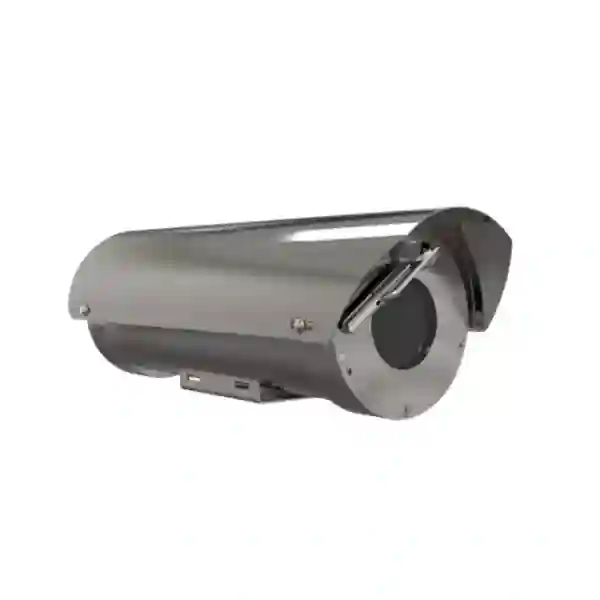
Hanwha TNO-X6320E2F2WT1-C Explosion-Proof Zoom Camera
A fixed-direction 32x optical zoom camera in a heavy-duty explosion-proof housing, designed for projects that demand detailed monitoring of a defined industrial scene. The exact WT1-C configuration includes a wiper, single-mode fibre connectivity and 110 VAC input. Verify hazardous-area classification, certification, mounting and electrical compatibility before specifying it for any site.
Specifications that matter before buying
Published specifications describe the exact named configuration as understood from manufacturer material; obtain the current full datasheet and certification package when completing a contractual submittal. Numerical WDR ratings vary between the manufacturer’s feature summary and detailed specification, so no single WDR value is relied upon here.
Identify the right camera before discussing price
The Hanwha TNO-X6320E2F2WT1-C is an explosion-proof network zoom camera intended for demanding industrial monitoring locations where an ordinary outdoor CCTV housing may be unsuitable. Its proposition is specific: a fixed viewing position with a motorised 32x optical zoom lens, protected by a stainless-steel hazardous-area enclosure, with integrated single-mode fibre and a wiper. That combination can help an engineer watch a defined process area, distant gate, transfer point or equipment corridor while maintaining a protected optical window. It is not a substitute for a professional area-classification review, and the exact certification variant must be matched to the installation before procurement.
For procurement teams in Tanzania, the key questions are not only resolution and price. Confirm whether the camera’s fixed view covers the required hazard or operating condition, whether its optical zoom makes the target large enough for the intended task, whether the supplied 110 VAC power can be accommodated safely, and whether the documented protection and certification markings suit the classified location. Ask for an up-to-date exact-model quotation and technical documentation rather than treating a general explosion-proof description as unconditional approval. Hanwha TNO-X6320E2F2WT1-C should be evaluated as part of the complete surveillance design.
What the exact model designation means
The model identifier matters because visually similar members of the Hanwha explosion-proof family can differ in power input, operating-temperature classification, connectivity, wiper provision and certification suffix. For this WT1-C variant, manufacturer information identifies the wiper-equipped version, single-mode fibre option, the T1 temperature range of -40°C to +60°C and the 110 VAC input. An order for a different suffix or a version without W may materially change what arrives on site. A tender should reproduce the complete identifier on the purchase specification, approved submittal and acceptance checklist.
The first three letters also help prevent a frequent planning mistake. TNO is presented by Hanwha as the explosion-proof zoom or fixed camera family; the TNU family contains explosion-proof PTZ positioning models. A zoom lens changes the field of view and magnification but does not independently turn a fixed camera toward another compass direction. If guards need to sweep widely separated assets under joystick control, specify the necessary pan-and-tilt movement and assess a positioning model instead. This is a functional selection issue, not merely a naming difference.
32x optical zoom for planned observation tasks
The lens spans approximately 4.44 to 142.6 mm focal length and offers 32x optical zoom with autofocus. At the wide end, the operator can survey the selected scene; at the telephoto end, the camera can concentrate pixels on a comparatively narrow area. This is valuable when an equipment face, vehicle approach, fixed access point or process indicator is farther from a safe mounting location than a conventional fixed wide-angle camera can cover effectively. Optical zoom changes the actual lens magnification rather than simply enlarging already recorded pixels.
Zoom is not proof that any subject can be identified at any distance. Actual detail depends on target size, viewing angle, lighting, visibility, camera motion, atmospheric effects and the final pixels across the target. A narrow zoomed view also sacrifices surrounding context. Before selecting the unit, agree whether the purpose is general awareness, event verification, observing a defined machine state or identifying a person. Have the installer produce expected scene images or a field-of-view assessment at both useful wide and telephoto settings, and determine which setting must be used during unattended recording.
Fixed viewing direction versus full PTZ coverage
A fixed explosion-proof zoom camera can be a sensible choice where operators repeatedly inspect one process corridor or a single high-risk equipment zone. It does not necessarily require the moving pan-and-tilt mechanism used by a full PTZ system, and a properly chosen fixed orientation can keep a critical area visible continuously. Its zoom can still bring selected details closer when an event requires examination. This arrangement can simplify the monitoring concept when the project has a clearly defined principal line of sight.
However, using this model to cover several widely separated bearings from one mounting point would be an incorrect design assumption. The presence of video presets or interfaces for camera control does not establish motorised movement of the protective housing. If the specification demands rotation, tilt range, automated tours or true scene tracking through mechanical repositioning, ask for an exact model with those capabilities. A project may also need multiple fixed-view cameras instead of one moving unit when evidence of simultaneous events is important.
1080p image capture and realistic detail expectations
The camera records Full HD 1920 by 1080 video from a 1/2.8-inch-class CMOS imaging device, with the manufacturer listing up to 60 frames per second for H.265 or H.264 under supported signal settings. This combination can provide smooth video for moving vehicles, operations and personnel when exposure, light and bit rate are configured appropriately. The high frame-rate ceiling does not mean every integration will automatically record at that rate, nor that it should. Frame-rate choices affect bandwidth, storage and sometimes low-light image quality.
Specify the evidence needed first, then set resolution, frame rate, exposure and compression as a coordinated system. A slow-moving pump monitoring task may benefit more from clear image detail and manageable storage than from the highest available frame rate. A vehicle approach or fast process movement may justify a higher setting. For long-distance observations, haze and heat shimmer can make optical image quality less predictable regardless of resolution. Test the real scene rather than relying only on a camera datasheet number.
Day, night and difficult backlit scenes
Hanwha lists day/night operation with an infrared-cut filter, low-light sensitivity, backlight management, digital noise reduction, image stabilisation and defog-related image processing. These functions are particularly relevant where industrial lighting creates bright and dark regions together, such as a shaded loading point behind strong daylight, or equipment illuminated unevenly at night. The built-in gyroscope supports digital image stabilisation, which may help compensate for some vibration-related disturbance in the image.
This is a visible-light camera, not a thermal imager. The listed low-light sensitivity is not a guarantee of useful identification in complete darkness, and the product information should not be read as confirming an integrated infrared illuminator. If night-time scenes are critical, survey available lighting, glare and shadows and consider suitably certified supplementary lighting where necessary. The manufacturer’s web summary and detailed specifications present differing WDR numerical statements, so the content avoids depending on a single disputed decibel figure; obtain the current exact-model datasheet for contractual acceptance.
Wiper-equipped optical window
The WT1 configuration includes an integrated wiper arrangement intended to help clear the protective viewing window. At exposed industrial locations, sea spray, rain, dust and accumulated surface deposits can undermine otherwise capable optics. A wiper can be useful for retaining a clearer line of sight between planned cleaning visits, especially where reaching the mounted camera requires scaffolding, a lift or a controlled work permit. The feature should be treated as an aid to maintenance, not a replacement for it.
The wiper cannot guarantee an unobstructed picture under every condition. Sticky deposits, abrasives, chemical films or a damaged window may still require qualified manual cleaning or component servicing. Confirm how the wiper is operated through the selected management interface, what consumables or accessories are required, and which cleaning products are allowed by the enclosure manufacturer. Where the risk assessment identifies a need for an additional wash system, obtain exact approved accessory compatibility rather than assuming every washer kit is included.
316L stainless steel housing and ingress protection
The enclosure construction is described as 316L stainless steel, with toughened optical glass, and the current manufacturer model specification lists protection corresponding to IP66 and IP67. These details are useful when assessing a camera exposed to rain, washdown, airborne contaminants or corrosive industrial conditions. The housing is substantially different from the lightweight outdoor enclosures commonly used for commercial building security cameras, and its mechanical needs must be reflected in the mounting design.
An ingress rating describes performance under defined test conditions; it does not establish unrestricted chemical resistance, indefinite underwater use or immunity from incorrect cable termination. Corrosion behaviour also depends on cleaning chemicals, deposits, joints, nearby metals and maintenance. Ask the engineering contractor to check enclosure, bracket, fastener and cable-entry materials together, particularly where coastal exposure or process chemicals are present. The site should maintain inspection records so any damage to seals, viewing glass or external hardware is identified before it affects image quality or safe operation.
Hazardous-area suitability is a documented engineering decision
The phrase explosion-proof describes an enclosure and certification approach, but it should never be interpreted as permission to mount equipment in any combustible atmosphere. Manufacturer documentation for this family references hazardous-location certification schemes including cLC CSA, cLCus Class I Division 1 and INMETRO across relevant variants. The exact suffix, complete certification number, ambient temperature range, gas or dust classification and temperature class must be checked against the supplied unit. Regional marketing statements alone do not prove suitability for the project’s classified zone.
The responsible designer should compare the installation’s hazardous-area classification with the product nameplate, current certificates, special conditions, applicable installation standard and approved cable entries. A cLC CSA-marked unit must not automatically be described as IECEx-certified, ATEX-approved or approved by an authority in Tanzania without evidence. Confirm the acceptance requirements with the owner, qualified hazardous-area engineer and relevant inspection bodies. Do not open, modify or re-terminate a certified enclosure outside its authorised installation and maintenance procedure. Camera selection is one element of a wider explosion-protection design.
Operating range, weather and site exposure
Hanwha states an operating temperature range of -40°C to +60°C for the T1 configuration. That broad specified range can be useful when comparing proposed mounting positions that experience hot sun, equipment heat or varying conditions across day and night. It does not mean the unit can be exposed to arbitrary temperatures beyond those limits, and the ambient rating of certified equipment must be interpreted in conjunction with its certificate conditions. A site survey should account for heat reflected from adjacent structures and radiant heat from operating plant.
Humidity, moisture ingress, vibration, contamination and accessibility can matter as much as nominal temperature. A protected camera may still suffer degraded images if its glass becomes wet or dirty, while improper cable entries can undermine the stated housing protection. For installations in Tanzania, base the design on measured or reliably documented site conditions rather than a general national climate assumption. Record the expected temperature range, cleaning practices, mounting elevation, wind exposure and nearby sources of heat or mechanical shock before finalising accessories and placement.
110 VAC input must match the electrical design
The exact camera listing specifies a 110 VAC power input and up to 37 W power consumption. It should not be advertised as a native 230 VAC, PoE or universal-input camera. A purchasing decision therefore needs a power-distribution check before equipment is committed. Where the available plant supply differs from the specified camera input, the electrical engineer must identify an appropriate compliant power arrangement and ensure that every associated enclosure, isolation device and cable route is suitable for the installation environment.
Do not assume a small plug-in consumer voltage converter is appropriate for an industrial classified zone. The design must consider supply protection, earthing and bonding, surge exposure, cable sizing, isolation, continuity during outages and procedures for safe disconnection. Clarify whether any transformer or regulated supply is part of the quoted scope and where it would be installed. The power requirement is an important practical distinction between this special-purpose camera and common Ethernet-powered CCTV models. Confirm frequency and all connection details in the current installation documentation.
Fibre connection and network topology
The F2 model includes a single-mode fibre module described by Hanwha as using 9/125 micrometre fibre, alongside an RJ-45 Ethernet interface in the product specification. Fibre connectivity can be advantageous where a control room and camera location are separated by substantial distance or where electrical conditions make ordinary copper network planning difficult. The actual optical path still requires the correct transceivers, connectors, fibre routing, switch or termination equipment and a tested link budget. A fibre-capable camera is not a complete ready-installed network.
Before placing an order, document whether the project intends to use the integrated fibre interface or copper Ethernet, the type and length of fibre, the intended topology, approved route, termination design, redundancy needs and maintenance access. In a classified area, cabling and gland selection are safety-critical installation matters rather than simple IT preferences. Coordinate the fibre designer with the electrical and hazardous-area teams; also confirm that any intermediary switch or media equipment has a suitable installation location and power source. Validate the end-to-end path under realistic site conditions.
Compression and multiple live streams
Supported video codecs include H.265, H.264 and MJPEG, with Hanwha’s WiseStream II compression approach listed for efficient streaming. The camera supports multiple configurable video profiles, enabling a monitoring design in which different viewers or recorders request streams suited to their particular task. For example, an evidence recorder may need a high-quality primary stream while a monitoring dashboard benefits from a lower-bandwidth view. These are design options, not an assurance that every connected software platform supports every profile.
Network sizing should be based on measured or conservatively engineered bit rates for the intended scene, codec, frame rate, resolution and image quality. Industrial scenes with constant movement, rain, flashing lights or detailed textures may require more bandwidth than static test scenes. Avoid promising a fixed storage reduction percentage merely because H.265 is available. Verify recorder codec support, stream-count requirements, multicast configuration and whether remote viewing is permitted by the site’s security policy. A commissioning test should show the picture, delay and recording quality at the actual end devices.
Open integration and recording systems
Hanwha lists ONVIF interoperability profiles and its SUNAPI interface for the model, which can support integration planning with compatible video management and recording systems. The current published specification identifies ONVIF Profiles S, G and T. That documentation is useful when specifying a mixed-camera estate, but a standards label is not a substitute for verifying the particular firmware, NVR or VMS combination. Live video, events, profile selection, edge-recording interaction and specialised controls can be supported differently by different systems.
Before procurement, request written compatibility confirmation for the chosen VMS version and recorder model. Test camera discovery, authentication, both live and recorded streams, event delivery, time synchronisation, playback and any wiper or zoom commands the operators will use. If the owner needs a single security operations console, include operator roles and alarm response workflow in the acceptance test. If the site uses a closed industrial network, determine which services are required and avoid enabling discovery or management protocols unnecessarily. Integration planning reduces surprises after installation.
Edge recording and continuity strategy
The model includes two microSD-family card slots, with Hanwha listing support for up to 256 GB per slot, or 512 GB total capacity when appropriate media is installed. This can be useful for local event capture or for projects exploring resilience when their recording link is interrupted. However, memory slots are not the same as supplied memory cards, and the stated maximum capacity does not establish an achievable retention time. Recording duration varies greatly with actual bit rate, events, frame rate and chosen recording schedule.
Set out whether the camera will record continuously, on detected events or under a hybrid rule. Then calculate realistic storage and retention using site-specific assumptions, including the portion reserved for system overhead and overwriting. Consider what happens when a card fails, fills or becomes inaccessible and whether video must be reconciled with central storage. Memory-media replacement may require controlled access to a hazardous-area enclosure, so card selection and maintenance policy matter. A formal evidence-retention requirement should be implemented in the overall VMS and storage design.
Analytic events and operational alarms
Manufacturer-listed camera analytics include motion detection, tampering, fog-related detection, shock detection, face detection and rules for virtual regions or lines such as crossing, intrusion, entry, exit and loitering. These features can assist operators by directing attention to a defined event rather than requiring continuous manual scrutiny of every live feed. For example, a line-crossing rule may help flag access through a monitored approach, while a tamper alert may indicate a camera obstruction or unexpected scene disturbance.
Event analytics are not equivalent to a guaranteed safety interlock or a certified fire-and-gas detection system. They require sensible placement, calibration and continuous review of missed events and unwanted notifications. Rain, insects, moving machinery, reflections and rapidly changing lighting can change event behaviour. Specify who receives alerts, which are recorded, what counts as actionable and how alerts are audited. For critical industrial shutdowns or personnel safety functions, use the appropriate dedicated certified systems; surveillance analytics can contribute supporting context but should not be presented as the sole protective measure.
Reducing false alerts in an industrial scene
A useful event design begins by distinguishing normal operational activity from actions that genuinely require attention. A fence-line scene might contain regular vehicle traffic, moving shadows or equipment vibration. A process bay could contain rotating machinery, steam or intermittent bright light. If every change generates an alert, operators may soon ignore the important ones. Choose rule boundaries and schedules from the actual view, then record baseline behaviour during normal production and during representative night-time conditions.
Test a practical sample of expected events before acceptance, using consistent success criteria rather than an informal demonstration. Record examples of missed detection, nuisance alarms, weather effects and situations where the zoomed view excludes part of the virtual region. Revisit settings after changes to lighting, equipment layout or the camera’s field of view. If site policy requires incident investigations, document who can modify analytics and retain a record of changes. The most valuable detection system is one that produces understandable, timely notifications with a defined response.
Cybersecurity and access management
The published network specification includes user authentication, IP-based access control, IEEE 802.1X options and audit logging. These features create useful security controls, but they require configuration within a wider operational policy. Treat the camera as a managed network endpoint rather than a device that should be exposed directly to the public internet. Use appropriate network segmentation, carefully assigned user privileges, strong unique credentials, approved remote-access methods and central time synchronisation for traceable events.
During deployment, check the current manufacturer firmware and advisories relevant to the precise hardware and configuration. Do not assume the latest file named for a nearby model is interchangeable without vendor guidance. Disable unnecessary services, control administrator access, maintain a configuration backup and record ownership of upgrades. On industrial sites, coordinate maintenance windows with operations so that network or firmware changes do not interfere with critical surveillance coverage. Review access logs as part of normal security governance, especially after personnel or contractor changes.
Physical installation and mounting loads
The manufacturer lists approximate dimensions of 176 by 154 by 720 mm and a weight of about 21 kg for the model. This is a considerable load compared with many ordinary building cameras. The mounting design must account for the camera mass, bracket and any accessories, fastener specification, structural substrate, wind and vibration conditions, and safe service access. Do not select a bracket solely because it looks physically similar to one shown with another explosion-proof camera model.
Where a mounting point is on a gantry, pipe rack, mast or structural column, obtain an engineering review of local loads, clearance and vibration. The long enclosure body needs room for cable connections and service procedures. Check whether the desired field of view can be achieved without placing the lens behind an obstruction, process plume or reflective surface. Design for practical access during cleaning and inspection without disrupting the plant unnecessarily. All hardware in the hazardous location must be reviewed under the site’s relevant installation requirements and maintenance rules.
Cable entries, seals and system boundaries
Manufacturer material for the explosion-proof bullet family refers to multiple M20 rear housing cable entries, although the current exact-model installation manual should govern the final connection arrangement. Cable entries are part of the protection concept, not a cosmetic detail. Confirm the permitted gland types, thread sizes, sealing method, unused-entry closures, cable materials and applicable torque and assembly instructions before installation begins. Unapproved substitutions can compromise ingress performance or certified enclosure integrity.
Plan the full boundary from the camera to the nearest suitable termination, power equipment and network cabinet. The routes should consider physical damage, chemical exposure, lightning or surge risks, mechanical strain and future inspection access. Fibre and power may have distinct routing and termination requirements. A qualified hazardous-area installer should record each approved entry, maintain the manufacturer’s required fittings and check the finished assembly against the project’s drawings. Do not drill additional holes in the enclosure or alter its certified construction to solve routing problems.
Tanzania project planning without unsupported local promises
For a Tanzanian procurement, it is useful to frame the requirement around the actual facility: process industry, fuel handling, energy infrastructure, industrial storage or another environment that has been formally assessed for hazardous areas. Local operating conditions can include heat, moisture, airborne dust, weather and interrupted utility services, but these vary widely between sites. The design should be grounded in the specific owner’s surveys and risk assessments rather than an assumption that all facilities in Tanzania have the same operating profile.
FourTeck Tanzania can be approached for a technical product enquiry, with the exact model and site requirements included. This page does not claim current local stock, installation teams, local certification, a delivery time, an authorised distributorship or a warranty term, because those details must be verified for the exact transaction. Buyers should request a current commercial offer that identifies the physical product, manufacturer documents, configuration, accessories, shipping and commissioning responsibilities. Any local regulatory or import requirement belongs in the formal procurement review.
Use case: fuel and chemical handling areas
A classified fuel-transfer or chemical-handling area may require cameras positioned outside normal pedestrian access yet still able to inspect a loading position, vehicle movement or a defined operational stage. The 32x optical zoom can help an operator examine a more distant target from a suitable mounting position, while the fixed enclosure directs attention to the selected scene. In a facility with a limited number of important sightlines, a fixed zoom design can complement other security and process-monitoring systems.
The selection should begin with the actual hazard classification, not the product name. Confirm whether the enclosure and complete suffix are acceptable for the atmosphere, ambient conditions and installation method at the intended location. Determine the viewing task at both wide and narrow zoom; a camera pointed at a distant coupling might not simultaneously cover a nearby access route. Evaluate lighting, window contamination, power supply, network resilience and alert rules. Surveillance footage is evidence and situational awareness, not a replacement for dedicated instrumentation, procedures or safety systems.
Use case: port, logistics and exposed industrial yards
Open logistics areas can have long viewing distances, intermittent vehicle traffic, rain, airborne dust and strong shifts between direct sun and shade. In such a setting, a zoom-capable camera may support examination of a fixed checkpoint or equipment zone where the security team wants more detail than a broad overview alone provides. The stainless-steel enclosure and wiper are relevant selection factors when environmental exposure is a concern, subject to an engineering review of the materials and the real contaminants present.
Still, a single narrow-angle zoom view cannot continuously document an entire yard or a multi-lane approach. Pair it with appropriately positioned overview cameras where simultaneous coverage is required. Review whether the location is genuinely classified as hazardous; special explosion-proof equipment is not automatically the most economical choice for every outdoor area. Assess mounting height, vehicle lights, late-afternoon glare, rain effects and maintenance access, and specify a tested recording plan for events that matter to the operation. The correct camera mix is determined by the coverage plan.
Use case: energy and process equipment monitoring
Defined industrial tasks such as observing a pump station exterior, a tank-farm corridor or the approaches to a process unit may benefit from a robust camera focused on a specific line of sight. A remotely adjustable optical zoom lets trained operators change between the local context and a selected detail, depending on the task. Video analytics may assist with detecting unauthorised approach or view obstruction, while multiple streams can help separate operator viewing from central recording needs.
Before calling the design complete, establish what video can and cannot prove. A camera image may show personnel movement, visible smoke or external activity, but it does not measure pressure, gas concentration, flame characteristics or process temperature unless additional specialist sensing equipment is specified. A thermal inspection requirement would need a thermal-capable solution rather than assuming this visible-light zoom model measures temperature. Link camera alarm response to the facility’s existing incident procedures and keep protective instrumentation independent. Confirm visibility during night, rain and normal plant emissions.
Choose between this zoom camera and a PTZ model
Choose the TNO fixed zoom approach when the surveillance plan has a principal direction, a known observation subject and a clear requirement for optical enlargement. The design can be particularly appropriate when critical evidence should remain centred on a consistent scene. A true PTZ alternative becomes relevant where the operator needs to change bearing or elevation, scan across several assets or follow a moving target across a large space. PTZ capability, however, introduces its own operational questions about where the camera points when nobody is controlling it.
Compare candidates using coverage diagrams and event requirements instead of generic feature counts. List how many locations must be watched simultaneously, what must be recorded while the operator is zoomed in, and how quickly an off-axis event must be noticed. If a site requires constant evidence of multiple views, several fixed devices may be preferable to a single continuously repositioned camera. For hazardous areas, each candidate must independently match classification, power, temperature and mounting constraints. Do not exchange a TNO for a TNU based merely on similar focal-length specifications.
Compare near-identical suffixes carefully
Several closely related Hanwha part numbers share the X6320 family identifier. Some versions may omit the wiper, use a different communications arrangement or carry different certification suffixes and temperature specifications. The precise WT1-C designation should be retained from technical enquiry through supplier quotation, purchase order, packing-list inspection and final commissioning. This avoids a situation where a camera with attractive headline specifications arrives but lacks the field-maintenance feature or designation expected by the owner.
Compare any alternative variant with a documented matrix: complete part number, model-family type, zoom mechanism, wiper, fibre interface, supply voltage, ambient rating, housing requirements and certification documentation. If a supplier proposes a newer equivalent model, obtain a clear manufacturer or qualified engineering comparison rather than assuming equivalence. Product generations and firmware can change, and a replacement may require a new approval step for a classified installation. The correct purchasing decision depends on the exact accepted bill of materials, not brand and megapixel count alone.
Survey the location before finalising the bill of materials
A good camera site survey records the monitoring objective, target size, minimum and maximum viewing distance, mounting position, lighting, hazards, obstacles, cable route and maintenance constraints. It should include a sketch or annotated image of the expected field of view. Ask operators which events have been difficult to verify with existing cameras, and establish whether the proposed optical zoom will address that gap. If a fixed angle will miss essential areas, correct the coverage plan before equipment is ordered.
Record the area’s formal classification, temperature class and local acceptance criteria alongside the environmental conditions. Measure or document the electrical supply and confirm the 110 VAC arrangement. Identify the control room, network capacity, fibre requirements, VMS software, storage retention and recovery process after outages. Clarify who will supply mounting accessories, glands, brackets, media and any optional wash equipment. These items affect cost and delivery risk but are often absent from a simple camera-only quote. A complete survey turns a product selection into a testable design.
Prepare a specification that contractors can price consistently
A comparison-ready request for quotation should state the exact product model, quantity, intended application, certification needs and reference to the manufacturer’s current documents. Include the required installation standard, ambient conditions, power scheme and network interfaces, plus any mandatory accessories. Tell vendors whether the quote must cover only supply or also engineering drawings, installation, integration, commissioning and user training. Without a common scope, the lowest quoted line item may exclude essential elements.
Ask that proposed deviations be identified explicitly rather than hidden in supplier notes. These could include a changed model suffix, alternative certification, different power equipment, unsupported VMS function or substitute mounting accessory. Require clarity on factory configuration, freight, taxes where applicable, warranty terms, service arrangements and the acceptance documentation provided with delivery. Do not treat a catalogue lead time from another region as a Tanzanian delivery commitment. Obtain written terms from the party actually offering the product before comparing prices.
Installation and commissioning sequence
Begin with the approved design and a qualified installation team. Verify that the delivered model number, nameplate, certificate package, enclosure and accessories match the accepted bill of materials. Inspect the unit for transit damage before mounting. Confirm the support structure and lifting plan are suitable for the approximately 21 kg housing, and that the specified cable entries and earth or bonding arrangement match manufacturer instructions and site standards. No part of the explosion-protection boundary should be modified ad hoc.
After safe mounting and termination, commission the network and image functions systematically. Confirm power input, network connectivity, configured accounts, time source, live stream, zoom response, wiper operation if applicable, recording, events and remote viewing. Check both normal and representative low-light scenes and compare the actual image with the approved coverage design. Save configuration records, drawings and baseline screenshots. Conduct final inspection by the personnel responsible for hazardous-area acceptance. Formal handover should identify unresolved limitations and maintenance responsibilities, not only demonstrate that a picture appears.
Define practical acceptance tests
A meaningful factory or site acceptance test starts with observable pass criteria. Confirm that the delivered body and suffix match the purchase order, the camera operates on its specified supply and a live feed reaches the intended operator and recorder. Record the applied stream profile, frame rate and codec, then test primary and secondary viewing paths. Demonstrate zoom on a representative target to confirm the required detail, including the correct focus behaviour. Verify wiper control from the chosen interface and make sure the window remains in acceptable condition.
Test selected alarms using agreed scenarios and document both successful events and false responses. Confirm local or central storage operates under the planned conditions, that time stamps are accurate and that authorised users can retrieve evidence. Include a practical network-interruption or recovery test if required by the project. Inspect sealing, cable entries and mounting against approved drawings before sign-off. The acceptance record should include firmware version, operating settings, serial identification kept in project records, personnel signatures and any outstanding actions. These steps create a usable operational baseline.
Routine maintenance and long-term serviceability
Even a heavy-duty explosion-proof housing requires an inspection programme. Cleaning the optical window, checking wiper condition, observing surface corrosion and inspecting mounting hardware can help preserve performance and identify developing issues. Maintenance intervals should be set from the site’s actual contamination, exposure and operating experience, not from an invented universal schedule. Where access is difficult or subject to work permits, a planned visit may be more efficient than repeated emergency callouts following degraded video.
Any work affecting the certified enclosure, cable entries or electrical connections should follow the manufacturer’s current instructions and be performed by authorised, competent personnel under site procedures. Keep the camera configuration, firmware and documentation controlled. Check that alarm rules still match the current process layout, and verify recordings after significant network or VMS changes. Record image-quality changes with reference screenshots where possible. A clear responsibility matrix for the site owner, integrator and maintenance contractor is often more valuable than assuming all tasks are covered by a camera warranty.
Understand total installed cost
The camera price is only one part of an industrial surveillance investment. The project’s total cost may include the certified mounting system, structural work, electrical adaptation for 110 VAC, fibre equipment, hazardous-area glands and cabling, commissioning labour, VMS licensing, recording storage and any optional washing accessories. Access equipment, work permits and future inspection visits can also affect lifetime expenditure. These are possible cost categories to check, not claims that each item must be purchased for every project.
Evaluate cost against the outcome the camera is intended to support. If better zoom detail at one critical position reduces uncertainty during incident review, the value may justify specialist equipment. If the main need is wide-area coverage, a different camera layout could be more appropriate. Require competing proposals to identify assumptions and excluded work so their installed prices are comparable. Seek verified pricing in the transaction currency and do not rely on converted foreign list prices as local offers. Budget decisions should be linked to accepted technical scope and maintainability.
What to provide when requesting a quotation
For an efficient technical enquiry, specify the model TNO-X6320E2F2WT1-C exactly, estimated quantity and whether the camera is intended for a new site or replacement. Describe the application in non-sensitive terms, approximate mounting height and viewing distance, the required evidence or monitoring task, and whether an actual hazardous-area classification has been completed. Provide the required certification and ambient-temperature conditions from the engineering documentation, not an assumed zone based on the presence of fuel or chemicals.
Also include the available power supply, preferred fibre or copper network arrangement, VMS or NVR platform and any accessories that the owner expects. State whether the request covers supply only or installation and commissioning as well. If drawings or specifications are confidential, arrange an appropriate secure technical exchange rather than placing sensitive facility details in a public enquiry. Ask the quoting party to confirm exact model identity, included items, relevant certificates, lifecycle position, availability, warranty and lead time in writing.
Key buyer decisions at a glance
The essential decision sequence is straightforward: establish the hazard and environmental requirements first, then confirm the camera’s viewing geometry and image usefulness, followed by power, fibre connectivity, system integration and service access. A camera that satisfies only the headline optical specification can still be unsuitable if its certificate marking, cable entry or supply arrangement does not fit the site. Likewise, a correctly certified camera might not deliver the required evidentiary detail if mounted too far away or oriented at the wrong area.
When comparing this model against alternatives, keep the acceptance questions concrete. Can the camera see the desired target at the required time? Does the exact shipped suffix match the approved documents? Is the complete installed assembly appropriate for its classified environment? Can the organisation reliably record, retrieve and maintain the video? Has the owner assigned responsibility for inspection and software updates? A technically sound answer to each question is more useful than an unsupported claim that one product is the best hazardous-area camera for every facility.
Frequently asked questions
Is the TNO-X6320E2F2WT1-C a PTZ camera?
No. Hanwha identifies this model as an explosion-proof zoom camera. It supports 32x optical zoom, but buyers should not assume that the body provides the mechanical pan-and-tilt positioning available in a dedicated PTZ model. Check the surveillance coverage requirement before choosing between fixed zoom and positioning equipment.
Does the camera include a wiper?
The exact WT1-C model is specified as a wiper-equipped variant. Check the delivered nameplate and current accessory or operating instructions to confirm the controls and any associated washing equipment. A wiper helps maintain visibility but does not eliminate manual inspection and cleaning.
Can it run directly from Power over Ethernet?
No PoE capability is stated for this variant. The manufacturer’s product specification gives a 110 VAC input and a maximum power consumption of 37 W. The electrical designer should verify the complete supply arrangement and any site-specific adaptation before procurement.
Is it suitable for every hazardous location?
No. Explosion-proof equipment must be matched to the precise classified location, atmosphere, temperature class, ambient conditions, certificate marking and permitted installation method. The exact model suffix and supplied certification documents require review by qualified project personnel.
What image resolution does it provide?
The published specification lists Full HD 1920 by 1080 pixels with a maximum of 60 frames per second under the supported H.265 or H.264 settings. Useful scene detail still depends on the chosen lens position, lighting, target distance, movement, exposure and recording quality.
Is this a thermal or night-vision camera?
It is a conventional visible-light network camera with day/night and low-light imaging functions, not a thermal temperature-measurement camera. It should not be specified for thermal inspection, gas detection or operation in total darkness without validating an appropriate lighting and sensing design.
Does it support fibre connectivity?
The F2 version includes a single-mode 9/125 micrometre fibre interface, and the published specification also lists an RJ-45 Ethernet interface. The correct fibre accessories, terminations, compatible network equipment and installation route must be designed and tested separately.
Can existing CCTV software record it?
Hanwha lists video codecs, ONVIF profiles and SUNAPI support that can assist integration. Nevertheless, compatibility with a particular recorder or video-management-software release, especially for zoom, events and wiper operation, needs confirmation through documentation and testing.
What storage is included?
Hanwha lists two microSD-family card slots supporting capacities up to 256 GB each. This states a supported capability, not that memory cards are supplied. Actual recording duration and failover behaviour depend on the configured system and installed media.
Can FourTeck confirm the price, stock and installation?
The page does not claim live pricing, stocked inventory, delivery times or installation coverage. Submit an exact-model enquiry describing the technical requirements and ask for a written offer that confirms what is available, what is included and the applicable commercial terms.
What should be checked before replacing an older camera?
Compare the full model number, explosion-protection documents, power input, cable entries, dimensions, mounting loads, field of view and network functions. A newer or superficially similar camera cannot automatically be treated as an approved drop-in replacement for a classified site.
What is the best way to evaluate the camera in Tanzania?
Start with a site-specific hazardous-area assessment and a coverage study, then validate the 110 VAC power arrangement, fibre network, mounting plan, integration, recording and maintenance responsibilities. Send those requirements with the exact model identifier for a technically meaningful quotation.
Request a model-specific technical quotation
Enquire about the Hanwha TNO-X6320E2F2WT1-C for a defined Tanzania industrial project. Include the exact product identifier, site classification, intended view, network requirements, 110 VAC power plan and required commercial scope. Ask for written confirmation of availability, appropriate certifications, accessories, lead time and warranty before placing an order.
FourTeck Tanzania product enquiry: request a technical review and quotation. No product availability, installation service or project approval is implied until confirmed.




Reviews
There are no reviews yet.