
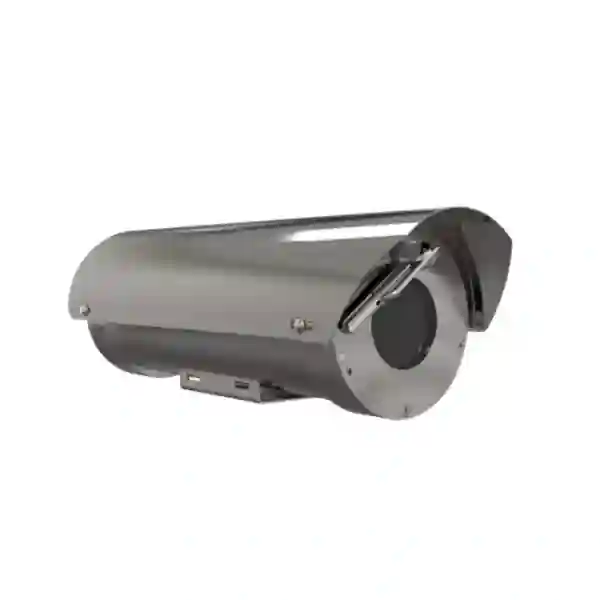
Hanwha TNO-X6320E2F2T2-C Explosion-Proof Zoom Camera
Consider Full HD surveillance with 32x optical zoom for demanding industrial environments. The buyer’s key task is to verify exact-model hazardous-area suitability, fibre integration and 110 V AC power before approving a Tanzania installation.
Specifications at a glance
| Brand and model | Hanwha Vision TNO-X6320E2F2T2-C |
|---|---|
| Camera type | Explosion-proof network zoom camera; visible-light CMOS imaging |
| Image quality | 1920 × 1080; up to 60 fps using supported H.264/H.265 settings |
| Lens | 4.44–142.6 mm, 32x optical zoom with autofocus |
| Data interface | Network streaming and integrated single-mode fibre, F2 family |
| Storage | Dual microSD slots; 256 GB maximum per slot |
| Integration | ONVIF Profiles S, G and T; application compatibility requires testing |
| Housing / ingress | STS316L stainless steel; IP66 / IP67 |
| Power | 110 V AC input; 37 W maximum |
| Critical qualification | Confirm -C certification, ambient range and installation approvals |
Some manufacturer documents differ on wiper, WDR and ambient figures. Confirm the current supplied unit and certification documents before final specifications are approved.
Selecting the correct explosion-proof camera
The Hanwha TNO-X6320E2F2T2-C is a specialist network zoom camera for applications in which an ordinary outdoor CCTV enclosure may not be suitable. It combines Full HD video, a 32x optical zoom system, fibre connectivity and a robust stainless-steel assembly. The important starting point for a buyer in Tanzania is not simply resolution or appearance. It is whether the specific supplied unit, its certification marking and its installation conditions match the hazardous-area assessment of the facility. That answer must come from qualified engineering review and exact-model documentation.
An explosion-proof design does not make every installation automatically safe. Its protection depends on the complete assembly, cable entries, electrical arrangements, area classification, ambient conditions and correct maintenance. A camera can have excellent picture quality and still be the wrong selection for the site’s gas group, dust exposure or certified temperature class. Use this page to frame the procurement questions, then require the relevant manufacturer certificates and approved drawings before any equipment is ordered or installed.
Industrial applications and genuine buyer needs
The model can be evaluated for visually observing equipment yards, process corridors, loading operations, selected perimeter approaches and other industrial activities where specialist enclosure protection is needed. Potential buyers include EPC engineers, industrial security managers, safety teams, operations personnel and facility owners. The camera supplies visible-light footage, not a measurement of gas, fire or temperature, so its surveillance role should be defined carefully. A useful requirement identifies the scene, target, viewing distance, expected light and what an operator must decide after seeing an event.
Some projects need a long-range close-up of a valve station or distant access point. Others need continuous overview of a vehicle route, which a single tightly zoomed view may not cover. Clarify whether the objective is detection, recognition, detailed identification, incident reconstruction or simply operational verification. The camera choice should be supported by an image-quality test against that objective. When hazardous-area protection is not needed at the chosen mounting point, an ordinary industrial outdoor camera may be a simpler alternative.
Full HD imaging and frame-rate trade-offs
Hanwha specifies 1920 × 1080 imaging and up to 60 frames per second using supported H.264 or H.265 configurations. Full HD is useful for observing industrial activities, but the actual level of resolved detail depends on how much of the subject fills the image. Frame rate is another design decision rather than a number to maximize automatically. Fast-moving vehicles and machinery may benefit from more temporal detail, whereas less active views can often be designed differently. The selected recorder must preserve the required quality in both live and archived footage.
Request sample images from the planned viewpoint. A test should include the smallest important subject, representative movement and normal environmental obstacles. Check whether a worker, vehicle or equipment condition remains recognizable at the required distance. Lens position, exposure, compression, vibration and lighting may matter as much as the camera’s nominal resolution. If the acceptance goal is identification, set measurable pixels-on-target criteria with the integrator instead of relying on generic promises about maximum distance or image clarity.
What the 32x optical zoom offers
The published lens covers 4.44 to 142.6 mm and provides 32x optical zoom with autofocus options. This makes it possible to establish a wider visual context and then inspect a smaller remote area in greater detail. Optical magnification is different from digital enlargement, which does not create new captured scene detail. The ability to zoom should not be confused with a guarantee of automatic tracking or unrestricted pan-and-tilt movement. Treat this model as a fixed-direction zoom camera unless the selected complete system specifies otherwise.
The manufacturer states a horizontal field of view spanning approximately 61.8 degrees at wide angle to 2.19 degrees at the telephoto end. That very narrow long-range view magnifies positioning errors and camera movement. Test whether structural vibration, sun shimmer, vapor or nearby pipework interferes with the target. Consider additional cameras when a critical scene needs simultaneous wide and detailed coverage. Document any useful zoom positions and agree how operators return to the default view after examining an incident.
Focus, distance and sightline planning
Autofocus, manual focus and one-shot focusing are listed in the camera specification, along with a minimum object distance of about 1.5 metres. These capabilities can simplify setup, but focusing performance still depends on contrast, light and what occupies the scene. A highly reflective vessel, fence or backlit opening may challenge any autofocus method. If a lens is often zoomed toward a distant asset, its real-world view should be confirmed during both day and night commissioning.
Before installation, place the planned camera position on a drawing and mark each required target. Record the approximate distance, subject size, mounting height and any obstruction. Avoid an angle dominated by nearby branches, guardrails or process pipework. Where heat, mist or dust may obscure the view, test under operating conditions rather than only during a clean daytime demonstration. The completed system should show operators enough surrounding context to interpret the image and act appropriately.
Low-light performance and day-night viewing
The camera includes automatic day-night operation with an infrared-cut filter and manufacturer-listed low-light sensitivity. Those specifications describe performance under defined test conditions; they do not assure detailed recognition in every dark industrial yard. Practical results depend on illumination at the subject, lens aperture, shutter setting, zoom position and the required evidence quality. Do not assume an integrated infrared illuminator is included just because the device can switch into a black-and-white low-light mode.
Assess the actual lighting around gates, tanks, equipment bays or walkways. Moving headlights, bright process lighting, shadows and flare activity can change the picture considerably. Supplemental lighting, if required, must itself be selected for the site classification and approved by the responsible engineers. An acceptance test should cover typical nighttime operating conditions, not only a manufacturer demonstration. Compare live video with exported recordings to confirm that important details survive the recording settings.
WDR, stabilization and image processing
Hanwha lists wide dynamic range, backlight and highlight compensation, digital noise reduction, defog and gyroscope-supported digital image stabilization. Such controls can help manage high contrast, light haze and some image movement, all of which may be present at exposed industrial locations. However, source materials show inconsistent numerical WDR values for this family, so a specific decibel figure is deliberately not promised. A processing feature should be tested against the actual scene, not treated as a guarantee.
Start image tuning by optimizing the mounting angle, lighting and shutter settings. Then review contrast compensation, stabilization and noise reduction one setting at a time. Heavy processing can sometimes affect fine detail or the appearance of moving objects. Save a configuration baseline and identify which operator has authority to change it. Test representative daytime and night conditions, including large contrasts between sky, illuminated machinery and shaded backgrounds. The meaningful outcome is usable video, not simply every option being enabled.
H.265, H.264 and multiple streams
The manufacturer lists H.265, H.264 and MJPEG encoding, WiseStream II and multiple streaming profiles. These options allow system designers to differentiate recording quality, operator viewing and lower-bandwidth remote previews. Choosing the right stream matters because a low-resolution preview can look satisfactory on a small screen while losing information needed during investigation. Verify the recorder’s codec support, available decoding hardware and maximum profile settings before committing to a fleet deployment.
Bandwidth and storage must be calculated for each proposed scene, not guessed from a catalogue percentage. Constant movement, low-light image noise, high frame rates and fine industrial textures can raise bitrate requirements. Plan the network around peak demand and evaluate the footage at the proposed bitrate. If a remote link is constrained, preserve the agreed recording quality and use a separate preview stream where supported. Document stream names, resolution, frame rate and retention so operators and support staff understand which video they are viewing.
Fibre connectivity and industrial networks
This F2 model is associated with an integrated single-mode fibre module in Hanwha’s technical documentation. Fibre can be useful where the camera is distant from the recorder or where electrical interference and cable-route design are important. It does not eliminate the need to engineer compatible optical interfaces, terminations and an approved physical route. Confirm the exact supplied interface, connectors, fibre characteristics and patching arrangements against current documentation and the project’s network drawings.
Specify the fibre budget, expected splice losses, protected routing, cabinet equipment and a maintenance strategy. Confirm whether an intended VMS or control-room switch requires particular transceivers or media conversion. When copper connectivity is under consideration, establish what is actually available on the supplied variant instead of assuming that every camera in the family offers identical ports. Network segmentation, physical cable protection and recovery after a switch outage should be part of commissioning. A working fibre link alone does not demonstrate a fully secure or resilient surveillance system.
Power requirements: check before ordering
The exact model is published with a 110 V AC input requirement and maximum power consumption of 37 W. This is a decisive purchase detail. Do not presume PoE, 24 V power or direct compatibility with a site’s usual electrical distribution. A qualified electrical designer must establish the correct supply method, any necessary power conversion, protection, isolation and cable installation for the specific facility. Copying the power requirement from a neighbouring model suffix could lead to the wrong hardware being ordered.
Confirm frequency suitability and the current installation manual with the manufacturer or supplier, along with the planned earthing and certified cable-entry arrangements. Define whether the video service needs to operate during mains interruption. Power continuity requires consideration of the camera, associated fibre and network devices, switches, recorder and monitoring workstation, not only a battery for one device. Test startup and recovery in the completed design. Make power approval an explicit step in the quotation, shop drawings and site acceptance procedure.
Certification and area-classification fit
Hanwha’s model guidance associates the -C suffix with the cLC CSA certification family. This information is not equivalent to saying that the unit is automatically authorized for every hazardous area in Tanzania. Before purchase, examine the exact issued certificate and marking, including protection method, gas or dust group, temperature class, ambient limits and installation conditions. The designer must compare those conditions with the facility’s classification drawings and any local or owner-specific regulatory requirements.
Do not transfer certification claims from a -Z or -M suffix, or from another camera generation, to this model. Weatherproof ingress ratings and explosion-protection certification answer different questions. Certified housings also depend on suitable glands, terminations, blanking elements, mounting and permitted maintenance practices. Keep the approved certificate, manuals, drawings and inspection records with the asset documentation. Site safety and qualified hazardous-area personnel should approve the complete installation before energization.
The T2 designation and environmental limits
The model name includes a T2 configuration, and manufacturer documents describe temperature designations for the range. Some available manufacturer publications disagree on the precise upper ambient-temperature limit for related configurations. For that reason, this page avoids presenting an unqualified maximum or minimum ambient figure as a purchasing guarantee. The current exact-model datasheet, label, approval certificate and manual should determine the limits used by a project engineer.
Outdoor temperature planning must consider sun-exposed metal surfaces, radiated heat from nearby equipment, enclosure location, airflow and operational changes. The microclimate near a heated process vessel can differ markedly from standard weather observations. Confirm any ambient-temperature assumptions before the mounting plan is approved. Likewise, cleaning chemicals, corrosive atmospheres, dust and water exposure deserve separate assessments. A product marketed for difficult environments still needs the complete installation to remain within its stated and certified conditions.
Housing, water and corrosion considerations
Hanwha identifies STS316L stainless steel construction and IP66/IP67 ingress protection for this model. Those properties are relevant to rugged industrial installations but do not promise immunity to all chemical exposure, abrasion, marine atmosphere or maintenance damage. The camera weighs approximately 21 kg, substantially more than a compact commercial CCTV unit. The enclosure and support system therefore need coordinated handling, structural review and maintenance access planning.
Assess corrosion at the brackets, fasteners, glands and mating surfaces rather than looking only at the body material. Select compatible fittings and address potential galvanic interactions when different metals meet. Inspect the protective window for deposits that reduce optical quality, but follow manufacturer and site-approved cleaning methods. Document whether high-pressure washing, spray, dust or nearby process materials could affect the equipment. In corrosive locations, inspection frequency and the availability of approved replacement components are important commercial and operational considerations.
Mounting dimensions and mechanical design
The manufacturer lists dimensions around 176 × 154 × 720 mm. Allow not only for the camera body but also for its mounting interface, cable-routing space, safe handling and inspection. A long and heavy enclosure can impose meaningful loads on poles, wall brackets, platforms or existing steelwork, especially where wind and vibration are present. Ask a competent structural engineer to confirm the proposed support, fixings and any additional strengthening needed.
Check that the installed view is not blocked by pipes, building corners or routine movements of equipment. Confirm that safe access is available for future inspection and that field work can comply with facility permits. Do not alter certified enclosure features or drill new entries without explicit approval. At commissioning, inspect final alignment and verify that normal vibration does not compromise the narrow telephoto view. Record as-built dimensions and mounting information in the handover pack.
Cable entries and classified-area installation
Certified cable entries are part of the hazardous-area solution, not an optional finish to an otherwise complete camera. Hanwha’s family documentation describes rear entries, but exact arrangements and permitted glands must be confirmed for the supplied assembly. A weather-resistant cable gland is not necessarily an approved explosion-protected component. Match entries, blanking elements, seals, cable type and termination method with both the manufacturer’s instructions and the installation design.
Preserve the integrity of the enclosure during installation and maintenance. Protect fibre bends, prevent cable strain and allow enough space for reliable termination. Keep records of installed accessories and their certification or approval basis. Arrange inspection by qualified personnel before the system is accepted. If a future cable change is needed, repeat the relevant safety review instead of assuming the previous approval automatically covers a new route or part. No product feature can compensate for an unsuitable certified-area installation.
Analytics that support operators
The camera’s listed analytics include motion, tampering, fog and shock detection, plus virtual-area and virtual-line rules such as intrusion, loitering, entry, exit and directional crossing. These features can help a monitoring team review unusual activity or direct attention to selected scenes. Their performance depends on image angle, lighting, target size, environmental movement and careful configuration. They are surveillance aids and should not be represented as certified gas, fire, machinery or personnel safety-detection systems.
Define what happens after each event. Who receives it, what picture appears and what action is authorized? A rule that continually alerts on machinery movement, shadows or wildlife may create fatigue rather than value. Run supervised tests during normal production and update sensitivity only through an agreed change process. When a VMS is involved, verify whether it receives the specific event type and records useful video before and after it. Do not assume all third-party systems expose every manufacturer-specific analytics function.
Local media and recording strategy
Two microSD/SDHC/SDXC slots are listed, each with a stated capacity of up to 256 GB, for 512 GB total. These slots provide potential local storage options, but the presence of removable media does not guarantee a particular recording duration, automatic failover or legal evidence workflow. Card endurance, media selection, recording settings, access controls and outage behaviour all need to be validated. A separate central recorder may still be required for operational oversight and retention.
Calculate retention from the selected bitrate and activity rather than assuming that Full HD always consumes a fixed amount of storage. Decide who may access recordings, how events are exported and when footage must be preserved. Test what happens after a network interruption, camera restart or media fault. If an organization requires evidence for incident investigation, verify accurate time synchronization and an appropriate chain-of-custody process. Recording quality is an end-to-end property of the deployed system, not merely a memory-card specification.
VMS and NVR interoperability
Hanwha lists ONVIF Profiles S, G and T, along with standard network streaming capabilities. These features support an interoperability assessment with an existing video management system, but compatibility is not guaranteed for every software release or function. A device may display live video while advanced analytics, zoom controls, event metadata, media retrieval or playback operate differently. Request confirmation for the actual recorder and its licensed version.
Build a test checklist covering camera discovery, authentication, live display, stream switching, recording, zoom and focus commands, event delivery, playback and export. Test device reconnection after maintenance or network loss. Confirm whether firmware versions and third-party integrations are supported and how upgrades will be managed. When several industrial cameras share one recorder, also review channel licences, decoding capacity, storage and user permissions. Integration effort can be significant even when the camera and VMS both advertise ONVIF.
Security, access control and firmware
The published feature set includes HTTPS, 802.1X network authentication, IP-based access control and audit-log capabilities. These mechanisms are useful only when configured in a broader IT and operational-technology security plan. Use named accounts, restricted permissions, protected management interfaces and monitored network segments. Avoid shared administrator credentials and uncontrolled remote access. The existence of a security feature does not mean it is automatically enabled or appropriately configured.
Agree who is allowed to change image profiles, add users, retrieve recordings and apply firmware updates. Maintain a configuration backup and a register of authorized changes. Verify firmware compatibility with the exact device and recorder before upgrading, and plan a maintenance and recovery procedure. Synchronize device clocks so video events can be correlated with access control or industrial operations logs. Security review should be part of commissioning and routine maintenance, not postponed until after an incident.
A practical procurement sequence
Start with a site and use-case briefing. Collect classification drawings, mounting positions, desired views, target distances, power information, network architecture, lighting conditions and recording objectives. Identify the exact model and suffix on the bill of materials. For specialized cameras, a small character difference can represent a different supply arrangement, fibre interface, wiper configuration or certification. Ask the vendor to identify precisely what will be delivered.
Then prepare a complete equipment schedule covering the camera, approved mounting and cable components, any electrical adaptation, network termination, recorder licences, software integration and installation services. Have qualified safety, electrical and security personnel review the proposal before purchase. Require a quotation that separates these items and names the documents to be supplied. No local availability, price, warranty or delivery time is asserted here, because those commercial details must be verified for the actual Tanzania order.
Commissioning and site acceptance
Commissioning should prove more than a picture appearing on a monitor. Test the required viewing directions, full zoom range, focusing, recorded frame rate and day and night image quality. Confirm that a representative object is identifiable at the agreed distance when that is the project objective. Check streaming, recorder reconnection, alarm routing and export of archived evidence. Document limitations such as blind spots, dust, vibration or glare rather than ignoring them at handover.
Electrical and hazardous-area checks should be performed and signed off by the appropriate qualified personnel. Confirm that certificate markings and installed cable accessories match the approved equipment schedule. Perform controlled recovery tests for a network interruption or restart, and ensure operators know how failures are reported. Keep as-built drawings, operating settings, credentials held securely, recording policy and maintenance instructions together. Acceptance criteria should be agreed before commissioning so the contractor and facility assess the same outcome.
Maintenance and lifecycle planning
A specialist camera requires an inspection plan appropriate to the site classification and manufacturer’s instructions. Routine checks may include video clarity, health of the recording path, time synchronization and approved physical inspection of the housing, mount, window, seals and cable entries. Field personnel must respect area access controls and the limits on opening or servicing a certified enclosure. Unauthorized modifications can undermine the installation’s protection method.
Monitor recurring issues such as dirty glass, vegetation in the viewing path, loose mounts, intermittent fibre links and storage errors. Keep a record of changes so faults can be traced without random adjustments. When a component needs replacement, verify that the replacement is approved for the exact model and installation. Retain serial numbers, certificates and revision information in the asset register. These practices help protect reliability and reduce risk when the system is maintained by a new contractor.
What to include in a Tanzania quotation
A useful quote identifies the exact Hanwha model, full configuration, required certification documents, planned electrical and network interfaces and the installation scope. It should also clarify who supplies brackets, approved cable entries, fibre components, any necessary power equipment, recording capacity and software licences. Avoid a camera-only price that omits essential engineering. Where local delivery, stock, import arrangements or commercial terms matter, request written confirmation rather than relying on a catalogue listing from another market.
Separate equipment supply from installation, commissioning, training and after-sales obligations. Agree responsibilities between the surveillance, electrical, safety and network teams. Ask who verifies the hazardous-area design and how deviations are approved. A reliable procurement process also defines what happens if the quoted model is unavailable: no substitute suffix should be accepted without a fresh technical comparison. This reduces the risk of receiving a visually similar but electrically or certificationally different product.
Choosing this camera instead of another solution
The best choice depends on the site and task. A standard outdoor IP camera may meet surveillance needs when installed outside any classified area. A correctly approved PTZ camera may be better when operators need controlled movement across several directions. A thermal camera or industrial sensor is more relevant for temperature measurement or non-visible-light monitoring. The Hanwha zoom model should be evaluated on its actual strengths, not described as universally superior to these different technologies.
Compare alternatives using a common checklist: certified-area fit, optical detail at the target, mounting, supply voltage, network transport, recorder compatibility, maintainability and total installed cost. Ask whether the scene will be continuously observed or checked periodically, and whether more than one viewing angle is required. Most importantly, evaluate the full certified assembly rather than copying claims between models. A suitable solution is the one that satisfies both operational surveillance requirements and the facility’s installation restrictions.
Frequently asked questions
Is the Hanwha TNO-X6320E2F2T2-C a standard bullet camera?
It is a specialist explosion-proof zoom network camera. The certified enclosure and exact installation conditions distinguish it from an ordinary weatherproof CCTV device. The site still needs qualified confirmation that the issued certificate and supplied assembly match its classified-area requirements. Do not choose it solely from a product photograph or the word outdoor.
Does it support 4K footage?
The stated maximum primary imaging resolution is 1920 × 1080 Full HD, not 4K. A 32x optical zoom can help frame distant targets, but it does not increase the sensor’s pixel count. Ask for a real scene demonstration if the project requires recognizing fine details at a particular distance.
Can it record at 60 fps?
Hanwha specifies up to 60 frames per second using supported H.264 or H.265 settings. Actual recording depends on the selected stream, recorder and network capacity. High frame rates can assist with moving subjects while increasing storage and bandwidth demands. Confirm the final setting during commissioning.
Does the F2 model have fibre connectivity?
Manufacturer material associates F2 with an integrated single-mode fibre module. The complete solution still requires compatible equipment, a correctly designed optical path, suitable termination and approved cable entries. Confirm connector and interface details for the delivered unit before ordering network accessories.
Can a PoE switch supply this camera?
Do not assume that it can. The exact camera model is listed for 110 V AC input with a maximum consumption of 37 W. The responsible electrical engineer must confirm power conversion, protection, wiring and hazardous-area suitability where required. Other Hanwha models may use different power arrangements.
Does it have a built-in wiper?
Do not rely on generic family feature lists. Hanwha’s model guidance associates a W in certain variant identifiers with wiper-equipped assemblies, while some summary material appears inconsistent. This model lacks that W designation. Request written verification of the exact delivered configuration if a mechanical wiper is essential.
Is the -C certification enough for every Tanzania site?
No. The -C suffix is linked to a manufacturer certification family, but it does not establish acceptance at any particular installation. Engineers must compare the precise marking, ambient restrictions, gas or dust group and current certificate with site classification and applicable requirements. Qualified approval is necessary.
Is this a thermal measurement camera?
No. It is a visible-light CMOS camera with an optical zoom lens. It may assist visual observation of plant equipment but should not be used as a substitute for specialized gas, fire, temperature or safety instrumentation. If thermal measurement is the requirement, specify a purpose-built system.
Will it work with a third-party NVR?
The published network features include ONVIF Profiles S, G and T. These provide a basis for compatibility testing, not a blanket guarantee. Confirm live video, zoom commands, event integration, recording and export with the exact NVR or VMS version proposed for the facility.
What local storage capacity is listed?
There are two microSD/SDHC/SDXC slots, each listed for up to 256 GB, or 512 GB total. This does not specify how many days of footage can be retained. Retention depends on stream bitrate, scene motion, operating hours and recording policy. Evaluate storage and media endurance before deployment.
How well does it perform at night?
The camera provides day-night and low-light controls, but useful detail depends on actual illumination, shutter, zoom and target distance. There is no reliable single recognition-distance promise for all dark scenes. Nighttime testing at the planned camera location is more useful than relying on one sensitivity figure.
What is needed to request a quotation?
Share the exact model, intended surveillance task, area-classification documentation, approximate viewing distances, mounting location, electrical supply, fibre or network design, VMS platform and required installation services. Ask for an exact-configuration review and clear written commercial terms. Stock, price, warranty and delivery must be confirmed separately.
Request an exact-model technical quote
Contact FourTeck Tanzania through its verified enquiry channel to discuss this Hanwha camera and the complete proposed system. Provide the classified-area requirements, viewing objective, cable route, supply voltage and existing VMS details. Request confirmation of the exact model, certifications, suitable accessories and responsibilities before purchase.
This page does not assert local stock, price, lead time, warranty or site-specific approval. A complete quotation should address equipment, installation, commissioning and documentation rather than the camera alone.




Reviews
There are no reviews yet.