
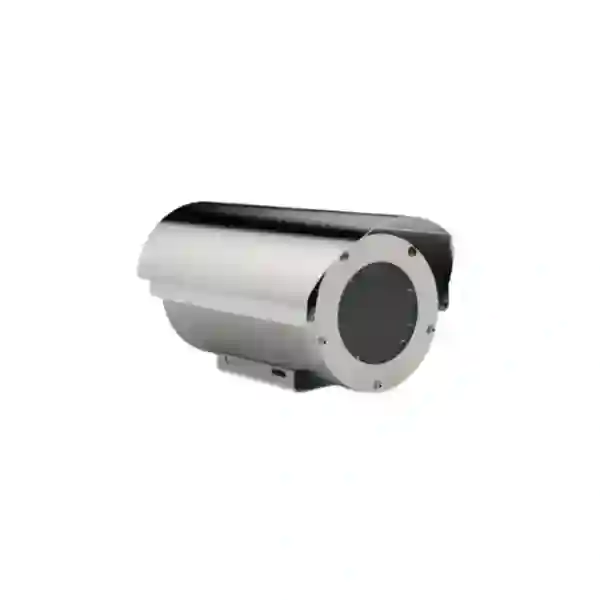
TNO-X6320EPT0-M Explosion-Proof Zoom Camera
For an industrial surveillance project, the essential question is whether a camera provides the required view and whether its complete certified installation is suitable for the site. The TNO-X6320EPT0-M combines Full HD imaging, 32× optical zoom, 150 dB WDR, video analytics and PoE in a protected stainless-steel housing. Ask for exact-model certification and project-fit verification before procurement.
Verified technical specifications
| Resolution | 1920 × 1080, 2MP Full HD |
|---|---|
| Video sensor | 1/2.8-inch CMOS |
| Video rate | H.265/H.264 up to 60/50 fps (60/50 Hz); MJPEG up to 30 fps |
| Lens | 4.44–142.6 mm; 32× optical zoom with autofocus |
| Wide dynamic range | 150 dB |
| Video codecs | H.265 / H.264 / MJPEG; WiseStream II |
| Network | RJ-45 10/100BASE-T; ONVIF S, G, T; SUNAPI |
| Local storage | Dual microSD/SDHC/SDXC; up to 256 GB per slot |
| Power | IEEE 802.3af Class 3 PoE; stated 12 W |
| Construction | 316L stainless steel; IP66/IP67 listed |
| Operating environment | −10°C to +55°C; 0–90% RH, non-condensing |
| Approx. size / weight | 176 × 334 mm / 8.54 kg |
Specification basis: Hanwha Vision exact-model product information. Verify the latest matching datasheet, certificate and installation manual before site approval.
Designed for defined industrial monitoring points
The Hanwha TNO-X6320EPT0-M explosion-proof camera is built for an unusually demanding type of surveillance project: viewing processes and activity in an industrial environment where electrical equipment selection may be affected by the risk of a flammable atmosphere. The objective is to obtain usable images without treating an ordinary outdoor CCTV unit as automatically suitable for a formally classified location. Buyers should begin with a site assessment, required observation tasks, exact camera position and certification evidence. A rugged-looking enclosure alone does not establish that equipment meets a facility’s explosion-protection requirements.
This product is described by Hanwha Vision as an explosion-proof zoom camera. It combines visible-light imaging with an optical zoom lens in an industrial protected housing. It is not presented as a camera that mechanically pans and tilts its entire housing to scan a site. If operators need to inspect a specific process asset, fixed access point or transport route from one direction, this model may warrant evaluation. If they need continuous coverage in several directions, an engineered multi-camera or explosion-proof PTZ system may better match the requirement.
Full HD imaging and frame-rate decisions
The manufacturer specifies a 1/2.8-inch CMOS imaging sensor with a maximum output resolution of 1920 by 1080 pixels. The product supports several smaller resolution options, allowing a system designer to choose streams for recording, live supervision or limited-bandwidth viewing. This flexibility should be evaluated against the actual evidence requirement. An image is not automatically suitable for identification just because it is Full HD; focal length, viewing distance, target size, glare, vibration and illumination all affect how much useful detail can be resolved.
H.265 and H.264 operation is specified up to 60 frames per second in a 60 Hz configuration or 50 frames per second at 50 Hz; MJPEG has a listed maximum of 30 fps. The highest rate is not always the best operating choice. A slowly changing equipment bay may need a different recording profile from a vehicle approach lane. Set requirements for both the level of detail and motion continuity, then assess network throughput, recorder licensing and storage retention. Verify final performance with the proposed management platform rather than assuming that a headline specification applies unchanged throughout the system.
32× optical zoom and viewing geometry
The camera has a 4.44–142.6 mm lens, offering 32× optical zoom with autofocus. At its wide setting, more surrounding context is visible. At its telephoto setting, a small part of the monitored area fills more of the image. Hanwha lists a horizontal field-of-view range of approximately 61.8 degrees to 2.19 degrees. These numbers give an engineer useful starting information for a site drawing, but they should be tested against required target sizes, physical obstructions and the chosen mounting height.
Optical zoom and digital zoom are not interchangeable. Optical magnification changes the detail captured from the scene, while digital magnification enlarges captured pixels. Neither technique turns a fixed-position camera into a pan-and-tilt device. When deciding where to mount the unit, mark both the widest required contextual view and any narrow close-up view on the drawing. Confirm the line of sight stays useful as personnel, vehicles or process equipment move. Autofocus helps when zoom changes, but focusing performance should still be checked during commissioning at actual working distances.
Low light, day/night and contrasting illumination
The official specification lists automatic day/night operation using an infrared-cut filter, with minimum illumination values of 0.05 lux in colour and 0.005 lux in monochrome under the manufacturer’s test conditions. These figures describe sensitivity rather than guaranteed recognition performance in a particular dark facility. An image may be technically visible but still unsuitable for investigating a moving person or machine. Exposure duration, image noise, object contrast and the available lighting are critical factors in whether footage answers an operational question.
The camera also lists 150 dB wide dynamic range, backlight compensation, highlight compensation, defog, noise reduction and gyro-assisted digital image stabilization. These functions can help manage bright entrances, shaded work areas or vibration, but they do not eliminate poor positioning. Solar glare, dirty viewing windows and thick dust can still obscure a target. Do not infer that the exact PoE variant has an integral infrared floodlight or window wiper without current model-specific confirmation. If the lighting or cleaning task demands either feature, specify and verify a suitable alternative arrangement.
Video analytics as operator tools
Hanwha identifies functions including motion detection, tampering, fog detection, shock detection, face detection, virtual lines and virtual areas. A carefully defined virtual line can help flag traffic crossing an access boundary; an intrusion area can bring a selected part of a scene to an operator’s attention. These are potentially useful security features because they can direct attention to events rather than requiring someone to watch every stream continuously. Their effectiveness depends on scene layout, sensitivity settings and what the receiving operator is expected to do.
In industrial spaces, reflections, rain, dust, moving branches, steam, vehicle lights or regular machinery movement may create nuisance alarms. Define a small set of events with clear responses, configure exclusion areas where appropriate and test in the actual operating environment. An analytics event is not proof of a security incident or a certified machine-safety condition. The camera must not replace gas monitoring, fire detection, process protection or functional-safety interlocks. Verify which analytic notifications can be received and searched by the selected recorder or video management system.
Streaming and bandwidth planning
The manufacturer lists H.265, H.264 and MJPEG compression, WiseStream II and up to ten streaming profiles. An integrator may configure one profile for archive recording and another for remote live viewing, subject to software support. H.265 can be considered where compression efficiency matters, while compatibility with older management systems may influence the chosen codec. It is sensible to test video quality using representative plant scenes rather than claiming a predetermined bandwidth saving that cannot be guaranteed for every image.
Bandwidth planning should account for the total camera population, each selected frame rate and resolution, simultaneous viewers, scene activity, recording schedule and network margin. Video can become more demanding when movement, changing light or fine detail increases, even if the resolution is unchanged. The camera provides a 10/100BASE-T RJ-45 interface, but end-to-end reliability also depends on switches, cables, uplinks, routing and recorder capacity. A stable network design matters more than a single impressive bitrate specification.
Edge storage and retention
Two microSD/SDHC/SDXC slots are listed, each supporting up to 256 GB for a stated total of 512 GB. Edge recording can provide a local storage option in a planned surveillance workflow, especially where continuity of centralized access is a concern. However, card capacity alone cannot tell a buyer how many days of video will be retained. Recording profiles, scene complexity, event triggers, card health and overwrite rules all influence the outcome. Do not assume the camera automatically restores every missed central recording after a network outage without testing that feature in the final system.
For evidence-focused operation, agree where the primary archive will live and how authorized users will search, export and protect footage. An NVR or video management platform may remain central even when edge storage is enabled. Plan time synchronization, retention limits, backup procedures and access logs. Storage maintenance is particularly important in hazardous locations because opening the housing or handling internal media may require controlled procedures. The system designer should decide whether card replacement is a realistic service activity and whether centralized archiving is preferable.
ONVIF and software integration
The exact-model specification lists ONVIF Profiles S, G and T, along with Hanwha SUNAPI and an open-platform interface. These capabilities create options for network video integration but do not prove that every third-party recorder supports every camera function. A recorder may display live footage while offering limited access to advanced analytics, edge storage controls or specialized events. For a mixed-manufacturer facility, the relevant question is which specific workflows will operate with the selected VMS version, license and camera firmware.
Before ordering, identify the current recorder make, model and software release. Test live view, zoom control where required, scheduled recording, event reception, playback, export and clock accuracy. Check which user permissions apply to operators and administrators. The specification also mentions alarm input/output, audio interfaces and RS-485. Those features should only become part of the design if the system and certified installation requirements call for them. A listed interface is not permission to install arbitrary connected accessories inside a hazardous zone.
Network security and administration
Hanwha lists HTTPS, IEEE 802.1X authentication options, digest authentication, IP-based access control and audit logs. Such controls can contribute to a managed camera network when they are configured and monitored appropriately. Place cameras in a suitable segmented network, restrict management access and assign strong account credentials. Avoid exposing management services to the open internet for convenience. Secure remote viewing should be designed through the organization’s approved access architecture, with logging and defined administrator responsibilities.
A commissioning record should include the exact device identifier, firmware baseline, configuration backup and contact responsible for updates. Disable unused network services where feasible and check time synchronization. When the video system is connected to a wider industrial or enterprise environment, coordinate security changes with relevant IT and operational teams. Firmware and remote-access procedures need testing because a failed update can interrupt a critical monitoring function. No camera should be described as cyberattack-proof simply because security options appear in its datasheet.
PoE and industrial cabling considerations
The model is specified for IEEE 802.3af Class 3 Power over Ethernet with 12 W power consumption. This can simplify the electrical design by carrying power and data over an approved Ethernet path. However, hazardous-area installation rules remain separate from the convenience of PoE. The camera’s protective enclosure, allowed entries, grounding, certified glands, cable selection and external protection components must be checked against the matching manual, certificate and site classification. Ordinary network cabling practice is not by itself adequate justification for an explosion-risk location.
Check the PoE switch’s total power budget, individual port ratings, cable route, surge exposure and backup-power requirements. A site that needs continuous recordings during a utility outage must plan power continuity for its cameras, network and recorders together. Determine whether equipment cabinets and cables are installed outside or within classified boundaries and obtain the appropriate engineering approvals. At commissioning, verify stable camera operation and recording recovery after controlled interruptions. Do not substitute a different power supply from another similarly named camera variant.
Stainless housing and mechanical mounting
The enclosure is specified as stainless steel STS316L, with approximate dimensions of 176 by 334 mm and a listed weight of 8.54 kg. Those details matter when engineering a reliable support rather than merely describing the product’s appearance. Determine whether the wall, pole or structure can safely carry the assembly under relevant loading and vibration conditions. Use appropriately approved mounting components and follow the manufacturer’s installation instructions. Avoid assuming a generic bracket or fastener is acceptable simply because it physically fits.
316L stainless steel can be relevant in demanding environments, yet overall chemical resistance depends on the complete installed system. Seals, window, fixings, cable entries and accessories may face different exposures. Confirm any cleaning chemicals, marine atmosphere, splashing or corrosive process conditions with the manufacturer and qualified site engineer. Plan sufficient access for viewing-window inspection and maintenance. Poor positioning may create repeated cleaning needs or compromise image quality even if the enclosure remains structurally sound.
Ingress protection and weather exposure
Hanwha lists IP66 and IP67 environmental protection. These are ingress classifications established under specified test conditions, not a universal guarantee that the assembly will withstand all water jets, chemicals, immersion scenarios or pressure-cleaning methods. A buyer should consider whether the location involves heavy rain, wind-driven deposits, industrial washdown or persistent dust. The ingress rating does not replace separate hazardous-area certification or a site-specific assessment of cable entries and assembled fittings.
For outdoor industrial surveillance in Tanzania, the useful questions are site-specific rather than city-specific: does the selected mounting point experience direct sun, airborne dust, spray, chemical exposure or unusually high ambient temperature? Is the network cabinet protected, and how is water prevented from entering field connections? Can personnel safely reach the camera for inspection? Record these conditions before buying. A protective housing is one part of an environmental system, and proper installation is essential to retaining its designed performance.
Temperature limits and thermal exposure
The official operating range for TNO-X6320EPT0-M is −10°C to +55°C, with operating humidity specified at 0–90 percent relative humidity under non-condensing conditions. Do not confuse those limits with broader storage-temperature values. A camera exposed to intense sun or nearby process equipment can see temperatures different from general outdoor air measurements. Predict actual equipment exposure at the planned position and consider whether suitable shade, spacing or a differently rated model is required.
A site may be within the nominal ambient range for much of the year yet experience local condensation or sustained heat at a particular location. Such conditions can affect reliability and image quality. Assess maintenance access and thermal exposure together because the camera may be difficult to inspect after installation in an industrial classified area. If the proposed location exceeds the verified environmental limits, evaluate a manufacturer-listed alternative with suitable documentation. Never assume that the explosion-proof housing automatically extends its operating temperature range.
Exact-model hazardous-area documentation
The manufacturer places this model within an explosion-proof camera family and lists certification families including INMETRO and cLCus/cLC CSA in its published product information. Historical model identification material associates the M suffix with an INMETRO variant. That is useful identification context, but it is not enough to specify a hazardous-area installation by itself. Before a purchase, request the exact current certificate, protection marking, ambient restrictions and installation instructions that correspond to the actual unit being offered.
The responsible engineer must compare these documents with the formal zone or division classification, gas and dust hazards, temperature requirements and approved installation methods for the particular site. The camera’s IP66/IP67 rating describes environmental ingress protection and should never be mistaken for explosion-protection acceptance. Certifications used in other countries are not automatic proof of Tanzanian approval. Have qualified hazardous-area personnel review the entire arrangement, including cable glands and mounting details, rather than relying on a brief online product summary.
Tanzania project assessment
The Tanzania context matters most where it changes installation conditions, commercial terms and approval responsibilities. Industrial projects can involve very different combinations of heat, humidity, airborne dust, rainfall, corrosive processes and difficult site access. Rather than asserting the same conditions everywhere, prepare an equipment schedule for the real facility. List the purpose of each camera, exact installation location, environmental exposure, hazard classification and expected viewing distance. These inputs are necessary for a credible technical selection.
Questions about local pricing, sourcing, certification acceptance, warranty, tax or delivery should be resolved through written project documentation. A globally listed model is not automatically in stock for the Tanzanian market, nor does it necessarily meet the owner’s local approval procedure. Confirm who is responsible for hazardous-area engineering and who will sign off the installed system. An effective quotation should name the precise variant and distinguish supplied equipment from design, network work, civil work, installation and commissioning services.
Fixed zoom versus PTZ
A fixed-position zoom camera concentrates on a defined installed line of sight while allowing the focal length to change. This can suit an inspection corridor, process component, entry point or selected transfer area. The narrow telephoto view may reveal more detail in the central target, but it removes peripheral context. Where several critical events can occur simultaneously across a wide area, one zoom camera is unlikely to maintain all those views at once. Consider multiple fixed cameras or a suitable panoramic solution.
A hazardous-area PTZ camera has a different role: it can physically change viewing direction if the exact model is designed for that capability. That can aid active operator investigations, but it also creates a risk that the camera looks away from another event. Compare requirements for continuous recording, preset tours, zoom controls, electrical supply and maintenance. Do not assume the explosion-proof certification or accessories of a PTZ product transfer to this fixed zoom model.
Why this is not a thermal camera
The TNO-X6320EPT0-M is specified with a visible-light CMOS sensor and conventional Full HD video. It is not a radiometric temperature camera, despite any superficial similarity between its model prefix and prefixes used by other Hanwha products. It should not be offered as a tool that measures process temperature, diagnoses overheating or replaces thermal condition monitoring. For those needs, specify thermal sensing capability, measurement range, accuracy and the necessary environmental and hazardous-area ratings explicitly.
This distinction can materially affect a project’s success. A facility may want to observe whether an operator enters a restricted zone, inspect a process dial visually or detect an unusual heat signature. Those are different tasks requiring different camera features and validation tests. Establish the operational problem in plain language before comparing model numbers. Use the published exact-model sensor and analytics specification, not assumptions about naming conventions, to determine what evidence the installed device can provide.
Camera position and coverage assessment
Before placing an order, put the intended camera position on a drawing. Indicate mounting height, direction, distance to the critical object, likely obstruction from vehicles or machinery and the required field of view. Identify whether a close-up must show general activity, a mechanical condition or a person-sized target. The same 32× optical lens can serve very different outcomes depending on placement. A target that looks adequate in daylight may be much less useful at night or through dust.
Evaluate the viewing-window orientation and accessibility as carefully as the scene. A camera placed behind a structure, near bright floodlights or in the path of regular spray may yield disappointing images even when its specifications are impressive. Where classified-area access requires permits or shutdown windows, changes after installation may be disproportionately costly. Ask the installer to document expected wide and telephoto views and to provide a realistic site acceptance test.
Recording system design and incident review
A surveillance project should be judged by whether operators can retrieve the needed evidence, not simply by whether live video is visible. Agree which events require recording, how long the data should be retained, how exports will be controlled and how timestamps will be verified. Choose H.265, H.264 or another supported configuration based on image requirements and recorder compatibility. Size storage for the chosen frame rate, scene complexity, total camera count and retention objective.
If the site uses central NVR or VMS storage, determine the relationship between central recordings and the camera’s dual microSD slots. Test what happens during a network outage and after restoration rather than relying on assumptions about edge-storage backfill. Document who can view, export and delete recordings, and whether incident searches rely on analytics events. A technically capable camera offers little operational value if recording searches, permissions and maintenance responsibilities have not been planned.
Commissioning and quality assurance
The acceptance checklist should include verification of the exact model and certificate package before energizing the installed system. Electrical and hazardous-area checks must follow the installation design and competent personnel’s procedures. Then demonstrate correct video orientation, sharp focus, the intended zoom range, usable day and night imagery, stable PoE operation and successful connection to the chosen recorder. Record the installed hardware, firmware version and final configuration for later maintenance.
Where analytics are part of the brief, test representative events and false-alarm scenarios. Where recording is critical, verify playback and export as well as live viewing. Check user roles, timestamps, network restrictions, environmental sealing and documentation handover. The project should identify who accepts the installation, who maintains software and who responds when the camera reports an outage. An acceptance report is especially valuable for industrial systems with limited access and stringent change controls.
Maintenance and lifecycle considerations
Operations teams should plan routine checks for lens obstruction, degraded image quality, storage faults, network interruptions, time drift and unauthorized changes. Depending on the industrial process, dust or deposits can accumulate on the viewing window even though the housing is weather resistant. Inspect and maintain the camera only as permitted by the applicable hazardous-area and manufacturer’s procedures. The need for controlled access may affect maintenance intervals, staffing and the economics of selecting a different model.
Firmware should be managed against the exact camera model and supported vendor releases. Compare compatibility with the recorder before applying updates, preserve configuration records and define recovery steps. A replacement unit should not be accepted merely because its housing looks similar. Check the part number, hazardous-area approval, power requirement, optical performance and supported accessories. Long-term reliability depends on good records and accountable maintenance as well as on the original product specification.
Requesting a project-specific quotation
A useful enquiry should identify the exact TNO-X6320EPT0-M model, purpose of observation, classified-area requirements, environmental conditions, desired view, network system and recording platform. Share a camera schedule or proposed installation drawing when available. Ask the supplier for the current exact-model datasheet, certification documents, authorized installation configuration and a list of accessories included or excluded. If the requirements call for an integrated wiper, fiber connection or motorized PTZ, request a separately verified alternative rather than presuming this unit offers those features.
The quotation should distinguish equipment, mounting, network components, electrical work, engineering review, commissioning and ongoing support. Confirm availability, lead time, taxes and warranty in writing rather than relying on overseas listings or historic price sheets. For Tanzania projects, clarify which party is responsible for local compliance review and site approval. The Hanwha TNO-X6320EPT0-M explosion-proof camera should be purchased only after its exact configuration and installation method have been shown to meet the real project brief.
Common questions before purchase
Is this camera a thermal imager?
No. It is a visible-light CMOS network zoom camera. Its Full HD image, day/night mode and video analytics are not equivalent to thermal sensing or radiometric temperature measurement. For hot-spot monitoring or temperature thresholds, select and verify a purpose-built thermal product rather than inferring that capability from the TNO model prefix. Temperature measurement requires separate documented specifications and an appropriate system design.
Can the camera be used in every hazardous zone?
No. The exact certificate marking, ambient limits, gas or dust grouping, site classification and installation method all matter. The term explosion-proof does not provide blanket authorization for any plant area. Obtain the current product-specific certificate and installation manual, then have qualified personnel compare them against the classification and applicable owner or regulatory requirements. The complete cable and mounting arrangement must also be suitable.
What does the M suffix mean?
Historical Hanwha model-code information identifies the M suffix in this family with an INMETRO variant. Current exact-model certificate and nameplate information must be reviewed before relying on any certification claim. INMETRO association by itself does not establish approval by authorities in Tanzania or compatibility with a particular hazardous atmosphere. Request the complete documents for the specific unit being supplied.
How far can 32× optical zoom see?
The camera has a 4.44–142.6 mm optical lens and can narrow its view considerably. There is no meaningful universal detection or identification distance without defining target size, viewing conditions, mounting position and required evidence quality. A long focal length can add detail in its direction of view, but haze, motion, lighting and vibration may still limit usefulness. Validate coverage on a site plan and during commissioning.
Does the camera mechanically pan and tilt?
The exact model is described as an explosion-proof zoom camera, not as a complete mechanical PTZ system. Its lens can change the field of view within its installed direction. If operators must scan several directions, compare an appropriately certified explosion-proof PTZ or a multiple-camera design. Do not equate optical zoom with the ability to turn the whole camera assembly across an installation.
Does it include an infrared illuminator or wiper?
Do not assume either feature from the general description. The listed low-light sensitivity does not itself mean there is integrated IR illumination, while manufacturer family descriptions distinguish this PoE T0 configuration from wiper-equipped variants. Confirm the exact offered assembly with current documentation. If a site needs active illumination or frequent window cleaning, specify those needs explicitly and obtain an approved solution.
What codecs are supported?
Hanwha lists H.265, H.264 and MJPEG, plus multiple streaming profiles and WiseStream II. The practical choice depends on recording software, network capacity, frame rate and desired image detail. H.265 may offer an efficient option, but not every recorder uses every camera function identically. Validate compatibility and required evidence quality in the intended installation instead of assuming that one codec is always best.
How much storage is provided?
The specification lists two microSD/SDHC/SDXC slots with up to 256 GB each, or 512 GB combined. The actual amount of video retained depends on compression, motion, resolution, frame rate, event configuration and overwrite rules. If the camera must preserve evidence through network interruptions, test the real edge and central recording workflow. Storage capacity should be calculated for the project, not advertised as a fixed number of recording days.
Can it connect to an ONVIF recorder?
The model lists ONVIF Profiles S, G and T. That provides a reason to evaluate integration, but actual functions depend on the recorder, firmware, device driver and license. Basic video may work while analytics or event search require additional configuration. Check live view, playback, exported recordings, timestamps and required alerts using the intended NVR or VMS before approving the integration.
What power source does it require?
The exact model’s published specification lists IEEE 802.3af Class 3 PoE with a consumption of 12 W. Confirm the switch power budget, backup supply, cable path and any site-specific protective requirements. Ordinary Ethernet wiring is not automatically suitable for a hazardous location. Certified entries and the manufacturer’s installation instructions must be included in the electrical design before installation.
Is the housing protected against weather?
Hanwha lists a 316L stainless steel housing with IP66/IP67 ingress protection and an operating temperature range of −10°C to +55°C. Those specifications support evaluation for demanding environments, but they do not guarantee resistance to all chemicals, cleaning methods, process heat or condensation. Check the entire installed assembly and the actual conditions at the camera’s mounting position. Environmental and explosion-protection approvals are separate considerations.
Is it suitable for Tanzania?
The camera may be evaluated for an individual Tanzanian industrial project, but no local stock, price, delivery, warranty or regulatory acceptance is verified in this content. The responsible engineer and relevant project authority must review the exact certificate and installation against the site’s requirements. Seek a written quotation and compliance review. Do not treat manufacturer documentation for another market as proof of automatic local approval.
What should be included in commissioning?
Document exact model and certificate, approved mounting and electrical installation, camera orientation, wide and telephoto imagery, low-light performance, recording, time synchronization, user accounts and event behavior. Verify live view and playback through the intended VMS. Test expected analytics only where they are part of the specification. Handover should also identify who maintains the unit, approves updates and responds to camera or storage faults.
What details are needed for a quote?
Supply the exact part number, intended viewing area, target distances, mounting location, hazardous-area classification where applicable, network infrastructure and video recording system. Identify environmental exposures and any certificates or integration checks required by the project. Ask for itemized equipment and accessory information and written confirmation of commercial terms. A clear technical brief is more useful than a request based only on the camera’s optical zoom figure.
Request a project-specific technical quotation
Provide the exact model, site classification, desired camera view, environmental exposure, preferred recording platform and required certification documentation. Confirm availability, commercial terms, compatible accessories and compliance responsibilities in writing before purchasing.




Reviews
There are no reviews yet.