
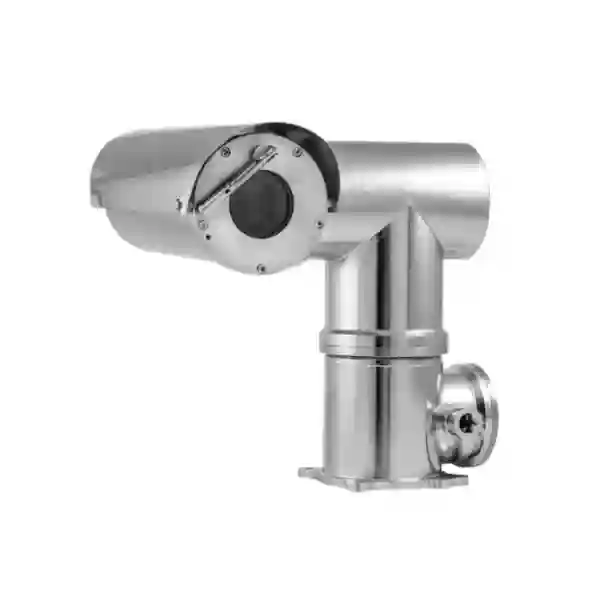
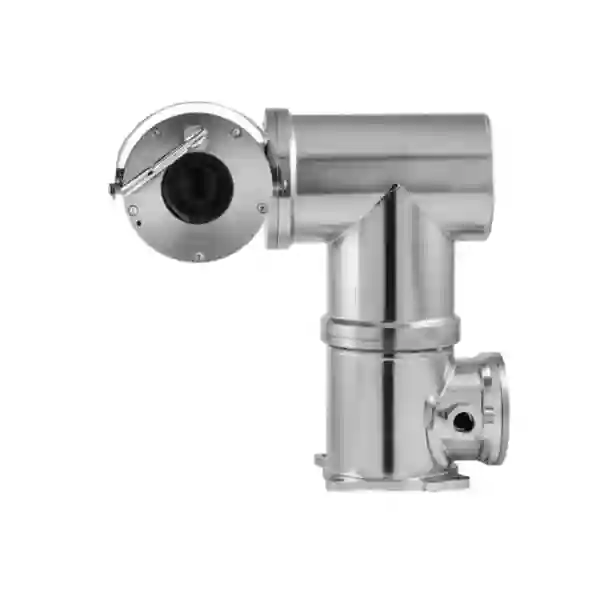
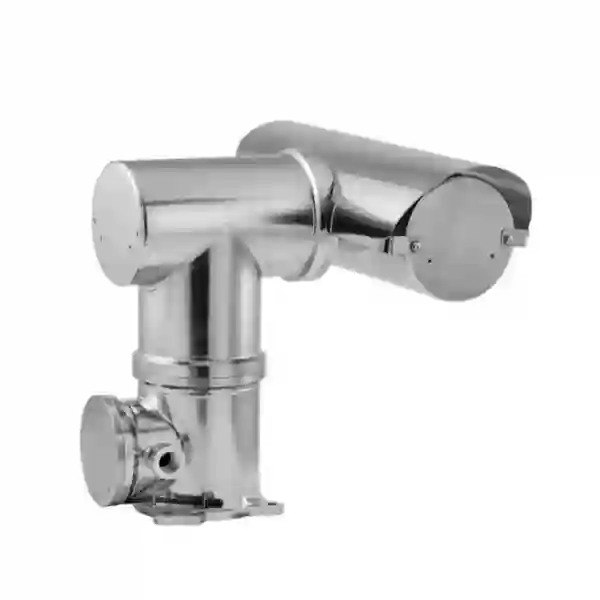
Hanwha Vision • Hazardous-area video surveillance
Hanwha TNU-X6320A2F2WT1-Z Explosion-Proof PTZ Camera
A 2MP positioning camera with 32x optical zoom, single-mode fibre, an integrated wiper and a 316L stainless-steel enclosure for carefully engineered industrial surveillance. Confirm 110V AC power and the exact cLCus Class I, Division 1 approval before specifying this variant for a Tanzanian installation.
Verified specifications at a glance
| Camera type | Explosion-protected positioning IP PTZ camera |
|---|---|
| Image sensor and video | 1/2.8-inch CMOS; up to 1920 × 1080 |
| Lens and zoom | 4.44–142.6 mm; 32x optical, 16x digital |
| Pan / tilt | 0–360° pan; -90° to +90° tilt |
| Image processing | 120 dB WDR, ICR day/night, gyro-based DIS, defog |
| Compression | H.265, H.264, MJPEG, WiseStream II |
| Network interface | Duplex single-mode 9/125 µm fibre, 10/100 Mb Ethernet |
| Integration | ONVIF Profiles S and G; SUNAPI |
| Local storage | Two microSD/SDHC/SDXC slots, max 256 GB each |
| Enclosure | Electro-polished 316L stainless steel; toughened window; built-in wiper |
| Ingress protection | IP66 / IP67 |
| Operating conditions | -40°C to +60°C; 0–90% RH, non-condensing |
| Electrical input | 110V AC, up to 80 W |
| Size and weight | 418 × 457 × 401 mm; approximately 33 kg |
| Exact version approval | cLCus Class I, Division 1 variant; check current certificate and marking |
Figures represent the manufacturer’s reviewed exact-model information; project approval, availability, accessories and integration remain subject to written verification.
A hazardous-area camera selected for the correct application
The Hanwha Vision TNU-X6320A2F2WT1-Z is a specialised explosion-protected positioning PTZ camera for industrial monitoring where the installation environment creates constraints that ordinary outdoor CCTV equipment cannot address. It combines a 2-megapixel network camera, 32x optical zoom, integrated wiper, single-mode fibre interface and robust 316L stainless-steel housing. This exact model uses a 110V AC supply and belongs to the cLCus Class I, Division 1 certification variant. Those characteristics make exact-model verification essential before the camera is specified, ordered or installed.
The principal buyer question is not simply whether the image is clear. It is whether a camera can be installed in the designated hazardous location, powered safely, connected over the intended network, mounted with sufficient mechanical support and operated reliably from the control room. A successful project starts with an approved area-classification dossier and ends with recorded acceptance tests. This page explains what the product offers, how its features translate into operational value and which questions a Tanzanian industrial project should answer before issuing a purchase order. Request a model-specific technical review rather than assuming that all explosion-proof cameras or all members of the TNU-X6320A family are interchangeable.
What the exact model code tells the procurement team
Model suffixes have practical consequences. In TNU-X6320A2F2WT1-Z, the power selection corresponds to 110V AC, F2 identifies the single-mode fibre configuration, W identifies the wiper, T1 denotes the stated -40°C lower operating-temperature option and Z identifies the cLCus Class I, Division 1 certification selection. The manufacturer also offers other power, fibre, ambient-temperature and certification combinations in the wider family. Treating a near-matching model as equivalent can result in the wrong power equipment, an incompatible network handoff or an enclosure whose approval documentation does not fit the installation.
Include the entire manufacturer designation on the bill of materials, procurement request and engineering drawings. Ask the supplier to identify the same designation on the equipment nameplate, manufacturer documentation and final commercial quotation. If a substitution is proposed, compare each changed code position and obtain engineering approval. In particular, do not interpret the existence of separate INMETRO or Canadian certification variants as proof that this Z-suffix device carries all the approvals associated with the family. Certification must be checked for the supplied device, intended gas or dust environment, temperature class and local project requirements.
2MP imaging and the role of resolution
The camera produces video up to 1920 × 1080, usually described as Full HD or 2MP. That resolution can help a control-room operator understand the position of plant equipment, observe personnel movement and review events across a defined industrial scene. It does not by itself establish face-identification distance, licence-plate readability or any guaranteed detection range. Those outcomes depend on lens setting, pixel density, lighting, vibration, angle of view, motion blur, atmospheric conditions and the way video is recorded or displayed.
Specify the operational task first: broad observation of a loading area, close visual checks of a remote valve assembly, or investigation of movement along a process corridor require different framing. Decide which object details must be visible and under what conditions. Use field-of-view drawings or representative video trials where a task is critical. The camera supports multiple resolutions for different streams, allowing engineers to consider a high-detail recording stream alongside a less demanding operator preview. The recording profile should be chosen using actual retention and network calculations rather than assuming that Full HD alone guarantees adequate forensic evidence.
32x optical zoom and effective framing
The 4.44–142.6 mm lens provides 32x optical zoom, supplemented by a manufacturer-listed 16x digital zoom feature. Optical zoom changes the physical field of view and can bring a distant area into clearer framing without merely enlarging an existing crop. The published horizontal field-of-view range is approximately 64.44 degrees at wide angle to 2.29 degrees at telephoto. This flexibility is useful when an operator wants first to establish context and then inspect a selected part of the process area from the same mounting position.
High magnification also raises design questions. Small mechanical movement becomes more noticeable, a moving subject can leave the frame faster and haze or heat shimmer can reduce apparent detail. Digital zoom is not additional optical detail, so it should not be presented as the equivalent of a longer lens. Plan presets around actual operator tasks, with enough wide views to restore context after a close inspection. Confirm the minimum object distance of 1.5 metres when siting a camera close to equipment. Where identification is essential, test target size at the proposed distance rather than relying on the quoted optical zoom ratio alone.
Positioning range, presets and operator workflow
Hanwha lists a 0–360-degree pan range and a -90 to +90-degree tilt range for this positioning unit, with maximum preset speeds of 45 degrees per second for pan and 24 degrees per second for tilt. Those movements allow one suitably located camera to survey a number of defined viewpoints, subject to structures that obstruct the line of sight. A sensible preset scheme may include an overview of the installation, a service access route, a loading interface and another high-priority location selected by the site operator.
PTZ is not equivalent to simultaneous observation of every direction. When the camera turns to one preset, activity outside that selected field of view may not be recorded in useful detail. Critical scenes may still need dedicated fixed cameras. Agree on control priorities if multiple users or systems can move the device. Avoid poorly planned tours that repeatedly point into the sun, behind equipment or at areas with no operational value. For safety-related procedures, distinguish the camera’s surveillance function from independent sensors, alarms and interlocks. Never make process safety depend on an unverified image-analytics or PTZ tracking capability.
Low-light performance without overstating night vision
The manufacturer specifies day/night operation with an infrared-cut filter and minimum illumination of approximately 0.05 lux in colour and 0.005 lux in black-and-white under the stated measurement conditions. This can be valuable on sites where ambient lighting varies between daylight, twilight and floodlit night work. It does not mean the camera contains a built-in infrared illuminator or will produce detailed images in total darkness. Lighting design and scene contrast remain part of the overall surveillance solution.
Before selection, examine the actual night scene and the lighting permitted in the classified area. Operators may need to watch reflective tanks, bright yard luminaires, poorly illuminated walkways or moving headlights in one composition. Set realistic requirements for motion sharpness and subject detail at night; very slow shutter settings may brighten a still frame while making moving people or vehicles less useful. If supplemental lighting is required, the lighting hardware itself must be appropriate for its hazardous location. Specify a day and night acceptance test with known reference targets so that performance is judged under relevant site conditions.
120 dB WDR and difficult industrial lighting
Wide dynamic range is specified at 120 dB, and the device supports backlight compensation and highlight compensation options. These controls matter where a bright exterior appears behind a shaded gantry, floodlights face a camera or reflective equipment occupies part of the frame. WDR can help retain useful scene information over contrasting light levels. However, no numerical WDR value guarantees clear capture against welding arcs, smoke plumes, extreme glare or rapidly moving headlights in every configuration.
During commissioning, test representative conditions rather than choosing the most aggressive image setting automatically. Compare highlights, shadows, motion rendering and noise with the actual VMS recording profile. Operators often need to see who entered an area or whether a piece of equipment is in an expected state; an image that looks bright on a display may still conceal important detail. Record the final camera settings, including noise reduction, shutter and exposure choices, so future maintenance staff can restore the baseline. Changes should be assessed against the site’s evidence and surveillance objectives rather than made solely for aesthetic appearance.
Digital stabilisation, vibration and mounting choices
The integrated gyro-supported digital image stabilisation feature helps address image movement in settings where environmental or structural vibration may affect the view. The manufacturer also lists digital noise reduction and image defog functions. These features can improve usability but do not replace a properly engineered support or remove physical movement from the camera housing. At long zoom settings, even modest displacement of a mast or bracket may create an unstable image that becomes difficult for operators to interpret.
The equipment weighs approximately 33 kg, so the installation demands a suitable structural assessment. A site designer should consider bracket capacity, support stiffness, wind exposure, fatigue, vibration from nearby machinery, safe maintenance access and required clearances through the full movement envelope. Check any proposed mounting accessory against the current manufacturer installation instructions and the exact positioning camera variant. Do not assume that a generic CCTV pole or light-duty wall bracket is acceptable. Where the camera must operate near pumping equipment, rotating machinery or exposed process structures, involve the mechanical or structural team early rather than attempting to correct fundamental instability with software settings.
316L stainless steel, weather resistance and cleaning
The housing uses 316L stainless steel, with electro-polished welded assemblies according to Hanwha Vision’s product information, and a toughened-glass camera window. The stated IP66 and IP67 ratings address defined dust and water-ingress test conditions. This materials-and-enclosure combination is relevant for industrial and exposed environments where dust, moisture and corrosion can shorten the life of unsuitable equipment. It is nevertheless important to differentiate a tested enclosure rating from a guarantee that the installed system will remain protected regardless of handling or cable-entry workmanship.
Environmental performance depends on preserving the manufacturer’s approved sealing arrangement. Installation teams must choose appropriate glands, conduit connections, blanking arrangements and maintenance procedures for the classified environment. Chemical exposure, wash-down practices, salt deposits and cleaning agents should be assessed separately; stainless steel is not universally immune to corrosion. Inspect the viewing window, wiper and exterior surfaces under the site’s maintenance plan. Never open a certified enclosure or modify an entry to solve a routine field problem without following the applicable manufacturer instructions and hazardous-area work controls.
Integrated wiper and visibility during rain
An integrated wiper is one of the defining features of this WT1 configuration. It provides a mechanical way to clear suitable moisture from the camera window, which is valuable when rainfall, mist or spray reduces an otherwise adequate view. Hanwha also lists a water-removal function through the wiper. For a large industrial site, that can improve an operator’s ability to regain visibility without immediately visiting an elevated camera station. The benefit depends on the environmental condition and on keeping the wiper assembly serviceable.
A wiper cannot be assumed to remove every contaminant. Oil films, chemical residue, abrasive dust and dried deposits may need appropriate cleaning procedures. Do not infer that a washer tank, detergent system or remote washing assembly is included: washer equipment is listed separately in the manufacturer family documentation as an optional accessory. If a proposed application needs washing, verify the correct accessory, installation compatibility and any hazardous-area constraints before pricing. Establish a maintenance trigger for poor visibility and test the wiper from the intended control interface during commissioning. Maintenance planning is particularly important when access requires a lift, shutdown permit or specialist work team.
Hazardous-area approval: match the certificate to the zone
For the exact Z-suffix version, Hanwha identifies cLCus Class I, Division 1 certification. That designation is not a general claim that the camera may be installed in every explosive atmosphere or that all country-specific approvals automatically apply. The project’s competent electrical or hazardous-area authority must assess classification, gas or dust group, temperature class, ambient temperature, installation method and the complete certificate or marking for the supplied device. The labels on the actual equipment and its current certification documents take precedence over simplified marketing summaries.
This distinction is particularly important for Tanzania projects that may use different documentation frameworks across an owner, EPC contractor, insurer and regulatory authority. A certificate under one scheme should not be casually relabelled as ATEX, IECEx or local approval. Ask the engineering team to state the required scheme, classification method and acceptance criteria in writing. The selection should be rejected or held for review when the requirements cannot be reconciled. Design the associated cabling, junction points, power equipment and maintenance procedure to the same classification requirements. A certified camera alone does not make a noncompliant installation safe.
Power input: why 110V AC is a critical decision
This model is specified for 110V AC input with maximum power consumption of 80 W. The 110V requirement is not optional: the wider series contains different power variants, but this particular suffix must not be treated as a 24V AC or universal-input camera. Before ordering, confirm the available supply at the exact mounting location, nominal voltage and frequency, distribution protection, earthing arrangement, isolation requirements and the manufacturer’s installation instructions. An engineering review should also establish whether any external power-conversion equipment is needed.
Do not connect the unit directly to an unspecified site circuit or assume that normal facility mains match the camera input. Where conversion is proposed, the transformer or power supply, protective devices, cable routing and hazardous-area location must all be checked by qualified personnel. Consider safe isolation for servicing and site rules for maintaining equipment in classified areas. The stated 80 W is a maximum device consumption reference, not a complete sizing result for every distribution arrangement. Allowances for conversion losses, cable characteristics, upstream protection and any separately powered accessories should be calculated for the actual installation.
Single-mode fibre network design
The F2 version includes the manufacturer’s duplex single-mode 9/125-micrometre fibre network module, and the camera product information identifies 10/100 Mb Ethernet operation. Fibre is useful where the project network is designed to span industrial infrastructure and where designers wish to avoid relying on a conventional copper data connection over the entire route. However, the presence of an integrated fibre module does not define the whole network. The appropriate mating equipment, optical budget, connector details and plant topology still require design review.
Confirm the exact fibre interface specification and how it will connect to the site switch, patch panel or media-conversion equipment. Do not assume a particular transceiver standard, connector type, maximum distance or optical power level without the manufacturer’s approved technical details. Plan end-to-end continuity testing, protected cable routing, bend-radius control, identification labels and suitable spare fibres where required. The optical path should be included in redundancy and failure-response planning. A site with a copper-only access network may be better served by a different exact model variant or an engineered conversion strategy, not an improvised field modification.
Video compression and practical bandwidth
The camera supports H.265, H.264 and MJPEG, as well as WiseStream II and adjustable bit-rate options. Its full-resolution H.265 or H.264 stream can be configured at up to 60 frames per second on a 60 Hz setting or 50 frames per second on a 50 Hz setting; MJPEG has a lower stated maximum. Multiple streams and profiles support different monitoring and recording needs. These are maximum capabilities, not a recommendation to record every camera at the highest frame rate throughout the day.
Bandwidth planning should start with the number of cameras, scene complexity, motion level, expected light conditions, compression choice and required storage duration. High-motion process environments can demand more data than quiet scenes. H.265 may offer efficiency benefits, but existing recorders and client devices must be checked for support. Test actual bit rate over representative work cycles, then include network headroom and appropriate prioritisation for the critical streams. A design that works in a quiet demonstration may struggle when weather, moving vehicles and night-time noise increase encoding demand. Agree on acceptable live-view latency and recorded-image quality before sign-off.
ONVIF, SUNAPI and VMS integration
The manufacturer lists ONVIF Profiles S and G, SUNAPI and the Hanwha Vision Open Platform among the integration interfaces. Those capabilities can support network video management and relevant camera or recording functions in compatible systems. However, standards support does not establish that every VMS exposes all analytics, wiper controls, PTZ features, event types or edge-storage functions. A product may successfully stream video while important operator features remain unavailable in a particular software version.
Request confirmation using the intended VMS edition, driver or device pack, firmware baseline and network architecture. Validate authentication, live view, presets, alarm events, edge-recording retrieval if needed and user permissions. Test operation through both the selected VMS and any approved manufacturer configuration interface, recording which functions are supported and which require alternate workflows. If the existing installation uses a third-party NVR, evaluate decoder compatibility and storage needs rather than relying on a generic ONVIF label. Include software version numbers in commissioning documentation to make future troubleshooting and upgrades more predictable.
Analytics as a supporting operator tool
Available video analytics include motion detection, tampering, fog detection, face detection, shock detection, virtual-line crossing with direction and virtual-area events such as intrusion or entering and leaving. Such functions can help the control room focus attention when the camera view contains relevant activity. For example, a virtual-line alert might identify unexpected movement across a defined boundary, while a tampering alarm may prompt a check that the camera has been obstructed. The usefulness of each rule depends on how the view and event response are configured.
Operators should establish which alarms are informational, which initiate manual investigation and which must not be used as a substitute for process instrumentation. PTZ movement can change the perspective, so virtual boundaries must be designed and tested carefully for the applicable view and firmware behaviour. Rain, shadows, steam, changing illumination and moving machinery can also increase nuisance events. Run an acceptance period with controlled tests, tune rules against real environmental conditions and document known limitations. Avoid promising perfect detection, autonomous safety decisions or automated identification capabilities that the manufacturer has not specifically demonstrated for this device.
Edge recording, retention and recoverability
Two microSD/SDHC/SDXC slots are provided, with the manufacturer specifying support for up to 256 GB per slot and 512 GB total. This edge storage option can assist with local recording strategies or selected event recording depending on configuration. It should not be described as unlimited storage or as a guaranteed replacement for a properly sized central recording system. The capacity, card endurance, selected codec, bit rate and recording schedule determine how much useful footage can be retained.
Determine whether the business needs continuous recording, event-triggered evidence, failover recording or a combination. Then calculate retention at realistic bit rates and test how recordings are retrieved after a network interruption. Establish clock synchronisation, recording health alarms and a clear procedure for failed media. Media selection should account for manufacturer-approved formats and service conditions, as high write volumes can reduce ordinary memory-card life. Sensitive footage also needs governed access, retention and secure deletion. A successful recording design is one that produces retrievable evidence under the relevant failure scenarios, not merely one that displays an available-card-capacity number.
Access control and network hardening
Hanwha identifies HTTPS, SRTP, IEEE 802.1X options, digest user authentication, IP-based access restrictions and system, access and event logs. These functions support a more controlled security-camera deployment when correctly configured. In a plant environment, the camera may connect to a surveillance VLAN and a monitoring platform used by different contractors and operational teams. Without planned network controls, an otherwise capable industrial device can become difficult to manage and audit.
Before commissioning, assign accountable administrators and disable or replace default credentials according to approved procedures. Segment camera traffic from unrelated corporate and process systems, and permit only necessary management and streaming connections. Where supported by the selected integration, configure secure protocols and authentication policies consistently. Agree on log retention, time synchronisation, certificate handling, backup of approved configuration and a controlled firmware-update process. Updates should be assessed against vendor guidance and site change-control requirements; do not assume an update is safe to apply during critical plant operation. Cybersecurity settings must be tested alongside the VMS because restrictive policies can also block legitimately required services.
Size, weight and service access
Hanwha lists dimensions of approximately 418 × 457 × 401 mm and a product weight of about 33 kg. Those figures should appear in the installation survey rather than being left until the camera reaches site. Engineers need to know whether the support will accommodate the base, whether the unit can traverse its intended view without collision and whether a qualified team can lift, position and maintain it safely. The site must also consider access platforms, surrounding pipework, railings and clearances for cable termination.
Review lifting and installation method statements against the product’s centre of gravity and manufacturer instructions. Confirm that any wall, post, tower or gantry can support the equipment, mounting hardware and the environmental loads specified by the structural designer. Protect access for routine inspections without placing personnel in unnecessary conflict with moving equipment or restricted operating areas. When the camera is near marine or chemical-processing infrastructure, consider how service access, cleaning and the possibility of a plant shutdown affect the total lifecycle cost. A structurally acceptable installation is a prerequisite for obtaining the stable high-zoom image that motivated the camera selection.
Site survey before a purchase decision
The most useful early deliverable is a site survey that connects an operational objective to an exact mounting point. Record what the operator needs to see, the distance to each target, the likely obstacles, the lighting pattern, movement paths and the need for day and night coverage. Note any existing fixed cameras that already provide continuous coverage, because a PTZ should normally supplement rather than silently replace critical stationary views. Review whether maintenance access is available in normal operating conditions and whether a camera outage will create an unacceptable blind spot.
The survey must also document hazardous-area classification, environmental exposure, structural support, local electrical supply, route to the fibre network and the proposed VMS. For each item, identify the responsible discipline and the evidence needed for approval. A concise view schedule with target descriptions, required identification detail and likely presets can prevent an expensive mismatch between lens performance and customer expectations. The best purchase specification is not the longest feature list; it is the one that shows exactly how the selected camera will support defined operational tasks without introducing unresolved safety or integration risks.
Where this camera can add value
Potential applications include surveillance around oil and gas processing facilities, petrochemical equipment, storage and transfer systems, heavy industrial structures, marine installations and other engineered sites where an explosion-protected camera is required by the facility’s area classification. These are use-case examples, not statements that the camera has been approved for every named operation or location. The case for a positioning PTZ is strongest when operators need to alternate between general observation and closer visual checks of several areas from a single engineered viewpoint.
For a transfer station, the operator may want a wide overview before examining a selected connection. In a process plant, the same camera might support remote visual inspections of equipment and access routes. At a marine-facing facility, the materials, wiper and enclosure ratings may be especially relevant, subject to a separate corrosion and installation assessment. The site team should determine where constant recording from fixed cameras is still required. A video system can improve visibility and investigation, but it cannot replace gas detection, emergency shutdown, safety instrumentation or inspection procedures mandated for the facility.
Conditions to check for Tanzania projects
For industrial projects in Tanzania, document the actual site conditions rather than inferring requirements from the country name. A mining support facility, coastal terminal and inland processing site can have markedly different vibration, dust, moisture, lighting and maintenance conditions. Some locations may require specialist hazardous-area engineering; others may not justify an explosion-protected enclosure at all. The project owner or qualified local advisers should confirm applicable regulations, inspection responsibilities, power installation rules and the acceptance framework before the equipment is procured.
Local product availability, shipping lead time, delivery coverage, warranty, contractor authorisation and price have not been verified here and must be established through a formal offer. Likewise, the manufacturer certification displayed for a particular global variant is not proof of Tanzania-specific registration or regulatory acceptance. A purchasing team should obtain the exact current certificate and the relevant national or project acceptance decision where required. Ask the supplier to confirm that the supplied configuration is supported for the proposed region and that the documentation provided with the shipment matches the installed model.
Accessory planning without hidden assumptions
The manufacturer family information identifies optional installation accessories including a PTZ wall-mount bracket and washer-tank assembly. These are not automatically included with the camera and should not be priced as though they were standard contents. The final accessory schedule may also require project-specific items such as approved cable-entry components, an engineered mounting structure, fibre distribution equipment, power conversion, networking hardware and recording software. Their suitability and hazardous-area status need independent verification for the exact design.
Write a bill of materials with separate lines for the camera, mounting parts, any wash system, cable connection components, electrical protection and installation labour. Mark every line as supplied, by others, optional or still to be confirmed. This prevents confusion between a manufacturer-supported option and an accessory that has actually been quoted. Seek installation drawings and mechanical details before committing to fabricated supports. If the client needs a working end-to-end camera system rather than camera hardware alone, make that scope explicit. A technically complete quote explains interfaces and responsibility boundaries as clearly as it explains the headline camera specification.
Commissioning and acceptance checklist
A disciplined handover should verify the exact part number and nameplate, the certificate matched to the approved area classification, correct supply voltage, integrity of cable entries, structural fastening and the fibre link. The installer should follow the manufacturer’s installation procedures and the site’s hazardous-area permits. Record device firmware, IP addressing, authenticated access method and the selected recording profiles. For systems using a VMS, demonstrate the live feed, correct time, playback and operator access rights from the actual control-room workstations.
Acceptance tests should cover wide and telephoto image quality, preset positioning, day and night performance, wiper operation, alarm rules, intended retention and recovery after power or network interruption. If vibration is expected, observe performance during representative plant operation rather than only during a quiet shutdown. Confirm that the operator knows the camera’s blind spots and the difference between monitoring alerts and safety-system alarms. The signed record should include baseline settings, drawings, media and accessory details, responsible support contacts and open defects. An incomplete test is better documented as an outstanding item than treated as a successful handover.
Operations, maintenance and lifecycle planning
A camera installed in a hazardous industrial area is a maintained asset rather than a one-time purchase. Plan checks for visible contamination, mechanical damage, window clarity, wiper condition, mounting integrity, alarm health, recording operation and network availability. The frequency should come from the actual environment and the facility’s risk-based maintenance programme, not from a generic timetable on a product listing. Only authorised personnel should work on the device under applicable isolation and site rules.
Operating teams should track whether the camera still provides the views for which it was purchased. Changes in plant layout, temporary scaffolding and new equipment can create unexpected blind spots. Maintain a controlled record of presets, analytics regions, firmware versions, access credentials and replaced components. Confirm availability of approved spare parts and technical support before establishing long-term service commitments. If the service plan requires major lifting or shutdown coordination, include these costs in lifecycle evaluation. The industrial value of the system depends on sustained useful visibility and safe maintainability as much as it does on initial image quality.
Comparing this configuration with alternatives
When evaluating alternatives, start with the hazardous-area classification and power/interface requirements, not simply with resolution or optical zoom. A non-hazardous outdoor PTZ may be less complex in an ordinary location but is not a substitute where the approved engineering design requires suitable explosion protection. A fixed explosion-protected camera may be the better choice for uninterrupted recording of one critical scene. A higher-resolution PTZ may be useful when the identification task requires more pixels, subject to certification, storage and budget trade-offs.
Within Hanwha’s wider camera family, different suffixes change supply voltage, fibre provision, temperature option and certification selection. This model is the single-mode-fibre, 110V AC, wiper-equipped Z configuration. If the facility’s electrical network, optical handoff or certificate requirement differs, ask for a documented comparison rather than assuming a minor model-number change has no engineering impact. Compare not only acquisition cost but also installation interfaces, structural supports, approvals, recording licenses, commissioning, training and maintenance access. A defensible selection shows why the specific variant is appropriate for the site rather than simply why the manufacturer’s camera family is capable.
What to include in an informed quotation request
A useful RFQ includes the full model number, quantity, destination country, project type, required certification and operating conditions. Attach the area-classification information that can appropriately be shared, proposed camera mounting height, distance to target areas and preferred monitoring functions. Specify that the unit requires a 110V AC engineering review and that the network design calls for its single-mode-fibre configuration. Identify the planned VMS, desired recording period, operational duty cycle and any existing infrastructure that the solution must interoperate with.
Ask the quotation to distinguish the main camera from optional accessories and project-specific engineering services. Request manufacturer evidence for the exact certification suffix, an installation and commissioning scope, support arrangements and commercial terms without assuming any particular availability or warranty. The purchasing decision should address both compliance and operations: what the camera will see, how operators will use it, how recordings will be retrieved and who will maintain the installed system. This information allows FourTeck Tanzania to discuss a technically relevant configuration or identify questions requiring confirmation before a suitable offer can be prepared.
Frequently asked buyer questions
Is the TNU-X6320A2F2WT1-Z an ordinary outdoor PTZ camera?
No. It is an explosion-protected positioning PTZ intended for specially engineered industrial applications. Its 316L stainless-steel enclosure and cLCus Class I, Division 1 variant distinguish it from a general-purpose IP66 outdoor camera. The site must still verify that the exact approvals and installation method match its hazardous-area classification.
Does this model support single-mode fibre?
Yes. The F2 variant is identified by Hanwha Vision as incorporating a duplex single-mode 9/125-micrometre fibre network interface. Confirm optical-interface details, compatible switching equipment, link budget and connector requirements from current manufacturer documents before specifying the plant fibre connection.
Can it be powered from a 24V AC supply?
Not as specified. This exact A2 configuration is rated for 110V AC input. The presence of other family configurations with different supply options does not make this model dual-voltage. Have a qualified engineer confirm the correct supply and installation arrangement before commissioning.
How much optical zoom does the camera have?
It provides 32x optical zoom using a 4.44–142.6 mm lens. A separately listed 16x digital zoom function does not add optical detail. The ability to recognise a remote subject depends on its actual size in the image, focus, lighting, camera movement and recording quality.
Does it record directly onto memory cards?
The camera has two microSD/SDHC/SDXC slots, with a stated maximum of 256 GB per slot. Check current supported media, firmware and recording configuration. Required retention and retrieval must be calculated, verified and tested; edge recording should not automatically replace a centrally managed evidence system.
Will the wiper automatically clean oil or industrial dust?
The built-in wiper is designed to help clear moisture from the window, but it cannot be assumed to remove all oil films, chemicals or hardened dust. Any separate washer assembly is an accessory that requires its own compatibility and project review. Cleaning procedures should follow the installation and maintenance instructions.
Does cLCus Class I, Division 1 mean it is approved for every hazardous area?
No. The exact certificate, equipment marking, temperature class, gas or dust classification, ambient temperature and local acceptance requirements must match the intended installation. Other certifications available elsewhere in the camera family are not automatically applicable to this particular suffix.
Does the camera include built-in infrared illumination?
The manufacturer lists automatic day/night switching and low-light sensitivity, but the reviewed exact-model specification does not establish a built-in IR illuminator. Do not promise zero-light viewing. If supplementary lighting is necessary, design and approve it for the location independently.
Which video management systems can be used?
Hanwha lists ONVIF Profiles S and G alongside its SUNAPI interface. Compatibility with a particular VMS, NVR, firmware version and feature set still requires testing. Pay special attention to PTZ presets, wiper control, analytics events, security configuration and recovery of edge-recorded video.
What are the camera dimensions and weight?
The manufacturer lists approximately 418 × 457 × 401 mm and 33 kg. These values should be incorporated into structural, access and lifting plans. A support bracket should be approved for the actual camera and environment instead of being selected on weight alone.
Is this camera suitable for a coastal Tanzanian industrial facility?
Potentially, but suitability cannot be established from geography alone. The 316L enclosure and IP66/IP67 ratings are relevant factors, while specific chemical exposure, corrosion, salt deposition, area classification, electrical supply and maintenance arrangements need local engineering assessment. No project-specific approval or availability is implied.
How can I request a price and technical review?
Provide FourTeck Tanzania with the exact model designation, quantity, application, installation conditions, required hazardous-area documentation, power arrangement, fibre network details and intended VMS. Ask for a written quotation that confirms what is included, what remains optional and which technical issues must be resolved. Price, stock and delivery must be confirmed rather than assumed.
Request a model-specific technical quotation
Planning an industrial camera system in Tanzania? Share your classified-area requirements, intended mounting point, 110V AC power design, single-mode-fibre connection, VMS platform, quantities and required viewing tasks. FourTeck Tanzania can use those details to review the required configuration and prepare the next commercial discussion. The exact approval, supply and accessory scope must be confirmed before purchase.
Contact FourTeck Tanzania to request a technical review and quotation.




Reviews
There are no reviews yet.