
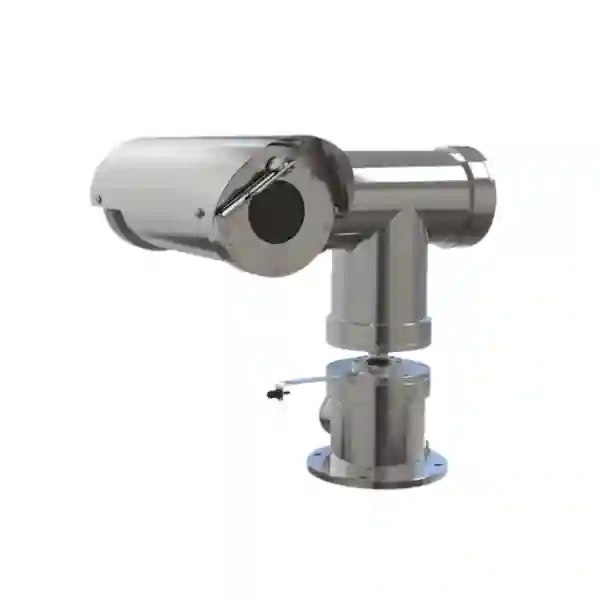
Hanwha TNU-X6320E1F2WT1-M Explosion-Proof PTZ Camera
Evaluate a specialist Full HD industrial PTZ with 32x optical zoom, 24 VAC power, integrated wiper and single-mode fiber configuration. Hanwha Vision lists this exact model as discontinued and identifies TNU-X6320A1F2WT1-M as its replacement. Use this guide to assess fit, limitations and your next procurement step in Tanzania.
For legacy support or a new specification, request a model-specific technical and commercial assessment. No Tanzania pricing, stock, lead time or local approval is implied.
At a glance
Model identity and current lifecycle
The Hanwha TNU-X6320E1F2WT1-M is a specialist network surveillance camera rather than a general-purpose security camera. It combines remotely controllable pan, tilt and zoom with an explosion-protected positioning-camera format designed for industrial projects where ordinary camera housings may be unsuitable. For a buyer evaluating a legacy installation, the complete model string is important: a similar-looking Hanwha variant may use a different supply voltage, physical communications connection, operating-temperature configuration or certification designation. Begin every quotation, technical review and spare-parts conversation with the full model number rather than a shortened series name.
Hanwha Vision now marks TNU-X6320E1F2WT1-M as discontinued and explicitly identifies TNU-X6320A1F2WT1-M as its replacement. Discontinued does not automatically mean that every existing installed unit stops working, that spares cannot exist, or that a particular reseller can supply a new unit. Equally, it is not evidence that new stock is available. Buyers should establish whether their need is to support an installed system, source an exact historical part, or specify equipment for a new project. The appropriate procurement route can differ significantly between those three situations.
For a new project in Tanzania, the named replacement is a sensible starting point for an engineering evaluation, not an automatically approved like-for-like substitution. Verify the hazardous-area classification, current certification documents, power arrangements, fiber-optic termination, mounting loads, recording software and installation requirements before authorizing a change. If a tender or maintenance record specifically requires the discontinued unit, explain the lifecycle position and request permission to assess a technically suitable alternative instead of silently changing the item. This protects both safety-critical design decisions and the accuracy of the purchasing record.
Who should consider this camera?
This type of camera is intended for demanding surveillance tasks at industrial facilities with a documented need for explosion-protected equipment. Possible application environments include fuel-handling infrastructure, chemical-processing areas, marine or offshore installations and other designated hazardous locations. Suitability cannot be determined from an industry name alone. An oil facility, for example, may have both ordinary locations and formally classified hazardous areas. The actual mounting position, surrounding atmosphere, risk assessment and applicable engineering standards determine whether an explosion-protected device is necessary and whether this particular variant is acceptable.
Security teams typically approach this class of equipment because a distant process zone must be observed without placing operators near an operational hazard. Operations personnel may want visual confirmation of a valve position, an access route, a loading activity or a vessel approach. Health and safety teams may require an inspection-grade observation point designed around site rules. These are potential monitoring objectives, not a claim that the camera itself measures gas, prevents an explosion, replaces a safety instrument or removes the requirement for physical access controls. Its value is video visibility within a correctly engineered system.
The decision should involve more than the person buying cameras. A practical review includes the site owner, hazardous-area or electrical engineer, CCTV designer, network specialist and the team responsible for maintenance. They should agree what must be seen, how closely it must be seen, whether the camera will be directed manually or by presets, how footage will be retained and how an incident will be handled if video is unavailable. The TNU-X6320E1F2WT1-M is best assessed as one component in this larger operating and safety context.
Verified headline specifications
Hanwha Vision lists Full HD 1080p video at up to 60 frames per second, 32x optical zoom with autofocus, multiple streaming, intelligent video analytics, a built-in wiper, 150 dB wide dynamic range, dual microSD family memory slots and 24 VAC power among the discontinued model’s key features. The historic F2 variant is identified in Hanwha Vision America product references as a single-mode fiber configuration. Together, these details explain why the camera attracts attention for monitored industrial spaces: it pairs directional viewing with a specialized physical and communications package.
These specifications should be treated as the starting point of a design review, not as a complete statement of delivered performance. Actual image usefulness depends on lighting, atmospheric visibility, optical distance, mounting vibration, the selected video profile and the target being observed. A 60 fps capability is not a guarantee that the recording server will capture every stream at that rate. Likewise, availability of onboard memory slots does not establish a particular supported card capacity or recording-retention period without the exact camera documentation, selected cards and configuration.
When comparing vendor literature, take special care not to blend the original model with its successor. Hanwha’s published headline gives the original model 150 dB WDR, while the replacement model’s current headline specifies 120 dB WDR. These marketing specifications should not be used as interchangeable values. Request the current technical document for the exact part under consideration and confirm any performance attribute that is a mandatory procurement criterion. Final safety, environmental and interface data should be reviewed using the exact model documentation before purchase.
- Original model: 1080p at up to 60 fps; autofocus and 32x optical zoom.
- Original model: 150 dB WDR; integrated wiper; video analytics; dual microSD-family slots.
- Original model: 24 VAC input and an F2 single-mode fiber configuration.
- Lifecycle: discontinued; manufacturer-named successor TNU-X6320A1F2WT1-M.
Understanding explosion protection
The term explosion-proof refers to a purpose-built protection method and enclosure concept, not to a claim that a camera is indestructible. In classified areas, a device must be suitable for the atmosphere, installation zone or division, gas or dust group, temperature limits and governing approval scheme. The designation on a procurement line is therefore not enough by itself. Engineering documentation should connect the exact delivered camera and its nameplate to the site’s hazardous-area dossier, ambient conditions, wiring design and installation method.
One practical distinction is that weather protection and explosion protection solve different problems. A camera with an outdoor ingress rating may resist rain or dust but still be inappropriate for an explosive atmosphere. Conversely, a correctly specified explosion-protected camera must still be installed and maintained so that seals, cable entries, fasteners and other elements retain the intended protection characteristics. The mounting hardware, electrical entry method and any accessories may need their own suitability review. Confirm the entire assembly rather than assuming that buying a specialized camera automatically makes the installation compliant.
Historical Hanwha product references associate the -M family designation with an INMETRO version. That model designation is not evidence of any Tanzanian project approval or a substitute for examining actual certificates and conditions of use. A qualified engineer should check the relevant current documents for the precise unit, including temperature class, applicable hazardous-area classification, environmental range and any restrictions on installation. Where jurisdiction-specific acceptance is required, obtain written confirmation from the appropriate responsible parties before specifying, energizing or modifying equipment at a classified site.
Pan, tilt and zoom planning
Pan, tilt and zoom lets an operator alter the camera’s view from a control room or another authorized location. Wide views can support general situational awareness, while a narrow zoomed view can help the observer inspect a particular item of interest. The 32x optical zoom is a significant capability, but it does not tell you the minimum readable detail at a particular range. Work backward from the site task: identify the target dimensions, desired image detail, lighting and obstruction risk, then select representative viewing positions for a field test or design calculation.
Movement introduces an operational tradeoff. A camera pointed at a valve cannot simultaneously monitor a gate behind it unless the scene still falls within the field of view. Presets and patrol patterns can help schedule coverage, but they do not make a single PTZ camera equivalent to several continuously observed fixed cameras. For critical locations, pair the PTZ viewing plan with fixed cameras where persistent recording of a specific area is necessary. Ensure that patrol commands, priority levels and operator permissions are clearly assigned so that simultaneous requests do not create confusion.
Mounting and sightline design matter as much as optical reach. Check roof lines, overhead pipework, glare sources, moving cranes and seasonal changes in visibility. Consider whether an operator must see a whole loading bay or the condition of a distant component, because these lead to different useful viewpoints. Allow access for maintenance without assuming that staff can work near energized or operating processes. For Tanzania projects, climatic and site conditions should be evaluated from actual facility data rather than generic assumptions about the whole country.
Full HD video and frame-rate decisions
Full HD 1080p resolution is a useful engineering reference because it provides a defined image raster for calculating pixel coverage across the field of view. It does not automatically satisfy every identification or inspection requirement. The level of detail depends on the lens setting, target distance and how much of the image the target occupies. A large industrial scene may benefit from a broad view, but fine markings on distant equipment can still be too small to read. Establish observable success criteria before evaluating the proposed installation.
A maximum headline frame rate of 60 fps can be valuable where the scene involves quicker motion or where operators need smoother visual feedback during movement. However, frame rate has a cost in bandwidth and storage, particularly when several simultaneous streams are requested. Many monitoring applications can use lower frame rates without compromising their operational purpose. A careful designer tests the actual scenario, measures the bandwidth produced by representative motion and lighting, and selects profiles that serve the task rather than automatically recording every channel at its highest setting.
Recording decisions should distinguish live viewing, continuous recording, event recording and short-term local fallback storage. An operator viewing a responsive stream over the network is not proof that the VMS has stored footage at the same resolution and frame rate. The retention policy, selected codec, edge recording settings and possible failover behavior need to be documented separately. Test playback and evidence export early in commissioning so that the system meets the site’s practical investigation requirements. Avoid projecting storage use from resolution alone without considering bit rate and operational patterns.
Wide dynamic range and difficult lighting
The original camera’s listed 150 dB wide dynamic range is relevant when a single view contains bright and shaded areas. Consider a sheltered process platform looking toward intense daylight, a reflective metal structure or a doorway between contrasting light conditions. WDR processing can help retain useful detail in scenes with challenging brightness differences, but it cannot guarantee usable footage through smoke, heavy rain, a dirty window or complete darkness. The right response is to design lighting, optics and mounting position together and test the resulting image.
For procurement comparisons, do not treat the number attached to WDR as an isolated score for total image quality. Methods, exposure decisions and the scene itself influence the result. A new camera may use different processing while also specifying a different nominal WDR figure. Ask for relevant sample footage or a site trial under realistic conditions rather than accepting a numerical comparison as conclusive. In the specific lifecycle decision here, the original’s 150 dB headline and the named replacement’s published 120 dB headline should be recorded faithfully.
Lighting studies should include daytime glare, low-angle sunlight, night-time operational lighting and any high-intensity work lamps near the viewing path. Check how automatic exposure behaves when large moving objects pass through the scene. If footage is used to support security or process incident reviews, include representative difficult scenes in acceptance testing and keep agreed reference images. Routine lens-window cleaning and wiper maintenance also affect image clarity. These straightforward tasks can be as important to long-term visibility as selecting a camera with advanced image processing.
Single-mode fiber integration
The F2 element of this historic configuration is associated with single-mode fiber connectivity in Hanwha Vision America’s product references. Fiber can be useful in industrial network designs that span electrically noisy zones or larger plant areas, but the word fiber does not establish the precise optical budget, connector system or supported reach of an installed assembly. Confirm the exact camera-side fiber interface and the other equipment at the far end of the link. Review any compatible media converter, network switch, fiber termination enclosure and spare-fiber requirements as a complete chain.
Specify the route as carefully as the endpoint. A plant fiber design may pass through ducts, cable trays, hazardous-area boundaries and outdoor cabinets. Document the proposed fiber type, splice locations, end-to-end loss budget, protection against mechanical damage, cable entry method and maintenance access. The design team must ensure that cable glands and sealing arrangements maintain the relevant enclosure protection concept. Do not assume a standard office fiber patch cable or unverified aftermarket connector will be acceptable simply because the network protocol is Ethernet.
Before purchasing a replacement model, inspect the current fiber topology rather than relying on a shared F2 designation alone. Confirm whether the physical interface, fiber geometry, termination details and networking behavior are compatible. A successful desktop link test does not resolve hazardous-area installation requirements, while an approved cable route does not prove that the chosen network endpoint will work. Acceptance should include optical power or loss evidence as appropriate, link stability, PTZ command latency, live-view quality, event handling and the ability to restore service after power cycling.
24 VAC power and electrical design
Hanwha specifies 24 VAC power for the discontinued TNU-X6320E1F2WT1-M. This is an essential procurement constraint. Do not substitute a visually similar model built for a different voltage, and do not infer Power over Ethernet capability merely because the camera is network-connected. A site engineer should check the supply at the actual point of connection, the expected running and starting demand, allowable cable drop, protective devices and the installation instructions for the specific assembly being installed.
Power design must also account for what happens when the wider site loses electricity. Depending on the project, the camera may be connected to a protected distribution board or supported by an appropriately engineered backup supply. The backup design has to cover not just the imaging device but also network switches, fiber equipment, recording servers and the interfaces through which operators view alarms. The fact that a camera remains energized is of limited value if its upstream communications path or recording service has failed.
Hazardous-area electrical work is not a routine low-voltage accessories job. The installation team must review approved cable-entry details, protective earthing and bonding, isolation procedures, enclosure-opening restrictions, inspection schedules and any certificate conditions. A generic power adapter or ad hoc junction box should not be selected without engineering approval. For a replacement project, verify supply voltage and all downstream equipment again; a successor may have the same nominal voltage but still require checks of connector arrangements, startup behavior and installation guidance.
Wiper, outdoor exposure and inspection access
An integrated wiper is among the original manufacturer’s confirmed headline features. This can improve usability where water on the camera window would otherwise interfere with the view, but it should not be marketed as a substitute for cleaning, preventive maintenance or appropriate enclosure selection. Windborne dust, salt residue, industrial deposits and other contaminants may still accumulate. A wiper works on the available viewing window; it does not remove every obstruction in the environment or maintain optics automatically under all site conditions.
Before agreeing on a mounting position, consider whether operators or maintenance personnel can inspect and clean the assembly safely. A camera mounted high over a process area may offer excellent sightlines but require specialized access equipment or a shutdown to service. The operational plan should identify who is permitted to inspect the unit, what maintenance can be performed in place, how the hazardous-area status affects the work permit and which parts must be kept available. Do not assume any washer tank or bracket is included simply because related accessories appear on manufacturer pages.
Physical durability should be assessed using the exact model’s mechanical drawings and documents rather than another family’s dimensions. Loading from mounting brackets, wind, vibration, cable weight and nearby machinery can affect a large PTZ assembly over time. Check the structure and fixing details using competent engineering review. For exposed industrial locations in Tanzania, base material and corrosion decisions on actual exposure conditions and customer standards. Where aggressive chemicals, marine aerosols or washdowns are expected, confirm that the precise product configuration and maintenance plan are suitable.
Video analytics and actionable alerts
Hanwha lists intelligent video analytics for the legacy model. That can be useful for generating observations or events in supported conditions, but the availability of an analytics feature does not guarantee that a specific alarm rule will work reliably at every industrial site. Steam, dust, rain, moving plant equipment, lighting changes and swinging vegetation can all affect event behavior. Define the operational question first: for instance, is the objective to notice entry into a monitored area, flag an unexpected movement pattern or help an operator find a relevant recording?
An analytics workflow needs agreed camera placement, event criteria, response ownership and a method for reviewing false positives and missed events. Test it against representative normal operations and unusual but harmless activity, not only a clean demonstration scene. Decide whether an event should create a VMS marker, notify a control room or initiate a human review. Safety-critical automatic actions should never be inferred from a CCTV analytics label; any integration into a protected process requires separate formal engineering assurance.
Where analytics are required for a current procurement, ask for a current feature matrix for the precise model and firmware. The discontinued camera and its newer successor may differ in supported triggers, configuration interface, performance characteristics or integration behavior. Maintain a written list of mandatory functions and validate them in the actual software stack. A useful result is an agreed set of alarms that operators understand and trust, not simply the longest menu of available features on a product sheet.
Network, recording and management integration
Industrial video systems commonly include the camera, communications links, switches, time synchronization, video management software, storage and operator workstations. Treat compatibility as a project requirement to test rather than a feature implied by the presence of an IP interface. Obtain exact firmware information and the camera-side protocols supported by the unit being offered. Ask the VMS provider to confirm live viewing, PTZ control, preset management, stream selection, event reception, playback and supported recovery behavior for the actual device and software version.
Separate the network carrying security video from business traffic where the site policy requires it. Use suitable access controls, account management, network segmentation, monitoring and change procedures. The camera should not be exposed directly to public networks without an approved security design. Document who is permitted to move the PTZ head, modify analytics, export recordings and install firmware. These controls affect whether footage is reliable and whether the system can be operated safely during an incident or maintenance event.
Legacy camera procurement carries particular support questions. Confirm which firmware is installed, whether supported updates are available, how configuration backups are maintained and what the vendor currently recommends for secure deployment. Discontinued status should trigger a support review rather than an automatic claim that the product is insecure. A replacement should be assessed for interoperability with the existing VMS, account structure, recording profiles, network topology and cyber maintenance process. Test migration in a controlled environment before swapping field equipment.
Storage and retention planning
The original product literature identifies two onboard microSD-family storage slots. Onboard storage can form part of a video design, but installed cards, capacity, recording modes and health monitoring must be established individually. Do not assume memory cards are supplied or that edge storage eliminates the need for a central recording policy. Establish whether the project requires continuous evidence, motion-related clips, alarm snapshots, temporary network-failure buffering or a combination of methods.
Retention should be calculated from the operational requirement and measured or conservatively modeled stream characteristics. Resolution, codec, frame rate, compression settings, scene movement, recording hours, camera count and redundancy all affect storage use. Define how long recordings must remain accessible and how footage should be exported for an investigation. Where the system supports recording at more than one location, test the actual synchronization and recovery behavior after a communications outage. A camera that records locally but never reconciles footage with the central system may create an evidence gap.
Include practical servicing details in the design. Storage media may have endurance constraints and should be monitored or replaced in accordance with site policy and manufacturer guidance. Establish how time stamps are synchronized, what happens when memory fills, who can retrieve footage, and how credentials are protected during maintenance. These decisions are especially important where the camera is hard to access physically. The right storage architecture should be documented before installation and verified through playback, alarm and failure-recovery tests during handover.
Industrial use cases in Tanzania
At a fuel or energy installation, a remotely controlled camera may help operators review a loading area, perimeter approach or external process equipment from a safer monitoring location. The appropriate camera position still depends on the precise hazard classification and the desired visual task. It should not be described as a certified gas sensor, automatic fire-detection solution or substitute for access restrictions. Establish the approved mounting location and determine which details operators need to distinguish at normal and zoomed views.
At a heavy industrial or manufacturing facility, the requirement may be a long viewing distance across machinery, structures and access routes. Site surveys should identify vibration, glare, moving obstructions and practical maintenance routes. If plant operations continue through the night, evaluate the available lighting rather than assuming that the camera delivers equivalent detail at every hour. The monitoring team should identify which events are routine and which require attention before configuring analytics or camera tours.
In a port, marine or coastal project, environmental exposure and the position of the communications infrastructure may dominate design decisions. Fiber pathways, corrosion risk, safe service access and wind loading deserve explicit treatment. Neither the use case nor a product’s appearance verifies suitability for a specific marine classification or environmental exposure. Obtain the facility’s engineering standards and the exact manufacturer’s approval documents. Plan the system as a site-specific installation, not a universal solution labeled for all ports or coastal facilities.
For remote infrastructure, the biggest questions may concern power continuity, networking and maintenance logistics. A camera with strong optics does not solve a weak backhaul or an unavailable on-site support team. Identify the expected communications arrangement, permissible outages, approved remote access mechanism and escalation plan. These examples are planning scenarios relevant to potential Tanzanian buyers; they are not claims that this camera is stocked locally, that FourTeck has completed these installations or that any particular facility has approved the product.
Pre-purchase site survey: what to document
Start with a survey that captures the precise operational objective and site constraints. Record the proposed mounting coordinates, available viewing corridors, approximate target distances and required visual detail. Include daytime and night-time photographs of the scene where permitted, together with notes about equipment movement and temporary obstructions. Confirm whether the camera is meant to provide occasional close inspection, general situational awareness or continuous coverage of a critical point. An unambiguous task statement helps the team choose between PTZ, fixed cameras and other monitoring options.
Next, collect the hazardous-area classification and relevant engineering controls from the responsible site authority. Record ambient temperature limits, expected contaminants, electrical classification, cable-entry rules, grounding requirements, inspection access and any shutdown restrictions. Do not select the certificate by name alone; the full marking and conditions must match the installation. Confirm the project-specific approval route in Tanzania through the appropriate authorities and engineering stakeholders, rather than treating an overseas certificate as automatic local acceptance.
Then examine electrical and network infrastructure. Identify the available 24 VAC supply, distribution protection, backup arrangements, fiber type and route, switch location, environmental enclosures, recording destination and management software. The survey should identify any unknowns that require manufacturer confirmation. For replacement work, inspect the existing mounting and terminations without assuming that a newer assembly shares every mechanical or connector detail with the previous one. Photographs, as-built records and part labels can prevent expensive mismatches.
Finish the survey by writing down measurable acceptance criteria. Examples include successful image capture at agreed targets, operator PTZ responsiveness, visible presets, stable recording, successful playback, fiber link recovery after interruption and maintenance accessibility. Agree who will sign off each criterion and which tests require special permits. This approach turns an expensive specialist camera purchase into an accountable engineering decision, particularly when the exact requested model has reached the end of its manufacturer lifecycle.
Commissioning and acceptance testing
Commissioning begins with a documented installation inspection, not simply an image appearing on a monitor. The responsible qualified personnel should verify that the delivered camera matches the approved part and paperwork, that the enclosure and mounting arrangement are correct, and that the cable entry and electrical installation meet the relevant requirements. Record model identification, installed firmware, installation date, network details and any certificate references in the asset register. Maintain the approved documentation with the site safety and maintenance records.
After the safety and electrical checks are complete, test viewing and PTZ functions using the operational scenes selected during design. Assess broad and zoomed views, autofocus behavior, image quality against difficult lighting, preset repeatability and any required wiper operation. Include observation from the real control workstation rather than only a technician’s setup screen. If network latency or bandwidth makes PTZ control awkward, address the connection or stream configuration before acceptance. A demonstration under ideal lighting is not a substitute for representative operating conditions.
Test end-to-end recording, event workflows and resilience separately. Check timestamp consistency, scheduled retention settings, alarm retrieval, user access, export permissions and playback after a planned network interruption. If the system depends on backup power, test an approved outage scenario and confirm what remains operational. Avoid destructive tests or enclosure work in a hazardous area without the required procedures. Sign off any unresolved exceptions explicitly, along with the party responsible, agreed corrective action and acceptance conditions.
Finally, hand over a usable system. Operators should know how to call presets, return to a safe default view, handle conflicting PTZ requests and report image obstructions. Maintenance staff should have the approved cleaning and inspection procedures, relevant spare-part information, backup configurations and escalation process. Keep configuration changes under control after handover, particularly where they influence alert sensitivity or video retention. Good commissioning reduces uncertainty about both the product and the operational environment into which it has been installed.
Maintenance and lifecycle support
Long-term operation requires more than the initial camera and a recorder. Define periodic visual checks for the image window, wiper condition, mounting integrity, signs of corrosion, cable routes and network health. The maintenance regime must follow the governing hazardous-area procedures, with suitable authorization and isolation where required. Do not open or modify an explosion-protected assembly in an unsafe condition. Maintain a history of inspections, incidents and replaced components so that recurring problems can be distinguished from isolated failures.
Because the TNU-X6320E1F2WT1-M is discontinued, identify the support path early. Ask the supply chain to verify whether an exact replacement unit, compatible manufacturer parts or authorized service arrangements are actually obtainable. Do not assume that a product being listed in an old catalogue means it remains orderable. Where operational continuity is important, establish what happens when a unit cannot be repaired and whether a qualified substitute can be installed without changes to the site’s approvals or infrastructure.
Review lifecycle exposure at regular intervals. Changes to video software, network security policy, recording requirements or site hazard classification may affect a camera that still appears to work normally. Track the status of firmware and configuration backups, evaluate whether any migration is necessary and maintain replacement drawings. A proactive plan is generally more useful than waiting for a failure before learning that the original equipment is no longer part of the current product range.
Comparing the original camera with its named successor
Hanwha Vision identifies TNU-X6320A1F2WT1-M as the replacement for the TNU-X6320E1F2WT1-M. The current manufacturer listing describes the successor as a 2 MP 1920 by 1080 explosion-proof PTZ with 32x optical zoom, 24 VAC power, an integrated wiper and a single-mode fiber arrangement. These points indicate a similar broad application class. They do not mean that the units are identical in software, physical construction, approvals or installation details. A formal substitution comparison should accompany any new project specification.
One verified difference in the published headlines is WDR: 150 dB for the discontinued model and 120 dB for the named replacement. The successor’s current listing also mentions specific imaging, stabilization and construction details that cannot automatically be asserted about the older model. It would be misleading to combine the two sets of specifications into one product table. Keep separate source documents, verify the features required by the site and request demonstrations for material performance differences. Evaluate capability against the real task, not against a general assumption that a newer model is better at everything.
A replacement review should compare the exact certification version, applicable temperature markings, voltage and power, physical dimensions, mounting pattern, cable entries, fiber termination, network protocols, recording compatibility, analytics configuration, wiper and cleaning provisions, and maintenance access. If any detail is unknown, classify it as pending verification and request the current technical drawings or installation guide. This is especially important where a fixed conduit installation or certified mounting arrangement leaves little room for an unplanned dimensional change.
For a legacy installation, the business decision may be to retain a working device, carry an approved service spare, or gradually migrate an area to the successor. The preferred choice depends on risk, support status, remaining project life and the cost of associated changes. For a new installation, request a current manufacturer-supported proposal using the successor as a starting candidate. In both cases, the most defensible outcome is a documented fit assessment rather than a blanket statement that the new model drops straight into the old one.
How to request an accurate quotation
A useful quotation request should identify the complete discontinued model, state whether the requirement is an exact historical replacement or a new engineering specification, and note that the manufacturer has announced a successor. Provide the intended installation country and a concise description of the environment without disclosing sensitive site details unnecessarily. Where a classified area is involved, share the relevant technical classification through the customer’s approved procurement channel. Ask the respondent to identify precisely which model they are offering.
Include essential system information: supply voltage, existing or proposed fiber connection, recorder or VMS name and version, mounting requirements, anticipated operational tasks and any mandatory certificate conditions. If image detail at a specific distance is critical, describe the target and ask for a demonstrated or calculated basis for the proposal. Request separate identification of the camera, any required brackets, cable-entry hardware, optional cleaning accessories, network adaptation and commissioning work. Do not presume that these items are included as standard.
Before confirming a commercial order, obtain written clarification of current supply status, applicable support arrangements, lead time, documentation set and any exclusions. Prices, stock, delivery, warranty conditions and installation coverage are not confirmed by this product description. Do not infer Tanzania regulatory acceptance from a foreign certificate. The right next step is to request a technical and commercial assessment of the exact model or the manufacturer-named successor with the supporting drawings and certification documents.
Questions buyers frequently ask
Is the TNU-X6320E1F2WT1-M still a current Hanwha camera? No. Hanwha Vision marks the model as discontinued. That status should appear in any current purchasing discussion so customers do not mistake an archived specification for a currently manufactured item. It does not determine whether any specific seller has stock or a service arrangement.
What is the named replacement? Hanwha Vision identifies TNU-X6320A1F2WT1-M. It is a candidate for new specifications and legacy migration studies, but the buyer should verify certification, connections, mounting, software and performance requirements. The manufacturer naming a successor does not replace project-specific engineering acceptance.
Does this camera offer optical zoom? Yes. Hanwha’s original-model headline specifies 32x optical zoom and autofocus. That helps the operator move between broad views and selected distant targets. The required detail at a specific distance still depends on field of view, environmental visibility, target dimensions and configuration.
Can it run from a standard PoE network switch? The original model is specified for 24 VAC power; a PoE supply is not stated as its power method. The presence of a fiber-network connection must not be confused with electrical supply. Confirm the approved electrical design with the manufacturer’s exact installation documentation.
Why is single-mode fiber relevant? The original F2 variant is identified in Hanwha product references as a single-mode fiber configuration. That can suit some industrial communications designs, but exact interface details, cable entry, termination, optical budget and the far-end equipment must be checked before procurement.
Does explosion-proof mean it is approved for every dangerous site? No. Suitability depends on the actual hazardous-area classification, certification, installation conditions, applicable standards and approval process. A site engineer must verify the exact unit, not only the product family or a descriptive marketing term.
How should the 150 dB WDR figure be interpreted? It is the manufacturer’s listed WDR headline for the discontinued model. Actual image quality depends on scene conditions and configuration. The replacement currently carries a 120 dB published WDR headline, so the two models’ published figures should not be merged.
Are price, stock, shipping time or warranty confirmed for Tanzania? No. None of those commercial details is verified here. Request an individual quotation with exact model identification, documentary evidence of supply status, current manufacturer information and written terms appropriate to the proposed deployment.
Request a model-specific technical assessment
Provide the complete model number, whether you are replacing an existing unit or planning new surveillance, the relevant site classification, supply voltage, fiber requirements and recording platform. Ask for confirmation of lifecycle status and the suitability of the manufacturer-named successor before approving a specification.
Contact FourTeck Tanzania through your established enquiry channel for a quote or compatibility review.




Reviews
There are no reviews yet.