
Industrial video surveillance • Tanzania
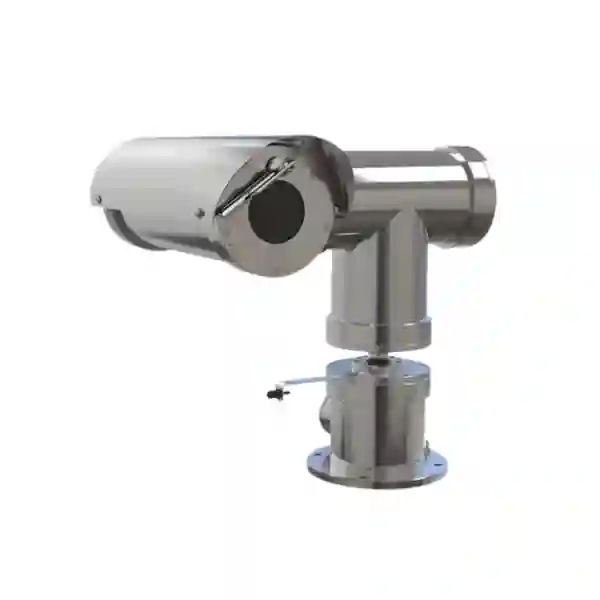
Hanwha TNU-X6320E1WT1-C Explosion-Proof PTZ Camera
Need a remotely controlled industrial camera for a correctly classified hazardous location? The Hanwha TNU-X6320E1WT1-C combines Full HD viewing, 32x optical zoom, a positioning head and an integrated wiper. Match the exact -C certification and electrical arrangement to your site’s engineering requirements before ordering.
Request a project-specific specification review and quotation.
At-a-glance technical summary
| Camera type | Explosion-proof positioning / PTZ IP camera |
|---|---|
| Video | 2 MP Full HD, up to 1080p at 60 fps |
| Lens | 32x optical zoom with autofocus |
| Movement | Motorised pan and tilt; exact movement limits to be checked for -C |
| Image processing | Day/night, 150 dB WDR family reference, video analytics |
| Environment | IP66 / IP67, 316L stainless-steel family construction |
| Power | 24 VAC; confirm unit-specific load and protection |
| Wiper | Integrated viewing-window wiper |
| Model suffix | -C: CSA-oriented certification variant; verify exact marking |
| Commercial details | Local pricing, stock and lifecycle require confirmation |
Selected values draw on Hanwha Vision’s closely related TNU E1 documentation and exact-model listings. Confirm the latest documentation for the ordered -C suffix.
Is this the right industrial camera for your site?
The Hanwha TNU-X6320E1WT1-C is intended for organisations that need remotely directed video observation in demanding industrial locations, rather than an ordinary office or retail CCTV installation. It combines an explosion-proof positioning enclosure with an IP camera, optical zoom and motorised pan-and-tilt movement. For a plant security team, the practical advantage is the ability to inspect changing areas of interest from a controlled monitoring position while keeping the camera assembly suitable for a specified hazardous environment, subject to engineering approval.
Typical evaluation scenarios include controlled industrial process areas, fuel-handling infrastructure, chemical processing facilities and other sites where the area classification requires equipment selected for a particular explosive atmosphere. These are examples of potential applications, not a statement that any specific Tanzanian plant or zone is automatically covered. A safety engineer must establish the classification, gas or dust group, temperature class, installation method and applicable approvals before the product is specified.
Request a technical quotation only after confirming the exact -C suffix, intended operating environment, electrical design and lifecycle status. A correctly specified hazardous-area camera is a complete engineered assembly, not simply a standard PTZ camera placed in a strong outdoor box.
What the model designation tells a buyer
The exact part number matters because similar-looking Hanwha product codes can describe meaningfully different equipment. TNU identifies the positioning/PTZ family, whereas TNO is used for explosion-proof fixed-direction zoom camera products. The X6320 platform is associated with Full HD imaging and a 32-times optical zoom lens. The E1 portion is associated with the 24 VAC configuration, and the WT1 combination identifies a wiper-equipped temperature variant. This page addresses TNU-X6320E1WT1-C and should not be used as a substitute for another suffix.
Hanwha’s published model listings describe the -C variant as the cLC CSA-oriented certification version. Other suffixes, including -Z and -M, reflect different certification selections; configurations containing F2 can differ in the communications arrangement. An apparently similar camera offered under another code may therefore require a different electrical, network or hazardous-area approval review.
At purchasing stage, put the complete model code on every request for quotation, drawing schedule, material requisition and approval record. Confirm the manufacturer’s current data sheet for the ordered suffix, because broad family documents and older reseller descriptions can combine several configurations within one specification table.
Video performance: Full HD at high frame rates
The camera family is documented for 1920 by 1080 Full HD video at up to 60 frames per second with H.264 or H.265 encoding under the specified operating conditions. Full HD can provide an appropriate balance between scene awareness, recording resources and available bandwidth for certain industrial monitoring tasks. The high frame-rate capability can be useful where moving machinery, passing vehicles or repositioning camera views make smooth video important, although a project’s actual frame rate depends on the chosen stream profile and recorder.
A quoted resolution does not establish that every distant target will be identifiable. Target size in the image, field of view, lighting, motion blur, optical quality, compression and distance all affect detail. A security design should define whether the objective is general observation, detection, recognition or identification. A live demonstration at representative mounting positions is preferable to assuming that a 2 MP label is sufficient for every process or perimeter.
The camera provides colour and monochrome operation through automatic day/night switching. Evaluate representative daytime and nighttime scenes, including illuminated metalwork and shadowed equipment, instead of treating a minimum-illumination figure as a guarantee of usable evidence under every condition.
32x optical zoom for targeted visual inspection
A key reason to consider this equipment is the integrated 32x optical zoom lens with autofocus. Optical zoom changes the actual framing of the scene and is more useful for recovering detail on distant equipment than simply enlarging a recorded image digitally. The closely related documented TNU E1 platform uses a lens range around 4.44 to 142.6 mm. Buyers should confirm the exact lens sheet and achievable field of view for their selected -C assembly before signing off a camera coverage drawing.
The benefit of long optical zoom depends on what the operator is trying to see. At a wide setting, an operator can orient the view toward a general process area; a narrower view can then examine a valve position, transfer point or approaching vehicle. Zoomed views inevitably cover less of the surroundings, so one manually directed PTZ camera cannot continuously monitor every possible location at once.
Consider whether an additional fixed overview camera is required. For critical safety or security processes, maintain adequate coverage while the PTZ is looking elsewhere. Test autofocus on reflective structures, fence lines, pipes and backlit scenes, where contrast and foreground obstacles can affect focus acquisition.
Motorised movement and camera positioning
The positioning camera arrangement provides remote pan-and-tilt control rather than a permanently fixed viewing direction. Hanwha’s published E1 PTZ family lists full-circle pan movement, a tilt range from approximately minus 90 to plus 90 degrees, and preset movement speeds up to about 45 degrees per second for pan and 24 degrees per second for tilt. These figures are useful family references; confirm them against the exact -C variant, firmware and controller specification for a formal design.
A motorised head can reduce the need for an operator to enter a restricted area merely to change a viewing direction. That benefit requires suitable remote controls, correctly defined permissions and a stable communications route. Automation or presets should be agreed with operations teams so movement does not conflict with the reason the camera was originally selected.
Map realistic inspection positions before installing the equipment. Account for vessels, pipe racks, gantries, crane movement and future plant expansion. Verify that the mounting orientation and full movement envelope do not cause collisions, cable strain, visual obstruction or a view into an area where recording is inappropriate.
Wide dynamic range in contrasting industrial light
The published X6320 E1 camera family lists wide dynamic range of 150 dB, together with backlight compensation and related image-processing controls. In practice, a high-contrast industrial scene may contain bright daylight through a doorway, deep equipment shadows, reflective tanks and artificial light. Wide dynamic range can help balance bright and dark regions, but performance depends on the actual scene and settings.
Plan a test where the camera faces both a bright opening and a dimmer working zone. Observe whether the information that matters remains visible at the intended zoom setting. The correct result may require adjusting exposure, shutter limits or image-processing parameters rather than simply leaving all controls on automatic. Fast-moving subjects can still experience motion artifacts under challenging exposure conditions.
Do not equate dynamic range with night-vision illumination. The base product should not be represented as having a built-in infrared floodlight unless the exact manufacturer’s configuration says so. Where sites need lighting after dark, address the illumination strategy separately and use fixtures approved for the classified area where applicable.
Day and night coverage without exaggerated claims
Industrial surveillance often has to work through shift changes, power fluctuations and mixed artificial lighting. Automatic infrared-cut filter switching supports a transition between daytime colour recording and monochrome low-light operation. Published family sensitivity figures are approximately 0.05 lux in colour and 0.005 lux in monochrome under specific measurement conditions. These are laboratory reference values, not promised usable images at those illumination levels in every facility.
Prepare a nighttime acceptance test with the actual lamps, light spill and target movement found on site. Consider whether operators need to recognise safety signage, verify a vehicle number, inspect moving process components or merely detect unexpected activity. Each objective needs a different amount of detail and illumination. A zoomed lens typically admits less light at its telephoto end than at the wide end.
Where glare, condensation on surrounding structures, glare from work lights or vehicle headlights are present, verify the scene using a trial camera or manufacturer-supported demonstration. Camera selection should be driven by a target-based image-quality requirement rather than a single sensitivity number.
Weather-resistant housing and stainless-steel construction
The family is designed for challenging outdoor and industrial use, with stainless-steel construction and published IP66/IP67 ingress protection. The documented material is 316L stainless steel, which is often selected for demanding industrial atmospheres. These characteristics can be valuable around spray, moisture or corrosive environments, but no enclosure is immune to every chemical, cleaning agent or maintenance practice.
An IP rating concerns ingress protection under specified test conditions. It does not, by itself, prove that a product is appropriate for a hazardous gas or dust zone. The explosion-protection marking and the actual installation certificate must be reviewed separately. The hazardous-area approval can be invalidated by inappropriate cable glands, unapproved modifications, incorrect sealing practices or an unsuitable installation method.
For coastal or wet industrial sites in Tanzania, include corrosion exposure, cleaning practices, wind loading, external fixtures and mounting fasteners in the survey. Confirm the exact weight, envelope dimensions and bracket loading for the assembled -C model. Do not assume a light-duty commercial CCTV bracket will safely carry a heavy positioning camera over the required service life.
Environmental operating limits and practical site conditions
Published information for the TNU-X6320E1WT1 series describes an operating-temperature range from minus 40 to plus 60 degrees Celsius for the WT1 configuration, subject to the exact certificate and model. The broad range is relevant to industrial conditions, but the maximum permitted ambient temperature can also interact with hazardous-area temperature classification, equipment loading and the details of the manufacturer’s approval.
Temperature is only one part of a site assessment. Outdoor installations may experience direct solar radiation, heat from nearby plant, conductive dust, salt exposure and frequent temperature changes. A camera mounted against a sunlit vessel or near a hot exhaust can be exposed to conditions that are not represented by the general weather forecast. Instrument engineers should assess the temperature at the actual equipment position.
Confirm humidity, condensation management, cable-entry protection and maintenance access. Follow the installation documentation on orientation and permitted mounting accessories. Where continuous duty is critical, include a documented inspection schedule and acceptance criteria rather than assuming that a broad temperature specification eliminates the need for preventive maintenance.
Integrated wiper: maintaining a usable viewing window
The integrated wiper is one of the model’s practical industrial features. Camera windows can accumulate rainwater or other contamination that interferes with the scene. A remotely operated wiper can improve the ability to recover a clear view without sending a person to the camera location for every minor obstruction. Its benefit is greatest where a compatible cleaning and maintenance procedure is already part of the wider installation plan.
A wiper is not a self-cleaning system for every type of contamination. Oil films, thick dust, aggressive deposits, dried salt and chemical residues may still require planned manual cleaning. Some applications may need additional washer equipment, but the compatibility and certification of any reservoir, tubing or accessory must be verified for the exact model and installation.
Check how the wiper is controlled through the proposed video-management system. During acceptance, verify that it works reliably without obscuring required imagery or creating unexpected maintenance exposure. The safest design includes access procedures, a cleaning method that is compatible with the window, and an inspection record for the condition of the wiper blade.
Explosion-proof does not mean universal hazardous-area approval
The term explosion-proof describes a specific protective approach and certification context; it should never be read as permission to install equipment in every classified atmosphere. Published Hanwha listings distinguish the -C suffix as a cLC CSA certification-oriented variant. Whether it is acceptable at a proposed Tanzanian facility depends on the governing project specification, zone or division classification, gas and dust groups, temperature class, local rules and the certificate issued for the exact assembly.
Before purchase, request the manufacturer’s current certificate, full marking, installation instructions and any special conditions of use. A qualified hazardous-area designer should compare these documents with the facility’s hazardous-area classification dossier. An IP66/IP67 rating is useful but is not a substitute for this review. Do not infer local regulatory acceptance from a foreign certificate name.
The installation method is as important as the camera body. Cable entry devices, conduit, glands, junction boxes, earthing and isolation practices must satisfy the selected protection concept and project requirements. Work should be carried out by competent personnel under approved site procedures, not by treating the unit as a conventional plug-and-play IP camera.
Where the camera fits within an industrial security design
This camera is best evaluated as one element of a larger surveillance and operational awareness design. A control room might need a fixed camera for permanent coverage, a positioning camera for targeted checks and a recording system that preserves video evidence. The PTZ adds flexibility but cannot replace multiple fixed views where simultaneous observation is required. Define the purpose of each camera location before deciding how many units are necessary.
Possible observation tasks include checking a loading point, viewing movement around a restricted gate, examining activity near a processing vessel, and reviewing an alarm location from a safe control point. These examples describe potential use cases, not a promise that the camera alone can detect a leak, identify a specific hazard, or make a safety-critical process decision.
Process-safety instrumentation, fire and gas detection, machine safeguards and emergency systems have their own requirements. A video camera should not be substituted for certified safety functions. Where operators use the view to inform a response, clearly document the human decision process and limits of visual evidence.
Network video and standards-based integration
The platform supports IP-network video using H.265, H.264 and MJPEG compression options and published network protocols such as RTSP and HTTPS. Hanwha’s related E1 PTZ specifications identify an RJ-45 Ethernet connection and ONVIF interoperability features. These capabilities can help integration with appropriate network video recorders and management software, but successful operation must be confirmed with the chosen firmware versions and software releases.
Ask the integrator to demonstrate live viewing, PTZ commands, presets, alarm events, recording playback, clock synchronisation and user access from the intended management platform. ONVIF support is not a guarantee that every optional analytic event or wiper command will behave identically in every third-party application. Some features may rely on manufacturer-specific APIs or software integrations.
Keep industrial camera networks logically managed and documented. Define camera addressing, switching, cabling, routing, remote access, and maintenance responsibility with the site’s IT and operational technology teams. Use secure network design rather than exposing camera interfaces directly to the public internet.
Recording bandwidth, codecs and image retention
A high-frame-rate Full HD PTZ can generate substantial video traffic depending on scene movement, compression settings and quality targets. H.265 can provide efficiency advantages in suitable environments, while H.264 may be preferable where older systems require broad compatibility. The selected encoder settings should be tested with the intended recorder, particularly if a facility needs continuous recording and rapid playback during an incident.
Calculate storage from an actual measured bit rate, the planned number of cameras, daily recording hours and required retention period. Include a practical margin for busy scenes, frame-rate changes, future additions and storage-system overhead. Analytics-triggered recording can reduce routine storage, but it may miss context before or after an event if pre-event and post-event buffers are poorly configured.
Agree which stream is for live monitoring and which is for recording. A lower-bandwidth substream may be sufficient for a mobile operator panel, while forensic playback may require a higher-quality primary stream. Confirm the retention policy, access permissions and export process before commissioning the system.
Edge storage and interrupted connections
The documented X6320 E1 platform provides two microSD-family card slots, with a published maximum of up to 256 GB per slot, or 512 GB total, subject to the approved card type and firmware support. Local storage can be useful as part of an evidence strategy where a network link is temporarily unavailable. It should be treated as a complementary capability rather than a complete replacement for a properly managed video recorder.
Confirm whether the planned workflow supports recording during loss of the central connection, how files are retrieved and whether the chosen system can reconcile edge-stored footage automatically. Do not assume automatic backfill, unlimited card endurance, or guaranteed event capture unless tested with the exact recorder and firmware combination.
Memory cards have finite write endurance and can fail without a visible warning. Select compatible industrial-duty media as recommended by the manufacturer, monitor storage health where supported, and document replacement procedures. For a hazardous-area camera, maintenance to internal components may require site isolation and permit controls; follow the approved instructions rather than opening the enclosure while energized.
Video analytics: useful events, not autonomous safety decisions
The E1 camera platform lists analytic functions such as motion detection, tampering alerts, fog detection, virtual line crossing and virtual area events. A carefully configured event can help an operator focus attention or create searchable review points in a busy monitoring room. For example, a virtual line might support review of traffic through a monitored boundary, provided the camera is appropriately positioned and the scene is stable.
Video analytics are sensitive to the actual scene. Rain, moving shadows, reflections, camera movement, insects near the window, steam, dust and changes in illumination can influence event quality. PTZ movement also changes the geometry of a virtual line or area, so confirm whether each rule is valid for the intended preset and software configuration.
Run a documented test with realistic people, vehicles and operating conditions. Determine what constitutes a useful alert, the acceptable false-alarm rate and who will investigate the result. Do not describe this platform as a modern AI object-classification camera, automated gas detector or certified safety device merely because it includes intelligent video analytics.
Power engineering: plan for 24 VAC, not standard PoE
The TNU-X6320E1WT1-C is identified as a 24 VAC camera configuration. This is a critical distinction from many standard network cameras powered directly by Power over Ethernet. The facility must provide a suitable low-voltage AC supply using an approved power arrangement, cable size, protective devices and equipment appropriate to the classified location. A network switch with PoE ports is not, by itself, the correct power source for this model.
Hanwha’s closely related TNU E1 PTZ listing provides a maximum power-consumption reference of up to 80 watts. An electrical designer should confirm the exact -C assembly, any starting or heater load and supply tolerances before sizing the transformer and cabling. Do not treat the reference value as a substitute for the latest unit-specific installation guide.
In Tanzania, the upstream site supply and its protection must be reviewed locally; no claim is made here about a particular utility feed or site configuration. Include surge protection, earthing, isolation, continuity arrangements and safe maintenance procedures in the design. Power loss at a remote camera can interrupt both live operation and local recording.
Mounting strength, service clearance and access
Explosion-proof positioning equipment can be much heavier than a standard dome or bullet camera. Hanwha’s published data for the closely related TNU E1 PTZ model lists approximately 53 kg, but the final installation design must use the current documentation for the exact ordered -C assembly and all accessories. The combined loading should include the unit, mounting assembly, site wind conditions, vibration and any required safety factors.
Survey the actual support structure before the purchase order is released. A bracket that fits mechanically may still be unsuitable because of its loading, material, corrosion resistance, certification assumptions or maintenance access. Discuss wall, pole and structural mounting options with the project engineer. Do not assume that a mounting part shown for another Hanwha enclosure is interchangeable.
Plan adequate clearance for full PTZ movement and future replacement of components. Consider lifting equipment, safe access, restricted work areas and the location of cable entries. A robust mounting design reduces operational interruptions and provides a more predictable camera view during windy or vibrating plant conditions.
Cabling, cable glands and hazardous-area boundaries
The required communications and power routes should be designed together. Published model distinctions show that specific F2 variants include a fibre-related option; the TNU-X6320E1WT1-C code should not be assumed to provide the same built-in fibre arrangement. Confirm the network interface and cable-entry details of the exact unit before specifying converters, fibre termination or junction equipment.
At a hazardous-area boundary, the choice of gland, conduit, sealing system and associated accessories is an engineering decision. The manufacturer’s certificate may impose conditions that are not evident from the sales description. Request a drawing showing cable approach, mechanical protection, earthing provisions, spare capacity and the connection point to the wider surveillance network.
Also consider cable distances, lightning exposure, electromagnetic interference, industrial switching infrastructure and the practical route for maintenance. A video system may work during bench tests but become unreliable after installation because of power drop, network congestion or unsuitable environmental protection. Resolve those constraints during design review, not after the camera has been mounted.
Cybersecurity and access control
A network camera is an addressable computing device and should be included in the organisation’s security-management process. Published platform controls include HTTPS, user authentication, access restrictions and network authentication features, but actual configuration options depend on firmware and system integration. Secure deployment requires more than enabling a password at initial installation.
Create named administrative accounts where supported, apply strong credential practices, restrict management access and coordinate firmware policies with the authorised maintenance team. Keep camera traffic on managed network segments and record changes to settings or device ownership. Disable unnecessary services where supported and test the effect on the recorder before altering a production configuration.
Because the family includes older platform models, verify current vendor support, available firmware, known vulnerabilities and security-update plans during procurement. The closely related -Z product is marked discontinued by Hanwha, but this page does not assert the current lifecycle status of the -C suffix without exact confirmation. That distinction makes a written lifecycle response particularly valuable.
Tanzania project context: assess the site, not just the climate
An industrial camera project in Tanzania can involve outdoor process areas, remote facilities or infrastructure where the security team needs dependable visual access without unnecessary entry into controlled zones. The suitability of this model depends on the actual facility, its hazardous-area documentation, electrical design and maintenance resources rather than a generic statement that it is suitable across the entire country.
At the initial survey, capture the monitored target, mounting location, classified-area boundaries, viewing distances, access restrictions, lighting and communication paths. Establish who owns the video system, who maintains the explosion-protection documentation and who approves work permits. Procurement and engineering teams should agree whether the camera is being selected for physical security, operational observation or both.
Do not assume local stock, installation coverage, import status, tax treatment, warranty handling or a delivery window from this product description. Those commercial details need confirmation through a current project quotation. Similarly, any required Tanzanian regulatory or client-specific approvals must be checked by the responsible specialist before an order is placed.
Comparing TNU positioning, TNO zoom and other variants
The best alternative depends on the task. A TNU positioning camera lets an operator change direction remotely. A TNO fixed-direction zoom camera can magnify an area but does not provide the same motorised positioning behavior. For a permanently observed transfer point, a suitable fixed camera may offer simpler continuous coverage. For several inspection directions from one mounting location, a positioning camera may be operationally more useful.
Suffixes also change specification and certification details. Do not substitute a -Z or -M item for the -C model without a fresh review of the approval paperwork. Similarly, a fibre-equipped variant may change network design and installation costs. Compare exact part numbers rather than assuming a product-family brochure applies equally to every orderable unit.
Hanwha identifies the related TNU-X6320E1WT1-Z as discontinued and names a newer -Z replacement. That does not prove the -C product is discontinued or that the newer -Z replacement is suitable for a CSA-driven procurement. Ask for the current equivalent with the required certification if the exact -C variant cannot be offered.
A practical commissioning and acceptance checklist
Commissioning should demonstrate a complete usable system, not simply a live picture. Begin with document review: complete model number, manufacturer certificate, hazardous-area approval, mechanical drawings, electrical calculation and approved installation procedure. Confirm the delivered nameplate corresponds to what was ordered and that site records identify the installed location.
Then verify the video objectives under representative daytime and nighttime conditions. Test the wide and telephoto views, autofocus, preset movement, wiper operation, selected compression profiles and recorder playback. Confirm that the camera can be controlled by authorised users and that access rights prevent unintended changes. Where configured, test alarms and the operator’s response procedure.
Finally, document failures and recovery behavior: interruption of power, loss of network connection, clock problems, recording gaps and restoration of normal service. Record the firmware, settings backup, administrator handover, maintenance schedule and as-built drawings. Acceptance criteria should be agreed before installation; an unresolved defect in a hazardous-area installation must be escalated to the responsible engineer rather than accepted informally.
Maintenance planning for long-term operational use
Remote positioning can reduce unnecessary trips to a camera, but an explosion-proof assembly still requires planned inspection. Agree how and when the lens window, wiper mechanism, fasteners, cables, mount and environmental seals will be checked. The schedule should reflect site contamination, exposure and the manufacturer’s certified maintenance instructions rather than a fixed generic interval.
Keep records of inspections and any faults that influence picture quality. If the operator notices a wiper that stops halfway, unexpected focus drift, a restricted pan range or increased recording interruptions, investigate the underlying issue rather than repeatedly compensating through the software. Service work on certified enclosures must follow the site’s isolation and permit processes.
Set a strategy for spares, compatible accessories and firmware support at procurement stage. If a product is near the end of its support lifecycle, ask whether a newer certified model can meet the same functional requirement. A camera that is technically capable today may still be a poor project fit if it cannot be supported throughout the planned operating period.
What to include in a technical quotation request
A useful request for quotation starts with the exact model Hanwha TNU-X6320E1WT1-C and the number of units under consideration. State the monitored area, approximate installation height and distances, project location in Tanzania if relevant, required hazardous-area classification, ambient conditions and whether a fixed overview camera is also planned. Describe the current video-management system and preferred method of accessing recordings.
Ask for confirmation of the current product lifecycle, exact certificate marking, included accessories, power requirements, recommended mounts and tested recording-system compatibility. If the requested -C variant is not available, require the supplier to identify an explicit alternate model and explain every technical and certification difference. Alternatives should be approved by engineering before commercial substitution.
The quotation should separate the camera from mounting accessories, power equipment, network infrastructure, recording licences and any commissioning or maintenance services actually being offered. This makes it easier to compare proposals and prevents a low initial hardware figure from hiding essential project costs.
Decision guide: when to choose another solution
Select another camera category if the environment is not classified and a standard industrial PTZ meets the actual requirements at lower installation complexity. Consider a fixed camera when continuous coverage of one target is more important than moving between different targets. Consider a higher-resolution or different-lens product if tests show that Full HD cannot deliver the detail required at the viewing distance.
A different certified product may be necessary if the site’s hazardous-area group, temperature class, certificate jurisdiction or installation concept does not match the -C documentation. Likewise, an Ethernet-over-fibre requirement, a different power scheme or a current support-lifecycle condition may point toward another exact variant. The correct approach is to specify the engineering requirement first and then choose a model that satisfies it.
Where several independently important targets must be observed at the same time, do not rely exclusively on one PTZ camera. Combine suitable fixed views with remotely controlled inspection where justified. This produces a more resilient operating design than choosing the camera solely because its optical zoom specification sounds impressive.
Next step: verify the specification before ordering
FourTeck Tanzania can use the product requirements below as the starting point for a technical quotation or suitability review. The appropriate next step is to request confirmation of the exact TNU-X6320E1WT1-C configuration, current manufacturer documentation and commercial terms for the intended project. No stock or price claim is made on this page.
Share the facility’s hazardous-area classification, desired views, network-video platform, 24 VAC power arrangement and any compulsory certification or documentation requirements through an approved enquiry channel. Do not transmit confidential plant drawings or security credentials through an unverified public channel. The final equipment selection should be authorised by the responsible safety, electrical and security-design specialists.
If the exact model cannot be sourced or does not match the installation certificate, request a clearly documented replacement proposal rather than accepting an unspecified ‘equivalent’. The objective is a camera that meets the site’s technical and safety requirements and can be maintained responsibly throughout its service life.
Frequently asked questions
What is the Hanwha TNU-X6320E1WT1-C?
It is a Hanwha Vision explosion-proof positioning/PTZ network-camera model intended for appropriately specified industrial installations. Published material for the platform identifies Full HD video, 32x optical zoom, motorised pan and tilt, integrated wiper and 24 VAC power. Its use in a particular hazardous location requires review of the exact model certificate and the site’s classification documentation.
Does this camera support 32x zoom and 1080p video?
Published TNU X6320 E1 family and exact-model distributor descriptions identify 32x optical zoom and Full HD 1080p recording, with up to 60 frames per second under supported settings. Achievable target detail depends on scene geometry, lighting, lens setting and compression. For a project specification, confirm the current manufacturer data sheet for the exact -C unit and test representative scenes.
Is the -C suffix the same as -Z?
No. Hanwha’s published model-code information distinguishes the -C version as a CSA-oriented certification selection and the -Z version as another certification selection. Similar electronics do not make the variants interchangeable in a hazardous location. Confirm the full nameplate marking, certificate, conditions of use and approved cable-entry method before substituting one for the other.
Can it be powered by a standard PoE switch?
The TNU-X6320E1WT1-C is identified as a 24 VAC model rather than a standard PoE-only camera. Plan the approved low-voltage AC power system separately from its data-network connection. Electrical protection, cabling and the permitted installation arrangement must be designed for the exact assembly and local site requirements. Do not connect power based on assumptions taken from another model.
Is it waterproof and corrosion-resistant?
The camera family lists IP66/IP67 ingress ratings and 316L stainless-steel construction. Those features support selection for demanding weather and industrial conditions, but a corrosion survey and maintenance plan remain necessary. The IP rating does not establish suitability for a particular explosive atmosphere. Certified protection, cable glands and correct installation must be assessed separately.
Does it include night vision or infrared illumination?
The platform supports automatic day/night switching and has published low-light performance specifications. That is not the same as confirming a built-in infrared illuminator. Plan artificial illumination when the target task requires it, and ensure any luminaires in a classified location have appropriate approvals. Evaluate actual image detail at the far end of the zoom range.
Can it connect to an existing network video recorder?
The related platform offers standard IP-video encoding and ONVIF functions. Many integrations may be possible, but a specific NVR or VMS should not be declared compatible without a test or current manufacturer compatibility information. Check PTZ control, presets, event reception, video playback, time synchronisation and any wiper command separately.
Can one PTZ replace all fixed cameras at an industrial site?
Usually not where simultaneous coverage is required. A PTZ provides flexible operator-directed viewing, but its narrow zoomed view cannot show every other target at the same time. A design may combine fixed overview cameras for continuous recording with a positioning camera for closer examination. Base the architecture on documented observation and evidence requirements.
Is TNU-X6320E1WT1-C currently manufactured or in stock in Tanzania?
The exact current manufacturing status, local stock and procurement terms have not been verified for this listing. Hanwha identifies a closely related -Z variant as discontinued, but this does not prove the same status for -C. Request current written confirmation of the exact model, certificates and support arrangements before planning delivery or making a product substitution.
Is the camera automatically approved for Tanzanian hazardous areas?
No. A foreign certification descriptor or an enclosure IP rating is not a blanket local approval. The project’s competent designer should match the exact certificate marking to the classified zone or division, gas or dust group, temperature class and relevant rules. The complete installation, including cable entries, power and accessories, must comply with the approved design.
What information should I supply for a quotation?
Provide the exact model, number of cameras, general application, site classification, estimated mounting height and viewing distances, video-management system, electrical supply design and required certificates. Ask for line-item details for accessories and services actually included. Do not provide confidential security plans or access credentials except through an authorised secure process.
Request a technical quotation in Tanzania
Provide the exact part number TNU-X6320E1WT1-C, site hazardous-area classification, target viewing distances, available power and existing recording platform. Ask for a current certificate and project-specific commercial proposal before final selection. Local price, stock, delivery terms and compliance are not represented as verified on this page.
Contact FourTeck Tanzania through an approved enquiry channel for a specification review.




Reviews
There are no reviews yet.