
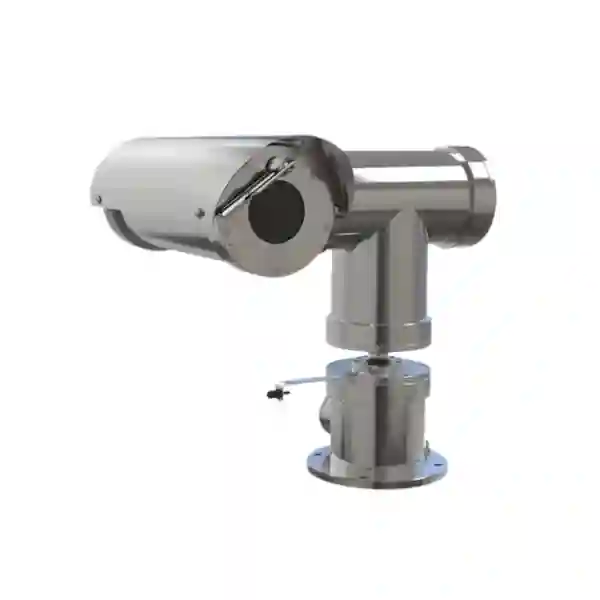
Hanwha TNU-X6320E1F2WT2-C Explosion-Proof PTZ Camera
Full HD industrial positioning camera with 32x optical zoom, integrated wiper, single-mode fibre configuration and 24VAC power for carefully engineered hazardous-area surveillance. Review certification and site suitability before choosing equipment for a Tanzania project.
Verified product snapshot
| Model | TNU-X6320E1F2WT2-C (discontinued E-series) |
| Product category | Explosion-proof PTZ / positioning IP camera |
| Imaging | 1080p Full HD, up to 60fps |
| Optics | 32x optical zoom with autofocus |
| Wide dynamic range | 150dB (original E-series specification) |
| Visibility aids | Integrated wiper and intelligent video analytics |
| Network variant | Single-mode fibre (confirm exact optical interface) |
| Power requirement | 24VAC |
| Ingress protection | IP66 / IP67 in historical model documentation |
| Lifecycle | Discontinued; Hanwha-named successor TNU-X6320A1F2WT2-C |
This is a legacy product information summary, not a quotation or hazardous-area approval certificate. Verify the exact serial/configuration and relevant documentation before purchase or installation.
What this camera is—and the availability point buyers must know
The Hanwha TNU-X6320E1F2WT2-C is an explosion-proof positioning PTZ network camera developed for surveillance in demanding industrial locations where a conventional outdoor camera may be unsuitable. It combines Full HD video, a 32x optical zoom lens, remote pan-and-tilt positioning, an integrated window wiper, a single-mode fibre communications variant and a 24VAC power requirement. These attributes make the model relevant when a control room must watch machinery, routes, perimeter approaches or operational processes without sending a person into every area to inspect a scene.
The most important purchasing detail is its lifecycle. Hanwha Vision currently labels this exact E-series model discontinued and names TNU-X6320A1F2WT2-C as the replacement. Therefore this listing is best approached as a reference for an existing installation, a model-specific inquiry, or a specification comparison before ordering a modern equivalent. It is not a promise that unused E-series equipment remains available in Tanzania. An enquiry should identify whether the buyer wants an identical spare, a compatible replacement, or a new surveillance system designed around current equipment.
An explosion-proof label is not permission to install the product in every hazardous area. The site owner and qualified engineer must compare the full certified marking, temperature class, gas or dust environment, cable-entry arrangement, ambient conditions and applicable requirements with the project’s classification. Hanwha’s historic model references describe this C variant in relation to cLC CSA and Class I Division 1 certification; the specific project approval package needs verification. Ask for the actual certificate and manufacturer documentation before procurement.
Who should evaluate this model and when it may be unsuitable
This camera suits technical procurement teams, industrial security consultants, facility engineers and systems integrators assessing surveillance around potentially hazardous processes. Typical design questions arise in oil and gas operations, chemical processing, heavy industry, storage and other environments where gas or vapour risks may affect equipment choice. These are examples of possible application environments, not an assertion that the camera has approval for any particular Tanzanian site, zone or process. Every site still requires its own risk assessment and product-certification review.
An operator may need to observe a distant valve bank, follow vehicle movement inside a controlled plant, or inspect activity near critical equipment from a safer location. Optical zoom and controllable positioning can help with these tasks when correct camera placement and network infrastructure are provided. The useful benefit is not simply an impressive zoom number: it is the ability to collect relevant visual evidence with a field of view that operators can deliberately change. A wider fixed camera may still be better for continuous all-area awareness.
The model is a poor default choice for an ordinary office doorway, a small indoor corridor or a general retail site where an appropriately rated standard camera is sufficient. It may also be unsuitable when the power design provides only PoE, when there is no practical fibre route, when a site requires a different hazardous-area approval, or when an unsupported legacy camera would create unacceptable maintenance exposure. Procurement should prioritise current certified alternatives when long service life, software support and spare-parts continuity matter.
Full HD images, 32x optical zoom and realistic identification goals
The manufacturer lists 1080p video at up to 60 frames per second and 32x optical zoom with autofocus for this model. Full HD resolution can support useful observation of equipment activity and people moving within an industrial scene, while the optical zoom allows an operator to narrow the view to a selected point. The final image quality still depends on actual distance, lighting, atmospheric conditions, camera movement, compression, recording settings and the size of the detail being inspected. A numeric zoom ratio cannot by itself establish an identification distance.
A practical design begins with the question the recording must answer. Is the goal to confirm that a gate is open, see whether a vehicle has entered a route, distinguish an object near machinery, or identify a person at a defined location? Each goal implies different pixels on target and often a different field of view. Draw the relevant areas on a site plan, identify expected viewing distances, test both wide and telephoto compositions, and document what is visible in day and night conditions. Confirm performance with sample footage whenever the installation is safety-critical.
At a tight zoom setting the camera sees less of the total scene. This creates an important trade-off: detail at one location versus awareness elsewhere. Where two incidents may occur simultaneously, a separate fixed overview camera may be necessary. The PTZ should be treated as a tool for selective observation, not as an automatic substitute for dedicated coverage of every process point. Plan presets around operational priorities and verify whether the monitoring team has time to move between them.
Pan-tilt positioning as part of an operational workflow
A positioning camera becomes genuinely valuable when its movement is linked to an observation procedure. Instead of allowing random patrols alone, define a set of views: an entry approach, a loading point, a section of process equipment, a vehicle intersection and the access path leading back toward the control room. Each view should have a clear purpose and a responsible operator. The installation team can then test repeatability, clearance, obstruction and the degree of detail that remains useful at normal operating distances.
During commissioning, confirm whether the selected recorder or video management platform can operate the camera’s PTZ controls, call presets, display events and retain operator audit records as required. Manufacturer support for multiple streaming and intelligent video analytics is useful, but it does not guarantee that every third-party VMS implements each function. Integrations may differ by firmware, drivers, profiles and licensed features. Obtain compatibility confirmation for the chosen equipment and do not rely on a generic statement that both devices are network cameras.
PTZ surveillance has human-factor limits. A camera may be pointing elsewhere during an incident, an automated tour may miss a fast event, and an operator may zoom too far to understand surrounding context. Agree on default home positions, manual control rights, preset names and event response rules. Add fixed views where uninterrupted evidence is essential. These steps help the network camera support real decisions rather than becoming a moving image source with no defined response procedure.
Explosion-protected construction and certification review
The defining feature is the industrial explosion-protected assembly, not just the imaging sensor inside it. Hanwha describes this range as explosion-proof positioning equipment and historical materials associate the specified C suffix with a cLC CSA variant. The historical model description also identifies IP66 and IP67 ingress-protection ratings. Those references help a buyer start the evaluation, but they are not a site-specific declaration of conformity or acceptance by Tanzanian authorities. The original certification documents and exact marking on the proposed unit must govern selection.
Before accepting a quotation, request the model-specific certificate, enclosure drawings, installation instructions and a complete statement of allowable environmental and electrical conditions. Check the project’s hazardous-area classification, gas or dust group where relevant, temperature class, required protection concept, cable-entry certification, glands, conduit seals and any restrictions on repair. Approval for a particular North American classification should not be presented as automatic approval under a different national or international scheme. The responsible site engineer must assess what is applicable.
Small installation changes can undermine a carefully selected hazardous-area product. An unapproved gland, altered enclosure, wrong thread adaptor, damaged seal, incorrect bonding or unauthorized opening procedure can matter more than a marketing feature. Use qualified personnel and the current manufacturer instructions for all installation, commissioning and maintenance work. If the equipment is already installed, keep records of enclosure inspection, modifications and certificates; replacing a camera may require a fresh review of the entire mounting and cabling arrangement.
Ingress protection, window wiper and environmental exposure
IP66 and IP67 are relevant because many industrial locations are exposed to rain, airborne dust and cleaning-related moisture. The model’s integrated wiper is intended to assist visibility when water or contamination affects the viewing window. Neither capability means the camera is self-cleaning, immune to corrosive chemicals, suitable for every washdown procedure or able to maintain perfect clarity during heavy contamination. The nature of deposited material and the service environment must guide inspection intervals and cleaning methods.
Historical manufacturer model listings describe the WT2 C fibre variant with an environmental range of approximately minus 60 degrees Celsius to plus 40 degrees Celsius. Because published specifications can differ across product generations and documents, the exact model datasheet and certification marking should be checked before relying on a temperature limit. In a Tanzanian project the upper ambient rating, direct solar exposure and any nearby process heat may be more relevant than the very low minimum temperature. Avoid assuming that another member of the range has the same limits.
Survey the mounting location for sun, rain direction, vibration, wind-driven particles, salt exposure where applicable and obstacles that may interfere with movement. If the location faces spray or contamination, document the cleaning regime and permitted access arrangements before mounting. Confirm whether any washer-tank or cleaning accessory is included; an integrated wiper is not proof that an external wash system is part of the supplied package. Maintenance access should be feasible without compromising plant operations.
Single-mode fibre network planning
The F2 part of this configuration is associated with single-mode fibre, an important distinction from camera models designed only around direct copper Ethernet. Fibre can support an industrial network architecture that separates a field location from upstream communications equipment. However, the precise interface, termination style, optical budget, module details and compatible networking hardware must be verified using the full installation documentation for the actual unit. Do not infer fibre connector type or maximum distance from the model code alone.
Start with a network drawing. Show the camera location, cable route, patch points, industrial switch or media conversion equipment if required, power location, recorder, security boundary and management system. Assess cable protection, bend radius, termination methods, access to service points and the possibility of damage along the route. A successful connection test should include more than a link light: confirm video stability, control responsiveness, packet loss and recovery after a planned interruption.
Fibre provides a transport path, not an end-to-end security policy. Separate management access from routine viewing users, limit unnecessary inbound access, configure time synchronisation and ensure the network can carry both live viewing and recording traffic. Consider which functions must continue if an upstream link or control-room switch fails. When a camera is connected to an existing industrial network, the IT and operational-technology teams should agree on isolation, access permissions and maintenance procedures before the device is commissioned.
24VAC power and electrical design
Hanwha lists a 24VAC power requirement for the exact TNU-X6320E1F2WT2-C model. This is a critical purchasing check because a network connection does not mean the unit can be powered using ordinary Power over Ethernet. Supply design needs to account for the correct voltage, cable size, run length, protective devices, isolation, grounding and the equipment’s complete electrical load. Use the exact model installation manual to confirm current requirements and acceptable tolerances rather than copying a power figure from a related product.
Where the camera is positioned near hazardous process equipment, electrical installation practice is as important as the enclosure itself. The site’s authorised electrical designer should determine circuit protection, approved wiring methods, disconnection arrangements, glands and bonding. Any power conversion or auxiliary cabinet must be located and specified appropriately for its own installation zone. Make sure the documented design distinguishes the 24VAC supply for this legacy model from other Hanwha variants that may use different input voltages.
Plan how the surveillance function behaves during a power disturbance. A UPS may be appropriate for the upstream recorder, switches and correctly designed field power system, but backup needs must be calculated rather than promised. Test controlled shutdown, restoration and the camera’s return to a useful monitoring view. During handover give maintenance staff a circuit identifier, isolation procedure and contact point for troubleshooting so nobody improvises repairs at a live hazardous-area installation.
Mounting design, structural loading and service access
An explosion-proof positioning assembly requires more careful mounting consideration than a compact wall camera. Before selecting a bracket, inspect the supporting structure, mounting elevation, line of sight, movement clearance, exposure to impact and the possibility of vibration from nearby equipment. Obtain manufacturer dimensions, weight and approved accessory information for the exact configuration. Do not reuse the bracket specification of a fixed camera or assume a newer model has an identical mounting interface without documented confirmation.
Prepare a drawing that includes mounting height, orientation, fastener specifications, cable entry, maintenance clearance and a safe access method. The mounting location should permit useful views without placing the housing directly into a process obstruction or predictable collision path. Consider whether the operator needs to see the underside or rear of equipment and whether another fixed camera would provide better visibility. A mock-up or photographic survey can expose these issues before costly support steel or conduit is installed.
During installation verify anchor suitability, torque requirements and any secondary retention measures required by the approved design. Keep certified enclosure parts intact and follow the manufacturer’s permitted service process. Maintenance access must not rely on unsafe improvisation: document how the wiper, window and cable termination points can be inspected. If replacing a discontinued E-series device, confirm the new assembly’s loads and cable entry arrangement before treating a bracket or support as reusable.
Recording, streaming and video-management integration
The manufacturer identifies multiple streaming and two microSD-family card slots among this model’s features. These can be useful in a design where operators need a live view while a recorder retains evidence, but slot presence is not proof that cards are supplied, configured or supported at every capacity. Verify supported media, firmware and retention behaviour before making local storage a critical part of the operating procedure. Local recording also does not eliminate the need to plan secure retrieval and preservation of incident footage.
Recording requirements should be driven by the risks being monitored. Define retention in days, frame rate, compression, viewing resolution, event recording and who may export evidence. A 1080p stream set for high frame rate and frequent movement may require materially different bandwidth and storage from a lower-rate overview stream. Estimate traffic from the actual encoding configuration and representative scenes; do not rely on a generic storage figure from an unrelated installation. Test simultaneous live viewing, PTZ operation and recording under realistic conditions.
The integration checklist should name the actual NVR or VMS product, its firmware or software version and any relevant device licence. Confirm discovery, live view, PTZ control, presets, event receipt, timestamps, user rights and playback. Check how the system reacts if the camera or recorder restarts. If replacement with the A-series camera is being considered, repeat this compatibility review instead of assuming a model-number successor behaves identically in every existing system.
Network security and control-room permissions
A network camera is part of the site’s connected infrastructure and should be managed with the same discipline as other operational equipment. Before connecting it, record the required addresses, ports, time service, authorised client devices and support contacts. Restrict remote access, use strong unique credentials, provide separate accounts where needed and avoid sharing administrative access with routine monitoring operators. Changes should follow the site’s approved management process so that later troubleshooting has an audit trail.
Evaluate supported secure-management features using Hanwha’s documentation for the installed firmware. Where HTTPS, network authentication, event logs or other safeguards are available, configure them according to the organisation’s security standard and verify that the surrounding switches and applications are compatible. Do not assume that an old model has every security feature of a newly released series. Because Hanwha lists this camera as discontinued, availability of future firmware fixes and long-term support deserves particular scrutiny.
Treat video access as a privacy and operational governance issue. Define which staff may watch live scenes, move the PTZ, export footage or change schedules. Ensure retention policies align with applicable organisational rules and legal advice. Keep camera clocks synchronised and periodically test whether exported footage contains usable time information. A secure, maintainable recording workflow provides more value after an event than raw image quality alone.
Intelligent analytics without exaggerated promises
Hanwha lists intelligent video analytics among the camera’s features. Analytics can assist an operator with identifying activity worthy of a closer look, but the available event types, setup methods and third-party reporting behaviour must be checked against the exact device firmware. Do not infer AI object classification, recognition accuracy or new-generation analytics simply because a modern Hanwha product offers them. A legacy analytics feature can be useful without replacing a competent monitoring process.
Begin with one clearly defined event, such as an unexpected movement within a controlled observation zone or an intrusion into a designated boundary. Set the camera position, recording schedule, sensitivity and any exclusion areas under supervision. Test with representative activity and lighting, including harmless movement that could cause alerts. Document false alerts and missed events before enabling a security response. The operator should know what an alert does and does not prove.
PTZ motion creates a special design challenge for event rules. If a zone is meaningful only when the camera is at a particular preset, it may not behave as expected while the camera is moving or looking elsewhere. Some project requirements are better handled by a fixed detector or overview camera that watches continuously. Confirm the supported behaviour in the selected platform, and present analytics as an aid to human assessment rather than a guaranteed incident-detection system.
Designing coverage for industrial operations in Tanzania
For a Tanzania-based project, the useful starting point is the industrial activity and the location’s technical constraints, not a generic claim that any explosion-proof camera will be suitable. Identify the site’s hazardous-area drawings, working temperatures, local maintenance arrangements, power quality, cable routes and communications resilience. Ask whether the project is a retrofit, a planned expansion or the replacement of a failed legacy unit. These answers influence whether this particular discontinued model is relevant.
In process areas, a camera can support remote observation, security investigations and coordinated response to unusual activity. It should not be described as a certified process-safety sensor, a substitute for required inspection or a replacement for plant alarms. The surveillance objective may be to see the condition of an access route, understand vehicle movements or review a visible change after an alarm from another system. Document those objectives separately from any safety instrumented functions.
Consider maintainability over the planned life of the project. Who can access the mounting point? What happens when a wiper needs attention? Are trained personnel available for the approved enclosure procedures? Can footage be reviewed during network interruptions? How will spare parts be managed if the old model cannot be ordered? A project that answers these operational questions is usually better specified than one selected by camera resolution alone. Local stock, delivery, installation and warranty terms must be confirmed in an actual quotation rather than assumed.
Daytime, nighttime and adverse-scene testing
A specification sheet is a starting point for image performance, not a substitute for viewing representative scenes. Industrial sites can contain strong backlighting, reflective metalwork, moving vehicles, shadows and artificial lights that influence what is visible. Hanwha lists wide dynamic range of 150dB for the original model, which is relevant when bright and dark portions of a scene occur together. The actual result still depends on configuration, exposure choices and the particular composition.
Survey each priority view in the lighting conditions that matter. If the operator needs to recognise a vehicle manoeuvre at night, test under the site’s installed lighting rather than assuming daytime imagery predicts night performance. Account for weather, spray, dust and atmospheric haze. Confirm whether the project needs dedicated illumination and whether any light source is permitted in the classified area. A camera’s automatic exposure or noise processing may improve an image while also changing motion clarity.
Capture test footage at both wide and zoomed positions. Check motion blur, focusing behaviour, colour consistency, readability of relevant details and how quickly the image settles after movement. Define what an acceptable result looks like for each observation task. If identifying a person or reading a marking is essential, arrange an appropriate controlled test at the specified distance. Avoid promising forensic performance merely from a 2MP figure or a 32x optical zoom specification.
Comparing the discontinued E model with the A-series successor
Hanwha Vision names TNU-X6320A1F2WT2-C as the replacement for TNU-X6320E1F2WT2-C. That is a useful manufacturer-directed starting point, not evidence that every feature, certificate, mechanical detail and interface is identical. Buyers should request the current A-series datasheet and make a line-by-line comparison with the installed or originally specified E-series documentation. The new model may be preferable for a fresh installation, but the replacement decision has to match the site design.
Start the comparison with certified markings and environmental limits, followed by voltage, network and fibre interface, lens range, field of view, PTZ operating behaviour, mounting arrangement and enclosure dimensions. Then examine integration with the existing recorder, security configuration, analytics and required accessories. Even when two product names look similar, a change in wide dynamic range specification or firmware behaviour may affect a carefully validated operating procedure. The original E-series model lists 150dB WDR, whereas Hanwha’s current A-series information lists 120dB; do not merge those numbers.
Where the old camera is part of an existing certified hazardous-area installation, treat the replacement as an engineering change. Record existing cable entries, mounting constraints and documents before removing anything. Confirm the proposed unit’s approved accessories and the responsible authority’s requirements. An upgrade should preserve the actual observation objective while addressing lifecycle support, rather than making an unverified promise of drop-in interchangeability.
A practical specification review before requesting a quote
Prepare an enquiry using the exact model number, required quantity and purpose. State whether the request concerns an existing camera, a spare or a new project; include the site’s hazardous-area classification and drawings through an appropriate private channel. Ask the supplier to identify whether an E-series unit can legitimately be sourced and supported, or whether the current A-series model should be proposed. Availability, delivery and support must be confirmed explicitly for Tanzania.
Attach the essential design constraints: available 24VAC power, fibre architecture, cable-entry requirements, environmental exposure, mounting location, recording platform, desired observation distances and operational use cases. Clarify whether brackets, accessories, media, networking equipment, installation and commissioning services are part of the requested scope. Make any acceptance criteria measurable—for example, stable video under test conditions, functioning presets and documented event playback—instead of asking for a camera that merely looks comparable.
Ask for manufacturer documentation and project-specific evidence, not unsupported broad assurances. A useful quotation can separate camera hardware, certified installation components, integration work, commissioning tests, training and ongoing support. This also makes it easier to compare different options fairly. Where price or lead time is not yet confirmed, leave it open for the formal proposal. Do not infer a Tanzanian shilling price from another region’s historic distributor listings.
Commissioning and handover checklist
A complete commissioning plan should start before the camera reaches the installation site. Review the approved construction documents, hazardous-area requirements, electrical drawings, certified cable entries and supported mounting accessories. Confirm that the chosen device and its serial-specific documentation match the order. The installing contractor should inspect the assembly according to the manufacturer’s instructions and the site’s safe-work procedures before energising or opening any relevant enclosure.
Once mechanically and electrically ready, verify correct supply, network connectivity, fibre path quality, management access and stream stability. Test all agreed camera views and preset positions. Review footage on the actual control-room display, not just on a laptop beside the installation. Confirm the wiper’s behaviour using the documented procedure without introducing unsafe test conditions. Trigger the configured events and demonstrate that authorised operators can find, play back and export the footage they need.
Handover should include an as-built drawing, camera identification, software and firmware versions, account ownership, storage configuration, recording policy, certificates, manufacturer manuals, acceptance-test evidence and a maintenance schedule. Also record any compromises and remaining actions openly. If the installed product is an E-series legacy unit, document support and replacement plans as part of handover. The purpose is to leave a system the operator can use and maintain, not only one that powers on during a demonstration.
Maintenance, troubleshooting and eventual replacement
Industrial cameras benefit from planned checks instead of waiting for an unusable image or failed PTZ movement. Review the viewing window, wiper condition, exterior damage, mount integrity, cable protection and accessible network indicators in accordance with approved procedures. Check that operators can still reach priority views and that recorded clips are retrievable. If the system relies on alerts, test those behaviours at agreed intervals and investigate recurring false triggers rather than disabling them without review.
Because the E-series model is discontinued, troubleshooting should also consider the age of software, existing spare parts and the feasibility of repair. Record symptoms and logs before making changes, and use authorised service methods for explosion-protected equipment. Do not modify an enclosure, substitute seals or bypass protective installation requirements to accelerate a repair. If parts are no longer available, document whether the manufacturer-named A-series successor meets the site’s engineering and certification criteria.
A good lifecycle plan identifies what failure would mean for site monitoring. If loss of the PTZ leaves an important area unobserved, consider a fixed backup view or a phased replacement strategy. Keep a record of operating constraints so a future procurement team does not have to reconstruct why the old model was chosen. The end goal is reliable observation and safe maintenance, not indefinite attachment to a discontinued part number.
What to include in a Tanzania project enquiry
Send the exact required camera designation and explain the intended use in ordinary language. For example, note whether the priority is monitoring a hazardous-area access approach, inspecting a distant production feature, or replacing a documented installed unit. Include the required viewing points, approximate distances, day-and-night conditions, mounting height and any environmental stresses. Provide site classification details only through the project team’s approved secure communications process.
Tell the supplier about the existing communications and power system. Is there a single-mode fibre route? Which network and video-management systems are installed? Can the site provide the specified AC supply under the required conditions? Are there approved conduit routes, glands and maintenance access? Do not assume that a camera sale includes every accessory or that compatibility can be guaranteed before the detailed review.
Ask for a response that distinguishes verified model facts, project assumptions, separately priced components and outstanding approvals. Request confirmation of lifecycle status, stock or procurement route, proposed successor, manufacturer documents, applicable certifications and commercial terms. If the site is selecting equipment for a new project, it may be more sensible to evaluate the current replacement first. FourTeck can use the supplied requirements to assess the enquiry without a public claim that the discontinued E-series model is stocked or immediately deliverable.
Decision summary: the right question is fit, not only a model number
The model provides a combination of legacy Hanwha explosion-proof positioning hardware, Full HD network video, 32x optical zoom, wiper-assisted visibility, fibre-oriented communications and 24VAC input. Those are meaningful attributes for a technical specification review. They are not enough by themselves to approve the equipment for a hazardous location, guarantee a recording-platform integration, or establish a current supply offer in Tanzania.
If you are maintaining a site that already uses this model, start with the unit’s identification label, drawings and certification package. If you are designing a new site, focus first on the observation objectives, zone classification, environment, infrastructure, lifecycle needs and current certified replacement options. In either case, a structured review reduces the chance of buying the right-looking camera for the wrong installation conditions.
Request a model-specific technical and procurement assessment with the relevant site requirements. The next step is to confirm suitability and availability, compare the manufacturer-designated successor where appropriate, and obtain a formal quotation for the complete installation scope. No local price, delivery commitment or site approval is implied by this product information.
Frequently asked questions
Is the Hanwha TNU-X6320E1F2WT2-C still current?
No. Hanwha Vision marks the E-series model discontinued and lists TNU-X6320A1F2WT2-C as its replacement. A discontinued model may still appear in legacy equipment records, but that does not prove new stock or manufacturer support. Ask for current availability and an engineering review of the suggested successor before ordering.
What resolution and zoom does the original camera provide?
Hanwha specifies Full HD 1080p video at up to 60 frames per second with 32x optical zoom and autofocus. Whether a particular target can be recognised at a given distance must be tested with the proposed mounting position, lighting, viewing angle and recording settings. Optical zoom does not guarantee identification quality.
Can it be powered by PoE?
The exact model is identified as requiring 24VAC power. Do not design the supply around PoE merely because this is an IP network camera. The electrical designer should verify voltage, current, circuit protection, approved field wiring and any required backup arrangement against the specific manufacturer instructions.
Why does the model include fibre?
This F2 variant is associated with single-mode fibre communications. The network design still needs confirmation of termination, interface details, optical requirements, upstream equipment and an appropriate secure network architecture. The presence of fibre support does not remove the need for a separate power circuit or guarantee compatibility with every existing switch.
Does explosion-proof mean it is approved for any hazardous area?
No. The certificate, marking, temperature class, area classification, installation method and applicable acceptance requirements must all match the proposed site. Historical documentation describes a cLC CSA variant, but this should not be treated as automatic Tanzanian regulatory acceptance. Obtain model-specific certificates and qualified engineering sign-off.
Does the wiper make the camera maintenance-free?
No. The integrated wiper is a visibility aid for the window, not an assurance that all dust, deposits, spray or corrosion will be removed. Maintenance access, permitted cleaning methods, inspections and any separate washer accessories should be addressed in the project plan and approved service instructions.
What should I check before replacing it with the A-series camera?
Check certification, environmental ratings, power, fibre interface, mechanical dimensions, bracket compatibility, camera views, PTZ controls, recording-system integration and approved accessories. Hanwha names the A-series successor, but the designation alone does not prove drop-in interchangeability. Treat a hazardous-area replacement as a documented engineering change.
Can the camera provide continuous coverage of an entire area?
A PTZ camera can move between useful viewpoints, but while it is zoomed into one point it is not simultaneously capturing every other direction. If uninterrupted evidence is required, design in additional fixed cameras or a suitable overview view. Establish operator priorities and preset positions before commissioning.
Are recordings stored inside the camera?
Hanwha lists dual microSD-family card slots. Actual cards, capacities, recording rules and supported firmware features must be checked for the device being supplied. Projects often also need an NVR or VMS with defined retention, access control, time synchronisation and evidence-export procedures.
Is a Tanzania price or delivery time available?
No verified local price, stock position or lead time is established by this product description. Commercial terms should be confirmed by a written quote for the requested equipment and location. Because the original model is discontinued, an equivalent or manufacturer-designated successor may require a separate proposal.
What should be sent with a request for quotation?
Provide the exact model number, quantity, whether the project is replacement or new installation, site hazardous-area requirements, 24VAC power plan, fibre and network details, recorder platform, mounting conditions and required observation points. Ask for certificates, accessories, commissioning scope, support terms and a comparison with the replacement model.
Can this network camera replace a safety system?
No. Video can help authorised staff observe a process and review visible events, but this camera should not be represented as a certified safety sensor or substitute for required plant protection, alarms, inspections or safety instrumented systems. The responsible engineers must keep those functions distinct from the surveillance design.
Request a model-specific technical and procurement review
Share your industrial surveillance requirements and clarify whether you need the original legacy model or the manufacturer-named successor. Include project classification, viewing objectives, power, fibre, mounting and recording information through an appropriate private enquiry channel. Ask for an itemised proposal with verified documentation, current availability, installation scope and commercial terms.
Availability, price, delivery, certification acceptance, integration and warranty are subject to verification. No external page or unverified checkout link is implied.




Reviews
There are no reviews yet.