
HANWHA VISION · INDUSTRIAL PTZ SURVEILLANCE · TANZANIA
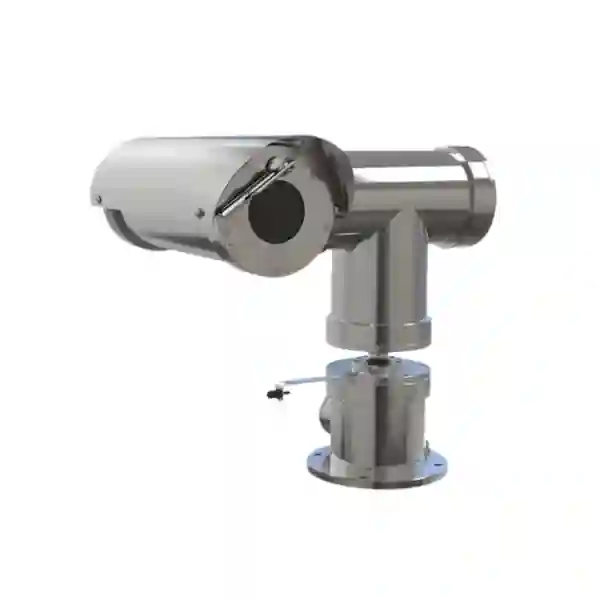
Hanwha TNU-X6320E2F2WT1-C Explosion-Proof PTZ Camera
A 2MP Full HD, 32x optical zoom positioning camera with single-mode fiber, a wiper, and stainless-steel construction. Evaluate its hazardous-area fit, 110V AC power requirement, and discontinued lifecycle before specifying it for an industrial site in Tanzania.
Check model status and electrical supply first
Hanwha lists this exact model as discontinued and identifies TNU-X6320A2F2WT2-C as its replacement. The older camera is rated for 110V AC, while Tanzania commonly uses 230V low-voltage distribution. A qualified engineer must confirm an appropriate supply arrangement and compare the replacement’s different environmental and imaging specifications before an order or installation is approved.
Verified technical specifications
| Manufacturer / model | Hanwha Vision / TNU-X6320E2F2WT1-C |
|---|---|
| Product type | Explosion-proof IP PTZ positioning camera |
| Lifecycle | Discontinued; manufacturer names TNU-X6320A2F2WT2-C as replacement |
| Video | 2MP, 1920 × 1080; H.265/H.264 up to 60 fps under specified system setting |
| Lens and zoom | 4.44–142.6 mm; 32× optical and 16× digital |
| Pan / tilt | 360° pan; -90° to +90° tilt |
| Wide dynamic range | 150 dB (legacy model) |
| Network | RJ-45 and duplex single-mode 9/125 μm fiber option for F2 models |
| Interoperability | ONVIF Profiles S and G; SUNAPI |
| Recording options | Dual microSD/SDHC/SDXC slots, up to 256 GB each |
| Housing and environment | STS316L; IP66/IP67; -40°C to +60°C |
| Electrical | 110V AC input; maximum 80 W |
| Size and mass | 480 × 512 × 475 mm; 53 kg |
| Certification listing | Manufacturer lists cLCus C1/D1 and cLC CSA; verify site-specific suitability |
Specifications reflect Hanwha Vision’s published information for the legacy model. They are not a confirmation of local stock, a complete hazardous-area certificate, or acceptance for a particular project. Always review the exact revision and installation documentation before procurement.
Industrial surveillance with a clear buying decision
The Hanwha TNU-X6320E2F2WT1-C is a specialist explosion-proof positioning camera for projects where surveillance equipment must be assessed against hazardous-area requirements, environmental exposure, and a demanding installation plan. It brings together a moving pan-and-tilt platform, a 32x optical zoom lens, Full HD network video, an integrated window wiper, and a stainless-steel assembly. This is not simply a conventional security camera inside a weatherproof enclosure. Its value depends on selecting the correct hazardous-area variant and arranging the associated electrical, mechanical, networking, and maintenance work correctly. For a Tanzanian project, the first discussion should focus on the classified location, the camera’s 110V AC supply, and the manufacturer’s current product lifecycle.
Hanwha Vision identifies this exact model as discontinued and names TNU-X6320A2F2WT2-C as its replacement. That status changes the buying conversation. A site maintaining an existing installation may need matching specifications, documentation, repair planning, or a carefully evaluated replacement. A site planning a new deployment should ask whether the successor meets the project’s actual temperature, electrical, certification, and integration requirements. FourTeck Tanzania can be approached for a specification review or quotation enquiry; however, stock, lead times, warranty, availability, and installation service must be confirmed rather than assumed. The practical objective is to avoid choosing a model solely from its headline zoom specification.
What the exact model provides
This camera uses a 1/2.8-inch CMOS imaging device with a maximum listed resolution of 1920 x 1080 pixels. Hanwha lists H.265 and H.264 operation at up to 60 frames per second under the relevant system frequency, alongside MJPEG at up to 30 frames per second. The integrated optical system ranges from 4.44 mm at the wide end to 142.6 mm at the telephoto end. Its 32x optical zoom lets an operator move between broad contextual views and narrower details, while a separate 16x digital zoom function enlarges existing pixels rather than adding optical detail. These specifications should be read together with the proposed viewing distance and incident-identification objectives.
The PTZ mechanism supports a 360-degree pan range and a tilt range from -90 to +90 degrees. Its published maximum preset movement speeds are 45 degrees per second for pan and 24 degrees per second for tilt. The listed camera functions also include day/night switching, digital image stabilization using an integrated gyro sensor, defog processing, intelligent video event functions, multiple streams, dual memory-card slots, and network security controls. Each feature addresses a different operating need. None substitutes for determining actual field of view, scene lighting, target size, or the amount of attention an operator can devote to a single movable camera.
Product lifecycle: discontinued does not mean interchangeable
The manufacturer’s current product record labels TNU-X6320E2F2WT1-C discontinued. This is a material decision point for procurement, spares management, maintenance planning, and long-term system support. It does not independently establish that every distributor has no remaining stock, and it should not be used to claim that compatible spares or repair services are obtainable. The most reliable next step is to request the exact revision and service information for the equipment already installed, or obtain a current proposal for an approved successor. Ask the supplier to identify the actual model offered rather than accepting a generic description of an explosion-proof camera.
Hanwha names TNU-X6320A2F2WT2-C as the replacement. Its published operating temperature range of -60°C to +40°C differs from the earlier camera’s -40°C to +60°C. The newer model’s listed WDR is 120 dB, while the discontinued unit lists 150 dB. Those differences are significant in applications where a camera faces high ambient temperatures or scenes with strong light contrast. The replacement also needs its own drawing and approval review. An equivalent camera is not proven to be a direct physical, electrical, optical, regulatory, or software drop-in until those parameters have been checked.
Explosion-proof construction and hazardous locations
Explosion-proof equipment is selected for a defined hazardous environment, not merely because a site is industrial. The Hanwha listing identifies the TNU-X6320E2F2WT1-C as an explosion-proof PTZ camera and lists certifications including cLCus Class I Division 1 and cLC CSA, together with environmental IP66 and IP67 ratings. These markings are important inputs to an engineering review, but they are not a blanket claim that the model is authorized for every hazardous area, gas group, temperature class, regulatory regime, or Tanzanian installation. Certification details and any conditions of use must be checked against the exact nameplate and current certification documents.
The site’s hazardous-area classification should be established by a suitably qualified professional before hardware selection. That professional should review the zone or division, atmosphere, ambient temperature, cable-entry method, isolation arrangements, grounding, mounting position, and any local authority requirements. Environmental ingress protection and explosion-protection approvals answer different questions: IP66/IP67 concerns dust and water ingress under defined tests, whereas hazardous-location approval concerns ignition risks under specified conditions. A camera with a stainless housing and water-resistance label is not automatically an acceptable substitute for a correctly certified explosion-proof assembly.
A critical Tanzania electrical check: 110V AC
Hanwha specifies a 110V AC input for this exact camera and a maximum power consumption of 80 W. Tanzania’s commonly distributed low-voltage electrical supply is 230V phase to neutral, as described by TANESCO. The difference must be dealt with in the electrical design before energizing the device. Do not connect a 110V-rated camera directly to a nominal 230V feed. The installation may require a properly engineered, rated, protected, and approved conversion or distribution arrangement suitable for the installation environment. Compatibility should be determined from the manufacturer’s electrical documentation and the actual delivered unit.
The site electrician or design engineer should confirm input frequency, voltage tolerances, starting behavior, protective devices, earthing and bonding, cable sizing, distribution-board allocation, and surge conditions. Where the site has generator transfer, uninterruptible power, or unstable supply conditions, consider those interfaces as part of the complete power system. An enclosure located outside the classified area may be preferable for certain power components, subject to the project design. It is not enough to select a transformer by matching the nominal wattage; continuous capacity, installation temperature, fault conditions, earthing strategy, and approved protection measures all need verification.
Full HD imaging: what 2MP means in practice
The 1920 x 1080 resolution supports a Full HD monitoring workflow and can be useful when the objective is observing movements, inspecting equipment, or tracking activity at a selected point. Pixel count alone does not confirm that a distant object can be identified. The distance to the subject, optical zoom setting, video compression, light level, motion, vibration, haze, and camera angle all affect the evidence available to an operator. For any critical scene, define the required task—general observation, recognition, or detailed inspection—and then evaluate a realistic sample image at the intended position and target distance.
At wider lens settings, the camera sees more of the installation but spreads its pixels across a larger scene. At the telephoto end, the field of view narrows dramatically and operator pointing accuracy becomes more important. The manufacturer lists a horizontal field-of-view range of approximately 61.8 to 2.19 degrees. Such a wide-to-narrow transition is useful around large process structures, but it is not the same as simultaneously recording every point at maximum detail. If continuous visual proof is required at several locations, plan fixed overview cameras or additional positions alongside the PTZ unit.
The 32x optical lens and target selection
The lens focal length range of 4.44–142.6 mm is one of the main reasons to consider this model for industrial monitoring. A camera operator can examine a gate, a processing station, or a piece of equipment from a broader vantage point without immediately relocating a camera. Optical magnification increases the size of the subject on the sensor within the limits of focus, atmospheric conditions, and lighting. Hanwha specifies autofocus, manual focus, and a one-shot focus option, allowing the operating mode to be matched to the behavior of the scene.
Zoom can also make small camera movements more visible. At long focal lengths, vibration, wind loading, heat shimmer, and motion of the mounting structure may reduce usable detail. Digital image stabilization can help address certain movements, but should never be treated as a substitute for a properly engineered support. A meaningful acceptance test should compare sample frames at the intended wide, middle, and high zoom positions during representative operating conditions. It should also record whether the planned inspection points can be reached by the PTZ without obstruction from pipework, handrails, cable trays, or other structures.
Pan, tilt, presets, and operator expectations
The positioning platform supports a full 360-degree pan travel and a tilt range spanning -90 to +90 degrees. Presets can be useful when a security team repeatedly checks defined points such as an access gate, an elevated vessel, or a transfer point. The published maximum preset movement figures describe device capability, not the actual time that a complete operational inspection will take. Time is also spent focusing, settling, streaming, and interpreting the image. The monitoring plan should therefore decide whether the site needs continuous manual control, periodic preset tours, alert-led pointing, or a mixture of these workflows.
An important limitation is that one PTZ camera looks primarily where it is pointing. A distant activity may occur outside its current view. For sites with multiple simultaneous risks, a PTZ should usually be considered part of a wider camera architecture rather than the sole source of visual coverage. Specify how many presets are operationally meaningful, what event should redirect the camera, whether security operators can override automation, and how the image is restored after a handover. The desired result is a predictable surveillance routine, not an impressive movement specification that leaves blind spots during real incidents.
Day and night operation in changing light
The published minimum illumination figures are 0.05 lux in color and 0.005 lux in black-and-white under stated exposure and image criteria. The camera also includes automatic day/night switching with a removable infrared-cut filter. These specifications indicate sensitivity under controlled conditions, but they do not guarantee that an outdoor industrial scene will be clearly identifiable at those light levels. Movement, rain, dirt on the window, reflected glare, and available exposure time still matter. The manufacturer’s minimum-illumination test conditions should not be confused with a site-wide performance guarantee.
Before procurement, review the actual scene at dawn, midday, after sunset, and under any active floodlights or process lighting. Determine whether bright lamps are likely to appear in frame, whether critical paths are shadowed, and whether there is enough light for useful detail at the planned zoom. Supplementary lighting may be needed, but lighting installation in classified areas requires its own engineering and approval review. A day/night feature is valuable because lighting changes, yet a credible surveillance specification should describe measurable image needs rather than assuming the camera can compensate for every poor-light condition.
Wide dynamic range, backlight, and image treatment
Hanwha lists 150 dB wide dynamic range for the discontinued model, with other image processing options including backlight compensation, highlight compensation, digital noise reduction, and defog. WDR is potentially useful where a scene contains a bright entrance and a darker interior, or where reflections and shadows occur together. The camera aims to retain more useful visual information across these conditions, although actual performance depends on scene contrast, movement, exposure behavior, and configuration. Operators should assess both bright and dark regions rather than selecting the highest-looking processing setting by default.
Image enhancement introduces tradeoffs. Strong noise reduction may hide subtle detail; some exposure settings may affect how moving subjects appear; digital processing cannot recover information that was never captured. A practical setup begins with a test image from a real camera position and a defined evaluation target. Compare settings under normal and adverse conditions, note the settings that work, and preserve the configuration for maintenance. The successor should not be assumed to match the previous WDR specification because the manufacturer lists a different WDR figure for the replacement model.
Stainless-steel housing for exposed settings
The mechanical specification lists stainless steel STS316L, a material often considered for demanding corrosive environments. The camera’s published operating environment spans -40°C to +60°C at 0–90% non-condensing relative humidity. This makes the exact ambient conditions around the intended mount a meaningful design input. A coastal, chemical, or industrial atmosphere may include deposits, salt, airborne contaminants, washdown activity, and thermal cycling. Material selection can help, but the overall installation also depends on hardware, gaskets, cable entries, fasteners, mounting supports, and maintenance procedures.
Do not describe a stainless assembly as maintenance-free or universally resistant to every chemical. The correct corrosion assessment considers substances present, their concentrations, cleaning agents, possible galvanic contact with adjacent metals, and service life expectations. Where a camera is exposed to intense radiant heat or process equipment, the ambient temperature at the actual camera location may differ substantially from the general outdoor weather reading. Use site measurements and the manufacturer’s installation documentation to determine whether the published temperature range is adequate. An environmental rating should always be applied to the complete installed assembly, not only to the camera body.
IP66 and IP67: understand the limits
The manufacturer identifies IP66 and IP67 environmental protection for this model. Those designations relate to specified dust and water tests and are useful when considering installation near rain, airborne particles, or occasional water exposure. They are not declarations that a camera is suitable for every cleaning pressure, hot-water washdown procedure, chemical spray, or prolonged submersion. A sealed assembly can also be compromised by an unsuitable cable gland, damaged seal, incomplete fastening, or incorrect installation. The system designer should review the complete entry arrangement and every exposed interface.
Maintenance teams should be given clear instructions for cleaning and inspecting the camera without undermining the protective design. The inspection programme should include housing integrity, corrosion, window condition, cable-entry seals, mounting fasteners, and signs of unwanted water ingress. Where the site uses pressure washing, specific limits must be checked rather than inferred from the IP code. For hazardous locations, opening an enclosure or replacing a component can have safety implications beyond ordinary CCTV maintenance; follow the certified equipment instructions and the site’s permit-to-work process.
Integrated wiper and visibility during weather
A built-in wiper is listed as one of the camera’s features. It is useful because a dirty or water-covered viewing window can undermine even a well-positioned optical system. When weather and surface contamination are recurring operational issues, the wiper may help restore a clearer viewing path without repeatedly accessing an elevated camera. It should nevertheless be evaluated as a maintenance aid, not a guarantee of continuous clear video. Sticky dust, oily deposits, salt residue, surface wear, and obstructed wiping patterns can still affect performance.
The manufacturer also lists a washer-tank accessory for the explosion-proof product family, but the presence of an accessory listing does not mean that a washer tank is included with every camera or compatible with every installation arrangement. Confirm part numbers, connection requirements, fluid suitability, hazardous-area implications, and the commissioning sequence before specifying accessories. A project design should state who can trigger cleaning, how often it is needed, and how technicians will reach the unit for inspection. At a critical facility, maintenance access is often a stronger predictor of long-term image quality than a single headline camera feature.
Single-mode fiber connectivity on the F2 variant
The F2 portion of this product variant is particularly important for network planning. Hanwha lists a duplex single-mode 9/125 micrometre fiber module for F2 models alongside RJ-45 10/100BASE-T Ethernet information. Fiber can be attractive for camera locations separated from the control room by substantial site distances or electrical infrastructure, but the model name alone does not prove compatibility with any existing fiber plant. The actual optical interface, termination, transceiver arrangement, available pairs, connector condition, and network topology must be checked against manufacturer drawings and site infrastructure.
A network design should document the route from the camera to the recorder or monitoring workstation, including whether the connection passes through approved intermediate cabinets, switches, or media devices. Establish which fibers are available, how links will be tested, whether suitable spare capacity exists, and how a link fault will be diagnosed. Fiber routing may reduce some electrical-interface issues, but it does not remove the camera’s separate AC power requirement, bonding considerations, or installation responsibilities. For any classified location, cable entry and accessory selection must follow the project’s hazardous-area engineering approval.
Integration with video management systems
The published interoperability information identifies ONVIF Profiles S and G, a Hanwha SUNAPI HTTP interface, and Hanwha’s Open Platform environment. These are useful indicators for integration planning, but they are not an assurance that every function will work with every recorder, video management system, or software release. A compatible system may be able to obtain video while still requiring separate verification for PTZ control, preset management, event triggers, secure connections, storage operation, or device health. Confirm the exact firmware and software versions involved.
Before ordering a replacement, list the current recording platform and the functions the operator actually uses. Ask for evidence that the desired combination supports the selected stream, PTZ movement, permissions, time synchronization, alarm events, and recordings. Test representative event sequences rather than checking only whether a live video tile opens. On an existing site, a replacement camera may trigger changes to firewall rules, device licenses, user permissions, or recorder profiles. Those operational dependencies can make the project more involved than simply attaching a new unit to an old cable.
Codecs, streams, and bandwidth planning
The model offers H.265, H.264, and MJPEG compression options, with Hanwha WiseStream II and multiple video profiles. The manufacturer lists up to ten streaming profiles and unicast access for up to twenty users under its published specifications. That does not mean a site should assume every user can simultaneously view a maximum-quality 60 fps feed without affecting its network. Real data demand changes with the chosen codec, target bitrate, frame rate, resolution, scene complexity, motion, recording schedule, and simultaneous viewing pattern.
For a practical network design, separate the recording requirement from the operator viewing requirement. A central recorder may need one carefully controlled primary stream, while a lower-bandwidth secondary stream is useful for monitoring displays or remote assessment. Measure typical and busy-scene traffic during commissioning, confirm network uplink headroom, and test behavior during interruptions. Decide what happens if the recorder is unreachable and how the control room will be informed. Avoid making storage estimates based on one generic bitrate without a representative sample or the actual recording policy.
Local edge storage and its real role
Hanwha specifies two microSD/SDHC/SDXC slots with a maximum of 256 GB per slot, or 512 GB in total. Edge storage can provide another recording option, but it should be planned with the same care as central storage. Memory cards and recording policies must be checked for supported formats, sustained write workload, retention needs, and the exact firmware configuration. The advertised maximum capacity does not define how many days of useful evidence a site will retain. That depends on actual bitrates, whether recording is continuous or event-based, how many streams are stored, and overwrite settings.
An industrial surveillance plan should decide which incidents require preservation, who retrieves evidence, how timestamps are maintained, and what happens when storage is full or a card fails. Where recordings are needed for formal investigation, central retention, backup procedures, and auditable access may matter more than the availability of removable media inside the camera. Edge storage is best regarded as a defined component of a wider recording design, not an automatic substitute for an NVR or VMS. Include practical retrieval tests in commissioning, especially where site conditions make physical access difficult.
Video analytics: useful events, not guaranteed decisions
The published analytics list includes motion detection, tampering, fog detection, face detection, shock detection, virtual-line crossing, and several virtual-area events such as intrusion, entry, exit, loitering, and appearance or disappearance. These functions may help a control room notice activity or prioritize an operator’s attention. Their effectiveness depends on camera position, the selected view, field of view, scene movement, weather, lighting, and the event configuration. An alert should be treated as an indication requiring an appropriate operating response rather than unquestionable proof of a safety or security event.
On a PTZ camera, event configuration deserves special attention because the camera may move away from the scene for which a rule was tuned. Review whether analytics remain meaningful during manual movement, presets, zoom changes, or patrol routines. Define appropriate zones and sensitivity with the operator present, then record nuisance alerts and missed events during testing. Complex facilities often contain steam, birds, moving equipment, reflective surfaces, and lighting transitions that make simplistic event rules unreliable. The aim is to reduce unnecessary alarm traffic while preserving the events that genuinely support an agreed monitoring process.
Privacy masking and appropriate surveillance governance
The camera specification lists up to twenty-four rectangular privacy masks and several image color options, alongside polygonal motion-detection areas. Privacy masking can help restrict visibility of sensitive locations when implemented and tested correctly. In a working industrial site, camera positions may cover staff areas, neighboring property, access routes, or areas unrelated to the original security purpose. The project should determine which views are necessary, who is allowed to operate the PTZ, and how the masks behave when zooming or moving through different presets.
An effective deployment also defines recording access, retention, incident-export procedures, and the process for granting or revoking operator permissions. These are governance decisions rather than properties that a manufacturer specification can resolve by itself. Have the responsible organization review applicable Tanzanian legal and organizational requirements before recording personal information. Avoid assuming that a privacy mask or a network login automatically delivers regulatory compliance. Document the intended camera use, assign accountable owners, and test the configuration during acceptance and periodic audit.
Network and device security practices
Hanwha lists HTTPS communication, digest user authentication, IEEE 802.1X options, IP-based access controls, and system or event logging. These features can support a considered security architecture, but their presence does not automatically make an installation secure. The device should be managed under the site’s current network-security policy. Keep camera traffic on approved network segments, restrict administrative access, establish controlled credentials, and verify the available firmware and security maintenance path. For a discontinued model, support and vulnerability management need deliberate attention.
Remote access should be designed around the organization’s approved secure network architecture rather than exposing the camera directly to the public internet. Verify certificate handling, time synchronization, audit logs, management access, and recovery procedures after power or network failures. Record firmware versions and configuration backups when commissioning, and establish an owner for future security reviews. Because the model is discontinued, ask Hanwha or an authorized technical channel what lifecycle and firmware support remains for the exact hardware. Do not infer current patch availability from the existence of an old firmware download.
Weight, dimensions, and structural support
The mechanical listing gives dimensions of approximately 480 x 512 x 475 mm and a product weight of 53 kg. Those figures make this a substantial installation rather than a light compact IP camera. The mounting design must consider static load, installation access, vibration, potential wind exposure, and the means of safely lifting and positioning equipment. An existing bracket selected for a small surveillance camera cannot be assumed appropriate. Engineering calculations and the manufacturer’s approved mounting instructions should govern the final support arrangement.
An installer should verify the substrate, fixings, structural design, clearances for full pan and tilt travel, cable routes, and safe access for maintenance. Consider how the wiper and viewing window will be reached after installation and whether nearby structures may block movement. The manufacturer lists explosion-proof PTZ mounting accessories, but the actual supplied or available bracket must be confirmed as suitable for the exact camera and site. On high structures or near process equipment, the consequences of mechanical failure can be serious; treat lifting arrangements and installation permits as core project deliverables.
Environmental temperatures and site surveys
The camera’s -40°C to +60°C operating range is wide, but it is still a definite limit. A nominal outdoor air temperature may not represent the condition at a camera positioned above hot machinery, beside a radiant process, or inside a poorly ventilated protective structure. The published humidity condition is non-condensing, which also matters where equipment undergoes repeated temperature changes. Record representative temperature and humidity at the intended equipment position, not simply in a distant control room or a general regional weather report.
For locations with dust, salt, precipitation, chemical exposure, or regular cleaning, evaluate the complete assembly and expected maintenance access. Inspect likely lines of sight when emissions or vapour are present; an unobstructed daytime image may differ from one captured during production. Avoid promising that an IP rating alone handles the full environment. Before a final decision, review the manufacturer’s current specifications, project hazardous-area documents, electrical drawings, and physical installation conditions together. The camera should be chosen on the basis of those combined constraints, rather than environmental figures considered separately.
Where industrial buyers may evaluate this model
Potential applications include viewing selected points at energy facilities, petrochemical installations, industrial process plants, and other sites with defined hazardous-location requirements. For example, an operator may need to inspect a transfer area from a controlled position, watch an access path beside process equipment, or look toward several distant inspection points without dispatching personnel for every visual check. These are possible surveillance scenarios, not claims that this specific camera is approved for all such facilities. The site classification and relevant certification documentation remain decisive.
At ports or large industrial yards, the combination of PTZ movement, optical zoom, and network streaming may also be useful for general remote observation, provided a specialist explosion-proof camera is justified by the environment and procurement requirements. Where no hazardous location is involved, a different industrial or outdoor PTZ may offer a more proportionate solution. The right question is not whether a camera can technically see a scene, but whether it provides the necessary detail, uptime, controllability, installation safety, and long-term support at an acceptable project cost.
Planning a useful field of view
Begin with a marked site drawing showing every monitoring objective: entry points, equipment stations, perimeter segments, and locations that require close inspection. For each point, record the distance, approximate viewing angle, minimum target detail, obstruction risks, and whether observation must be continuous. A PTZ can inspect multiple positions sequentially, but it cannot normally preserve detailed views in every direction at the same moment. If a requirement calls for simultaneous coverage, plan additional fixed cameras or other dedicated views instead of relying on a preset tour alone.
Use the lens range to develop realistic viewing expectations, then confirm them with an optical survey or representative installation test. Consider platform sway, heat distortion, rain, lighting, and the time required to move and focus between presets. Decide whether the camera operator can take manual control during an incident and how that affects automated patrols. For an established surveillance system, compare the previous and proposed cameras using a repeatable set of test scenes. Acceptance should be based on whether the necessary information is visible, not only on nominal focal length or megapixel count.
Pre-order survey and documentation checklist
A useful enquiry for the Hanwha TNU-X6320E2F2WT1-C should include the project purpose, existing camera details if applicable, site classification, ambient temperature, supply voltage, cable paths, and the recording platform. Include drawings or photographs of the proposed mounting location when the organization is authorized to share them. This allows the technical reviewer to distinguish a straight replacement request from a new design and reduces the risk of ordering a unit that will require unexpected changes to the mounting or power scheme.
Ask the seller to identify the exact model and revision being offered; verify whether it is the discontinued unit or the named successor. Request confirmation of available documentation, applicable certificates, electrical input requirements, accessory part numbers, integration support, and procurement terms. Do not infer that a matching model number guarantees a particular stock status or future support arrangement. For a hazardous location, the final specification and installation proposal should be reviewed by appropriately qualified engineers and the site’s responsible safety personnel before any purchase is approved.
Electrical installation and commissioning sequence
An installation plan should start from the classified-area and power-system drawings. Confirm who is authorized to work on the site, which isolation and permit procedures apply, and where power conversion or protection equipment is permitted. Verify the delivered camera’s marked supply requirement, then have the electrical contractor test the designated circuit and protective arrangements before connection. Because this camera is specified for 110V AC, a nominal 230V supply cannot simply be connected to it. Any conversion approach must be engineered for the equipment and operating conditions.
After mechanical installation, check bonding and earthing, cable entries, clearances, and the integrity of the certified assembly according to the manufacturer’s instructions. Only then should the team proceed to controlled energization and functional testing. The acceptance process should verify startup, safe operation, PTZ movement, wiper action, image delivery, network communication, and recovery after an intended power-cycle test. Record test results and as-built drawings. Service teams should know which components may be accessed during routine maintenance and which interventions require an approved hazardous-location procedure.
Network commissioning and recording acceptance
The networking acceptance test should confirm the selected physical interface, IP addressing, controlled management access, and reliable connection to the intended recording or video management platform. On an F2 fiber installation, document the optical path and perform link checks appropriate to the site infrastructure. Verify that primary and secondary video streams operate with the expected quality and bandwidth, and check PTZ commands from the actual operator interface. A short successful live-view session is not enough to demonstrate a complete operational installation.
Test representative incident workflows: alarm generation, operator notification, preset movement, event recording, timestamp accuracy, footage playback, export, and recovery after temporary disconnection. Document the chosen codec, frame rate, retention policy, permissions, and configuration backup. If edge recording is used, simulate or review how central recording interruptions will be handled. The goal is a camera system that behaves predictably during normal monitoring and during faults. Acceptance records also make it easier to compare performance if the discontinued model is later replaced with a newer product.
Operating procedures for a control room
Control-room teams benefit from simple rules about when to use a PTZ for broad surveillance and when to zoom in for inspection. Create a concise operating guide listing meaningful presets, the purpose of each view, expected response to an alert, and responsibility for returning the camera to its normal monitoring position. Where a critical area requires constant oversight, assign another camera to maintain that view while the PTZ is being used elsewhere. This helps prevent the common misunderstanding that one movable camera gives continuous coverage of everything around it.
Operators should also know how to recognize a degraded picture caused by rain, fouling, glare, fog, excessive digital zoom, or strong vibration. Agree on a reporting method for image-quality problems and a escalation path for electrical, mechanical, or network faults. Training should include evidence export procedures and approved access permissions. A technically capable camera adds the most value when the operational workflow is realistic and documented, especially at facilities where security, operations, maintenance, and safety teams share responsibility for incident response.
Maintenance and long-term serviceability
Planned maintenance should include inspecting the optical window and wiper, checking housing and fasteners, reviewing visible corrosion, validating image quality, checking preset accuracy, and testing recorded footage retrieval. For an elevated camera weighing 53 kg, maintenance access and lifting arrangements must be considered from the beginning. Do not assume that a wiper eliminates the need for cleaning, or that stainless-steel construction eliminates inspection. In aggressive environments, small problems with seals or mounting components can create larger reliability issues if they are not found early.
Because the exact model is discontinued, include a lifecycle review in every maintenance plan. Record the serial number, firmware revision, certificate information, wiring configuration, mounting arrangement, and VMS integration details. Establish how the organization will decide whether a fault is repairable and when a successor model should be evaluated. Avoid promising availability of replacement parts until a supplier confirms it. The value of good documentation is greatest when an urgent repair has to be performed without the original project team on site.
Replacement and retrofit decision framework
A retrofit review should compare the existing TNU-X6320E2F2WT1-C with the Hanwha-named successor TNU-X6320A2F2WT2-C across at least six areas: hazardous-area certification, ambient operating limits, power, mechanical mounting, network connectivity, and image performance. The legacy unit lists a -40°C to +60°C operating range and 150 dB WDR, while the named replacement is published with -60°C to +40°C and 120 dB WDR. Those figures demonstrate why the word replacement should not be read as proof of a fully interchangeable installation.
Also review software integration, existing presets, recorder licenses, firmware support, accessory reuse, and the operational effect of a new field of view. Confirm dimensional drawings and permitted mounting arrangements rather than assuming accessories can be reused. If the project is expanding, ask whether another architecture would better serve its coverage requirements. A responsible replacement quotation explains what remains unchanged, what must be adapted, and which assumptions require a site inspection. This approach reduces the risk of buying a camera that looks similar on a brochure but does not satisfy the site’s actual constraints.
When a different camera solution may be better
This model should not be a default choice for ordinary office, retail, or residential CCTV. It is a heavy specialist camera whose explosion-proof assembly and hazardous-area considerations can add complexity to installation and maintenance. A non-hazardous outdoor environment may be better served by a conventional IP PTZ or a combination of fixed cameras. If the application depends on constant simultaneous images from several directions, a single PTZ is also unlikely to satisfy the entire requirement, regardless of its movement range or zoom factor.
For new projects, the discontinued status is another reason to compare current options. If the location regularly exceeds +40°C, do not assume the named successor has the same high-temperature operating envelope as this legacy model. If the site requires a different input voltage, validate the electrical design before treating either camera as suitable. If detailed nighttime evidence is essential, test actual lighting and motion conditions rather than relying only on a minimum-lux specification. Selecting the least risky camera is usually more important than maximizing the number of features on the specification sheet.
What to include when requesting a technical quotation
A productive enquiry should identify whether the requirement is for an existing TNU-X6320E2F2WT1-C installation, a like-for-like replacement investigation, or a completely new hazardous-area surveillance project. Provide the proposed location classification, site operating conditions, intended camera distance, existing electrical supply, chosen communications route, and recorder or VMS information. If the organization has internal compliance or procurement rules, state them clearly. This gives the technical reviewer a chance to identify compatibility issues before hardware costs are compared.
Request a written response covering the exact product offered, current model status, applicable certificates, quoted accessories, power supply arrangement, integration dependencies, product documentation, and commercial terms. Ask for confirmation of actual stock, lead time, warranty, service responsibilities, and installation scope rather than relying on assumptions in a generic web listing. For Tanzania, pay particular attention to the 110V AC equipment requirement and the implications of the normal 230V distribution supply. A well-defined enquiry can support safer specifications and more meaningful comparisons between the legacy camera and newer alternatives.
Frequently asked questions
These answers address the questions that most affect a correct industrial surveillance specification, especially when the requested camera is discontinued and has a supply voltage different from normal Tanzanian distribution.
Is the Hanwha TNU-X6320E2F2WT1-C still in production?
Hanwha Vision labels the exact TNU-X6320E2F2WT1-C discontinued. This is a confirmed manufacturer lifecycle statement, not a claim about every reseller’s remaining inventory. Anyone seeking the unit should request verified availability and support terms, while new projects should evaluate current alternatives.
What camera replaces this discontinued model?
The manufacturer names TNU-X6320A2F2WT2-C as the replacement. Verify the current product documentation and project requirements before treating it as interchangeable. In particular, the published operating temperature and WDR values differ between the two models.
Can I connect this camera directly to 230V AC in Tanzania?
No. The published input rating for this exact model is 110V AC. Tanzania commonly supplies 230V phase to neutral, so an appropriately engineered power arrangement must be reviewed and implemented by qualified personnel. Do not energize it from a 230V circuit without an approved design.
Does explosion-proof mean it is suitable for every industrial zone?
No. The equipment must be matched to the actual hazardous-area classification, certificate conditions, ambient temperature, cable entries, and local installation requirements. The manufacturer certification listing is a starting point, not a universal approval for all industrial facilities.
What does the 32x optical zoom help with?
Optical zoom lets an operator inspect a narrower part of a scene at greater image scale without moving the camera location. It supports remote observation across large installations, but identification detail still depends on distance, lighting, atmosphere, stability, and the current pan/tilt position.
Is this a thermal imaging camera?
No thermal-imaging function is specified for this product. It is a visible-light Full HD CMOS PTZ network camera with day/night operation. Do not confuse explosion-proof construction or a low-light setting with thermal sensing.
Does the camera have built-in recording?
It has two microSD/SDHC/SDXC card slots, each listed at up to 256 GB. That offers an edge-storage option, but actual recording capability, retention, and card selection depend on setup and operating conditions. A broader recording design may still require an NVR or VMS.
Is the camera compatible with ONVIF recorders?
Hanwha lists ONVIF Profiles S and G. That helps identify a possible integration path but does not guarantee that every NVR supports every camera function. Test streaming, recording, PTZ commands, event notifications, and permissions with the specific platform and firmware.
Does the camera include a wiper?
The manufacturer lists an integrated wiper. Confirm the correct maintenance procedure and whether optional cleaning accessories are needed for the actual site. The wiper does not remove every form of contamination or replace periodic inspection of the optical window.
How heavy is the camera?
Hanwha specifies a weight of 53 kg and dimensions of approximately 480 by 512 by 475 mm. The structure, bracket, fixings, access equipment, and lifting procedure must be designed for the complete installation instead of being chosen as if this were a lightweight standard IP camera.
What is the operating temperature of the older model?
The published operating temperature range for TNU-X6320E2F2WT1-C is -40°C to +60°C. This differs from the manufacturer-named replacement, which lists -60°C to +40°C. Check temperatures at the proposed mounting position, especially around equipment that emits heat.
Can one PTZ camera replace several fixed cameras?
Not automatically. A PTZ can inspect several directions in sequence, but normally provides detailed coverage of only its current view. Where incidents must be seen simultaneously or continuously, fixed cameras may be required alongside the PTZ.
Are price, stock, warranty, and delivery confirmed for Tanzania?
No price, inventory level, warranty term, or lead time has been verified for a FourTeck Tanzania offer. Request written confirmation of the specific item and all commercial conditions before planning a purchase or an urgent replacement.
What information is needed for an accurate quote?
Provide the exact model, whether the installation is new or existing, hazardous-area classification, ambient temperatures, 110V power strategy, fiber or Ethernet network requirements, mounting drawings, and recording platform. Ask for a reviewed configuration and clear confirmation of the product proposed.
Can I use a standard IP66 camera instead?
IP66 addresses defined environmental ingress tests and does not establish hazardous-location suitability. If the area requires explosion-proof equipment, camera approval and installation requirements must be evaluated separately. For locations without that requirement, a conventional camera could be an appropriate alternative.
Request a reviewed industrial camera specification
Tell FourTeck Tanzania whether you need documentation for the legacy Hanwha TNU-X6320E2F2WT1-C, advice on a suitable successor, or a new explosion-proof PTZ camera proposal. Share your hazardous-area classification, site conditions, power arrangement, network design, and monitoring objectives so the exact configuration can be evaluated before any commercial offer is confirmed.
Ask for an exact-model quotation and technical compatibility review. Availability, price, warranty, lead time, and local services require separate written confirmation.




Reviews
There are no reviews yet.