
HANWHA VISION | IP VIDEO RECORDING
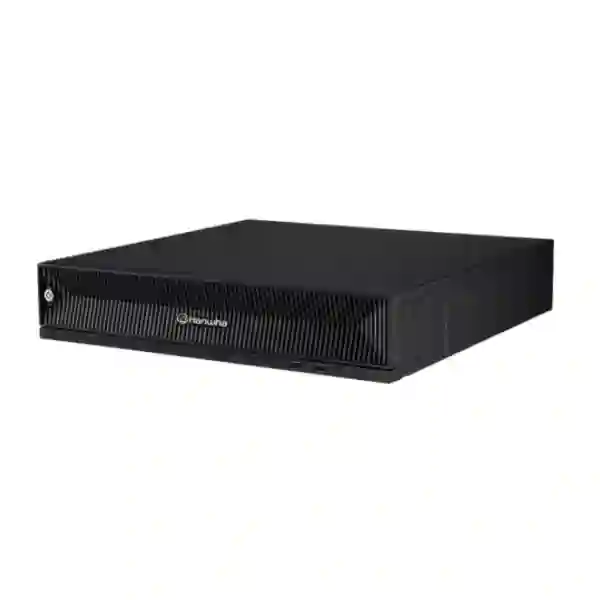
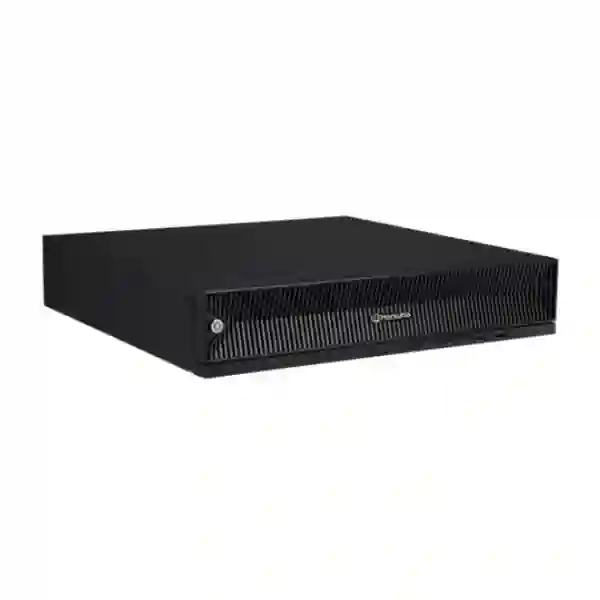
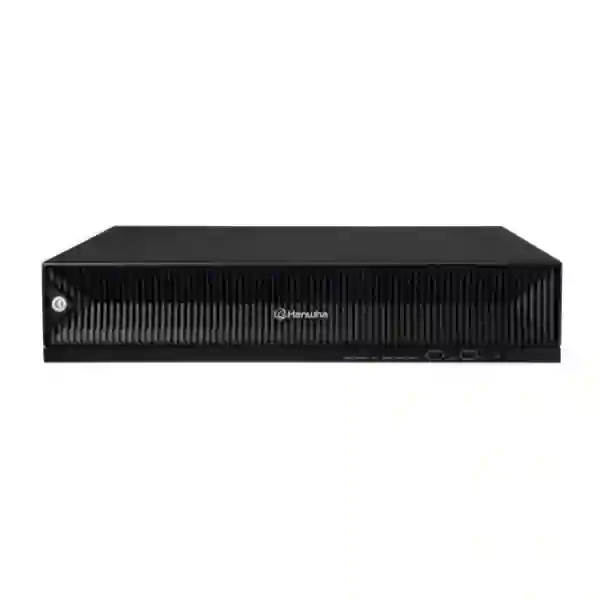
Hanwha XRP-4110B2 36-Channel SSM Network Video Recorder
A recording and video management appliance for projects that need up to 36 IP camera inputs, an eight-bay storage plan, and a disciplined approach to retention, resilience and investigations. Request a configuration review before specifying disks or promising recording days.
Verified technical specifications at a glance
The following values refer to the XRP-4110B2 model in Hanwha Vision’s product information. System performance, installed drive count and supported feature combinations must be assessed for the actual configuration.
| Product type | Server-based network video recorder with Wisenet SSM |
|---|---|
| Direct IP camera inputs | Up to 36 channels |
| Recording resolution | CIF to 32 MP |
| Maximum recording bandwidth | 400 Mbps aggregate |
| Maximum playback bandwidth | 150 Mbps |
| Compression | H.265 / H.264 / MJPEG / WiseStream |
| Storage bays | 8 × 3.5-inch SATA |
| Listed enterprise HDD capacities | 6 / 8 / 10 / 12 TB, compatibility to verify |
| RAID | 1 / 5 / 6 / 10 |
| Failover modes | Active-Active / Active-Standby (designed system required) |
| Local video outputs | 2 × HDMI: 4K + FHD |
| Wired network interfaces | 3 × Gigabit RJ-45 |
| Operating system | Windows 10 IoT Enterprise LTSC, SSM preinstalled |
| Processor / memory | Intel Core i5-8500T / DDR4 16 GB |
| Power supply | 100–240 V AC, 50–60 Hz |
| Maximum power consumption | 180 W with eight compatible HDDs |
| Environment | 0–40°C; relative humidity ≤80% |
| Dimensions / mass | 438 × 86 × 434.9 mm; approx. 9.1 kg excluding HDDs |
A 36-channel recorder for surveillance teams that need central control
The Hanwha XRP-4110B2 36-channel recorder is intended for IP video environments where an ordinary small recorder may not provide enough camera capacity, storage flexibility or operator workflow. It combines network recording with preinstalled Wisenet SSM software, so the procurement decision concerns a complete recording and management appliance rather than a bare server. A suitable project might include a manufacturing compound, warehouse, mixed-use building, campus, hospitality property or controlled commercial facility. The important starting point is not the building label but the number of camera streams, their recording profiles, the hours of operation, the investigation process and the consequences of losing recorded evidence.
For a Tanzania project, start by asking how many cameras operate today, how many could be added later and how operators need to review incidents. A 36-channel limit does not mean every deployment needs 36 cameras; spare channel capacity can be valuable when future expansion has already been planned. Equally, an impressive channel figure should not conceal an undersized storage design or an unsuitable network. Ask for a channel schedule, a realistic bandwidth estimate and a retention target before selecting hard disks. FourTeck Tanzania can assess the proposed configuration through a quotation request, subject to confirmation of product supply and project requirements.
What the 36-channel rating means in practice
Hanwha specifies up to 36 network camera inputs for this model as a standalone appliance. A channel normally represents a camera input being managed and recorded, but channel count should not be treated as a guarantee that every possible combination of resolution, frame rate and codec fits. Recording bandwidth, playback demand and storage write performance remain separate capacity constraints. If a site already needs more than 36 distinct camera inputs, do not simply assume a higher-resolution camera can replace several operational views. Review coverage, field of view, incident response and whether more than one appliance or a different platform is appropriate.
The manufacturer also describes larger channel counts in a clustering configuration, with up to 132 channels indicated for the applicable clustered environment. That is a system-design capability, not a statement that one XRP-4110B2 chassis has 132 physical or standalone input licenses. Clustering requires verification of software compatibility, server architecture, client access and the actual supported topology. For a single site, treat 36 as the practical direct input planning figure until the proposed cluster has been explicitly engineered. Clearly recording the difference in procurement documents prevents confusion between appliance capacity and what an integrated SSM deployment may ultimately display or administer.
High-resolution recording without confusing it with monitor output
Hanwha lists network camera recording support from CIF through 32 MP and identifies recording of 8K-class streams as a capability. This provides room for applications in which detail matters, such as viewing a large loading area or capturing a complex entrance scene. Resolution alone does not determine whether an image will meet an operational goal. Camera lens selection, sensor size, installation height, field of view, lighting, compression and motion blur all influence the usable detail after an incident. A project should define what an operator must observe or identify at each location, then select the camera and recording profile to support that outcome.
The same official specification distinguishes recording resolution from local monitor capability. The recorder has two HDMI connections, one identified for 4K and another for Full HD, with supported local display arrangements dependent on monitor selection. It would be misleading to promise 32 MP output on an ordinary monitor merely because a 32 MP camera can be recorded. Discuss the operator console separately: which cameras appear together, how many screens are needed, whether footage is investigated remotely and which workstation performs detailed playback. A good control-room plan balances image availability with usable layouts and operator attention rather than maximising visible tile count.
Plan recording traffic against the 400 Mbps ceiling
The published maximum recording bandwidth is 400 Mbps. This is an aggregate planning constraint, not the bandwidth allotted automatically to each of 36 cameras. Some cameras may generate modest traffic most of the time and substantially more during movement, low-light noise or busy scenes. Others may use several video profiles for recording and monitoring. A reliable design uses real or representative bitrate estimates for every stream, applies a sensible allowance for variable conditions and checks that the total stays within the recorder limit. Camera count and advertised resolution cannot replace that calculation.
A practical schedule should show each camera’s recording codec, nominal bitrate, maximum expected bitrate, frame rate, scene activity and whether audio is included. Add up the planned streams and consider simultaneous live viewing, export and playback separately. The official specification lists up to 150 Mbps playback bandwidth, so investigation workflows deserve attention alongside ingress traffic. For example, a monitoring desk reviewing several incidents during a busy shift can create a different load from a system only writing streams overnight. Do not promise a particular frame rate or real-world performance from the headline numbers without checking the complete configuration and current manufacturer guidance.
Eight SATA drive positions and the correct storage question
The XRP-4110B2 has eight 3.5-inch SATA hard-disk slots. Hanwha lists compatible enterprise drive capacities of 6 TB, 8 TB, 10 TB and 12 TB for the model in its published specification. Eight drive positions do not prove which disks are included in a commercial offer, or that all theoretical raw capacity will remain available for video after the selected RAID configuration. Storage media must be quoted explicitly. Request the number and exact approved model of HDDs, manufacturer compatibility confirmation, RAID layout and resulting usable capacity, rather than asking only for an eight-bay recorder.
The useful distinction is between raw disk capacity, usable array capacity and the retention that will actually be achieved under the selected recording plan. Eight 12 TB drives would have a theoretical combined raw capacity of 96 TB before RAID, formatting, reserves and other overheads; that number is not the same as usable evidence storage. A smaller set of disks may suit a lower-load site, while a high-resolution continuous-recording site can exhaust a large array quickly. Check the manufacturer HDD compatibility information and the proposed drives before purchase, especially where replacement media might be sourced at different points in the equipment lifecycle.
Estimate retention from data rather than assumptions
A retention requirement should be expressed as a clear policy, such as a defined number of calendar days for ordinary video and a separate procedure for footage preserved as evidence. The storage calculation then uses the aggregate recording bitrate over time. As a broad mathematical reference, one megabit per second recorded continuously produces approximately 10.8 gigabytes of data in 24 hours before overhead and variations. That relationship is useful for understanding why a relatively small increase in average bitrate, repeated across many cameras, can materially change the required disk allocation. It is a calculation aid, not a product-specific guaranteed capacity.
Real retention depends on continuous versus event-triggered recording, scene movement, compression, audio, camera resolution, day and night settings, disk protection strategy and actual usable array space. Avoid a quote that promises a fixed number of days without disclosing its assumptions. Ask the system designer to provide a retention worksheet that can be recalculated when new cameras are added. Include at least one stress scenario: peak scene activity, the busiest recording periods and simultaneous event investigation. If the business is subject to its own retention or evidence-handling rules, those requirements should be provided by the customer and implemented in the recording schedule.
Choose RAID for the failure scenario, not the biggest number
Hanwha confirms RAID 1, RAID 5, RAID 6 and RAID 10 support for the XRP-4110B2. These layouts make different trade-offs among disk redundancy, usable space and read/write behaviour. RAID 1 mirrors data; RAID 5 uses distributed parity with single-drive fault tolerance in a properly functioning array; RAID 6 adds additional parity protection; and RAID 10 uses mirrored sets with striping. Exact fault survival depends on the actual array and which drives fail. The level should be selected after considering disk count, rebuild time, recording write workload and the importance of retaining footage during hardware service.
RAID is not a replacement for an evidence backup process. An incorrect deletion, malicious action, site disaster or major system problem can affect data even when disks are redundant. Hanwha’s support guidance recommends checking RAID status periodically and replacing a failed disk promptly in a degraded array. Agree who will receive storage alarms, how replacement drives will be obtained and how the business will protect recordings that must survive beyond routine overwrite. For an installation in Tanzania, also decide whether suitable replacement disks and qualified maintenance assistance can be arranged; do not assume any particular local service guarantee is included in an equipment quotation.
Understand failover separately from disk protection
The manufacturer lists Active-Active and Active-Standby failover functionality and ARB support for the B2 model. These are important architecture features when continuity matters, but they are not magic switches that automatically make a single recorder immune to failure. Redundant operation has to be designed around supported software versions, compatible recorders, network paths and storage arrangements. ARB and failover also address different risks from RAID. A proposal should state exactly what happens when a network link, disk, recorder or relevant service becomes unavailable, and which camera streams are expected to recover or remain accessible.
Ask the installer to draw a simple fault path for each critical camera. Where does its video normally travel, where can it be buffered, what system takes over if a recorder is unavailable and how will staff know that a failure occurred? If a resilience feature depends on a camera’s own capability or an additional appliance, that dependency belongs in the bill of materials. Carry out an agreed failover test during commissioning and record the observed behaviour. This is especially important for sites with security staff on continuous shifts: a platform description is useful, but a demonstrated recovery procedure is what makes a continuity plan operational.
Use H.265, H.264, MJPEG and WiseStream appropriately
The listed recording formats include H.265, H.264, MJPEG and Hanwha WiseStream in supported camera configurations. Video compression affects network load, stored data volume, visual detail and compatibility with devices used to review or export footage. A modern codec can help reduce the bitrate needed for a given level of perceived quality, but savings depend on the subject, noise, lighting, camera settings and motion. Do not copy a single optimistic compression percentage into a project forecast. Test representative scenes and compare stored image quality at the bitrates actually proposed.
Some cameras may need a high-quality primary stream for evidence and a lighter stream for multi-camera viewing. Others may be limited by an integration or a third-party viewer. Confirm codec support across camera, SSM server, client and export workflow before finalising the design. If incident investigators must open footage on standard workplace computers, validate the export format and playback procedure on those devices. A recording system should optimise three outcomes together: usable footage when required, predictable network demand and enough retention headroom. Compression is a tool for those goals rather than an end in itself.
Check camera integration before committing to an appliance
The manufacturer lists Wisenet and ONVIF camera protocol support and includes ONVIF Profile S among the recorder’s network protocols. That does not establish every specific third-party camera’s complete feature compatibility. Basic discovery or live video can work while advanced camera events, audio, analytics, motion metadata or PTZ controls behave differently. For a mixed-brand estate, produce a compatibility matrix showing the exact make, model, firmware, codec and required feature for each camera family. Mark any desired capability that still needs a test rather than assuming that a standards label resolves all integration questions.
If the project contains existing analogue cameras, do not assume they plug directly into this IP recorder. Their conversion or replacement needs an explicit design. Likewise, camera power is a separate consideration: the published interface includes Gigabit Ethernet connections but does not identify a built-in bank of PoE camera ports. Plan suitable PoE switching or other approved camera power supplies. A camera-by-camera review should identify cable length, uplink capacity, network segregation, time synchronisation and event transport. These details can be more important to a successful upgrade than the number printed on the recorder’s front panel.
What Wisenet SSM brings to operations
Wisenet SSM is preinstalled on the XRP-4110B2, making the unit a combined video management and recording appliance. That is relevant to teams that want central camera administration, live monitoring, searches, event handling and playback rather than a collection of isolated recorders. The official specification identifies SSM Client and Wisenet Mobile among viewer options. Use the manufacturer’s compatible software release and deployment guidance for the actual project. Do not assume that every software feature advertised for a different SSM generation or another Hanwha model is automatically available on this appliance.
Before purchase, agree who administers user accounts, who watches live feeds, who reviews historical recordings and who authorises exports. These roles may have different requirements for screen layout, access rights and audit activity. Think through shift handovers, off-site supervisors, incident escalation and administrative changes after staff turnover. If remote viewing is needed, obtain a network security design before enabling it. A good SSM deployment is not simply a list of cameras in software; it is a repeatable process that helps operators locate the right feed, recognise the right alarm and preserve an incident record without unnecessary steps.
Use event searches and AI integrations with realistic expectations
Hanwha describes dynamic events, bookmarks and AI-based object searching when the recorder is connected to applicable P-series AI cameras. The recorder can receive and use supported camera event information, including certain object, face or vehicle-related data depending on source capabilities and software configuration. This does not mean the XRP-4110B2 independently converts every conventional camera into an AI analytics camera. The camera model, firmware, event format and available SSM features must be matched to the desired search task. Some site workflows may also require separate camera settings or specialised integrations.
Translate the proposed analytics into plain operating questions. Does the control room need to find a vehicle entering a gate, narrow down a search by time, distinguish motion near a restricted door or review a series of alarms from an overnight shift? Specify what counts as a useful detection and which false alerts are acceptable. Test with representative lighting, angles and movement. Human review remains important for safety and evidential decisions. An efficient video-search feature should reduce investigation effort, but it should not be described as guaranteed identification or as an autonomous decision-making system for every scene.
Design local live view and playback around the operator
The physical interface lists two HDMI outputs, one associated with 4K and one with Full HD. Hanwha specifies dual display when using Full HD monitors and a single-display arrangement when a UHD monitor is used. Control-room design should therefore start with the actual monitor arrangement and the tasks performed at the desk. A guard may need a stable set of entry feeds, while an investigator benefits more from quick playback access and searchable event lists. Splitting every screen into the maximum number of tiny tiles is rarely the most informative layout.
Write down a few realistic operator scenarios: identifying a loading-bay incident, switching from an overview camera to a PTZ camera, replaying an alarm while other cameras remain visible, and exporting a clip for an authorised manager. Ensure the intended client station and display configuration can support them. The manufacturer lists up to 36 simultaneous playback channels in the standalone configuration, but the user experience still depends on the selected viewing layout and available resources. Provide training that includes camera naming conventions, shortcuts, time navigation and the procedure for confirming that video has been recorded successfully.
PTZ, alerts and incident-response workflows
The XRP-4110B2 product specification includes PTZ control and preset support, with compatible controllers identified by Hanwha. A suitable PTZ system can help operators inspect an area after an alarm, but a moving camera may not continuously capture the location it has left behind. Consider pairing fixed overview coverage with targeted PTZ views for critical approaches or yards. Check camera and controller compatibility, preset behaviour, operating privileges and what is recorded during manual movement. A PTZ feature should serve a defined observation need rather than being added simply because the product lists it.
The recorder also documents event actions such as alarm output, pop-up, buzzer, e-mail notification and preset movement. Build an escalation matrix for each event class: who needs the alert, how urgent it is, what action should follow and when an alert can be closed. Repeated low-value alarms can cause staff to ignore genuinely important events. Test day and night scenes and keep the first configuration conservative. Where alarms interact with access control or other business systems, confirm the interface and required permissions with the relevant integrators. Do not promise a particular third-party integration until an end-to-end test has been completed.
Protect evidential exports and maintain a clear audit trail
The manufacturer lists AVI and SEC backup formats and identifies manual, scheduled and privacy-masking backup options. Those capabilities make it possible to plan how incidents move from routine recording into an authorised evidence workflow. Define who is permitted to export video, how the incident number is recorded, which camera names and time ranges must be documented, and where protected copies are stored. Users should verify the playback of an exported sample before relying on the procedure. A large file that cannot be opened when required is not an effective evidence handoff.
A robust evidence process also addresses time synchronisation, file integrity, recipient access and retention after the normal recorder overwrite period. Ensure clocks are correct across cameras and recorder; an inaccurate time stamp makes investigations harder to reconstruct. Keep a register of who requested material and when it was supplied, following the organisation’s policies and applicable requirements. Be cautious about copying footage to unprotected personal devices or distributing it to broad groups. The recorder is a recording platform, not a substitute for governance. The final operating policy should name the people responsible for access approval, retention exceptions and incident closure.
Network topology: keep recording traffic predictable
The published hardware specification includes three Gigabit RJ-45 Ethernet connections. Those interfaces offer design flexibility, but they do not automatically provide three independent failure-free networks or guarantee that every switching topology is supported. Agree how camera traffic, management access and operator clients will be routed, and document whether VLANs or separate switching segments are used. Avoid depending on an unplanned consumer router for critical camera transport. Uplink calculations should include simultaneous camera feeds, management traffic and maintenance operations, with headroom for variable video scenes and future expansion.
At commissioning, verify IP addressing, camera discovery, DNS where applicable, time synchronisation and any network services used by alerts or remote clients. The official protocol list includes IPv4, IPv6, RTSP, HTTPS and other common networking functions, but enabling a protocol should be based on a deliberate need. Identify who can modify firewall rules and how changes will be recorded. If the site connects multiple buildings, assess fibre paths, wireless bridges or other links for latency, interference, outages and maintenance access. Record a logical network diagram as part of the handover so future troubleshooting does not depend on the memory of one installer.
Security hardening for the recorder and cameras
Hanwha documents HTTPS authentication, digest authentication, IP filtering and user access logging among the security features of the XRP-4110B2. These should form part of a broader security configuration, not be treated as proof that a connected video network is secure by default. Change commissioning credentials, use strong individual accounts, limit administrative access, segregate cameras from untrusted devices and avoid exposing management interfaces directly to the public internet. Confirm which software and firmware releases are approved for the unit before applying updates, particularly where the system supports failover or specialised integrations.
Define an account-review schedule and a process for revoking access when employees or contractors leave. Keep a secure record of recovery procedures, configuration backups and the device inventory. Where remote maintenance is necessary, use an organisation-approved protected route and maintain oversight of who connects. Review event logs after meaningful changes or incidents, and ensure alert delivery is tested rather than merely enabled. Security also has a physical dimension: lock the equipment location, protect disk access and control who can remove exported storage media. Procurement should specify these operational controls in addition to the recorder’s technical feature list.
Power, rack space, temperature and installation readiness
The manufacturer’s B2 specification gives an AC input range of 100 to 240 V at 50 to 60 Hz and a maximum power consumption of 180 W when eight compatible HDDs are operating. The metal chassis measures approximately 438 by 86 by 434.9 millimetres, excluding any installation allowance for cabling or maintenance access, and weighs about 9.1 kilograms without HDDs. These values help rack planning but do not remove the need to check ventilation, cable routing, UPS selection and the combined load of switches, monitors and related devices.
Hanwha lists an operating temperature range of 0°C to 40°C and operating humidity of up to 80 percent. A rack room exposed to direct heat, dust or moisture may not remain inside those limits even if the ambient weather seems acceptable. Assess the actual enclosure temperature during busy operation, plan cooling and avoid obstructing air circulation. Size the UPS against the complete connected system and the desired shutdown or continuity procedure, not just the recorder’s headline consumption. Decide how alarms will be communicated during a power event. If the site experiences repeated interruptions, a tested restart and data-integrity process is as important as standby runtime.
Practical considerations for projects in Tanzania
The XRP-4110B2 may be relevant to Tanzanian businesses planning a central surveillance recording room, but its manufacturer specifications do not establish current local stock, approved distribution, installed pricing, customs arrangements or on-site maintenance coverage. Those commercial conditions should be confirmed for the actual quotation. For a project spread across a warehouse, retail compound or multiple buildings, include the network routes, UPS protection, operator location and service responsibilities in the scope. The customer’s own site conditions are more useful than assuming every installation has the same power quality or internet availability.
A disciplined local buying process should separate equipment cost from hard disks, cameras, PoE switches, cables, licences if required for the agreed functionality, rack accessories, installation, configuration and support. Ask whether the proposed HDD models are approved and whether the supplier will commission the system with an agreed retention test. If cloud or remote access is proposed, verify its architecture and organisational requirements rather than assuming the recorder is hosted in Tanzania. Obtain written confirmation of supply arrangements and warranty terms applicable to the actual order. No Tanzania shilling price, delivery promise or local regulatory approval is asserted here.
Common business scenarios and the questions each raises
For a logistics yard, the important questions often concern gate events, loading areas, overnight footage and whether operators can retrieve an incident quickly. For a manufacturing property, camera coverage may concentrate on entrances, safety-relevant movement and storage areas, while the retention policy should distinguish business investigation from routine supervision. A commercial building may prioritise reliable 24-hour common-area recording and a straightforward handover between security shifts. A campus may have many distinct camera groups and require tightly controlled access for different personnel. These are examples of design questions, not claims about any existing FourTeck installation.
In each scenario, the 36-channel count is only one checkpoint. A yard with a few high-bitrate cameras may need more storage than a larger indoor site using modest profiles. A facility with multiple camera brands may demand a compatibility test before an appliance is selected. An organisation that regularly exports evidence needs a documented search and approval workflow. A site with a busy monitoring desk may require a dedicated client workstation rather than relying only on local display. The strongest recommendation comes from a site survey and a recorded requirements matrix, not from choosing a product purely because it has more ports or a higher nominal channel figure.
A commissioning checklist that makes acceptance meaningful
Before sign-off, verify every camera name, location, recorded profile, live view, time setting and event configuration against an approved schedule. Check each HDD model against manufacturer guidance and capture the array health screen as part of the handover record. Confirm the usable space displayed by the recorder and compare an actual period of recorded data with the planned retention estimate. Test simultaneous live view and playback using the normal operator setup. Inspect low-light footage and scenes with high movement, because those conditions can reveal quality or bitrate problems that a quiet daytime demonstration misses.
The acceptance test should also cover restoration after controlled power interruption, access permissions, the alarm escalation route, an authorised export and at least one planned failure or disconnection test appropriate to the design. If redundancy was purchased, the recorded test results should demonstrate its configured behaviour. Record the firmware or software version in use and the procedure for approved updates. Provide the system diagram, support contacts, administrator handover and basic operator instructions. A commissioned recorder is not simply one that displays a camera image; it is one whose recovery, recording and investigation processes have been proved to work for the customer.
Comparing the B2 model with other Hanwha choices
The XRP-4110B2 belongs to a Hanwha appliance family with products serving different input capacities. Hanwha identifies the XRP-4010B2 as a 16-channel option and the XRP-4210B4 as a 72-channel option in its lineup information. Selecting among them should start with required channels, recording workload and deployment architecture, not the assumption that the larger model is always better. The exact drive architecture, software features, dimensions and power figures differ by model, so do not carry one model’s specification into another quotation. For a smaller site, unused capacity can add cost without solving a real operating need.
The similarly named XRP-4110G2 must also be treated as a distinct product, not as an interchangeable spelling of XRP-4110B2. Hanwha describes specific restrictions for the G2 version, including limitations involving clustering and failover, in its official product information. Therefore, the model suffix matters whenever continuity or integration features are on the requirements list. Ask suppliers to write the full model identifier on the quote, delivery note and commissioning record. Confirm model-specific software and licensing terms before accepting an alternative. A substitute can be suitable for a project, but only after the customer agrees that its actual functions match the specification.
Lifecycle care after installation
A surveillance recorder normally operates for long periods and should be included in a scheduled care programme. Review storage health, RAID warnings, free capacity and the gap between expected and observed retention. Keep track of unusual recording gaps and cameras that repeatedly disconnect. Revisit the user list and the status of external alert paths. Where there is a software update, check vendor guidance and assess any effect on camera compatibility, recording configuration or available features before applying it. Maintain a restorable copy of the agreed configuration in an appropriately protected location.
Plan for evidence handling during maintenance: identify how footage will be protected before an array change, repair or recorder replacement. Track the age and operating history of storage devices and use manufacturer compatibility guidance for replacements. An untested spare drive or undocumented network diagram can prolong an otherwise simple repair. Consider periodic refresher training because staffing and workflows change. The objective is predictable service and discoverable footage throughout the appliance’s working life. The purchase should include a clear division of responsibility between equipment supplier, installer, customer IT team and security operations where those roles are separate.
What to include in a request for quotation
A useful XRP-4110B2 quotation request identifies the project site and intended installation environment, the exact model, the existing and future camera counts, camera makes and firmware, recording profiles, expected aggregate bandwidth, retention days, required RAID policy and viewing workstations. It should describe whether the design requires failover, clustering, event integrations, mobile access or evidence exports. State which functions are mandatory and which may be optional. Include the customer’s operating hours, alarm response procedures, security requirements and any restrictions around remote connectivity. This brief allows suppliers to price a relevant system instead of a standalone chassis that may be incomplete.
Ask the supplier to separate the appliance, compatible HDDs, network and power equipment, implementation, training and any applicable support or licensing items in the response. Request confirmation of which features are supported on the specific B2 configuration and how critical requirements will be tested at commissioning. The final quote should state what is included, what is excluded and what the customer must provide. If an item is uncertain, it should be identified for verification rather than quietly assumed. To discuss the Hanwha XRP-4110B2 36-channel recorder, request a project-specific configuration and current commercial confirmation from FourTeck Tanzania.
Frequently asked questions about the XRP-4110B2
These answers address the common differences between a headline recorder specification and a working video surveillance system.
Is the XRP-4110B2 a 36-camera recorder?
Hanwha specifies up to 36 network camera inputs on the standalone appliance. Whether 36 selected camera streams can run with the intended quality and frame rate still depends on aggregate recording bitrate and the complete design. Clustering figures in the product information are not a substitute for the standalone channel limit. Supply the planned camera schedule and recording profiles when requesting a configuration.
Does the unit come with hard disks?
Eight SATA drive slots are a hardware feature, not proof that storage drives are supplied in a particular offer. Ask for a clear itemised quotation showing the number, capacity, manufacturer-approved model and RAID arrangement of HDDs. The quote should also state the calculated usable storage and retention assumptions. Never use a theoretical raw-capacity figure as if it were the amount of protected footage storage available.
Can it record 32 MP video?
The exact B2 product specification lists recording support through 32 MP. That does not mean every camera, lens, bitrate or display configuration delivers the same useful image quality. Validate each critical field of view and the resulting recording profile. The video may be captured at a high camera resolution while the local monitor displays a different resolution or a scaled multi-camera layout.
Is 400 Mbps enough for all 36 cameras?
The answer depends on the cameras’ total recording traffic. Four hundred megabits per second is the published maximum recording bandwidth, not a per-channel allocation. Add estimated normal and busy-scene bitrates for all intended streams, consider growth and verify playback requirements separately. A low-bandwidth thirty-six-camera system and a high-resolution thirty-six-camera system can have very different storage and networking needs.
Which RAID modes are available?
The manufacturer lists RAID 1, 5, 6 and 10 for this model. The suitable option depends on disk count, redundancy requirement, acceptable failure risk and usable capacity. An array can reduce exposure to some disk failures, but it does not replace evidence backup, physical protection or administrative controls. Include storage health monitoring, replacement access and evidence retention procedures in the overall design.
Can existing third-party IP cameras be connected?
The appliance supports Wisenet and ONVIF-related camera communication, but complete compatibility should be tested for each camera model and firmware. Live video, motion events, audio, PTZ and analytics may have different integration requirements. Provide a camera inventory and specify which features matter. Existing analogue-only cameras need separate conversion or replacement planning rather than an assumption of direct connection.
Does the recorder provide PoE power to cameras?
The official interface list describes Gigabit Ethernet network connections, not an integrated multi-port PoE camera switch. Plan the camera power arrangement independently with appropriate PoE network switching or other approved power equipment. Verify power budgets, cable routes and network uplinks in the site design. The number of network sockets on the recorder should not be mistaken for the number of directly powered camera channels.
Can AI search recognise vehicles and people?
Hanwha describes AI-based object search where supported P-series AI cameras are integrated. Exact search categories and event behaviour depend on the connected camera, software version and configuration. The recorder should not be sold as creating full AI analytics from every conventional video stream by itself. Define the intended investigation task and request a demonstration using compatible camera equipment.
Can the system continue if a component fails?
The B2 model lists failover functions and RAID support, but each protects against different categories of failure. Actual continuity requires the correct redundant components, network design, configurations and a successful test. A single chassis cannot provide every form of resilience merely because a feature appears in a specification. Ask for a written recovery scenario covering disk faults, link failures, recorder outages and restoration steps.
Will this work in a hot or dusty room?
The recorder’s published operating temperature is 0°C to 40°C, with humidity at or below 80 percent. It needs an installation space that maintains these conditions, with adequate ventilation and control of dust and moisture. The inside of a crowded rack can be warmer than the surrounding room. Verify airflow, UPS provision and equipment-room conditions before commissioning.
Is pricing or availability confirmed in Tanzania?
No current Tanzania selling price, stock level, delivery time or service commitment is confirmed in this description. Those details depend on the actual supply and installation offer. Request a quote covering the exact XRP-4110B2 model and selected hard disks, together with any required accessories, labour and support. Ask the supplier to confirm the applicable commercial terms in writing before ordering.
What information speeds up a quotation?
Provide the camera count and types, desired recording resolution, approximate bitrates if known, retention target, site layout, expected operator stations and any need for remote access or redundancy. Include existing storage or network constraints and note whether the request is for a new installation or an upgrade. This gives the technical team a basis for checking a working configuration rather than quoting only the recorder body.
NEXT STEP
Request a tailored XRP-4110B2 quotation
Share the proposed camera inventory, expected bitrates, retention target, preferred RAID design and installation conditions with FourTeck Tanzania. Request written confirmation of the exact model, drive configuration, supported functions, commercial terms and commissioning scope. This helps turn a recorder specification into a practical system design rather than an incomplete equipment list.
No local price, delivery timeframe, warranty or stock status is implied by this product description. Confirm those items in the quotation.




Reviews
There are no reviews yet.