
FortiGate 61F (FG-61F) Tanzania
The Fortinet FortiGate 61F is a compact next-generation firewall built for organizations that want security, routing, VPN and Secure SD-WAN functions consolidated at the network edge. It belongs to the FortiGate 60F family and adds 128 GB of internal SSD storage, making it particularly useful for buyers who value local logging capacity alongside branch firewall functions. For Tanzanian businesses evaluating an FG-61F for a head office, branch, retail location, professional office, school, clinic or distributed network, the important buying question is not simply maximum firewall speed. The appliance should be assessed against enabled security services, encrypted traffic, WAN bandwidth, VPN demand, user and device growth, logging requirements and the wider switching and wireless design.

FortiGate 61F overview and verified performance
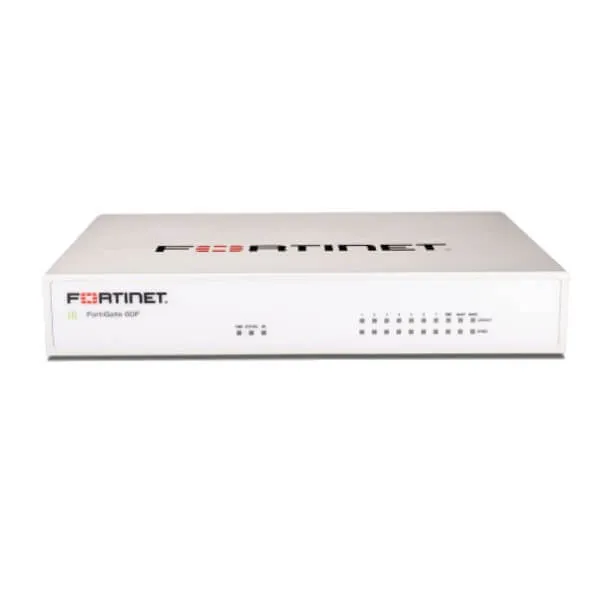
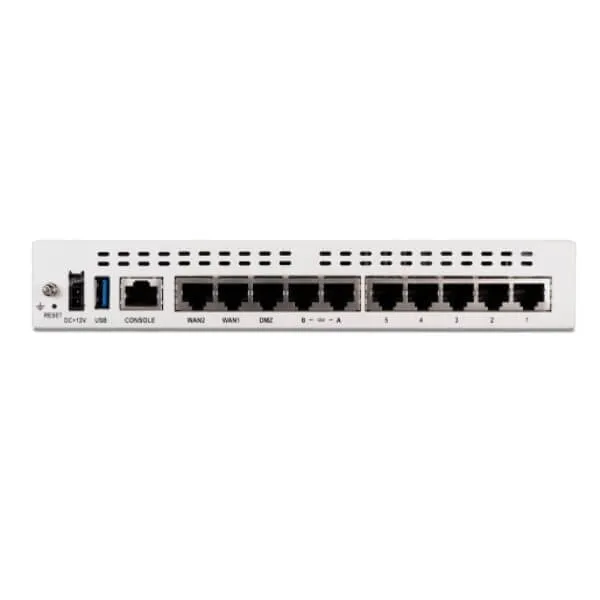
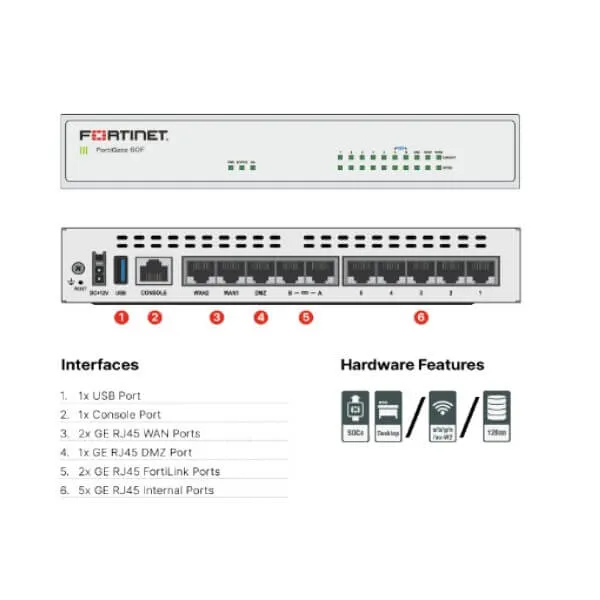
Fortinet positions the FortiGate/FortiWiFi 60F series as converged next-generation firewall and SD-WAN appliances for distributed enterprise sites. The FG-61F hardware specification includes two GE RJ45 WAN ports, one GE RJ45 DMZ port, five GE RJ45 internal ports, two GE RJ45 FortiLink ports, one USB port, one RJ45 console port and one 128 GB SSD. Fortinet publishes firewall throughput of 10/10/6 Gbps for 1518/512/64-byte UDP packets, 1.4 Gbps IPS throughput, 1 Gbps NGFW throughput and 700 Mbps threat-protection throughput. IPsec VPN throughput is listed at 6.5 Gbps under Fortinet’s stated test conditions. These are laboratory performance figures and should be interpreted with the vendor’s test notes rather than treated as guaranteed application throughput in every deployment.
The distinction between raw firewall throughput and threat-protection throughput matters during sizing. A business that only compares the largest headline number can underestimate the processing required when IPS, application control, malware protection, SSL inspection and detailed logging are active. A better procurement process maps actual internet circuits, peak traffic, number of users and endpoints, expected encrypted traffic, VPN tunnels, application mix and future growth. This produces a more defensible choice between the FG-61F and other FortiGate models.
Security
Use FortiOS policies with appropriate FortiGuard services to build application-aware, threat-aware controls. Subscription selection should be planned with the required security functions and support term.
Connectivity
Dual WAN interfaces and Secure SD-WAN capabilities can support resilient branch designs where multiple internet services are available. The design should define failover, application steering and monitoring objectives.
Local storage
The FG-61F differentiates itself from the FG-60F through its 128 GB internal SSD. Buyers with local logging requirements should confirm retention expectations and reporting architecture before deployment.
Technical specifications that matter when buying
| Firewall throughput | 10 / 10 / 6 Gbps (1518 / 512 / 64 byte UDP) |
| IPS throughput | 1.4 Gbps |
| NGFW throughput | 1 Gbps |
| Threat protection | 700 Mbps |
| IPsec VPN throughput | 6.5 Gbps |
| Concurrent TCP sessions | 700,000 |
| New TCP sessions/second | 35,000 |
| Storage | 1 × 128 GB SSD |
| Form factor | Desktop |
Published performance values are ‘up to’ figures and vary by configuration and enabled services. Fortinet also notes software-version considerations for SSL-VPN, so buyers planning remote access should validate the intended FortiOS release and current supported access method during solution design rather than relying on an older deployment assumption.
Secure SD-WAN, VPN and branch connectivity
For a branch or small headquarters, the FG-61F can consolidate WAN routing and security policy at one edge. Secure SD-WAN can be used to evaluate available links and steer traffic according to defined business rules. This is useful when an organization has two internet connections, a primary fixed service plus a secondary service, or multiple branch locations that need consistent policies. The design should identify which applications must remain available during a link failure, which traffic can use a secondary circuit, and how voice, cloud applications, business systems and general browsing should be prioritized.
IPsec VPN is relevant for site-to-site connectivity between offices and for securely connecting networks across public internet services. Before ordering, document the number of sites, expected encrypted bandwidth, addressing plan, routing method and whether central management will be used. Remote-user access requirements should be reviewed against the chosen FortiOS version and Fortinet’s current guidance. A firewall purchase is therefore strongest when it is attached to a clear connectivity design rather than treated as a standalone box.
For practical Tanzania deployments, see FourTeck’s broader Tanzania technology and network security resources. Organizations planning deployments across borders can also review FortiGate 61F Africa procurement guidance, which helps frame multi-country requirements without assuming identical availability, service terms or logistics in every market.
FortiGate 61F licensing and subscription planning
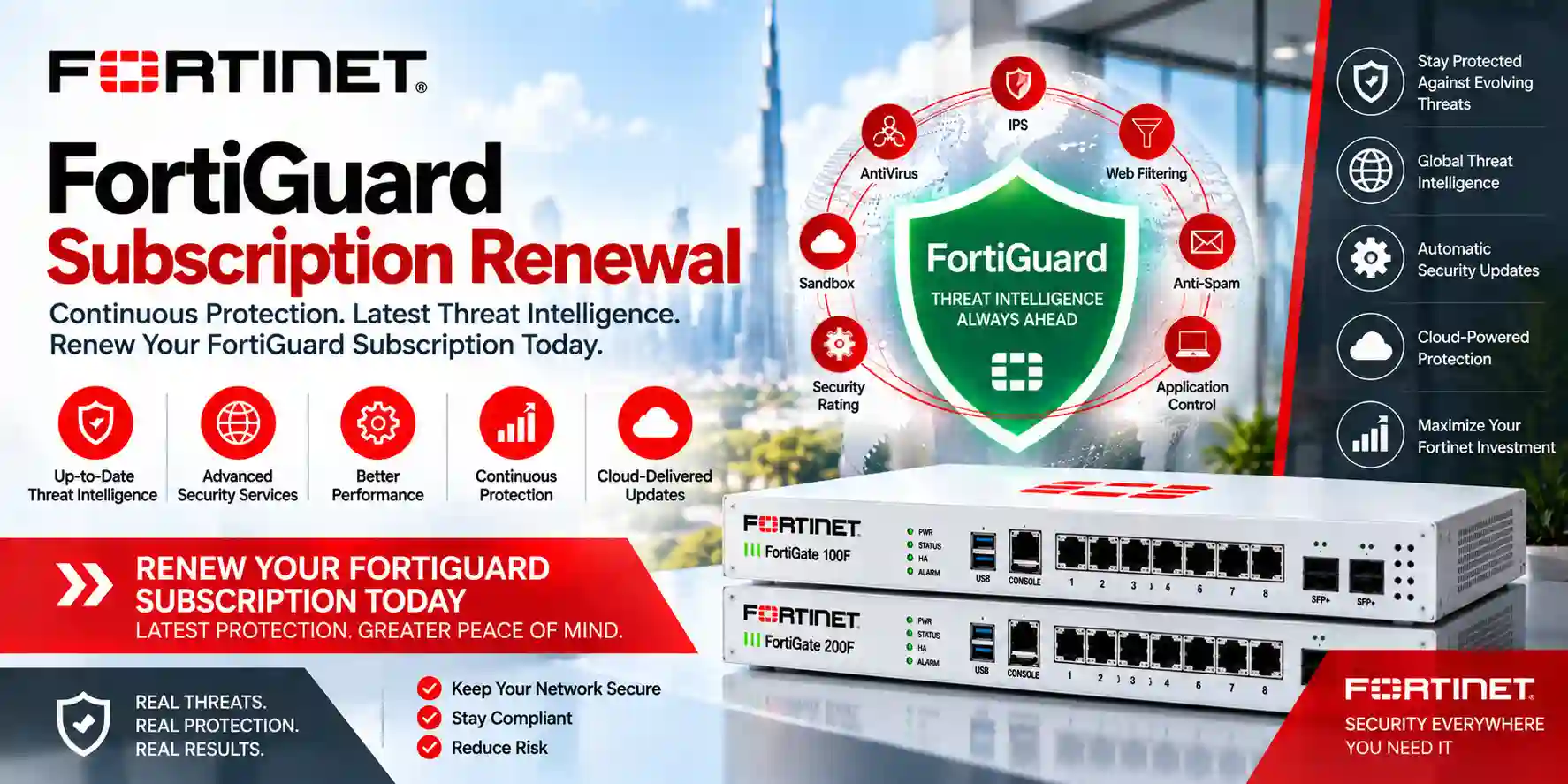
Hardware and security services should be scoped together. The appliance can perform core networking and firewall functions, while FortiGuard service bundles and support entitlements add security intelligence, updates and service capabilities according to the purchased package. Buyers should specify whether the project requires intrusion prevention, web filtering, application control, malware protection, advanced threat functions, vendor support and centralized management. The exact bundle, term and renewal date should be recorded in procurement documentation so future renewals do not become an emergency.
A quotation request should therefore state whether hardware-only pricing is being compared or whether a one-, three- or other available service term is required. Comparing a bare appliance price with a security bundle price can create a misleading procurement decision. FourTeck can use the requested security outcome and deployment term to prepare a more relevant quotation. For regional Fortinet-focused requirements, FourTeck’s Fortinet UAE resource provides additional Fortinet-oriented context, while Tanzania buyers should use the Tanzania contact path for their own quotation.
FortiGate 61F Tanzania
Tanzanian organizations considering the FortiGate 61F commonly need a compact security gateway that can protect internet access, connect sites and support business growth without turning branch networking into a collection of unrelated appliances. The FG-61F is particularly relevant where local storage is useful because its 128 GB SSD can support logging-oriented deployment requirements. A Tanzania project should begin with the actual internet circuits, the number of users and devices, critical applications, remote-access needs, branch links and the security services expected to remain enabled during peak periods. This prevents sizing from being based only on the 10 Gbps headline firewall figure when the more relevant security inspection figures may be lower.
Businesses in finance, professional services, hospitality, retail, education, healthcare, logistics and general commercial operations can use a next-generation firewall architecture to segment trusted and less-trusted networks, enforce application policy and secure site-to-site traffic. The design should also account for guest Wi-Fi, IP phones, CCTV, servers, cloud applications and third-party access where these exist. For organizations with two providers, Secure SD-WAN can form part of a resilience strategy, but link diversity and failover behavior should be validated rather than assumed.
When requesting a Tanzania quotation, provide the intended deployment location, internet speeds, number of sites, approximate endpoint count, required security services, VPN needs and preferred subscription term. If the project includes switching or wireless, include those requirements so the firewall, FortiSwitch and FortiAP design can be considered as a system. Buyers can also consult FourTeck Africa technology coverage for wider regional projects. Pricing, delivery, warranty handling and service options should be confirmed for the specific order rather than inferred from another country.
FortiGate 61F Dar es Salaam
Dar es Salaam businesses often operate in connectivity-intensive environments where internet access supports cloud applications, payment systems, collaboration, customer service, logistics platforms and remote connections. An FG-61F deployment can be planned as the secure edge between these services and the internal network. For an office with multiple departments, VLAN segmentation can separate corporate users, servers, guest access, voice and operational devices so security policy is applied according to business need rather than placing every endpoint in one flat network.
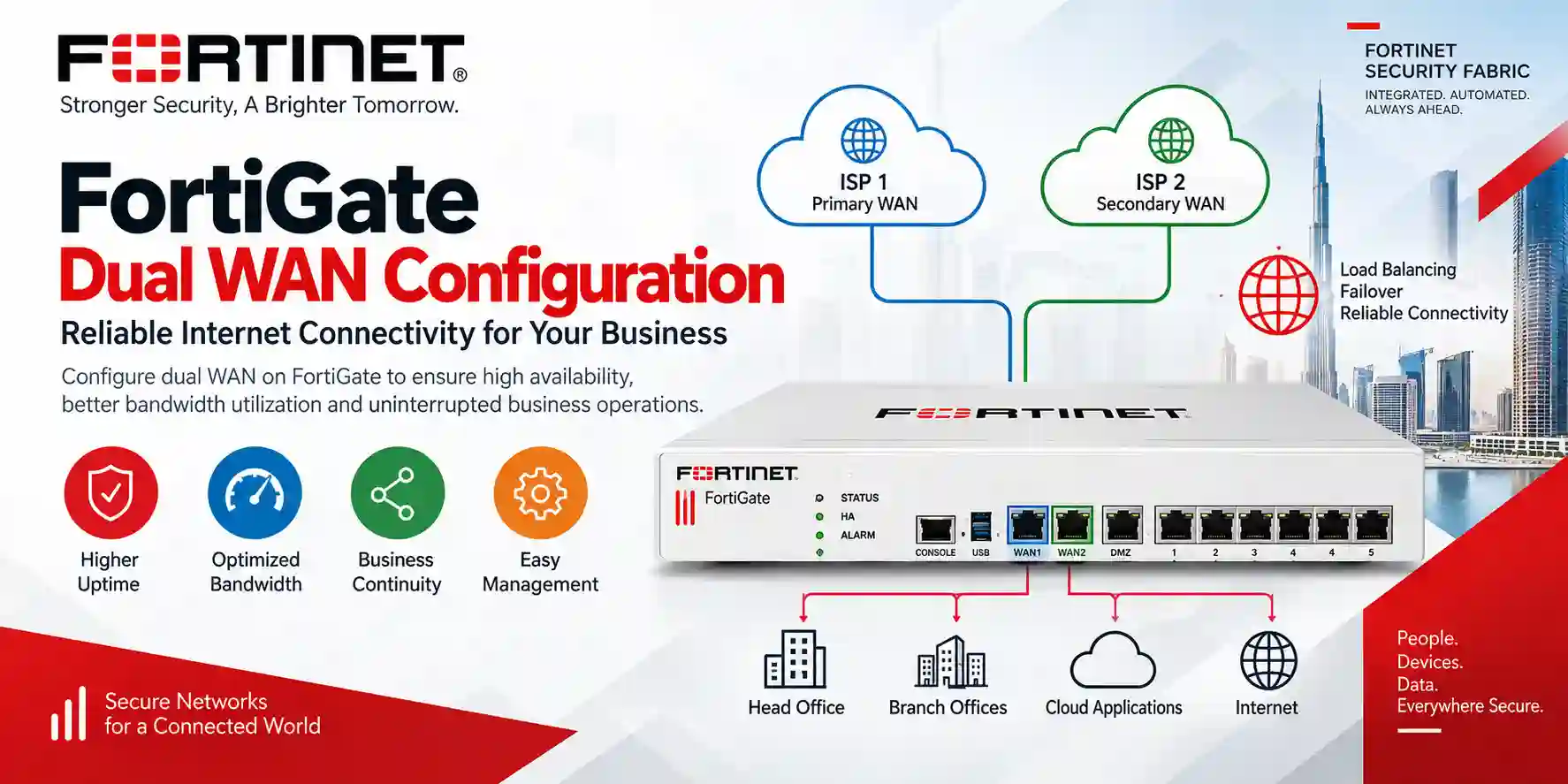
Dual-provider designs are also relevant to organizations that cannot afford a single WAN outage to stop critical work. The FG-61F’s SD-WAN functions can participate in link monitoring, failover and application-aware path selection. A good Dar es Salaam design documents the primary and backup circuit characteristics, public IP requirements, VPN dependencies and which applications must receive priority. If cloud services dominate the workload, SSL inspection and threat-protection demand should be considered when sizing because encrypted application traffic is different from simple stateful firewall forwarding.
Procurement teams should request a quote that clearly separates appliance, FortiGuard security bundle, FortiCare support, configuration scope and any complementary switching or wireless equipment. They should also document the desired subscription duration and renewal owner. This reduces ambiguity when comparing offers. FourTeck’s Tanzania channel can help translate a branch requirement into a product and licensing list, but stock, delivery and service commitments should be confirmed at quotation stage. For dual-link planning, the FortiGate dual-WAN configuration visual provides useful conceptual context without replacing an implementation-specific network design.
FortiGate 61F Mwanza
For organizations in Mwanza, the FortiGate 61F can be evaluated for branch security, secure internet breakout, VPN connectivity and centralized policy. The best fit depends on traffic rather than company name or employee count alone. A location with relatively few employees may still generate significant encrypted traffic through cloud backup, video, SaaS platforms, cameras or guest networks, while a larger office with lighter application use may have a different security profile. Documenting real traffic and expected growth is therefore more useful than relying on a generic user-count recommendation.
Where Mwanza is a branch connected to a Dar es Salaam headquarters or another regional hub, IPsec VPN and SD-WAN can support a structured site-to-site design. The network plan should define addressing, routing, tunnel redundancy, DNS dependencies and access rules between locations. If the branch has local servers or operational systems, segmentation can reduce unnecessary lateral access. The FG-61F’s internal SSD may also appeal where local logs are part of operational troubleshooting, although retention expectations should be designed around log volume and any centralized logging platform.
A complete Mwanza procurement request should include WAN bandwidth, number of providers, critical applications, endpoint estimate, VLAN count, VPN requirements and desired security subscription. It should also state whether the project needs installation, migration from an existing firewall or only supply. This information helps avoid comparing quotations that contain different service scopes. No buyer should assume stock or delivery time from a web page; confirm current commercial terms for the actual order and destination. Organizations with future expansion across East Africa can additionally review FourTeck Uganda and FourTeck Kenya when planning standardized regional security architectures.
FortiGate 61F Arusha
Arusha organizations in tourism, hospitality, professional services, education, NGOs and general commerce may have networks that combine employee devices, guest connectivity, cloud systems, voice, cameras and remote access. The FG-61F can sit at the edge of such a network, but successful deployment depends on separating traffic classes and defining policy. Guest networks, for example, should not automatically share the same trust level as business systems. Likewise, administrative systems and infrastructure management interfaces can be segmented to reduce exposure.
For hospitality or distributed operations, internet continuity can be a significant design consideration. Secure SD-WAN can be configured around multiple WAN links when the required services are available, with health checks and steering rules aligned to application priorities. The firewall cannot create physical provider diversity by itself, so procurement should assess the underlying circuits as well as the appliance. VPN design is similarly dependent on remote-site bandwidth, addressing and routing. A branch-to-head-office tunnel should be planned around the applications crossing it and the resilience expected during provider failure.
Arusha buyers should decide whether the 128 GB SSD is valuable for local logging and whether centralized analytics or management will also be used. They should specify the required FortiGuard and FortiCare term instead of asking only for an FG-61F hardware price. A useful request for quotation identifies appliance quantity, subscription term, WAN links, user/device scale, VPN sites and any FortiSwitch or FortiAP integration. This allows a supplier to respond to the architecture rather than only the model number. The result is a procurement process that is easier to compare and less likely to omit security services that the business expects after deployment.
FortiGate 61F Dodoma
Dodoma offices evaluating the FortiGate 61F may be replacing an older firewall, establishing a new branch or standardizing security across multiple sites. Each scenario needs a different checklist. A replacement project should inventory existing policies, VPN tunnels, public services, NAT rules, VLANs and authentication dependencies before migration. A new branch can start with a cleaner segmentation model. A standardization project should define a repeatable policy baseline while still allowing site-specific WAN and application requirements.
The FG-61F offers a practical set of Gigabit Ethernet interfaces for desktop branch deployments and includes dedicated FortiLink ports for integration scenarios involving FortiSwitch. FortiGate can also manage supported FortiAP deployments, allowing organizations to consider a more unified wired and wireless security design. Exact access-point and switch requirements should be validated against current software and hardware documentation, especially when planning larger topologies. The firewall should not be sized solely from port count; security inspection throughput and expected growth remain central.
For procurement in Dodoma, document whether the requirement is hardware only or a complete protected deployment with security services and support. State the desired license term, expected internet bandwidth, number of VPN peers and whether local logging is important. Include power and rack/desktop placement considerations in the implementation plan, and consider a suitable UPS as part of overall network resilience. Current pricing, availability, delivery arrangements and warranty handling can vary, so they should be confirmed in the specific quotation. A clear bill of requirements also makes later renewal planning easier because the business knows which subscriptions and support entitlements were selected from the beginning.
FortiGate 61F UAE
Organizations sourcing an FG-61F for the UAE should approach the model as part of a complete branch-security design. The 128 GB SSD makes the 61F distinct within the 60F family for buyers that want onboard storage. Secure SD-WAN, IPsec VPN, application control and FortiGuard-enabled security services can be combined according to the deployment objective. For offices with multiple internet circuits, policy can be built around business-critical applications, but actual carrier diversity, circuit performance and public-address requirements need to be documented independently of the firewall.
Multi-country organizations may also want a standard template that can be reused across UAE and African branches. Standardization can simplify policy management, VPN design, renewal tracking and support documentation, but the exact appliance size should still reflect each site’s bandwidth and traffic profile. A small sales office and a busy operational site may not require the same security capacity even if both are branches. Use the FG-61F’s published threat-protection and NGFW figures as more relevant reference points when multiple inspection services are active.
For UAE-specific FourTeck context, visit FourTeck UAE and the specialist firewall solutions resource for Dubai. Buyers should request current pricing and availability for the required appliance and security bundle rather than importing a price from another market. A strong RFQ includes quantity, subscription term, deployment site, WAN bandwidth, VPN requirements, desired security functions and any implementation scope. That information allows the commercial offer to be aligned to the real project.
FortiGate 61F Uganda
Ugandan organizations can evaluate the FG-61F for secure branch internet access, inter-office VPNs and SD-WAN. For businesses operating between Uganda, Tanzania and Kenya, consistent FortiGate policy can make regional branch management easier, provided each location is sized correctly. The first step is to record internet speeds, number of providers, business-critical cloud services, remote-access needs and expected encrypted traffic. This allows the appliance to be assessed against security inspection requirements rather than only raw forwarding speed.
The 128 GB SSD is useful when local storage is part of the logging plan, while centralized management and logging may be appropriate for organizations with many sites. Segmentation should also be planned for staff, servers, voice, guest Wi-Fi and operational devices. If FortiSwitch and FortiAP products are part of the design, FortiLink and integrated management can reduce the number of separate management points, although compatibility and scale should always be validated for the intended FortiOS version.
For Uganda-focused procurement and related network products, FourTeck Uganda is the relevant regional resource. A quotation should identify whether hardware-only or bundled security licensing is required and should specify term length. Delivery, support and warranty processes can differ by order and destination, so buyers should request those terms explicitly. If the firewall will connect to Tanzania branches, include the inter-site topology in the request so addressing, VPN and failover requirements can be considered before equipment is deployed.
FortiGate 61F Kampala
Kampala branches and headquarters often depend on cloud applications, collaboration platforms, payment services and site-to-site connectivity. An FG-61F can provide a consolidated security edge for these workloads, but the security policy should reflect business roles. Finance systems, administrative devices, guest Wi-Fi, servers and general user networks should not automatically receive identical access. VLAN segmentation and firewall policy can create clearer trust boundaries, while application control and threat services can add visibility and protection when the appropriate subscriptions are active.
Where two WAN services are available, Secure SD-WAN can help monitor links and direct traffic based on configured objectives. The network team should decide whether the secondary link is intended only for failover or will actively carry selected applications. It should also define what happens to VPN tunnels when the primary service fails. Testing these scenarios before production is more valuable than assuming redundancy because two cables are connected.
Kampala procurement teams should request the exact appliance model, service bundle and term on the quotation. If local logging is a requirement, note that the FG-61F includes a 128 GB SSD; if long-term retention or multi-site analytics are required, consider how logs will be centralized. Include migration and configuration requirements where relevant because a hardware-only quote and a deployed solution are not equivalent scopes. For regional standardization, keep model selection, FortiOS policy templates, subscription renewal dates and configuration backups documented so future branches can be added without recreating the security architecture from scratch.
FortiGate 61F Arua
Arua deployments may prioritize reliable branch connectivity, straightforward management and secure links to larger offices. The FG-61F can be considered where the branch traffic profile fits its inspected-throughput capabilities and where the 128 GB SSD supports local logging needs. Rather than selecting the appliance from a generic user count, inventory the actual endpoints and applications: employee laptops, phones, printers, cameras, guest devices, cloud services and any local servers can create very different traffic patterns.
For a remote branch, operational simplicity is important. A well-documented configuration should include WAN settings, VPN topology, VLANs, administrative access rules, backup procedures and escalation contacts. If dual internet services are available, SD-WAN rules can support failover and path selection, but the physical and carrier diversity of those links should be understood. If only one circuit exists, the firewall cannot independently provide internet redundancy; a secondary access method must be part of the wider design.
When requesting an FG-61F for Arua, provide the branch’s internet bandwidth, head-office location, required VPN applications, number of network segments and preferred security subscription. Ask the supplier to identify hardware, licensing and any professional-service scope separately. This creates a clearer comparison and helps the business understand what renews later. Organizations connecting Arua with Kampala, Tanzania or other East African locations should also document routing and address plans early, avoiding overlapping private networks that complicate site-to-site VPN deployments. Current commercial terms should always be confirmed for the destination and order date.
FortiGate 61F Mbarara
For Mbarara offices, the FortiGate 61F can form the security gateway for business internet, branch VPN and segmented local networks. A practical deployment starts by classifying traffic according to importance and risk. Corporate applications, guest access, voice, cameras and administrative systems can be separated so each receives an appropriate policy. This also makes troubleshooting easier because the network architecture clearly identifies which traffic should cross between segments.
Businesses using SaaS and cloud platforms should consider how much traffic is encrypted and what inspection policy is required. Raw firewall throughput is not the same as full security inspection throughput, so the published NGFW and threat-protection figures deserve attention during sizing. The 128 GB SSD can support local storage requirements, while larger or multi-site environments may additionally use centralized Fortinet management and logging products. The exact management architecture should reflect the number of sites and operational team.
Mbarara buyers planning connectivity to other Ugandan branches or Tanzania should define VPN bandwidth and resilience before ordering. If dual WAN is planned, include both circuit types and speeds in the RFQ. Specify whether the firewall is a new deployment or migration, because migration may require policy conversion, downtime planning and testing. State the FortiGuard/FortiCare term required and avoid comparing a hardware-only quote with a bundled security offer. Current availability, delivery, warranty handling and installation services should be confirmed directly for the specific project rather than assumed from a general product page.
FortiGate 61F Gulu
Gulu organizations looking for a compact Fortinet firewall can evaluate the FG-61F around three questions: how much inspected traffic must pass through the device, how important local logging is, and how the site connects to other offices. The model’s 128 GB SSD can be useful for logging, while its FortiOS platform provides firewall, VPN and SD-WAN capabilities. Security services should be selected according to risk and compliance needs rather than assumed to be identical for every business.
A branch connected to a Kampala or regional headquarters can use IPsec VPN to protect inter-site traffic. Before configuration, ensure the sites use compatible, non-overlapping address plans and decide which applications are allowed between networks. If business systems are hosted centrally, consider what happens when the WAN fails and whether a secondary link is needed. SD-WAN can automate policy around available links, but the overall continuity plan still depends on actual service-provider options and power resilience.
For procurement, Gulu customers should list quantity, WAN bandwidth, user/device estimate, VPN peers, security features, subscription term and whether installation is required. If the branch includes managed switches and access points, provide port counts, PoE requirements and wireless coverage objectives as separate design inputs. This helps create a coherent network rather than purchasing a firewall in isolation. Buyers should request current order-specific information for price, stock, delivery and support. Where the organization operates across East Africa, a standardized documentation template for all branches can simplify renewals, backups and troubleshooting even when the exact firewall model differs by site size.
FortiGate 61F Kenya
Kenyan businesses can use the FG-61F as a compact branch NGFW where the site’s security inspection and connectivity requirements fit the platform. The 60F family combines FortiOS networking and security with SD-WAN capabilities, while the 61F variant adds 128 GB SSD storage. Buyers should evaluate actual traffic, especially if cloud applications, encrypted web traffic, VPN and security inspection will run simultaneously. Published performance is measured under defined vendor conditions and should be treated as a sizing reference, not a universal guarantee.
For organizations operating in both Kenya and Tanzania, consistent FortiGate configurations can support a repeatable branch model. Standard objects, naming conventions, VPN templates and renewal tracking can reduce administrative overhead. However, circuit speeds and user profiles differ by site, so hardware sizing should remain site-specific. If two WAN links are used, define application priorities and failure behavior. If the branch hosts guest Wi-Fi, cameras or IoT devices, segmentation should prevent these networks from gaining unnecessary access to corporate resources.
For Kenya-specific enquiries, visit FourTeck Kenya. An RFQ should state appliance quantity, required FortiGuard/FortiCare term, WAN bandwidth, VPN topology, implementation requirements and delivery destination. Procurement teams should also decide whether local storage is an explicit requirement; if not, comparing the FG-61F with other current FortiGate options may be appropriate. Price and availability should be confirmed at the time of quotation, especially for multi-country projects where logistics and commercial terms can differ.
FortiGate 61F Kuwait
Kuwait buyers evaluating the FortiGate 61F may be looking for a desktop firewall for a branch, retail site, professional office or smaller business network. The model integrates firewall, Secure SD-WAN and VPN functions and includes 128 GB SSD storage. A suitable design considers internet speed, application mix, inspection services, remote users and inter-site traffic. If the business is moving from a simple router or legacy firewall, the migration plan should also identify public IP services, inbound rules, existing VPNs and network segmentation before cutover.
Dual-WAN environments can use SD-WAN to apply health checks and steering rules, but the business should specify whether it wants active use of both links or simple backup. Critical SaaS, voice and transaction applications may require different priorities from general web browsing. Security subscriptions should likewise reflect the desired controls; hardware-only procurement does not automatically represent the same security outcome as a bundled FortiGuard deployment.
For Kuwait-focused technology enquiries, FourTeck Kuwait provides regional context. Buyers should request current commercial terms and specify the support and security-service duration. For companies with branches in Kuwait, UAE and Africa, maintain a common documentation standard for firewall models, serial records, subscription dates, VPN relationships and configuration backups. This improves operational control without assuming every location should use the same hardware size. The FG-61F is best evaluated as one component in that wider secure-network architecture.
FortiGate 61F Ghana
Ghanaian organizations can consider the FG-61F for branch security, VPN and secure internet connectivity when its inspected performance aligns with their workload. The 128 GB SSD differentiates it from the storage-free 60F variant and may be useful when local logs form part of the operational plan. For cloud-heavy businesses, security inspection and encrypted traffic should be considered explicitly. A network that appears modest by employee count can still create substantial traffic through SaaS, video, backups and connected devices.
If the Ghana site connects to other African offices, design IPsec VPN addressing and routing before deployment. Avoid overlapping subnets between branches and decide whether internet breakout remains local or selected traffic traverses a central site. For resilience, document primary and secondary WAN options and test failure scenarios. SD-WAN can automate link decisions according to policy, but application continuity also depends on DNS, authentication and external service availability.
For regional enquiries, FourTeck Ghana provides a relevant FourTeck destination. Procurement teams should ask for a quote that clearly identifies the appliance, subscription bundle, term and any installation or migration services. They should also state whether the project needs FortiSwitch or FortiAP integration. Current pricing, delivery and warranty arrangements should be verified for the order. Multi-country businesses can benefit from aligning renewal dates and policy standards while still sizing each firewall to the site’s real bandwidth and security profile.
FortiGate 61F Nigeria
Nigeria deployments may involve offices with significant cloud, VPN and internet dependence, making security-throughput sizing and WAN resilience important. The FG-61F provides a compact FortiGate platform with 128 GB SSD storage, Secure SD-WAN capability and published threat-protection performance of 700 Mbps under Fortinet’s stated test methodology. Buyers should compare this inspected figure and the 1 Gbps NGFW figure with expected workloads rather than treating the 10 Gbps firewall figure as the only sizing metric.
Where multiple WAN services are used, define performance objectives for each application and decide which link failures should trigger a path change. Site-to-site VPNs should be mapped alongside WAN failover so branches remain reachable according to the continuity plan. Segmentation is equally important: employee, guest, server, voice and operational networks can be separated and governed by explicit policy. Security services and support should be selected as part of the initial procurement rather than added as an afterthought.
For Nigeria-specific FourTeck resources, visit FourTeck Nigeria. A useful quotation request includes internet bandwidth, device scale, branch count, VPN topology, subscription term and implementation scope. If the project spans Nigeria and Tanzania, ask for a standardized requirements matrix so each site can be matched to an appropriate firewall while retaining common policy and management practices. Price, stock, delivery and service availability must be confirmed for the actual order and destination.
FortiGate 61F Seychelles
Seychelles organizations evaluating the FG-61F should focus on secure edge connectivity, practical manageability and resilience. Hospitality, professional offices and distributed businesses may have mixed networks containing corporate users, guest access, cloud applications, IP voice and connected operational systems. A segmented design allows the firewall to apply different policies to these traffic classes and limits unnecessary access between them. The 128 GB SSD can support local logging needs, while broader logging and management architecture should be planned according to retention and multi-site requirements.
Internet resilience can be particularly important for organizations that depend heavily on online systems. If more than one access service is available, Secure SD-WAN can monitor links and steer traffic based on configured policy. The firewall cannot compensate for two services that share the same upstream failure point, so actual path diversity should be discussed with providers. VPN requirements for headquarters, cloud environments or remote offices should also be included in capacity planning.
A Seychelles RFQ should specify appliance quantity, required security and support term, WAN characteristics, endpoint estimate, VPN peers and any switching or wireless requirements. Ask suppliers to separate hardware, licensing and services so offers can be compared on equivalent scope. For wider African procurement context, FourTeck Africa can help frame multi-market requirements. Current commercial terms, shipping, support and warranty handling should be confirmed specifically for Seychelles rather than inferred from Tanzania, UAE or another market.
Deployment checklist for FortiGate 61F
Before ordering
Record WAN speeds, number of providers, expected user and device growth, security services, VPN peers, VLANs, public services, logging needs and desired support term. Identify whether the FG-61F is replacing an existing device and whether policy migration is required.
Before cutover
Back up existing configurations, document IP addressing, confirm administrator access, test DNS and routing dependencies, define rollback steps and schedule downtime where required. Validate VPN and critical application tests before declaring migration complete.
After deployment
Review logs, confirm security profiles, test WAN failover, verify backups, record subscription dates and maintain controlled administrator access. Periodically reassess capacity as internet circuits, cloud use and endpoint counts grow.
FortiGate 61F FAQ
What is the difference between FortiGate 60F and 61F?
Within Fortinet’s 60F-series specifications, the key hardware distinction is that the FG-61F includes one 128 GB SSD while the FG-60F does not list internal storage. Core published performance figures for the family are otherwise shared in the datasheet.
What is the FortiGate 61F firewall throughput?
Fortinet publishes 10/10/6 Gbps firewall throughput for 1518/512/64-byte UDP packets. For security-enabled sizing, also review the published 1.4 Gbps IPS, 1 Gbps NGFW and 700 Mbps threat-protection figures and the vendor’s test notes.
Does the FG-61F support SD-WAN?
Yes. Fortinet positions the 60F series as a converged NGFW and Secure SD-WAN platform. The exact SD-WAN design depends on WAN links, health checks, application objectives and routing requirements.
Does the FG-61F include security subscriptions?
The appliance and FortiGuard/FortiCare offerings can be quoted in different configurations. Buyers should confirm the exact bundle and term on the quotation rather than assuming a hardware listing includes every security service.
Is FortiGate 61F suitable for a branch office?
Fortinet positions the 60F family for distributed enterprise and branch use. Suitability for a specific branch depends on inspected traffic, WAN bandwidth, VPN demand, device count, enabled security services and expected growth.
Quotation checklist
For a useful FG-61F quotation, send the required quantity, deployment city/country, internet circuit speeds, approximate endpoint count, number of VPN sites, desired FortiGuard/FortiCare term, requirement for local logging, dual-WAN needs, and whether installation, migration, FortiSwitch or FortiAP products are part of the project. This allows the proposal to address the real deployment rather than only the appliance model.
Decision recap and consultation
The FortiGate 61F is a compact Fortinet NGFW with Secure SD-WAN capabilities and 128 GB SSD storage. Its published performance makes it relevant to many small-business and branch scenarios, but correct selection depends on the traffic that will actually be inspected and the security services that will be enabled. Buyers should compare requirements against NGFW and threat-protection performance, not only raw firewall throughput. They should also plan licensing, VPN, WAN resilience, segmentation, logging and future growth before purchase.
FourTeck can use these project details to prepare a more focused commercial discussion for Tanzania and supported regional requirements. For related technology services, FourTeck IT Services provides additional infrastructure context. Always request current order-specific information for pricing, availability, delivery, support and warranty terms.




Reviews
There are no reviews yet.