
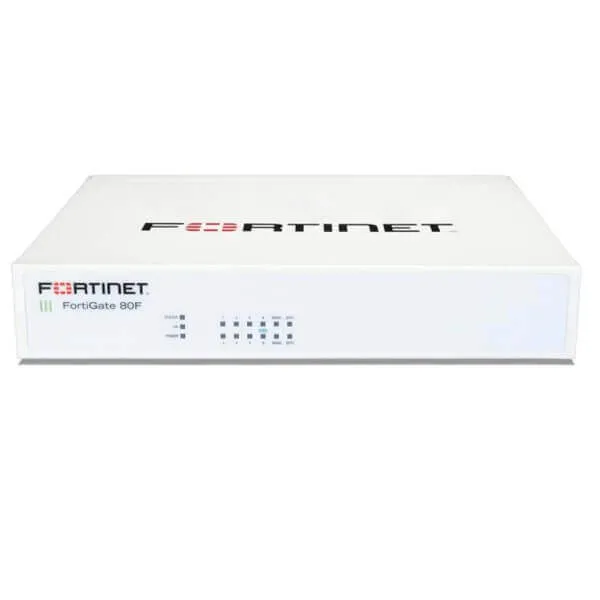
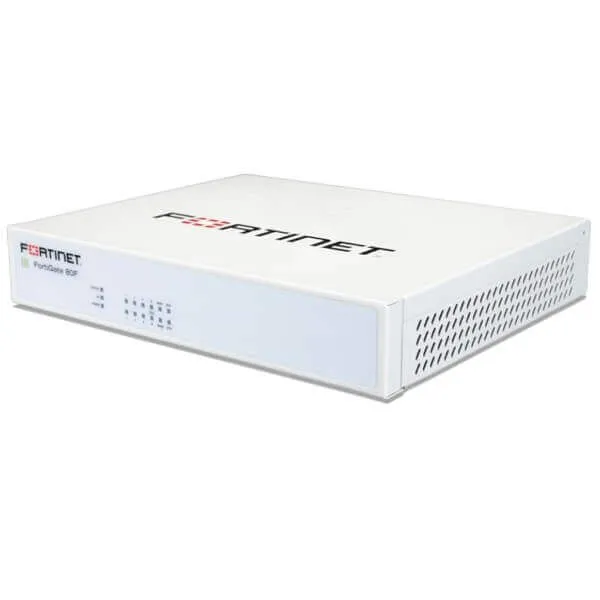
FortiGate 80F (FG-80F)
FortiGate 80F is a compact Fortinet next-generation firewall built for distributed enterprise sites, branch offices and mid-sized networks that need security and WAN connectivity in one platform. The FG-80F combines firewalling, secure SD-WAN, VPN, application control and FortiOS-based management, while FortiGuard security services can extend protection with subscription-based capabilities selected for the organization’s risk and operational requirements.
FortiGate 80F overview and direct buying answer
For buyers comparing business firewalls in Tanzania, the central question is whether the appliance can maintain useful performance after security inspection is enabled, not simply whether its headline firewall number looks large. Fortinet publishes up to 10 Gbps IPv4 firewall throughput for the FG-80F, together with 1.4 Gbps IPS throughput, 1 Gbps NGFW throughput and 900 Mbps threat-protection throughput under the vendor’s stated test conditions. It also lists 6.5 Gbps IPsec VPN throughput, 950 Mbps SSL-VPN throughput, 1.5 million concurrent TCP sessions and 45,000 new TCP sessions per second. These figures are useful sizing references, but actual production performance depends on configuration, enabled security services, traffic profile, encryption, logging and software version.
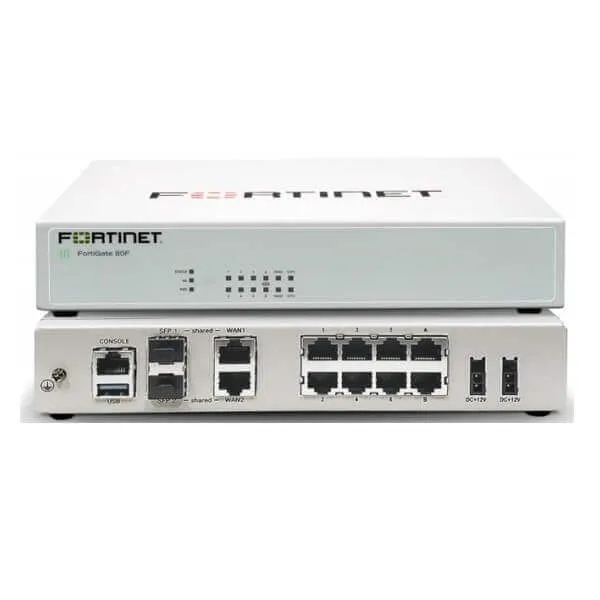
The FG-80F hardware provides two GE RJ45/SFP shared-media pairs, six GE RJ45 internal ports and two GE RJ45 FortiLink ports by default, along with USB 3.0 and an RJ45 console interface. Fortinet also lists a Trusted Platform Module and Bluetooth Low Energy. The base FG-80F should not be confused with 80F family variants that add storage, PoE, bypass, DSL or wireless capabilities. A quotation should therefore identify the exact required model and service bundle rather than treating every 80F-series appliance as interchangeable.
For a typical branch deployment, the FG-80F can sit between internet circuits and the internal LAN, enforce security policies, terminate site-to-site IPsec VPNs, segment departments or device classes, and provide SD-WAN steering across available WAN links. It can also participate in the broader Fortinet Security Fabric. Organizations planning FortiSwitch or FortiAP integration should validate topology, software compatibility, interface requirements and device counts during design. FourTeck’s Tanzania technology solutions site explains the wider network, Wi-Fi, firewall and infrastructure context that should be considered alongside the appliance.
Published IPv4 firewall throughput at 1518-byte and 512-byte UDP packet sizes; Fortinet lists 7 Gbps at 64 bytes.
Vendor-published IPS throughput using Fortinet’s enterprise traffic mix and logging methodology.
Published IPsec VPN throughput using the vendor’s stated AES256-SHA256 test profile.
Published maximum concurrent TCP sessions, useful when assessing busy branch and business environments.
Key capabilities of FortiGate 80F
Next-generation firewall security
The FG-80F can enforce firewall policies while supporting application-aware controls and FortiGuard-enabled security functions. In a production design, inspection profiles should reflect the organization’s applications and risk rather than enabling every feature without considering performance and operational impact.
Secure SD-WAN
FortiOS integrates SD-WAN capabilities so organizations can use multiple WAN paths with health checks, routing policies and application-aware steering. This can be valuable for sites using two internet providers or a primary circuit plus a backup path, provided the design is tested against real application requirements.
IPsec and remote connectivity
Site-to-site IPsec can connect branches, data-center resources and other trusted networks. Remote-access requirements should be planned according to current FortiOS capabilities, identity design and organizational policy. Published tunnel and throughput limits are engineering ceilings, not recommended user counts for every environment.
Segmentation and policy control
A firewall can separate staff, servers, guest Wi-Fi, cameras, voice devices and operational systems into controlled network zones. Segmentation is most useful when VLANs, switching, addressing and firewall rules are documented together instead of being added independently over time.
FortiLink ecosystem integration
The FG-80F includes FortiLink-designated interfaces and can form part of a Fortinet-managed branch architecture. When FortiSwitch and FortiAP devices are being considered, confirm the proposed models, supported software versions, port capacity, PoE needs and physical topology before ordering.
High-availability options
Fortinet lists active-active, active-passive and clustering high-availability configurations for the 80F series. A resilient design also needs appropriate WAN, switch, power and cabling redundancy; adding a second firewall alone does not remove every single point of failure.
Verified FG-80F technical specifications
| IPv4 firewall throughput | 10 / 10 / 7 Gbps (1518 / 512 / 64-byte UDP) |
| Firewall latency | 3.23 μs at 64-byte UDP |
| IPS throughput | 1.4 Gbps |
| NGFW throughput | 1 Gbps |
| Threat protection throughput | 900 Mbps |
| IPsec VPN throughput | 6.5 Gbps |
| SSL-VPN throughput | 950 Mbps |
| Concurrent TCP sessions | 1.5 million |
| New TCP sessions/second | 45,000 |
| Firewall policies | 5,000 |
| Shared media pairs | 2 × GE RJ45/SFP |
| Internal ports | 6 × GE RJ45 |
| Default FortiLink ports | 2 × GE RJ45 |
Performance values are Fortinet-published “up to” figures and vary with configuration. NGFW, IPS and threat-protection tests use specific enabled functions and traffic methodologies defined in the Fortinet datasheet. Use inspected-traffic requirements rather than raw firewall throughput alone when sizing.
Deployment, licensing and integration guidance
A useful FG-80F procurement exercise starts with a traffic and topology inventory. Record the speed of each internet circuit, expected growth, number of active users and devices, cloud applications, public services, VPN tunnels, guest networks and internal security zones. Then identify which traffic requires IPS, application control, malware inspection, web filtering or encrypted-traffic inspection. This turns a generic appliance purchase into a capacity decision based on inspected traffic.
FortiGuard security capabilities and FortiCare support are normally selected through service contracts or bundles appropriate to the required feature set and term. Because bundle names and inclusions can change over a product lifecycle, the quotation should state the exact service SKU, term and entitlement rather than relying on a broad phrase such as “licensed firewall.” Buyers should also identify renewal ownership, registration details and the person or team responsible for future subscription decisions.
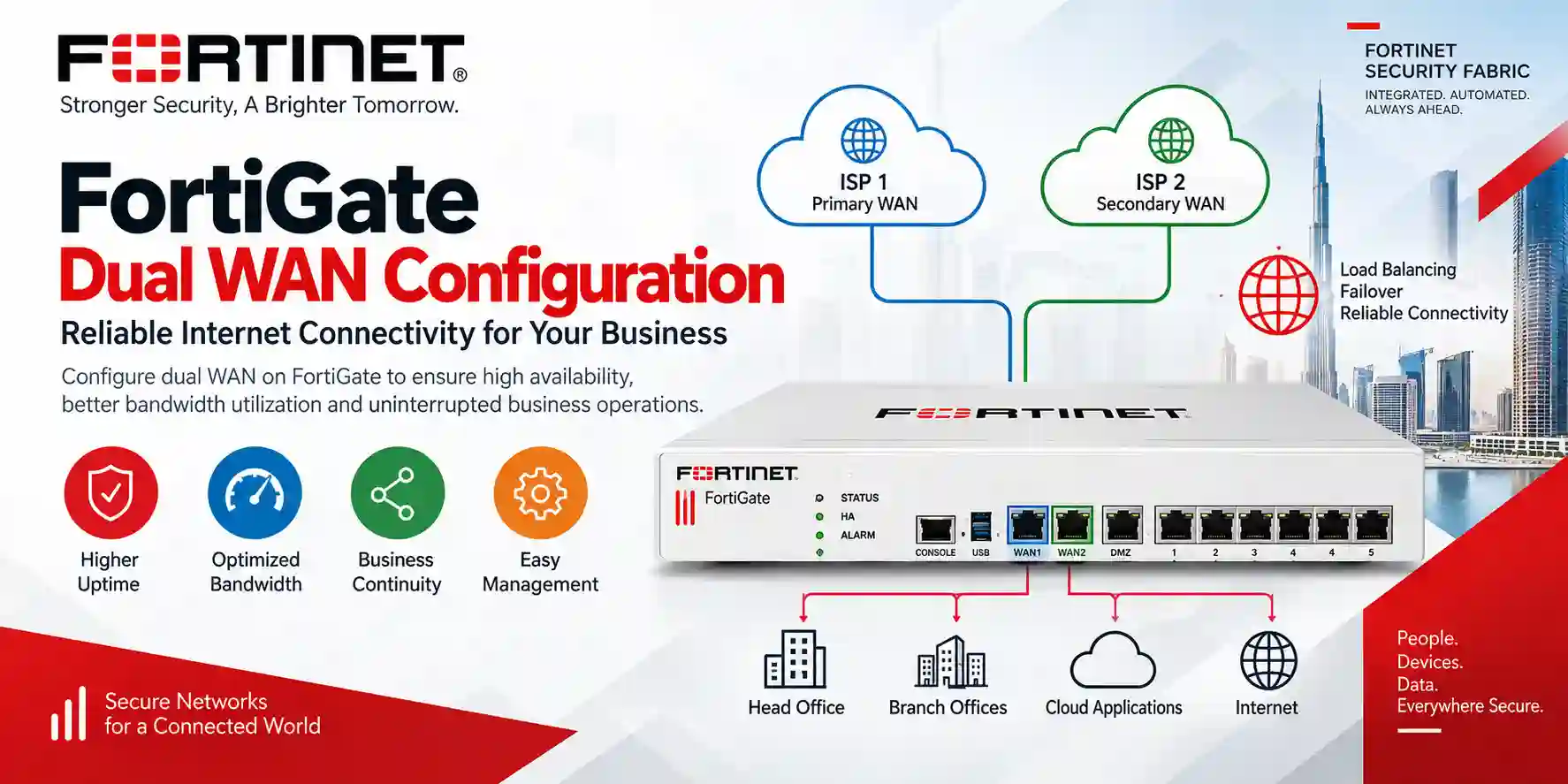
For dual-WAN projects, document which applications must fail over, whether inbound services need continuity, how DNS behaves, and whether sessions can tolerate path changes. SD-WAN can improve path selection, but business continuity depends on the complete architecture. The supplied FourTeck visual on FortiGate dual-WAN setup illustrates this broader design theme. For LAN planning, FourTeck’s networking and infrastructure guidance highlights the relationship between switching, VLANs, Wi-Fi, firewalling and power protection.
FortiGate 80F Tanzania
Organizations searching for FortiGate 80F Tanzania are usually trying to solve more than a firewall replacement. The project may involve two internet providers, branch-to-head-office VPN, cloud application access, guest Wi-Fi separation, remote administration, server protection or a need to apply consistent policies across several sites. The FG-80F can be a strong candidate when its inspected-security performance, interfaces and FortiOS feature set align with those requirements. A responsible sizing exercise should compare the site’s real traffic with Fortinet’s 1.4 Gbps IPS, 1 Gbps NGFW and 900 Mbps threat-protection reference figures rather than sizing against the 10 Gbps raw firewall figure alone.
Tanzania deployments can differ significantly between offices, retail locations, schools, hospitality properties, warehouses and operational sites. Internet service type, available redundancy, power conditions, rack environment and the skills of the team maintaining the network all affect the final design. If a business relies on cloud ERP, Microsoft 365, hosted voice or video meetings, WAN health and application prioritization may be as important as blocking threats. If the site hosts local servers or CCTV systems, segmentation can reduce unnecessary communication between user, server and device networks.
Before requesting a quotation, buyers should provide the number and speed of WAN links, current firewall model, approximate device count, important VPN connections, required security services, preferred subscription term and whether FortiSwitch or FortiAP integration is planned. It is also useful to state whether the project is a new installation or a migration. Migration projects may require export and review of existing policies, objects, NAT rules, VPN settings and routing so that obsolete configuration is not copied blindly to the new appliance.
FourTeck Tanzania positions firewalling as part of the wider business network. Its site covers firewall, VPN, network switching, Wi-Fi, structured cabling and integrated support considerations, helping procurement teams connect the FG-80F decision to the rest of the environment. For organizations operating in multiple markets, related FourTeck resources include FourTeck Africa technology solutions and FourTeck’s Fortinet UAE specialist site. These links are useful for regional technology planning; availability and commercial terms should still be confirmed for the specific destination and project.
FortiGate 80F (FG-80F) Dar es Salaam
For a Dar es Salaam office, branch, retail operation or service business, the FortiGate 80F can serve as the security and WAN policy point between business systems and one or more internet connections. The key design task is to understand how much traffic must be inspected and which services are business critical. A site with a fast fiber connection can still experience poor application performance if security inspection is undersized, internal switching is congested, DNS is unreliable or a backup WAN path has not been tested. The firewall selection should therefore be coordinated with the access switch, wireless network and ISP handoff.
Businesses with multiple Dar es Salaam locations may use site-to-site IPsec to connect branches to shared services, but the VPN design should define routing, overlapping subnet avoidance, failover behavior and which networks are actually allowed across the tunnel. A flat network that sends every device into the same security zone can make troubleshooting and policy control difficult. VLANs for staff, voice, servers, guests, cameras and management can create clearer boundaries when they are paired with deliberate firewall rules.
Dual-WAN is another common planning topic. Two providers do not automatically create resilient connectivity. Each circuit should have appropriate health checks and SD-WAN rules, and the team should decide what happens to important applications during an outage. Public services, inbound VPNs and third-party allowlists may need extra planning when the active public IP changes. Power resilience matters as well: the firewall, ISP termination equipment and critical switching must remain powered if the design expects connectivity to survive a short interruption.
When preparing an FG-80F quote for Dar es Salaam, include current and planned internet speeds, number of sites, subscription term, VPN needs and whether the firewall will manage or integrate with Fortinet switching or wireless. FourTeck can use this information to frame the product discussion around the complete network rather than a box-only purchase. The FourTeck Tanzania contact page is the verified route for submitting project requirements and requesting a commercial response.
FortiGate 80F (FG-80F) Mwanza
A FortiGate 80F deployment in Mwanza may support a regional office, distribution operation, hospitality site, healthcare environment, education facility or branch that depends on secure connectivity back to central applications. In these environments, the most valuable firewall design often combines perimeter protection with predictable branch connectivity. The FG-80F’s IPsec capability and FortiOS SD-WAN functions can support this model, but the network should be designed around actual circuit quality and application behavior rather than assuming every link performs the same way.
For branches that use cloud applications, it can be inefficient to backhaul all internet traffic through a distant head office simply because that was the historical topology. Secure local internet breakout may be appropriate for selected applications when policy, inspection and identity controls are correctly designed. Conversely, sensitive internal systems may still require traffic to traverse a controlled VPN path. The correct mix depends on application ownership, compliance requirements, user workflows and the organization’s monitoring strategy.
Procurement teams should also assess the physical environment. A compact desktop firewall still needs reliable power, suitable ventilation and organized cabling. If the site uses a UPS, include the ISP device and core switching in the runtime calculation. If fiber handoff is expected, confirm transceiver and interface compatibility instead of assuming that any SFP module will work. For copper connections, document whether the provider hands off Ethernet directly and whether public addressing, PPPoE or another method is used.
A useful Mwanza quotation request should describe current connectivity, future bandwidth plans, branch VPNs, the number of security zones, critical applications and subscription expectations. If the organization intends to standardize FG-80F appliances across several branches, it should also define naming, addressing, policy templates, firmware governance, backup procedures and logging. Standardization creates operational value only when the configuration and documentation are standardized along with the hardware.
FortiGate 80F (FG-80F) Arusha
Arusha businesses evaluating the FG-80F may include hospitality groups, tour operators, professional offices, educational organizations and multi-site companies that need secure internet access for staff and guests. These environments can place very different loads on a firewall. Guest internet may generate many concurrent sessions, while reservation, payment, ERP and collaboration systems need stable application performance. Separating guest and business traffic through VLANs and firewall policy is usually more manageable than allowing all users to share a single trusted network.
Hospitality and visitor-facing environments should pay particular attention to wireless architecture. The firewall can enforce policy and segmentation, but Wi-Fi performance also depends on access-point density, channel planning, switching capacity and cabling. FortiAP devices can integrate into Fortinet-managed architectures, while third-party wireless systems can also sit behind well-defined firewall zones. The purchasing decision should therefore include the wireless and switching topology, not just the number of internet users.
For organizations with remote staff or administrators, secure remote connectivity should be designed around current supported Fortinet methods, identity controls and least-privilege access. Avoid treating a VPN as an unrestricted extension of the office LAN. Define which user groups need which applications, apply multi-factor authentication where the selected solution supports and requires it, and review logs for unusual access. Site-to-site tunnels should receive similar attention, especially when third parties or partner networks are connected.
When comparing FortiGate 80F options in Arusha, ask for the exact appliance model and the exact FortiGuard/FortiCare term in the quote. The base FG-80F differs from PoE, storage and wireless variants within the wider 80F family. Clear model identification prevents procurement errors and makes future support easier. FourTeck’s wider Tanzania technology portfolio can also help connect firewall selection with network switches, Wi-Fi, UPS and structured cabling requirements that determine whether the final installation performs reliably.
FortiGate 80F (FG-80F) Dodoma
Organizations in Dodoma considering the FortiGate 80F may be planning secure connectivity for administrative offices, professional services, education, healthcare, NGOs or distributed operations. In these projects, policy clarity is often as important as appliance performance. The firewall should reflect who is allowed to access internal services, which systems can communicate between network zones, how guest users reach the internet and how remote or branch connections are authenticated and monitored.
The FG-80F provides substantial published session capacity and branch-class inspected throughput, but those numbers should be translated into an operational design. A site with hundreds of endpoints does not necessarily create the same load as another site with fewer users performing heavy encrypted transfers. Security profiles, SSL inspection, logging, application mix and concurrent sessions all influence resource use. Future bandwidth upgrades should also be considered so the firewall does not become the first bottleneck after an ISP upgrade.
For government-adjacent and regulated environments, procurement teams may have formal requirements for documentation, change control, logging, retention or approved configurations. Those requirements should be identified before ordering subscriptions and management components. The FG-80F can participate in centrally managed Fortinet environments, but centralized operations should be designed around the organization’s actual administrative model, software versions and security governance.
A Dodoma project brief should include a simple network diagram, WAN details, VLANs, server locations, VPN peers, public services, existing security subscriptions and expected project timeline. This helps separate hardware requirements from configuration work. If the appliance is replacing another firewall, plan a rollback method and maintenance window, and test critical services after cutover. Good documentation should capture interface assignments, routing, policies, VPNs and administrative access so ongoing support does not depend on one individual’s memory.
FortiGate 80F (FG-80F) UAE
For UAE projects, the FG-80F is relevant to branch offices and mid-sized environments that want Fortinet secure networking with SD-WAN and NGFW capabilities in a compact platform. Buyers operating between Tanzania and the UAE may benefit from standardizing firewall families, policy conventions and VPN architecture across countries, while still adapting ISP handoffs, addressing, regulatory requirements and support arrangements to each site. Standardization should simplify operations, not force identical designs onto offices with different traffic profiles.
A UAE branch may have high-speed internet connectivity that makes inspected throughput especially important. The Fortinet-published 1 Gbps NGFW and 900 Mbps threat-protection figures are more meaningful sizing references for heavily inspected traffic than the 10 Gbps raw firewall maximum. If the site expects internet speeds near or above those inspected figures, application mix, security profiles and future upgrades should be reviewed carefully before confirming the model.
Multi-site organizations can use IPsec and SD-WAN to connect UAE and African branches, but long-distance application performance depends on latency and the application architecture as well as the firewall. Where SaaS platforms are used, secure local breakout may reduce unnecessary backhaul. Where central applications are hosted in a data center, routing and tunnel resilience become more important. Logging, monitoring and configuration backup should be designed consistently across the estate.
FourTeck’s Fortinet UAE resource provides a regional specialist path for Fortinet-related requirements, while the Tanzania site remains the relevant route for Tanzania project discussions. Buyers should request the exact hardware and service bundle required for each destination and confirm commercial terms at quotation time rather than assuming pricing, stock or service coverage is identical across markets.
FortiGate 80F (FG-80F) Uganda
Uganda deployments of the FortiGate 80F can suit organizations that need a consistent branch-security platform across East Africa. A company with offices in Tanzania and Uganda may choose the same firewall family to simplify training and configuration templates, but each location should still be sized independently. WAN bandwidth, cloud usage, VPN traffic, local servers and the number of inspected sessions can differ substantially from one branch to another.
The FG-80F can support secure SD-WAN and IPsec designs where multiple links are available. The engineering objective is not simply to label one connection primary and another backup. Health checks should reflect real application reachability, routing should avoid unintended asymmetric paths, and the organization should understand what happens to active sessions when a path changes. For branches with limited on-site IT resources, remote management and configuration backup procedures should be established before the appliance enters production.
Security policy should also be consistent enough to audit. Define standard zones for corporate users, guests, servers, cameras and management devices where appropriate, then document exceptions rather than creating ad hoc rules at every branch. Subscription selection should reflect the security controls the organization intends to operate. Paying for a capability without assigning ownership for monitoring, updates and policy review does not create the intended security value.
FourTeck’s regional network includes FourTeck Uganda, which can be useful for Uganda-focused technology enquiries. For a cross-border rollout, procurement teams should provide a per-site schedule of WAN speeds, device counts, VPN relationships and desired service terms so each location can be evaluated without relying on a single generic branch specification.
FortiGate 80F (FG-80F) Kampala
Kampala offices often combine cloud applications, local business systems, Wi-Fi, voice, video meetings and branch connectivity on the same network. The FG-80F can provide the firewall and SD-WAN layer for such an environment, but performance depends on how those services are prioritized and segmented. For example, a large backup job should not unexpectedly degrade real-time voice or a critical SaaS application simply because all traffic follows the same policy and path.
A good Kampala design starts with application categories and security zones. Staff endpoints, guest users, servers and infrastructure management can be separated so access is intentional. Application control and threat inspection can then be applied according to risk. Where encrypted inspection is required, test compatibility with important applications and endpoints and account for the additional performance demand. The goal is a policy set that security teams can explain and maintain, not the maximum possible number of rules.
If the site has two WAN providers, FortiOS SD-WAN can use health measurements and rules to select paths, but the organization should define success criteria before implementation. Does the design need simple internet continuity, stable access to a cloud platform, resilient site-to-site VPN or all three? These goals may require different health checks and routing behavior. Inbound services and public IP dependencies should be documented separately.
For procurement, request the FG-80F by exact model and specify whether the quote should include a FortiGuard security bundle and FortiCare term. Include installation or migration scope separately so commercial comparisons remain clear. If centralized management, logging or Fortinet switching and wireless are part of the project, list those requirements at the same time. This reduces the risk of receiving a firewall quote that omits components necessary for the intended operating model.
FortiGate 80F (FG-80F) Arua
For an Arua branch or regional operation, network resilience may depend as much on connectivity planning and remote manageability as on firewall throughput. The FG-80F provides a capable branch platform for firewalling, VPN and SD-WAN, but a remote site should be designed so common failures can be diagnosed without immediate physical access. Clear interface labels, configuration backups, monitored WAN health and documented recovery procedures are particularly valuable.
If the site has primary and secondary connectivity, test both paths under real conditions. A backup circuit that has never carried business traffic can fail at the moment it is needed because of addressing, DNS, routing or account issues. SD-WAN rules should identify which applications deserve the best available path and which traffic can use a lower-priority link. VPN failover should also be tested so the branch can reach required central resources when the preferred circuit is unavailable.
Power continuity deserves equal attention. A firewall on a UPS does not preserve connectivity if the ISP modem, switch or wireless infrastructure loses power. Build the critical network chain into the power plan and monitor UPS health. Environmental placement should keep equipment protected from excessive heat, dust and accidental disconnection. Simple physical discipline can prevent incidents that software cannot solve.
An Arua quotation request should therefore include more than “one FortiGate 80F.” State the internet links, expected users and devices, VPN destinations, security services, required term and whether remote deployment assistance is needed. If the appliance is part of a multi-branch standard, include the desired configuration baseline. This enables a more useful commercial and technical discussion and helps ensure that the hardware, licensing and deployment scope are aligned.
FortiGate 80F (FG-80F) Mbarara
Mbarara organizations considering an FG-80F may need secure internet access for a branch, campus, healthcare site, retail operation or professional office. In these networks, endpoint count is only one sizing input. The amount of encrypted web traffic, use of cloud storage, video meetings, VPN traffic and security inspection can have a larger effect on firewall demand. The published Fortinet performance figures should be mapped to the intended profiles and traffic mix.
Network segmentation can improve both security and operations. Business users may require access to internal systems, while guests need internet only. Cameras and IoT devices can be restricted to the services they actually require. Administrative interfaces can be placed in a management zone accessible only to authorized staff. These boundaries reduce unnecessary trust and make firewall logs more meaningful during troubleshooting.
For a branch connected to headquarters, define which services remain usable if the VPN is down. Cloud applications may continue through local internet, while internal file or ERP services may not. This distinction helps prioritize resilience investments. If a second WAN circuit is available, determine whether it should protect internet access, the VPN, or both. Application-aware SD-WAN rules can support these objectives when the underlying routing and health checks are designed carefully.
The purchasing team should ask for the exact FortiGate hardware, subscription package and term, and should keep deployment services as a clearly described scope. Confirm whether configuration migration, VPN setup, VLAN policy, logging, testing and documentation are included. This creates a more accurate comparison between proposals and reduces ambiguity at handover. For multi-site organizations, consistent documentation is often one of the most valuable outcomes of the project.
FortiGate 80F (FG-80F) Gulu
A Gulu deployment may place the FG-80F at a branch edge where dependable connectivity to cloud and central systems is essential. The appliance’s compact format and FortiOS feature set can fit this role, but branch design should emphasize operational simplicity. Complex rule sets, undocumented routing and inconsistent naming make remote troubleshooting harder. A concise policy architecture with clear zones and standardized objects is usually easier to support.
If the organization uses IPsec to connect Gulu with another office, avoid overlapping IP address ranges between sites. Address conflicts complicate routing and can require unnecessary translation. Plan subnets before expansion, reserve space for future VLANs and document tunnel networks. If two internet links are available, test tunnel behavior across both and verify that remote peers accept the relevant public addresses.
Security services should be selected and operated according to the organization’s needs. IPS, application control, malware protection and web controls can add important visibility and protection, but they also require policy decisions and ongoing review. Logs should go somewhere useful, administrators should know how to retrieve them, and alerts should have an owner. A subscription alone is not a substitute for an operating process.
When seeking an FG-80F quote for Gulu, provide a short description of the branch purpose, WAN links, critical applications and central-site dependencies. State whether the appliance will be installed as a standalone firewall or as part of a Fortinet switching, wireless or centralized management architecture. That information helps determine whether the base appliance and selected service bundle are sufficient or whether related components need to be considered in the bill of materials.
FortiGate 80F (FG-80F) Kenya
Kenya is a natural regional planning market for organizations standardizing security across East African branches. The FG-80F can be evaluated as a repeatable branch firewall where each site needs secure internet, IPsec connectivity and SD-WAN. Standard hardware can simplify spares and training, while a shared FortiOS policy framework can make audits and changes more predictable. Nevertheless, each Kenyan site should be sized against its own bandwidth and inspection requirements.
A Nairobi office with high-speed fiber and heavy cloud use may place very different demands on the appliance than a smaller branch using a lower-bandwidth link. Similarly, a site hosting public services or terminating many VPN connections needs a different review from a simple outbound-internet branch. Use Fortinet’s published inspected-throughput metrics as engineering references and leave capacity for growth, software changes and new security requirements.
Cross-border VPN architecture should be documented with routing ownership and failover in mind. If Tanzania, Kenya and Uganda branches communicate directly, a full-mesh design may become harder to maintain as locations grow. Hub-and-spoke or SD-WAN-based designs can simplify some environments, while others may benefit from centralized cloud or data-center connectivity. The best topology depends on application location, latency sensitivity and resilience goals.
FourTeck’s Kenya technology site provides a matching regional route for Kenya-focused requirements. Procurement teams coordinating multiple countries should request separate destination-specific commercial terms while keeping a common technical baseline. This makes it easier to compare hardware, FortiGuard terms, installation scope and lifecycle responsibilities without assuming that every market has identical availability or logistics.
FortiGate 80F (FG-80F) Kuwait
Kuwait businesses considering the FortiGate 80F may use it for branch security, VPN connectivity and secure SD-WAN in compact business environments. High-speed broadband can make security-inspection sizing especially important. If a circuit approaches gigabit speeds and the organization intends to enable multiple inspection functions, the 1 Gbps NGFW and 900 Mbps threat-protection references should be considered carefully along with real traffic behavior and expected growth.
Organizations operating between Kuwait and African offices can standardize policy concepts such as corporate, guest, server and management zones while adapting routing and WAN details per location. Site-to-site IPsec can secure traffic between offices, but application experience also depends on latency and where systems are hosted. SaaS traffic may be better served by secure local breakout, whereas private applications may require controlled tunnels to a central environment.
A procurement specification should identify the exact FG-80F model, security service term, support requirements and whether centralized management or logging is needed. If the firewall will connect to FortiSwitch or FortiAP equipment, include those models and topology in the design review. Confirm optics and cabling for any SFP use, and avoid purchasing transceivers solely by connector type without compatibility validation.
The deployment scope should also include configuration backup, administrative access controls, firmware planning and handover documentation. These lifecycle tasks are easy to omit from a hardware quote but important to long-term reliability. For regional operations, assign ownership for renewals and registration so service contracts do not lapse unnoticed. Commercial availability and support arrangements should be confirmed specifically for Kuwait at the time of quotation.
FortiGate 80F (FG-80F) Ghana
Ghana projects can use the FG-80F as a branch or mid-sized business security gateway where internet protection, VPN and WAN control need to be combined. A multi-country organization may value a common Fortinet platform because administrators can apply familiar FortiOS concepts across sites. The benefit is strongest when policies, naming and documentation are standardized rather than merely purchasing the same appliance everywhere.
For a Ghana branch using cloud applications, determine whether security inspection and internet breakout occur locally or through another country. Backhauling all traffic can add latency and consume VPN bandwidth, while local breakout requires consistent local security policy and logging. The correct design depends on data flows, compliance requirements and operational ownership. SD-WAN can assist path selection where multiple circuits are available, but it should be configured against measurable application objectives.
Power, switching and ISP equipment should be included in resilience planning. A firewall cannot maintain service through an outage if upstream or downstream devices fail. Where a UPS is used, calculate the load of the critical chain and test runtime periodically. Where two providers are used, test failover during a planned maintenance window and document any applications that depend on a fixed public IP.
A Ghana quotation should specify appliance, service bundle, term, deployment expectations and any integration requirements. Avoid relying on generic claims such as “supports all users” because user count alone is not a dependable firewall sizing method. Provide bandwidth, application and inspection information instead. If the project is part of a broader African rollout, maintain a per-site worksheet so differences in WAN, VPN and security requirements remain visible during procurement.
FortiGate 80F (FG-80F) Nigeria
Nigeria deployments of the FG-80F may range from corporate branches to retail, professional services and distributed operations. In larger cities, high-bandwidth connectivity and heavy cloud usage can push organizations to focus on inspected throughput rather than basic firewall capacity. The FG-80F’s published 1.4 Gbps IPS, 1 Gbps NGFW and 900 Mbps threat-protection figures provide useful reference points for this assessment, subject to Fortinet’s test conditions and the production configuration.
Multi-WAN design can be particularly valuable where organizations want resilience across different providers. The design should consider more than link availability. Performance thresholds, latency, packet loss and application reachability can influence which path is best. SD-WAN rules should be understandable to the operations team, and changes should be documented so troubleshooting does not become dependent on hidden policy interactions.
For businesses connecting Nigerian branches to Tanzania or other regional offices, IP addressing and route design should be planned at group level. Reusing the same private subnets at many branches creates avoidable VPN complexity. A structured address plan, consistent VLAN naming and centralized configuration standards can reduce this problem. Security rules should then permit only the cross-site services required by business workflows.
Procurement teams should ask vendors to separate appliance hardware, FortiGuard/FortiCare term and professional services in the quote. This makes lifecycle cost and scope easier to understand. Confirm what configuration, testing and documentation are included, and identify who owns subscription renewal. For organizations with several branches, consider whether centralized management and logging are required as part of the architecture rather than adding them after the rollout becomes difficult to administer.
FortiGate 80F (FG-80F) Seychelles
For Seychelles organizations, the FortiGate 80F can be considered for business, hospitality and branch environments that need secure internet access and controlled connectivity to remote systems. Island deployments can make remote manageability and careful procurement especially important because replacement logistics and specialist access may differ from major mainland cities. The network should therefore be documented so routine configuration and diagnosis can be performed predictably.
Hospitality sites may have a mix of guest Wi-Fi, staff systems, payment applications, cameras, building systems and administrative services. These should not automatically share one trusted network. VLAN and firewall segmentation can create boundaries between user groups and device classes, while policies allow only necessary communication. Wireless capacity and switching remain separate design responsibilities; the firewall cannot compensate for poor radio planning or undersized PoE infrastructure.
If connectivity is critical, assess available secondary WAN options and define what failover is expected to protect. Cloud applications may recover easily through a second link, while inbound services or VPN peers can depend on public addressing and require additional configuration. Test the backup path and record the result. For power resilience, include the firewall, provider equipment, switches and essential access points in the continuity plan.
A Seychelles FG-80F request should include the exact destination, required subscription term, WAN interfaces, VPN needs and deployment expectations so logistics and technical scope can be evaluated together. Do not assume stock, delivery time or local support presence without written confirmation for the project. If the appliance will be remotely managed from another country, define administrator access, configuration backup, logging and escalation procedures before go-live.
Related network planning for an FG-80F project
A firewall is only one part of the path between users and applications. FourTeck Tanzania’s broader portfolio covers managed switching, Wi-Fi, structured cabling, servers, UPS and integrated IT services. For an FG-80F deployment, the most relevant internal considerations are switch VLAN support, sufficient uplink capacity, wireless segmentation, reliable power and clear cabling. Review the FourTeck Tanzania shop and technology catalogue when coordinating related equipment, and the FourTeck Tanzania services page when the requirement includes design, installation, configuration or lifecycle assistance.
For security-specific projects, an FG-80F can be paired conceptually with managed switching and wireless segmentation so corporate, guest, server and device traffic have clear boundaries. If the business is planning dual WAN, the ISP handoffs, routing and public-IP dependencies should be documented. If it is planning branch VPN, IP addressing and tunnel failover should be documented. If it is planning centralized management, administrative roles, backups and logging should be included in the scope. These details are what turn a firewall purchase into an operational security solution.
FortiGate 80F quotation checklist
✓ Exact model: FortiGate 80F / FG-80F, and whether another 80F-family variant is actually required.
✓ Primary and backup WAN speeds, handoff type, public addressing and expected bandwidth growth.
✓ Required FortiGuard security services and FortiCare term, with exact bundle/SKU confirmed in the quote.
✓ Number of branches, site-to-site VPN peers, remote-access requirements and critical applications.
✓ VLAN/security zones for staff, guests, servers, voice, cameras, IoT and management where applicable.
✓ FortiSwitch, FortiAP, centralized management, logging, HA, optics, rack, UPS and cabling requirements.
FortiGate 80F FAQs
What is the FortiGate 80F designed for?
Fortinet positions the 80F series for distributed enterprise sites and mid-sized business environments requiring converged firewalling, secure SD-WAN and security. Suitability for a specific site should be determined from inspected throughput, interfaces, VPN needs, traffic profile and growth rather than a generic user-count rule.
What is the FG-80F firewall throughput?
Fortinet publishes IPv4 firewall throughput of up to 10/10/7 Gbps for 1518/512/64-byte UDP traffic. Security-inspection figures are lower: the datasheet lists 1.4 Gbps IPS, 1 Gbps NGFW and 900 Mbps threat protection. Those inspected figures are often more useful for real-world sizing when security profiles are enabled.
Does FortiGate 80F support SD-WAN?
Yes. The FortiGate 80F series integrates secure SD-WAN through FortiOS. Organizations can use multiple WAN paths and policies, but resilient design still requires correct routing, health checks, public-IP planning and testing of critical applications.
How many ports does the base FG-80F have?
The official datasheet lists two GE RJ45/SFP shared-media pairs, six GE RJ45 internal ports and two GE RJ45 FortiLink ports by default, plus USB 3.0 and an RJ45 console port. Other 80F-family variants have different hardware, so confirm the exact model before ordering.
Does the FG-80F require a FortiGuard subscription?
The appliance can perform core firewall and networking functions, while many continuously updated FortiGuard security services and FortiCare support entitlements are subscription based. The appropriate bundle and term depend on the required protection and support model. Request the exact service SKU and inclusions in the quotation.
Can the FG-80F connect branch offices by VPN?
Yes. Fortinet lists IPsec VPN capabilities for the platform, including up to 6.5 Gbps IPsec throughput under its stated test method. Actual performance varies. Branch VPN planning should also consider routing, addressing, failover, authentication and the applications using the tunnel.
Can FortiGate 80F manage FortiAP access points?
FortiGate appliances include integrated wireless-controller functionality for supported FortiAP deployments. Confirm the proposed FortiAP models, FortiOS compatibility, supported device counts and topology before procurement. Wireless coverage and capacity still require radio planning and appropriate switching.
Is FG-80F suitable for dual internet connections?
It can support multi-WAN and SD-WAN designs. Whether it meets a particular dual-internet requirement depends on interface use, ISP handoffs, desired failover behavior, application policies and bandwidth. Both circuits and the intended failover should be tested before production reliance.
How should I size an FG-80F for Tanzania?
Start with current and planned WAN speeds, inspected traffic, concurrent sessions, VPN demand, security services, internal zones and growth. Compare these requirements with Fortinet’s inspected-throughput specifications rather than using only the raw firewall number or a simple user count.
Decision recap
The FortiGate 80F is a compact branch and mid-sized-business NGFW with secure SD-WAN, strong IPsec performance and a flexible mix of copper and shared RJ45/SFP interfaces. Its suitability depends on inspected traffic and deployment design. Use Fortinet’s 1.4 Gbps IPS, 1 Gbps NGFW and 900 Mbps threat-protection figures as important sizing references, confirm the exact FortiGuard/FortiCare package, and include WAN resilience, VPN, switching, Wi-Fi and power requirements in the project scope.
For Tanzania procurement, send FourTeck the WAN speeds, current firewall, security services, number of sites, VPN requirements and desired subscription term. This information supports a more precise technical and commercial response without making unsupported assumptions about stock, pricing or delivery.
Plan your FG-80F deployment with FourTeck Tanzania
A useful consultation can cover model sizing, dual-WAN design, IPsec connectivity, network segmentation, FortiGuard service selection, FortiSwitch/FortiAP integration, migration and documentation. Bring your current topology or a simple list of WAN links, VLANs and critical applications. FourTeck can use that information to discuss an appropriate bill of materials and project scope.




Reviews
There are no reviews yet.