
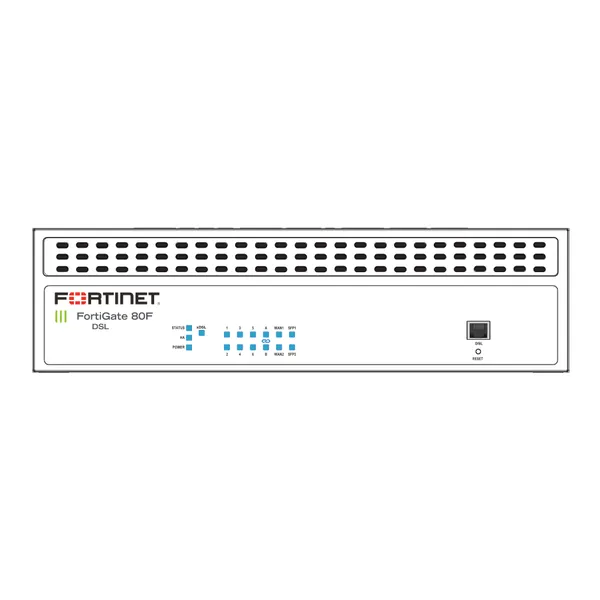
FortiGate 80F DSL (FG-80F-DSL) Tanzania
FortiGate 80F DSL is a compact Fortinet next-generation firewall designed for distributed enterprise and branch environments that can benefit from integrated DSL connectivity alongside Ethernet WAN options. For Tanzanian organizations planning a branch refresh, secure WAN rollout, VPN deployment or consolidated edge-security project, FG-80F-DSL provides a practical platform for bringing firewall policy, secure SD-WAN and WAN connectivity into one FortiGate appliance.
FortiGate 80F DSL overview
Fortinet identifies the FG-80F-DSL as an 80F-series model equipped with eight Gigabit Ethernet RJ45 ports, two RJ45/SFP shared-media WAN ports and an embedded DSL module. The broader FortiGate 80F family converges next-generation firewalling, SD-WAN and security functions through FortiOS. This makes the DSL variant particularly relevant where an organization wants FortiGate security while retaining DSL as a primary, secondary or site-specific access technology.
The purchasing decision should begin with the actual circuit presented at the site, expected user and application load, inspection requirements, VPN needs, high-availability strategy and the FortiGuard services required by policy. A model name alone should not be treated as a complete design. FourTeck can help customers prepare the technical information needed for a suitable quotation and deployment discussion.
Verified hardware highlights
Model: FortiGate 80F-DSL
SKU: FG-80F-DSL
Ethernet: 8 × GE RJ45 ports
WAN: 2 × RJ45/SFP shared-media WAN ports
DSL: Embedded DSL module
Platform: FortiOS / FortiGate 80F family

Why integrated DSL can matter at the branch edge
Branch networks are rarely designed around security alone. They also have to accommodate the access circuits available at each location, migration plans, provider handoffs, failover requirements and operational simplicity. An integrated DSL model can reduce the need for a separate modem in designs where the DSL service and local provider requirements are compatible with the appliance. At the same time, the shared-media WAN interfaces provide additional design flexibility for Ethernet or SFP-based connectivity.
For buyers, the key question is not simply whether a firewall has a DSL port. The important question is whether the complete WAN design matches the service delivered at the premises. Before procurement, document the provider, DSL service type, addressing method, authentication requirements, VLAN details if applicable, expected bandwidth and any provider-supplied equipment that must remain in the path. This information helps avoid assumptions during configuration.
Secure networking, SD-WAN and FortiOS
The FortiGate 80F family is positioned by Fortinet as a converged next-generation firewall and SD-WAN platform. FortiOS brings networking and security controls into the same operating environment, allowing administrators to develop policy around users, applications, interfaces, VPNs and WAN paths. In multi-site deployments, this convergence can simplify the architecture compared with managing unrelated routing and security products at every branch.
Secure SD-WAN is especially relevant when a site has more than one usable WAN path. Organizations can design path-selection and resiliency policies according to their application and operational requirements. The exact configuration should be based on measured circuit characteristics and business priorities rather than generic rules. Customers planning multiple links can also review FourTeck’s Tanzania guidance on dual-WAN and multi-WAN designs through the relevant FortiGate solution content available on the Tanzania website.
Security services and licensing planning
A FortiGate hardware purchase and the security-service plan should be considered together. Organizations commonly need to decide which FortiGuard security services, support coverage and subscription term fit their risk profile and operational model. The right bundle can depend on whether the appliance is being used primarily for basic edge policy, advanced threat inspection, web and application controls, remote access, site-to-site connectivity or a broader Security Fabric design.
Procurement teams should ask for quotations that clearly identify the appliance, service bundle, subscription duration, support terms and any required accessories. This avoids comparing quotes that appear similar but contain different service entitlements. Renewal planning should also be included in the lifecycle process so that security subscriptions do not become an afterthought.
Branch firewall
Apply centralized security policy at branch and distributed sites while keeping WAN and security functions on the FortiGate platform.
VPN connectivity
Plan secure site-to-site or remote connectivity according to organizational policy, identity architecture and application requirements.
WAN resilience
Use available WAN interfaces to develop resilient connectivity designs when multiple compatible circuits are available at the site.
FortiGate 80F DSL Tanzania
Organizations searching for FortiGate 80F DSL in Tanzania are often balancing three requirements: a dependable branch firewall, flexible WAN connectivity and a security platform that can be administered consistently across locations. FG-80F-DSL addresses that design space by combining the FortiGate 80F platform with an embedded DSL module. For Tanzanian buyers, this can be relevant in sites where DSL remains part of the connectivity mix or where a transition between access technologies is being planned.
A Tanzania deployment should begin with a circuit inventory rather than a product-only specification. Record the primary internet connection, any backup connection, public or private addressing, ISP authentication, required VPN peers, business-critical cloud applications, internal VLANs and expected growth. If DSL is intended for the integrated module, confirm the service characteristics before purchase. If the site also has fibre, fixed wireless or another Ethernet-delivered service, document how those circuits should participate in failover or SD-WAN policy.
Security planning is equally important. Decide which traffic needs inspection, which applications need priority, whether guest and corporate networks must be segmented, and how administrators will monitor events. Organizations with multiple Tanzanian branches should establish a repeatable template for interface naming, addressing, VPNs, policy, logging and change control. That approach makes the appliance part of a managed architecture rather than a standalone box.
For quotation preparation, provide the required appliance model, desired FortiGuard or support term, expected deployment role and any accessories. FourTeck can use this information to structure a more relevant commercial discussion without making assumptions about stock, delivery or service compatibility. Customers can also explore FourTeck Tanzania for related networking and security information and use the verified contact page for a project-specific request.
FortiGate 80F DSL Dar es Salaam
For businesses in Dar es Salaam, FG-80F-DSL can be considered for offices, professional-service environments, retail operations, branch locations and distributed business networks where FortiGate security and flexible WAN design are required. The city contains a wide variety of connectivity environments, so procurement should not assume that every site will use the same circuit type or handoff. A head office may use a high-capacity Ethernet service while a smaller branch or temporary location has different access options.
The embedded DSL capability is most useful when it matches the actual provider service. Before installation, confirm the line technology and authentication details with the connectivity provider. Where more than one WAN circuit is available, define which applications must survive a primary-link outage and what performance is acceptable during failover. Critical services such as ERP access, payment systems, cloud collaboration and VPN traffic may require different treatment from ordinary browsing.
Dar es Salaam buyers should also plan network segmentation before the firewall is configured. Separate corporate users, servers, voice systems, guest access, cameras and other device classes where the business risk warrants it. Firewall policy can then be designed around approved communication paths rather than allowing broad access between internal networks. If the organization has remote branches, define site-to-site VPN addressing carefully to avoid overlapping subnets.
A useful quotation request should include the number of sites, WAN services, expected users, VPN requirements, security-service term and whether centralized management or logging is part of the project. This creates a clearer basis for evaluating FG-80F-DSL and related Fortinet components. Avoid selecting a firewall solely from headline throughput; inspection profile, traffic mix and enabled services can materially affect real deployment requirements.
FortiGate 80F DSL Mwanza
In Mwanza, organizations evaluating FortiGate 80F DSL may include regional offices, logistics operations, healthcare providers, educational institutions, hospitality businesses and multi-site enterprises. The integrated DSL variant can be useful when the branch connectivity design includes a compatible DSL service, while the additional WAN interfaces allow the firewall to participate in broader connectivity strategies.
For a Mwanza branch, start by identifying what happens when the internet connection degrades or fails. Some organizations can tolerate short interruptions; others rely continuously on cloud applications, remote databases, IP communications or centralized business systems. A resilient design should specify the primary path, secondary path, health-check method and application priorities. Secure SD-WAN capabilities can then be configured around defined business outcomes instead of generic failover.
Remote-site security also benefits from standardized policy. If Mwanza is one location within a larger organization, align its firewall objects, VLAN structure, VPN conventions and logging requirements with the wider network. This reduces troubleshooting complexity and makes future changes easier to review. Administrators should also document who can change the firewall, how configuration backups are protected and how firmware maintenance is approved.
When requesting an FG-80F-DSL quotation for Mwanza, state whether DSL is a required production interface or simply a desired connectivity option. Include the number and type of WAN links, expected security subscriptions, VPN peers and any transceiver or mounting needs. This allows the procurement conversation to focus on the complete solution rather than only the appliance identifier.
FortiGate 80F DSL Arusha
Arusha organizations may consider FG-80F-DSL for branch security, hospitality networks, offices, travel-sector operations, institutions and businesses that need controlled access between users, cloud services and remote locations. The value of the DSL model depends on the actual WAN environment, so circuit verification should be part of the purchasing process.
Hospitality and guest-facing environments, for example, often need clear separation between guest traffic and business systems. An office may instead prioritize VPN connectivity to a headquarters or cloud environment. These are different policy problems even when the same firewall model is used. Define network zones, approved communication paths, DNS and web policy, remote administration rules and logging requirements before deployment.
For organizations with more than one circuit, application-aware path selection can improve resilience, but it should be based on measured link quality. Identify latency-sensitive applications, essential SaaS services and any traffic that must follow a specific path. Test failover during commissioning rather than waiting for a real outage to discover a routing, NAT or VPN dependency.
Arusha procurement teams should compare quotations on equivalent terms. Confirm the exact FG-80F-DSL SKU, subscription duration, support coverage and accessories. If the firewall will join an existing Fortinet environment, provide the current FortiOS strategy and management architecture so compatibility and operational planning can be discussed before implementation.
FortiGate 80F DSL Dodoma
For Dodoma offices and institutional networks, FG-80F-DSL can support a branch-edge design where security policy, VPN connectivity and WAN management need to be consolidated. Government-facing organizations, professional offices, NGOs, education environments and commercial branches may all have different compliance and availability requirements, so the firewall should be sized and configured from a documented requirement set.
The embedded DSL module can reduce external equipment in compatible deployments, but the line service must be verified. Where Ethernet connectivity is used, the shared RJ45/SFP WAN interfaces provide alternatives for appropriate handoffs. If a backup circuit is planned, define whether it is expected to carry all traffic or only critical applications during an outage.
Dodoma deployments should also address remote access. Determine which staff require access, what authentication controls apply, which internal resources are reachable and how access is logged. Site-to-site connectivity should use a documented addressing and routing plan, particularly for organizations that expect to add branches later.
A strong procurement brief should state the number of users and devices, circuit types, VPN requirements, desired security services and support term. This information helps determine whether FG-80F-DSL is aligned with the project or whether another FortiGate model should be evaluated. FourTeck can discuss the requirement and prepare a quotation based on the supplied scope.
FortiGate 80F DSL UAE
UAE buyers evaluating FG-80F-DSL should focus on whether the integrated DSL capability matches a current or planned access circuit and how the appliance fits the broader branch architecture. In modern multi-link environments, a FortiGate may terminate or manage different WAN paths while enforcing common security policy. The design should account for application performance, resilience and operational visibility.
For a branch rollout, document each site rather than assuming identical carrier handoffs. Record the connection type, addressing, VLAN requirements, authentication and expected bandwidth. Where DSL is present, confirm compatibility before procurement. Where fibre or Ethernet services dominate, determine whether the DSL interface provides useful backup flexibility or whether another 80F variant better matches the requirement.
Security subscriptions should be selected according to the controls the organization intends to operate. Procurement teams should request comparable bundle and term information when evaluating quotations. Administrators should also consider centralized management, logging, configuration standards and firmware lifecycle across the estate.
For regional Fortinet requirements, customers can review FourTeck Fortinet UAE resources and FourTeck firewall solutions in Dubai. These specialist FourTeck network sites provide additional context for security and firewall projects in the UAE market.
FortiGate 80F DSL Uganda
Ugandan organizations considering FG-80F-DSL can evaluate it as a branch firewall with integrated DSL capability and flexible WAN interfaces. It can be relevant to multi-site businesses that want consistent FortiGate policy across offices while accommodating different connectivity conditions at individual locations.
The procurement process should establish whether DSL is actually required at the intended site and whether the provider service is compatible. For sites with multiple internet paths, define failover expectations and application priorities. A backup link is useful only when routing, DNS, NAT, VPN and application dependencies have been tested under failure conditions.
Security design should separate trusted business systems from guest, IoT or other device classes where appropriate. VPN connectivity between Ugandan branches and headquarters should use a scalable addressing plan, and administrative access should be limited and logged. Subscription and support terms should be included in the initial budget rather than treated as separate future items.
Customers planning Ugandan deployments can also visit FourTeck Uganda for region-specific technology information. When requesting a quote, include site count, WAN details, user/device estimates, VPN requirements and the desired security-service term.
FortiGate 80F DSL Kampala
Kampala businesses frequently operate cloud-connected offices, retail branches, professional environments and regional headquarters that require dependable security at the internet edge. FG-80F-DSL can be assessed where integrated DSL is useful alongside other WAN connectivity options. The selection should be driven by the branch’s real traffic and security profile.
Start with an application inventory. Identify business-critical SaaS platforms, voice or video traffic, remote databases, payment systems and VPN services. Then determine how these applications should behave when a WAN path becomes congested or unavailable. Secure SD-WAN policy can be designed around those priorities, while firewall controls govern what traffic is allowed and inspected.
For organizations expanding within Kampala, standard templates help maintain consistency. Define VLANs, address objects, policy naming, logging and administrator roles in advance. If each branch is configured independently without a common standard, operational complexity increases as the estate grows.
A quotation request should specify FG-80F-DSL, the required subscription term, expected support coverage and any accessories. Buyers should also state whether the deployment must integrate with an existing Fortinet environment so that the discussion includes management and compatibility considerations.
FortiGate 80F DSL Arua
Arua branch environments may place particular emphasis on WAN resilience and simple remote administration. FG-80F-DSL offers an integrated DSL option while retaining other WAN interfaces, allowing architects to consider different circuit combinations according to what is available at the site.
Before procurement, obtain accurate service information from the connectivity provider. Record the line type, authentication method, addressing and expected service characteristics. If a secondary circuit is planned, decide which traffic it must support during a primary outage. This can prevent a backup link from being overwhelmed by nonessential traffic when it is most needed.
Remote administration should be designed securely. Limit management exposure, use appropriate authentication controls and retain configuration backups. Branch-to-headquarters VPNs should be monitored and tested, and changes should follow an approval process even at smaller sites.
For Arua procurement, include the branch’s WAN topology, approximate device count, applications, VPN peers and subscription requirements in the request. That gives the supplier enough context to discuss whether FG-80F-DSL is suitable without relying on unsupported assumptions about the deployment.
FortiGate 80F DSL Mbarara
Mbarara organizations can evaluate FG-80F-DSL for secure branch connectivity where FortiGate firewall functions and DSL access need to coexist. Businesses with distributed locations should pay particular attention to repeatability: the value of a branch firewall increases when policy, VPN, logging and maintenance practices are consistent across the network.
A site survey should identify ISP equipment, cabling, rack or wall-mount needs, power protection and the handoff for every WAN circuit. The integrated DSL module may simplify a compatible installation, but compatibility should be confirmed rather than assumed. Ethernet or SFP handoffs should likewise be documented accurately.
If Mbarara is connected to a Kampala or international headquarters, routing and VPN design should account for future growth. Avoid overlapping address ranges and document which networks are advertised across tunnels. Define what happens to inter-site traffic during WAN failover and test that scenario during commissioning.
Commercial evaluation should include hardware, subscriptions, support and accessories on the same comparison basis. A clear scope helps procurement teams avoid comparing incomplete quotations and provides administrators with a more predictable lifecycle plan.
FortiGate 80F DSL Gulu
Gulu deployments may include regional offices, institutions, NGOs, healthcare environments and commercial branches that rely on centralized applications. FG-80F-DSL can be considered when the branch requires a FortiGate security platform and an embedded DSL option as part of its connectivity design.
Resilience planning should identify the applications that genuinely need continuity. During a failover event, it may be preferable to prioritize business systems and VPN traffic while limiting high-bandwidth noncritical use. The exact policy depends on the available secondary link and organizational priorities.
Administrators should also establish monitoring expectations. Logging, alerting and periodic review are important because a firewall that is never monitored can hide configuration problems or security events. Firmware and subscription maintenance should be scheduled within the organization’s change-management process.
For a Gulu quotation, provide accurate information about WAN services, users, internal networks and required security controls. This supports a better technical discussion and helps determine whether FG-80F-DSL fits the site or whether another FortiGate form factor or capacity point should be considered.
FortiGate 80F DSL Kenya
Kenyan organizations can consider FG-80F-DSL for branch deployments that require FortiGate security and an integrated DSL capability. In multi-site networks, the appliance can form part of a standardized security architecture while allowing each site to use the WAN connectivity appropriate to its location.
Procurement should begin with connectivity and application requirements. Confirm whether DSL is needed, what other WAN circuits are available, which applications require priority and how VPN connectivity will be structured. Where multiple circuits are present, define health checks and failover behavior in advance.
Organizations operating between Kenya and Tanzania can benefit from consistent policy conventions across sites. Standardized address objects, VPN naming, security profiles and logging reduce operational friction for teams managing regional infrastructure. The same principle applies to subscription renewal and firmware planning.
For Kenyan technology requirements, FourTeck Kenya provides regional information. Buyers requesting FG-80F-DSL should include the service term and deployment scope so that the commercial response reflects the intended use rather than only the hardware SKU.
FortiGate 80F DSL Kuwait
Kuwait buyers evaluating FG-80F-DSL should determine whether integrated DSL remains relevant to the specific site or whether the appliance is being selected primarily for its FortiGate 80F security and networking capabilities. This distinction matters because branch connectivity varies widely, and the best hardware variant should match the actual access design.
For a new branch, document WAN handoffs, IP addressing, VPN requirements, internal segmentation and critical applications before configuration begins. If more than one circuit is available, define the desired path-selection and failover behavior. Test those conditions under controlled circumstances during deployment.
Security-service selection should be aligned with policy requirements and procurement should compare equal subscription terms. Operational planning should include administrator access, configuration backups, logging and firmware maintenance. These lifecycle elements are as important as the initial hardware installation.
Customers can visit FourTeck Kuwait for region-specific technology information. A complete quotation request should include the exact FG-80F-DSL model, term, site role and integration requirements.
FortiGate 80F DSL Ghana
For Ghanaian organizations, FG-80F-DSL can be evaluated as a branch-edge security appliance where integrated DSL and flexible WAN interfaces fit the connectivity plan. Regional enterprises may also use standardized FortiGate configurations to maintain common policy across offices in different countries.
The design process should verify the access circuit first. If DSL will be used, confirm provider compatibility and authentication. If another circuit is primary, define whether DSL is intended for backup and what traffic should use it during failover. This is particularly important when the secondary circuit has lower capacity.
Segmentation and VPN design should reflect business risk. Separate sensitive systems from guest or unmanaged device networks, limit inter-zone access and define remote access according to job requirements. Logging and change management should be part of the operating model from the start.
For Ghana-specific FourTeck information, visit FourTeck Ghana. Procurement teams should request hardware and security subscriptions together so that commercial comparisons reflect the complete intended solution.
FortiGate 80F DSL Nigeria
Nigerian enterprises and branch operators can assess FG-80F-DSL where a compact FortiGate platform with integrated DSL supports the site’s WAN architecture. For businesses with many branches, consistent policy and centralized operational practices can be more important than treating each firewall as an isolated installation.
Circuit diversity should be planned carefully. Document the characteristics of each available link and identify critical applications. If a lower-capacity connection is used as backup, define policies that preserve essential business traffic during an outage. VPN and DNS behavior should be included in failover testing.
Security requirements may include segmentation, web and application controls, threat inspection, site-to-site VPN and remote access. The relevant FortiGuard services and support term should be selected according to the organization’s policy and risk requirements rather than assumed from the appliance model.
Customers can review FourTeck Nigeria for regional technology information. A quotation request should include the number of branches, WAN topology, subscription term and integration requirements so that the scope is clear.
FortiGate 80F DSL Seychelles
Seychelles organizations considering FG-80F-DSL may include hospitality businesses, professional offices, distributed operations and institutions that require secure connectivity to cloud or remote systems. The appliance can be evaluated where an integrated DSL option complements the site’s available WAN services.
Connectivity planning should account for the business impact of an outage. Identify which services must remain available, whether a second circuit exists and what traffic it can realistically carry. A well-designed failover policy prioritizes essential applications rather than simply moving every session to a constrained backup link.
For hospitality or guest-facing environments, segmentation is particularly important. Guest access, corporate systems, payment environments, cameras and operational devices should not automatically share unrestricted network access. Firewall policy should reflect approved business communication paths and be reviewed periodically.
When seeking a Seychelles quotation, provide the exact FG-80F-DSL requirement, WAN information, user/device estimate, VPN needs and desired security-service term. FourTeck can then discuss the project from a defined scope without making assumptions about availability, delivery or local service conditions.
Related Fortinet and FourTeck resources
Customers planning a wider regional rollout can use the FourTeck network to explore related security and infrastructure topics. FourTeck Africa is relevant to multi-country technology requirements, while the dedicated Tanzania site remains the primary destination for Tanzania enquiries. Regional sites for Uganda, Kenya, Ghana and Nigeria provide market-specific entry points, and the specialist UAE Fortinet and firewall sites support customers researching Fortinet solutions in that market.
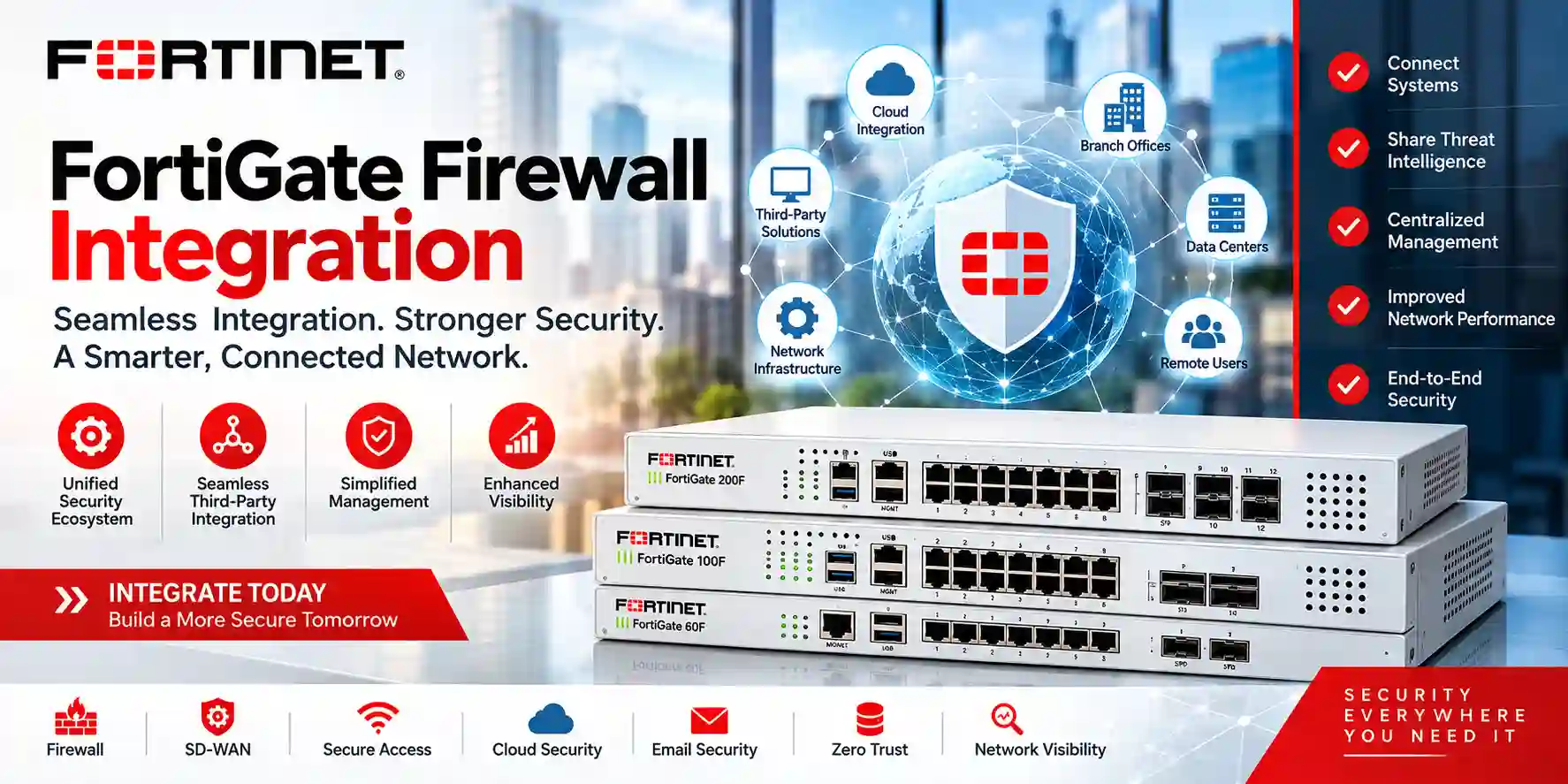
The supplied Tanzania media library also includes visual resources covering FortiGate dual-WAN, IPsec VPN, remote-access VPN, site-to-site VPN, FortiGuard renewal and Fortinet enterprise security. These topics are directly related to common FG-80F-DSL deployment questions and can support future solution pages and internal linking as verified product and category URLs become available.
Deployment and integration checklist
Before installation, document the ISP handoff and authentication, internal IP plan, VLANs, DHCP responsibilities, DNS strategy, VPN peers, routing, NAT requirements, administrative access, logging destination and configuration-backup process. Confirm the physical installation location, power availability and any mounting or transceiver requirements. If the firewall replaces an existing device, record current rules and identify which should be migrated, redesigned or retired rather than copying legacy policy blindly.
During commissioning, validate internet access, policy enforcement, DNS, application reachability and VPNs. If multiple WAN links are configured, test real failover and recovery. Verify that monitoring identifies link failures and security events. Finally, preserve a known-good configuration and record the final network diagram and administrative ownership.
Quotation checklist for FG-80F-DSL
State the number of locations, approximate users and important device groups.
List DSL and other internet links, handoff types and expected bandwidth.
Describe inspection, segmentation, VPN and remote-access requirements.
Specify the desired FortiGuard/support term so quotations can be compared consistently.
FortiGate 80F DSL FAQs
What is the FG-80F-DSL?
FG-80F-DSL is the FortiGate 80F-series model identified by Fortinet with eight GE RJ45 ports, two RJ45/SFP shared-media WAN ports and an embedded DSL module.
Does FortiGate 80F DSL support SD-WAN?
The FortiGate 80F family is positioned by Fortinet as a converged NGFW and SD-WAN platform running FortiOS. The actual SD-WAN configuration should be designed around the organization’s WAN circuits and application requirements.
Should I verify my DSL service before buying?
Yes. Confirm the provider service, line technology, authentication and handoff requirements before procurement. Integrated hardware should not be assumed compatible with every provider configuration without verification.
What information should I provide for a quotation?
Provide the exact model, number of sites, WAN services, approximate users/devices, VPN requirements, desired security services, subscription term and any mounting or interface accessories.
Can FG-80F-DSL be used in a multi-site network?
It can be considered for branch and distributed-site architectures. The overall design should address addressing, VPN topology, management, logging, policy standards and capacity at each site.
Decision recap
FortiGate 80F DSL is most compelling when a branch needs the FortiGate 80F security platform and the embedded DSL capability has a clear role in the WAN design. Verify circuit compatibility, define security and VPN requirements, select the appropriate FortiGuard and support term, and plan the appliance as part of a managed network lifecycle. For projects where DSL is not required, compare the requirement against other FortiGate variants rather than paying for an interface that has no planned use.
Consult FourTeck about FG-80F-DSL
Send FourTeck your site count, WAN circuit details, expected users, VPN requirements and desired subscription term. A requirement-led enquiry makes it easier to discuss the correct FortiGate configuration, licensing scope and related network components for Tanzania or a regional deployment.



Reviews
There are no reviews yet.