
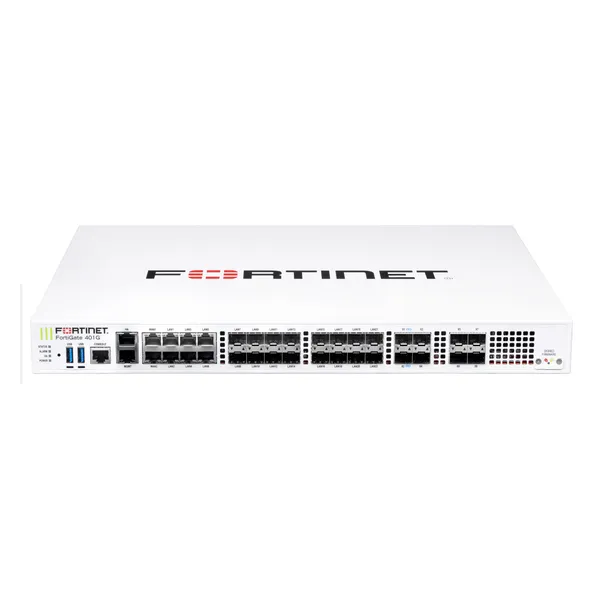
FORTINET G-SERIES • ENTERPRISE EDGE SECURITY
FortiGate 400G (FG-400G) Tanzania
FortiGate 400G is built for organizations modernizing enterprise internet edges, campuses, regional hubs and data-center-edge networks where security inspection, encrypted connectivity, segmentation and high-speed interfaces must operate together. Fortinet positions the 400G as a G-series platform for modern enterprise-edge modernization, with hardware acceleration and a consistent FortiOS operating model. FourTeck helps buyers translate bandwidth, users, applications, VPN demand, interfaces, resilience and security-service requirements into a practical FG-400G quotation.
Firewall throughput published by Fortinet for 1518-byte traffic, with 163/145 Gbps figures for 512/64-byte packets.
IPsec VPN throughput for high-capacity encrypted site connectivity and aggregation use cases.
Threat-protection throughput with the security functions represented by Fortinet’s published test methodology.
Concurrent sessions, useful context when sizing busy enterprise environments with large connection counts.
What the FortiGate 400G solves
Modern networks rarely have one clean perimeter. Users consume SaaS applications, branches connect through multiple carriers, internal segments exchange encrypted traffic, remote users require controlled access, and business applications may span local infrastructure and cloud platforms. The FG-400G gives security teams a consolidated enforcement point for firewall policy, intrusion prevention, application control, VPN, segmentation and secure SD-WAN. Fortinet’s 2026 positioning emphasizes modernization without forcing organizations to abandon the operational model used across existing FortiGate estates.
The appliance includes one NP7 network processor and one CP10 content processor. Fortinet documents that supported traffic between front-panel data interfaces can be offloaded through the NP7 path. The physical interface mix includes four 25/10GbE SFP28/SFP+ ports, four 10/1GbE SFP+/SFP ports, sixteen 1GbE SFP ports, eight multi-gigabit RJ45 data ports, a 2.5GbE HA interface and a dedicated management interface. That combination is especially relevant when a project mixes carrier handoffs, fiber distribution, aggregation switching, server segments and copper WAN/LAN connections.
Verified FG-400G specification highlights
| Firewall throughput | 164 / 163 / 145 Gbps (1518 / 512 / 64 byte UDP) |
| IPsec VPN throughput | 55 Gbps |
| IPS throughput | 25 Gbps enterprise mix |
| NGFW throughput | 14 Gbps enterprise mix |
| Threat protection | 13 Gbps |
| Concurrent sessions | 28 million |
| New sessions/second | 580,000 |
| SSL inspection throughput | 11.5 Gbps, IPS average HTTPS |
| Form factor / power | 1 RU / dual AC power supplies |
Published performance figures are laboratory measurements and should not be treated as guaranteed application throughput. Real deployment performance depends on traffic profile, enabled security services, packet sizes, encryption, policy complexity, logging and software configuration. Sizing should therefore use inspected traffic requirements rather than firewall-throughput headlines alone.
Buying, licensing and deployment guidance
A useful FG-400G request should specify more than the hardware model. Procurement teams should identify the required FortiCare support period, applicable FortiGuard security services, expected subscription term, optics or transceivers, rack and power requirements, centralized management needs and implementation scope. Organizations already operating FortiGate should also document the existing FortiOS version, configuration size, routing protocols, VLANs, VPN peers, high-availability design and any dependencies on FortiManager, FortiAnalyzer, FortiSwitch, FortiAP or FortiClient.
For a new deployment, begin with peak internet bandwidth and expected growth, then quantify east-west or inter-zone traffic that must cross the firewall. Record concurrent users and devices, remote-access demand, site-to-site VPNs, public services, SSL inspection expectations, application-control policies and logging retention. Finally, confirm physical interfaces. A firewall can have adequate inspection capacity but still be a poor fit if the project requires a different number or type of fiber, copper or high-speed aggregation connections.
FortiGate 400G (FG-400G) Tanzania
Tanzania organizations evaluating FortiGate 400G are usually addressing an enterprise-scale security requirement rather than a basic office-router replacement. The model is relevant where a headquarters, campus, data-center edge, regional service hub or large distributed organization needs substantial session capacity, high-speed fiber connectivity, VPN aggregation and security inspection under one FortiOS platform. A procurement team should start by describing the traffic that must be protected: internet circuits, private WAN links, cloud connectivity, public-facing applications, branch tunnels, remote users and internal segments. This produces a far more defensible specification than selecting a firewall solely because its maximum firewall throughput exceeds the ISP speed.
For Tanzanian networks, resilience planning can be as important as raw capacity. Organizations may operate primary and backup carriers, diverse fiber routes, microwave links or cellular backup. FortiGate secure SD-WAN capabilities can be considered where the design requires application-aware path selection and protected multi-WAN connectivity. The exact configuration should reflect business priorities such as ERP access, voice, video meetings, cloud applications, payment systems, customer portals and branch communications. High availability should also be reviewed where downtime at the perimeter would interrupt many users or sites.
Licensing is another procurement checkpoint. Hardware, FortiCare and FortiGuard services should be compared as a complete operating requirement rather than unrelated line items. Buyers should confirm subscription duration, renewal ownership, security functions expected by the policy design and the support process that will be used after deployment. If the organization has an existing Fortinet estate, migration planning should include configuration review, firmware compatibility, VPN peers, routing, objects, certificates and centralized management. FourTeck can help structure these details into a quotation request without making unsupported promises about stock, delivery dates or service coverage.
FortiGate 400G (FG-400G) Dar es Salaam
Dar es Salaam buyers may encounter FG-400G requirements in large corporate offices, financial and professional-services environments, logistics operations, hospitality groups, technology providers and organizations that centralize connectivity for multiple sites. In such networks the perimeter often carries a mixture of SaaS, business applications, video, voice, backups and encrypted branch traffic. The right sizing exercise therefore separates simple forwarding capacity from inspected throughput. If IPS, application control, malware protection and SSL inspection will be enabled broadly, the design team should model those services explicitly and leave practical headroom for traffic growth.
Interface planning deserves early attention. The 400G provides 25GbE, 10GbE, 1GbE fiber and multi-gigabit copper choices, which can support varied carrier and campus architectures. Before ordering, identify which interfaces connect to ISPs, core switches, DMZs, server networks and management systems, then list the required optics and cable types. If a high-availability pair is planned, document switch redundancy and upstream/downstream failure scenarios rather than assuming a second appliance alone removes every single point of failure.
For a Dar es Salaam quotation, share the current firewall, peak WAN utilization, number of protected sites, remote-access users, VPN tunnels, routing requirements, required subscriptions and preferred support term. Organizations replacing an existing FortiGate can additionally provide a sanitized configuration summary and the desired migration window. This helps distinguish a straightforward hardware refresh from a broader security redesign. FourTeck can then discuss the FG-400G as part of a complete requirement that may include FortiManager, FortiAnalyzer, FortiSwitch, FortiAP or endpoint connectivity where those components are genuinely relevant.
FortiGate 400G (FG-400G) Mwanza
In Mwanza, an enterprise firewall project may need to support a regional office, multi-site commercial operation, institution, industrial environment or service organization connecting users to central applications and cloud platforms. The FG-400G can be evaluated when smaller branch appliances no longer provide enough inspected throughput, session scale or interface flexibility. A sensible design begins with application dependency: determine which systems must remain reachable during an ISP failure, which traffic needs low latency, which services are public-facing and which internal zones require strict separation.
Multi-WAN planning should include more than automatic failover. Teams should define health checks, route priorities, session behavior, application steering and what happens when the backup path has materially lower capacity than the primary circuit. Security policies should remain consistent during failover, and monitoring should make path changes visible to administrators. Where Mwanza sites connect to Dar es Salaam or other Tanzanian locations, site-to-site IPsec design should consider tunnel redundancy, routing convergence, address planning and centralized logging.
Procurement should also account for the lifecycle of security services. FortiGuard subscriptions and FortiCare support are operational components, so renewal ownership and budget timing should be agreed before deployment. If the organization expects rapid user, branch or bandwidth growth, record those assumptions in the sizing brief. This makes later review easier and reduces the risk of treating a high-performance firewall as an unlimited resource. For an FG-400G Mwanza enquiry, FourTeck can help organize the model, service term, connectivity, optics, deployment and renewal questions into a clear commercial request.
FortiGate 400G (FG-400G) Arusha
Arusha organizations considering the FG-400G may include larger hospitality groups, institutions, regional enterprises, NGOs, service organizations and multi-location businesses that need controlled connectivity between local users, branches, cloud services and centralized applications. The firewall is best assessed as a security platform rather than simply a fast router. Policy design can segment staff, guest, server, voice, IoT and operational networks while VPN and SD-WAN capabilities support distributed connectivity. The actual architecture should reflect the organization’s risk model and application flows.
For hospitality or campus-style environments, connection count and segmentation can matter as much as raw bandwidth. Many client devices, guest networks, access points, cameras, phones and business systems can create a large and dynamic session profile. The 400G’s published 28-million concurrent-session capacity provides context, but administrators should still estimate real usage and inspection requirements. Where FortiAP and FortiSwitch are part of the environment, teams can also assess how FortiGate fits into broader Fortinet Security Fabric operations and whether centralized management simplifies multi-site policy administration.
Before requesting price, Arusha buyers should document required WAN interfaces, internal uplinks, VPN peers, public IP services, security subscriptions, logging, reporting and support term. If SSL inspection is planned, certificate deployment, application compatibility, privacy requirements and exception handling need governance before a rollout. FourTeck can assist with the product-selection and quotation conversation, while final configuration should follow the customer’s security policy and validated technical design. This approach keeps procurement tied to operational outcomes rather than marketing numbers alone.
FortiGate 400G (FG-400G) Dodoma
Dodoma requirements for an FG-400G may arise in larger institutional, enterprise, education, service or multi-site environments where policy control, encrypted connectivity and centralized visibility are priorities. Projects with many departments or security zones should first map trust boundaries: user networks, servers, guest access, management systems, voice, cameras, operational devices and external services. That map becomes the basis for firewall zones and policies and helps prevent an expensive appliance from being deployed with an overly flat network design.
Capacity planning should use realistic traffic. Measure busy-hour internet utilization, branch VPN flows, backup traffic and east-west movement that will cross the firewall. Then decide which flows receive IPS, application control, malware inspection or SSL inspection. Fortinet publishes separate firewall, IPS, NGFW and threat-protection figures because each workload is different; buyers should therefore compare the performance figure closest to their intended policy set. The 25GbE and 10GbE interfaces are useful where core or carrier connectivity needs higher-speed handoffs, but optics and upstream equipment must be compatible.
Operational readiness is equally important. Decide who administers FortiOS, how configuration changes are approved, where logs are retained, how backups are protected, and how firmware upgrades are tested. For high availability, document failover tests and maintenance procedures. A Dodoma procurement brief should include these operational expectations together with hardware and subscriptions. FourTeck can help buyers frame the FG-400G quote around users, bandwidth, VPN, interfaces, subscription term and related Fortinet components without implying a specific availability or delivery commitment until it is confirmed commercially.
FortiGate 400G (FG-400G) UAE
UAE enterprises evaluating the FortiGate 400G often operate high-bandwidth internet edges, cloud-heavy application estates, regional branches and dense office networks. The 400G’s combination of 25GbE, 10GbE and multi-gigabit connectivity makes it relevant to projects where the firewall must connect modern carrier services and fast core switching without forcing every link through 1GbE interfaces. Fortinet’s G-series positioning also targets organizations refreshing older FortiGate environments while seeking operational consistency through FortiOS and the wider Security Fabric.
A UAE project should define whether the 400G will serve as internet perimeter, data-center edge, VPN concentrator, segmentation firewall, secure SD-WAN hub or a combination of roles. Combining roles can simplify infrastructure, but it also concentrates dependencies, so sizing and high availability become more important. Security teams should calculate inspected throughput and concurrent-session requirements, while network teams validate routing, BGP or OSPF needs, VLAN design and optics. Procurement teams can then compare hardware and service bundles on a like-for-like basis.
For UAE-specific Fortinet enquiries, buyers can also review FourTeck’s Fortinet UAE resource, which covers firewall selection, license renewal, secure SD-WAN and related Fortinet solutions. That regional resource is useful when the project requires UAE-focused commercial coordination. As with every market, price should be evaluated together with subscription term, support, implementation scope, optics and lifecycle costs rather than as a bare appliance comparison.
FortiGate 400G (FG-400G) Uganda
Uganda organizations considering FG-400G may be consolidating multiple branches, upgrading a headquarters perimeter, building a regional service hub or introducing stronger segmentation and security inspection. The first sizing question is not simply user count. Teams should identify total WAN bandwidth, inter-site traffic, encrypted VPN load, cloud application usage, published services and inspection policies. A business with moderate headcount but large data transfers or many branch tunnels can have very different firewall requirements from an office with many users and lighter traffic.
Secure SD-WAN can be relevant where sites use multiple providers and need policy-driven path selection, but its value depends on application and carrier design. Define critical applications, acceptable failover behavior, latency sensitivity and backup-link constraints before configuration. For IPsec hub use, document branch counts, tunnel topology, routing and key-management practices. The 400G’s published 55 Gbps IPsec figure demonstrates substantial encryption capacity, while real deployments should still be validated against the complete policy set and traffic pattern.
Uganda buyers can use FourTeck Uganda for country-focused enquiries and related Fortinet product guidance. A strong quote request should state whether hardware only, FortiCare, FortiGuard services, centralized management, optics and deployment assistance are required. Organizations migrating from another firewall should also describe current VPNs, routing and security objects so the commercial scope reflects migration effort as well as appliance supply.
FortiGate 400G (FG-400G) Kampala
Kampala enterprises can assess the FG-400G for busy head offices, shared service locations, campuses and aggregation points serving multiple branches. In these roles the firewall may carry internet access, remote users, branch tunnels, SaaS traffic and connections to internal applications at the same time. Capacity planning should model peak periods rather than daily averages. If a business runs backups, software distribution or large cloud synchronization jobs, those bursts can affect security processing and WAN quality even when ordinary office browsing appears light.
Network architecture should also account for the 400G’s interface mix. Four 25GbE ports can support high-speed aggregation where compatible switching and optics are available, while 10GbE, 1GbE SFP and multi-gigabit copper ports give designers options for different zones and uplinks. Document every required connection before ordering transceivers. For high availability, map both power and network dependencies and ensure upstream switching, carrier handoffs and routing can survive the same failure scenarios the firewall pair is designed to handle.
Kampala procurement teams should request a bill of materials that clearly separates the appliance, subscription bundle, FortiCare term, optics and optional management or analytics components. This makes competing quotations easier to compare and avoids discovering later that one proposal omitted security services included in another. FourTeck Uganda can be used as the regional enquiry route, while technical acceptance should be based on the customer’s validated design, change-control process and security objectives.
FortiGate 400G (FG-400G) Arua
For Arua operations, the FG-400G is most relevant where the site acts as more than a small branch: for example, a regional aggregation point, large institution, distributed-services hub or environment carrying significant VPN and application traffic. Organizations should compare the appliance with actual needs rather than assuming a larger model is automatically preferable. If the site primarily has modest internet bandwidth and few users, a smaller FortiGate may be more appropriate; if it aggregates branches or protects substantial internal traffic, the 400G’s scale and high-speed interfaces may be justified.
Connectivity resilience deserves careful design in regional deployments. Where primary and backup links differ in speed or technology, define what traffic remains permitted during degradation. Critical ERP, voice or operational applications may need priority while nonessential updates or backups are restricted. FortiGate policy and SD-WAN capabilities can support such designs, but the rules must be created from business requirements. Monitoring should show link quality and security events so administrators can distinguish carrier problems from firewall or application issues.
An Arua quote request should therefore include site role, WAN links, number of connected branches, users, devices, VPN topology, security services, interface requirements and support duration. If the appliance is part of a national deployment, standardization with other FortiGate sites may reduce operational complexity. Centralized management and logging can also be evaluated where many firewalls are involved. These details allow the commercial conversation to focus on a deployable solution rather than a single model number.
FortiGate 400G (FG-400G) Mbarara
Mbarara businesses and institutions considering the FG-400G should first decide whether the firewall is protecting a single large site or acting as a regional hub. A hub design typically adds branch VPNs, centralized internet breakout, routing complexity and logging volume to normal local traffic. Those functions should be included in sizing. Fortinet publishes substantial VPN and session capacity for the 400G, but architecture still matters: tunnel topology, route exchange, encryption settings and application patterns influence how the system behaves in production.
Segmentation is another useful planning area. Instead of placing all internal systems behind one broad trusted zone, teams can identify departments, servers, guests, cameras, voice, wireless infrastructure and management networks and then define the flows that are genuinely required. This can improve visibility and reduce lateral exposure. The FG-400G’s high-speed interfaces are useful where segmentation occurs at significant throughput, but policy design and logging must remain manageable for the administrators who operate the environment.
For procurement, document whether the requirement includes a single unit or HA pair, AC power planning, SFP/SFP+/SFP28 optics, FortiGuard subscriptions, FortiCare, FortiManager or FortiAnalyzer. Also state the desired term so quotations can be compared consistently. If replacing another platform, include migration and cutover expectations. FourTeck can help organize these requirements for Mbarara enquiries while final stock, commercial terms and delivery timing should be confirmed at quotation stage.
FortiGate 400G (FG-400G) Gulu
Gulu deployments may involve organizations that need secure regional connectivity, centralized services and controlled access between local networks and national or cloud resources. The FG-400G can be considered when the protected environment needs enterprise-level throughput, many sessions or high-speed interfaces. The design team should capture the normal and failure-state traffic patterns. A backup WAN circuit that is much smaller than the primary link, for example, may require different SD-WAN steering and traffic priorities during an outage.
Security inspection policies should be planned according to data sensitivity and exposure. Internet browsing, public servers, branch tunnels, administrative access and internal application traffic may require different controls. SSL inspection can improve visibility into encrypted traffic but introduces certificate, privacy, application-compatibility and performance considerations that must be governed. Fortinet’s published SSL-inspection and threat-protection figures provide sizing references, not substitutes for testing representative applications.
For a Gulu procurement brief, include the existing network diagram if available, user/device estimates, internet speeds, branch list, VPN needs, required security functions, interface types, support term and whether centralized reporting is expected. Organizations with existing FortiGate appliances should also record current FortiOS and management tools. This creates a clearer path to determine whether FG-400G is appropriately sized and what subscriptions and accessories belong in the final bill of materials.
FortiGate 400G (FG-400G) Kenya
Kenyan enterprises may evaluate FortiGate 400G for headquarters, campus, data-center-edge and regional aggregation roles where branch connectivity and cloud use create sustained security demand. The model’s high session scale and mixed 25GbE, 10GbE, 1GbE fiber and multi-gigabit copper interfaces give architects flexibility when connecting carrier circuits, core switching and security zones. Selection should nevertheless be driven by inspected traffic and operational requirements, especially when SSL inspection, IPS and application control will be enabled at scale.
Organizations with offices in Nairobi and other cities can also consider how the 400G fits a wider branch architecture. Smaller FortiGate models may secure individual branches while the 400G serves as a central VPN or policy hub. That approach can simplify platform operations, but centralized dependencies should be protected with suitable HA, routing and carrier diversity. FortiManager and FortiAnalyzer may be relevant where many devices require consistent policy administration and consolidated logging.
For country-focused product exploration, FourTeck’s FortiGate Firewall Kenya guide explains firewall sizing, VPN, SD-WAN and security-service considerations. A Kenya FG-400G quotation should state bandwidth, users, branch count, VPN load, security bundle, support term and interface requirements. Comparing those same parameters across proposals is more useful than comparing headline price alone.
FortiGate 400G (FG-400G) Kuwait
Kuwait organizations considering the FG-400G may be modernizing a corporate perimeter, multi-site network or data-center edge where high-speed connectivity and security inspection must coexist. The model can support designs with fast fiber uplinks and substantial encrypted connectivity, but sizing should reflect the enabled security stack. Teams should document internet and private-WAN speeds, peak sessions, VPN traffic, public services, cloud dependencies and internal segmentation flows before selecting the final appliance and subscription package.
Environmental and operational planning should include rack space, dual power, upstream switch redundancy, optics, cable standards and management access. If an HA pair is planned, failover should be tested against real dependencies rather than only firewall health. Administrators should also define backup, logging and firmware-maintenance processes. A strong deployment plan makes the appliance easier to operate throughout its lifecycle and reduces surprises during renewals or future capacity upgrades.
Kuwait buyers can review FourTeck Kuwait for regional IT and network-security enquiries. When requesting FG-400G pricing, specify hardware quantity, service bundle, term, optics, management requirements and whether migration assistance is in scope. This lets the quotation reflect the complete project rather than a bare firewall appliance and gives procurement a clearer basis for comparing alternatives.
FortiGate 400G (FG-400G) Ghana
Ghana enterprises evaluating FG-400G may be looking for a security platform that can protect larger offices, campuses, service hubs and multi-branch networks without forcing high-speed links through entry-level firewall interfaces. The 400G’s hardware-accelerated architecture and enterprise performance profile make it relevant where security teams need policy enforcement, VPN, segmentation and threat inspection at significant scale. As with any NGFW, the useful sizing number is the one closest to the intended security workload, not merely the maximum stateless firewall figure.
A Ghana deployment brief should identify critical applications and their paths. Cloud productivity suites, ERP, voice, video, online services and branch applications may have different latency and availability requirements. If multiple ISPs are available, secure SD-WAN design can define preferred and backup paths while maintaining integrated security controls. If the firewall terminates branch VPNs, routing and tunnel design should be documented together with encryption requirements and monitoring.
Procurement should then map technical needs to commercial components: appliance quantity, FortiCare, FortiGuard bundle, subscription term, optics, centralized management and deployment scope. Organizations replacing an existing firewall should include migration requirements and an inventory of external dependencies such as VPN peers and public services. This disciplined approach helps Ghana buyers determine whether the FG-400G is the right performance class and avoids treating an enterprise firewall as a simple commodity purchase.
FortiGate 400G (FG-400G) Nigeria
Nigeria’s large and distributed enterprise environments can create demanding firewall requirements: multiple carriers, branch VPNs, cloud platforms, remote access, public applications and large internal networks may converge at the same security edge. The FortiGate 400G can be assessed for such roles when high session capacity, 25GbE/10GbE connectivity and hardware-accelerated inspection are relevant. The design should distinguish internet-edge traffic from east-west segmentation traffic because both may consume security resources even when external bandwidth alone appears modest.
Resilience planning is especially important for hub locations. A firewall HA pair, redundant switches and diverse WAN paths should be designed as one system. Secure SD-WAN policies can help manage multiple links, but teams must define service-level checks, preferred paths and degraded-state priorities. Logging and monitoring should capture both security events and network quality so operations teams can troubleshoot application problems without guessing whether the root cause is the carrier, routing, policy or destination service.
Nigeria procurement teams should request consistent subscription and support terms across competing quotations. They should also confirm optics, power, rack and management requirements and decide whether FortiManager or FortiAnalyzer is part of the architecture. If migrating from an older FortiGate, Fortinet’s emphasis on operational consistency can be useful, but every configuration still needs review for current FortiOS behavior and security policy. A complete requirements document makes the FG-400G commercial discussion faster and more technically defensible.
FortiGate 400G (FG-400G) Seychelles
Seychelles organizations considering FG-400G may have specialized requirements around central-office security, hospitality networks, institutional services, multi-site connectivity or high-value business systems. Because the market includes geographically distributed operations, VPN and WAN resilience can be important design areas. The 400G’s substantial IPsec capacity and interface flexibility can support hub designs, but the exact appliance size should reflect the number of sites, application traffic and inspection policies rather than geography alone.
Where internet circuits are costly or have different performance characteristics, SD-WAN policy can be designed to reserve preferred paths for critical business applications and use alternative links when quality falls below defined thresholds. Security policy should remain integrated with that routing logic. Teams should also decide how guest, staff, server, voice, IoT and operational networks are segmented, especially in hospitality or campus environments where many device types share physical infrastructure.
For an FG-400G Seychelles quotation, provide expected bandwidth, peak users and devices, VPN topology, interface requirements, HA expectations, subscription term and management needs. If equipment must integrate with existing Fortinet switches, access points or management platforms, list those models and software versions. Procurement can then evaluate hardware, security services and lifecycle support together. FourTeck can use this information to frame a product and licensing discussion while availability and logistics are confirmed during the formal quotation process.
Related Fortinet planning resources
Regional teams can use FourTeck’s specialist and country resources to continue product research. The Fortinet UAE portal covers FortiGate, licensing and security solutions; FortiGate Firewall Kenya provides Kenya-focused sizing guidance; FourTeck Uganda supports Uganda product enquiries; and FourTeck Kuwait provides Kuwait-focused IT and cybersecurity pathways. For Tanzania, the FourTeck Tanzania website remains the primary regional route.
Quotation checklist for FortiGate 400G
FortiGate 400G FAQ
What is FortiGate 400G designed for?
Fortinet positions it for modern enterprise-edge environments. It can be evaluated for high-capacity perimeter security, campus and data-center-edge connectivity, VPN aggregation, segmentation and secure SD-WAN where its performance and interface mix match the design.
What high-speed interfaces does FG-400G provide?
Fortinet documents four 25/10GbE SFP28/SFP+ interfaces, four 10/1GbE SFP+/SFP interfaces, sixteen 1GbE SFP interfaces and eight multi-gigabit RJ45 data interfaces, plus dedicated HA and management connections.
Should I size it using the 164 Gbps firewall figure?
Not by itself. Use performance measurements that resemble your enabled security workload, and account for VPN, SSL inspection, IPS, application control, logging, traffic mix and future growth.
Does FortiGate 400G support high availability?
FortiGate platforms support HA designs, and the 400G includes a dedicated HA interface. A complete resilient design must also address switches, WAN circuits, routing, power and operational failover testing.
What information should I send for a quote?
Send location, quantity, current firewall, internet bandwidth, branch and VPN requirements, expected inspection services, interface needs, HA requirement, subscription term, support expectations and any Fortinet management products already in use.
Decision recap and consultation
FortiGate 400G is a serious enterprise security platform with high firewall and VPN capacity, large session scale, hardware acceleration and a broad high-speed interface mix. It is most compelling when those capabilities correspond to a documented enterprise-edge, campus, hub or data-center-edge requirement. Before purchase, validate inspected throughput, VPN scale, port types, resilience, licensing, management and growth. FourTeck can help turn those inputs into a clearer quotation request and compare the required appliance, subscriptions and related components.
For the fastest consultation, prepare a simple network diagram and the quotation checklist above. That allows the discussion to focus on the actual traffic and security design rather than relying on model-name assumptions.



Reviews
There are no reviews yet.