
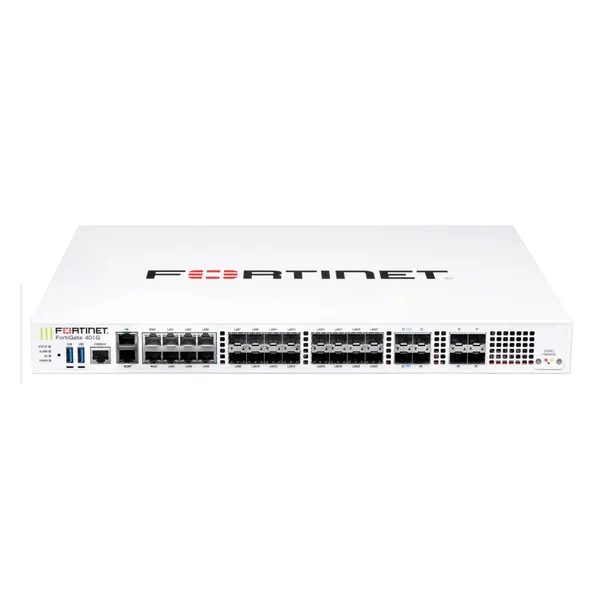
FortiGate 401G (FG-401G) Tanzania
FortiGate 401G (FG-401G) is built for organizations that need substantial firewall capacity, encrypted connectivity, application-aware security and integrated secure networking without separating every function into a different appliance. Fortinet identifies the FG-401G as the 960 GB local-storage variant associated with the FortiGate 400G platform. The platform is suited to enterprise head offices, campus cores, data-center edges, regional hubs and high-bandwidth WAN aggregation points where security inspection must coexist with demanding network traffic. FourTeck Tanzania can assist buyers with requirement definition, model fit, interface planning, subscription selection and quotation preparation without assuming that one firewall size fits every network.
FortiGate 401G overview and verified platform facts
Fortinet documentation describes the FortiGate 400G and 401G with one NP7 network processor and one CP10 content processor. The front-panel data interfaces connect through the integrated switch fabric to the NP7, allowing supported traffic between data interfaces to be hardware-offloaded. Fortinet separately documents dedicated management and HA paths, an architectural detail that matters for enterprise designs because management and HA control traffic can remain separated from ordinary data processing. The 401G designation adds local storage: Fortinet’s product matrix lists 960 GB for the 401G variant.
The FortiGate 400G platform is published at up to 164/163/145 Gbps firewall throughput for 1518/512/64-byte UDP traffic. Real deployments should be sized around enabled security services, traffic mix and encrypted inspection rather than headline firewall throughput alone.
Fortinet publishes 14 Gbps NGFW throughput and 13 Gbps threat-protection throughput for the 400G platform in its enterprise-mix tests. These figures are more useful than raw firewall throughput when estimating a deployment that will actively inspect business traffic.
Fortinet publishes 55 Gbps IPsec VPN throughput for the platform. This makes the family relevant to organizations consolidating branch tunnels, data-center connectivity, remote sites and secure inter-office traffic, subject to the exact configuration and test conditions.
Interfaces, acceleration and deployment flexibility
Fortinet documents eight multi-gigabit copper data ports supporting 5G/2.5G/1G/100M, sixteen 1 Gigabit Ethernet SFP ports, four 10/1 Gigabit SFP+/SFP ports and four 25/10 Gigabit SFP28/SFP+ ports on the 400G/401G family, plus dedicated management and HA interfaces. This mix gives architects room to connect WAN circuits, server or distribution links, fiber access, FortiLink connections and high-speed upstream infrastructure. Interface count alone should not determine the design: transceiver type, link speed, redundancy, LACP design, HA topology, routing architecture and expected east-west versus north-south traffic all influence the final bill of materials.
The NP7 acceleration architecture is especially relevant where large session volumes and encrypted traffic need predictable handling. Fortinet notes that all supported traffic between front-panel data interfaces can be offloaded through NP7. Buyers planning heavy inspection, segmentation or VPN aggregation should still model the services they intend to enable, because application control, intrusion prevention, malware inspection and SSL inspection have different performance profiles. FourTeck can use those requirements to help frame a more useful quotation discussion than simply matching internet-circuit speed to raw firewall throughput.
What FortiGate 401G can solve
The FG-401G can serve as a consolidated security and networking point for organizations that are modernizing perimeter security, connecting multiple sites, segmenting internal networks or replacing a collection of separate edge devices. FortiOS brings firewall policy, routing, SD-WAN, VPN and security controls into one operating environment. This can simplify policy consistency when the same organization needs to protect internet access, private WAN traffic, public-facing applications and remote connectivity. The model’s local storage also makes it relevant where the design calls for on-appliance storage capability, although logging architecture and retention requirements should be planned explicitly rather than assumed.
For distributed organizations, secure SD-WAN can combine path selection with security policy so that business applications use appropriate links while the firewall continues to enforce controls. For headquarters and campus environments, the platform can sit at the internet edge or aggregation layer, depending on topology. For data-center edge use, the higher-speed fiber interfaces can support connections to switching infrastructure while policy, VPN and threat controls remain centralized. A sound deployment begins with traffic baselines, growth expectations, security-service requirements and resilience objectives.
Technical specification highlights
| Item | Published platform detail | Planning relevance |
|---|---|---|
| Local storage | 960 GB on FG-401G | Distinguishes 401G from the non-storage 400G variant. |
| Firewall throughput | 164/163/145 Gbps, 1518/512/64-byte UDP | Use only with Fortinet test methodology; size inspected traffic separately. |
| IPsec VPN | 55 Gbps | Useful for hub, site-to-site and encrypted WAN planning. |
| NGFW throughput | 14 Gbps | More representative for application-control and IPS-oriented designs. |
| Threat protection | 13 Gbps | Important when multiple security services are enabled together. |
| Concurrent sessions | 28 million | Relevant to large user populations and high-session environments. |
| Form factor | 1 RU, dual AC power supplies | Supports rack planning and resilient power design. |
Licensing, FortiGuard services and lifecycle planning
Hardware selection is only one part of a FortiGate procurement. Security subscriptions determine which continuously updated services are available, and support terms affect access to updates and vendor assistance. Buyers should identify the intended security outcomes before choosing a bundle: intrusion prevention, web and DNS controls, malware protection, application visibility and other services may be relevant depending on the environment. Subscription names and inclusions can change, so the quotation stage should use current Fortinet ordering information rather than an old bill of materials.
Firmware planning also deserves attention because the 400G/401G family is comparatively recent. Administrators should confirm the FortiOS release supported for the appliance and the approved upgrade path at deployment time. For production environments, change windows, configuration backups, HA sequencing and release-note review should be part of normal operational practice. A procurement request is stronger when it states the desired support term, security-service term, HA requirement and expected implementation schedule.
FortiGate 401G Tanzania
Organizations searching for FortiGate 401G Tanzania are commonly evaluating an enterprise firewall for a head office, campus, data-center edge, ISP-facing environment or multi-site WAN hub. The most useful buying process starts with the actual inspected throughput requirement rather than internet bandwidth alone. A Tanzanian organization may have several providers, private links, cloud connectivity, branch VPNs and internal VLANs crossing the firewall. Documenting those paths helps determine whether the FG-401G should be used as a perimeter appliance, segmentation firewall, SD-WAN hub or a combination of roles.
Procurement teams should provide the number and speed of WAN links, required copper and fiber connections, transceiver expectations, anticipated concurrent users, VPN topology and the security services to be enabled. Where high availability is required, the project should account for a matched appliance pair, support and subscription alignment, rack space, power feeds and the switching design around the cluster. The FG-401G’s 960 GB local storage is a specific reason to select it over the FG-400G when the architecture benefits from local storage, but storage should not replace a broader logging and analytics strategy where compliance or long retention is required.
Tanzania deployments can span very different connectivity conditions, from large corporate campuses to distributed branches. Secure SD-WAN can help organizations define application-aware path behavior across multiple links, while IPsec VPN can connect sites over untrusted networks. Before requesting a quote, prepare current and projected traffic figures, the number of sites, existing Fortinet products, authentication requirements and any migration constraints. FourTeck can then discuss the appliance, relevant subscriptions and related infrastructure in a more precise commercial context. For broader regional security options, see FourTeck Africa FortiGate firewall solutions, which complements Tanzania-focused procurement planning.
FortiGate 401G Dar es Salaam
For enterprises in Dar es Salaam, the FG-401G can be considered for environments where internet edge security, headquarters connectivity and branch aggregation converge. A head office may need to terminate multiple ISP circuits, connect private WAN services, publish business applications and maintain encrypted links to branches. The firewall’s combination of multi-gigabit copper, 1 Gigabit fiber, 10 Gigabit and 25 Gigabit interfaces gives network architects several ways to integrate with existing switching and carrier handoffs, but exact optics and media requirements should be specified before ordering.
A Dar es Salaam deployment should also account for resilience. If the firewall is business-critical, a high-availability design may be more appropriate than a single appliance. The dedicated HA interface and dual AC power supplies support resilient architecture, but resilience is an end-to-end property: upstream routers, switches, power systems and internet circuits must also avoid unnecessary single points of failure. Teams should decide whether the firewall will provide dynamic routing, SD-WAN, NAT, VPN concentration and internal segmentation so configuration responsibilities are clear.
Security sizing should use the enabled inspection profile. A raw throughput figure does not tell a buyer how a device will behave when IPS, application control and threat protection are active. Fortinet’s published NGFW and threat-protection figures provide a more appropriate reference for security-heavy designs. Buyers can improve quotation accuracy by sharing current peak traffic, expected growth, branch count, remote-access needs, required subscriptions and support duration. For projects that include enterprise security architecture beyond a single firewall, FourTeck Africa provides a regional route for discussing related infrastructure and multi-country requirements.
FortiGate 401G Mwanza
Businesses evaluating FortiGate 401G in Mwanza may be planning a regional hub that connects offices, warehouses, operations sites or remote branches back to central applications. In this role, secure routing and VPN capacity can be as important as internet filtering. The FG-401G platform supports substantial IPsec throughput and high session capacity, which can suit a hub design where many encrypted site connections converge, provided the deployment is sized against the actual security profiles and traffic mix.
For a multi-site organization, document which applications must remain available during a WAN failure and which circuits are available at each location. Secure SD-WAN policies can then be designed around application priority, link health and business intent rather than simple primary/backup routing. Where voice, ERP, cloud applications and bulk transfers share the same links, this planning can materially improve user experience. The firewall should be integrated with a monitoring and logging process so administrators can distinguish security incidents from ordinary connectivity degradation.
Mwanza buyers should also consider migration sequencing. Replacing an existing firewall can affect public IP mappings, VPN peers, routing adjacencies, authentication, DNS behavior and application publishing. A good quotation request includes the current topology, required interfaces, subscription scope, HA preference and whether professional configuration assistance is needed. The 960 GB local-storage characteristic of FG-401G should be selected for a defined operational reason, while longer-term analytics or compliance logging may call for complementary Fortinet management and analysis products. The objective is a maintainable security platform that fits current demand and leaves sensible headroom for growth.
FortiGate 401G Arusha
FortiGate 401G procurement in Arusha can be relevant to organizations operating hospitality groups, corporate offices, institutions, logistics operations or regional branch networks that need stronger segmentation and reliable connectivity. Rather than treating the firewall only as an internet gateway, architects can use policy boundaries to separate user networks, servers, guest access, operational systems and externally reachable services. The exact segmentation model should reflect business risk and application dependencies, avoiding overly complex policy designs that become difficult to operate.
Where an Arusha organization connects to cloud services or centralized systems elsewhere, VPN and SD-WAN design becomes important. Multiple WAN links can be used for resilience and application-aware steering, while IPsec tunnels protect traffic across public networks. The FG-401G’s high-speed interface choices make it possible to connect modern switching infrastructure without forcing all links through 1 Gigabit ports. Buyers should verify the required SFP, SFP+ or SFP28 transceivers and fiber standards because these accessories are separate design decisions.
A procurement checklist should include expected inspected throughput, number of VLANs or security zones, site-to-site VPN count, remote-access approach, routing protocols, high-availability requirement, subscription term and support expectations. If existing FortiSwitch or FortiAP infrastructure is present, note that as well because FortiGate can participate in Fortinet’s integrated Security Fabric and FortiLink-based access architecture. The best result is achieved when appliance selection follows a documented topology and security policy rather than a model-name-only purchase request.
FortiGate 401G Dodoma
Organizations seeking FortiGate 401G in Dodoma may require a robust security gateway for administrative campuses, enterprise networks, institutions or distributed operations. These environments often place a premium on controlled access, predictable change management and resilient connectivity. The FG-401G can combine firewall enforcement, intrusion prevention, application control, VPN and SD-WAN functions, reducing the number of separate edge systems that administrators must coordinate.
For a campus or headquarters design, identify north-south internet traffic separately from inter-zone traffic. If internal segmentation traffic will cross the firewall, that load belongs in the capacity model even when it never reaches the internet. Encrypted inspection can also influence sizing, so security architects should identify which application categories require inspection and any justified exceptions. Fortinet’s published platform figures should be treated as controlled-test references, with production headroom reserved for growth, bursts and future policy expansion.
Dodoma procurement teams can accelerate quotation preparation by specifying appliance quantity, HA topology, security subscription duration, support duration, interface and optic needs, rack and power constraints, migration timing and required implementation assistance. If the organization is standardizing multiple sites, include the number of branches and their link types so centralized management and template-based policy options can be considered. A clearly scoped request helps separate hardware acquisition from the operational work required to deploy, monitor and maintain the firewall throughout its lifecycle.
FortiGate 401G UAE
For UAE procurement, FortiGate 401G can fit enterprise headquarters, data-center edge and regional hub designs requiring high session scale, multi-gigabit connectivity and integrated security. Organizations with multiple internet circuits, private cloud links and branch connectivity should map each traffic path before deciding where the appliance sits. High-speed SFP+ and SFP28 interfaces can integrate with distribution or core switching, while the multi-gigabit copper ports provide flexibility for WAN and LAN handoffs.
UAE projects frequently involve formal bills of materials, renewal terms and implementation scopes. Buyers should distinguish the appliance from FortiGuard security subscriptions, FortiCare support, optics and any management or analytics components. A complete request should state whether the project is a new deployment, refresh, capacity upgrade or HA expansion. Migration from an older FortiGate should include configuration review rather than assuming every legacy object and policy should be transferred unchanged.
For regional organizations operating between the Gulf and Africa, consistent policy and centralized operations can be important. FortiGate can form part of a common secure networking architecture across sites, but each location still needs appropriate circuit, regulatory and operational planning. For UAE-focused Fortinet procurement and related solutions, visit FourTeck Fortinet UAE. Use the quotation process to confirm current product availability, subscription choices and project-specific accessories rather than relying on static assumptions.
FortiGate 401G Uganda
FortiGate 401G in Uganda can support enterprises that need a secure hub for headquarters, branches and cloud-connected applications. A typical design may combine internet security with IPsec tunnels from multiple sites, application-aware WAN steering and segmented internal networks. The 401G’s local storage and the 400G platform’s security acceleration make it relevant to larger environments, but the decision should be based on inspected throughput and operational requirements rather than organization size alone.
Ugandan organizations with distributed sites should inventory circuit types and business-critical applications at every location. This makes it easier to design SD-WAN health checks, failover behavior and traffic priorities. If the headquarters firewall will terminate many branch tunnels, include tunnel count, peak aggregate traffic and expected growth in the sizing exercise. Authentication, DNS, directory services and public application dependencies should also be documented before migration.
Procurement should cover the complete lifecycle: appliance quantity, HA, subscriptions, support, optics, rack integration, configuration, testing and renewal planning. If the firewall will integrate with FortiSwitch, FortiAP, FortiManager or FortiAnalyzer, identify those systems in the requirement so compatibility and architecture can be reviewed. For country-focused procurement discussions, FourTeck Uganda provides a relevant regional channel for Fortinet and broader infrastructure requirements.
FortiGate 401G Kampala
Kampala organizations evaluating FG-401G may be consolidating security at a corporate headquarters or building a hub for nationwide branches. In such a topology, the firewall must often process ordinary internet traffic, encrypted site-to-site traffic and internal application flows at the same time. Capacity planning should therefore model the busiest realistic period and include inspection services, not just the contracted internet speed.
The interface mix can be useful where a Kampala data room has both copper carrier handoffs and fiber-connected switching. Designers can reserve high-speed ports for uplinks or server-side connectivity while using dedicated management and HA interfaces for operational separation. If high availability is required, both appliances should be designed as a system with synchronized licensing and compatible surrounding network paths. Power resilience and upstream switch redundancy should be considered alongside firewall redundancy.
Before requesting a quotation, teams should list required VPNs, routing protocols, VLANs, public services, authentication integrations, logging expectations and migration constraints. The 960 GB storage capability may be useful for local operational needs, but organizations with broader reporting, analytics or retention requirements should assess dedicated logging and management architecture. A successful deployment is one that can be operated consistently after installation, with clear policy ownership, backup procedures, firmware governance and renewal tracking.
FortiGate 401G Arua
For an Arua deployment, FG-401G may be considered where a regional facility aggregates significant traffic or acts as a secure hub for other sites. The key question is not simply whether the model is powerful, but whether its interface mix, inspected throughput and lifecycle fit the organization’s network. A regional hub may require resilient WAN connectivity, site-to-site encryption and segmentation between business systems, guest users and operational devices.
If multiple carriers or connectivity technologies are available, secure SD-WAN can be designed to monitor path quality and steer selected applications according to business policy. This requires careful health-check design and realistic failover testing. VPN topology should likewise be documented: hub-and-spoke, partial mesh and direct cloud connectivity have different routing and operational implications. Administrators should also plan how configuration backups, logs and alerts will be handled from a central IT team.
Arua buyers can prepare a more accurate bill of materials by identifying the required appliance count, security subscription, support period, transceivers, rack accessories and any central management components. Where the firewall is part of a wider Uganda rollout, standard policy templates and naming conventions can reduce configuration drift between locations. The FG-401G can provide substantial capacity, but disciplined architecture, tested failover and ongoing subscription management are what turn appliance capability into a dependable production service.
FortiGate 401G Mbarara
Mbarara organizations considering FortiGate 401G may be supporting regional operations with growing cloud use, branch connectivity and higher bandwidth demands. The firewall can sit at a central edge and enforce consistent application, threat and VPN policies. If internal segmentation is part of the project, planners should count inter-zone traffic in addition to internet traffic because those flows can become a substantial part of the security workload.
A resilient design should consider dual WAN circuits, HA appliances where justified, diverse power and redundant switching paths. Secure SD-WAN can automate path selection according to measured link conditions, but policy must reflect application importance and acceptable failover behavior. Critical systems should be tested during simulated circuit loss before production acceptance. Where remote sites connect through IPsec, tunnel monitoring and route convergence should also be included in operational procedures.
When preparing a quotation, specify current firewall model if this is a refresh, expected peak throughput, user and site counts, required ports, fiber types, subscription scope and desired support term. Migration assistance may be valuable when public services, complex NAT rules or many VPN peers are involved. Local storage distinguishes FG-401G from FG-400G, so buyers should state whether that feature is required. The goal is to align the selected appliance with a maintainable security architecture and a clearly understood renewal plan.
FortiGate 401G Gulu
FortiGate 401G in Gulu can be evaluated for regional hubs, institutional networks and larger business sites that need secure connectivity to headquarters, cloud services and remote locations. High-capacity firewalling is only one element of the platform; the combination of VPN, application control, intrusion prevention and SD-WAN can reduce dependence on separate edge devices. The right deployment role should be documented before hardware is ordered.
For a branch-hub design, calculate aggregate encrypted traffic and the number of simultaneous tunnels rather than sizing each branch independently. If internet breakout occurs locally, include that inspected traffic as well. Organizations that operate voice, video or latency-sensitive applications should define SD-WAN service-level objectives and test link failover under realistic load. Security policies should remain understandable, with zones and address objects organized around business purpose.
Gulu procurement requests should identify whether the project needs a single appliance or HA pair, the required subscription duration, support term, optics, central management and implementation scope. Where connectivity or power conditions vary between sites, those realities should inform failover and operational planning. The FG-401G’s enterprise capacity offers room for demanding designs, but buyers should preserve sensible performance headroom and avoid assuming that published maximum figures equal production capacity with every inspection feature enabled.
FortiGate 401G Kenya
Kenyan enterprises considering FortiGate 401G may be designing headquarters security, a data-center edge or an East African WAN hub. The model is especially relevant when the network needs multiple high-speed fiber links, large session capacity and integrated security services. Architects should decide whether traffic will traverse the appliance primarily north-south, between internal zones, across IPsec tunnels or through all three paths, because each contributes to capacity requirements.
A regional hub can use secure SD-WAN and VPN to connect branches while maintaining common security controls. Centralized management becomes more valuable as the number of FortiGate sites increases, and logging should be designed around incident investigation and retention requirements. When replacing an existing firewall, teams should inventory public IPs, NAT policies, routes, VPN peers and application dependencies so cutover risk is understood before the maintenance window.
Procurement teams should request a current quotation covering the correct appliance variant, subscriptions, support and required optics rather than comparing hardware-only prices. The 401G’s 960 GB local storage is a deliberate variant choice. For Kenya-focused sourcing and project discussions, FourTeck Kenya is the appropriate regional FourTeck resource. Multi-country projects can also be scoped with consistent requirements while allowing each site’s circuit and topology differences to be addressed.
FortiGate 401G Kuwait
FortiGate 401G in Kuwait can suit enterprise perimeter, campus and data-center edge requirements where high-speed connectivity and integrated security are priorities. Organizations should map the firewall to actual security zones, WAN circuits and application paths. High-speed interfaces can support modern switching environments, while dedicated management and HA connectivity help separate operational control from production data traffic.
Security-service selection should be based on risk and policy requirements. IPS, application control, malware protection and web or DNS security can change the relevant performance envelope compared with basic stateful firewalling. SSL inspection policies also require careful planning because certificate deployment, application compatibility and privacy requirements affect implementation. A pilot or staged rollout can reduce risk for networks with many legacy applications.
Kuwait buyers should include HA requirements, subscription duration, support, transceivers, central management and migration services in the commercial scope. If the appliance is part of a wider Gulf-and-Africa network, consistent templates can simplify operations while local routing and connectivity remain site-specific. Current availability and licensing should be confirmed during quotation because these commercial details can change. A complete technical requirement enables suppliers to respond with a more accurate bill of materials and avoids omissions that appear later during deployment.
FortiGate 401G Ghana
Organizations evaluating FortiGate 401G in Ghana may need a central firewall for corporate internet access, branch VPN aggregation, segmentation and secure cloud connectivity. The model’s performance class can suit larger environments, but sizing should reflect the combination of threat inspection and encrypted traffic. A headquarters with many branch tunnels can create a different load profile from a data-center edge with fewer but faster flows.
For distributed operations, SD-WAN can help make use of multiple circuits and define application-aware path selection. Network teams should establish measurable link-health thresholds and understand what happens to active sessions during failover. The routing design must also avoid unexpected asymmetric paths that complicate stateful inspection. Where the firewall protects public applications, NAT, virtual IP and upstream routing dependencies should be documented before cutover.
Ghana procurement should specify the 401G storage variant explicitly, along with quantity, HA, subscriptions, support term, optics and any management or analytics products. Migration and configuration work should be scoped separately from hardware supply so responsibilities are clear. Regional buyers can coordinate multi-site standards while retaining enough flexibility for local carrier and infrastructure differences. A strong bill of materials is built from topology and security requirements, not from a generic model list.
FortiGate 401G Nigeria
FortiGate 401G in Nigeria can be relevant to enterprises with high-bandwidth headquarters, data centers, financial or service environments, and extensive branch networks. Large user populations and application estates can create high session counts even when average bandwidth looks moderate, so concurrent sessions, new-session rates and inspection throughput should be considered together. The platform’s published 28 million concurrent-session capacity gives architects substantial scale, subject to the deployed feature set.
Where several branches connect to a central hub, IPsec and SD-WAN can provide encrypted connectivity and dynamic path choice. Organizations should model aggregate tunnel traffic, failover scenarios and the impact of security inspection on central links. High availability may be important at critical hubs, but surrounding routers, switches, power and carrier diversity must also support the intended service level. Operational monitoring should cover both security events and network-path health.
A Nigerian procurement request should identify whether FG-401G is replacing an existing platform or supporting a new build. Include interface speeds, optics, routing protocols, VLAN count, VPN requirements, subscriptions, support term, HA and expected implementation assistance. Local storage can support appliance-level functions, while broader analytics may require a dedicated architecture. Clear requirements make it easier to compare commercial proposals on equivalent scope instead of comparing incomplete hardware prices.
FortiGate 401G Seychelles
Seychelles organizations considering FortiGate 401G may have centralized environments supporting multiple sites, hospitality operations, corporate services or critical business applications. Connectivity resilience can be particularly important where organizations depend on multiple external links or remote services. Secure SD-WAN can help define preferred paths and failover behavior, while IPsec protects inter-site traffic across public connectivity.
The firewall should be sized against inspected traffic and application behavior. If the appliance will protect guest networks, corporate users, servers and site-to-site tunnels simultaneously, each traffic class should be represented in the design. Segmentation can reduce unnecessary trust between zones, but policies should remain operationally manageable. High-speed interfaces offer flexibility for core switching and server-side connectivity, provided the correct optics and link standards are selected.
For procurement, specify the required appliance count, HA approach, FortiGuard subscription, support term, optics, central management and migration scope. Remote operational support requirements should also be documented, including how administrators will access the device securely and how configuration backups and logs will be retained. Selecting FG-401G should be tied to a defined need for its storage variant and capacity. A disciplined requirement document helps ensure the final deployment is supportable over its full lifecycle.
Compatibility, integration and security architecture
FortiGate can integrate with the wider Fortinet Security Fabric. In practical terms, an enterprise may combine the firewall with FortiSwitch for secure access switching, FortiAP for wireless access, FortiManager for centralized administration and FortiAnalyzer for logging and analytics. Integration should be selected because it solves an operational requirement, not simply because products share a vendor. Teams should define which system is the source of truth for configuration, logs, authentication and incident workflows.
Directory and identity integration is another planning area. Firewall policy may use user or group context, remote access may rely on multifactor authentication, and administrative access should follow least-privilege principles. Existing RADIUS, LDAP, SAML or identity architecture should be reviewed during design. For network integration, confirm dynamic routing protocols, VLAN design, LACP requirements and whether virtual domains are needed for administrative separation. The 400G platform supports virtual domains, but the exact operational model should be tested against licensing and FortiOS requirements.
How to size FortiGate 401G for a real deployment
Start with measured peak traffic, then separate ordinary firewall traffic from traffic that will receive IPS, application control, malware inspection or SSL inspection. Add inter-zone flows if the firewall will segment internal networks. Estimate VPN traffic independently, including a failover case where branch or cloud traffic may shift onto a different path. Add growth headroom based on the organization’s realistic project horizon. This method produces a more defensible decision than buying against a single headline number.
Next, map physical connectivity. Count copper, SFP, SFP+ and SFP28 links; identify speeds and redundancy; list required transceivers; and reserve ports for future expansion. Determine whether the firewall will use static routing, BGP, OSPF or another routing design. Document HA links, management access and out-of-band requirements. Finally, list subscriptions, support, central management, logging and implementation services. These inputs form a quotation checklist that technical and procurement teams can review together.
FortiGate 401G quotation checklist
State quantity, single or HA deployment, rack requirements, WAN links, LAN/uplink speeds, copper/fiber media, optics, VLANs, routing and expected peak traffic.
List required IPS, application control, web/DNS controls, malware protection, SSL inspection expectations, VPN, SD-WAN and desired subscription duration.
Specify support term, logging and retention, centralized management, backup process, migration assistance, maintenance window and target deployment date.
Related FourTeck resources
For Tanzania sales engagement and requirement discussion, use the FourTeck Tanzania contact page. Buyers planning wider African deployments can review FortiGate firewall solutions for Africa. Kenya-based requirements can be directed through FourTeck Kenya, Uganda requirements through FourTeck Uganda, and Gulf-region Fortinet requirements through FourTeck Fortinet UAE. These links are intended to help regional procurement teams route inquiries to the most relevant FourTeck platform.
Frequently asked questions about FortiGate 401G
What is the difference between FortiGate 400G and 401G?
Fortinet’s product matrix identifies FG-401G as the local-storage variant with 960 GB of storage. Buyers should select the storage variant when their design calls for that capability and confirm the exact current ordering information in the quotation.
What performance should I use for sizing?
Use the metric closest to the intended workload. Raw firewall throughput is not a substitute for NGFW, threat-protection or SSL-inspection performance. Include VPN traffic, internal segmentation and growth headroom in the model.
Does FG-401G support high-speed fiber connectivity?
Fortinet documents four 25/10 Gigabit SFP28/SFP+ ports, four 10/1 Gigabit SFP+/SFP ports and sixteen 1 Gigabit SFP ports on the 400G/401G family. Confirm transceiver and fiber requirements for the exact network design.
Can FortiGate 401G be used for SD-WAN?
Yes. FortiGate integrates secure SD-WAN capabilities in FortiOS. The design should define link-health measurements, application priorities, failover behavior and routing so that SD-WAN policy matches business requirements.
What information should I provide for a quote?
Provide delivery country, quantity, HA requirement, peak and inspected throughput, WAN and LAN interfaces, VPN/site count, subscription term, support term, optics, existing firewall model and target implementation date.
Decision recap
FortiGate 401G is a high-capacity enterprise NGFW and secure networking appliance with 960 GB local storage. It is best evaluated for demanding head-office, campus, data-center edge and WAN-hub roles where the architecture needs high session scale, strong VPN capacity, multi-gigabit interfaces and integrated FortiOS security. The purchasing decision should be based on inspected throughput, interface design, HA, subscription scope, support and operational architecture. FourTeck can use these details to prepare a more relevant commercial discussion for Tanzania and regional projects.
Consult FourTeck about FG-401G
Share your site count, bandwidth, security services, interface requirements, HA preference, subscription term and deployment country. FourTeck can then discuss the FortiGate 401G requirement in the context of the wider network instead of treating the appliance as an isolated line item. Availability, commercial terms and current licensing should be confirmed at quotation time.



Reviews
There are no reviews yet.