
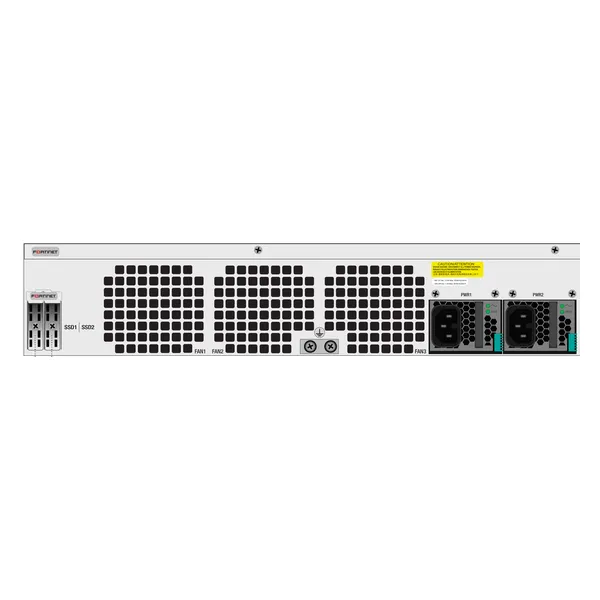
FortiGate 3001G (FG-3001G) Tanzania
FortiGate 3001G is a new-generation high-performance Fortinet security appliance for organizations designing large data-center edges, enterprise cores, internet gateways, security service platforms and consolidated secure networking environments. Fortinet documentation published in 2026 identifies FG-3001G as a supported FortiGate model in the FortiGate 3000G family. The platform is intended for environments where ordinary branch firewalls are not sufficient and where security teams must evaluate firewall throughput, IPS, NGFW inspection, threat protection, VPN capacity, encrypted traffic, interface density, high availability and operational resilience together.
For Tanzanian buyers, the practical question is not simply whether FG-3001G is powerful. The correct question is whether its performance profile, interfaces, storage, FortiGuard services and lifecycle fit the actual network. FourTeck approaches this as an architecture and procurement decision: document present and forecast traffic, identify north-south and east-west inspection requirements, define WAN and data-center interfaces, establish availability targets, confirm subscription scope and then prepare a quotation around the required hardware and services.
Fortinet product-matrix firewall throughput for the FG-3000G platform at 1518-byte UDP, with 394 Gbps at 512-byte and 234 Gbps at 64-byte packet sizes. Performance figures are laboratory maximums and real deployments vary.
The current Fortinet product matrix lists 90 Gbps IPS throughput using its enterprise traffic mix for the 3000G platform, a substantial security-inspection capability for demanding environments.
Fortinet lists up to 85 Gbps NGFW throughput and 80 Gbps threat-protection throughput for the FG-3000G platform under the vendor’s stated enterprise-mix test conditions.
Fortinet lists 105 Gbps IPsec VPN throughput for the platform, making VPN architecture, encryption requirements and tunnel design important parts of sizing rather than afterthoughts.
What FortiGate 3001G solves
Large networks frequently face a mismatch between raw link speed and the performance available after security controls are enabled. A firewall may pass basic traffic quickly yet become the bottleneck once intrusion prevention, application control, malware inspection, SSL inspection, VPN services and detailed logging are introduced. The FortiGate 3000G generation is positioned for high-throughput secure networking. Fortinet’s published product matrix lists 397/394/234 Gbps firewall throughput for 1518/512/64-byte UDP traffic, 90 Gbps IPS, 85 Gbps NGFW, 80 Gbps threat protection and 105 Gbps IPsec VPN throughput for FG-3000G. FG-3001G is the storage-equipped member of the same series, and Fortinet’s documentation separately confirms it as a supported model. These numbers should be used as vendor reference points, not guarantees for a production network.
The platform is therefore relevant when a security design must support substantial internet connectivity, multiple routed segments, large user populations, high session counts, extensive VPN traffic or data-center workloads without forcing teams to separate every networking and security function into unrelated appliances. FortiOS provides a common operating environment for firewalling and secure networking, while FortiGuard services can add continuously updated security capabilities according to the selected service package. The business value is architectural consolidation and policy consistency, but the final result still depends on correct design, licensing, optics, routing, HA topology and operational procedures.
FG-3001G interfaces, acceleration and storage
Fortinet’s 3000G family documentation and current market ordering information identify a high-density interface design built around 100GE, 25GE/10GE and 10G Base-T connectivity. The 3000G family uses purpose-built Fortinet acceleration, including NP7 network processing and the newer CP10 content processor in published 3000G ordering descriptions. This matters because large security gateways must process packets, sessions and security content at rates that can overwhelm general-purpose processing when inspection is enabled.
FG-3001G adds onboard storage relative to the non-storage member of the series. Storage can be relevant for local logging and operational workflows, but buyers should not assume it replaces a properly sized centralized analytics and retention platform. Logging design should consider event volume, compliance retention, search requirements, reporting, incident response and whether FortiAnalyzer or another approved logging architecture is part of the environment. Interface planning should likewise confirm required transceiver types, fiber standards, link distances, breakout requirements, switch compatibility and redundancy before purchase.
Security services, FortiOS and licensing decisions
A FortiGate appliance purchase should be separated conceptually into hardware capability, FortiOS functions, security subscriptions and support. Different FortiGuard bundles can change the security services available to the deployment, while FortiCare options affect support coverage. The correct bundle depends on the threat model and the controls the organization intends to operate. Procurement teams should avoid comparing quotations only by appliance model because two FG-3001G proposals can represent materially different service coverage and term lengths.
For a useful quotation, specify whether the design needs advanced malware protection, web and DNS security, intrusion prevention, application control, remote-access functions, centralized management, centralized logging, sandbox integration, identity integration or other Fortinet Security Fabric components. Renewal planning is equally important. Security subscriptions are operational dependencies, so organizations should document renewal ownership, renewal dates and budget responsibility. FourTeck can structure the discussion around the appliance, service term and related components rather than treating the firewall as a standalone box.
High availability and resilient architecture
For an appliance in this performance class, high availability is commonly an architectural requirement rather than an optional enhancement. Fortinet supports FortiGate HA designs, and the current product matrix identifies active-active, active-passive and clustering capabilities across high-end FortiGate platforms. The suitable topology depends on failure domains, upstream and downstream network design, maintenance requirements and the organization’s recovery objectives. Buyers should size the solution so a surviving unit can sustain the required security load during a failure or maintenance event.
Resilience planning should extend beyond two firewalls. Dual power feeds, independent upstream paths, switch redundancy, correct HA links, routing convergence, DNS dependencies, VPN peer behavior and monitoring all influence real availability. A procurement bill of materials should therefore include the required optics, cables, rack power considerations, subscriptions and management components. This reduces the risk of receiving the core appliances while discovering that essential interconnect or service items were omitted.
FortiGate 3001G Tanzania
Organizations evaluating FortiGate 3001G in Tanzania are typically planning for workloads that go beyond a single-office perimeter. Relevant environments include large enterprises, financial and service organizations, data centers, telecommunications environments, universities, government-scale networks and businesses consolidating multiple high-speed security functions. Tanzania buyers should begin with measured traffic rather than nominal ISP bandwidth. Peak throughput, encrypted traffic percentage, packet sizes, concurrent sessions, new connections per second, east-west inspection, remote access, site-to-site VPNs and future growth all affect the design.
Procurement should also account for the physical data-center environment. The rack location needs suitable power, cooling, cabling and upstream switching. High-speed interfaces require compatible optics and fiber. Where the firewall protects multiple business units or security zones, teams should map VLANs, routing domains, virtual domains where appropriate, security policies and logging requirements before migration. This makes the implementation plan auditable and reduces emergency policy changes during cutover.
Tanzanian organizations comparing the FG-3001G with smaller FortiGate models should focus on required inspected throughput and scale, not simply on the largest available appliance. Oversizing can waste capital while undersizing can force premature replacement or unsafe inspection bypasses. The 3001G becomes compelling when a documented requirement calls for its high-end performance class, dense high-speed interfaces and storage-equipped variant. For broader Fortinet planning, visit FourTeck Tanzania to connect the firewall decision with related security and infrastructure requirements.
FortiGate 3001G Dar es Salaam
Dar es Salaam organizations often concentrate headquarters, data-center, connectivity and customer-facing systems in environments where perimeter downtime has an immediate operational impact. An FG-3001G project should therefore start with a dependency map: internet circuits, MPLS or private WAN connections, cloud connectivity, public services, VPN users, branch tunnels, partner networks and critical application flows. The purpose of the exercise is to understand which traffic must continue during maintenance and which controls must remain enabled during failover.
For large campuses and enterprise headquarters, secure SD-WAN may be considered alongside NGFW controls where multiple WAN links need policy-driven path selection. For data centers, the emphasis may instead be high-throughput north-south inspection, segmentation, public-service protection and resilient routing. A service provider or managed environment may prioritize scale, virtual domains and operational separation. These are different designs even when the appliance model is identical.
A Dar es Salaam quotation request is more useful when it includes existing firewall model, internet and WAN speeds, interface media, number of sites, VPN requirements, current subscription services, preferred support term and HA requirement. This allows the bill of materials to be developed around a real architecture. Buyers should also plan migration: configuration conversion, rule review, object cleanup, NAT validation, routing tests, application tests, rollback criteria and post-cutover monitoring are as important as hardware installation.
FortiGate 3001G Mwanza
For Mwanza enterprises, the FG-3001G may serve as a centralized security platform when substantial branch, campus, data-center or inter-site traffic converges on a core location. The sizing conversation should distinguish internet-edge traffic from internal segmentation traffic. A network can have moderate internet bandwidth but very large east-west flows between server, user, backup and application networks. If those flows require inspection, the firewall design must account for them explicitly.
Connectivity resilience can be equally important. Multiple carriers or paths do not automatically produce application resilience; routing, health checks, SD-WAN rules where used, DNS behavior and session handling determine whether services recover cleanly. A FortiGate design can combine security and networking policy, but implementation should be tested against the organization’s actual applications. Sensitive applications may react differently to path changes, NAT changes or session interruption.
Procurement teams in Mwanza should request a complete scope covering the appliance, subscription bundle, term, optics, rack connectivity, HA peer if required, centralized management or logging requirements and implementation responsibilities. That approach avoids a common problem in enterprise firewall purchasing: comparing a bare hardware quote with a fully licensed and deployment-ready solution. The model number alone does not define the complete security outcome.
FortiGate 3001G Arusha
Arusha organizations with hospitality, service, institutional, enterprise or multi-site operations may evaluate FG-3001G when central infrastructure has grown beyond branch-class firewall capacity. Before selecting it, the network team should classify users, servers, guest services, administrative systems, voice, cameras, operational systems and cloud-bound traffic into security zones. This produces a clearer policy model and helps determine whether high-throughput internal segmentation is required.
Encrypted traffic is a major sizing consideration. Modern applications increasingly use TLS, and security inspection of encrypted sessions can consume materially different resources from simple stateful firewalling. Fortinet publishes separate SSL-inspection performance figures for its platforms because raw firewall throughput does not describe this workload. Teams should define what traffic may be decrypted, what must be exempted for privacy or technical reasons, certificate deployment processes and how exceptions are governed.
For Arusha procurement, it is useful to document growth for at least the expected lifecycle rather than sizing only for today’s links. New cloud services, additional branches, higher ISP speeds and security-policy expansion can all increase demand. The objective is a balanced design with enough headroom without assuming that the most expensive configuration is automatically the best fit.
FortiGate 3001G Dodoma
Dodoma deployments may include institutions, large administrative environments, enterprises and organizations with strict availability and governance requirements. In these networks, change control and policy traceability can be as important as throughput. A FortiGate 3001G design should define administrator roles, authentication, configuration backup, logging, approval workflows and monitoring before production cutover. High-capacity hardware is most valuable when it is operated through disciplined security processes.
Segmentation should be designed around business risk rather than an arbitrary number of VLANs. Critical servers, user networks, management interfaces, public services, third-party connections and operational systems may require different controls. The firewall policy should be explicit about permitted flows and should avoid broad rules that undermine the purpose of segmentation. Where virtual domains are appropriate, they can support administrative or policy separation, but their use should be planned against operational complexity.
A Dodoma buyer requesting FG-3001G pricing should provide expected security-service requirements and support term, because subscriptions are central to the commercial comparison. The procurement team should also clarify whether professional services include migration, policy review, HA configuration, VPN setup, testing, documentation and knowledge transfer. Defining these deliverables makes competing proposals easier to compare on scope rather than headline price alone.
FortiGate 3001G UAE
Organizations coordinating Tanzania and UAE infrastructure may use the same Fortinet architecture to simplify policy standards, VPN design and operational practices across regions. The FG-3001G is relevant to high-capacity hubs and data-center edges where large volumes of encrypted and inspected traffic converge. Cross-region designs should document latency, routing, cloud connectivity, site-to-site VPN topology and failover behavior rather than assuming that identical hardware creates identical performance in every location.
For UAE-linked procurement and technical coordination, FourTeck’s Fortinet UAE resource can support regional Fortinet discussions, while Tanzania requirements should remain aligned to the destination network, subscription and implementation scope. Licensing and support terms should be checked against the actual deployment and entitlement requirements rather than transferred by assumption between markets.
A cross-border enterprise should standardize naming, logging, firmware governance, backup procedures, incident escalation and security policy review. Central management can reduce inconsistency, but local connectivity and application dependencies still need region-specific testing. The goal is a repeatable security architecture with documented exceptions, not a one-size-fits-all configuration copied between sites.
FortiGate 3001G Uganda
Ugandan enterprises evaluating FG-3001G may be building a regional hub, large campus or data-center security layer. The same sizing discipline applies: establish peak inspected traffic, VPN demand, session scale, interface requirements and growth. Regional connectivity can make resilient WAN design important, but resilience should be validated at the application level and not reduced to counting ISP circuits.
For organizations operating across Tanzania and Uganda, consistent FortiGate policy architecture can simplify operations. Site-to-site VPNs, SD-WAN policies, routing and centralized visibility should be documented so teams understand how traffic behaves during normal operation and failures. The FourTeck Uganda site provides a regional path for Uganda-focused requirements while Tanzania procurement can be coordinated through the Tanzania operation.
When requesting a quote, specify whether the requirement is hardware only, hardware plus FortiGuard services, HA pair, migration project or a broader managed security scope. This distinction prevents ambiguity and makes lifecycle costs easier to evaluate.
FortiGate 3001G Kampala
Kampala is a common regional hub for corporate and service operations, so an FG-3001G deployment may sit at the convergence point for internet, branch, cloud and partner connectivity. A hub design should model both steady-state and failure-state traffic. If a secondary data center or WAN path fails, the surviving firewall may suddenly receive substantially more traffic. Capacity planning must account for that condition while security inspection remains enabled.
Teams should also evaluate operational visibility. High traffic volume generates substantial logs and events, and local storage should not be treated as the only retention strategy where long-term analytics or compliance reporting is required. Centralized logging, alerting and incident workflows should be sized with the firewall. The best deployment is one in which security teams can investigate events efficiently rather than merely generate them.
Kampala buyers should include interface maps and desired optics in the quotation request. High-speed firewall projects can be delayed by small physical-layer mismatches, so transceiver type, fiber, switch ports and rack design should be validated before delivery and cutover.
FortiGate 3001G Arua
An Arua requirement for a firewall in the FG-3001G class should be justified by centralized workload, regional aggregation, data-center functions or future scale rather than by brand preference alone. A structured assessment can compare current utilization, projected link upgrades, security services and HA requirements to determine whether the 3001G is appropriately sized.
Remote-site and regional connectivity can benefit from clear VPN and SD-WAN standards. The design should define tunnel encryption, route exchange, path monitoring, failover, segmentation and logging. Where branches use smaller FortiGate appliances, the central hub must be sized for aggregate tunnel and inspected traffic rather than the bandwidth of any single branch.
Procurement should include a configuration and acceptance plan. Tests can cover routing, internet access, critical applications, VPNs, failover, logging and rollback. A documented test plan turns deployment from an improvised cutover into a controlled infrastructure change.
FortiGate 3001G Mbarara
Mbarara organizations considering FG-3001G should assess whether the firewall will protect only an internet edge or also perform internal segmentation, VPN concentration and secure WAN functions. Combining these roles can simplify architecture, but it also means capacity must be allocated across multiple workloads. Peak conditions and maintenance scenarios are especially important.
Security policy design should accompany hardware sizing. Application control, IPS and threat-protection services provide value when policies are deliberately constructed, tuned and reviewed. Blanket enablement without operational review can create unnecessary noise, while excessive exemptions can reduce protection. The deployment plan should therefore include policy ownership and a post-cutover tuning period.
For procurement, document subscription duration, support level and renewal planning. A multi-year security investment should be evaluated on the complete term, not only acquisition cost. Clear scope also helps finance and technical teams understand which capabilities depend on active services.
FortiGate 3001G Gulu
Gulu deployments may use a high-capacity FortiGate as a regional aggregation point or as part of a larger distributed enterprise. The network team should map every upstream and downstream dependency before installation. This includes WAN routers, core switches, server networks, public IP ranges, VPN peers, identity services, DNS, NTP, logging and monitoring platforms.
A migration from another firewall should not blindly convert every historical rule. Migration is an opportunity to identify obsolete objects, duplicate rules, unused services and overly broad access. Configuration-conversion tools can assist, but technical review and application testing remain necessary. Security policy should reflect current business requirements rather than preserving years of accumulated exceptions without validation.
The quotation should distinguish product supply from implementation. If installation is required, define whether the scope includes rack mounting, cabling, base configuration, routing, HA, VPNs, policy migration, testing and documentation. This produces a clearer commercial and technical outcome.
FortiGate 3001G Kenya
Kenyan organizations connected to Tanzanian operations may consider the FG-3001G for regional data-center and hub designs. Inter-country enterprise networks should define where internet breakout occurs, where security inspection is performed and how traffic reaches cloud services. Centralizing all traffic through one region can simplify policy but may introduce latency or dependency; distributed inspection can improve locality but requires consistent management.
For Kenya-specific procurement discussions, FourTeck Kenya provides a relevant regional resource. Cross-border projects should align hardware, software versions, policy standards and monitoring while respecting the actual operational requirements of each site. VPN architecture should also consider redundant paths and peer availability.
Buyers should request model-specific current documentation at the quotation stage because the FG-3001G is a recently introduced platform and Fortinet documentation evolves. Confirm interfaces, storage, supported FortiOS train, bundle part numbers and required accessories against the final bill of materials before purchase.
FortiGate 3001G Kuwait
Kuwait-linked enterprises may use FG-3001G-class firewalls for high-speed data-center edges, secure WAN hubs and consolidated security gateways. The architecture should be driven by measured inspected traffic and application criticality. Where Tanzania and Kuwait sites exchange substantial data, VPN and routing design should consider latency, encryption overhead, path redundancy and failover behavior.
Regional procurement can be coordinated with the FourTeck Kuwait resource for Kuwait-focused requirements. Hardware and service entitlements should always be validated for the destination deployment. Teams should avoid assuming that a quote prepared for one geography automatically has the same commercial or support conditions elsewhere.
A standardized deployment template can still provide value across regions: consistent administrator access, logging, naming, firmware governance, backups and policy review make operations easier. Site-specific exceptions should be documented so troubleshooting teams know exactly where configurations differ and why.
FortiGate 3001G Ghana
Ghana deployments for FG-3001G may center on enterprise data centers, financial services, service providers, large campuses or regional hubs. The security architecture should identify traffic classes that need full threat inspection and those that require different handling because of privacy, technical compatibility or performance. This is especially relevant for TLS decryption policies.
Centralized operations can reduce configuration drift across a multinational environment. Teams should consider how FortiManager, FortiAnalyzer or approved equivalent operational tools fit the design. Management and logging are not substitutes for firewall capacity; they are complementary components that make a large firewall estate manageable and auditable.
For Ghana-focused coordination, FourTeck Ghana is the relevant regional resource. A complete quotation request should include target topology, security services, HA, support term, interface requirements and migration expectations.
FortiGate 3001G Nigeria
Nigeria’s large enterprise and service-provider environments can generate the kind of scale for which the FortiGate 3001G family is designed. However, the model should still be selected through sizing rather than assumption. Internet bandwidth, data-center traffic, VPN aggregation, session rates, encrypted inspection and growth must be evaluated together.
A resilient design should test carrier failure, firewall failure, switch failure and maintenance scenarios. Security policies and routing should behave predictably when topology changes. Monitoring should alert teams to degraded redundancy before a second failure becomes an outage. These operational details determine whether expensive redundant hardware actually provides resilient service.
Nigeria-focused requirements can be coordinated through FourTeck Nigeria. For multinational buyers, maintain a common bill-of-materials template but validate subscriptions, accessories and implementation requirements for each destination.
FortiGate 3001G Seychelles
Seychelles organizations may have different connectivity economics and redundancy options from larger mainland markets, which makes architecture discipline particularly important. An FG-3001G deployment should be justified by actual central security demand, data-center scale or regional aggregation. Where external links are comparatively constrained, internal east-west inspection or future consolidation may still be the dominant sizing factor.
WAN resilience should consider the real diversity of available paths rather than assuming that two commercial services are physically independent. Firewall SD-WAN policy can select among available links, but it cannot remove a shared upstream failure outside the organization’s control. Application owners should therefore identify critical services and acceptable recovery behavior.
Procurement should include remote operational considerations such as spare strategy, support entitlement, configuration backup and clear escalation procedures. The objective is to reduce recovery time when a fault occurs. A documented architecture, current configuration backup and tested replacement process can be as important as the original installation.
Buying and sizing checklist
Before requesting an FG-3001G quotation, collect the current and target internet/WAN speeds; peak and average throughput; estimated encrypted-traffic percentage; concurrent and new-session requirements; number of IPsec and remote-access users; interface speeds and media; routing protocols; HA requirement; number of security zones; required FortiGuard services; logging retention; centralized management requirements; migration source platform; support term; rack power and cooling; and target implementation date. For data-center deployments, include east-west flows and not only internet traffic.
Also identify the business applications that cannot tolerate interruption. Their dependencies should become part of the acceptance test. A successful firewall project is not proven merely by ping tests; it is proven when critical applications, VPNs, public services, identity flows, monitoring and failover operate as expected with the intended security controls enabled.
FortiGate 3001G FAQs
Is FG-3001G an official Fortinet model?
Yes. Fortinet’s 2026 FortiOS documentation lists FG-3001G as a supported model, and the FortiGate 3000G Series QuickStart Guide explicitly covers FG-3000G and FG-3001G.
What is the difference between FG-3000G and FG-3001G?
The 3001 designation identifies the storage-equipped member of the family. Fortinet’s current product information associates the FG-3001G with onboard storage. Confirm the exact storage configuration and final part number on the current quotation and model documentation.
What performance does the 3000G platform provide?
Fortinet’s current product matrix lists up to 397/394/234 Gbps firewall throughput for 1518/512/64-byte UDP, 90 Gbps IPS, 85 Gbps NGFW, 80 Gbps threat protection and 105 Gbps IPsec VPN throughput. These are vendor laboratory figures under stated test conditions; production performance depends on configuration and traffic.
Should we buy one FG-3001G or an HA pair?
That depends on the organization’s availability requirements. If firewall failure or planned maintenance cannot be allowed to interrupt critical services, an HA architecture should be evaluated. The complete design must also address upstream switching, routing, power and WAN dependencies.
Which FortiGuard subscription should we choose?
Choose according to the controls the organization intends to operate and the support level required. Compare bundle contents and term lengths on the actual quotation rather than assuming all FG-3001G offers include identical security services.
Decision recap
FortiGate 3001G is a high-end firewall platform for demanding secure networking rather than a general-purpose small-office appliance. Its value is strongest when a documented requirement calls for very high inspected throughput, high-speed interfaces, VPN scale, resilient architecture and the storage-equipped 3001G variant. The purchase decision should combine hardware sizing with FortiGuard services, HA, optics, centralized operations, migration and lifecycle planning.
Consultation and quotation preparation
Send your present firewall model, current link speeds, target link speeds, site count, VPN requirements, interface map, HA requirement and preferred subscription term. FourTeck can use those inputs to frame the FG-3001G bill of materials and identify questions that must be resolved before procurement. This approach is especially useful for migrations where optics, licensing, routing and service scope can materially change the final project cost.



Reviews
There are no reviews yet.