
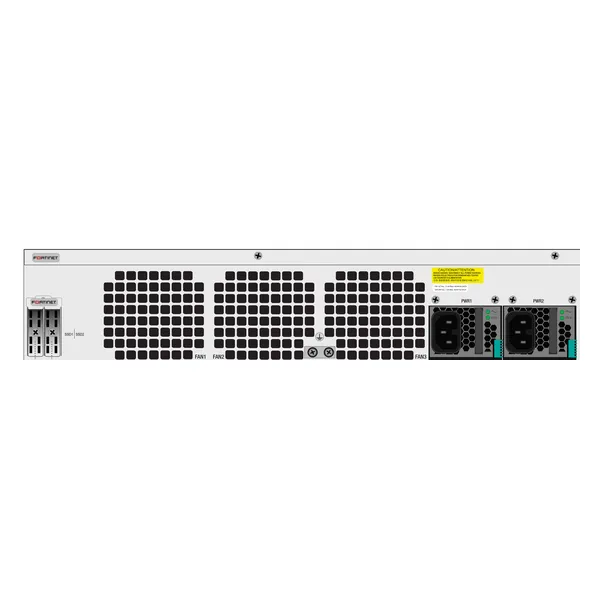
FortiGate 3501G (FG-3501G) Tanzania
FortiGate 3501G is the local-storage variant of Fortinet’s high-end FortiGate 3500G platform for organizations that need substantial firewall capacity, high-speed network connectivity and consolidated security services. Current Fortinet product-matrix information identifies the 3500G platform with 2 × 400GE QSFP-DD, 4 × 100GE QSFP28, 30 × 25GE SFP28 and 2 × 10GE RJ45 interfaces; the FG-3501G variant adds 2 × 1.92 TB local storage. The platform is a 2RU appliance with dual power supplies. Buyers should size the appliance against real application traffic, inspection profiles, VPN requirements, interface speeds, availability design and FortiGuard service requirements rather than relying on headline firewall throughput alone.
High-speed architecture
The 3500G platform is built for dense high-speed connectivity, making it relevant to data-center borders, enterprise cores, large campuses, aggregation points and environments where 25GE, 100GE or 400GE links are part of the network design.
Local storage variant
FG-3501G is identified by Fortinet as the 3500G variant with 2 × 1.92 TB local storage. Storage can be relevant when planning local logging and operational workflows, while centralized logging requirements should still be evaluated separately.
Security and networking
FortiOS brings firewalling, segmentation, VPN, application control, secure SD-WAN and integration with Fortinet Security Fabric technologies into a common operating environment. Feature availability can depend on software release and subscriptions.
FortiGate 3501G overview and verified platform facts
The FortiGate 3501G belongs to Fortinet’s high-end firewall class. Fortinet’s current product matrix lists the FortiGate 3500G platform at up to 3.1 Tbps firewall throughput for 1518/512-byte UDP traffic and 0.93 Tbps for 64-byte UDP traffic, with 800 Gbps IPsec VPN throughput under the vendor’s stated test conditions. The same matrix lists 87 Gbps IPS throughput for enterprise traffic mix, 77 Gbps NGFW throughput, 112 Gbps SSL inspection throughput for the referenced test profile and 197 Gbps application-control throughput for HTTP 64K. These are laboratory/vendor performance figures and should not be treated as guaranteed production results. Real performance varies with configuration, packet size, enabled security profiles, traffic composition, encryption, logging and software release.
A sound procurement process therefore begins with workload discovery. Document current and projected internet capacity, east-west inspection needs, number and speed of data-center links, expected concurrent sessions, new sessions per second, IPsec topology, remote-access requirements, application mix, SSL inspection policy, high-availability design and log-retention objectives. This turns the product conversation from a model-number purchase into an architecture decision. It also helps identify the optics, transceivers, cables, subscriptions, management systems and support coverage that need to appear on the bill of materials.
| Planning item | Fortinet-listed information | Buyer consideration |
|---|---|---|
| Interfaces | 2×400GE, 4×100GE, 30×25GE, 2×10GE RJ45 | Match port type, speed, optics and topology. |
| Local storage | 2×1.92 TB on FG-3501G | Define local versus centralized logging strategy. |
| Form factor | 2RU | Reserve rack space, power and cooling capacity. |
| Power | Dual power supplies | Plan independent feeds and HA resilience. |
Deployment, licensing and integration guidance
A FortiGate 3501G project may involve much more than installing a perimeter firewall. Large organizations commonly need zones for users, servers, public services, management, partners, backup systems and operational technology; route design; dynamic routing; high availability; policy migration; NAT; IPsec VPN; remote access; secure SD-WAN; authentication; centralized management; logging; alerting and integration with existing monitoring. The exact scope should be documented before cutover so security policy, network dependencies and rollback procedures are clear.
FortiGuard subscriptions should be selected according to required security services and the organization’s operational model. Buyers should verify the exact bundle, term and service entitlement on the quotation rather than assuming every security capability is included indefinitely with hardware. Similarly, FortiManager and FortiAnalyzer may be appropriate where centralized policy administration, fleet management, analytics or longer-term log workflows are required. The right architecture depends on the number of devices, administrative model, compliance objectives and desired visibility.
For broader Fortinet architecture information, customers can explore FourTeck Fortinet resources for the UAE when coordinating regional Fortinet requirements, FourTeck Africa technology coverage for multi-country projects, FourTeck Uganda for Uganda-related procurement discussions, FourTeck Kenya for Kenya requirements and FourTeck UAE for broader regional technology sourcing conversations. Availability, commercial terms and service scope should be confirmed for each project and country.
FortiGate 3501G Tanzania
Organizations searching for FortiGate 3501G Tanzania are usually planning a high-capacity security project rather than a small branch firewall refresh. Relevant environments include large enterprise headquarters, data centers, telecommunications networks, financial platforms, universities, government-scale networks, cloud connectivity hubs and organizations consolidating multiple security zones. The key purchasing question is not simply whether FG-3501G has enough raw throughput; it is whether the proposed design has enough inspected capacity, interface density, redundancy, VPN capability and operational headroom for the traffic profile expected during the appliance lifecycle.
For Tanzania deployments, start by mapping primary and backup internet circuits, private WAN services, data-center interconnects and high-speed LAN or core links. If the network uses 25GE or 100GE switching today, or expects migration toward higher-speed links, the 3500G platform’s interface mix can reduce the need to design around lower-speed firewall ports. The 400GE interfaces may also be relevant in particularly demanding aggregation designs. Port availability alone is not a complete design: compatible optics, cabling, switch capabilities, link aggregation, routing and physical path diversity must be checked as a complete system.
Security requirements should be translated into policies before sizing. Teams should identify which traffic needs intrusion prevention, application control, web security, malware inspection or SSL inspection; which server segments need stricter east-west controls; and which connections can be handled with different profiles. VPN requirements deserve separate attention because site-to-site tunnels, remote access and encrypted inter-site traffic can create different capacity and authentication needs. Where multiple Tanzanian sites are involved, secure SD-WAN may help combine transport selection and security policy, but topology and circuit quality should be assessed carefully.
A quotation request should state whether the project is a new deployment, replacement or migration, plus required subscription term, high-availability requirement, management and analytics platform, optics, rack constraints and desired implementation assistance. This information allows a supplier to prepare a more useful bill of materials and reduces the risk of discovering missing components late in the project. FourTeck can use these inputs to discuss an FG-3501G configuration without making assumptions about stock, delivery time, licensing or service coverage.
FortiGate 3501G Dar es Salaam
FortiGate 3501G Dar es Salaam searches often align with dense enterprise connectivity, data-center activity and organizations that aggregate substantial internet and private-network traffic. A large firewall in this environment may sit at an internet edge, between data-center security zones, in front of hosted services, or at the hub of a multi-site WAN. The 3500G platform’s combination of very high firewall capacity and high-speed interfaces makes it a candidate for designs where lower-end appliances could become a bottleneck as bandwidth and encrypted traffic grow.
Before selecting FG-3501G for a Dar es Salaam site, document every physical and logical connection expected at the firewall. Include carrier handoffs, upstream routers, core switches, server fabrics, DMZs, management networks and HA heartbeat or synchronization needs. Record interface speeds and media types. This is especially important when the project involves 25GE, 100GE or 400GE connectivity because the complete optical path must be compatible. Redundant links should be mapped to separate failure domains where the surrounding infrastructure permits it.
Operational planning is equally important. A high-capacity firewall can enforce many security controls, but the organization still needs policy ownership, change control, log review, incident response and configuration backup procedures. Determine whether administrators will manage one appliance pair locally or use centralized FortiManager for a broader estate. Decide how events and traffic logs will be retained and analyzed, and whether FortiAnalyzer or another supported logging workflow forms part of the architecture. Local storage on FG-3501G can be useful, but it does not eliminate the need to define retention, resilience and compliance requirements.
For procurement, provide peak and projected traffic, enabled inspection features, VPN requirements, HA expectations, subscription term and required accessories. If replacing another firewall, include current interface mappings and routing protocols so migration complexity can be estimated. For a new data-center build, include rack, power and cooling planning alongside security design. These details make a Dar es Salaam FG-3501G quotation more precise and help technical teams compare the proposed architecture against business continuity requirements rather than comparing hardware price alone.
FortiGate 3501G Mwanza
A FortiGate 3501G Mwanza requirement can arise where a regional hub, large industrial organization, service provider, institution or distributed enterprise needs to consolidate significant security and WAN traffic. Because FG-3501G is a high-end platform, buyers should validate whether traffic scale and growth justify this class of appliance. For some designs the model may serve as a central hub protecting many remote locations rather than being selected solely for the bandwidth of one local internet circuit.
Hub architecture changes the sizing conversation. Count the number of remote sites and tunnels, identify expected aggregate VPN traffic, determine whether branch internet traffic is backhauled or breaks out locally, and model failover conditions. A firewall that performs comfortably during normal operation should also be evaluated for scenarios in which traffic shifts from a failed link or alternate site. If Mwanza is part of a two-site resilience plan, routing convergence, asymmetric paths, stateful failover expectations and application dependencies should be reviewed before deployment.
The FG-3501G’s high-speed interface options can support connection to modern switching and data-center infrastructure, but physical compatibility must be confirmed. The procurement list should specify optics and cable types rather than assuming they are included. Teams should also decide whether the local storage variant is preferred for logging and operational reasons. Central analytics may still be advisable when the organization wants consolidated visibility across multiple FortiGate devices or longer retention than a local appliance workflow is designed to provide.
For Mwanza procurement, include application criticality and maintenance-window constraints in the project brief. High availability is commonly considered for critical perimeter or hub roles because a single appliance can otherwise become a major dependency. HA does not automatically solve upstream carrier, switch, power or configuration risks, so resilience should be designed end to end. FourTeck can work from a documented requirement covering appliance, subscriptions, interfaces, management, analytics and implementation scope, with commercial availability and service details confirmed specifically for the requested project.
FortiGate 3501G Arusha
FortiGate 3501G Arusha projects may involve large corporate campuses, hospitality groups, institutions, regional headquarters, service providers or organizations operating many connected sites. In such environments, firewall sizing should account for more than internet browsing. Business applications, cloud services, voice, video, guest networks, data replication, remote access, branch VPN and server traffic can all contribute to aggregate demand. Security inspection can also materially change effective throughput compared with basic Layer-3 forwarding.
A useful Arusha design exercise separates traffic into security zones and trust levels. Corporate users, guest access, public-facing services, management systems, IoT devices and server workloads should not automatically share identical policy. Segmentation can reduce exposure and make security policy easier to reason about, but it also increases the importance of firewall policy design and capacity planning when substantial east-west traffic crosses the appliance. The 3500G platform’s high-speed connectivity can be valuable when the firewall is intentionally placed in these higher-bandwidth paths.
Organizations with many sites should also examine whether secure SD-WAN is part of the target design. FortiGate can combine WAN path selection with security enforcement, but successful deployment depends on accurate link monitoring, application definitions, SLA rules and failover testing. If different sites use different carrier technologies or bandwidth levels, policy should reflect the real behavior of those circuits. Critical applications should be tested under both normal and degraded conditions rather than assuming that failover alone guarantees acceptable user experience.
When requesting an FG-3501G quotation for Arusha, provide expected user and site counts, peak throughput, WAN topology, security profiles, VPN needs, interface requirements and subscription duration. Also state whether the project needs HA, centralized management, analytics, migration or policy cleanup. This produces a more complete procurement conversation and helps avoid under-scoping the operational components around the appliance. No assumption should be made about local inventory, delivery or on-site engineering until those items are explicitly confirmed in the commercial proposal.
FortiGate 3501G Dodoma
FortiGate 3501G Dodoma can be relevant to large institutional, public-sector, enterprise and infrastructure environments where security architecture must accommodate substantial bandwidth, multiple security zones and strict operational controls. Procurement teams should begin with requirements and governance rather than selecting a firewall solely from a throughput table. Document what must be protected, which networks communicate, which services are internet-facing, how administrators authenticate, where logs are retained and what change-control process applies.
For networks handling sensitive systems, segmentation design is particularly important. Separate user, server, management, partner, public-service and other security domains according to organizational requirements. Determine which flows need deeper inspection and which are tightly controlled by source, destination, service and identity. FortiGate policy can support a consolidated security architecture, but the effectiveness of that architecture depends on accurate rules, maintained objects and disciplined operational processes. Migration projects should include a review of legacy rules so obsolete access is not automatically carried into the new platform.
Resilience planning should cover the complete service path. FG-3501G has dual power supplies and can be deployed in high-availability architectures, but buyers should also consider independent power feeds, redundant switching, diverse carrier paths, routing design and management access. Maintenance and software-upgrade procedures should be defined before production. Where centralized administration is required across many firewalls, FortiManager may simplify policy and configuration workflows; where consolidated security analytics and log retention are priorities, FortiAnalyzer can be evaluated as part of the solution.
A Dodoma quotation request should therefore include a topology diagram or clear written description, bandwidth figures, expected growth, inspection services, VPN requirements, port and optics requirements, HA preference, subscription term and management or logging needs. For regulated or formally governed environments, include documentation and acceptance-test requirements as well. FourTeck can use this information to prepare a product discussion around FG-3501G while ensuring commercial commitments such as price, delivery and implementation scope are stated only in the final project-specific proposal.
FortiGate 3501G UAE
FortiGate 3501G UAE requirements often involve regional headquarters, data centers, cloud interconnects, service providers and enterprises with high-speed network cores. The platform’s 400GE, 100GE and 25GE interface mix can fit designs where firewall connectivity needs to align with modern spine-leaf, aggregation or high-capacity edge networks. Buyers should confirm exact interface use, optics and adjacent switch compatibility before ordering, particularly when the architecture depends on breakout, link aggregation or multiple high-speed paths.
For a UAE regional hub, encrypted traffic and multi-country connectivity can be significant sizing factors. Model aggregate IPsec traffic, site-to-site tunnels, remote access and cloud connectivity separately from unencrypted internet traffic. If the firewall is expected to inspect encrypted application sessions, use the relevant vendor inspection figures as a planning reference and maintain headroom for growth. Performance results depend on configuration and test conditions, so production sizing should be based on the actual mix of enabled security services.
Many UAE enterprises also operate hybrid environments spanning on-premises data centers, public cloud and branch offices. FortiGate can form part of a broader Fortinet Security Fabric architecture, while FortiManager and FortiAnalyzer can support centralized operations. The design should define which system is authoritative for configuration, where logs are stored, how administrators authenticate and how changes are approved. If the organization already has Fortinet infrastructure, software compatibility and operational standards should be reviewed before introducing the new appliance.
Procurement teams should request a bill of materials that clearly separates hardware, FortiGuard subscriptions, support, optics, management or analytics components and professional services. This makes renewal planning clearer and prevents a headline appliance price from obscuring the complete lifecycle requirement. For UAE-focused coordination, the FourTeck network resources linked above can support regional conversations, while actual stock, lead time, licensing eligibility and service scope should always be confirmed against the specific quotation.
FortiGate 3501G Uganda
FortiGate 3501G Uganda is most relevant where an organization needs a high-end firewall for a central data center, large enterprise edge, aggregation role or multi-site security hub. Before procurement, compare the appliance class with real traffic and growth. If the environment has many branches, the central firewall may need to handle aggregate tunnel traffic and security inspection from the entire estate, which can make its requirements very different from those of individual branch firewalls.
Start by documenting internet and private WAN services, site-to-site VPN topology, cloud connections and critical applications. If branches backhaul traffic through a central Uganda location, model normal and failover loads. Determine whether secure SD-WAN is being used only at branches or also at the hub, and identify how route exchange and path selection interact with security policy. Large deployments benefit from clear naming standards and centralized policy governance so configuration remains understandable as the network grows.
The FG-3501G local-storage configuration may support local operational needs, while centralized analytics can still be considered for multi-device environments. Logging strategy should answer practical questions: which events are retained, for how long, who reviews them, what alerts require action and how incident data is protected. Subscription planning should likewise identify the required FortiGuard services and term. Buyers should verify renewal costs and entitlements in the commercial proposal rather than treating security subscriptions as an unspecified accessory.
For Uganda procurement, provide current bandwidth, growth assumptions, number of sites, tunnel counts, expected inspection services, high-availability needs, interface speeds and management requirements. If the project spans Kampala, Arua, Mbarara, Gulu or other locations, include the role of each site so hub and branch responsibilities are clear. FourTeck Uganda resources can be used for regional coordination, while all commitments on availability, delivery, configuration and support should be confirmed for the individual project.
FortiGate 3501G Kampala
A FortiGate 3501G Kampala deployment may serve as a national headquarters or data-center security hub for organizations with numerous branches and cloud services. In this role, the firewall can become a convergence point for internet access, private WAN, IPsec, application publishing and inter-zone traffic. That concentration makes architecture and resilience as important as raw throughput. The design should identify dependencies that could still cause an outage even when two firewalls are deployed.
High availability should be evaluated together with switching, routing, power and carrier diversity. A redundant firewall pair connected through one upstream switch or one carrier handoff still has external single points of failure. Likewise, HA behavior should be tested with critical applications because state synchronization, routing convergence and session behavior can affect recovery. Operational teams need documented procedures for failover tests, firmware maintenance, backups and emergency changes.
Kampala organizations running high-speed campus or data-center switching can benefit from carefully mapping the FG-3501G’s 25GE, 100GE and 400GE interfaces to the intended topology. Procurement should include the correct optical modules and cabling, with compatibility confirmed for both firewall and neighboring equipment. If segmentation drives substantial internal traffic through the firewall, east-west throughput and inspection policy should be included in sizing rather than considering internet bandwidth alone.
When requesting a Kampala quotation, specify whether the firewall will be an internet edge, data-center segmentation device, VPN hub, secure SD-WAN hub or a combination of these roles. Include subscriptions, centralized management, analytics, migration and implementation needs. This makes it easier to build a complete scope and compare alternatives on architecture, lifecycle and operational fit. Price and lead time are inherently quotation-specific and should be confirmed at the time of procurement.
FortiGate 3501G Arua
FortiGate 3501G Arua inquiries should be assessed against the scale and role of the site. Because this is a high-end platform, it may make most sense when Arua forms part of a larger enterprise, carrier, institutional or multi-site architecture with substantial aggregation, data-center or hub requirements. If the site is primarily a smaller branch, a different FortiGate class may provide a more proportionate fit; sizing should therefore precede model confirmation.
Where Arua is a regional aggregation point, WAN resilience can be a major design factor. Document available circuits, expected failover paths, latency-sensitive applications and the traffic that must remain available during an outage. Secure SD-WAN policies can steer applications across suitable paths, but the configuration needs meaningful performance thresholds and testing. VPN design should include authentication, encryption requirements, routing and how tunnels recover when an underlay circuit changes.
Security policy should also reflect the site’s business role. A regional hub may need segmentation between local users, servers, management systems, guest networks and traffic arriving from remote branches. Avoid creating broad rules simply to accelerate deployment; establish clear objects and policy ownership from the start. If a central security team manages the environment, FortiManager can be evaluated to standardize administration across devices, while logging and analytics should be designed around the organization’s retention and monitoring requirements.
For an Arua project, a useful request for quotation includes site role, link speeds, expected peak traffic, number of remote locations, VPN needs, required security inspection, HA requirement, interface media, subscriptions and implementation scope. This allows the supplier to determine whether FG-3501G is appropriate or whether another model should be considered. Any local delivery, installation or support requirement should be explicitly requested and confirmed rather than inferred from the product listing.
FortiGate 3501G Mbarara
FortiGate 3501G Mbarara can support large regional networks when the site has significant aggregation, security or data-center responsibilities. Buyers should begin with a capacity worksheet covering internet bandwidth, private links, server traffic, VPN, user growth and security inspection. This is particularly important for high-end firewalls because a model can appear oversized when only internet bandwidth is considered while being appropriate once internal segmentation and aggregated multi-site traffic are included.
If Mbarara hosts applications used by remote offices, the firewall design should account for both inbound user traffic and replication or backup flows. Large data transfers can consume capacity differently from interactive applications, while SSL inspection and threat prevention add processing requirements. Network architects should decide which traffic crosses the security boundary and avoid unnecessarily hairpinning high-volume trusted flows if the security model does not require it. Conversely, bypassing inspection simply for performance should not undermine the intended security architecture.
The physical design should consider rack space, power feeds, cooling, transceivers and cable management. Fortinet lists the platform as 2RU with dual power supplies. For critical roles, connect redundant power and network paths according to the surrounding infrastructure design. Local storage on FG-3501G can be incorporated into the logging plan, but organizations that require consolidated reporting across many sites may still prefer centralized analytics and retention.
A Mbarara procurement brief should state whether the appliance is standalone or part of an HA pair, what subscription term is required, whether FortiManager or FortiAnalyzer is already deployed, and which optics are needed. Migration scope should identify the existing firewall, rule count, VPNs, routing protocols and downtime constraints. These details help turn the product request into a deployable solution and allow commercial teams to quote the required components without making unsupported assumptions about availability or services.
FortiGate 3501G Gulu
FortiGate 3501G Gulu requirements may be driven by a large institutional network, enterprise hub, service-provider environment or regional infrastructure project. The platform should be evaluated where substantial traffic, high-speed interfaces or aggregation justify a high-end firewall. For smaller environments, right-sizing remains important because operational simplicity and lifecycle cost can matter as much as maximum capacity.
For a Gulu hub, network teams should model traffic during both normal operation and circuit failures. If multiple sites use the hub for VPN or internet security, the appliance may see higher load when alternate paths converge after an outage. Secure SD-WAN policies should be tested under loss, latency and link-down conditions. Critical applications may need distinct steering rules, and routing should be designed to avoid unexpected asymmetric paths that complicate stateful firewall behavior.
Security operations need equal attention. Define administrator roles, multi-factor authentication where appropriate, configuration backup, change approval, log review and incident escalation. FortiGate is a powerful control point, but security value depends on maintained policies and active monitoring. If many Fortinet devices are deployed, centralized management and analytics can reduce fragmented operations. Subscription renewals should be tracked as a lifecycle responsibility so required security services do not lapse unexpectedly.
For procurement in Gulu, share topology, throughput, number of sites, tunnel requirements, inspection profiles, high-availability design and required interfaces. Specify whether the quotation should include subscriptions, optics, management, analytics, migration and implementation. This creates a transparent bill of materials and makes future renewal planning easier. Local logistics and service arrangements can vary, so they should be confirmed in writing for the project rather than presented as general product-page promises.
FortiGate 3501G Kenya
FortiGate 3501G Kenya is suited to evaluation for large data-center, enterprise-core, service-provider and multi-site hub roles where high-capacity security inspection and fast interfaces are required. Kenya-based organizations with regional operations may use a central firewall architecture to secure connectivity between offices, cloud platforms and hosted services. In these cases, sizing should include traffic from the full regional footprint and expected growth rather than only the local internet circuit.
A data-center design should identify north-south and east-west traffic separately. Internet-edge throughput, public application publishing and remote access can have different inspection needs from internal server segmentation and replication. The 3500G platform’s high-speed interfaces can support modern switching environments, but interface planning should include optics, port allocation, link aggregation and redundancy. If 400GE is not required immediately, the overall port mix may still provide useful headroom for future network upgrades.
Regional operations also make centralized administration valuable. FortiManager can be evaluated for policy and configuration workflows across a FortiGate estate, while FortiAnalyzer can support consolidated logging and analytics. The architecture should define administrator access, change-control processes and software lifecycle standards. Subscription selection should be based on required FortiGuard services and documented in the quotation with term and entitlement.
For a Kenya quotation, include current and projected bandwidth, data-center link speeds, VPN traffic, number of sites, security profiles, HA needs and integration requirements. State whether the project requires migration from another firewall and whether existing Fortinet systems must be integrated. FourTeck Kenya can support a regional procurement discussion, while actual commercial terms, delivery, support and professional-service scope should be verified for the specific opportunity.
FortiGate 3501G Kuwait
FortiGate 3501G Kuwait searches can relate to high-throughput enterprise, data-center, energy, service-provider and infrastructure environments. These organizations may need to protect very fast links while applying security controls to encrypted and application-rich traffic. Vendor firewall-throughput numbers are useful for comparison, but architecture should be based on the inspection services that will actually be enabled and the expected traffic mix during peak conditions.
Where the firewall connects to high-speed core or data-center switches, validate the physical design early. The 3500G platform provides 400GE, 100GE and 25GE connectivity, but procurement must identify suitable optics and cables and confirm compatibility with adjacent equipment. Redundant paths should be designed around independent failure domains where possible. The appliance’s dual power supplies support resilient power design, but facility power and upstream network redundancy remain separate considerations.
For environments with many security zones, policy structure matters. Group networks and services logically, minimize unnecessary broad access, and document the purpose of critical rules. SSL inspection policies should be planned with application compatibility, certificate deployment and privacy requirements in mind. VPN and remote access should use the organization’s identity and authentication standards. Central management and analytics may be appropriate where operational teams need consistent control across several devices or sites.
A Kuwait request for quotation should specify appliance quantity, HA requirement, subscription bundle and term, interface and optic needs, management and analytics components, implementation scope and migration requirements. If the firewall supports critical production systems, include acceptance testing and rollback expectations. Commercial terms can change with configuration and timing, so price, stock and lead time should be obtained through a current project-specific quotation rather than assumed from generic listings.
FortiGate 3501G Ghana
FortiGate 3501G Ghana may be considered by large enterprises, data centers, financial institutions, service providers and distributed organizations that need a powerful central security platform. A high-end firewall purchase should begin with a traffic and topology assessment. Measure internet and WAN capacity, but also account for server segmentation, backup traffic, VPN, cloud connectivity and the security services enabled on each flow.
For multi-site Ghana deployments, determine whether the central appliance is a VPN or secure SD-WAN hub. Count remote locations, identify underlay links and model aggregate traffic during failover. If branches use local internet breakout, central load may be lower; if traffic is backhauled for security or application access, hub requirements can be considerably higher. Routing and SD-WAN design should be tested so path changes do not create unexpected asymmetric traffic or application interruption.
The FG-3501G’s local storage can contribute to operational logging, while organizations with formal retention or multi-device visibility requirements may evaluate centralized analytics. Management design should specify who can change policies, how access is authenticated and how configuration changes are reviewed. For critical networks, maintain current backups and documented recovery procedures. FortiGuard subscriptions should be selected according to required security functions and tracked through their renewal lifecycle.
For Ghana procurement, a complete quotation request should include throughput targets, interface speeds, optics, HA, subscriptions, VPN requirements, management, analytics and implementation. Migration projects should add existing firewall details, policy complexity and downtime constraints. This allows suppliers to respond with a more complete bill of materials. Delivery, service coverage and support arrangements should be confirmed for the project and should not be inferred merely because a product is marketed for Ghana.
FortiGate 3501G Nigeria
FortiGate 3501G Nigeria is relevant to high-capacity security projects such as data centers, large financial or commercial networks, service-provider environments, national enterprise hubs and organizations consolidating multiple security functions. Nigeria deployments can involve large user populations, many branches and significant application traffic, so the firewall should be sized using aggregate demand and security inspection rather than simple internet bandwidth.
For a large branch estate, create a traffic model that distinguishes local breakout from traffic routed through central hubs. Include IPsec encryption, cloud applications, voice and video, remote access and server traffic. Consider failure scenarios where one hub or circuit absorbs traffic normally handled elsewhere. Capacity headroom is valuable not only for business growth but also for resilience events, software changes and new security policies that increase inspection load.
High-speed physical connectivity is another planning advantage of the 3500G platform. Network architects can map 25GE, 100GE and 400GE interfaces to data-center or aggregation designs, but every connection needs compatible optics, cable type and neighboring switch support. HA pairs should be integrated into redundant switching and routing where possible. The dual power supplies should be connected in line with the site’s resilient power architecture rather than treated as a complete availability solution by themselves.
For a Nigeria quotation, provide a topology, expected throughput, security profiles, VPN and SD-WAN requirements, port allocation, subscription term and centralized management needs. If multiple business units share the platform, virtual-domain requirements and administrative separation may also need review. The goal is a bill of materials and deployment plan aligned with actual operations. Stock, delivery dates, pricing and local engineering services should be confirmed at quotation stage because these are commercial variables, not fixed technical specifications.
FortiGate 3501G Seychelles
FortiGate 3501G Seychelles may be evaluated for high-value data-center, telecommunications, financial, hospitality-group or multi-site environments that require a substantial central firewall. Because the market includes geographically distributed operations and organizations dependent on resilient connectivity, procurement should focus on availability architecture as well as security performance. The model should be justified by traffic scale, aggregation role and growth rather than selected solely because it is a high-end appliance.
Connectivity planning should identify primary and backup links, cloud paths, inter-site VPN and any traffic that must traverse the firewall between internal zones. Secure SD-WAN can help control path selection where multiple transports exist, but policies should be based on measured link characteristics and tested application behavior. For critical services, document what happens when a circuit, firewall, switch or power feed fails. This makes resilience an end-to-end design rather than a single product feature.
The FG-3501G provides local storage and high-speed interfaces that can support demanding deployments, while centralized management and analytics may be useful for organizations with several properties or sites. A group operating multiple networks can standardize security objects, VPN templates and operational processes while retaining site-specific policies where necessary. Logging, retention and incident-response procedures should be defined before deployment so the security platform supports practical operations after installation.
For Seychelles procurement, include appliance quantity, HA requirements, subscription term, optics, management, logging, VPN and migration scope. Logistics can be an important project consideration, so lead time and delivery arrangements should be explicitly confirmed in the quotation. If implementation assistance is needed, define whether the requirement covers design, staging, migration, testing, documentation or ongoing support. A clear scope helps avoid ambiguity and ensures the technical and commercial proposal addresses the full lifecycle of the deployment.
FortiGate 3501G buying and sizing checklist
Traffic and performance
Record current and projected internet, WAN and east-west throughput; packet and application mix; SSL inspection scope; IPS and application-control policies; concurrent sessions; new sessions; IPsec traffic and expected failover load. Keep capacity headroom for growth and operational changes.
Interfaces and resilience
Map every 25GE, 100GE, 400GE and management connection, required optics, link aggregation, redundant switching, HA links, power feeds and rack requirements. Confirm adjacent equipment compatibility before ordering transceivers.
Licensing and operations
Specify required FortiGuard services and term, support coverage, FortiManager or FortiAnalyzer requirements, log retention, administrator roles, authentication, backup procedures, firmware lifecycle and incident-response responsibilities.
FortiGate 3501G FAQ
What is the difference between FG-3500G and FG-3501G?
Fortinet’s product matrix identifies FG-3501G as the local-storage variant, with 2 × 1.92 TB storage. Buyers should verify the exact ordered model on the quotation.
Which high-speed interfaces are listed for the FortiGate 3500G platform?
The current Fortinet product matrix lists 2 × 400GE QSFP-DD, 4 × 100GE QSFP28, 30 × 25GE SFP28 and 2 × 10GE RJ45 interfaces for the 3500G platform. Exact port usage and optics should be validated for the intended topology.
Should I size FG-3501G using firewall throughput alone?
No. Production sizing should consider enabled inspection, encrypted traffic, VPN, session behavior, application mix, interface design, growth and failover scenarios. Vendor performance figures are measured under defined test conditions and are not guarantees for every production configuration.
Does the appliance price automatically include all FortiGuard services?
Subscription and support entitlements depend on the ordered bundle and term. Request a quotation that clearly identifies hardware, security subscriptions, support, management, analytics and accessories.
Can FG-3501G be used in a high-availability design?
FortiGate platforms support high-availability architectures, but the complete design must also address switches, routing, carriers, power and operational procedures. Confirm the proposed HA topology and software requirements during solution design.
What information should I send for a quotation?
Send site role, current and future bandwidth, interface speeds, VPN and SD-WAN requirements, security services, HA preference, subscription term, optics, management and logging needs, migration scope and target deployment timing. This supports a more complete bill of materials.
Decision recap and consultation
FortiGate 3501G is a high-end, local-storage FortiGate variant suited to evaluation for demanding enterprise, data-center and aggregation roles. Its value depends on matching the platform to real inspected traffic, high-speed interfaces, VPN, resilience and operations. Before ordering, validate the exact bill of materials, FortiGuard subscription, support, optics, management and analytics components. A well-prepared topology and capacity worksheet enables a faster, more accurate technical and commercial review.
Quotation checklist
Provide: deployment country and site role; appliance quantity; standalone or HA; current and projected bandwidth; 25GE/100GE/400GE port needs; optics; internet and private WAN circuits; IPsec and remote-access VPN requirements; SD-WAN topology; security inspection profiles; FortiGuard bundle and term; FortiManager/FortiAnalyzer needs; local and centralized logging expectations; migration source platform; desired implementation scope; and any formal acceptance or documentation requirements.




Reviews
There are no reviews yet.