
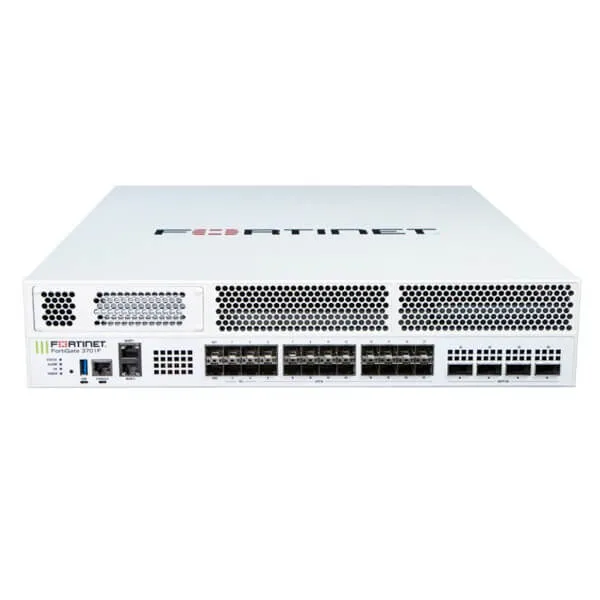
FortiGate 3700F (FG-3700F) Tanzania
FortiGate 3700F is a high-end next-generation firewall built for organizations that need to secure high-throughput data center, hybrid cloud and enterprise network traffic without treating security as an afterthought. For Tanzanian enterprises planning dense east-west segmentation, high-speed north-south inspection, encrypted inter-site connectivity or resilient data-center edge designs, the FG-3700F provides a platform with substantial interface density, hardware acceleration and integrated FortiOS security capabilities. Fortinet specifies up to 589 Gbps IPv4 firewall throughput, 86 Gbps IPS throughput, 80 Gbps NGFW throughput, 75 Gbps threat-protection throughput and 160 Gbps IPsec VPN throughput. Actual performance varies with configuration, traffic profile and enabled security services, so procurement should be based on the intended inspection stack rather than headline firewall throughput alone.
Up to IPv4 firewall throughput for large-scale routing and security designs.
Threat protection throughput with firewall, IPS, application control and malware protection in Fortinet testing.
High-speed QSFP-DD connectivity for modern data-center aggregation and core designs.
Specified concurrent TCP session capacity for very large connection environments.
What FortiGate 3700F Is Designed to Solve
High-capacity networks create a difficult security problem: bandwidth grows, applications move between data centers and clouds, encrypted traffic becomes normal, and security inspection must keep pace without creating an avoidable bottleneck. FortiGate 3700F addresses this class of requirement with purpose-built acceleration and a broad range of high-speed interfaces. It is particularly relevant where an organization needs a firewall at a data-center perimeter, between major network zones, at a hybrid-cloud interconnection point, or in an enterprise core where many applications and users converge.
The platform should not be selected only because it is powerful. A sound design starts by documenting peak and sustained traffic, expected growth, SSL inspection requirements, IPS and application-control policies, VPN traffic, segmentation boundaries, routing protocols, high-availability objectives, logging architecture and interface types. This makes the procurement decision measurable and helps determine whether FG-3700F capacity aligns with the intended security posture.
Verified FortiGate 3700F Performance and Capacity
| Capability | Fortinet specification | Planning relevance |
|---|---|---|
| IPv4 firewall throughput | Up to 589 / 589 / 420 Gbps | Baseline packet-forwarding capacity; not a substitute for security-service sizing. |
| IPS throughput | 86 Gbps | Relevant when intrusion prevention is enabled on production traffic. |
| NGFW throughput | 80 Gbps | Useful for application-aware firewall planning with IPS. |
| Threat protection | 75 Gbps | A more meaningful reference for combined security controls. |
| IPsec VPN throughput | 160 Gbps | Supports large encrypted site-to-site and hybrid connectivity designs. |
| SSL inspection throughput | 55 Gbps | Important for environments where encrypted application inspection is central to policy. |
Fortinet performance values are measured under defined test conditions and are stated as up to figures. Production results depend on firmware, traffic composition, cipher suites, packet sizes, policy complexity and enabled services. Capacity planning should therefore use realistic enterprise traffic assumptions and operational headroom.
Interfaces, Acceleration and Data-Center Connectivity
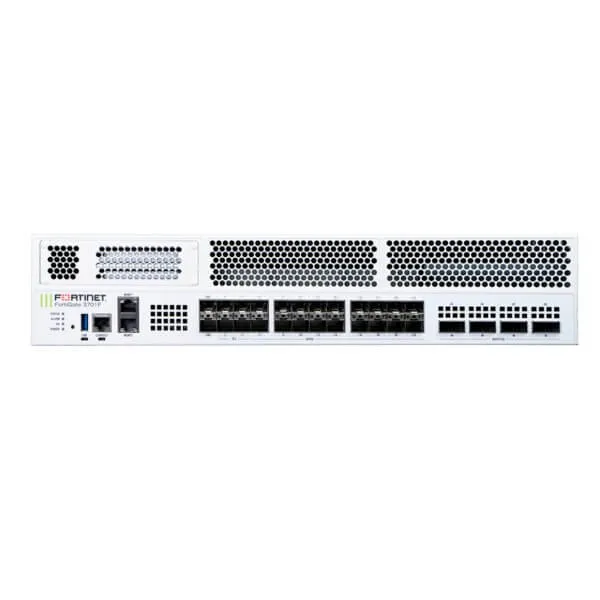
The FG-3700F provides four hardware-accelerated ports supporting 400GE QSFP-DD, 200GE QSFP56, 100GE QSFP28 and 40GE QSFP+ connectivity; eighteen ports supporting 50GE SFP56, 25GE SFP28 and 10GE SFP+; four ultra-low-latency ports supporting 25GE SFP28, 10GE SFP+ and GE SFP; two HA ports supporting 50/25/10/1GE; and two 10GE/GE RJ45 management ports. Fortinet documentation describes three NP7 processors, with the ultra-low-latency interfaces connected directly to an NP7 path. This architecture matters when designing security into high-throughput data-center fabrics where interface selection and traffic path can influence latency and performance.
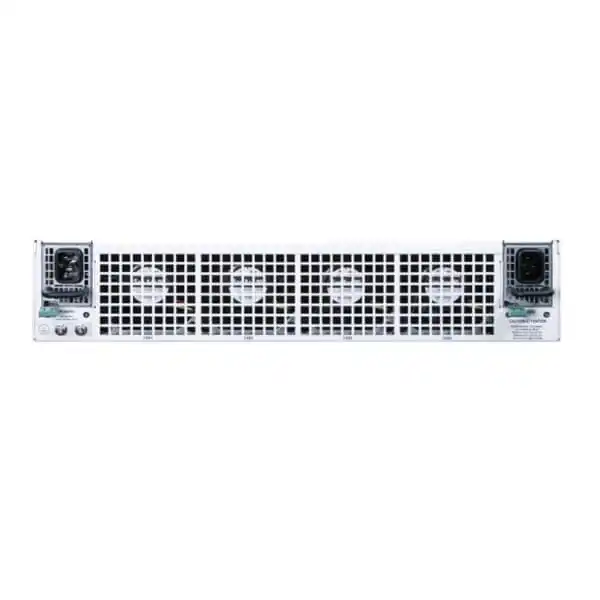
The appliance supports active-active, active-passive and clustering high-availability configurations. Redundant hot-swappable power supplies support resilient deployment design. The unit is a 2RU rack-mount platform with front-to-back airflow, so rack space, cooling, power feeds, transceiver requirements and cable architecture should be confirmed during the bill-of-materials stage.
Security, Segmentation and Hybrid IT
FortiGate 3700F runs FortiOS and can combine firewall policy, intrusion prevention, application control, VPN, SD-WAN capabilities, segmentation and Fortinet security services in a common operating environment. For a data center, this can simplify policy consistency across physical and virtual boundaries. For hybrid IT, it can support controlled connectivity between enterprise facilities, hosted workloads and cloud environments. Integrated ZTNA enforcement is also part of Fortinet’s positioning for the platform, helping organizations move from broad network trust toward application-specific access decisions.
Licensing and FortiGuard service selection should be treated as part of the architecture, not an afterthought. Required security services, FortiCare level, term length and renewal strategy affect both protection scope and total lifecycle cost. A quotation request should therefore specify which inspection functions are expected from day one and which capabilities may be introduced later.
FortiGate 3700F for Data Centers in Tanzania
Data-center firewall selection in Tanzania increasingly involves more than protecting a single internet connection. Enterprises may need to segment server environments, inspect traffic between critical zones, terminate large VPN estates, connect disaster-recovery environments, protect hosted applications and integrate security policy with cloud connectivity. FG-3700F is positioned for this demanding tier. Its high-speed interfaces allow architects to consider 100GbE and 400GbE network designs while retaining security enforcement at strategic control points.
For procurement teams, the practical questions are workload-driven. Document expected aggregate bandwidth, the percentage of traffic requiring deep inspection, encrypted traffic volume, session counts, east-west versus north-south flows, routing requirements and failover objectives. Where the firewall protects revenue-critical or public-facing applications, include maintenance windows, high-availability topology and logging dependencies. The resulting specification is far more useful than simply asking for a firewall capable of a particular ISP speed.
Organizations standardizing on Fortinet can also evaluate how the appliance participates in a wider Security Fabric design. Centralized management, analytics, endpoint access controls, switching, wireless and other security functions may influence the preferred architecture. Explore the FourTeck Tanzania technology portfolio when planning related infrastructure, or review the broader FourTeck Africa solutions for regional project context.
FortiGate 3700F Dar es Salaam
For enterprises in Dar es Salaam, FortiGate 3700F is relevant to large head-office networks, carrier-connected environments, financial and service-sector infrastructure, hosting platforms and organizations consolidating multiple high-speed links. The model’s value is strongest when traffic volumes and security requirements justify a data-center-class appliance. A design can use the platform for internet edge security, inter-zone segmentation, high-capacity IPsec connectivity or as a security enforcement point between data-center and cloud resources.
A Dar es Salaam deployment should begin with an interface and transceiver map. The firewall supports multiple Ethernet speeds and form factors, but the exact optics and breakout approach must match upstream switches, routers and carrier handoffs. Teams should also plan rack position, dual power feeds, cooling, management connectivity and HA links. These details prevent a technically correct firewall selection from becoming an incomplete implementation bill of materials.
Security-service sizing is equally important. If SSL inspection, IPS, application control and malware protection are expected on substantial traffic volumes, use the corresponding inspected-throughput figures rather than raw firewall performance. If multiple branches will terminate encrypted tunnels in Dar es Salaam, estimate both aggregate VPN bandwidth and tunnel counts. If the firewall will segment internal server zones, document policy objects, virtual domains and operational ownership. FourTeck can use these requirements to prepare a more precise commercial and technical discussion instead of a generic appliance quote.
FortiGate 3700F Mwanza
In Mwanza, organizations considering FG-3700F are likely to be planning centralized security for a substantial enterprise environment rather than a small branch. The appliance can be considered where a regional data hub, private cloud, large campus, aggregation site or business-critical network requires strong throughput headroom and resilient security controls. Its 400GbE-capable interface set is particularly relevant to organizations modernizing core switching and data-center interconnects, while lower-speed high-density interfaces provide flexibility for diverse adjacent systems.
Procurement should connect the firewall specification to the network roadmap. If current traffic is much lower than the appliance capacity, document the growth, consolidation or segmentation requirement that justifies the platform. If future data-center switching will move from 10/25GbE toward 100GbE or higher, define which firewall ports will be used now and which are reserved for expansion. This approach helps avoid both overbuying unused capability and under-specifying a platform that must remain in service through several network refresh cycles.
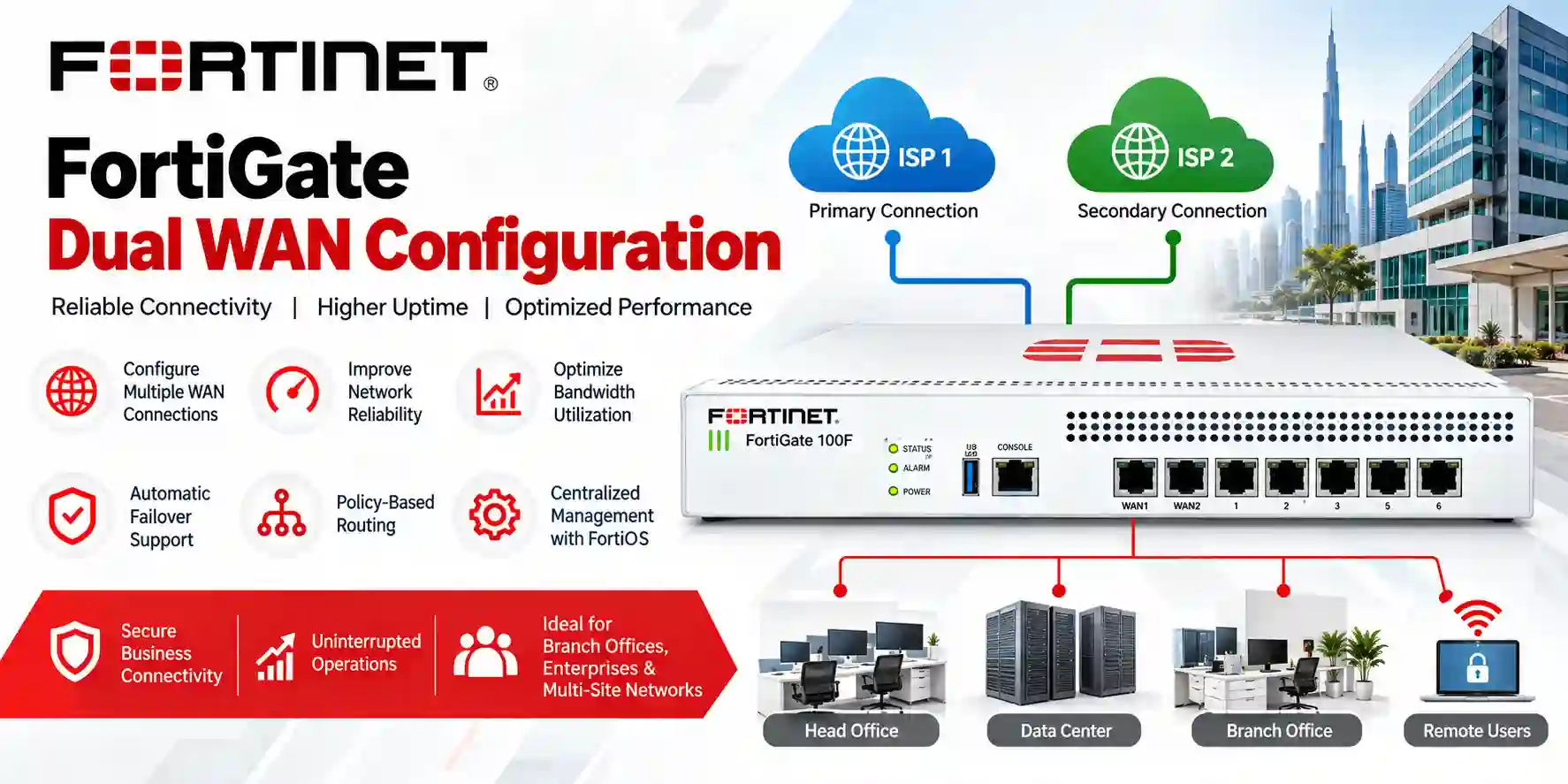
For distributed organizations, Mwanza may also participate in a wider site-to-site VPN design. Fortinet specifies 160 Gbps IPsec VPN throughput under its published test conditions, providing substantial encrypted capacity for suitable deployments. Real-world architecture still requires route design, redundancy, ISP diversity, authentication choices and operational monitoring. Where multi-WAN resilience is part of the project, the FortiGate multi-WAN planning visual can support internal planning discussions while the production configuration is developed around actual circuits and policy requirements.
FortiGate 3700F Arusha
Arusha organizations evaluating FortiGate 3700F should focus on workload criticality, consolidation and secure connectivity. A high-end firewall may suit a large institutional network, shared services environment, data center or enterprise that aggregates traffic from many sites. Rather than deploying isolated controls for firewalling, VPN and application inspection, FortiOS enables these policy functions to be coordinated on one platform, subject to the chosen subscriptions and design.
For environments serving many remote users, partner networks or distributed facilities, access policy deserves particular attention. Integrated ZTNA enforcement can form part of a strategy that grants application access based on identity and device context instead of relying only on network location. Traditional IPsec and SSL VPN capabilities remain relevant for defined use cases. The correct mix depends on user populations, application architecture, endpoint posture and operational requirements, so remote access should be designed rather than enabled as a generic feature.
High availability is another major procurement factor. Fortinet lists active-active, active-passive and clustering options for the series. Organizations should define acceptable downtime, session behavior during failure, redundant switching paths, independent power sources and change-management procedures before deciding topology. A pair of powerful firewalls cannot provide end-to-end resilience if upstream links, power or management dependencies remain single points of failure. Include these dependencies in the quotation and deployment scope so the security platform fits the larger availability design.
FortiGate 3700F Dodoma
For large networks in Dodoma, FG-3700F can be evaluated as a security platform for centralized infrastructure, data-center services, large institutional networks and interconnection environments that demand substantial capacity. The appliance’s high session scale, VPN capacity and dense high-speed ports can support architectures where many users, applications and network segments converge. Selection should remain evidence-based: inventory applications, define trust zones, quantify traffic, identify encryption requirements and establish the security controls that must operate concurrently.
Segmentation is especially important where networks contain systems with different risk profiles. A data-center firewall can enforce policy between server tiers, shared services, management networks and external connectivity, but policy quality matters as much as appliance speed. Teams should define ownership for firewall rules, review cycles, logging, exception handling and emergency changes. Virtual domains may be useful when administrative or tenant separation is required; Fortinet specifies 10 VDOMs by default and up to 500 maximum for the model, subject to licensing and configuration considerations.
A procurement request should include the preferred HA model, required transceivers, support term, FortiGuard security services, management platform dependencies and any migration assistance needed from an existing firewall. This allows suppliers to quote comparable scopes. It also reduces the risk of evaluating proposals that appear similar at hardware level but differ materially in subscriptions, optics, support or implementation assumptions.
FortiGate 3700F UAE
Organizations connecting Tanzanian operations with UAE infrastructure may evaluate FG-3700F for high-capacity data-center edge, inter-site VPN and hybrid-cloud security. The platform’s IPsec performance and high-speed interfaces make it suitable for designs where encrypted traffic and application flows move between major enterprise locations. Architecture should account for WAN latency, cloud on-ramps, routing, failover and security policy consistency rather than treating the firewall as an isolated box.
For UAE-oriented sourcing and project coordination, FourTeck’s regional network can provide additional context through Fortinet UAE solutions and Dubai firewall solutions. These regional resources can be useful when a project spans multiple jurisdictions or when security standards need to be coordinated across corporate sites. Final hardware, subscription and service scope should still be specified for the exact deployment.
When comparing quotations, confirm appliance model, subscription bundle, FortiCare level, term length, optics, power requirements and implementation scope. Avoid comparing a hardware-only price against a multi-year security-services bundle as though they were equivalent. The commercial decision should reflect lifecycle requirements and the security functions the organization expects to operate.
FortiGate 3700F Uganda
For Uganda-based enterprises and regional networks, FortiGate 3700F can serve as a high-capacity control point for data-center traffic, enterprise internet edges, segmentation and encrypted site connectivity. The model is most appropriate where security throughput, session scale and interface density justify its high-end positioning. Organizations operating across East Africa can standardize policy concepts while still adapting routing, ISP diversity and deployment topology to each site.
A cross-border design should document where applications are hosted, where users connect, which sites exchange large data volumes and where security inspection must occur. Centralizing every flow through one firewall may create unnecessary latency, while distributing enforcement without common management can increase operational complexity. FortiOS and related Fortinet management tools can support coordinated policy, but topology should follow application and resilience needs.
For projects extending into Uganda, consult FourTeck Uganda for regional technology context. Procurement teams should request an itemized scope that separates hardware, subscriptions, support, optics and professional services. This makes it easier to compare offers and plan renewals over the lifecycle of the deployment.
FortiGate 3700F Kampala
Kampala enterprises with large data-center or head-office environments may consider FG-3700F where multiple high-speed network domains converge. The platform can enforce security at an internet edge, between core zones, around hosted services or on hybrid-cloud paths. Its large concurrent-session capacity can be relevant to environments with extensive client populations, service platforms or high connection churn, while the 400GbE-capable ports provide room for high-bandwidth network designs.
The deployment plan should identify which traffic requires full security inspection and which traffic follows different policy paths. SSL inspection can reveal threats hidden in encrypted sessions, but it also introduces certificate, privacy, compatibility and performance considerations. Application owners should participate in testing so critical systems are validated before broad policy enforcement. The same discipline applies to IPS profiles and application controls: security settings should match risk and business requirements rather than simply enabling every option.
High availability should be tested with realistic failure scenarios, including link loss, device failure and maintenance events. Monitoring and logging should also be sized to the event volume expected from a high-capacity firewall. A complete quote therefore often includes more than the appliance: subscriptions, support, transceivers, management or analytics components and implementation services may all be relevant.
FortiGate 3700F Arua
In Arua, FG-3700F is a specialized choice for organizations that need to aggregate substantial traffic or operate a significant regional infrastructure hub. Many ordinary branch requirements can be served by smaller firewall models, so buyers should validate the business case for this high-end platform. Appropriate drivers may include centralized data services, large VPN aggregation, future network consolidation, stringent segmentation requirements or a strategic architecture that reserves significant capacity for growth.
Connectivity planning should examine both current carrier handoffs and future upgrades. The appliance offers a broad mix of high-speed optical interfaces, but usable capacity depends on compatible optics, switch ports and cabling. Document these dependencies in advance. For resilient WAN designs, identify separate provider paths and decide how routing or SD-WAN policy should react to impairment and failure, not just total outage.
Security operations should also be considered. A platform capable of processing very large traffic volumes can generate substantial logs and alerts. Define where logs are retained, how incidents are investigated, who approves policy changes and how firmware maintenance is scheduled. These operational requirements help turn the firewall from a hardware purchase into a maintainable security service.
FortiGate 3700F Mbarara
Mbarara organizations assessing FG-3700F should align the platform with a clear consolidation or high-capacity requirement. The firewall can support enterprise segmentation, secure data-center connectivity, large VPN estates and application-aware inspection. Because Fortinet publishes separate figures for firewall, IPS, NGFW, threat protection and SSL inspection, buyers can model the specific workload rather than assuming one throughput figure applies to every security function.
For a migration from another firewall, capture the current rule base, NAT policies, VPNs, routing, objects, certificates, authentication integrations and logging destinations. Migration is an opportunity to remove obsolete rules and simplify policy rather than copying technical debt to a faster appliance. Application testing and rollback planning are particularly important for critical systems.
If the environment includes branch sites, consider how the central firewall interacts with smaller edge devices, SD-WAN policies and security management. A consistent platform can reduce operational fragmentation, but each location should still be right-sized. The FG-3700F can act as a powerful aggregation point while branches use appropriately scaled appliances.
FortiGate 3700F Gulu
For Gulu deployments, the FG-3700F may be relevant where a regional hub must support significant enterprise traffic, centralized applications or encrypted connectivity to many remote locations. Its scale makes it better suited to strategic aggregation and data-center roles than routine small-site firewalling. Buyers should define peak traffic, growth assumptions and security-service requirements so the platform’s capacity is tied to measurable needs.
Power and environmental planning deserve attention for any high-end appliance. Fortinet specifies a 2RU rack-mount chassis, front-to-back airflow and redundant hot-swappable power supplies. The surrounding rack design should provide appropriate cooling, power redundancy and cable management. Management ports should connect to a protected administration network, and out-of-band access should be considered where operational policy requires it.
For VPN aggregation, document remote-site addressing, routing, authentication, encryption standards and failover behavior. The objective is not merely to establish tunnels but to operate them predictably. Monitoring should distinguish ISP issues, tunnel state, packet loss and application performance so support teams can diagnose incidents efficiently.
FortiGate 3700F Kenya
Kenya and Tanzania frequently appear together in East African enterprise network planning, particularly for organizations operating shared applications, regional data centers or interconnected offices. FG-3700F can support a high-capacity security role where traffic between countries, cloud platforms and data-center resources requires inspection and segmentation. IPsec VPN, dynamic routing and high-speed interfaces provide building blocks for such designs, while actual architecture should be based on carrier services and application paths.
For regional procurement context, FourTeck Kenya provides a related market resource. Cross-border projects should maintain a consistent technical bill of materials while clearly separating country-specific logistics, services and commercial terms. Security policy standards can be common even when connectivity and implementation schedules differ.
Capacity planning should consider traffic growth over the expected service life, but avoid arbitrary over-sizing. Use measured utilization where available, add realistic growth and resilience headroom, then map the requirement to the throughput figure that reflects the intended inspection profile. This produces a defensible design and clearer quotation request.
FortiGate 3700F Kuwait
For enterprises linking Tanzania with Kuwait operations, FG-3700F can be considered where major data-center, cloud or corporate network traffic requires a common security architecture. The firewall’s high VPN capacity and interface flexibility can support encrypted inter-site connectivity, while FortiOS policy functions can help maintain consistent controls across environments. Network design should still account for latency, provider diversity and where inspection is most effective.
The FourTeck Kuwait regional site can provide additional technology context for projects involving Kuwait. When preparing a multi-country quotation, specify the exact hardware model, security subscriptions, support duration, optics and professional-service expectations for each site so commercial scopes remain comparable.
Security teams should also define common policy governance. Decide how rule requests are approved, how objects are named, how logs are retained and how firmware is managed. Consistency reduces troubleshooting time and supports audits, especially when infrastructure spans countries and operational teams.
FortiGate 3700F Ghana
Ghana-based deployments can use FG-3700F in high-capacity data-center and enterprise edge roles where substantial security inspection and network aggregation are required. Its interface mix makes it possible to connect modern switching fabrics without forcing all adjacent systems onto one link speed. This flexibility can help during phased data-center modernization when legacy and newer infrastructure coexist.
For regional project research, see FourTeck Ghana. A multi-region organization should separate architectural standards from local assumptions: standardize security objectives and management practices, then validate carrier handoffs, power, rack environment and implementation requirements for each location.
Licensing is a key commercial consideration. Define which FortiGuard security services are required and for how long, together with the desired FortiCare support level. Hardware alone does not describe the complete security service. Itemized proposals make renewals and total-cost planning easier.
FortiGate 3700F Nigeria
Nigeria deployments may involve very large user populations, data-center workloads, digital services and multi-site enterprise networks. FG-3700F provides the scale required for demanding use cases, including high connection counts, deep inspection and large encrypted links. It should be deployed where measured or forecast requirements justify this capacity and where the network can make effective use of its high-speed interfaces.
Organizations operating between Tanzania and Nigeria should map application flows before deciding where security inspection occurs. Some traffic may be best inspected close to users, while data-center traffic may require segmentation near workloads. Central management and common policy templates can support consistency without forcing identical physical topology.
For Nigeria-specific technology context, visit FourTeck Nigeria. Procurement teams should ask for explicit subscription terms, optics, support and implementation scope alongside the appliance so proposals can be evaluated on equivalent assumptions.
FortiGate 3700F Seychelles
In Seychelles, FG-3700F may suit organizations with centralized data-center services, high-capacity external connectivity or a strategic need to consolidate security functions at a core site. Because the platform is designed for demanding environments, sizing should be driven by actual traffic and growth plans. For smaller sites, a distributed design with appropriately sized edge appliances may be more efficient while a high-end platform protects central resources.
Island connectivity makes resilience planning particularly important. Security architecture should account for multiple WAN paths where available, routing convergence, VPN failover and operational visibility. A firewall cannot compensate for every upstream dependency, so availability planning should include carriers, switching, power and management access.
When connecting Seychelles resources to Tanzania or other regional sites, document data flows and security requirements per application. This helps determine whether traffic should use site-to-site VPN, cloud security paths or other connectivity. The FG-3700F’s substantial IPsec capacity provides room for large encrypted designs, but performance must be evaluated in the context of the full inspection stack and real WAN conditions.
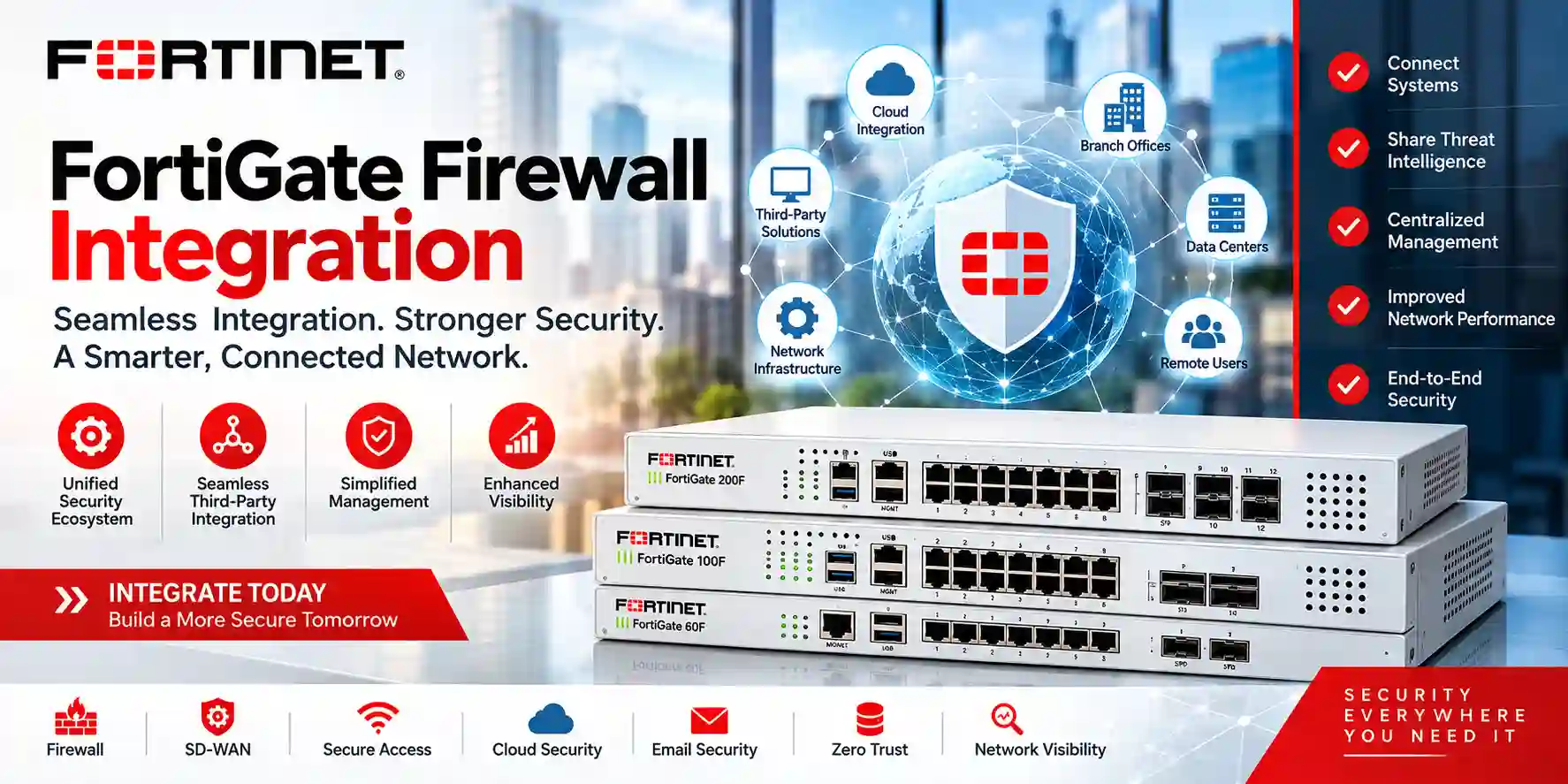
FortiGate 3700F Integration and Deployment Planning
A successful deployment combines hardware selection with architecture, migration and operations. Start with a logical diagram showing internet links, WANs, core switches, server zones, cloud connections, management networks and HA paths. Then build a physical port map that identifies speed, media, transceiver and peer device for every interface. This prevents late discoveries around incompatible optics or insufficient switch capacity.
Next, define security policy by application and trust boundary. Document which flows require IPS, application control, malware protection or SSL inspection. Identify exceptions that require business approval. For encrypted inspection, plan certificate deployment and application compatibility testing. For VPN, define encryption standards, routing and identity. For high availability, test device, link and power failure. For logging, estimate retention and analytics requirements.
FortiGuard Services, FortiCare and Lifecycle Planning
FortiGate hardware is one component of the security lifecycle. Security services provide threat intelligence and inspection capabilities, while support services affect access to assistance and updates. The exact bundle should be selected against the organization’s control requirements rather than simply choosing the shortest or cheapest option. Buyers should request clear line items for hardware, FortiGuard services, FortiCare, term length and renewal assumptions.
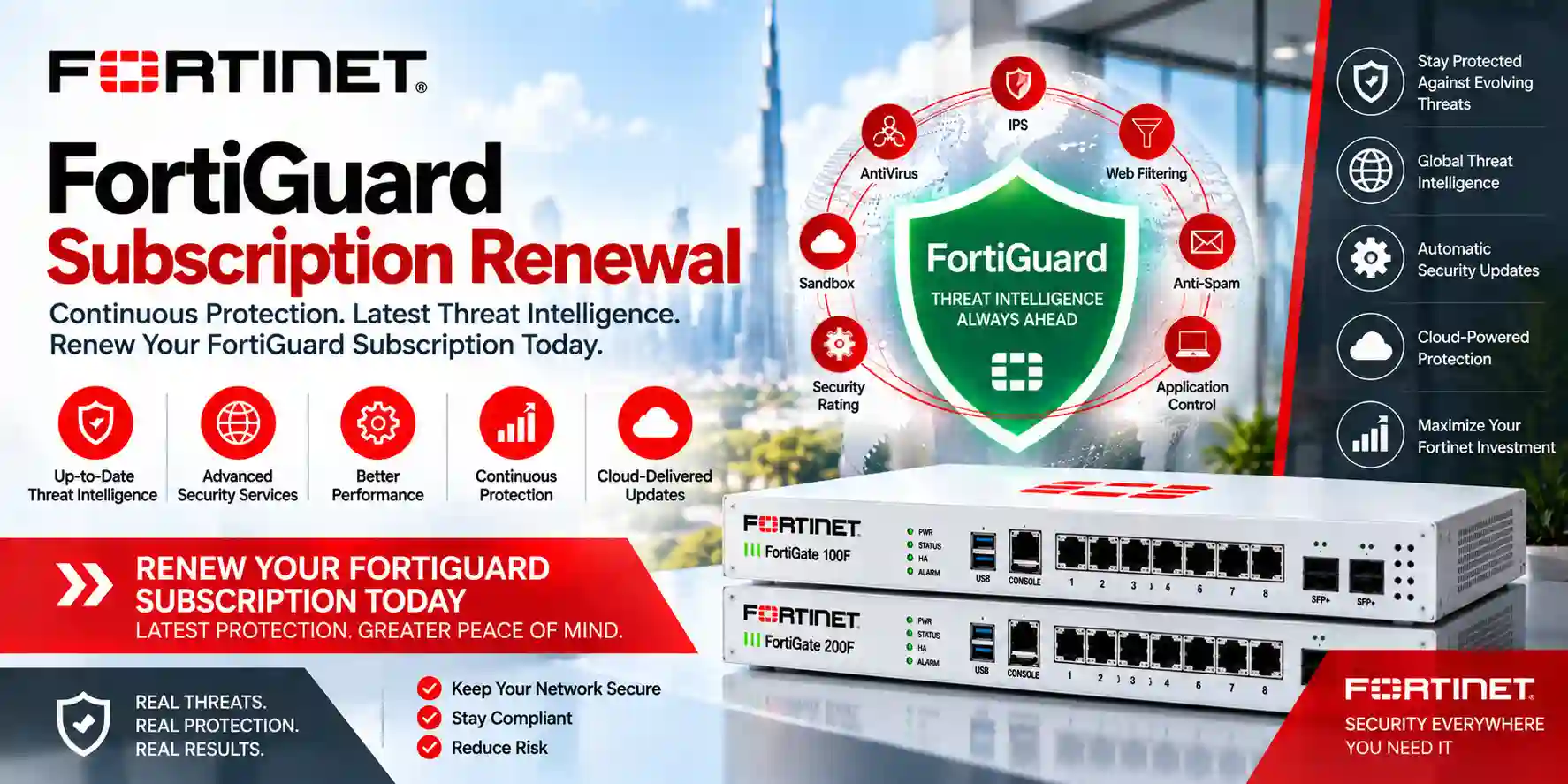
Lifecycle planning should include firmware governance, configuration backups, certificate management, rule reviews, subscription renewals, hardware support and eventual refresh. High-capacity perimeter and data-center firewalls often become critical infrastructure, so ownership for these recurring tasks should be established before production launch. The FortiGuard renewal planning visual can help teams communicate subscription lifecycle needs internally.
Buying and Sizing Guidance
Choose FG-3700F when the requirement is genuinely high-capacity. Begin with measured peak throughput and session data where possible. Add forecast growth and failure-state headroom. Then size against the security profile that will actually run: threat protection, NGFW, IPS, SSL inspection or VPN. Raw firewall throughput is useful but can materially overstate the capacity available when multiple inspection services are enabled.
Check interface requirements carefully. A 400GbE-capable firewall only creates value if the surrounding network can use that capacity. Determine how many 400/200/100/50/25/10GbE connections are required, which ports will be dedicated to HA, and which transceivers or breakout cables are needed. Confirm rack depth, power, cooling and airflow. If the project uses a pair of appliances, duplicate dependencies appropriately.
Finally, decide the operational model. Identify who manages policy, monitors events, handles upgrades and responds to incidents. Consider whether centralized management and analytics are required. Procurement that includes these decisions produces a solution that is easier to operate and budget over time.
Quotation Checklist for FortiGate 3700F
For an accurate quotation, provide the number of appliances, desired HA topology, required FortiGuard services, FortiCare level and subscription term. Include expected firewall and inspected traffic, VPN throughput, concurrent users or sessions, WAN and data-center interface speeds, transceiver requirements, rack and power constraints, existing firewall platform, migration scope, routing protocols, logging or management requirements and target deployment timeframe. If the project spans Tanzania and other countries, list each destination and the equipment or services required per location.
FortiGate 3700F FAQ
What is the FortiGate 3700F firewall throughput?
Fortinet specifies up to 589 Gbps IPv4 firewall throughput for 1518-byte and 512-byte UDP traffic and up to 420 Gbps for 64-byte UDP traffic. Security-service throughput is lower and should be used when sizing inspected traffic.
What is the FG-3700F threat protection throughput?
Fortinet specifies 75 Gbps threat protection throughput with firewall, IPS, application control and malware protection enabled under its stated test methodology. Production performance varies with configuration and traffic.
Does FortiGate 3700F support 400GbE?
Yes. The model includes four hardware-accelerated ports supporting 400GE QSFP-DD as well as 200GE, 100GE and 40GE modes, making it suitable for high-speed data-center connectivity.
Can FG-3700F be deployed in high availability?
Yes. Fortinet lists active-active, active-passive and clustering configurations. The appropriate topology depends on availability objectives, network design and operational requirements.
How should I request a FortiGate 3700F quote in Tanzania?
Provide the required quantity, HA design, FortiGuard and FortiCare term, expected inspected throughput, VPN needs, interface speeds, optics, migration requirements and management or logging scope. This allows a quotation to reflect the complete deployment rather than hardware alone.
Decision Recap
FortiGate 3700F is designed for organizations that need high-capacity security at data-center, enterprise core and hybrid IT boundaries. Its combination of 400GbE-class interfaces, NP7 acceleration, high session scale, strong VPN capacity and FortiOS security services makes it a candidate for demanding architectures. The right purchasing decision depends on inspected traffic, interfaces, subscriptions, resilience and lifecycle requirements. FourTeck can use those inputs to help frame a product and commercial scope for Tanzania and regional projects.
For broader enterprise infrastructure planning, visit FourTeck or the FourTeck Tanzania website.
Consult FourTeck Tanzania About FG-3700F
Share your topology, throughput, security-service, interface, HA and subscription requirements. A requirements-led discussion helps align the FortiGate 3700F configuration with the network you intend to protect and makes commercial comparisons more meaningful.



Reviews
There are no reviews yet.