
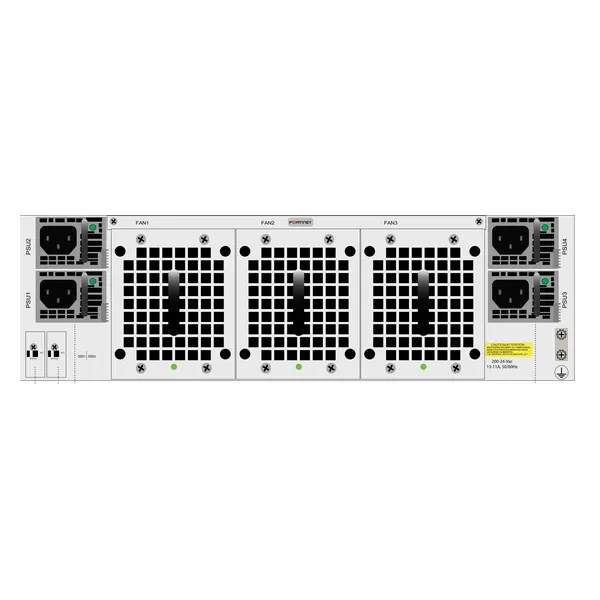
FortiGate 3801G (FG-3801G) Tanzania
FortiGate 3801G is designed for security environments where very high interface density, accelerated traffic processing, segmentation, VPN, encrypted-traffic inspection and operational resilience must coexist. For Tanzanian data centers, large campuses, financial environments, telecom networks, cloud edges and regional headquarters, the purchasing decision should include the appliance, FortiGuard services, transceiver plan, high-availability architecture, rack space, power, cooling and implementation scope.
The 3800G platform provides four hardware-accelerated 400GE-capable ports, six 200GE-capable slots and eighteen 50GE-capable slots, giving architects substantial flexibility for core, aggregation and data-center designs.
FG-3801G is the storage-equipped member of the pair, with 2 × 1.92 TB onboard storage according to Fortinet’s current product matrix. Storage requirements should still be mapped to logging, analytics and retention architecture.
Fortinet documents four NP7 processors and twelve CP10 processors in the FG-3800G/FG-3801G architecture. The integrated switch fabric provides accelerated paths for supported data traffic between front-panel data interfaces.
What is the FortiGate 3801G?
The FortiGate 3801G is a large enterprise and data-center class FortiGate appliance in Fortinet’s 3800G family. It is intended for networks where ordinary branch or midrange firewall platforms cannot provide the interface scale, session handling, accelerated security processing or physical connectivity required at the perimeter or between high-value network zones. Fortinet’s current documentation lists FG-3801G as a supported FortiGate model, while the hardware architecture documentation identifies four NP7 network processors and twelve CP10 content processors. These purpose-built processors are part of Fortinet’s approach to offloading supported networking and security functions from general-purpose CPU processing.
For procurement teams, the model number is only one part of the project. A useful bill of materials should account for the required FortiGuard security service bundle, FortiCare support level, optical transceivers and fiber type, redundant power arrangement, rack position, cooling, HA peer if required, management design and implementation effort. Organizations should also define the expected traffic mix. Internet bandwidth alone does not represent the workload: east-west segmentation, application inspection, VPN encryption, TLS inspection, branch tunnels, public services and internal data-center traffic can all influence sizing.
Verified FG-3801G hardware highlights
| 400GE-class interfaces | 4 × QSFP-DD ports supporting documented 400/200/100/40 GigE modes |
| 200GE-class interfaces | 6 × QSFP56 slots supporting documented 200/100/40 GigE modes |
| 50GE-class interfaces | 18 × SFP56 slots supporting documented 50/25/10/1 GigE modes |
| Management | 2 × 10GE/GE RJ45 management ports plus console and USB connectivity |
| Acceleration | 4 × NP7 processors and 12 × CP10 processors documented for the 3800G/3801G architecture |
| Onboard storage | 2 × 1.92 TB storage on FG-3801G according to Fortinet’s current product matrix |
Performance depends on configuration, traffic profile, enabled security functions and Fortinet test methodology. Confirm current Fortinet datasheets and the proposed FortiOS release during final design rather than sizing from a single headline throughput number.
Deployment and buying guidance
Before ordering FG-3801G, document the current and expected WAN bandwidth, core and data-center link speeds, VLAN and VRF design, public services, remote-access requirements, site-to-site VPN count, east-west inspection goals, high-availability expectations, logging architecture and compliance retention. Confirm whether 400GE, 200GE, 100GE, 50GE, 25GE or 10GE optics are needed on each path and verify supported transceiver types. Power and thermal planning matter for a 3RU high-capacity appliance, especially when two units are deployed as an HA pair. The implementation plan should include migration windows, configuration conversion or redesign, rollback, policy cleanup, routing validation, NAT, VPN testing, application testing and monitoring after cutover.
FortiGate 3801G Tanzania
For organizations evaluating FortiGate 3801G in Tanzania, the strongest use case is usually a high-capacity security boundary rather than a conventional office firewall. Large financial institutions, data centers, telecommunications environments, cloud and colocation facilities, government-scale networks, universities, industrial groups and multi-site enterprises may need to aggregate high-speed links while enforcing segmentation and security policy. The FG-3801G’s dense mix of 400GE-, 200GE- and 50GE-class interfaces can support architectures where the firewall sits between high-bandwidth network zones or at a large internet edge. A Tanzania quotation should therefore start with topology rather than only user count. Buyers should identify upstream carriers, core-switch interfaces, routing protocols, link speeds, public address requirements, VPN endpoints, protected server networks and future bandwidth growth.
Power, cooling and rack planning should be addressed early. High-end security appliances are infrastructure components, and their resilience depends on the environment around them. Confirm rack depth, airflow, redundant feeds, UPS capacity and maintenance access. If high availability is required, reserve space and power for both appliances and design physically diverse links where the wider infrastructure allows it. Optical connectivity should be specified carefully because the appliance supports several interface families and speeds; the correct optic, fiber standard, connector and remote-side compatibility are part of the solution.
Security-service selection also changes the commercial scope. A hardware-only comparison can be misleading when the intended project requires IPS, malware protection, web security, application control, DNS security or other FortiGuard capabilities. Support entitlement and software lifecycle planning should be included in the procurement conversation. FourTeck Tanzania’s integrated IT and security overview explains how firewall projects connect with switching, servers, wireless, cabling and power. For an exact project request, use the Tanzania technology enquiry page and provide interface speeds, expected traffic, HA requirements and licensing expectations.
FortiGate 3801G Dar es Salaam
Dar es Salaam organizations considering FG-3801G are likely to be operating networks where connectivity, data-center services and business continuity have become strategic infrastructure. A large headquarters, carrier-connected facility, financial platform, hosting environment or multi-tenant data center may have several high-speed uplinks and security zones that cannot be consolidated safely onto a smaller firewall without careful capacity analysis. The design process should map internet circuits, private WANs, cloud connectivity, DMZs, server segments, management networks and inter-site VPNs. This makes it possible to determine where the 3801G should sit and which interfaces must operate at 400GE, 200GE, 100GE, 50GE, 25GE or lower speeds.
In a dense urban network environment, redundancy is often as important as raw throughput. A resilient design can use separate upstream paths, redundant switching, HA firewalls and independent power feeds, but each dependency should be tested as a complete failure scenario. Simply installing two firewalls does not create end-to-end resilience if both rely on one switch, one fiber path or one UPS. Procurement should therefore include the supporting optics, cabling and rack infrastructure as well as the firewall appliances and subscriptions.
Migration planning is another key issue. An existing perimeter may contain years of firewall rules, NAT objects, VPNs and routing exceptions. Moving to FG-3801G is an opportunity to identify unused policies, duplicate objects and legacy services before cutover. Critical applications should be tested through the new inspection path, especially when TLS inspection or stricter application control is introduced. Operational teams should receive documented management access, backup procedures, monitoring responsibilities and escalation paths. FourTeck’s Tanzania services page provides context for integrated deployment and lifecycle work, while the FG-3801G project itself should be scoped against the exact network rather than treated as a box-only purchase.
FortiGate 3801G Mwanza
A FortiGate 3801G project in Mwanza should be justified by workload and architecture. Large regional operations, industrial networks, institutions, service platforms and organizations consolidating several security zones may need a firewall that can terminate high-speed fiber while applying policy at scale. The procurement team should begin by documenting traffic sources and destinations: internet access, server workloads, backup replication, branch connectivity, remote access, cloud services, partner networks and operational technology where relevant. This reveals whether traffic is primarily north-south through the internet edge or whether significant east-west inspection is also expected.
For sites outside the largest data-center clusters, supportability becomes a major design criterion. Spare optics, standardized fiber types, remote management, configuration backups and clear labeling can reduce recovery time when a fault occurs. The dedicated management interfaces on the platform can be incorporated into an out-of-band management design where appropriate. Administrators should define who can reach the management plane, how privileged access is authenticated and where logs are sent. If central Fortinet management or analytics products are part of the architecture, include those dependencies and licenses in the bill of materials rather than adding them after deployment.
Power quality and cooling should also be verified before installation. A high-capacity firewall should be mounted in a suitable rack with stable power and sufficient environmental control. If the project uses HA, test not only firewall failover but also upstream and downstream link behavior, routing convergence and application continuity. When preparing a Mwanza quotation, include the FG-3801G quantity, required support term, FortiGuard services, interface and optic schedule, expected FortiOS version, migration requirements and any training or documentation deliverables. These details help distinguish a production-ready security platform from an incomplete hardware order and make commercial comparisons more meaningful.
FortiGate 3801G Arusha
For Arusha, FG-3801G can be relevant to large organizations that operate substantial digital infrastructure, centralized services or multiple connected locations. The firewall can form part of a security architecture that separates internet-facing services, internal users, servers, guest access, management networks and partner connectivity. Before choosing this model, architects should calculate the expected inspected traffic rather than relying on raw port speed. Security profiles, encrypted traffic, VPN encryption and application behavior all affect the workload, and the design should preserve sufficient headroom for growth and incident conditions.
Organizations with geographically distributed sites should also decide where policy should be centralized and where local breakout is appropriate. A powerful central firewall can aggregate many connections, but branch design, WAN resilience and cloud access patterns influence whether all traffic should traverse one location. SD-WAN and VPN architecture can be reviewed alongside the security policy so that resilience and path selection support business applications rather than creating unnecessary backhaul. For environments handling guest, staff and operational networks, segmentation should be explicit and documented.
An Arusha deployment plan should include rack position, power feeds, cooling, interface mapping, transceiver compatibility and cable labeling before the maintenance window. Security teams should establish a baseline configuration, administrator roles, configuration backup, firmware process, logging destinations and alert ownership. If the 3801G replaces an older firewall, policy migration should be accompanied by cleanup rather than copying every historical rule unchanged. Application owners should participate in acceptance testing for ERP, finance, voice, video, cloud and remote-access services. The goal is a controlled security transition with a documented rollback path. FourTeck’s Tanzania contact workflow can be used to provide these technical inputs so the quotation includes the components and services that the actual Arusha environment requires.
FortiGate 3801G Dodoma
FortiGate 3801G deployments in Dodoma may be considered for large institutional, government-scale, enterprise or data-center networks that require high interface capacity and controlled segmentation. The design should begin with information classification and network boundaries: which services are public, which systems are internal, which networks host sensitive applications, which third parties require access and which users connect remotely. Those answers determine firewall zones and policy structure more effectively than simply reproducing an existing VLAN list.
The platform’s high-speed interface options can connect to modern core and aggregation networks, but interface planning must be exact. Architects should confirm the required port speed on both ends, supported optics, breakout requirements, fiber plant and redundancy. Management and HA links deserve the same attention. A high-end firewall can become difficult to operate if interface names, routing relationships and failover behavior are not documented. Where a pair is used, test planned and unplanned failover, state synchronization and routing convergence during commissioning.
Security subscriptions and support terms should be aligned with the organization’s operating model. Buyers should identify which FortiGuard capabilities are required, who will monitor events, how logs are retained and who owns rule review. A procurement request should state whether installation, migration, configuration validation, training and post-cutover support are expected. It should also define any compliance documentation or change-control requirements. For Dodoma organizations, this preparation can shorten the gap between hardware delivery and production readiness. The firewall should arrive as part of a defined architecture with power, rack, optics, licensing and operational ownership already planned, rather than as an isolated appliance waiting for design decisions after purchase.
FortiGate 3801G UAE
In the UAE, FG-3801G is positioned for demanding enterprise and data-center security designs where high-speed links and dense segmentation can create workloads beyond conventional perimeter appliances. Large headquarters, cloud interconnect environments, colocation networks, financial platforms and service providers can use the 3800G family as part of a resilient security edge. The architecture should be based on real traffic matrices, including internet ingress and egress, inter-zone traffic, private cloud links, partner connectivity, remote access and encrypted application flows.
Data-center designs often require careful coordination between firewall ports and high-speed switching. The four 400GE-capable ports, six 200GE-capable slots and eighteen 50GE-capable slots provide considerable flexibility, but optics and breakout choices must be validated against both Fortinet support and the connected switch platform. Where the firewall protects multiple tenants or business units, virtual-domain and administrative design should be reviewed alongside routing and policy separation. Logging and management should be sized as independent operational functions, especially in environments with large event volumes.
Commercial evaluation should compare complete configurations rather than appliance price alone. FortiGuard services, FortiCare support, HA quantity, optics, professional services and renewal terms can materially affect lifecycle cost. UAE buyers can also review FourTeck’s Fortinet-focused UAE resource for regional Fortinet context. For multinational groups, keeping interface standards, naming, policy conventions and management processes consistent between UAE and Tanzania sites can simplify operations even when the actual firewall model differs by site. A consistent architecture makes audits, troubleshooting and future migrations easier.
FortiGate 3801G Uganda
Ugandan organizations evaluating FortiGate 3801G should treat it as a core security infrastructure decision. The platform is most appropriate where high-speed connectivity, large traffic volumes, segmentation or substantial VPN requirements justify a top-tier appliance. A national enterprise, data-center operator, financial institution, telecom environment or organization aggregating many branches may need this class of firewall. The initial assessment should quantify WAN and private-network capacity, expected inspected throughput, application mix, VPN topology, server exposure and future expansion.
For multi-site organizations, the central firewall design should be coordinated with branch connectivity. Site-to-site VPN, SD-WAN policy, routing and failover can influence how much traffic reaches the central platform. If cloud applications dominate, architects should decide whether local internet breakout at branches is preferable to backhauling everything through a central site. Security policy should follow data sensitivity and application needs, not simply physical geography. The FG-3801G can provide a strong central enforcement point, but the surrounding architecture determines how effectively its capacity is used.
Uganda procurement should include licensing, support, optics and implementation. FourTeck’s Uganda technology site can provide regional context, while the Tanzania team can coordinate requirements for cross-border groups. Document the expected support term, security-service bundle, HA design, management system, log destination and migration responsibilities. If the deployment replaces a different vendor or an older FortiGate, allow time for rule rationalization and application testing. A structured acceptance plan should verify routing, NAT, VPN, failover, security profiles, monitoring and backup before the old platform is removed.
FortiGate 3801G Kampala
Kampala is a natural location for centralized enterprise infrastructure, and organizations operating large headquarters or data centers may evaluate FG-3801G when their security edge must connect to high-capacity switching and multiple carriers. The firewall selection process should model peak traffic rather than average office use. Backups, software distribution, cloud synchronization, video, remote access and security incidents can create short periods of much higher load. Encrypted traffic inspection also requires deliberate capacity planning because modern applications increasingly use TLS.
A Kampala design should map critical services to failure scenarios. What happens if one ISP fails, one core switch is unavailable, one firewall reboots or one power feed is lost? The answer determines whether an HA pair, dual-homed switching, diverse carrier paths and redundant power are required. HA links and management interfaces should be separated appropriately, and operations teams should know how to confirm cluster health and perform controlled upgrades. Where change windows are limited, staging and pre-validation can reduce production risk.
Procurement teams should request a bill of materials that identifies each appliance, subscription, support contract, optic and accessory. Ambiguous quotations that list only ‘FG-3801G’ can hide important differences in licensing and deployment readiness. The statement of work should clarify whether configuration migration, rack installation, cabling, policy redesign, VPN recreation, testing and documentation are included. For regional organizations linking Kampala with Tanzania, Kenya or UAE locations, consistent naming and policy standards can make cross-border support more predictable. Central logging and configuration management can also improve visibility across sites, provided bandwidth, retention and access controls are planned.
FortiGate 3801G Arua
In Arua, the FG-3801G would generally be considered for specialized high-capacity environments or as part of a wider national architecture rather than ordinary branch-office use. If an organization proposes this model for an Arua site, the business case should be supported by measurable requirements such as high-speed aggregation, large data flows, centralized security for multiple remote locations, service-provider workloads or significant segmentation. This avoids over-specifying hardware while ensuring that genuinely demanding environments retain enough capacity and interface flexibility.
Remote operability deserves special emphasis. Administrators should be able to manage the appliance securely, retrieve logs, confirm HA state and restore configuration without relying on undocumented local procedures. Dedicated management connectivity, controlled administrator access and reliable configuration backups can reduce dependence on emergency site visits. Spare optics and clear cabling records may also be valuable where replacement logistics take longer than in a major data-center hub. If a secondary WAN or out-of-band path is available, its role should be designed and tested rather than assumed.
The physical installation should verify rack dimensions, airflow, power feeds and UPS runtime. High-capacity appliances should not be placed into an environment that cannot support their thermal and electrical needs. If the Arua site connects to a central Kampala or regional data center, routing and VPN design should account for link quality and failover. Security policies can then be standardized while allowing local exceptions only where justified. The quotation should state hardware, FortiGuard subscriptions, support, optics, implementation and any travel or site-work assumptions separately so the customer can understand the complete deployment scope.
FortiGate 3801G Mbarara
Mbarara organizations with large regional operations, data-intensive applications or centralized branch connectivity may evaluate FG-3801G as part of an enterprise security architecture. The model should be sized against actual inspected traffic, not simply the number of employees. A site serving many remote branches or hosting central applications can carry far more traffic than its local user count suggests. Data replication, cloud connectivity, VPN tunnels, remote users and inter-zone flows should therefore be included in the capacity model.
Segmentation is often one of the most valuable design outcomes. Instead of treating the internal network as one trusted zone, organizations can separate servers, users, guest access, management, voice, cameras and specialized systems according to risk. The firewall policy can then permit only the required communication paths. This approach requires accurate application knowledge and should be introduced carefully so that legitimate business workflows are not interrupted. Logging and monitoring help identify unexpected dependencies during migration.
For Mbarara procurement, include a detailed interface schedule. Each high-speed connection should identify the local port, remote device, intended speed, optic and fiber type. This prevents last-minute compatibility problems during installation. The same discipline applies to power and rack planning. If HA is required, both units and their supporting infrastructure should be included from the start. Operational handover should provide administrators with diagrams, configuration backups, access procedures, renewal dates and a clear firmware-maintenance process. These items may appear secondary to firewall throughput, but they determine whether the platform remains manageable throughout its lifecycle.
FortiGate 3801G Gulu
A Gulu FG-3801G requirement should be evaluated in the context of the complete network. For a normal branch, a smaller FortiGate may be more appropriate; for a regional aggregation site, large institution, service platform or data-center environment, the 3801G’s interface density and accelerated architecture can become relevant. The design team should document the reason for each high-speed port, the traffic that crosses each security zone and the expected growth horizon. This produces a defensible sizing decision and helps procurement avoid comparing unlike firewall configurations.
Connectivity resilience is important for sites that depend on centralized cloud or data-center applications. Dual carriers, diverse physical routes and automated failover can improve availability, but the firewall policy and routing design must support those paths. VPN tunnels should be monitored, and branch failover should be tested under realistic conditions. If the site hosts local services, determine whether they remain available during WAN outages and whether local DNS, authentication or other dependencies need redundancy.
Operational simplicity should be a design objective. Standard templates, interface naming, address objects and policy conventions make remote support easier across many locations. Central management and logging can help, but the organization should decide who reviews alerts and how long logs are retained. A Gulu quotation should identify the hardware model, subscriptions, support duration, optics, HA quantity and deployment services. If migration is included, list the current firewall, routing protocols, VPNs and critical applications so the implementation team can prepare a test and rollback plan before the production window.
FortiGate 3801G Kenya
Kenyan enterprises and data-center operators can consider FG-3801G for high-throughput security boundaries that connect modern core switching, multiple carriers or large private-cloud environments. Nairobi-based headquarters and data centers may require dense high-speed interfaces, while national organizations can use a central platform to enforce policy for branch and cloud connectivity. The right design depends on traffic flows, not location alone. Architects should map internet, cloud, inter-data-center, partner, branch and management traffic separately.
The FG-3801G’s onboard storage distinguishes it from the non-storage FG-3800G variant, but logging architecture should still be planned at system level. Large networks can generate substantial event volumes, and organizations may use FortiAnalyzer or other centralized logging and SIEM workflows depending on requirements. Security teams should define retention, alerting and investigation processes before go-live. Policy ownership is equally important: firewall rules should have identifiable business purposes and review cycles so the configuration does not accumulate unnecessary access over time.
Kenya procurement should compare complete lifecycle scope. FortiGuard services, support, optics, HA appliances, installation and renewals are all part of the operational cost. FourTeck’s Kenya technology site provides a regional route for related requirements. For organizations operating in both Kenya and Tanzania, consistent firewall standards can simplify administration: common naming, management controls, logging, VPN conventions and documentation templates allow teams to troubleshoot more quickly. Hardware size can still vary by site; standardization should apply to architecture and operations rather than forcing every location to use the same appliance.
FortiGate 3801G Kuwait
Kuwait deployments of FG-3801G are most relevant to large enterprises, data centers, service providers and critical infrastructure environments that need a high-capacity security platform with substantial interface flexibility. The design should determine whether the firewall is primarily an internet edge, a data-center segmentation platform, a cloud interconnect control point or a combination. Combining roles can be efficient, but architects must ensure that failure domains, routing and maintenance windows remain manageable.
High-speed port planning is central to the project. The appliance offers several interface classes, and each connected switch or router must be checked for compatible speed, optic and breakout configuration. Redundancy should be designed end to end. An HA pair should connect through a topology that avoids shared single points of failure where the business requires continuous availability. Power feeds, UPS, rack cooling and cable routing should be included in site readiness checks.
Security services and support should be selected according to the threat-control requirements and operating model. A quotation should make the subscription term and service bundle explicit so renewals are predictable. If the firewall is part of a regulated environment, logging, administrator controls, configuration backup and change records should be incorporated into operating procedures. Migration from an existing platform should include rule review and application validation rather than a blind one-for-one conversion. For regional groups, the same standards used for Tanzania, UAE or Kenya can be extended to Kuwait to simplify management, while capacity and connectivity remain tailored to the local site.
FortiGate 3801G Ghana
Ghanaian organizations assessing FG-3801G should focus on environments with genuinely high security throughput, interface density or central aggregation requirements. Large financial networks, service providers, data centers, cloud-connected enterprises and institutions with many remote sites may fit this profile. The first design exercise should classify traffic: user internet, public services, private applications, branch VPN, cloud connections, partner access and management. Each class can have different inspection and availability requirements.
A resilient architecture should identify dependencies outside the firewall. Upstream carriers, core switches, power, DNS, authentication and management platforms can all affect service continuity. HA is valuable only when the surrounding network is designed to survive the same failures. Testing should include link loss, device failover and restoration, with application owners confirming that critical services recover as expected. Monitoring should alert on degraded paths before they become full outages.
Procurement teams should ask for transparent line items covering appliances, subscriptions, support, optics and professional services. If centralized logging or management is required, include those products and capacity assumptions. FourTeck’s Ghana technology site can support regional enquiries. Organizations spanning Ghana and Tanzania can benefit from common security standards and documentation, while still sizing each location independently. A consistent approach to policy naming, administrator roles, firmware maintenance and renewal tracking can reduce operational complexity across the group.
FortiGate 3801G Nigeria
Nigeria’s large enterprise, telecom, financial and data-center environments can generate the scale at which FG-3801G becomes a relevant security platform. Multiple high-capacity internet links, private networks, cloud connections and internal data-center segments can create complex traffic paths that need both performance and policy control. Architects should build a traffic matrix that identifies source, destination, expected bandwidth, encryption, inspection requirements and availability target for each major flow.
The interface mix supports very high-speed connectivity, but the physical layer must be engineered carefully. Optics, fiber types, breakout modes and connected switch capabilities should be validated before procurement. For HA deployments, use a topology that supports independent paths and document how routing converges when a unit or link fails. Security teams should also isolate management access and protect administrator credentials with appropriate controls. Configuration backups should be automated or operationally scheduled and tested for recovery.
A Nigerian procurement request should state the intended FortiGuard security services, FortiCare term, HA quantity, optics, rack and power assumptions, logging platform and migration scope. If the firewall protects public-facing applications, coordinate with application owners for NAT, certificates, load balancing dependencies and testing. If it serves branch VPNs, inventory tunnels and routing before cutover. The strongest project outcome comes from treating the FG-3801G as part of an architecture rather than a standalone purchase. This approach also makes lifecycle costs and renewal obligations clearer to finance and procurement teams.
FortiGate 3801G Seychelles
In Seychelles, FG-3801G is likely to suit specialized environments with unusually high bandwidth, centralized services or data-center requirements rather than ordinary offices. A large hospitality group, service provider, financial platform or multi-site organization may evaluate the model when several networks converge on a central security point. Because island logistics can influence maintenance planning, the design should emphasize remote manageability, clear documentation and compatible spare components as well as throughput.
Connectivity architecture should account for primary and backup paths and the business impact of link failure. If critical applications are cloud-hosted or remote, WAN resilience can be as important as firewall capacity. The security policy should distinguish guest, staff, server, management and operational traffic where applicable. In hospitality environments, guest access should remain isolated from corporate and property-management systems. In financial or professional environments, sensitive applications may require more restrictive segmentation and logging.
Site readiness should confirm rack dimensions, power redundancy, UPS, cooling and optic compatibility before shipment. For an HA pair, verify that both units can be supported physically and electrically. Procurement should include FortiGuard subscriptions, FortiCare support, optics and implementation services, and should document renewal dates from the start. Remote administration, configuration backup and monitoring procedures should be agreed during handover. For organizations with related operations in East Africa or the UAE, common configuration standards can help central teams support Seychelles alongside other locations without assuming that bandwidth, carriers or site conditions are identical.
Compatibility, licensing and integration checklist
Network integration
Confirm routing protocols, VLANs, VRFs, link aggregation, interface speeds, optic compatibility, NAT, public addressing and dependencies on load balancers or upstream routers. Document every production interface before installation.
Security services
Select FortiGuard services according to the required controls. Do not compare a hardware-only quote with a fully licensed security bundle without normalizing the service term and support coverage.
Operations
Plan FortiOS maintenance, administrator roles, MFA, configuration backup, centralized logging, alert ownership, rule reviews and renewal tracking. Operational process is part of the security design.
Related FourTeck resources
For Tanzania projects, browse the FourTeck Tanzania technology shop for the wider business-technology portfolio, review integration and technology services when the firewall is part of a larger deployment, and use the contact and quotation page to provide the project scope. Regional organizations can also use the FourTeck Kenya site, FourTeck Uganda site, FourTeck Ghana site and Fortinet UAE specialist site for country-specific coordination.
FortiGate 3801G quotation checklist
Include the exact model FG-3801G and quantity; HA requirement; preferred support term; required FortiGuard security services; internet and private-link bandwidth; core-switch port speeds; required 400GE/200GE/100GE/50GE/25GE/10GE optics; fiber types; VPN tunnel and remote-user requirements; routing protocols; public services; logging and retention needs; rack and power details; current firewall model; migration window; configuration-conversion expectations; testing requirements; documentation; administrator training; and any regional rollout dependencies. Supplying these inputs enables a much more accurate quotation than requesting only a firewall price.
Frequently asked questions
What is the difference between FG-3800G and FG-3801G?
The key model distinction documented in Fortinet’s current product matrix is onboard storage: FG-3801G includes 2 × 1.92 TB storage, while the base FG-3800G is the non-storage variant. Confirm the latest ordering information before purchase.
Which high-speed ports are available?
Fortinet documents four 400GE-capable QSFP-DD interfaces, six 200GE-capable QSFP56 interfaces and eighteen 50GE-capable SFP56 interfaces, with lower supported speeds depending on the interface family. Two 10GE/GE RJ45 management ports are also documented.
Does FG-3801G support FortiOS?
Yes. Current Fortinet FortiOS release documentation lists FG-3801G among supported FortiGate models. Production deployments should validate the exact recommended FortiOS release, upgrade path and feature requirements before implementation.
Should I buy one FG-3801G or an HA pair?
That depends on the required availability target and network topology. Critical environments commonly evaluate HA, but two appliances alone do not remove every failure point. Upstream switching, carriers, power and cabling should also be reviewed for redundancy.
What information is needed for a Tanzania quote?
Provide the model and quantity, expected traffic, interface speeds, HA requirement, FortiGuard services, support term, optics, VPN scope, logging needs, current firewall and migration expectations. FourTeck can then review the requirement as a complete deployment rather than a hardware-only request.
Decision recap
FG-3801G is a high-capacity FortiGate platform for environments that need dense high-speed connectivity, hardware-accelerated security processing and onboard storage. The purchasing decision should be based on inspected traffic, interface requirements, segmentation, VPN, availability and lifecycle operations—not headline throughput alone. Validate optics, FortiGuard subscriptions, FortiCare support, HA, rack, power, cooling, logging and migration before issuing the final order.
Plan your FortiGate 3801G deployment with FourTeck Tanzania
Send your current firewall model, bandwidth, interface speeds, required security services, HA preference and deployment location. The information helps build a quotation around the real network, including licensing, optics and implementation requirements.



Reviews
There are no reviews yet.