
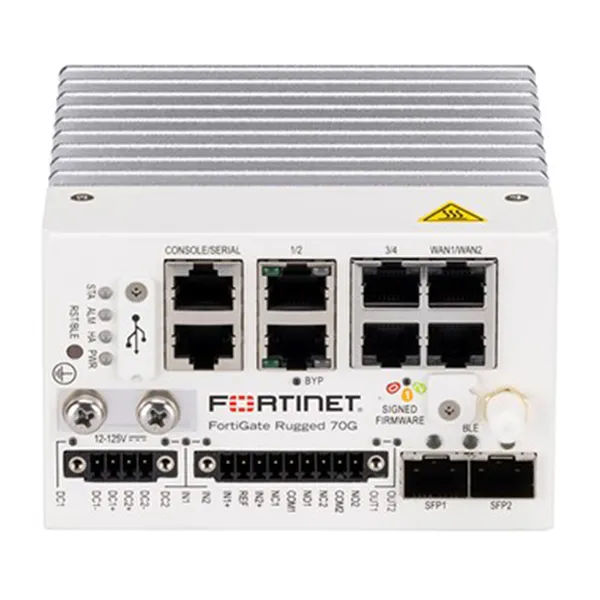
FortiGate Rugged 70G (FGR-70G)
The FortiGate Rugged 70G is built for organizations that need security at industrial and operational-technology network edges. Its compact DIN-rail format, fanless rugged design, wide operating-temperature range and redundant DC power inputs make it relevant to factories, utilities, transport infrastructure, remote facilities, energy sites, outdoor cabinets and other demanding deployments. Fortinet combines these physical characteristics with FortiOS networking and security functions so teams can build segmentation, encrypted connectivity, SD-WAN and threat inspection around a common operating platform.
What is the FortiGate Rugged 70G?
The FGR-70G is a Fortinet ruggedized next-generation firewall intended for industrial and OT environments. Fortinet’s current Rugged Series data sheet identifies the model as a DIN-rail appliance with an IP40 rating, redundant 12V to 125V DC inputs, an operating temperature range from -40°C to 75°C, and storage temperature from -40°C to 85°C. The same official data sheet publishes 2.5 Gbps IPS throughput, 1.5 Gbps NGFW throughput and 1.3 Gbps threat-protection throughput under Fortinet’s stated enterprise traffic-mix test conditions. These figures should be interpreted using the vendor’s test methodology and matched against the actual security services, traffic profile and design requirements of the deployment.
For buyers, the important distinction is that the FGR-70G is not simply a standard branch firewall placed in a different enclosure. Rugged installations can involve electrical cabinets, industrial temperature ranges, vibration, limited rack space, DC power systems, serial-connected equipment and network zones where availability and change control matter. The security design therefore needs to account for both cyber policy and physical deployment conditions. Before ordering, confirm interface requirements, power architecture, environmental conditions, required FortiGuard/FortiCare services, expected inspected throughput and the topology between IT and OT zones.
DIN-rail form factor, fanless construction and published environmental tolerances support industrial cabinet and field-oriented deployment planning.
Redundant 12–125V DC inputs help the appliance fit power architectures that differ from conventional office rack equipment.
Networking and security capabilities can be managed through the Fortinet operating environment, helping standardize policy across suitable FortiGate deployments.
The platform can be considered for segmentation, secure remote connectivity, protected industrial WAN edges and controlled traffic between operational zones.
Verified FGR-70G specifications
| IPS throughput | 2.5 Gbps (vendor enterprise traffic-mix methodology) |
| NGFW throughput | 1.5 Gbps (vendor enterprise traffic-mix methodology) |
| Threat protection throughput | 1.3 Gbps (vendor enterprise traffic-mix methodology) |
| Form factor | DIN-rail |
| IP rating | IP40 |
| Power input | 12V to 125V DC, redundant dual inputs |
| Operating temperature | -40°C to 75°C |
| Humidity | 5% to 95%, non-condensing |
| Operating altitude | Up to 3,048 m (10,000 ft) |
Industrial security and deployment planning
Industrial cybersecurity projects are usually more successful when the firewall is selected after the traffic paths and operational dependencies are documented. Start by identifying the assets on each side of the proposed security boundary: controllers, HMIs, engineering workstations, historians, cameras, sensors, management systems, remote maintenance services and business applications. Then map which systems genuinely need to communicate. This produces a practical basis for zones, policies and logging rather than relying on a broad allow-list that weakens segmentation.
Physical installation deserves equal attention. Verify cabinet dimensions, DIN-rail position, ventilation, grounding approach, DC supply voltage, redundant feed availability, fiber or copper handoff, cable bend radius and access for maintenance. A rugged firewall can tolerate demanding environmental conditions within its published limits, but good enclosure engineering still matters. Heat from neighboring equipment, dust accumulation, poorly managed wiring and unstable power can undermine an otherwise sound network design.
For remote sites, determine how administrators will reach the firewall during normal operation and during a WAN outage. Management access should be controlled, logged and separated from unnecessary exposure. Where site-to-site VPN or SD-WAN is required, document primary and secondary paths, routing behavior and failover expectations before commissioning. For plants with strict maintenance windows, configuration backups, change approval and rollback procedures should be prepared before policy changes are introduced.
FortiGate Rugged 70G Tanzania
Organizations evaluating the FortiGate Rugged 70G in Tanzania may be securing industrial estates, manufacturing lines, utilities, transport systems, mining-related facilities, warehouses, energy infrastructure or distributed operational sites. The purchasing process should begin with the environment and traffic requirements rather than only the appliance headline throughput. A useful quotation request includes the number of sites, WAN bandwidth, required VPN tunnels, industrial network segments, interface media, power source, cabinet conditions, security services and expected growth. This information helps distinguish a simple hardware requirement from a wider OT segmentation or secure-connectivity project.
Tanzania deployments can vary greatly between controlled equipment rooms and remote field cabinets. Confirm ambient temperature, enclosure protection, grounding, DC voltage and network handoffs at every site. If the firewall will sit between IT and OT networks, document protocols and application flows before enforcing restrictive rules. Where multiple plants or branches are connected, consistent naming, addressing, VPN templates and policy conventions can make support easier. Customers can also review FourTeck Tanzania’s integrated IT and security portfolio and use the Tanzania technology enquiry page to provide the model, quantity and deployment details required for a quotation.
FortiGate Rugged 70G Dar es Salaam
For Dar es Salaam businesses, the FGR-70G can be evaluated where industrial networks meet corporate systems, internet links or remote support services. Port, logistics, manufacturing, processing, utilities and distributed facilities may require network boundaries that are physically compact yet capable of enforcing modern security controls. Before procurement, identify whether the appliance will protect a production cell, an entire plant edge, a remote cabinet, a WAN aggregation point or a dedicated OT zone. Those roles produce different interface, routing, inspection and availability requirements.
A Dar es Salaam project should also consider how the rugged firewall integrates with switching, fiber uplinks, upstream internet services, UPS/DC power and monitoring. If the site uses multiple internet circuits, define whether the goal is resilience, application steering or both. If external engineers require access to industrial systems, build an approved remote-access workflow rather than exposing management interfaces or controllers directly. FourTeck’s Tanzania technology services overview provides context for integration work, while the business technology shop helps buyers review complementary infrastructure categories.
FortiGate Rugged 70G Mwanza
Mwanza buyers considering the FGR-70G should focus on site conditions, connectivity and the operational consequences of downtime. Industrial and logistics environments can include equipment distributed across buildings, yards or remote operating areas, so firewall placement should follow the actual trust boundaries and communication paths. A rugged appliance may be appropriate at a protected cabinet or industrial network edge, but the design still needs suitable upstream switching, fiber or copper links, power protection and documented maintenance access.
For procurement, record the primary WAN bandwidth, backup-link strategy, expected encrypted traffic, number of protected network zones and whether inspection services will be enabled. Where the firewall separates production assets from user networks, define required traffic explicitly and test policy changes in a controlled window. For multi-site organizations, a standard configuration baseline can reduce troubleshooting time while allowing site-specific addressing and permitted services. Include subscription and support requirements in the quotation so the commercial comparison reflects the intended security posture rather than hardware alone.
FortiGate Rugged 70G Arusha
Arusha organizations may evaluate rugged security for industrial facilities, infrastructure sites, hospitality support operations, utilities and distributed technical locations where equipment is installed outside a conventional data-room environment. The FGR-70G’s DIN-rail format and published environmental range can be useful when cabinet installation is a design requirement. The firewall should nevertheless be treated as part of a complete system: enclosure, power, grounding, uplinks, switching, remote administration and recovery procedures all influence reliability.
A strong buying specification describes what the firewall must protect and how it will connect. State internet or private-WAN bandwidth, VLANs or zones, VPN requirements, remote maintenance users, logging needs and any future capacity changes. If industrial protocols traverse the boundary, document the source, destination and operational purpose before rules are created. This reduces the temptation to use overly broad policies. Organizations can use the verified FourTeck Tanzania contact workflow to share these details and request product-selection guidance without assuming stock, lead time or licensing terms before a formal quotation is prepared.
FortiGate Rugged 70G Dodoma
In Dodoma, rugged firewall requirements can arise in infrastructure, public-service, utility, transport, campus and distributed operational environments. The FGR-70G should be considered where a compact industrial security gateway is technically appropriate, not merely because the site is remote. Assess the network boundary first: which devices sit behind it, what external services they require, how administrators connect, and what happens if the WAN or firewall becomes unavailable. This operational map determines whether additional redundancy, spare strategy or alternate connectivity is needed.
Power planning is particularly important for field deployments. Fortinet publishes redundant wide-range DC inputs for the FGR-70G, but the project team still needs to confirm the available supply, protection and grounding at the installation point. Network teams should also prepare configuration backup, firmware governance and logging procedures. A quotation should identify the exact FGR-70G model, required services, quantity, deployment environment and integration scope. Avoid assuming that a cellular variant is included: the standard FGR-70G and FGR-70G-5G-DUAL are distinct models and should be specified separately.
FortiGate Rugged 70G UAE
UAE industrial and critical-infrastructure projects can involve high temperatures, distributed assets, secure remote operations and strict network segmentation requirements. The FGR-70G provides a rugged FortiGate option for suitable cabinets and industrial network edges. Buyers should validate the exact environmental envelope at the intended mounting location rather than assuming an outdoor installation is automatically acceptable; the published IP40 rating and temperature specifications need to be considered together with the enclosure and site design.
For regional projects spanning Tanzania and the UAE, standardizing FortiOS policy conventions, VPN naming, administrator roles and documentation can simplify operations while allowing each site to retain its own network addressing and access requirements. FourTeck’s Fortinet UAE resource covers FortiGate, licensing and related Fortinet solutions, while FourTeck UAE provides broader IT infrastructure context. Procurement teams should request current commercial terms for the exact model and subscription bundle rather than relying on generic firewall pricing.
FortiGate Rugged 70G Uganda
Uganda deployments may include utilities, processing sites, logistics facilities, industrial campuses and remote technical locations where secure connectivity has to operate alongside challenging physical conditions. The FGR-70G can be assessed for segmentation and secure WAN roles when its interfaces, throughput and environmental specifications align with the project. Start with a site survey or structured questionnaire covering cabinet conditions, DC power, uplinks, WAN services, protected assets and remote support workflows.
Organizations operating in both Uganda and Tanzania can benefit from repeatable firewall standards, but policy should still reflect each site’s actual communication requirements. Use common templates for administrator roles, logging, backup, VPN naming and change control, then tailor permitted traffic to the local assets. The FourTeck Uganda technology site provides regional context for IT and networking enquiries. For the FGR-70G itself, request the exact hardware, FortiCare/FortiGuard requirements and implementation scope so the proposal can be compared on a like-for-like basis.
FortiGate Rugged 70G Kampala
Kampala-based organizations with industrial sites or branch networks may use a central engineering or security team to manage equipment installed elsewhere. In that model, the firewall design should make remote administration secure and predictable. Define management source networks, authentication practices, logging destinations, configuration backup and emergency access before rollout. If remote vendors need temporary access to OT assets, use controlled workflows with clear authorization and time limits instead of permanent broad rules.
The commercial request should distinguish hardware from subscriptions and professional services. State the required inspection functions, VPN scale, WAN bandwidth, number of protected zones and expected future expansion. If the appliance will be installed in an industrial cabinet, include the power and environmental details so accessories and integration needs can be reviewed. A clear bill of requirements helps avoid purchasing a firewall that is technically powerful but poorly matched to the physical or operational environment.
FortiGate Rugged 70G Arua
For Arua and surrounding operational sites, resilience and maintainability can be as important as raw firewall performance. Remote or distributed installations should be designed so a network team can identify faults without unnecessary travel. That means consistent interface descriptions, documented cabling, monitored WAN status, configuration backups and clear escalation procedures. The FGR-70G’s rugged hardware characteristics can support suitable industrial deployments, while the broader architecture determines how easily the site can be supported.
When preparing a quotation, include whether the site needs a single WAN, redundant terrestrial links, private connectivity or an external cellular solution. Do not confuse the standard FGR-70G with the separate dual-5G model. Identify fiber requirements, SFP needs, industrial switching and DC power arrangements before finalizing the bill of materials. For security policy, start from required operational flows and restrict unnecessary paths between production equipment, corporate users and external services.
FortiGate Rugged 70G Mbarara
Mbarara industrial, agricultural-processing, logistics and distributed business environments may require secure links between operational equipment and central applications. A rugged firewall can provide an enforcement point, but successful segmentation depends on understanding which systems communicate and why. Inventory key endpoints, identify critical services and decide which traffic should cross between OT, management and business zones. This creates a defensible policy design and makes later troubleshooting easier.
Physical design should cover cabinet mounting, DC supply, grounding, ambient conditions and network handoff. Operational design should cover VPN, monitoring, firmware management, backup and change windows. Procurement should cover the exact model and required subscriptions. Combining those three views prevents the firewall purchase from becoming an isolated hardware decision. If the organization expects additional sites, define a repeatable baseline now so future deployments can reuse tested conventions without blindly copying policies that do not fit.
FortiGate Rugged 70G Gulu
Gulu projects with remote infrastructure or industrial operations should evaluate how the firewall will be maintained over its lifecycle. Installation is only the first stage. Teams need a process for configuration backups, firmware review, security-service renewal, log monitoring and controlled policy changes. The FGR-70G can form part of that lifecycle when its rugged hardware profile and FortiOS capabilities align with the environment.
For WAN-connected sites, define failure behavior before commissioning. Decide what should happen if the primary circuit fails, whether a secondary path exists, which applications are essential and how the central team will know a failover occurred. Where production traffic is sensitive to interruption, schedule changes carefully and document rollback steps. Include these operational expectations in the buying conversation so the proposed solution covers integration and support requirements as well as the firewall appliance.
FortiGate Rugged 70G Kenya
Kenya organizations evaluating rugged FortiGate security may have manufacturing, energy, transport, logistics or distributed infrastructure requirements similar to other East African operations, but each site still needs its own engineering assessment. Confirm network interfaces, inspected throughput, VPN design, power, temperature and cabinet conditions. Where a company operates sites in Kenya and Tanzania, common security architecture can help central teams manage both environments while preserving local addressing and application requirements.
Cross-border procurement teams should use the exact FGR-70G model designation in requests and separate optional subscriptions, accessories and implementation services. Ask for current quotation details rather than assuming price, stock or delivery. For integrated deployments, consider the surrounding switch, fiber, UPS/DC power, monitoring and logging environment. The firewall’s role is strongest when it is part of a documented security boundary rather than an appliance inserted into an unknown traffic path.
FortiGate Rugged 70G Kuwait
Kuwait industrial environments can place equipment in demanding thermal and infrastructure conditions, making published operating limits and enclosure design important procurement criteria. Fortinet specifies the FGR-70G for a broad operating temperature range, but installation teams must still assess cabinet ventilation, direct heat exposure, power quality and protection from environmental contaminants. The IP40 rating should be considered when selecting the enclosure and mounting location.
Cybersecurity planning should identify the firewall’s role in the industrial architecture: perimeter gateway, zone boundary, remote-site edge or secure WAN node. Each role changes the policy, routing and resilience requirements. For multi-country organizations, standard FortiOS operational procedures can support centralized governance, but local network flows should remain explicitly documented. Include support and security-service requirements in the commercial request so the proposed lifecycle matches the intended deployment period.
FortiGate Rugged 70G Ghana
Ghana customers can consider the FGR-70G for industrial and operational networks where compact DIN-rail mounting and rugged environmental characteristics are relevant. Use cases may include processing facilities, utilities, logistics infrastructure and remote technical sites. A proper assessment should document protected assets, network zones, WAN connectivity, remote access and the security inspection functions that will be enabled.
For distributed operations, logging and management deserve early planning. Decide where events will be reviewed, who is authorized to change policy, how backups are stored and how configuration standards are maintained across sites. If the firewall sits in a remote cabinet, ensure the surrounding network and power design is documented for field technicians. Procurement teams should request exact model and subscription details and avoid assuming that features associated with the FGR-70G-5G-DUAL variant are present in the standard FGR-70G.
FortiGate Rugged 70G Nigeria
Nigeria’s industrial, energy, manufacturing and distributed infrastructure environments can create strong requirements for secure segmentation and resilient site connectivity. The FGR-70G can be assessed where rugged installation characteristics and FortiGate security functions fit the technical design. Sizing should use expected inspected traffic rather than only internet circuit speed, particularly when traffic crosses multiple security zones or encrypted tunnels.
Large organizations should define a repeatable deployment standard covering naming, administrator roles, backups, logging, VPN conventions and baseline hardening. Site-specific policies can then be added from documented operational flows. This approach helps avoid configuration drift across many remote locations. Commercial evaluation should include the hardware, appropriate security subscriptions, support coverage and any integration services needed to connect the appliance to existing switches, monitoring platforms and WAN services.
FortiGate Rugged 70G Seychelles
Seychelles organizations with utilities, transport, hospitality infrastructure or distributed technical facilities may require secure network edges in locations where space, environment and remote support affect equipment selection. The FGR-70G’s compact DIN-rail format can be useful in appropriate cabinets, while its security role should be defined from the network architecture. Consider which systems require access across the firewall, what connectivity exists to central services and how the site will be managed during outages.
Island and remote-site operations often benefit from careful spare, backup and documentation practices because replacement logistics can matter. That does not justify assuming local stock or a particular delivery time; those details should be confirmed in the quotation. Instead, design the operational plan around configuration backups, clear cabling records, monitored WAN status and known recovery procedures. If redundant connectivity is required, specify it explicitly and choose the appropriate external or integrated connectivity architecture for the project.
Related FourTeck Tanzania infrastructure
A rugged firewall normally depends on other infrastructure. Review FourTeck Tanzania’s networking and security portfolio for managed switching, Wi-Fi, servers, UPS, racks and integrated security context. The Tanzania product shop is useful when a project requires complementary business technology, and the services page explains broader planning, deployment and support capabilities. For regional Fortinet research, visit FourTeck’s Fortinet specialist site, FourTeck UAE and FourTeck Uganda. These links provide related regional and solution context; exact FGR-70G availability and commercial terms should be confirmed through a quotation.
FGR-70G buying and quotation checklist
✓ Quantity and deployment sites
✓ WAN and inspected traffic requirements
✓ VPN and SD-WAN requirements
✓ Number of network/OT zones
✓ DC voltage and redundant power design
✓ Copper/fiber interface requirements
✓ FortiGuard/FortiCare requirements
✓ Logging, management and implementation scope
Providing these details improves quotation quality because it allows the hardware, subscriptions and integration requirements to be considered together. If the exact traffic profile is not yet known, describe the applications and operational objective. A product-selection discussion can then focus on fit instead of guessing from user count alone.
Frequently asked questions
Is the FGR-70G designed for industrial environments?
Yes. Fortinet positions the FortiGate Rugged family for industrial and operational-technology environments. The FGR-70G uses a DIN-rail form factor and has published environmental and power specifications intended for rugged deployment scenarios.
What is the FGR-70G operating temperature range?
Fortinet’s Rugged Series data sheet lists an operating temperature range of -40°C to 75°C and 5% to 95% non-condensing humidity. Installation design must still account for the actual enclosure, ventilation and environmental exposure.
Does the standard FGR-70G include dual 5G modems?
Do not assume so. Fortinet lists the FGR-70G and FGR-70G-5G-DUAL as separate models. If integrated dual-5G connectivity is required, specify the correct variant during procurement.
How should the FGR-70G be sized?
Use the expected traffic profile, security services, VPN requirements, interface needs, network zones and growth plan. Vendor throughput figures are useful reference points but should be interpreted according to the published test conditions and the actual inspection configuration.
What information should I send for an FGR-70G quote in Tanzania?
Send the exact model, quantity, site location, WAN bandwidth, VPN needs, protected network zones, power conditions, cabinet environment, required subscriptions and any installation or configuration scope. This gives the sales and technical teams a clearer basis for the proposal.
Decision recap
Choose the FGR-70G when the project calls for a Fortinet rugged firewall and its verified environmental, power, performance and interface characteristics fit the design. Confirm the exact model, because the standard FGR-70G is distinct from cellular variants. Treat subscriptions, deployment services and surrounding industrial network infrastructure as part of the purchasing decision. For OT environments, document communication flows and operational dependencies before enforcing segmentation so security improvements do not unintentionally disrupt production.
Consult FourTeck Tanzania about FortiGate Rugged 70G
Share your site count, network diagram or basic topology, bandwidth, protected assets, power conditions and security objectives. FourTeck Tanzania’s enquiry process is designed to collect enough context to evaluate technology requirements and prepare a meaningful quotation. Current price, stock, delivery timing, subscription terms and implementation scope should be confirmed at quotation stage.



Reviews
There are no reviews yet.