
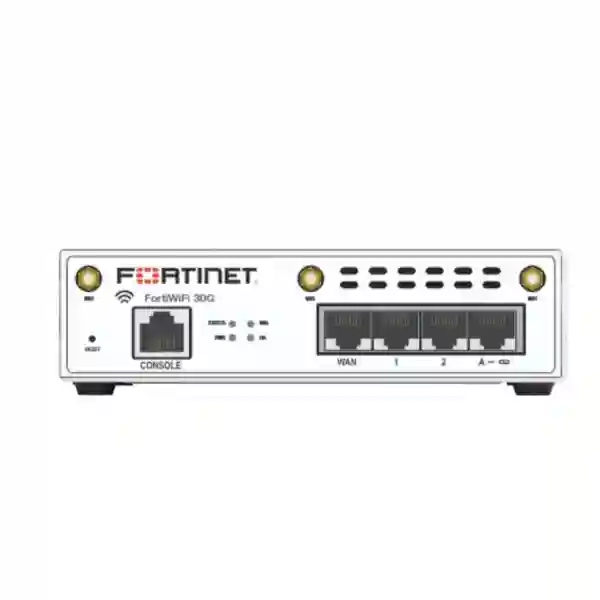
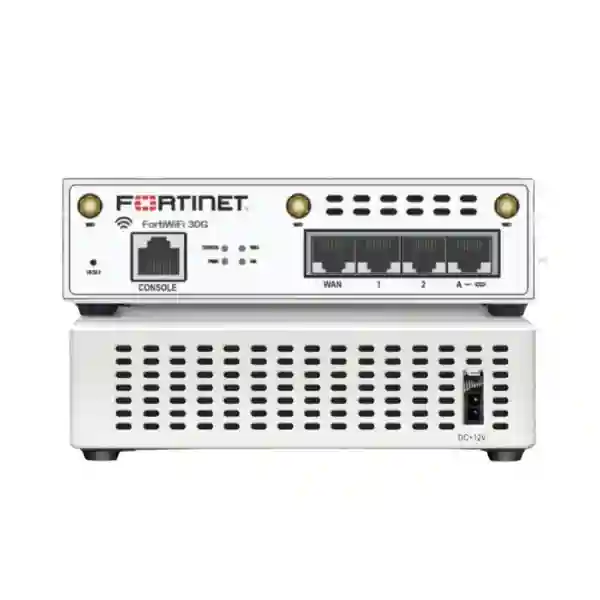
FortiWiFi 30G (FWF-30G)
A compact Fortinet security appliance that brings next-generation firewalling, Secure SD-WAN and integrated dual-radio Wi-Fi 6 together for small offices, distributed branches and business sites that need a simpler secure edge.
The FWF-30G is the wireless member of Fortinet’s 30G family. It uses FortiOS for converged networking and security and adds dual-radio 2.4 GHz/5 GHz 802.11a/b/g/n/ac/ax wireless, making it useful where a compact branch needs both firewall protection and local Wi-Fi.
FortiWiFi 30G overview
Fortinet positions the FortiGate and FortiWiFi 30G series as converged next-generation firewall and SD-WAN appliances for distributed enterprise sites. For a buyer, the practical distinction is that FortiWiFi 30G includes integrated wireless while retaining the security and networking functions delivered through FortiOS. That makes the FWF-30G particularly relevant to a compact branch, retail office, professional office, remote site or small business environment where reducing separate edge devices can simplify deployment.
The product should still be sized from the real workload rather than from the product name alone. Internet speed, encrypted traffic inspection, VPN use, number of users, application mix, wireless client density and enabled FortiGuard services all influence the design. FourTeck Tanzania’s integrated IT and security overview explains why firewall selection should be coordinated with switching, Wi-Fi, cabling, UPS and other infrastructure instead of treated as an isolated purchase.
NGFW security
FortiOS provides the policy, application control, VPN and security framework used by the 30G family, with FortiGuard AI-powered security services available according to the selected service package.
Secure SD-WAN
The 30G family converges networking and security so branches can apply security policy while steering traffic across WAN connectivity according to the deployment design.
Integrated Wi-Fi 6
FWF-30G provides dual-radio 2.4 GHz and 5 GHz wireless supporting 802.11a/b/g/n/ac/ax, allowing local wireless access without requiring a separate AP for every small-site scenario.
Verified FWF-30G technical highlights
| Wireless | Dual radio, 2.4 GHz / 5 GHz, 802.11a/b/g/n/ac/ax |
| Firewall throughput | 4 / 4 / 3.9 Gbps for 1518 / 512 / 64-byte UDP packets |
| IPS throughput | 800 Mbps |
| NGFW throughput | 570 Mbps |
| Threat protection throughput | 500 Mbps |
| IPsec VPN throughput | 3.5 Gbps at 512-byte packet size |
| Concurrent TCP sessions | 600,000 |
| Interfaces | 1 hardware-accelerated GE WAN, 2 hardware-accelerated GE RJ45, 1 hardware-accelerated GE RJ45 FortiLink, 1 RJ45 console |
| Form factor | Desktop; optional wall mounting |
Performance figures are vendor test values and are not a promise of application performance. Real results depend on configuration, traffic profile, enabled inspection, firmware, network conditions and other deployment variables.
Security, wireless and branch design
A useful FWF-30G design begins with traffic flows. Staff devices, guest wireless, printers, IP phones and other endpoints do not necessarily belong in the same trust zone. FortiOS policies and VLAN-aware network design can be used to create clearer boundaries, while the wireless service can be planned around the physical site. Integrated Wi-Fi is convenient for compact spaces, but larger or high-density buildings may still be better served by dedicated access points with deliberate RF planning.
For wired infrastructure, review the Tanzania networking and switching guidance. For broader wireless planning, the same FourTeck Tanzania site describes business Wi-Fi considerations such as coverage, capacity, guest separation, roaming and uplink design. The important procurement question is therefore not merely whether FWF-30G has Wi-Fi, but whether its integrated radio design matches the site size, construction, client count and required coverage.
FortiGuard, FortiCare and lifecycle planning
Hardware and security services should be quoted separately and clearly. Fortinet offers FortiGuard security services and FortiCare support options in different bundles and terms. Buyers should confirm which services are required, the subscription duration, renewal expectations and whether the chosen package aligns with web filtering, intrusion prevention, malware protection and other security outcomes. Fortinet’s ordering guidance lists FWF-30G branch bundles and renewal references, so a quotation should identify the exact bundle rather than using the appliance model name alone.
Firmware planning matters as well. Fortinet’s documentation lists FWF-30G among supported FortiWiFi models in current FortiOS release documentation. Production upgrades should nevertheless follow Fortinet’s release notes and compatibility guidance rather than automatically installing a release because it is newer.
Who should consider FortiWiFi 30G?
FWF-30G is most naturally evaluated for a small branch or compact office that needs a security gateway and local Wi-Fi in one platform. Typical evaluation scenarios include a professional office with cloud applications, a small retail or service branch requiring secure internet and guest access, a distributed company standardizing Fortinet at remote sites, or a location that needs IPsec connectivity back to another office. It can also suit temporary or space-constrained deployments where reducing separate appliances is useful.
It is not automatically the right choice for every small site. A building with several floors, many wireless clients, challenging RF conditions, high inspection throughput requirements or rapid growth may need separate access points or a larger firewall. Sizing should compare the expected protected throughput rather than relying only on headline firewall throughput.
FortiWiFi 30G Tanzania
For organizations evaluating FortiWiFi 30G in Tanzania, the most useful procurement process starts with the network rather than the box. Record the primary and backup internet links, approximate user and device count, applications that matter most, VPN requirements, existing switches, current wireless coverage and any segmentation requirements. These details determine whether the FWF-30G’s integrated design is a good fit and which security subscription should be considered.
Tanzania deployments can range from a compact administrative office to a retail branch, clinic, school office, hospitality back office or distributed company location. In each case, wireless usage can be different. A branch where Wi-Fi is mainly for a modest number of staff devices may benefit from the integrated radio. A site with guest traffic, dense meeting areas or multiple floors should first assess coverage and capacity. Security policy should distinguish business devices from guest or unmanaged endpoints where appropriate.
Internet resilience is another practical consideration. Where business applications depend on cloud services, a second WAN path can reduce the operational impact of a single circuit failure when designed correctly. Secure SD-WAN can then be part of the branch architecture, but failover behavior, health checks and application requirements should be documented before implementation. If site-to-site connectivity is needed, IPsec design should include peer addressing, encryption parameters, routes and the networks permitted across the tunnel.
Power quality and equipment placement also affect reliability. A firewall should be installed in a secure, ventilated area with appropriate power protection. Cabling, switch ports and network labels should be documented. FourTeck Tanzania’s verified contact and quotation page asks firewall buyers to provide user count, internet speed, VPN use, branch connectivity and expected security services; those are the right inputs for an FWF-30G discussion.
FortiWiFi 30G (FWF-30G) Dar es Salaam
A Dar es Salaam business considering FWF-30G may be trying to consolidate the internet edge for a professional office, retail location, branch, reception area or service operation. Start by documenting the available internet circuits and whether the site depends on cloud ERP, Microsoft 365, hosted voice, remote desktop, VPN or web applications. These workloads help establish how disruptive an internet interruption would be and whether dual-WAN planning is worth including.
Wireless planning should consider the actual floor plan. Integrated Wi-Fi 6 is valuable when the firewall can be placed where radio coverage is also useful; it is less helpful if the secure network cabinet is hidden behind dense walls or placed at one end of a large floor. In those situations the firewall can still provide security while dedicated access points deliver coverage. Staff, guest and operational devices can be separated with appropriate network policy rather than sharing a single flat wireless network.
For a quotation, include internet bandwidth, expected simultaneous users, wired devices, wireless clients, VPN peers and security inspection needs. If the branch connects to headquarters or cloud resources, identify the traffic that must cross the tunnel and the applications that require priority. This produces a more defensible design than buying on maximum firewall throughput alone.
FourTeck Tanzania’s contact page identifies Dar es Salaam among its listed office contacts. Buyers can use the central enquiry workflow to provide the exact FWF-30G model, quantity and project context. No stock or delivery assumption should be made until a current quotation confirms commercial availability.
FortiWiFi 30G (FWF-30G) Mwanza
For a Mwanza branch or business site, FWF-30G can be assessed where a compact appliance is preferred for internet security, VPN connectivity and local wireless access. The design should account for the site’s dependence on centralized systems. If staff regularly connect to a head office, data centre or cloud platform, WAN stability and VPN behavior can matter as much as raw firewall performance.
A useful site survey records where the internet service enters the building, where the firewall can be securely mounted, the location of staff work areas and the construction materials between the appliance and wireless clients. Integrated Wi-Fi should not be assumed to cover every corner simply because Wi-Fi 6 is supported. Radio coverage is affected by distance, walls, shelving, interference and client capabilities. A separate AP design may be more appropriate for wider premises.
Businesses with guest access should consider isolation from internal resources. Devices such as printers, cameras or IoT equipment can also be placed into more controlled segments according to risk and operational need. Where the site has two internet services, Secure SD-WAN can be evaluated for path selection and resilience, but failover tests should be included in acceptance rather than left as a theoretical feature.
When requesting FWF-30G for Mwanza, provide the branch size, current router or firewall, ISP handoff, required VPNs, wireless user estimate and future growth. This gives the supplier enough information to identify whether the 30G class is suitable or whether a larger model and separate wireless infrastructure should be considered.
FortiWiFi 30G (FWF-30G) Arusha
Arusha organizations may evaluate the FWF-30G for offices, hospitality administration, tour operations, professional services and branch environments where secure internet and manageable wireless are required in a compact footprint. The integrated approach is attractive when the site is small enough for the appliance location to make sense both as the security gateway and as a wireless radio position.
For hospitality-adjacent or visitor-facing environments, guest traffic should be treated separately from business systems. A small office may use the integrated radio for staff and a controlled guest SSID, while a larger guest environment usually deserves dedicated wireless planning. The firewall’s role is then to enforce segmentation and internet policy while access points are positioned for RF coverage. This distinction prevents a security appliance from being chosen as the only wireless device when the physical building requires more coverage.
VPN requirements should be described before ordering. A branch-to-head-office tunnel has different operational needs from occasional remote administration. If the site relies on central applications, consider how traffic should behave if one WAN circuit degrades. Secure SD-WAN can be used as part of that architecture, but business priorities and health-check criteria should be agreed first.
The FourTeck Tanzania contact page lists Arusha among its office contacts and provides a central enquiry form. A useful request includes the exact FWF-30G model, quantity, current internet speeds, user count, wireless coverage expectation, existing switch environment and preferred security-service term.
FortiWiFi 30G (FWF-30G) Dodoma
For Dodoma offices and branches, FortiWiFi 30G is relevant when a business wants Fortinet firewalling and integrated Wi-Fi 6 in a small desktop platform. Procurement should still begin with capacity. Count users and devices, identify business-critical applications, record ISP speeds and note whether security inspection, VPN or guest wireless will be heavily used. These inputs are more useful than simply describing the site as small.
Segmentation can be especially useful where administrative users, guests, printers, cameras and other connected devices share the same premises. Keeping those device groups in appropriate network zones can reduce unnecessary access between them. If the FWF-30G is used for wireless, SSID design should reflect those same boundaries. Strong authentication and disciplined administrator access are also part of the security design.
For organizations connecting Dodoma to other offices, document the remote networks and the desired routing behavior. IPsec VPN throughput is only one part of the design; tunnel stability, route control, DNS dependencies and failover expectations also matter. Where two internet links are present, testing should include what happens during a real outage and how sessions recover.
FourTeck Tanzania’s verified contact page lists Dodoma among its office contacts. Buyers can submit the model and quantity together with site information for a quotation. The commercial response should confirm the exact hardware region code, FortiGuard/FortiCare package and subscription term rather than assuming those details from the generic FWF-30G model name.
FortiWiFi 30G (FWF-30G) UAE
For UAE branch deployments, the FWF-30G can be evaluated as a compact secure edge where built-in Wi-Fi 6 is desirable. Organizations operating across multiple countries often benefit from standardizing firewall policy, VPN templates, administrator roles, logging and naming conventions. A standardized model can reduce operational variation, but every site should still be checked for internet speed and wireless density before the same hardware is repeated everywhere.
A UAE office with high-speed connectivity may need careful sizing if deep inspection is enabled. The relevant comparison is the protected workload, not just the maximum stateful firewall number. If the branch has several meeting rooms, many wireless users or a larger floor area, dedicated access points may provide better coverage while FWF-30G remains the security gateway. For regional Fortinet procurement and broader security options, see FourTeck’s Fortinet UAE specialist site and FourTeck UAE.
Multi-country companies should also decide where VPNs terminate and how branches reach shared cloud or data-centre applications. Secure SD-WAN policy can support multiple paths, but change control and monitoring should be consistent across sites. When comparing subscriptions, confirm service scope and renewal term in writing.
A useful UAE quotation request includes model, region code requirement, quantity, security bundle, FortiCare term, internet speeds, branch topology and desired wireless role. This reduces ambiguity between hardware-only and bundled commercial options.
FortiWiFi 30G (FWF-30G) Uganda
Uganda organizations evaluating FWF-30G should begin by deciding whether the appliance will serve a standalone small office or a branch connected to a wider enterprise network. A standalone site may prioritize web security, guest separation and straightforward Wi-Fi. A branch may place more emphasis on IPsec VPN, centralized policy and WAN resilience.
The integrated Wi-Fi 6 radio can simplify a compact office, but wireless coverage should be validated against the building layout. Where the firewall must be installed in a locked communications space, its radio location may not be ideal for users. Dedicated access points can then complement the firewall. Wired switch capacity and VLAN configuration should be included in the design so wireless and wired users follow the intended segmentation.
For organizations with operations across East Africa, consistent Fortinet configurations can simplify support. Policy names, VPN standards, administrator controls and backup procedures can be documented so a Uganda branch is not managed as an exception. For regional enquiries, FourTeck Uganda provides a country-specific FourTeck destination.
Before procurement, confirm the exact subscription package, term and support coverage. Do not assume that every FWF-30G quotation contains the same FortiGuard services. Include expected users, bandwidth, wireless client count, VPN peers and growth so the selected platform can be evaluated against the actual protected traffic.
FortiWiFi 30G (FWF-30G) Kampala
In Kampala, FWF-30G can suit a compact office or branch where a single Fortinet platform for security, SD-WAN and local Wi-Fi reduces device sprawl. The purchasing team should identify how many employees are normally active, which applications are cloud based, whether guest wireless is needed and whether the site connects to other offices.
If two ISP connections are available, Secure SD-WAN can be considered for resilience and path control. The design should define what constitutes a failed link, whether applications should prefer one circuit and how VPN connectivity should behave during failover. These decisions should be tested during deployment. A second circuit alone does not create resilience unless routing and health checks are configured correctly.
Wireless requirements deserve a separate check. An integrated Wi-Fi 6 radio is efficient for a suitable floor area, but dense offices or multi-floor buildings may need dedicated APs. Staff and guest SSIDs should map to deliberate security policies. The firewall should be installed where power, ventilation and physical security are appropriate, even if that means using separate APs for better radio placement.
For a Kampala quotation, state whether the requirement is hardware only or includes a FortiGuard/FortiCare bundle. Add current bandwidth, user count, VPN topology and desired subscription term. This helps avoid comparing offers that appear similar but include different service packages.
FortiWiFi 30G (FWF-30G) Arua
An Arua deployment may place a higher value on compactness, manageable remote connectivity and straightforward branch standardization. If local technical resources are limited, configuration consistency and remote management processes become especially important. The FWF-30G can form part of a repeatable branch template with defined WAN, LAN, wireless and VPN settings.
The branch template should not ignore local conditions. Confirm the ISP handoff, public addressing requirements, power protection, cabinet location and wireless coverage. Where a second internet path is available, decide whether it will be active or primarily a backup. Secure SD-WAN policy can then reflect business priorities rather than being enabled without a clear objective.
For wireless users, determine whether integrated Wi-Fi can cover the operational area. If the appliance is placed in a secure room far from users, a dedicated access point may produce a better result. Network segmentation can separate business devices from guests or less-trusted endpoints. Configuration backups and administrator access controls should be included in the handover.
When requesting an FWF-30G for Arua, include enough detail to evaluate fit remotely: floor type, user count, wireless device estimate, ISP speed, required VPN destinations, existing switches and security services. The quote should identify the precise bundle and term so procurement can compare like with like.
FortiWiFi 30G (FWF-30G) Mbarara
For Mbarara businesses, FWF-30G can be assessed for a small branch that needs internet security, VPN and wireless in a compact appliance. The strongest use case is not simply a low user count; it is a site whose protected throughput and wireless coverage needs fit the platform after security services are considered.
A branch using cloud accounting, collaboration, web applications and VoIP should identify which services are sensitive to latency or interruption. If dual internet is planned, traffic steering can prioritize the preferred path and provide a failover strategy. The deployment team should test link failure rather than assuming that a configured backup will behave exactly as expected.
Wireless planning should consider work areas, walls and guest access. The integrated 802.11ax radio can reduce equipment count for a compact office, while a larger site may pair the firewall with dedicated wireless infrastructure. The LAN design should also account for switches, printers, phones and other devices that may need their own VLAN or policy.
A complete procurement request should include the FWF-30G model, quantity, subscription duration, internet speeds, approximate concurrent users and VPN needs. If the organization expects growth, include the likely future bandwidth and device count so model selection is not based only on today’s minimum requirement.
FortiWiFi 30G (FWF-30G) Gulu
A Gulu office can evaluate FortiWiFi 30G where a secure branch edge and integrated Wi-Fi are needed without introducing unnecessary hardware. The deployment should begin with a simple network map showing WAN links, wired endpoints, wireless users, switches and any remote networks reached by VPN.
That map helps expose dependencies. A branch may have adequate internet bandwidth but poor wireless placement, or good wireless coverage but an undersized security gateway once inspection is enabled. FWF-30G should therefore be assessed against protected traffic and the intended FortiGuard services. The published threat-protection and NGFW figures are more informative for security-heavy workloads than headline stateful firewall throughput alone.
If the site uses integrated wireless, create separate policies for staff and guest access where appropriate. If coverage extends beyond a compact area, use dedicated APs rather than trying to solve RF limitations with firewall placement. For branch connectivity, document the VPN peer, protected networks and failover behavior so troubleshooting is repeatable.
For procurement in Gulu, ask for a clearly itemized quote showing hardware, security subscription and support term. Provide the current ISP speed and expected upgrades. This gives the supplier a basis for checking whether FWF-30G remains appropriate throughout the planned lifecycle.
FortiWiFi 30G (FWF-30G) Kenya
Kenya businesses with distributed branches can evaluate FWF-30G as part of a standardized Fortinet edge design. Standardization can make VPN configuration, security policy, logging and administrator procedures easier to repeat, particularly when branches in Kenya, Tanzania and Uganda share applications or central services.
The integrated Wi-Fi 6 feature can be useful for small sites, but each branch should still be checked for RF coverage. A Nairobi-style office floor, retail branch, warehouse administration room or remote branch can have very different wireless needs even with the same number of users. Separate APs remain appropriate when coverage or density exceeds what an integrated radio placement can reasonably serve.
For Kenya-specific FourTeck information, visit FourTeck Kenya. Cross-border organizations should align naming conventions, firmware policy and VPN standards while still respecting local ISP addressing and site conditions. If dual WAN is used, test application behavior during path changes.
When comparing FWF-30G quotations, check whether offers include the same FortiGuard and FortiCare term. Hardware-only pricing cannot be compared directly with a multi-year security bundle. Include current and expected internet bandwidth so the model can be evaluated against the security inspection workload.
FortiWiFi 30G (FWF-30G) Kuwait
Kuwait branch buyers may consider FWF-30G for compact offices requiring Fortinet security and integrated wireless. High-speed internet availability makes protected-throughput sizing important: enabling inspection services changes the relevant performance envelope, so a buyer should not select solely from the 4 Gbps-class firewall figure.
A small office can benefit from the integrated dual-radio Wi-Fi 6 capability if the appliance can be located appropriately. Where the communications cabinet is distant from users, dedicated APs may deliver a more predictable result. Segmentation between staff, guests and operational devices can be designed through SSIDs, VLANs and firewall policy according to the site’s needs.
For country-specific FourTeck enquiries, see FourTeck Kuwait. If the Kuwait office connects to other regional sites, document the VPN architecture and required routes. Secure SD-WAN can support multiple WAN paths, but policy should be driven by application requirements and tested failure scenarios.
Procurement should confirm the appropriate hardware region code and the exact FortiGuard/FortiCare package. A clear bill of materials prevents confusion between hardware-only, one-year and multi-year offers and makes renewal planning easier.
FortiWiFi 30G (FWF-30G) Ghana
For Ghana, FWF-30G can be evaluated for small business and branch sites that want a single Fortinet platform for security, WAN control and local Wi-Fi. The selection process should document user count, bandwidth, application mix, VPN requirements and wireless coverage rather than treating every branch as identical.
A compact office with a modest wireless footprint may gain from the integrated Wi-Fi 6 radios. Larger or denser environments can use the firewall as the security gateway while dedicated access points handle radio coverage. Staff and guest networks should be separated when business requirements call for it, and administrator access should be restricted and documented.
For regional FourTeck information, visit FourTeck Ghana. Companies operating both Ghana and East Africa can standardize policy templates and VPN design while adapting WAN settings to each provider and site. This balances operational consistency with local network realities.
A Ghana quotation request should specify whether FortiGuard security services and FortiCare are required and for what term. Include anticipated bandwidth upgrades and the number of branch VPNs so the appliance can be evaluated for the planned lifecycle rather than only the initial installation.
FortiWiFi 30G (FWF-30G) Nigeria
Nigeria organizations with small branches can consider FWF-30G when integrated Wi-Fi, NGFW security and SD-WAN in a compact platform match the site requirement. In multi-branch environments, consistency can be valuable: standard VPN templates, security profiles, device naming and configuration backups make support easier across locations.
WAN design should reflect the applications the branch uses. Cloud services, VoIP, video meetings and centralized ERP can respond differently to packet loss and failover. If multiple links are available, Secure SD-WAN policy should be built around measurable health checks and application priorities. Testing should include real link interruption and recovery.
For country-specific FourTeck information, see FourTeck Nigeria. Wireless coverage should be considered separately from firewall sizing. Integrated Wi-Fi is convenient for a suitable compact office, while larger premises may require multiple dedicated APs and switching capacity.
When requesting pricing, compare equivalent bundles. Confirm the exact hardware, FortiGuard services, FortiCare level and term. Provide user count, bandwidth, VPN requirements and expected growth so the security appliance is selected for the actual branch workload.
FortiWiFi 30G (FWF-30G) Seychelles
Seychelles businesses may evaluate FWF-30G for compact offices, hospitality administration areas and branch environments where space-efficient security and wireless integration are useful. The business case should account for connectivity resilience, especially where cloud applications or remote systems are operationally important.
If more than one internet service is available, define how traffic should move between links and how VPNs should recover. Secure SD-WAN can support policy-driven path use, but resilience depends on correct configuration and testing. For a single-link site, the design should still document recovery procedures and configuration backups.
The integrated Wi-Fi 6 radio may suit a compact administrative area, but larger guest-facing or multi-building environments should use purpose-designed wireless coverage. The firewall can still enforce segmentation between business, guest and device networks. Environmental placement, power protection and secure mounting should be included in the deployment checklist.
A Seychelles quotation should specify model, quantity, required subscription term, internet speed and VPN topology. Where regional standardization is important, compare the FWF-30G against the models used at other branches so security policy and support processes remain consistent without forcing an undersized design.
Related infrastructure for an FWF-30G deployment
Managed switching
Use VLAN-capable switching when staff, guest, voice, cameras or other device groups need separation. Port capacity and PoE needs should be planned with future growth.
Dedicated access points
Integrated Wi-Fi is not a substitute for RF planning in large or dense sites. Add appropriately placed APs when coverage, roaming or capacity requires them.
UPS and cabling
Protect the firewall and network edge with suitable power conditioning/UPS design and document WAN, LAN and uplink cabling for easier support.
Quotation checklist
For a meaningful FortiWiFi 30G quotation, provide: exact model FWF-30G; required quantity; installation country; current and planned internet speeds; number of users and devices; approximate wireless client count; number of rooms or floors; required staff and guest SSIDs; site-to-site and remote-access VPN needs; number of WAN circuits; existing switches and VLANs; FortiGuard security services required; preferred FortiCare level and subscription term; expected deployment date; and any standard configuration that must match other branches.
This information helps distinguish a straightforward hardware request from a branch-security project. FourTeck Tanzania’s contact page is the verified destination for submitting the requirement.
FortiWiFi 30G FAQs
Does FortiWiFi 30G support Wi-Fi 6?
Yes. The FWF-30G specification lists dual-radio 2.4 GHz/5 GHz wireless with 802.11a/b/g/n/ac/ax support. 802.11ax is Wi-Fi 6.
What is the difference between FortiGate 30G and FortiWiFi 30G?
They belong to the same 30G family, but the FortiWiFi FWF-30G adds integrated dual-radio wireless. This can reduce the need for a separate AP in a suitable compact site.
Is FWF-30G suitable for a branch office?
Fortinet positions the 30G family for distributed enterprise sites and secure branch use. Suitability for a specific branch depends on protected throughput, internet speed, VPNs, enabled security services and wireless coverage requirements.
Does it include Secure SD-WAN?
The 30G family is positioned by Fortinet as a converged NGFW and Secure SD-WAN platform powered by FortiOS. Deployment still requires appropriate WAN design and policy configuration.
Do I need FortiGuard and FortiCare?
The required services depend on the security outcomes and support coverage you need. Fortinet offers multiple bundles and renewal terms. Ask for the quote to state the exact service package and duration.
Can I use separate access points with FWF-30G?
Yes. Integrated wireless is useful for compact sites, but dedicated APs may be preferable when the building needs wider coverage, higher density or better radio placement.
Decision recap
Choose FWF-30G for evaluation when the project calls for a compact Fortinet branch appliance with integrated Wi-Fi 6, NGFW security, VPN and Secure SD-WAN capabilities. Validate it against protected throughput and RF coverage, not only user count. Confirm the exact security bundle, support term and hardware region code in the commercial quote. For larger wireless areas or heavier inspected traffic, compare dedicated APs and higher-capacity firewall models before finalizing the design.
Consult FourTeck Tanzania about FWF-30G
Send the exact model, quantity, internet bandwidth, users, VPN topology, wireless coverage requirement and preferred subscription term. FourTeck can use those inputs to discuss product fit and the surrounding switching, Wi-Fi, cabling and security requirements. For broader regional technology planning, FourTeck’s network also includes specialist and country sites across Africa and the Middle East.


Reviews
There are no reviews yet.