
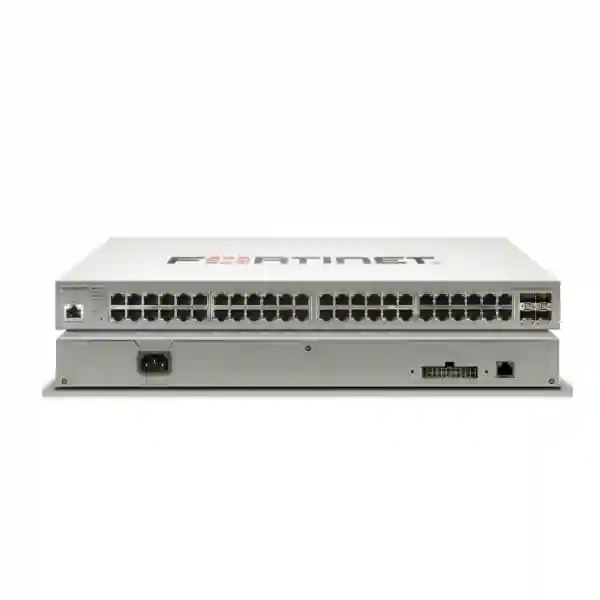
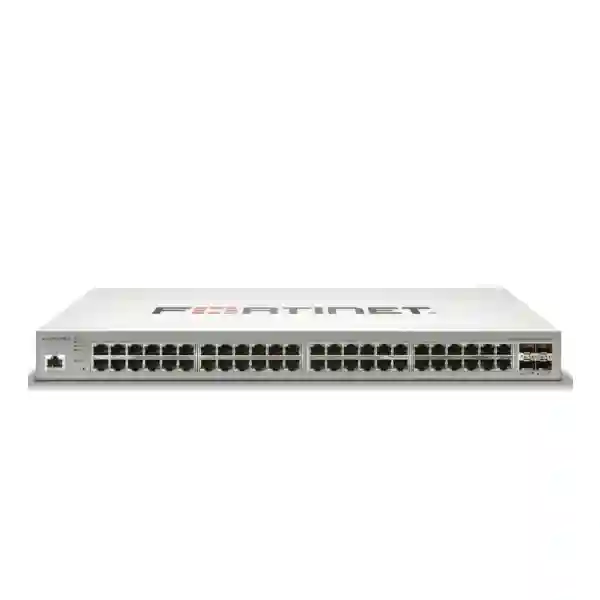
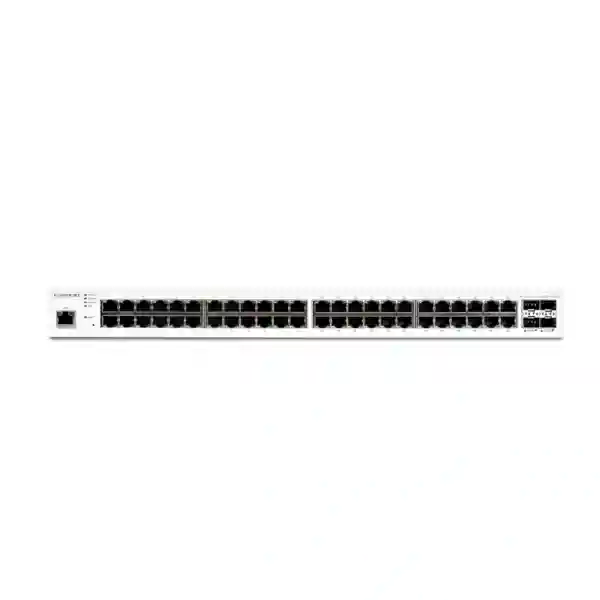
FortiSwitch FS-248E-POE Tanzania
The FortiSwitch FS-248E-POE is a secure-access switching option for organizations that need a high-density Gigabit access layer with centralized Fortinet integration. The model combines 48 Gigabit Ethernet RJ45 interfaces with four SFP uplink interfaces and PoE+ capability on 24 access ports. Its maximum PoE allocation is 370 W, providing a practical foundation for mixed endpoint environments where data and electrical power need to travel over the same Ethernet cabling. For Tanzanian offices, campuses, hospitality environments, healthcare facilities, schools and distributed enterprises, the switch can be considered when the network design requires substantial copper-port density together with powered devices and FortiGate-aligned management.
Dense wired access for users, servers, printers, phones, cameras and other Ethernet endpoints.
Dedicated fiber-capable uplink interfaces for network aggregation and suitable optical connectivity.
Power and data can be delivered to compatible powered devices over selected access ports.
Plan the total powered-device demand against the switch’s published maximum PoE budget.
FortiSwitch FS-248E-POE Overview
A switch purchase should begin with the access-layer requirement rather than only the port count. The FS-248E-POE is positioned by Fortinet as a Layer 2/3 FortiGate switch-controller-compatible PoE+ switch. That makes it relevant where an organization wants to connect a large number of wired endpoints while retaining a path to Fortinet-oriented administration. The combination of forty-eight copper interfaces and four SFP interfaces supports designs in which user and device access is concentrated at the edge while uplinks connect toward distribution, security or core infrastructure.
PoE is particularly important when the edge includes wireless access points, VoIP handsets or IP surveillance devices. Instead of providing a separate electrical adapter beside every supported endpoint, compatible PoE devices can receive power through Ethernet. This can simplify cabling and makes power planning more centralized, but it does not remove the need for engineering. Buyers should count powered devices, identify their standards and maximum draw, decide which ports require power, and leave sensible headroom within the 370 W switch budget.
Fortinet documentation continues to list FS-248E-POE among supported models in FortiSwitchOS 7.6.x documentation. Firmware selection, FortiGate interoperability and feature availability should still be checked against the exact intended software release before deployment or upgrade. This is especially important in established networks where existing FortiGate firmware, security policy, switch topology and operational change windows can constrain the acceptable software path.
Key Business Benefits
The principal value of the FS-248E-POE is consolidation. A single access switch can terminate many wired endpoints while providing PoE+ on half of its forty-eight copper ports. This is useful for mixed floors where some connections serve ordinary workstations and printers while others serve powered infrastructure devices. Four SFP ports also provide flexibility for uplink design without consuming the standard copper access interfaces.
For organizations already using FortiGate, FortiSwitch integration can reduce the operational separation between switching and security. The practical benefit is not simply a brand match: network teams can design access switching as part of the wider Fortinet environment. Before procurement, confirm the exact management mode, topology and software versions required for your deployment so the planned feature set is supported.
Technical Planning for FS-248E-POE
| Item | Verified model information | Planning implication |
|---|---|---|
| Access ports | 48 GE RJ45 | Map users and devices before deciding switch quantity. |
| Uplinks | 4 SFP | Confirm fiber type, optics and upstream interface compatibility separately. |
| PoE | 24 PoE+ ports | Identify exactly which endpoints need switch-supplied power. |
| PoE budget | Maximum 370 W | Add endpoint power requirements and maintain design headroom. |
| Positioning | Layer 2/3, FortiGate switch-controller compatible | Validate intended FortiGate/FortiSwitchOS versions and architecture. |
PoE Planning and Endpoint Selection
Power over Ethernet is a design resource, not merely a checkbox. Start by separating non-powered endpoints from powered endpoints. Then list each access point, camera, phone or other powered device and document its required PoE standard and expected draw. Twenty-four PoE+ ports do not mean every deployment will consume the same amount of power. A site with low-draw phones may have a very different budget profile from one with many wireless access points or surveillance cameras.
Fortinet’s management documentation supports PoE controls including port status, mode and priority. On supported configurations, priority can help administrators determine which devices receive power first when available power is constrained. This can be useful when critical communications or wireless infrastructure should take precedence over lower-priority devices. Configuration choices must be tested against the deployed FortiSwitchOS version and operational policy.
Fortinet Integration and FortiLink
For Fortinet-centric networks, FortiLink is an important design consideration. Fortinet documentation identifies the FS-248E-POE as a model that can participate in FortiLink configurations, and the architecture allows switch management to be integrated with a FortiGate environment. The exact physical port choice and topology depend on configuration. Buyers should therefore avoid treating an uplink diagram as universal: redundancy, inter-switch links, fiber requirements, VLAN design and upstream capacity should be planned for the actual site.
Organizations reviewing a broader Fortinet security architecture can also explore FourTeck Tanzania technology solutions and the regional FourTeck Africa portfolio. These resources are useful when the switching requirement is part of a wider firewall, wireless, branch or security refresh rather than an isolated hardware replacement.
FortiSwitch FS-248E-POE Tanzania
Tanzanian organizations evaluating the FS-248E-POE commonly need to balance port density, PoE requirements, uplink design and compatibility with existing security infrastructure. A useful procurement process starts with a physical port schedule: count desktops, printers, IP phones, cameras, access points, building systems and any other Ethernet devices expected during the intended service period. Do not size only for today’s active ports. Reserve capacity for moves, additions, replacements and temporary connections so routine expansion does not immediately require another access switch.
The second step is power planning. Because this model offers PoE+ on 24 ports with a maximum 370 W PoE budget, the design team should identify which devices actually need PoE and record their power requirements. If the site expects a substantial wireless or CCTV rollout, calculate the combined maximum requirement and decide whether powered devices should be distributed across multiple switches. This also helps create sensible failure domains: concentrating every critical powered endpoint on one access switch may not match the organization’s resilience objectives.
Third, evaluate uplinks. Four SFP interfaces give the design flexibility for fiber-capable connectivity, but transceiver selection, fiber type, distance and upstream equipment must be checked separately. For multi-floor or multi-building deployments, document cable pathways and aggregation points before ordering. If FortiGate integration is planned, include FortiGate model, firmware and desired management approach in the bill-of-material review. A quotation request that includes these details is much more useful than asking for a switch price alone.
FortiSwitch FS-248E-POE Dar es Salaam
In Dar es Salaam, the FS-248E-POE can fit office towers, hospitality properties, retail operations, professional services environments and larger business premises that need a dense wired edge. The practical question is whether forty-eight copper ports and twenty-four powered ports align with each wiring-closet requirement. Sites with many IP phones and access points should build a per-floor endpoint inventory and compare that inventory with both the PoE-port count and total power budget.
Fiber uplinks deserve particular attention in larger buildings. The four SFP interfaces can support a design in which access switching connects toward an aggregation layer, but the correct optics and fiber infrastructure depend on the upstream device and cable plant. A survey should identify rack space, patch-panel organization, electrical protection, cooling, grounding and UPS requirements. These environmental details are important to availability even though they are not headline switch specifications.
For procurement, include the expected endpoint mix, number of switches, FortiGate integration requirement and any required optics in the request. That allows the solution to be evaluated as a working access layer rather than a single chassis. Businesses with regional operations can also reference FourTeck’s broader technology portfolio when coordinating common network standards across locations.
FortiSwitch FS-248E-POE Mwanza
For Mwanza deployments, the FS-248E-POE is relevant where organizations want a centralized access switch for a substantial group of wired devices and a defined subset of PoE endpoints. Hotels, schools, healthcare facilities, warehouses and offices can have very different traffic and power profiles, so the same forty-eight-port switch should not be deployed with the same assumptions everywhere. Begin with the application mix and identify devices that are operationally critical.
A campus or multi-building environment should pay special attention to uplink design. Copper access connections normally remain local to the wiring area, while fiber may be used to connect remote closets or buildings. The four SFP interfaces provide uplink options, but optical modules and fiber distances must be matched to the network design. Document redundancy requirements before installation; resilience is an architectural property and should not be assumed from port count alone.
PoE planning is equally important. If cameras, phones and access points share the powered ports, classify them by business priority and calculate total demand. Fortinet supports configurable PoE behavior in FortiSwitch management, but administrators should validate the features available in the chosen software release. A clear port and power schedule simplifies commissioning, troubleshooting and future expansion.
FortiSwitch FS-248E-POE Arusha
Arusha organizations may use dense access switching in hospitality, tourism operations, education, offices and institutional networks where wireless coverage, IP telephony and surveillance coexist with ordinary wired users. The FS-248E-POE’s mix of forty-eight GE RJ45 ports, twenty-four PoE+ ports and four SFP interfaces can support this mixed edge when the endpoint count and power plan fit the model.
Hospitality and campus environments should avoid designing PoE solely from the number of sockets. Wireless access points and cameras can have different power requirements, and future endpoint replacements may change consumption. Maintain budget headroom and document which powered services are critical. If network continuity matters, also consider upstream redundancy, UPS runtime and the consequences of a switch outage on phones, cameras and wireless coverage.
For Fortinet-integrated environments, provide the existing FortiGate and software information during solution review. This makes it easier to assess FortiLink design and software compatibility. A complete procurement request should also identify any fiber uplinks, rack accessories and implementation expectations rather than treating the switch as the entire solution.
FortiSwitch FS-248E-POE Dodoma
In Dodoma, institutions, offices, education environments and multi-department facilities evaluating the FS-248E-POE should begin with segmentation and endpoint planning. Forty-eight physical access interfaces provide substantial connection density, but logical design still determines how safely and efficiently devices share the network. Define user groups, voice, wireless, surveillance, management and other device classes before commissioning VLANs and access policies.
The switch’s PoE+ capability can reduce local power-adapter requirements for compatible devices, but the 24 powered-port limit and 370 W maximum budget must be respected. If a building requires more than twenty-four powered endpoints, decide whether some devices will use local power or whether the powered workload should be distributed across additional PoE switches. This decision should be made before patching and labeling.
For a quotation, provide the number of closets, endpoint totals, PoE device types, uplink media, existing FortiGate details and expected growth. That information helps prevent a purchase that meets today’s port count but creates avoidable constraints during expansion.
FortiSwitch FS-248E-POE UAE
UAE buyers considering the FS-248E-POE may be coordinating branch standards, refresh projects or Fortinet-based security architectures across multiple offices. The model’s 48 GE RJ45 access ports, four SFP interfaces and 24 PoE+ ports make it a candidate for high-density access closets where not every copper endpoint needs switch-supplied power. Procurement teams should compare the planned powered-device inventory with the 370 W budget and confirm the required optics separately.
Where a FortiGate is already deployed, document its model and software version before deciding the FortiSwitchOS path and FortiLink topology. For regional Fortinet requirements, FourTeck’s Fortinet UAE resource provides a specialist regional context. Cross-border projects should standardize documentation, naming, VLAN design and configuration-control practices while still allowing site-specific differences in cabling and endpoint demand.
Quotation preparation should cover the switch, optics where required, rack environment, UPS planning and implementation scope. Separating mandatory components from optional services makes commercial comparison clearer and reduces ambiguity during deployment.
FortiSwitch FS-248E-POE Uganda
Ugandan businesses can evaluate the FS-248E-POE for branch, campus and office access networks where a large number of Gigabit endpoints must be consolidated. The forty-eight copper interfaces are useful for dense edge connectivity, while twenty-four PoE+ ports can support selected phones, cameras and wireless access points. The important design task is to identify which endpoints genuinely need PoE and ensure their aggregate demand fits within 370 W.
If the switch will form part of a Fortinet-managed environment, confirm the FortiGate platform, software train and intended topology. Fortinet documentation continues to include this model in supported FortiSwitchOS releases, but feature support and upgrade requirements should always be validated for the exact release. Regional buyers can review FourTeck Uganda solutions when coordinating requirements within Uganda.
A good procurement brief also identifies fiber distances, upstream ports, rack location, UPS strategy and expected growth. These details reduce the risk of ordering the correct switch but overlooking the supporting components required for deployment.
FortiSwitch FS-248E-POE Kampala
Kampala offices, commercial facilities and institutions may need access switches that combine high port density with support for powered network devices. The FS-248E-POE provides a useful split: forty-eight Gigabit copper ports for general access, with PoE+ available on twenty-four ports. This can suit a floor where phones, cameras and access points occupy part of the edge while desktops and printers use non-powered connections.
Before purchase, create a port map and power map. The port map reserves interfaces by device category and growth; the power map records expected consumption and priority for every powered endpoint. Then determine whether the four SFP uplinks match the planned aggregation design and whether suitable fiber and optics are already available. This planning is particularly useful when moving from unmanaged or independently managed switches toward a more structured Fortinet environment.
Implementation should include labeling, configuration backup, monitoring and a documented rollback process. The hardware selection is only one part of a maintainable network; operational discipline determines how easily future teams can troubleshoot and expand it.
FortiSwitch FS-248E-POE Arua
For Arua organizations, a dense access switch can simplify branch networking by concentrating endpoint connections in a controlled wiring location. The FS-248E-POE can support a mixture of standard Gigabit endpoints and up to twenty-four PoE+ connections, subject to the overall 370 W budget. This is relevant for facilities where voice, Wi-Fi or surveillance equipment shares the same structured cabling environment as ordinary business devices.
Network teams should account for supportability as well as capacity. Record cable destinations, patch-panel ports, switch interfaces, VLAN assignments and PoE roles. If a remote team will support the site, clear documentation can reduce diagnostic time. For FortiGate-integrated management, confirm software compatibility and access-control requirements before the change window.
When requesting pricing, identify whether the requirement is hardware-only or includes design, configuration and deployment assistance. Also specify optics and fiber requirements rather than assuming they are part of the base switch. This creates a clearer bill of materials and helps avoid delays caused by missing accessories.
FortiSwitch FS-248E-POE Mbarara
Mbarara deployments in education, healthcare, commercial and branch environments can benefit from a structured approach to access switching. With forty-eight GE RJ45 interfaces, the FS-248E-POE can aggregate a significant number of wired devices. Its twenty-four PoE+ interfaces are useful where selected endpoints require both power and data, while four SFP interfaces can be incorporated into the uplink design.
The selection should be tested against projected growth. If forty-eight access ports are nearly fully allocated on day one, the site may have insufficient flexibility for expansion or temporary devices. Likewise, a PoE plan that consumes almost the entire 370 W budget immediately offers little headroom for device changes. Design margins should reflect the organization’s likely growth and replacement cycle.
For managed Fortinet environments, establish firmware and configuration standards before rollout. Consistent templates, naming and monitoring make multi-site operations easier while allowing local variations in endpoint counts and uplink media.
FortiSwitch FS-248E-POE Gulu
Gulu buyers evaluating the FS-248E-POE should distinguish physical connectivity from service requirements. The model provides the physical edge capacity, but the final network also depends on addressing, segmentation, security policy, wireless architecture, voice design and upstream bandwidth. A switch quote is therefore most useful when accompanied by a concise network requirement.
For PoE deployments, prioritize critical endpoints and calculate power demand. The model’s twenty-four PoE+ ports and 370 W maximum budget should be compared with the actual powered-device list. If an organization expects surveillance growth or additional wireless coverage, include those future devices in the calculation now.
The four SFP interfaces can support fiber-based uplink designs, but optical transceivers are selected according to the required medium and distance. Verify both ends of each link. Installation planning should also include rack power, UPS capacity, cable management and environmental conditions so the network is maintainable after commissioning.
FortiSwitch FS-248E-POE Kenya
Kenyan enterprises coordinating Fortinet infrastructure across East Africa may consider the FS-248E-POE where a 48-port Gigabit access layer with partial PoE+ coverage is appropriate. The switch is especially relevant when the endpoint mix includes many standard wired devices plus a smaller group of powered phones, cameras or access points. Calculate the powered workload rather than assuming twenty-four PoE ports automatically fit every design.
Multi-site organizations should standardize the information captured for every branch: access-port count, powered-device count, PoE demand, uplink medium, FortiGate model, software version and resilience requirement. This produces comparable site designs and simplifies procurement. FourTeck Kenya can be referenced for Kenya-focused technology requirements while Tanzania projects remain coordinated through the Tanzania site.
If fiber uplinks are planned, confirm transceiver and cable compatibility before ordering. For replacement projects, also review the existing rack, UPS and patching so legacy constraints do not undermine the new switch deployment.
FortiSwitch FS-248E-POE Kuwait
Kuwait organizations using Fortinet security infrastructure can evaluate the FS-248E-POE as an access-layer component where forty-eight Gigabit copper connections and a defined pool of PoE+ ports are required. Its four SFP interfaces provide uplink flexibility, but the design team should verify optics, fiber media and upstream compatibility separately.
A common procurement mistake is to focus on port count while overlooking powered-device demand. Twenty-four PoE+ ports share a maximum 370 W PoE budget, so list endpoint requirements and preserve headroom. In environments with dense wireless or camera deployments, distributing powered devices across multiple switches may provide a more practical capacity and resilience model.
For regional projects, configuration standards should define management access, VLAN conventions, firmware policy, monitoring and backup. This allows the switch to be operated consistently even when local site layouts differ. Include those operational requirements in implementation planning rather than addressing them only after hardware delivery.
FortiSwitch FS-248E-POE Ghana
Ghanaian offices and institutions can assess the FS-248E-POE for access networks where many wired connections and a moderate number of PoE endpoints are concentrated in a communications room. The forty-eight GE RJ45 interfaces offer dense edge connectivity, while twenty-four PoE+ ports can power compatible devices within the published 370 W maximum budget.
The network design should reserve ports for expansion and separate critical powered endpoints from optional ones. If the site relies heavily on Wi-Fi, IP telephony or surveillance, model the effect of a switch outage and determine whether powered devices should be distributed for resilience. Uplink planning should similarly consider whether multiple paths are required and how the four SFP interfaces will be used.
For FortiGate integration, verify the target software combination and topology before deployment. Procurement documents should identify switch quantity, optics, endpoint power demand and implementation scope so commercial proposals can be compared on the same basis.
FortiSwitch FS-248E-POE Nigeria
Nigeria deployments can range from single office floors to large distributed enterprise environments. The FS-248E-POE is most appropriate where its specific balance of forty-eight Gigabit copper ports, four SFP interfaces, twenty-four PoE+ ports and 370 W power budget aligns with the access-layer design. Larger environments may use multiple access switches, making topology, aggregation and failure-domain planning essential.
Before standardizing the model across sites, create a reference design that defines endpoint assumptions, PoE thresholds, uplink approach, management method and software baseline. Then test each location against that reference rather than forcing every branch into an identical configuration. This preserves operational consistency while acknowledging differences in user density, wireless coverage and surveillance requirements.
For purchasing, request a bill of materials that separates the switch from optics, cabling-related components and services. Confirm software and FortiGate compatibility for the intended deployment and document upgrade procedures. These steps help turn a hardware purchase into a supportable network platform.
FortiSwitch FS-248E-POE Seychelles
Seychelles businesses, hospitality properties and institutions evaluating the FS-248E-POE should consider both local access density and the importance of resilient network services. A single switch can connect many wired endpoints, but if critical wireless, voice and surveillance services all depend on its PoE ports, the operational impact of maintenance or failure increases. Capacity and resilience should therefore be planned together.
The model provides twenty-four PoE+ ports within a maximum 370 W power budget. Create a powered-device inventory and leave room for endpoint upgrades. The four SFP interfaces can support fiber-capable uplinks; however, optics, fiber specification and upstream ports must be matched to the actual distances and network equipment.
For remote or distributed support, prioritize documentation. Keep port maps, VLAN information, management details, firmware records and configuration backups current. When requesting a quote, include these architectural requirements along with hardware quantity so the proposed solution can account for the complete deployment context.
Buying and Quotation Checklist
For an accurate FS-248E-POE quotation, prepare the number of required switches; current and future copper endpoint counts; number and type of PoE devices; estimated PoE consumption; required SFP uplinks; fiber medium and distance; upstream switch or FortiGate details; FortiGate and FortiSwitchOS versions where relevant; rack and UPS requirements; VLAN and segmentation needs; and whether configuration, migration or deployment assistance is required. This information allows a solution discussion to focus on compatibility and design instead of only unit pricing.
Frequently Asked Questions
How many Ethernet ports does the FS-248E-POE have?
Fortinet lists 48 Gigabit Ethernet RJ45 access ports plus four SFP interfaces on the FS-248E-POE.
How many ports provide PoE+?
The model provides PoE+ on 24 ports with a published maximum PoE limit of 370 W. Actual endpoint planning should consider the power demand of every connected powered device.
Can FS-248E-POE be managed with FortiGate?
Fortinet positions the model as FortiGate switch-controller compatible. The exact FortiLink topology, firmware combination and supported features should be validated for the intended deployment.
Is the FS-248E-POE still supported by FortiSwitchOS?
Fortinet documentation lists FS-248E-POE among supported models in FortiSwitchOS 7.6.5. Always review the release notes and upgrade guidance for the exact version you plan to use.
What information should I provide before requesting a quote?
Provide switch quantity, endpoint counts, PoE device requirements, fiber uplink requirements, existing FortiGate details, software versions and any implementation scope. This helps identify supporting components and compatibility considerations.
Decision Recap
Choose the FS-248E-POE based on a verified fit between your access-port requirement, powered-device count, PoE budget, uplink design and Fortinet management architecture. Its core published profile is clear: 48 GE RJ45 ports, four SFP interfaces, PoE+ on 24 ports and a maximum 370 W PoE budget. The right bill of materials may also require optics, fiber components, rack infrastructure, UPS capacity and implementation services.
Talk to FourTeck About Your FortiSwitch Design
Share your endpoint count, PoE requirements, existing FortiGate environment and uplink design with FourTeck. A requirements-led discussion can help identify whether FS-248E-POE fits the planned access layer and what supporting components should be considered before procurement.




Reviews
There are no reviews yet.