
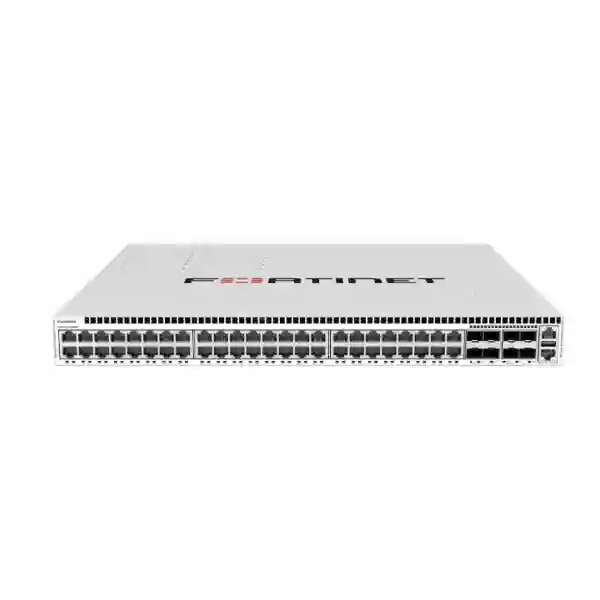
FortiSwitch FS-648F Tanzania
The Fortinet FortiSwitch FS-648F is designed for organizations that need dense multi-gigabit copper connectivity, high-speed fiber uplinks and a switching platform that can participate in a Fortinet security-driven network architecture. For Tanzanian enterprises planning campus refreshes, aggregation upgrades, headquarters networks, education environments, hospitality infrastructure or multi-building deployments, the FS-648F combines 48 multi-gigabit RJ45 interfaces with eight 10/25GE SFP+/SFP28 interfaces in a compact 1RU chassis. The non-PoE FS-648F is particularly relevant where powered endpoints are served by separate access switches or injectors and the priority is resilient, high-throughput switching.
Multi-gigabit RJ45 ports: 32 supporting 1/2.5GE and 16 supporting 1/2.5/5GE.
SFP+/SFP28 interfaces support high-speed uplinks, aggregation and stacking designs.
Published duplex switching capacity with 1,071 Mpps packet forwarding.
FortiSwitch FS-648F Overview
FS-648F belongs to Fortinet’s secure campus switching portfolio and is positioned for larger campus and multi-tier environments. Its port mix lets network architects connect conventional Gigabit Ethernet devices while creating migration paths for 2.5GE and 5GE endpoints. Eight SFP28-capable interfaces provide room for 10GE or 25GE fiber connectivity toward distribution, core, server or peer-switch layers. This combination can reduce the need to replace an entire switching layer simply because selected endpoints or uplinks need more bandwidth.
The switch provides a dedicated 10/100/1000 management port and an RJ45 serial console port. Fortinet publishes 64K MAC address storage, 4K VLAN support, 8 MB packet buffers, 4 GB DDR4 memory, 32 MB flash and a 32 GB SSD. Layer-3 scale includes published route and host entry capacities suitable for sophisticated campus designs. Exact feature availability should always be checked against the FortiSwitchOS release selected for deployment because Fortinet continues to add capabilities through software releases.
Verified Technical Specifications
| Copper interfaces | 32 × 1GE/2.5GE + 16 × 1GE/2.5GE/5GE RJ45 |
| Fiber interfaces | 8 × 10GE/25GE SFP+/SFP28 |
| Switching capacity | 720 Gbps duplex |
| Packet rate | 1,071 Mpps duplex |
| Form factor | 1RU rack mount |
| Power | 2 × 350W, dual hot-swappable AC, 100–240V AC |
| PoE | Not provided on FS-648F; FS-648F-FPOE is a separate model |
| Operating temperature | 0°C to 45°C |
Security, Routing and FortiSwitchOS Capabilities
FortiSwitchOS gives the FS-648F a feature set that extends beyond basic Layer-2 connectivity. Current Fortinet documentation identifies support across the FS-648F family for VLANs, spanning tree, static and LACP trunks, LLDP/CDP, port mirroring, flow tracking, 802.1X authentication and SFP modules. Fortinet has also added capabilities for this model through later software, including MCLAG, hardware-based IPv6 Layer-3 routing, MACsec, enhanced ACL functions, QoS, VXLAN and BGP EVPN with VXLAN in supported releases. Organizations should align the desired architecture with a validated FortiSwitchOS version before production rollout.
This matters for procurement because a switch purchase is not only a port-count decision. Buyers should map authentication, segmentation, routing, resiliency, management and upgrade requirements before selecting optics and support. A campus design may use the FS-648F as an aggregation point for access switches, as a high-density multi-gigabit access platform for devices that do not need PoE, or as part of a resilient pair where supported design patterns are appropriate.
FortiSwitch FS-648F Tanzania
Organizations evaluating FortiSwitch FS-648F in Tanzania commonly need to balance current Gigabit Ethernet estates with growing demand for faster endpoint and uplink connectivity. The FS-648F supports that transition without forcing every copper interface into one speed class. Thirty-two RJ45 ports can negotiate 1GE or 2.5GE, while another sixteen extend to 5GE. This gives infrastructure teams a practical way to segment ordinary office devices, higher-throughput workstations, wireless infrastructure where power is handled separately, appliances and other Ethernet-connected systems according to actual bandwidth requirements.
For Tanzania procurement planning, the most useful first step is to document the physical and logical network rather than beginning with quantity alone. Record how many endpoints need 1GE, 2.5GE and 5GE, which links need fiber, the required fiber distance, available rack space, power redundancy expectations and the switching or firewall platforms that will connect upstream. The eight 10/25GE SFP+/SFP28 interfaces make optics selection especially important: transceiver type, fiber media, connector format and distance must match the planned link. Buyers should request a bill of materials that clearly separates the switch, compatible optics, patching, support and any other required components.
The non-PoE nature of FS-648F should also be deliberate. If the same 48 access ports must directly power phones, cameras or wireless access points, compare the separate FS-648F-FPOE model and its electrical requirements. If power is not required at these ports, the FS-648F avoids paying for an unused PoE subsystem and retains the same published 720 Gbps switching capacity. For broader Fortinet planning, visit FourTeck Tanzania for related infrastructure discussions and FourTeck Africa for regional enterprise technology context.
FortiSwitch FS-648F Dar es Salaam
Dar es Salaam organizations often operate concentrated headquarters, hospitality properties, financial environments, education campuses, logistics facilities and multi-floor commercial buildings where switch uplinks can become a bottleneck before edge port counts are exhausted. FS-648F offers a useful architecture for such environments because its 48 copper ports are multi-gigabit capable and its eight SFP28 interfaces can serve 10GE or 25GE uplink roles. A design team can therefore separate user-facing copper connectivity from high-speed backbone links while retaining room for redundancy.
When specifying an FS-648F deployment in Dar es Salaam, identify whether it will sit at the access, distribution or campus-core layer. That choice determines the required fiber modules, link aggregation design, routing responsibilities and resilience model. A headquarters floor with non-PoE endpoints has different needs from a distribution rack aggregating multiple downstream switches. The switch’s dual hot-swappable AC power supplies can support power-path resilience, but effective resilience still depends on the upstream electrical design, UPS capacity, cabling routes and peer-switch topology.
Procurement teams should ask for configuration scope in addition to hardware. VLAN design, 802.1X, LACP, spanning tree, ACLs, routing, management integration and logging requirements should be written into the implementation plan. This makes quotations easier to compare and reduces ambiguity about what constitutes a complete deployment. Where the network uses Fortinet security infrastructure, architects can also assess Fortinet’s integrated management approach rather than treating switching as an isolated device purchase. For regional Fortinet-focused information, FourTeck’s Fortinet specialist site provides additional technology context; model-specific configuration should still follow current Fortinet documentation.
FortiSwitch FS-648F Mwanza
For Mwanza businesses and institutions, FS-648F can fit network modernization projects where a central rack needs to aggregate many wired devices or downstream switches while preserving faster uplinks for servers, storage-facing networks or building-to-building fiber. Its compact 1RU format is valuable where rack capacity is limited, but physical planning should still account for the 442 mm chassis depth, front-to-back airflow and suitable service clearance. Environmental and power conditions should be evaluated before installation rather than after equipment arrives.
A practical Mwanza sizing exercise starts with endpoint categories. Separate ordinary 1GE clients from 2.5GE and 5GE devices, then map expected traffic toward shared services and WAN or security gateways. This prevents overestimating requirements based purely on theoretical port speed while also preventing undersized uplinks. The eight 10/25GE interfaces can be allocated to redundant upstream connections, switch interconnects or other supported high-speed links according to the architecture. Where stacking is planned, current Fortinet guidance should be followed for supported ports and homogeneous-node requirements.
Buyers should also decide whether PoE is necessary. FS-648F itself has no PoE ports, so deployments serving powered cameras, phones or access points directly need another power strategy or a PoE-capable switch model. This distinction is important in quotation requests because FS-648F and FS-648F-FPOE are not interchangeable line items. Include desired transceivers, fiber specifications, rack accessories, support expectations and implementation tasks in the request so that technical suitability can be reviewed before purchase.
FortiSwitch FS-648F Arusha
Arusha deployments can range from hospitality and tourism operations to education, professional services and multi-building institutional networks. In these environments, the value of FS-648F is its ability to combine dense copper access with higher-speed fiber connectivity. Network teams can retain 1GE compatibility for established equipment while assigning 2.5GE or 5GE where additional throughput is justified. This supports staged upgrades rather than requiring every endpoint and cable path to be replaced simultaneously.
For hotels, campuses and office complexes, segmentation is often as important as raw throughput. VLAN planning can separate operational systems, staff devices, guest or tenant networks, management services and specialized equipment. FortiSwitchOS capabilities such as 802.1X, ACLs, link aggregation and Layer-3 functions can support more structured network policy when configured within a validated design. Exact software features should be checked against the target FortiSwitchOS release, particularly for advanced functions introduced in later versions.
Before requesting an Arusha quotation, document the number and speed of copper ports, fiber uplink distances, required redundancy, existing FortiGate or other network components, and whether the project includes installation or migration. If an existing network must remain operational during changeover, the implementation sequence should address VLAN migration, uplink cutover, spanning-tree behavior, address management and rollback. A clear migration plan turns a switch purchase into a controlled infrastructure change rather than a simple hardware swap.
FortiSwitch FS-648F Dodoma
Dodoma organizations planning government, institutional, education or enterprise networks may need switching that can support many logical segments and high-speed interconnection without occupying excessive rack space. FS-648F’s 1RU design, 48 multi-gigabit copper interfaces and eight 10/25GE fiber interfaces make it a candidate for structured campus designs where both density and uplink headroom matter. The published 4K VLAN capability and high MAC table capacity support large Layer-2 environments, while FortiSwitchOS offers Layer-3 and security-related functions for designs that require them.
Network governance should be part of the selection process. Define administrator access, management network separation, authentication policy, configuration backup, software maintenance, monitoring and change control before deployment. A switch with extensive features can only contribute to security when those features are incorporated into operational procedures. If 802.1X is required, document the identity infrastructure and endpoint onboarding workflow. If MACsec or advanced routing is planned, validate software support and interoperability for the intended topology.
For procurement, avoid specifying only “48-port FortiSwitch.” The FS-648F’s particular value is its multi-gigabit copper and 25GE-capable uplink mix, while its lack of PoE is an equally important characteristic. A precise request should name FS-648F, quantities, optics, fiber media, rack and power requirements, desired support, configuration scope and target deployment date. This helps suppliers prepare technically comparable quotations and reduces substitutions that may not match the network design.
FortiSwitch FS-648F UAE
In the UAE, FS-648F can serve enterprise campuses, commercial towers, data-intensive office environments and aggregation designs that need multi-gigabit access with 10/25GE fiber connectivity. The dense 1RU platform is useful where rack efficiency matters, while dual hot-swappable AC power supports designs that use independent power paths. Infrastructure teams should still calculate rack power, cooling and UPS capacity based on the complete installation rather than treating switch redundancy as a substitute for resilient facility power.
The UAE market often involves mixed-vendor networks and phased refresh projects, so compatibility planning deserves attention. Copper cabling should be assessed for the intended negotiated speeds, and fiber transceivers must be selected for the correct media and reach. Where FS-648F connects to existing core switches, firewalls or server infrastructure, confirm interface speed, optics interoperability, LACP requirements, VLAN tagging and routing responsibilities before commissioning. Advanced FortiSwitchOS features should be mapped to the exact software release used in production.
For UAE-related procurement and integration context, FourTeck UAE covers enterprise IT requirements across the market. Buyers comparing FS-648F with the FS-648F-FPOE should focus on whether the switch itself must deliver endpoint power. The non-PoE FS-648F is appropriate when powered-device requirements are handled elsewhere, while the FPOE variant is a separate design choice with materially different power specifications.
FortiSwitch FS-648F Uganda
Ugandan enterprises considering FS-648F can use its port flexibility to build a campus layer that supports conventional Gigabit devices and selected higher-speed endpoints on the same platform. This is particularly useful during phased upgrades, when existing client devices may remain at 1GE but new wireless, workstation or infrastructure requirements call for 2.5GE or 5GE. The eight 10/25GE fiber ports can provide high-capacity paths toward core, firewall or peer-switch layers.
The design process should begin with traffic flow and resilience. Determine which services are local, which traverse security gateways, where inter-VLAN routing occurs and how downstream switches are aggregated. If MCLAG, stacking, VXLAN, BGP EVPN or other advanced functions are part of the architecture, validate the intended FortiSwitchOS version and topology against Fortinet documentation. Avoid assuming that every feature behaves identically across software generations.
For procurement support across Uganda, FourTeck Uganda provides a regional route for technology enquiries. A useful FS-648F quotation request should identify switch quantity, copper speed requirements, optics, fiber distance, upstream interfaces, rack constraints, power arrangement and configuration expectations. This gives technical teams enough information to evaluate whether FS-648F is the correct model rather than simply matching a brand and port count.
FortiSwitch FS-648F Kampala
Kampala headquarters and campus networks may face rapidly increasing east-west traffic as wireless systems, collaboration platforms, local servers and security services grow. FS-648F provides 720 Gbps published switching capacity and a combination of multi-gigabit copper and 25GE-capable fiber interfaces that can help architects avoid a mismatch between edge connectivity and backbone throughput. The right topology depends on actual traffic patterns, not only the maximum interface rates.
For multi-floor buildings, consider whether FS-648F is best placed in a central distribution rack or closer to endpoint concentrations. Fiber backbone design should account for distance, pathway diversity, transceiver type and future expansion. Link aggregation can increase capacity and resilience where supported at both ends, while spanning-tree and MCLAG designs require deliberate configuration to prevent loops and preserve predictable failover behavior.
Operational readiness matters as much as installation. Define how administrators will access the management plane, how configuration changes will be approved, how firmware is maintained and how logs and alerts are monitored. If the network is Fortinet-centric, evaluate the available integrated management model and security policy workflow. Procurement documents should state these operational requirements so implementation effort is visible rather than hidden behind the hardware price.
FortiSwitch FS-648F Arua
For Arua organizations, a high-density switch such as FS-648F can be valuable when infrastructure is being consolidated into fewer, better-defined network racks. Forty-eight copper ports provide broad endpoint capacity while eight high-speed fiber interfaces offer flexibility for upstream and inter-switch connections. Because the platform supports multiple copper speeds, teams can preserve compatibility with 1GE equipment while preparing selected ports for higher-throughput requirements.
Site readiness should be checked carefully. FS-648F uses front-to-back airflow and is specified for operation from 0°C to 45°C, so rack ventilation and room conditions must remain within the vendor’s operating envelope. Dual hot-swappable AC power supplies support redundant power arrangements, but the rack should have suitable electrical distribution and UPS capacity. Fiber routes and patching should be documented before optics are ordered.
Arua buyers should distinguish between immediate requirements and growth assumptions. Count active endpoints, reserved ports, expected uplinks and the devices that genuinely need 2.5GE or 5GE. Then document VLAN, routing, authentication and management requirements. This produces a defensible bill of materials and makes it easier to determine whether one FS-648F, a resilient pair or a different FortiSwitch model better fits the project. Avoid selecting the FPOE variant unless endpoint power is actually required and the electrical design supports it.
FortiSwitch FS-648F Mbarara
Mbarara enterprises, education environments and growing institutional networks can use FS-648F where port density and uplink performance are more important than integrated PoE. The switch’s mix of 32 ports up to 2.5GE and 16 ports up to 5GE allows bandwidth to be assigned according to endpoint needs. Eight 10/25GE SFP+/SFP28 interfaces then provide a separate high-speed tier for backbone connectivity.
When migrating from older 1GE switching, cabling validation should be included in the project. Multi-gigabit Ethernet can reuse suitable copper infrastructure in many scenarios, but actual achievable speed depends on cable category, installation quality, distance and endpoint capability. Rather than assuming every existing run will support the desired rate, test representative links and document exceptions. Fiber uplinks similarly require matching optics, connectors and fiber types.
The network design should also specify failure behavior. Determine what happens if an uplink, power feed or switch fails, and decide whether redundancy is required at each layer. Fortinet supports technologies such as LACP, spanning tree, stacking and MCLAG in applicable FS-648F software releases, but topology and configuration must be engineered correctly. A procurement request that includes resilience objectives will produce a more useful solution than a hardware-only price request.
FortiSwitch FS-648F Gulu
Gulu network upgrades may involve replacing several generations of switching while keeping critical services online. FS-648F can provide a transition point because it supports 1GE alongside 2.5GE and 5GE copper speeds and offers 10/25GE fiber interfaces for backbone connectivity. This lets infrastructure teams migrate endpoints in stages while establishing faster inter-switch paths first.
A staged deployment should document existing VLANs, trunk links, spanning-tree roles, gateway locations and management addressing before equipment is installed. Configuration can then be prepared and reviewed ahead of cutover. If the FS-648F will perform Layer-3 functions, routing ownership and failover should be explicit. If routing remains on a firewall or core device, switch configuration should reflect that boundary rather than introducing unnecessary complexity.
Procurement should include lifecycle operations. Ask what support coverage is required, how software upgrades will be scheduled and who owns configuration backups and incident response. Fortinet publishes a limited lifetime warranty for the model family, subject to its warranty policy, but warranty and technical support are different considerations and should not be treated as interchangeable. Buyers should confirm the support package and terms applicable to the exact purchase before ordering.
FortiSwitch FS-648F Kenya
Kenyan enterprises looking at FS-648F may be designing high-density campus access, distribution or aggregation layers where 25GE uplink capability provides room beyond traditional 10GE designs. The eight SFP28 interfaces are particularly useful when a switch must connect to multiple upstream systems or form resilient high-speed links. Meanwhile, the 48 multi-gigabit copper ports preserve flexibility for devices with different negotiated speeds.
Selection should be based on topology. If most connected devices need PoE, compare a PoE-capable FortiSwitch rather than adding external power complexity around FS-648F. If endpoints are servers, appliances, desktops or downstream devices that do not need switch-supplied power, the non-PoE model may be a cleaner fit. Calculate expected port utilization over the planned service life and reserve enough uplink capacity for growth without oversizing every component.
For Kenya-related enquiries, FourTeck Kenya provides regional technology information. A complete quotation brief should include quantities, rack locations, uplink destinations, fiber distances, transceiver requirements, VLAN and routing scope, security integration and migration expectations. This allows the project to be evaluated as a network system rather than as a standalone switch purchase.
FortiSwitch FS-648F Kuwait
Kuwait enterprise networks can use FS-648F for dense campus switching where rack efficiency, multi-gigabit copper and 25GE uplinks are required. In office towers, education environments and institutional campuses, high-speed uplinks can prevent aggregated endpoint traffic from being constrained by older backbone interfaces. The 1RU chassis also supports higher port density per rack unit than designs that spread equivalent connectivity across several smaller switches.
Environmental engineering remains essential. Rack airflow must align with the switch’s front-to-back cooling direction, and room temperature should remain inside the published operating range. Dual hot-swappable AC supplies can be connected to appropriately designed power paths for resilience. Power, cooling and UPS calculations should include all switches, optics and neighboring equipment rather than relying only on a single device’s maximum consumption figure.
For procurement, specify whether advanced FortiSwitchOS functions are required. Features such as MACsec, MCLAG, hardware-based IPv6 routing, VXLAN and BGP EVPN with VXLAN have software-version dependencies. Confirm the release strategy before production deployment and validate compatibility with connected equipment. For regional context, FourTeck’s approved network includes Kuwait-focused resources, while final model configuration should be based on Fortinet’s current documentation and the project’s tested design.
FortiSwitch FS-648F Ghana
Ghanaian organizations modernizing campus networks can consider FS-648F when they need a bridge between widespread 1GE endpoints and emerging multi-gigabit requirements. The switch supports 2.5GE on all 48 copper interfaces and 5GE on sixteen of them, allowing bandwidth upgrades to be concentrated where they deliver value. Eight 10/25GE fiber ports provide capacity for aggregation, core connectivity or resilient peer links.
A good design separates access requirements from backbone requirements. Count endpoints and their speed needs, then model traffic moving toward shared services, internet security gateways and inter-building links. This prevents a situation where high-speed access ports feed an undersized uplink. Conversely, it avoids buying unnecessary optics or backbone capacity when actual workloads do not justify them. Capacity planning should include expected growth and redundancy overhead.
Security planning can incorporate 802.1X, VLAN segmentation, ACLs and other supported FortiSwitchOS controls. Organizations using Fortinet security products can evaluate how switching fits into their broader operational model. Configuration, software version, authentication infrastructure and monitoring should be documented before rollout. The procurement package should clearly distinguish hardware, optics, support and implementation so decision-makers can compare total project scope rather than only unit price.
FortiSwitch FS-648F Nigeria
Nigeria’s large enterprise, financial, education, hospitality and multi-site environments can create substantial switching demand, especially where campuses consolidate traffic from many access layers. FS-648F offers 720 Gbps published switching capacity and eight 25GE-capable fiber interfaces, giving network architects options for high-throughput aggregation. Its multi-gigabit copper interfaces also allow endpoint upgrades without abandoning 1GE compatibility.
For larger deployments, consistency is important. Define standard VLANs, authentication policy, management addressing, logging, uplink templates and software versions across sites. If stacking is used, Fortinet documentation identifies specific stack ports for FS-648F and requires homogeneous nodes for the documented stacking model. If MCLAG or other redundancy mechanisms are chosen instead, design and test their behavior against the connected core or firewall infrastructure.
Procurement teams should request exact model identification because FS-648F and FS-648F-FPOE differ materially in PoE capability and power specifications. They should also specify transceiver requirements instead of using generic “fiber module” descriptions. Fiber type, speed, wavelength, reach and connector requirements all influence the correct bill of materials. A technically detailed request reduces the risk of receiving an attractive quotation that is incomplete for the intended topology.
FortiSwitch FS-648F Seychelles
Seychelles hospitality, institutional and enterprise networks may require compact switching with strong fiber connectivity, particularly where buildings or operational areas are linked through structured backbone networks. FS-648F provides 48 multi-gigabit copper ports and eight 10/25GE fiber interfaces in 1RU, supporting designs that need high density without consuming excessive rack space.
Remote or island deployments make planning and spares strategy especially important. Confirm optics, patching, power, rack depth and software compatibility before shipment so installation is not delayed by a small missing component. If the network is business-critical, consider the operational impact of switch, optic, fiber or power failures and determine what redundancy or spare equipment is justified. Dual hot-swappable power supplies address one element of resilience but do not replace end-to-end design.
The non-PoE FS-648F should be selected when endpoint power is not needed from the switch or is provided elsewhere. Hospitality networks with large numbers of access points, cameras or phones may instead require PoE-capable access switches, potentially using FS-648F in an aggregation role. Mapping device types to switch roles can therefore produce a more efficient architecture than forcing one switch model to serve every layer.
Deployment and Integration Guidance
Before installation, verify rack dimensions, airflow direction, AC power feeds, UPS capacity and cable management. Label copper and fiber paths and maintain an interface plan showing endpoint, VLAN, speed and uplink assignments. For fiber connections, choose transceivers based on the connected device, media type and distance. Do not assume that an SFP28 cage automatically makes every optic or cable compatible.
At the logical layer, decide where gateways reside, how VLANs are trunked and how loops are prevented. Use LACP where aggregated links are part of the approved design, and document spanning-tree priorities rather than leaving topology outcomes to default behavior. If 802.1X is used, test authentication, fallback and remediation cases before broad rollout. Advanced functions such as MACsec, VXLAN, EVPN, PIM or dynamic ACLs should be introduced only where the target software version and end-to-end architecture support them.
FS-648F Buying Checklist
✓ Confirm that non-PoE operation matches endpoint requirements.
✓ Count 1GE, 2.5GE and 5GE copper devices.
✓ Map all 10GE/25GE uplinks and fiber distances.
✓ Specify transceiver and cabling requirements.
✓ Confirm rack depth, airflow and power design.
✓ Define VLAN, routing and authentication scope.
✓ Identify redundancy and failure-recovery objectives.
✓ Select a validated FortiSwitchOS release.
✓ Include configuration, migration and support scope.
✓ Request an itemized bill of materials.
Frequently Asked Questions
Does FortiSwitch FS-648F provide PoE?
No. Fortinet lists FS-648F without PoE. FS-648F-FPOE is a separate model with 48 PoE ports and a different power design.
How many ports does FS-648F have?
It has 48 multi-gigabit RJ45 interfaces plus eight 10GE/25GE SFP+/SFP28 interfaces, as well as dedicated management and console connectivity.
What is the switching capacity?
Fortinet publishes 720 Gbps duplex switching capacity and 1,071 Mpps duplex packet forwarding for FS-648F.
Can FS-648F be used for Layer-3 networking?
Yes, FortiSwitchOS supports Layer-3 capabilities on this platform. The exact routing features available depend on the software release, so validate requirements against current Fortinet documentation.
What should be included in a Tanzania quotation request?
Include switch quantity, endpoint speed requirements, uplink design, optics, fiber distances, rack and power information, desired FortiSwitchOS features, integration requirements, support and migration or configuration scope.
Decision Recap
Choose FS-648F when the design needs dense non-PoE multi-gigabit copper access, 10/25GE fiber uplinks, enterprise switching scale and FortiSwitchOS capabilities in a 1RU platform. Re-evaluate the model if most attached devices require switch-supplied PoE, if fewer ports would materially reduce project cost, or if the architecture needs a different uplink profile. The strongest procurement decision comes from matching the model to a documented topology, not from selecting on port count alone.
Plan Your FortiSwitch FS-648F Deployment
Prepare your endpoint count, desired port speeds, uplink destinations, fiber distances, PoE requirements, existing Fortinet environment and resilience objectives. FourTeck can use this information to discuss an appropriate FS-648F bill of materials and deployment scope for Tanzania and supported regional projects.



Reviews
There are no reviews yet.