
FortiSwitch FSR-108F Tanzania
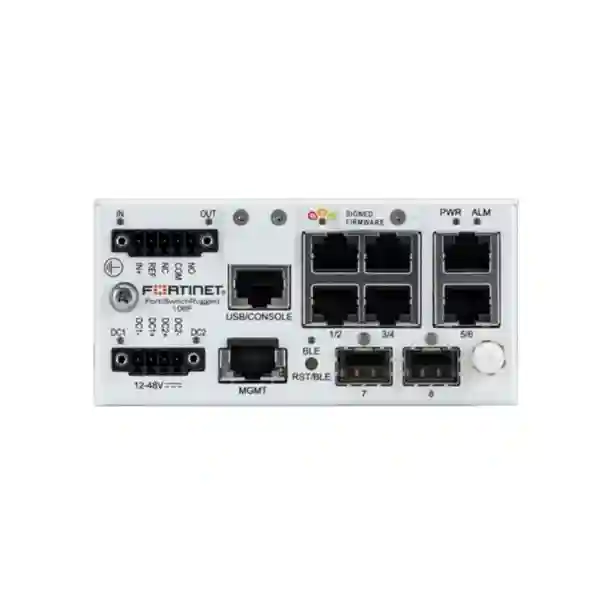
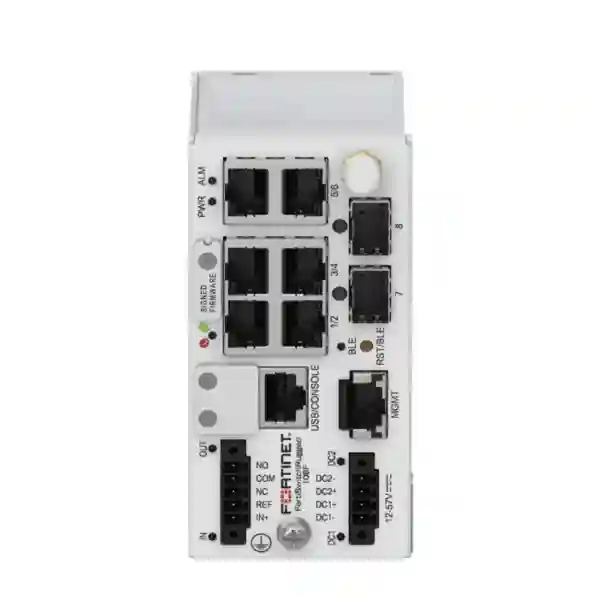
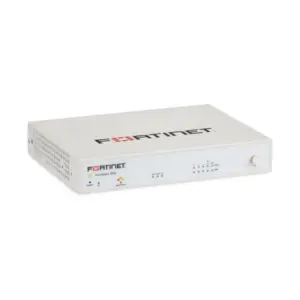
The FortiSwitch FSR-108F is a rugged industrial Ethernet switch for networks that need compact copper access, fiber connectivity and Fortinet switching capabilities in demanding operational environments. Fortinet specifies six 1G/100M/10M RJ45 interfaces and two 1G/100M SFP interfaces, a dedicated 10/100/1000 service port and an RJ45 serial console port. Its published system figures include 16 Gbps duplex switching capacity, 23.8 Mpps forwarding, 16,000 MAC addresses, support for 4,000 VLANs and network latency below one microsecond. The FSR-108F does not provide Power over Ethernet, so project design should provide separate power for connected endpoints or select a PoE-capable rugged model when endpoint powering is required.
10/100/1000 copper network interfaces for industrial Ethernet endpoints.
100M/1G SFP interfaces for fiber or compatible transceiver-based links.
Published duplex switching capacity with 23.8 Mpps packet forwarding.
Use independently powered endpoints or assess a PoE rugged model where needed.
What is the FortiSwitch FSR-108F?
FSR-108F belongs to Fortinet’s FortiSwitch Rugged family, which Fortinet positions for challenging industrial and operational technology environments. This distinction matters because FSR-108F is not the same model as the standard FortiSwitch FS-108F used in conventional access-switching discussions. Buyers should preserve the complete model number in quotations, bills of materials and procurement documents to avoid selecting the wrong platform. For industrial cabinets, field locations, utilities, transportation, manufacturing, building systems and other operational networks, a rugged switch can be selected where environmental and installation requirements go beyond a typical office wiring closet.
The FSR-108F is especially relevant when a project needs a small number of copper Ethernet ports plus fiber-capable uplinks, but does not require PoE from the switch itself. The two SFP interfaces can support designs in which the switch connects over fiber to another network area, while the six RJ45 interfaces serve local devices. Exact optics, cable type, distance and interoperability should be confirmed during design rather than assumed from the presence of SFP slots alone.
Verified FSR-108F specifications
| Network interfaces | 6 × 1G/100M/10M RJ45; 2 × 1G/100M SFP |
| Service port | 1 × 10/100/1000 |
| Serial console | 1 × RJ45 |
| PoE | Not provided on FSR-108F |
| Switching capacity | 16 Gbps duplex |
| Packet forwarding | 23.8 Mpps duplex |
| MAC address storage | 16,000 |
| VLANs supported | 4,000 |
| Network latency | Below 1 microsecond |
Industrial network planning with FSR-108F
Industrial Ethernet projects should start with the environment and connected equipment rather than with port count alone. Identify every controller, workstation, gateway, sensor aggregation device, camera encoder, building-system endpoint or other Ethernet node that will connect locally. Then determine whether each endpoint is copper or fiber, what link speed it supports, how it receives power and whether traffic should be separated into VLANs. The FSR-108F offers six copper network interfaces, so reserve capacity for maintenance access and future expansion instead of filling every port on day one without a growth plan.
Fiber planning deserves equal attention. An SFP slot is a flexible interface, but the correct transceiver depends on fiber type, wavelength, distance, connector strategy and the device at the opposite end. Procurement teams should therefore request the switch and optics as a coordinated bill of materials. For installations spanning separate buildings or electrically noisy areas, fiber can be attractive because the physical medium and distance characteristics differ from copper, but final selection should be based on site engineering.
Management design also matters. Fortinet documents current FortiSwitchOS releases that support the FSR-108F, and Fortinet provides FortiSwitch management options across its switching portfolio. Before deployment, confirm the intended FortiSwitchOS version, management architecture, configuration backup process, administrator authentication, monitoring method and change-control procedure. This creates a maintainable industrial network rather than an isolated switch that becomes difficult to troubleshoot later.
Important PoE buying note
FSR-108F has no PoE ports. If the intended endpoints are IP cameras, wireless access points, phones or other devices that expect switch-delivered power, include external power arrangements or evaluate another FortiSwitch Rugged model with PoE. This check is particularly important in remote cabinets where adding separate power supplies later can increase installation complexity. A quotation request should state the endpoint models and their power method so the switch choice can be validated before purchase.
FortiSwitch FSR-108F Tanzania
For Tanzania projects, the FortiSwitch FSR-108F fits procurement searches where the requirement is specifically for ruggedized Fortinet switching rather than a standard office access switch. Potential applications include industrial facilities, utilities, transportation infrastructure, building automation, outdoor or semi-protected cabinets, remote technical rooms and operational sites where a compact Ethernet switch must connect local equipment to a wider network. Buyers should first document the installation enclosure, available power, ambient conditions, copper endpoint count, fiber path and network-management approach. That information is more useful than asking only for an eight-port switch because it exposes whether the FSR-108F’s particular interface mix is appropriate.
A Tanzania quotation should identify FSR-108F exactly, required quantity, the SFP transceiver requirements for each fiber interface, patching and fiber accessories, mounting context, upstream switch or firewall, and whether configuration or integration assistance is required. Where a FortiGate firewall already forms the security edge, network planners can consider how VLANs, management access and segmentation will be coordinated with the switching layer. The design should still be based on documented compatibility and the required FortiSwitchOS/FortiOS combination rather than assumptions.
FourTeck Tanzania’s business technology portfolio covers networking, firewalls, wireless, cabling and supporting infrastructure, which is useful when the FSR-108F is one component of a larger site. For a formal requirement, use the verified FourTeck Tanzania contact page and include project context so the enquiry can be evaluated around the actual environment.
FortiSwitch FSR-108F Dar es Salaam
Dar es Salaam buyers may encounter rugged switching requirements in logistics, commercial infrastructure, warehouses, industrial premises, security systems, facilities networks and distributed operational environments. The FSR-108F can be evaluated where a small local Ethernet node needs six copper connections and up to two SFP-based network links. A practical design begins by mapping the cabinet or equipment location and tracing where each network cable terminates. If fiber is being used to connect a gatehouse, plant area, utility room or separate building back to a central network, specify the complete optical path and not only the switch model.
Dar es Salaam procurement teams should also separate ruggedness requirements from power requirements. FSR-108F is rugged but not PoE. A surveillance project, for example, may need a rugged switch because of the installation location but also require PoE for cameras. In that case, FSR-108F may not be the correct member of the rugged family unless cameras have independent power. Conversely, industrial controllers, gateways and other powered equipment may not need PoE at all, making the non-PoE design entirely reasonable.
For quotation preparation, provide the number of sites, expected switch quantity, connected endpoint types, existing Fortinet environment, desired management method and fiber details. Also identify whether the project needs structured cabling, SFP optics, UPS or DC power planning, firewall integration or configuration support. This produces a more complete bill of materials and reduces the risk that installation is delayed by a missing transceiver, patch lead or power component.
FortiSwitch FSR-108F Mwanza
In Mwanza, an FSR-108F project may be driven by the need to extend managed Ethernet into an operational area where conventional office switching is not the preferred form factor or environmental choice. Industrial, transport, facilities, storage and infrastructure sites can have network cabinets located away from the main IT room, making local switching and fiber uplinks valuable. The FSR-108F’s two SFP interfaces give designers options for connecting the local switch into a fiber topology, while six copper interfaces can serve nearby Ethernet devices.
The correct topology depends on resilience requirements. Some sites need a simple uplink to a central switch; others need a network design that considers redundant paths, spanning-tree behavior, link aggregation or segmentation. Those decisions should be made at architecture level and checked against model-specific FortiSwitch features. The published hardware capacity of 16 Gbps and 23.8 Mpps provides a clear baseline for the model, but application suitability still depends on actual traffic patterns and the role of the switch.
Mwanza buyers requesting pricing should avoid an incomplete description such as “Fortinet 8-port switch.” State “FortiSwitch Rugged FSR-108F,” because the standard FS-108F is a different product. Include whether PoE is required, because the FSR-108F does not provide it. If fiber is part of the requirement, identify single-mode or multimode infrastructure where known, approximate distances, connector presentation and the upstream equipment. These details help turn a product enquiry into an installable network specification.
FortiSwitch FSR-108F Arusha
Arusha organizations considering the FortiSwitch FSR-108F may be supporting hospitality infrastructure, facilities systems, operational sites, security networks, branch connectivity or other environments where the switching point sits outside a conventional air-conditioned IT room. Rugged switching is valuable only when it matches the real environmental and installation requirement, so the project should record enclosure type, available power, cable entry, grounding approach, upstream connectivity and maintenance access before hardware is finalized.
For hospitality or campus-style properties, the FSR-108F may serve as a compact field switch for independently powered Ethernet devices while fiber connects the location back to a main communications room. However, many hospitality endpoints such as access points, cameras and phones commonly use PoE. Because FSR-108F is non-PoE, endpoint power must be designed separately or a PoE-capable alternative should be considered. This is a functional selection issue, not a minor accessory decision.
When seeking a quotation in Arusha, list every endpoint that will connect to the switch and mark whether it needs PoE. Add the number of fiber links, transceiver requirements, expected VLANs and the existing firewall or switch environment. If the network will be managed centrally, include the Fortinet software context so version compatibility can be checked. A complete enquiry also states whether installation, configuration, cabling or documentation is required, allowing the FSR-108F to be evaluated as part of the operational network rather than as an isolated hardware purchase.
FortiSwitch FSR-108F Dodoma
Dodoma deployments can include administrative campuses, institutions, utilities, facilities systems, security infrastructure and branch networks where Ethernet connectivity needs to reach technical areas outside the main data room. The FSR-108F is worth considering when the requirement combines a compact rugged switch with six copper interfaces and two fiber-capable SFP interfaces. Rather than choosing by brand alone, planners should document how many devices connect locally, how far the uplink travels and whether the switch location has suitable power and enclosure conditions.
Segmentation can be important in institutional and facilities networks. Operational devices should not automatically share the same broadcast domain or access policy as general office users. Fortinet publishes VLAN support for the FSR-108F, and a properly designed network can use segmentation as part of a broader security architecture. The exact policy belongs at the network-design layer: identify device groups, required communications, management access and upstream firewall controls, then implement only the connectivity each group needs.
Procurement in Dodoma should include lifecycle details as well as initial hardware. Record the target FortiSwitchOS version, configuration backup method, administrator ownership, monitoring process and spare strategy. For remote or operational sites, good documentation can be as important as the switch itself because troubleshooting often begins with knowing which endpoint is on which port and where the fiber link terminates. A request to FourTeck should therefore include topology, quantities, optics, power method and desired services so the quotation reflects the complete deployment.
FortiSwitch FSR-108F UAE
For UAE industrial and infrastructure projects, the FSR-108F can be assessed for compact rugged Ethernet roles in facilities, logistics, manufacturing, transport, energy, building systems and field cabinets. The model’s interface layout supports six local copper Ethernet connections and two SFP links, which can be useful when a distributed technical area connects back to a larger network over fiber. Site engineers should confirm environmental requirements, power design, fiber standard and cabinet layout before ordering.
UAE buyers often coordinate multiple technology packages within the same project, so interface responsibilities should be clear. If CCTV, wireless or access-control devices are expected to connect, check their power source carefully because FSR-108F has no PoE. If the endpoint vendor assumes PoE and the switch specification assumes external power, the mismatch may only become visible during installation. A port-and-power schedule prevents this problem and also reveals whether six copper ports provide enough usable capacity after allowing for future expansion.
For regional projects, FourTeck’s UAE technology site can provide a related contact path for UAE infrastructure requirements. Procurement teams managing both Tanzania and UAE locations can use a consistent documentation format for switch model, optics, VLANs, endpoint power and management. Consistency simplifies cross-border support even when each site has different quantities and physical conditions.
FortiSwitch FSR-108F Uganda
Uganda organizations evaluating FSR-108F should focus on where the switch will operate and what it must connect. A rugged switch can support operational network edges in industrial, utility, security, facilities and remote-site applications, while SFP interfaces can be useful for fiber links between technical areas. The FSR-108F provides six copper Ethernet interfaces and two SFP interfaces, so it suits relatively compact edge requirements rather than high-density access switching.
Power and resilience planning are particularly important at distributed sites. The switch itself and every connected endpoint need a defined power source, and the FSR-108F cannot power endpoints through PoE. Where cameras or wireless devices are involved, confirm whether they use local power, injectors or a different PoE switch model. The network path should also be documented from endpoint through access switch and uplink to the firewall, server or control platform.
For Uganda-related enquiries, the FourTeck Uganda site provides a regional technology reference. A useful quotation request includes the exact FSR-108F model, quantity, site count, fiber distances, required optics, connected devices, existing Fortinet products and whether configuration assistance is needed. This gives the supplier enough context to identify missing dependencies before equipment reaches the site.
FortiSwitch FSR-108F Kampala
Kampala projects may need rugged switching for facilities, security, industrial operations, transport systems or distributed building infrastructure where a small managed Ethernet node is positioned away from the central communications room. FSR-108F’s combination of copper and SFP interfaces allows a local group of Ethernet devices to connect through a fiber or transceiver-based uplink architecture. The model should not be confused with a generic desktop eight-port switch: its value is tied to rugged deployment requirements and Fortinet network integration.
Before procurement, create a port map. Assign the six copper ports to known devices, identify the purpose of each SFP interface and reserve capacity where future additions are expected. Mark the traffic class or VLAN for each endpoint and determine whether upstream security policy must restrict communication between operational systems and business users. This planning is particularly useful where the switch connects devices from different building or security subsystems.
Kampala buyers should also document serviceability. Record switch naming, IP addressing, administrator access, configuration backup, software version and fiber labeling. If a fault occurs later, technicians can identify the uplink and connected device without tracing every cable from the beginning. For a commercial quotation, include installation environment, quantity, optics and accessory needs instead of requesting the bare switch alone.
FortiSwitch FSR-108F Arua
Arua deployments may involve branch, infrastructure or remote operational sites where the ability to maintain a clear and compact network design is important. The FSR-108F can be evaluated as a rugged edge switch when six copper interfaces are sufficient and one or two SFP connections are appropriate for the uplink design. Fiber may be especially useful where the switch is separated from the central network by distance or by a physical environment that makes copper less suitable, subject to the project’s actual cabling conditions.
Remote-site design should reduce avoidable service visits. Correct optics, labeled fiber, documented port assignments and a known configuration backup location all help. Power should be planned explicitly, including the switch supply and endpoint supplies. Because the FSR-108F has no PoE, a remote camera or access point cannot simply be connected and powered from its Ethernet port. That limitation should be checked during design, not discovered during commissioning.
For Arua procurement, provide the exact site topology and identify whether the switch will be standalone or part of a broader Fortinet-managed environment. State expected VLANs, upstream device, fiber type, distances and the number of local endpoints. If spare units or optics are part of the maintenance strategy, include them in the procurement discussion rather than treating spares as an afterthought.
FortiSwitch FSR-108F Mbarara
Mbarara organizations can consider the FSR-108F for operational network segments that require rugged Fortinet switching with modest port density. A typical design question is whether a technical area needs a local switch close to equipment or whether cabling should return directly to a central room. Where a local switch is appropriate, the six copper ports can connect nearby endpoints while SFP interfaces provide flexible uplink options.
The network should be sized around both present devices and expansion. Filling all six copper interfaces immediately leaves no simple local port for growth, temporary maintenance or replacement testing. If the site is likely to expand, compare the FSR-108F with higher-port-count rugged models before standardizing. Likewise, if endpoints need PoE, compare with a PoE-capable model because FSR-108F itself provides none.
Mbarara quotation requests should include switch quantity, endpoint list, fiber details, management expectations and any related firewall, cabling or UPS requirement. If the site uses operational devices that should be isolated from general user traffic, describe the segmentation objective so VLAN and upstream policy planning can be considered. This turns the purchase from a simple port-count exercise into a maintainable network decision.
FortiSwitch FSR-108F Gulu
Gulu buyers searching for FortiSwitch FSR-108F may be planning an industrial edge, facilities network, security infrastructure or remote communications point. The rugged family is designed for challenging environments, but every project still needs an enclosure and power design appropriate to the actual site. The switch’s six copper and two SFP network interfaces make it a compact platform where local endpoint density is limited and fiber-capable connectivity is useful.
For distributed networks, standardization can simplify support. If multiple Gulu or Uganda sites use the same switch role, document a repeatable template covering port assignments, VLANs, management address, uplink configuration, software baseline and labels. The physical fiber path and SFP specification should still be recorded per site because distances and existing cabling may differ. Standardization should make the design clearer, not conceal site-specific requirements.
A procurement checklist should confirm that PoE is not needed, since the FSR-108F has no PoE ports. It should also confirm the number and type of SFP modules, patch cords, power accessories and any cabinet or UPS items. Providing these details at quotation stage reduces the chance of receiving the correct switch but an incomplete installation package.
FortiSwitch FSR-108F Kenya
Kenya projects can use the same disciplined selection process for FSR-108F: confirm the rugged deployment need, map six copper endpoints, define the purpose of the two SFP links and verify that endpoint power is independent of the switch. Industrial sites, logistics facilities, security systems, utilities and distributed building infrastructure are examples of environments where rugged switching may be relevant, but the final decision should be based on environmental and network requirements rather than sector labels alone.
Fiber uplinks can support connections between field areas and central network rooms, but optics must be specified correctly. The project should document fiber type, approximate distance, connector presentation and the peer interface. Where redundancy is required, the topology and model-specific feature support should be checked against current Fortinet documentation. Where simple connectivity is sufficient, avoid unnecessary complexity and keep configuration easy to support.
The FourTeck Kenya site is a relevant regional reference for Kenya technology enquiries. Multi-country IT teams can standardize naming, configuration records and procurement fields across Kenya and Tanzania while still adapting power, optics and physical installation to each location. This is particularly useful for organizations maintaining operational networks in several East African markets.
FortiSwitch FSR-108F Kuwait
Kuwait industrial and infrastructure buyers may consider FSR-108F where rugged Ethernet switching is needed close to operational equipment. Project engineers should define the environmental enclosure, power input design, local copper endpoints and fiber uplink architecture. The FSR-108F is compact, so it is best evaluated for focused edge roles rather than high-density switching requirements.
Heat, cabinet design and site conditions should be treated as engineering inputs, not marketing assumptions. Verify the Fortinet environmental specifications applicable to the intended installation and ensure the complete enclosure, power and cabling system is appropriate. The switch’s published networking performance does not replace this site assessment. Similarly, PoE is absent on the FSR-108F, so powered field devices need another solution.
For Kuwait quotations, include exact quantity, required SFPs, endpoint list, management method and whether the deployment connects to an existing Fortinet security environment. Where the project is part of a regional standard, keep model naming and configuration documentation consistent across locations. Procurement should also distinguish required hardware from optional installation and support services so commercial comparisons remain clear.
FortiSwitch FSR-108F Ghana
Ghana buyers can assess FSR-108F for compact rugged switching roles in operational networks, facilities, logistics, industrial systems and security infrastructure. The combination of six copper interfaces and two SFP interfaces can suit a field or technical cabinet where local devices connect over Ethernet and the network returns to a central location over fiber. The exact use case should be validated against the device count and required topology.
A strong design also defines network ownership. Decide who manages the switch, where configuration backups are stored, how firmware changes are controlled and what monitoring is expected. If the switch participates in a Fortinet-managed environment, confirm current software compatibility before rollout. If it is used in a standalone design, document access controls and management addressing so the device remains supportable.
Ghana procurement teams should explicitly record that FSR-108F is non-PoE. Where the attached devices require PoE, select an appropriate powering approach or compare other rugged models. Include optics, fiber patching, power and cabinet accessories in the bill of materials. A complete quote request reduces the risk of fragmented purchasing in which essential installation items arrive from different sources at different times.
FortiSwitch FSR-108F Nigeria
Nigeria projects may require rugged Ethernet at industrial plants, logistics facilities, utilities, transport sites, security networks and distributed technical locations. FSR-108F can be considered where six copper ports are sufficient and fiber connectivity is part of the architecture. For larger endpoint counts, compare higher-density rugged switches rather than adding multiple small switches without a clear topology.
Power quality and continuity should be addressed at project level. The switch and attached devices need appropriate power protection for the site, and non-PoE endpoints must have their own supplies. If the network supports operational processes, define what happens during a power interruption and whether upstream devices, fiber equipment and the FSR-108F remain available together. A UPS strategy is useful only when it covers the components needed for the service to function.
For Nigeria procurement, provide the exact model, site quantity, connected equipment, optics and desired management. Add the existing firewall or core-switch details if integration is required. This information helps distinguish a straightforward hardware request from a deployment that also needs configuration, segmentation, fiber work or documentation. The objective is an operationally complete solution rather than a switch delivered without the components needed to use it.
FortiSwitch FSR-108F Seychelles
Seychelles deployments can present distributed-site and environmental planning considerations where compact rugged networking may be useful. The FSR-108F should be assessed based on the protected installation location, local power, connected devices and uplink path. Its six copper interfaces are suitable for a small endpoint group, while two SFP interfaces provide fiber-capable connectivity where the site design calls for it.
For island or remote operational locations, spare and support planning can be important because a missing transceiver or power accessory can delay restoration. Record the exact SFP specification, patching, switch configuration and labeling, and consider whether project spares are justified by the operational impact of failure. This is a procurement decision based on service criticality rather than a claim about product reliability.
Seychelles buyers should also confirm whether connected cameras, access points or other endpoints require PoE. FSR-108F cannot provide it. A clear endpoint schedule showing data interface and power source is an effective way to validate the design before purchase. If the switch will integrate with Fortinet management or security systems, include current software versions and architecture in the enquiry so compatibility can be checked against vendor documentation.
Compatibility, management and integration guidance
Fortinet’s current FortiSwitchOS release documentation lists FSR-108F among supported FortiSwitch Rugged models. That is useful evidence that the model remains represented in the current software family, but deployment teams should still verify the exact FortiSwitchOS release and any FortiGate/FortiLink compatibility requirements for their chosen architecture before upgrading or standardizing. Software support changes over time, and the correct reference is the vendor documentation for the versions actually being deployed.
For an integrated Fortinet environment, plan management access, VLANs, switch naming, administrator roles, configuration backups and monitoring before commissioning. For operational networks, segmentation should reflect how systems communicate. A building controller may need access to a management server but not to user laptops; a security subsystem may need a defined path to its recorder or management platform. These policy decisions should be documented and enforced at the appropriate switching and firewall layers.
If the FSR-108F connects to third-party equipment, validate Ethernet speed, duplex behavior, optics, VLAN tagging and any required protocols. Standards-based Ethernet makes multi-vendor networks possible, but successful integration still depends on compatible configuration. Testing the actual path during commissioning is preferable to assuming every device will negotiate and pass tagged traffic exactly as expected.
Related FourTeck network resources
FortiSwitch FSR-108F quotation checklist
Include the exact model FSR-108F and quantity; project country and site; number and type of copper endpoints; whether any endpoint requires PoE; number of SFP links; fiber type and approximate distance where known; required transceivers; upstream switch or firewall; current Fortinet software environment; VLAN or segmentation requirements; power and UPS context; cabinet or mounting environment; and whether installation, configuration, testing or documentation is required.
Providing these details helps distinguish hardware supply from a complete network requirement and makes technical review more useful before purchase.
Frequently asked questions
Is FSR-108F the same as FS-108F?
No. FSR-108F is a FortiSwitch Rugged model. FS-108F is a different FortiSwitch model in the secure access family. Preserve the full model number in procurement documents.
Does FortiSwitch FSR-108F provide PoE?
No. Fortinet lists no PoE ports or PoE budget for FSR-108F. Devices that require power must use another power method, or the project should assess a suitable PoE-capable rugged switch.
How many network interfaces does FSR-108F have?
Fortinet specifies six 1G/100M/10M RJ45 network interfaces and two 1G/100M SFP interfaces, plus a service port and RJ45 serial console port.
What is the switching capacity?
The published duplex switching capacity is 16 Gbps, with 23.8 Mpps packet forwarding.
What should I send for a Tanzania quote?
Send the exact FSR-108F model, quantity, site, endpoint list, PoE requirements, fiber and SFP details, existing Fortinet environment and any installation or configuration requirements. This gives the sales and technical team enough context to review the complete requirement.
Decision recap
Choose FSR-108F when the project specifically calls for a compact Fortinet rugged switch, six copper Ethernet interfaces are sufficient, up to two SFP interfaces fit the uplink design, and connected endpoints do not need PoE from the switch. Compare another model when more ports, PoE, higher-speed uplinks or different physical requirements are necessary. The strongest procurement decision comes from matching the exact model to the environment, endpoint power, fiber design, management architecture and growth plan.
Plan your FSR-108F requirement with FourTeck Tanzania
For a useful quotation, share the switch quantity, connected devices, site environment, fiber distances, SFP needs, existing Fortinet products and whether configuration or integration support is required. FourTeck can use that information to discuss the network requirement in context rather than treating the rugged switch as an isolated line item.

Reviews
There are no reviews yet.