
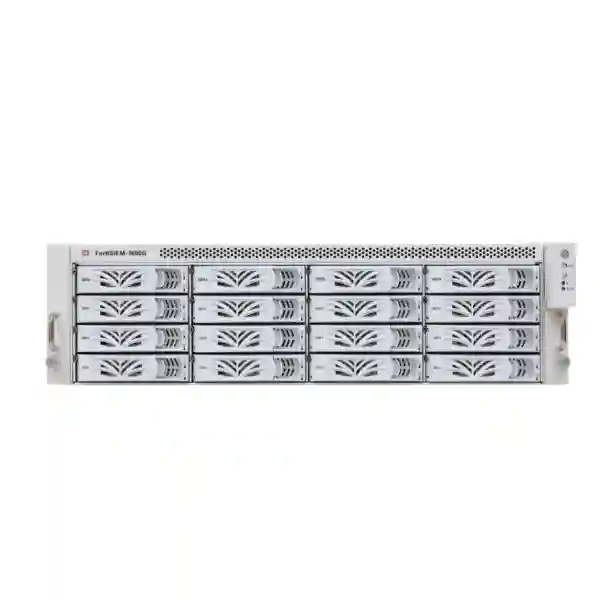
FortiSIEM FSM-3600G Tanzania
FortiSIEM FSM-3600G is a high-capacity all-in-one security information and event management hardware appliance for organizations that need centralized visibility across security, network, server, application, cloud and endpoint event sources. Fortinet lists the FortiSIEM 3600G for Supervisor or Worker roles and benchmarks it at up to 50K events per second with Collectors. The appliance itself does not include the device or EPS licenses required for production monitoring, making sizing and licensing an important part of procurement.
Verified platform profile
Fortinet specifies dual Intel Xeon Gold 6226R processors, 128 GB DDR4 memory, two 1GbE RJ45 interfaces, two 10GbE SFP+ interfaces and two 25GbE SFP28 interfaces. Storage is built around hot-swappable HDD and SSD media, with approximately 11 TB usable hot event data storage and approximately 65 TB usable warm event data storage in the published configuration.
Plan licensing with the appliance
FSM-3600G hardware and FortiSIEM monitoring entitlement are distinct procurement elements. A project should establish the number of monitored devices, expected EPS, endpoint requirements, retention objectives, growth allowance and support term before finalizing a bill of materials.
Why organizations evaluate FortiSIEM 3600G
Large environments rarely suffer from a lack of telemetry; the harder problem is turning telemetry into usable operational context. A SIEM deployment can consolidate logs and events, correlate activity, support investigation workflows and give security teams a common place to examine incidents. FortiSIEM is designed to combine security monitoring with infrastructure visibility, which can be valuable when a suspected security incident also has network, system or application symptoms. The FSM-3600G provides a dedicated hardware platform for organizations that prefer an appliance deployment rather than placing the entire workload on general-purpose virtual infrastructure.
Sizing should not be based on the headline EPS figure alone. Real projects should inventory event sources, estimate normal and peak rates, define retention, identify remote sites, determine collector placement, plan network paths, document time synchronization, and decide whether the platform will operate as an all-in-one system or as part of a distributed architecture. Procurement teams should also distinguish hardware, base licensing, device/EPS expansion and support so that the commercial proposal matches the intended deployment.
FortiSIEM FSM-3600G specifications
| Role | Supervisor or Worker; all-in-one hardware appliance ordering option |
| CPU | 2 × Intel Xeon Gold 6226R, 16C32T, 2.90 GHz |
| Memory | 128 GB DDR4 ECC registered memory |
| Interfaces | 2 × 1GE RJ45, 2 × 10GE SFP+, 2 × 25GE SFP28 |
| Storage | 12 × hot-swappable 8 TB HDD and 4 × hot-swappable 3.84 TB SSD in the published configuration |
| Usable event data storage | Approximately 11 TB hot/SSD and 65 TB warm/HDD |
| Performance benchmark | Up to 50K EPS with Collectors |
| Form factor | 3 RU |
Deployment and integration planning
A successful FSM-3600G project starts with discovery. Identify firewalls, switches, routers, wireless infrastructure, Windows and Linux systems, directory services, databases, business applications, cloud platforms and security products that should send or expose telemetry. Confirm supported collection methods and normalize timestamps. For distributed organizations, collectors can help place collection closer to event sources and reduce architectural dependence on a single WAN path. Fortinet documentation supports both all-in-one and cluster installation approaches, so the selected design should reflect availability, scale and operational requirements.
The hardware guide requires network configuration during initial setup and notes that the appliance does not ship with a default IP address. Deployment teams should therefore prepare rack space, power, management addressing, DNS, NTP, routing, required firewall rules and administrative access before commissioning. Licensing should be generated and registered for the intended deployment type, and the event database choice should be planned as part of implementation rather than treated as an afterthought.
FortiSIEM FSM-3600G Tanzania
Organizations searching for FortiSIEM FSM-3600G in Tanzania are commonly planning a centralized monitoring capability for a head office, data center, multi-branch enterprise, financial environment, service provider, government institution, university, healthcare network or other operation with substantial security telemetry. The first procurement question should be workload rather than simply appliance availability. Teams should estimate current device counts and event rates, then include realistic growth for new branches, cloud services, security controls and applications. A 50K EPS benchmark with collectors provides an important capacity reference, but the final architecture still depends on how events are generated, collected, retained and analyzed.
Tanzania deployments can span sites connected through different carriers and link types. That makes collector placement, buffering strategy, routing and time synchronization important design subjects. A central SIEM should not become dependent on fragile assumptions about continuous connectivity from every branch. During discovery, document critical log sources, the path each source uses to reach collection infrastructure, expected peak event rates, retention requirements and the people responsible for investigating alerts. This produces a stronger basis for a quotation and implementation plan.
Procurement should also separate the FSM-3600G hardware from FortiSIEM licenses and support. Fortinet states that device and EPS licenses are purchased separately. Buyers should therefore request a bill of materials that explains the appliance, base entitlement, expansion requirements and support period. For broader security architecture context, organizations can review FourTeck Tanzania technology solutions and discuss how SIEM collection fits alongside existing network and security infrastructure. For regional projects beyond Tanzania, the FourTeck Africa technology portfolio provides a broader regional reference.
FortiSIEM FSM-3600G Dar es Salaam
Dar es Salaam enterprises often concentrate core infrastructure, internet connectivity, headquarters systems and data-center services in the same metropolitan environment while still supporting branches elsewhere in Tanzania. For an FSM-3600G project, this creates a natural need to map central and remote telemetry separately. Start by identifying high-volume sources in the primary environment, including perimeter security devices, core network infrastructure, identity systems, servers, virtualization platforms and major applications. Then add branch sources and determine whether remote collection should be direct or collector-assisted.
The appliance’s mix of 1GE, 10GE and 25GE interfaces supports integration into modern data-center networks, but interface speed is only one part of design. Management segmentation, routing, source reachability, NTP, DNS and administrative access should be planned before installation. Rack planning should account for the 3 RU form factor and the published power and environmental requirements. Security teams should also define which events deserve immediate correlation and which are primarily retained for investigation, compliance or operational troubleshooting.
A quotation request from Dar es Salaam should include estimated monitored devices, normal and peak EPS, required retention, number of remote sites, expected growth and desired support term. This prevents a hardware-only quote from hiding licensing or architecture decisions. Organizations integrating FortiSIEM with Fortinet security controls may also explore FourTeck’s Fortinet-focused solution reference for related product families while keeping Tanzania deployment requirements central to the project.
FortiSIEM FSM-3600G Mwanza
For organizations operating from Mwanza or using Mwanza as an important regional site, SIEM planning should account for the relationship between local infrastructure and centralized security operations. A site may contain branch servers, switching, wireless systems, security gateways and business applications while the main investigation team operates elsewhere. The objective is to preserve useful telemetry and deliver it to the FortiSIEM architecture in a reliable, supportable way.
Before selecting the FSM-3600G configuration, measure event production rather than estimating only from employee count. A small number of busy security or infrastructure devices can generate more events than a much larger number of lightly used systems. Collect representative logs during business peaks, identify seasonal or batch-processing spikes and document retention expectations. Collector placement can then be evaluated against WAN reliability, bandwidth and operational requirements. The appliance’s published 50K EPS benchmark with collectors is a platform reference, not a substitute for this discovery work.
Mwanza buyers should request a commercial proposal that identifies hardware and licensing separately and includes assumptions used for sizing. The proposal should also state which deployment tasks are included, such as initial appliance setup, source onboarding, parsing validation, dashboards, alert tuning, user roles and knowledge transfer. This creates a clearer procurement baseline and reduces the risk of buying an appliance before the monitoring scope is defined.
FortiSIEM FSM-3600G Arusha
Arusha organizations evaluating FortiSIEM FSM-3600G may need to monitor a combination of office IT, hospitality systems, institutional networks, distributed branches, cloud applications and internet-facing services. The practical starting point is an asset and telemetry inventory. Identify which systems are security-critical, which produce logs suitable for correlation, which require performance visibility and which must be retained for audit or investigation. This inventory helps turn a broad SIEM requirement into a measurable design.
For sites connected to centralized infrastructure, review WAN behavior and determine whether event collection should continue during temporary connectivity interruptions. Time accuracy is equally important because correlation depends on consistent timestamps across sources. Deployment preparation should include NTP, DNS, addressing, routing, administrative segmentation and rack/power planning. The FSM-3600G hardware guide supports all-in-one and cluster approaches, allowing architects to choose a topology appropriate to scale and resilience objectives.
Licensing should be sized together with the hardware. Fortinet’s ordering information states that the FSM-3600G does not include device or EPS licenses. A useful Arusha quotation therefore includes device counts, EPS assumptions, growth, retention and support requirements rather than only a chassis price. This makes it easier for technical and procurement teams to compare proposals on equivalent scope.
FortiSIEM FSM-3600G Dodoma
Dodoma deployments can involve institutions that place strong emphasis on governance, auditability, controlled administration and documented security operations. FortiSIEM can provide a centralized platform for collecting and correlating events, but the quality of the outcome depends on source coverage and operating procedures. Define which systems must be monitored, who reviews alerts, how incidents are escalated, how long data is retained and which reports are needed by technical or governance teams.
The FSM-3600G offers substantial compute and storage resources for a dedicated SIEM appliance, including 128 GB memory and a combination of SSD and HDD event storage. These resources should be matched to the expected workload. Establish normal and peak EPS from representative data, include future systems and account for remote locations. Where multiple sites feed the central environment, collectors can form part of a distributed design and the published performance benchmark is specified with collectors.
A procurement package should clearly identify the appliance, device/EPS licensing, support and implementation scope. It should also document prerequisites such as rack capacity, power, network addressing, management access, DNS and NTP. Buyers should avoid treating SIEM as a plug-and-play log archive; correlation quality improves when source onboarding, normalization, use-case design and alert tuning are planned from the beginning.
FortiSIEM FSM-3600G UAE
Organizations procuring FortiSIEM FSM-3600G for UAE environments may be consolidating telemetry from data centers, cloud workloads, branch offices and security platforms. The architecture should be driven by measurable event volume and monitoring scope. Inventory device types, estimate normal and peak EPS, define retention and identify integrations required for incident workflows. The 3600G can operate as a Supervisor or Worker and is benchmarked up to 50K EPS with collectors, supporting substantial distributed deployments when correctly designed.
Data-center preparation should include the 3 RU rack requirement, network interface planning, power, environmental conditions and management segmentation. The published interfaces include 1GE RJ45, 10GE SFP+ and 25GE SFP28 connectivity. These options help fit the appliance into different network designs, while actual log collection paths should be engineered according to source locations and security policy. Licensing remains separate from the hardware and should be quoted according to device/EPS requirements.
For UAE procurement and complementary infrastructure discussions, buyers can review FourTeck UAE and FourTeck IT services. These links provide regional context for organizations coordinating SIEM with broader network, infrastructure and security projects.
FortiSIEM FSM-3600G Uganda
Uganda enterprises considering FSM-3600G should begin by mapping the security operations model: centralized SOC, distributed IT teams, managed monitoring, or a hybrid arrangement. That decision affects user roles, alert ownership, collector placement and the systems that need priority onboarding. Large SIEM projects are easier to control when onboarding is phased, beginning with identity, perimeter, core infrastructure and critical servers before adding lower-priority sources.
Event-rate sizing should include both steady-state and bursts. Authentication storms, vulnerability scans, network changes and security incidents can produce peaks that differ from ordinary averages. Retention also affects design because investigators may need historical context long after an event occurred. The FSM-3600G combines SSD hot storage and HDD warm storage in its published configuration, giving architects a hardware basis for tiered event data while still requiring careful retention planning.
For Uganda-specific commercial coordination, FourTeck Uganda is a relevant regional reference. A quotation should list the hardware, applicable FortiSIEM licensing, support period, implementation assumptions and any collector requirements so buyers can evaluate the complete monitoring platform rather than an isolated appliance.
FortiSIEM FSM-3600G Kampala
Kampala organizations frequently operate mixed environments combining local data-center systems, cloud applications, branch connectivity and diverse security tools. SIEM value comes from bringing these sources into a consistent operational view. During design, prioritize systems whose compromise would create the greatest business impact and sources that improve identity, network and endpoint context. This helps security teams avoid collecting large volumes of low-value data before essential detection coverage is established.
FSM-3600G deployment planning should include network paths from sources and collectors, management access, NTP, DNS, rack space and power. Fortinet’s setup guidance notes that the appliance requires IP configuration during commissioning rather than relying on a default management address. Implementation teams should therefore arrive with addressing and management requirements already approved. The selected event database and deployment role should also be agreed before production onboarding.
Commercially, Kampala buyers should ask for explicit licensing assumptions. The appliance is ordered separately from device and EPS licenses, so a low hardware quote does not by itself define total project scope. Provide device counts, measured or estimated EPS, remote-site information, retention goals and expected growth to obtain a more meaningful bill of materials.
FortiSIEM FSM-3600G Arua
Arua-based or regional operations may need to forward telemetry over links where bandwidth and continuity differ from a headquarters network. For that reason, the SIEM architecture should examine collection location and WAN dependency early. Determine which sources can send events directly, which benefit from a local collector, and what should happen when connectivity is interrupted. The goal is reliable monitoring without creating unnecessary traffic or fragile dependencies.
Sizing begins with evidence. Gather sample event rates from firewalls, authentication systems, servers, switches and applications, then model peak conditions and growth. The FSM-3600G’s benchmark of up to 50K EPS with collectors indicates the class of workload the platform targets, while actual design should remain tied to the organization’s source mix and enabled features. Retention requirements should be documented because they influence storage and investigation capability.
For procurement, specify the desired support term and implementation outcomes in addition to the appliance. Useful deliverables can include source onboarding, health checks, dashboards, correlation tuning, administrator training and documentation. Separating these services from product licensing makes project responsibilities clearer and supports better acceptance testing.
FortiSIEM FSM-3600G Mbarara
Mbarara organizations planning centralized monitoring should identify the systems that matter most to business continuity and security. A practical first wave might include perimeter devices, identity services, critical servers, virtualization platforms and core network equipment. Subsequent phases can expand to applications, databases, cloud services and additional endpoints. This staged approach helps teams validate parsing, alert quality and operational workflows before expanding volume.
The FSM-3600G provides dedicated compute, memory and event storage, but the appliance should be placed within a complete operational design. Define management networks, source connectivity, collector topology, time synchronization and backup or recovery procedures. If monitoring spans several sites, document link characteristics and decide where collection should occur. The architecture should remain understandable to the administrators who will operate it after deployment.
A strong Mbarara quotation includes measured assumptions rather than generic capacity language. State device count, EPS, retention, remote locations and expected growth. Because Fortinet sells device/EPS licensing separately from the FSM-3600G hardware, these details directly affect the bill of materials and help prevent licensing gaps after installation.
FortiSIEM FSM-3600G Gulu
Gulu deployments should consider both technical monitoring and the people/process side of SIEM. Centralized event collection only becomes useful when alerts have owners, escalation paths and investigation procedures. Before onboarding every available log source, define priority use cases such as privileged access monitoring, suspicious authentication, perimeter events, server changes or critical service failures. Then identify the telemetry required to support those use cases.
FSM-3600G can serve as a Supervisor or Worker and can participate in a distributed FortiSIEM architecture. This flexibility is relevant when a growing environment needs collectors or multiple processing roles. Network and infrastructure prerequisites should be prepared before installation, including rack space, power, IP addressing, DNS, NTP and secure administrative connectivity. Event database planning and license registration are also part of the commissioning workflow.
Procurement teams should request a transparent scope that distinguishes appliance hardware, licenses, support and professional services. If event rates are not yet known, conduct a discovery exercise before final sizing. This produces a more defensible design and reduces the chance that future growth or newly onboarded systems exceed the original assumptions.
FortiSIEM FSM-3600G Kenya
Kenyan enterprises with multiple offices, cloud workloads and data-center services may use a distributed SIEM design to consolidate security and infrastructure telemetry. FSM-3600G is positioned for demanding Supervisor or Worker roles, and its 50K EPS benchmark with collectors makes it relevant to larger monitoring estates. The benchmark should be interpreted alongside the actual device population, event mix, retention and feature use.
Design workshops should identify high-value event sources and establish collection paths. Security teams should verify that timestamps are consistent, network routes are permitted and log sources can be monitored for collection failures. Operational planning should cover administrator roles, alert ownership, escalation and regular tuning. A SIEM that is technically connected but operationally unmanaged can generate noise rather than actionable visibility.
For Kenya-specific technology coordination, buyers can review FourTeck Kenya. A complete quotation should document the FSM-3600G hardware, device/EPS licensing, support, collector requirements and implementation scope. Including growth assumptions helps ensure that the proposed architecture remains useful as new sites and systems are added.
FortiSIEM FSM-3600G Kuwait
Kuwait organizations evaluating FSM-3600G may require a dedicated platform for centralized event analytics across enterprise networks, servers, security controls and applications. Start with an event-source matrix that lists each technology, collection method, expected EPS, retention requirement and business criticality. This creates a structured onboarding plan and gives procurement teams measurable inputs for licensing.
The hardware platform includes high-speed network interfaces and mixed SSD/HDD event storage, supporting data-center deployment. Rack, power, cooling and management network requirements should be reviewed before delivery. The implementation team should also decide whether the appliance is used in an all-in-one configuration or as part of a distributed architecture, and should prepare licensing and event database decisions as part of commissioning.
For regional procurement context, FourTeck Kuwait can support broader technology discussions. Buyers should request a quote that clearly separates hardware, licensing, support and services and that states the assumptions used for device counts, EPS and retention.
FortiSIEM FSM-3600G Ghana
Ghana enterprises can approach an FSM-3600G project by defining the monitoring outcomes they need before selecting integrations. Common objectives include centralized visibility, faster investigation, security correlation and consolidated monitoring across heterogeneous infrastructure. Each objective should map to specific event sources and operational workflows so the SIEM deployment remains focused and measurable.
Capacity planning should use representative event data. Measure high-volume devices, account for peaks and include planned infrastructure growth. If remote sites are involved, evaluate collector placement and WAN characteristics. The FSM-3600G’s published storage architecture and 50K EPS benchmark with collectors provide a foundation for larger deployments, but retention and workload assumptions still need validation.
Organizations can use FourTeck Ghana for regional technology context. The purchasing package should include the appliance plus the correct device/EPS licensing and support. Implementation scope should state which event sources will be onboarded and how alert tuning, dashboards, documentation and knowledge transfer will be handled.
FortiSIEM FSM-3600G Nigeria
Nigeria deployments may involve large user populations, several data centers, cloud platforms and many branches, making architecture discipline particularly important. Instead of treating every log source equally, classify sources by security value, event volume and operational importance. This supports phased onboarding and makes EPS forecasting more accurate. Identity, perimeter, critical server and core infrastructure telemetry are often sensible early priorities.
The FSM-3600G is designed for substantial FortiSIEM workloads and can operate as a Supervisor or Worker. Distributed collection can help scale event ingestion and support geographically dispersed sources. Teams should document collector locations, routing, time synchronization, management access and event retention. Hardware capacity should be reviewed together with license entitlements because the appliance does not include the required device or EPS licenses.
For Nigerian procurement discussions, FourTeck Nigeria offers a regional reference point. A complete proposal should explain appliance hardware, licensing, support and implementation services separately and should record sizing assumptions so the design can be revisited as the environment grows.
FortiSIEM FSM-3600G Seychelles
Seychelles organizations may operate a smaller number of sites than large continental enterprises while still depending heavily on internet-connected services, hospitality systems, financial applications or distributed infrastructure. SIEM sizing should therefore focus on actual event behavior rather than geography. A concentrated set of busy security devices and servers can generate significant telemetry, and retention requirements can be just as important as raw ingestion rate.
For island and remote-site environments, connectivity planning deserves careful attention. Determine whether event sources should send directly to the central platform or through collectors, and define how temporary WAN interruptions are handled. Maintain consistent NTP and ensure that collection health is monitored. The FSM-3600G offers a dedicated hardware foundation with substantial local event storage, while the broader architecture should be designed for the organization’s operational realities.
Procurement should combine hardware sizing with licensing and support. Provide device inventory, EPS estimates, retention, critical integrations and expected growth when requesting a quotation. This gives technical teams enough information to recommend an architecture without making unsupported assumptions about capacity or licensing.
Quotation checklist for FortiSIEM FSM-3600G
For an accurate proposal, prepare the number of monitored devices, estimated average and peak EPS, endpoint count where relevant, retention period, number of sites, collector requirements, existing Fortinet and third-party systems, preferred support term, deployment model and implementation expectations. Include projected growth so licensing and architecture can be planned beyond the first day of operation.
Also identify data-center prerequisites: 3 RU rack capacity, suitable power, management addressing, DNS, NTP, network routing and secure administrative access. If the organization has formal change control, schedule source onboarding in phases and define acceptance criteria such as successful collection, parsing, alert generation, dashboards and administrator handover.
Frequently asked questions
What is FortiSIEM FSM-3600G?
It is Fortinet’s FortiSIEM 3600G all-in-one hardware appliance. Fortinet positions the platform for Supervisor or Worker roles in FortiSIEM deployments.
How much event throughput does FSM-3600G support?
Fortinet publishes a performance benchmark of up to 50K events per second with Collectors. Actual architecture should be validated against source mix, enabled functionality, retention and deployment design.
Are FortiSIEM device and EPS licenses included?
No. Fortinet’s ordering information states that FSM-3600G hardware does not include device or EPS licenses; those must be purchased separately.
What information is needed for sizing?
Provide device counts, average and peak EPS, endpoint requirements, retention, site count, collector topology, expected growth and key integrations. These inputs help determine hardware architecture and licensing.
Can FSM-3600G be used in a distributed deployment?
Yes. Fortinet documentation supports all-in-one and cluster installation approaches, and the 3600G can serve Supervisor or Worker roles. The right design depends on scale and resilience requirements.
Decision recap
FortiSIEM FSM-3600G is aimed at organizations that need a dedicated, high-capacity FortiSIEM hardware platform. Its published configuration combines dual Xeon Gold processors, 128 GB memory, high-speed interfaces and tiered SSD/HDD event storage, with a benchmark up to 50K EPS when collectors are used. The appliance should be purchased as part of a complete design that covers device/EPS licensing, source onboarding, retention, collector placement, support and operational processes.
Talk through your FortiSIEM design
Share your device inventory, event-rate estimate, retention target and site topology to build a more useful quotation. FourTeck can use those requirements to structure a product and licensing discussion without assuming stock, delivery dates or a one-size-fits-all architecture.




Reviews
There are no reviews yet.