
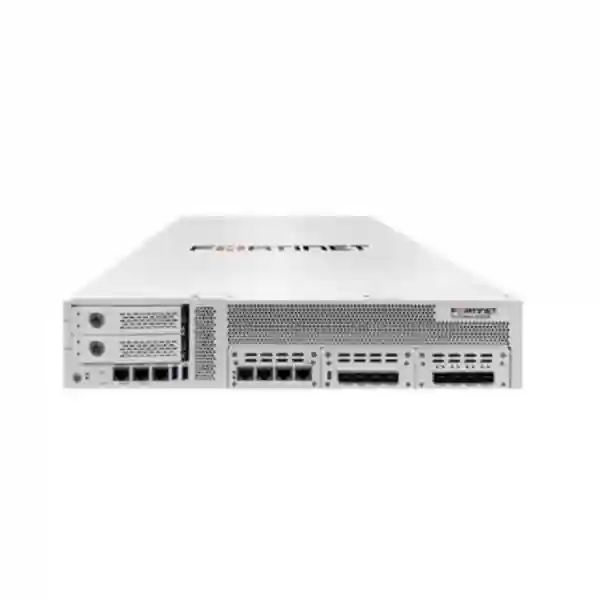
FortiWeb FWB-2000F Tanzania
Protect public-facing web applications and APIs with a purpose-built FortiWeb platform sized for demanding enterprise environments. The FWB-2000F combines hardware SSL/TLS processing, high-speed interfaces, local SSD storage and clustering options with FortiWeb application-security capabilities. This page helps IT, security and procurement teams evaluate the appliance, prepare deployment requirements and request a correctly scoped quotation.
What is the FortiWeb FWB-2000F?
FortiWeb FWB-2000F is Fortinet’s FortiWeb 2000F hardware appliance, positioned as a web application firewall for protecting web applications and APIs. Fortinet’s current product information lists the 2000F at up to 5 Gbps throughput. The appliance provides four 10GE SFP+ ports, four GE RJ45 bypass ports, four GE SFP ports, hardware SSL/TLS processing and two 480 GB SSDs. It is a 2U rack-mount platform with dual hot-swappable power supplies, Trusted Platform Module support and high-availability options for active/passive or active/active clustering. Performance figures are vendor-rated maximums and real deployment results depend on configuration, traffic, enabled protections and application behavior.
Fortinet-listed FortiWeb 2000F throughput for planning and model comparison.
Dedicated hardware processing supports encrypted application-security workflows.
Verified local storage configuration on the FWB-2000F appliance.
Supports active/passive and active/active clustering approaches.
Verified FWB-2000F hardware and performance
| Model | FortiWeb 2000F / FWB-2000F |
| Throughput | Up to 5 Gbps |
| Interfaces | 4 × GE RJ45 bypass, 4 × GE SFP, 4 × 10GE SFP+ |
| Storage | 2 × 480 GB SSD |
| Form factor | 2U rack mount |
| Power | Dual hot-swappable power supplies |
| High availability | Active/Passive, Active/Active clustering |
| Administrative domains | 64 |
Application and API protection planning
A WAF purchase should start with the applications rather than the appliance alone. Document every internet-facing application, API endpoint, hostname, certificate, authentication flow, application owner, hosting location and expected peak traffic pattern. Teams should identify whether applications are hosted in a local data centre, private cloud, public cloud or mixed environment, and whether the FortiWeb appliance will sit inline, operate with reverse-proxy functions, or form part of a wider security architecture. Security policy must be tested against real application behavior so protection does not create avoidable false positives or disrupt legitimate transactions.
FortiWeb is designed to address application-layer threats, including risks represented in common OWASP categories, while Fortinet also emphasizes machine-learning-assisted detection and API protection. Buyers should still treat deployment as an engineering project: establish application baselines, tune policies, coordinate certificate handling, plan change control and define who reviews security events. The surrounding network matters too. For perimeter segmentation, VPN and broader network-security requirements, review FourTeck Tanzania’s integrated cybersecurity and infrastructure guidance. For procurement and available technology categories, the FourTeck Tanzania shop provides a related purchasing path, while FourTeck Tanzania services helps frame installation and lifecycle requirements.
Licensing and bundle selection
The hardware SKU is only one part of a FortiWeb procurement decision. Fortinet publishes Standard and Advanced bundle options for the 2000F, along with renewal SKUs and service combinations. The correct quotation should therefore state whether the requirement is hardware only or a hardware bundle, the desired subscription and support term, and the security services required by the organization. Avoid comparing quotations only by appliance model: two FWB-2000F quotations can represent different service coverage and subscription content. Ask for line-item clarity so procurement teams can distinguish appliance, support, security services, optics or transceivers, implementation work and any optional services.
FortiWeb FWB-2000F Tanzania
For organizations evaluating FortiWeb FWB-2000F in Tanzania, the central question is whether the appliance fits the actual web-application estate and operational model. Banks, insurers, government organizations, universities, healthcare providers, e-commerce operators, hospitality groups, enterprises and service providers may expose very different combinations of portals, customer applications, APIs and administrative interfaces. A sound project begins by identifying which services are publicly reachable, how critical they are, where they are hosted and what normal transaction volumes look like. That inventory gives security teams a basis for deciding where WAF enforcement belongs and how changes will be tested.
The FWB-2000F’s vendor-listed 5 Gbps throughput should be treated as a planning ceiling rather than a guarantee for every security profile. Real traffic includes encrypted sessions, different request sizes, application logic and enabled inspection features. Capacity planning should therefore include current peaks, expected growth, TLS requirements, redundancy and the possibility of additional applications moving behind the WAF. Where availability is important, the appliance’s active/passive and active/active clustering capabilities can be considered as part of a resilient design. The wider architecture should also consider upstream firewalls, switching, routing, DNS, load balancing, server capacity and monitoring.
Tanzania procurement teams should request a quotation that identifies the exact FWB-2000F appliance or bundle, subscription term, support level, required optical modules, rack and power considerations, implementation scope and handover expectations. The unit is a 2U rack appliance with front-to-back forced airflow and dual hot-swappable power supplies, so rack depth, cooling, power feeds and UPS strategy belong in the deployment checklist. For a broader regional security architecture, organizations with connected operations can also review FourTeck Africa technology coverage. This is particularly useful when the same application platform serves users across several countries and security policy needs consistent governance.
FortiWeb FWB-2000F Dar es Salaam
Dar es Salaam organizations often concentrate headquarters, customer-facing portals, data-centre resources and internet connectivity in the same operational ecosystem. For an FWB-2000F project, that makes dependency mapping especially important. A public application may traverse an edge router, next-generation firewall, load balancer or reverse proxy before reaching web servers, and the WAF must be positioned with a clear understanding of those traffic paths. Document public DNS records, virtual IPs, certificates, backend server pools and application owners before implementation begins. This reduces uncertainty during cutover and gives the project team a rollback plan if an application behaves unexpectedly.
Security teams in Dar es Salaam should also decide how they will move from monitoring to enforcement. Immediately enabling aggressive blocking on a complex production application can create avoidable disruption. A controlled approach observes legitimate traffic, identifies anomalies, tunes policy and then increases enforcement under change management. Applications that process payments, identities, customer records or business transactions deserve especially careful test plans. APIs need equivalent attention because modern mobile apps and integrations may depend on endpoints that are less visible to traditional browser-focused testing.
Physical deployment is another practical issue. The FortiWeb 2000F occupies 2U, uses dual hot-swappable power supplies and is designed for front-to-back airflow. Confirm rack depth, redundant power availability, UPS capacity and cooling before delivery. Network teams should verify whether 1GE copper, SFP or 10GE SFP+ connectivity is expected at each point and specify compatible optics separately where required. Procurement should request exact bundle and service terms rather than assuming all FWB-2000F offers contain identical licensing. A strong Dar es Salaam deployment package should therefore combine the appliance with architecture validation, policy design, staged testing, documentation and an agreed operational ownership model.
FortiWeb FWB-2000F Mwanza
Organizations in Mwanza considering the FortiWeb FWB-2000F may be protecting central business applications used by local staff, customers, branches or remote users. The first sizing exercise should separate internet bandwidth from protected application traffic. A company may have a large internet circuit but only a portion of that traffic reaches web applications behind the WAF. Conversely, an application platform with intensive API activity can generate significant transaction load even when user counts appear moderate. Collect peak request rates, TLS usage, upload patterns, API behavior and seasonal demand before deciding that a model is appropriately sized.
Availability planning is particularly important when an application supports revenue, reservations, logistics, operations or customer service. Fortinet lists active/passive and active/active clustering for the 2000F, allowing architects to evaluate redundancy instead of making the application-security layer a single point of failure. That decision must be coordinated with switching, upstream routing, server or load-balancer design and application health checks. A redundant WAF pair does not by itself make an application highly available if power, internet, DNS or backend services remain dependent on a single component.
For Mwanza procurement, create a bill of materials that distinguishes the base appliance from support and FortiWeb security subscriptions. Include any transceivers, patching, rack accessories and implementation services needed by the design. The 2000F has four 10GE SFP+ ports as well as GE copper bypass and GE SFP connectivity, but the correct interfaces depend on the surrounding network. Deployment planning should include backups of configuration, administrator access controls, certificate ownership, log retention, alert routing and escalation procedures. This turns the purchase from a hardware transaction into an application-security control that can be operated consistently after handover.
FortiWeb FWB-2000F Arusha
Arusha businesses in hospitality, travel, professional services, education and other sectors can depend heavily on public websites, booking workflows, portals and APIs. An FWB-2000F evaluation should identify the applications whose outage or compromise would have the greatest operational impact. Prioritize systems that accept credentials, personal information, payments, bookings, uploads or partner integrations. The WAF policy can then be designed around the real exposure rather than applying identical settings to every hostname without understanding application behavior.
Encrypted traffic is central to modern application delivery. The FortiWeb 2000F includes hardware SSL/TLS processing, but certificate and key management still require disciplined operational processes. Determine who owns certificates, how renewals are tracked, which cipher and protocol policies are required and how emergency certificate changes will be handled. Where applications are managed by external developers or SaaS partners, define responsibilities clearly so WAF changes and application releases do not occur independently. Security teams should receive advance notice of significant code, API or authentication changes that can alter traffic patterns.
For Arusha deployments, infrastructure readiness should be verified before equipment arrives. The appliance is a 2U rack unit with dual hot-swappable power supplies and front-to-back airflow. Confirm rack space, cooling, UPS-backed power and network-port availability. If 10GE fiber links are planned, specify transceiver type and fiber compatibility rather than assuming optics are included. Procurement teams should also define the desired FortiCare and FortiWeb bundle term and ask the supplier to separate recurring renewals from one-time hardware and implementation costs. This produces a clearer lifecycle budget and helps avoid gaps when security-service renewals become due.
FortiWeb FWB-2000F Dodoma
For institutions and enterprises in Dodoma, FortiWeb FWB-2000F can be evaluated as an application-security layer for portals, APIs and web services that require controlled exposure to the internet or other networks. Public-sector and regulated environments often benefit from a documented implementation process because application ownership, infrastructure ownership and security oversight may sit with different teams. Before deployment, identify the application owner, security approver, network owner and change authority for every protected service. This makes policy tuning and incident response more predictable.
The technical design should map the full request path from client to application. Include DNS, internet links, edge firewalls, NAT, load balancing, TLS termination, WAF inspection and backend servers. Determine whether client source information must be preserved for application logging and how health monitoring will work. Where APIs are protected, document authentication methods and expected clients. FortiWeb’s application and API security capabilities are most useful when policies reflect these known application characteristics rather than relying on generic rules alone.
Dodoma procurement teams should verify the exact part number and bundle because Fortinet offers hardware and service combinations with different terms. The FWB-2000F hardware specification includes two 480 GB SSDs, hardware SSL/TLS processing, dual hot-swappable power supplies, TPM and multiple GE/10GE interfaces. A complete quotation may additionally require subscriptions, support, optics, professional services and training or handover. For long-term operations, request documentation covering network diagrams, protected hostnames, policy purpose, certificate handling, administrative roles, backup procedures and renewal dates. Those operational records can be as important as the initial installation because application environments continually change.
FortiWeb FWB-2000F UAE
UAE enterprises evaluating FWB-2000F commonly need to align application security with high-speed data-centre networks, hybrid cloud services and formal cybersecurity governance. The appliance’s 10GE SFP+ interfaces can suit architectures where protected application traffic traverses higher-speed aggregation layers, but interface speed should never be confused with inspected application throughput. Fortinet lists the 2000F at up to 5 Gbps throughput, so architects should model real security traffic, encryption and growth rather than sizing from port speed alone.
Multi-site and hybrid application environments also create certificate, DNS and change-management dependencies. Security teams should maintain an inventory of public applications and APIs, identify which environments are production versus development, and define how new services are onboarded to WAF protection. Policy testing should be included in application release processes so security controls remain aligned with code changes. Where availability targets are strict, the FortiWeb clustering options should be considered alongside redundant switching, power, upstream security and backend application architecture.
For UAE procurement and related regional requirements, FourTeck UAE provides a relevant FourTeck network path. Buyers should request an exact bill of materials and confirm whether pricing represents hardware only, a Standard bundle or an Advanced bundle, plus the applicable support term. Implementation scope should define migration, policy tuning, certificate configuration, testing, documentation and handover. This prevents a high-value WAF from being purchased without the engineering work required to make it effective in production.
FortiWeb FWB-2000F Uganda
Ugandan organizations protecting customer portals, business applications and APIs can assess FWB-2000F around three dimensions: application risk, traffic capacity and operational maturity. Begin with a list of protected services and classify them by business impact. Applications containing customer accounts, payment workflows, confidential records or privileged administration usually justify tighter policy, logging and change control. Lower-risk services still need protection, but the policy can be tuned according to their function and exposure.
Capacity planning should consider peak application traffic and not simply total internet usage. Fortinet lists up to 5 Gbps throughput for the 2000F and provides hardware SSL/TLS processing. Actual results vary by configuration, so projects should include headroom for growth and inspection requirements. If the WAF is deployed as a cluster, validate the surrounding network topology and failure behavior. Test not only whether a second node is available but also whether sessions, routing and backend services behave as expected during maintenance or failure events.
Procurement teams should define whether they need hardware only or a FortiWeb bundle with security services and FortiCare. Subscription duration, renewal ownership and support escalation should be documented from the beginning. Organizations operating across Uganda and neighboring markets can use FourTeck Uganda for related regional technology requirements while maintaining consistent security architecture across branches. A useful quotation request should include expected protected applications, traffic estimates, network interface requirements, HA preference, current firewall/load-balancer design and desired implementation scope.
FortiWeb FWB-2000F Kampala
Kampala enterprises frequently operate application environments that combine public cloud services, local infrastructure, internet-facing portals and branch connectivity. When evaluating FWB-2000F, determine exactly which traffic should pass through the appliance and where TLS will terminate. A clear logical diagram should show public DNS, edge security, WAF interfaces, server networks and management access. This diagram becomes the basis for interface allocation, routing, firewall rules and troubleshooting.
Application security policy should be introduced with measurable objectives. Identify common attack categories relevant to each service, determine how alerts will be reviewed and establish an escalation path for suspected incidents. Machine-learning-assisted detection can improve analysis, but it does not eliminate the need for application knowledge and operational review. Teams should coordinate with developers so legitimate changes in URL structure, API behavior or request payloads are not mistaken for malicious activity. Conversely, unusual patterns should be investigated rather than automatically dismissed as false positives.
For a Kampala data-centre installation, check rack space and environmental requirements. Fortinet specifies the 2000F as 2U with front-to-back airflow and dual hot-swappable power. Plan separate power feeds where the facility supports them and include the appliance in UPS and monitoring design. Network connectivity may use GE copper bypass, GE SFP or 10GE SFP+ interfaces depending on topology. Specify optics separately. Procurement should ask for bundle details, subscription term, support level and implementation deliverables in writing so competing quotations can be compared on equivalent scope rather than headline price alone.
FortiWeb FWB-2000F Arua
For organizations in Arua, a FortiWeb project may protect applications hosted locally, centrally in another city, or in a cloud environment. That hosting location changes the best deployment approach. If servers are remote from the appliance, architects should examine latency, routing and failure dependencies before forcing traffic through an inefficient path. In some cases a centrally deployed WAF protects applications for multiple branches; in others, a different FortiWeb form factor may be more appropriate. The FWB-2000F should be selected because its capacity and interfaces fit the application architecture, not simply because it is available.
Operational access is also important. Administrative interfaces should be placed on controlled management networks, protected by strong authentication and limited to authorized personnel. Configuration backups and change records should be maintained so teams can recover from an error or understand why a policy changed. Security alerts need a destination and owner; generating logs without a review process provides limited operational value. Define who monitors, who investigates and who can approve blocking or exception changes.
Arua procurement planning should include logistics without making assumptions about stock or delivery time. Request confirmed availability and lead time at quotation stage. Specify the exact FWB-2000F requirement, subscription bundle, term, optics, rack requirements and implementation expectations. If a central IT team supports multiple Ugandan locations, standardize naming, documentation and policy templates so the WAF can be operated consistently. The project should finish with tested application access, documented rollback procedures, administrator handover and a renewal calendar for any subscribed FortiWeb security services.
FortiWeb FWB-2000F Mbarara
Mbarara organizations assessing FWB-2000F should start by separating business requirements from product specifications. Business requirements include which applications must remain available, what data they process, who uses them, acceptable downtime and compliance obligations. Product requirements then translate those needs into throughput, interface, redundancy, logging and subscription choices. This sequence prevents teams from buying a model first and trying to fit the architecture around it later.
The FortiWeb 2000F provides four 10GE SFP+ ports, four GE RJ45 bypass ports and four GE SFP ports, which gives designers several connectivity options. However, transceiver type, fiber standard, switch compatibility and logical interface design must be confirmed. The appliance also provides two 480 GB SSDs and hardware SSL/TLS processing. If encrypted application traffic is expected to grow, certificate operations and TLS policy should be incorporated into lifecycle planning rather than treated as one-time setup tasks.
For organizations with small internal security teams, operational simplicity should influence implementation. Use clear policy names, document exceptions, restrict administrative privileges and define maintenance windows. Application owners should know how to report false positives and security teams should know how to distinguish an application defect from WAF enforcement. Procurement should request both initial and recurring costs, including the selected FortiWeb service bundle and renewal period. A complete handover should include configuration backup, network diagram, protected application inventory, certificate ownership, alerting destinations, support contacts and renewal dates so the deployment remains maintainable after the installation project closes.
FortiWeb FWB-2000F Gulu
Gulu enterprises and institutions can use an FWB-2000F evaluation to formalize how public applications are exposed and protected. Start by locating every web service that accepts connections from outside trusted networks. Shadow applications, forgotten test systems and old administrative portals can create risk even when the main production website is well protected. An application inventory should include owner, hostname, IP address, backend servers, certificate, authentication method, data sensitivity and business criticality.
Once the inventory is established, define onboarding stages for the WAF. A typical controlled process includes network connectivity, certificate preparation, monitoring, policy tuning, functional testing, security testing and enforcement. Each stage should have an owner and success criteria. For high-impact applications, schedule changes when application and network teams are available to validate transactions. Record exceptions and revisit them periodically because temporary allowances can otherwise become permanent gaps.
The physical FWB-2000F platform should be integrated into normal data-centre operations. Allocate 2U rack space, verify cooling and front-to-back airflow, connect redundant power where available, and monitor power and network status. High availability should be tested rather than assumed. If a cluster is deployed, simulate planned maintenance and relevant failure scenarios. Procurement teams in Gulu should request current lead time rather than relying on generic availability claims, and they should identify the exact FortiWeb bundle and subscription duration required. This provides a clear basis for budgeting, renewal planning and technical acceptance.
FortiWeb FWB-2000F Kenya
Kenyan enterprises with high-transaction web services, digital platforms and API-driven applications can evaluate the FortiWeb FWB-2000F as part of a layered application-security architecture. The design should distinguish WAF responsibilities from those of a next-generation firewall, endpoint security, identity controls and application code. A WAF focuses on web and API traffic; it complements rather than replaces broader network security. This distinction helps teams build policies and monitoring processes around the correct threat surface.
Sizing should include application growth. Fortinet lists up to 5 Gbps throughput for the FortiWeb 2000F, while its interfaces include four 10GE SFP+ ports. Because interface capacity and inspected throughput are different measures, procurement documents should not treat a 10GE port as evidence that every protected workload will operate at 10 Gbps. Model expected traffic, encryption, security features and HA architecture. If applications have seasonal peaks, include those periods rather than using daily averages.
Kenya-based procurement teams should ask for the exact appliance/bundle part number, support term and service description. Confirm whether implementation includes policy migration, certificate setup, application onboarding, tuning and documentation. Organizations with regional offices can standardize WAF governance even when individual sites use different deployment models: consistent application inventories, policy review, certificate management and incident procedures reduce operational complexity. The FWB-2000F is most effective when it becomes part of that repeatable application-security process rather than an isolated appliance at the edge.
FortiWeb FWB-2000F Kuwait
Kuwait organizations evaluating FortiWeb FWB-2000F may have enterprise portals, ERP front ends, customer applications, e-commerce services or APIs that require stronger application-layer controls. Begin by documenting which applications are externally accessible and how authentication, TLS and backend connectivity work. If the environment uses a load balancer or application delivery controller, define whether the WAF sits before or after it and how client addressing, health checks and certificate termination will be handled.
The FWB-2000F’s dual hot-swappable power supplies and clustering options support resilient design, but resilience requires an end-to-end view. Redundant WAF nodes connected to a single switch, single power distribution unit or single upstream circuit still leave important failure points. Build a dependency map and decide which components need redundancy according to the application’s recovery objectives. Maintenance procedures should allow firmware, certificate and policy changes without unplanned application downtime where architecture permits.
Commercial evaluation should include recurring security-service costs. Fortinet’s ordering information distinguishes Standard and Advanced bundles, so procurement teams should compare equivalent service levels and terms. Request a quotation that lists hardware, subscriptions, FortiCare, optics, implementation and optional support separately. For multi-country organizations, align renewal dates and policy governance where practical. A clear operational handover should identify administrators, application owners, alert recipients, backup procedures and escalation paths. This provides continuity when staff change or when an application is updated months after the original deployment.
FortiWeb FWB-2000F Ghana
Ghanaian organizations considering the FortiWeb FWB-2000F should evaluate the business importance of the applications being protected and the maturity of the operational processes around them. A WAF can inspect and control web traffic, but effective protection depends on accurate application onboarding, policy tuning and response procedures. Identify sensitive workflows such as login, account management, payment, file upload and administrative access. These areas often deserve tighter monitoring and testing than static public content.
API protection should be included in discovery because modern web and mobile applications can rely heavily on APIs that are not obvious from the public website. Work with developers to inventory endpoints, authentication methods and expected request behavior. When application releases change those patterns, update and test WAF policy. FortiWeb’s machine-learning-assisted capabilities can support threat detection, but human ownership remains essential for interpreting events and managing legitimate changes.
For Ghana procurement, verify the exact FWB-2000F hardware or bundle and confirm current commercial terms at quotation time. Do not assume stock, delivery or warranty conditions without written confirmation. Technical scope should state whether the project includes HA, network integration, certificate setup, policy tuning, testing and documentation. The 2U appliance requires suitable rack, cooling and power arrangements, and 10GE connectivity requires compatible optics where used. A well-structured quotation and implementation plan helps security, infrastructure and procurement teams evaluate the same scope and avoids surprises during deployment.
FortiWeb FWB-2000F Nigeria
Nigeria’s large enterprise and digital-service environments can generate demanding web and API workloads, making accurate WAF sizing important. For the FortiWeb FWB-2000F, use measured application traffic where possible. Review peak bandwidth, requests per second, TLS session behavior, file uploads, API transactions and growth forecasts. Fortinet’s listed up-to-5-Gbps throughput is a useful model reference, but production capacity depends on configuration and enabled protections. Include realistic headroom instead of sizing exactly to today’s peak.
Large organizations may also have multiple application teams. Establish a standard onboarding process so every new portal or API is documented before protection is enabled. Define who supplies certificates, who validates application transactions, who approves policy exceptions and who responds to alerts. Central governance can prevent inconsistent security posture across business units. Where applications are hosted across data centres and clouds, document which WAF instance or service protects each hostname and how traffic is routed during failures.
Procurement should distinguish capital hardware from recurring FortiWeb and support services. Ask vendors to identify the precise Fortinet bundle SKU and term, plus any professional services. Network teams should confirm SFP/SFP+ optics, switch ports, rack depth and redundant power. Security teams should define logging, monitoring and retention requirements. Before production cutover, test normal transactions, administrative functions, APIs, file handling and failure scenarios. A documented acceptance test gives the business confidence that the FWB-2000F is protecting applications without disrupting legitimate customers or integrations.
FortiWeb FWB-2000F Seychelles
Organizations in Seychelles may operate customer-facing hospitality, financial, government or business applications that serve both local and international users. For an FWB-2000F project, consider where those applications are physically hosted and where users enter the network. If the application resides in another country or cloud region, routing all traffic through a local appliance may not be optimal. Architecture should minimize unnecessary latency while preserving the desired security control and operational visibility.
Business continuity is another key consideration. Internet, power, DNS, WAF, switching and backend application availability all influence the user experience. FortiWeb supports active/passive and active/active clustering on the 2000F, but the complete service path should be reviewed for single points of failure. If the application is critical to reservations, customer service or operations, document recovery procedures and test them periodically. Configuration backups and certificate-renewal procedures should be stored where authorized staff can access them during an incident.
Seychelles procurement teams should request confirmed availability, shipping terms and support arrangements rather than relying on assumptions. The technical bill of materials should include the exact FWB-2000F appliance or bundle, subscription duration, optics and implementation requirements. The appliance is a 2U rack platform with dual hot-swappable power supplies and front-to-back airflow, so the hosting environment must provide suitable rack depth, ventilation and power. A remote or regional support model can work effectively when documentation, secure management access and clear escalation procedures are established from the start.
Deployment checklist for FWB-2000F
Before ordering, record protected hostnames, backend server locations, peak traffic, TLS certificate ownership, API requirements, required network interfaces, high-availability preference and expected subscription term. Before installation, confirm rack space, cooling, redundant power, UPS, switch ports, optics, management addressing and change window. During onboarding, establish monitoring first, validate legitimate transactions, tune policies and move to enforcement under change control. After deployment, maintain configuration backups, administrator roles, application ownership, policy exceptions, certificate renewal dates, security-service renewal dates and incident escalation contacts.
FortiWeb FWB-2000F FAQs
What is the FortiWeb FWB-2000F used for?
It is a Fortinet FortiWeb hardware web application firewall designed to protect web applications and APIs from application-layer threats and malicious traffic.
What throughput does Fortinet list for FortiWeb 2000F?
Fortinet currently lists up to 5 Gbps throughput for the 2000F. Fortinet notes that performance values are up to figures and can vary with system configuration.
Does FWB-2000F support high availability?
Yes. Fortinet lists active/passive and active/active clustering for the FortiWeb 2000F.
What should be included in a quotation?
Specify the exact appliance or bundle, service term, FortiCare level, required security services, optics, HA quantity, implementation scope and documentation requirements. This makes commercial comparisons more meaningful.
Is the FWB-2000F a replacement for a network firewall?
No. FortiWeb is focused on web application and API protection. It normally complements broader network firewall, identity, endpoint and application-development security controls.
Quotation checklist
List hostnames, APIs, peak traffic, TLS requirements, hosting locations and critical workflows.
Confirm interfaces, optics, HA, rack space, power, switching, routing and management network.
State exact bundle, subscription term, FortiCare, implementation, handover and renewal ownership.
Decision recap and consultation
Choose the FortiWeb FWB-2000F when its verified performance, interfaces, hardware platform and FortiWeb security capabilities align with your protected application workload and architecture. Validate sizing against real traffic, decide whether HA is required, identify the correct FortiWeb bundle and plan implementation as an application-security project rather than a simple rack installation. FourTeck can help structure the requirement, prepare the bill of materials and coordinate the technology discussion around application security, networking and infrastructure.


Reviews
There are no reviews yet.