
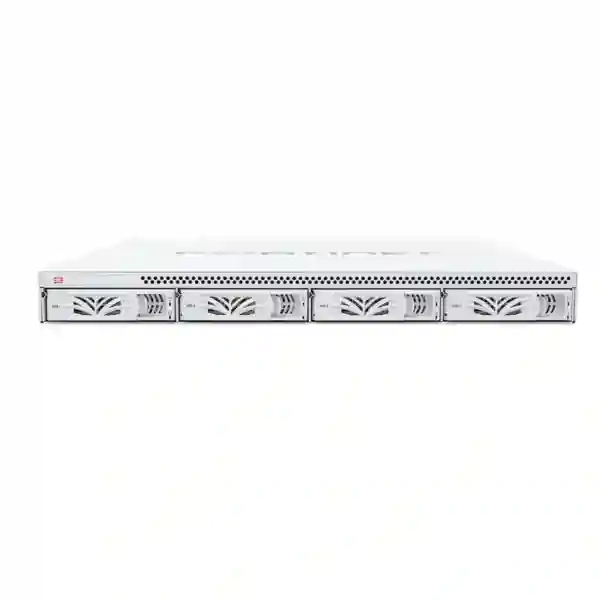
FortiMail FML-900G Tanzania
FortiMail FML-900G is an enterprise-class secure email gateway for organizations that need scalable protection against phishing, spam, malware, ransomware, zero-day threats and business email compromise. Fortinet positions the FortiMail 900G for mid-to-large enterprise, education and government deployments. For Tanzanian organizations planning an appliance-based email security architecture, the FML-900G provides a strong platform for protecting inbound and outbound mail while supporting policy control, quarantine, data loss prevention and integration with broader security operations.
FortiMail 900G verified platform overview
The FortiMail 900G is a 1U rack-mount appliance with four 10/100/1000 copper interfaces and two Gigabit SFP interfaces. Fortinet specifies redundant hot-swappable power supplies, 16 GB memory, secure encrypted drives, and 2 x 4 TB storage with optional additional 2 x 4 TB capacity. Hardware RAID supports RAID 0, 1, 5 and 10 plus hot-spare configurations according to drive count. These characteristics make the platform suitable for organizations that need a dedicated, resilient email-security system rather than relying only on controls embedded in a mail platform.
Fortinet lists support for up to 500 protected email domains, with an advanced management license able to increase the protected-domain limit by 50 percent. The appliance supports data loss prevention and centralized quarantine. Microsoft 365 and Google Workspace email API integration is offered as an option. Fortinet publishes email-routing performance of up to 1.3 million messages per hour, FortiGuard Antispam plus Virus Outbreak performance of up to 900,000 messages per hour, and FortiGuard Enterprise ATP performance of up to 650,000 messages per hour, based on Fortinet’s stated 100 KB-message test conditions without queuing. Actual production sizing should account for traffic profile, inspection services, policy complexity, peak volumes and deployment architecture.
Threat protection
Layered controls help detect and block spam, phishing, malicious attachments, ransomware, impersonation and business email compromise.
Data protection
DLP and outbound policy controls can help organizations reduce accidental or unauthorized movement of sensitive information through email.
Operational resilience
Redundant hot-swappable power, RAID-capable storage and rack deployment support enterprise operational requirements.
FortiMail FML-900G specifications
| Deployment | Mid-to-large enterprise, education and government departments |
| Form factor | 1U rack mount |
| Interfaces | 4 x GE RJ45, 2 x GE SFP |
| Memory | 16 GB |
| Storage | 2 x 4 TB; optional 2 x 4 TB additional storage |
| RAID | Hardware RAID 0, 1, 5, 10 and hot spare depending on drive count |
| Protected domains | 500; advanced management license increases limit by 50% |
| Email routing | Up to 1.3 million messages/hour under Fortinet stated test conditions |
Why deploy dedicated enterprise email security?
Email remains a major path for social engineering and malicious content because it combines trusted business identities, urgent requests, attachments, links and financial workflows. A dedicated secure email gateway creates a policy and inspection layer between users and potentially harmful messages. For finance, procurement, executive and administrative teams, this can be especially important because attackers frequently imitate suppliers, managers and service providers. FortiMail can be positioned as part of a wider defense strategy that also includes endpoint protection, identity security, multifactor authentication, DNS controls, firewalls, user awareness and incident response.
The FML-900G is not simply a spam filter. Its value comes from combining message inspection, reputation and threat intelligence, anti-malware controls, policy enforcement, quarantine and data protection. Deployment design should therefore begin with the organization’s mail flow, domains, user population, cloud or on-premises mail platform, peak message volume, retention expectations, compliance needs and integration requirements.
Compatibility, deployment and integration planning
Before procurement, document the current email architecture. Identify whether mail is hosted on Microsoft 365, Google Workspace, Exchange or another platform; list accepted domains; review DNS and MX records; identify outbound relays and applications that send mail; and document any existing secure email gateway. Migration planning should also consider allow lists, block lists, transport rules, journaling, quarantine workflows and administrator roles. Fortinet offers optional Microsoft 365 and Google Workspace email API integration, but the correct architecture should be selected according to the customer’s platform and security objectives.
For broader infrastructure planning, FourTeck Tanzania provides information on integrated IT and cybersecurity solutions, while the Tanzania technology shop helps buyers review related business technology. The services page is useful when email security is part of a wider deployment, and the FourTeck Tanzania overview provides company context. Buyers can also use the Tanzania contact page for quotation discussions. For connected security architecture, review the site’s firewall, networking and infrastructure guidance on the home and shop sections before finalizing a bill of materials.
FortiMail FML-900G Tanzania
Organizations evaluating FortiMail FML-900G in Tanzania typically need more than a hardware quotation. A useful procurement process should establish the number of protected domains, approximate mailbox population, average and peak email volume, current email platform, expected growth, inbound and outbound routing design, availability requirements and the security services that will be enabled. Tanzania deployments can include corporate headquarters, financial organizations, education groups, government departments, healthcare networks, hospitality operators and businesses with distributed branches. Each environment has a different risk profile, and the email security policy should reflect how people actually communicate.
For a multi-site Tanzanian business, centralizing policy can make administration more consistent. Domain protection, anti-phishing rules, attachment controls, quarantine procedures and outbound DLP policies can be designed around organizational standards rather than configured independently at every office. Procurement teams should include rack space, redundant power feeds, UPS capacity, switch connectivity, fiber requirements where SFP interfaces are used, management addressing and administrative access in the deployment checklist. The appliance’s 1U format simplifies data-center placement, but environmental requirements and airflow still need to be respected.
A quotation request should state whether the project is a new deployment, a replacement of an existing gateway or an expansion. It should also identify required subscriptions, support term, installation scope, migration assistance, administrator training and documentation. This gives suppliers enough context to avoid quoting only the appliance while leaving essential subscription or implementation elements undefined. For Tanzania buyers, the goal is a complete email-security outcome: the correct platform, properly licensed services, a tested mail-flow design and an operational process for quarantine, alerts and incident response.
FortiMail FML-900G Dar es Salaam
Dar es Salaam organizations often operate the largest concentration of users, headquarters functions and external business communication in a Tanzanian enterprise. That makes email security particularly relevant to finance, procurement, executive offices, customer service, logistics and supplier-management teams. When evaluating the FortiMail FML-900G for a Dar es Salaam deployment, sizing should start with message volume and domain count, but architecture should also consider internet redundancy, mail-hosting location, branch connectivity and the organization’s recovery plan. A headquarters appliance can become a critical dependency, so power, rack, cooling and network redundancy should be reviewed before installation.
Organizations using Microsoft 365 or Google Workspace should decide whether the required protection model uses mail-flow integration, optional API capabilities or a combination appropriate to their environment. DNS changes should be scheduled carefully and validated before cutover. Existing transport rules, trusted senders, business applications and multifunction devices that relay email need to be inventoried so legitimate traffic is not unexpectedly interrupted. Administrators should also define how quarantine notifications are delivered and who can release messages.
Dar es Salaam procurement teams can improve quotation accuracy by providing the current architecture, number of domains, approximate users, peak email traffic, required subscription duration and expected deployment services. Where the email-security project forms part of a wider cybersecurity upgrade, the gateway should be considered alongside firewall policy, endpoint controls, identity protection and security monitoring. This layered approach helps avoid treating email threats as an isolated problem. The FML-900G’s enterprise positioning makes it appropriate for evaluation where organizations need substantial capacity and resilient hardware, but final selection should always be based on measured requirements rather than city or company size alone.
FortiMail FML-900G Mwanza
For organizations in Mwanza, FortiMail FML-900G can be evaluated for centralized email protection where a business, institution or public-sector environment has a substantial user population or supports multiple operating locations. The purchasing discussion should identify whether Mwanza is the primary mail-security site, a disaster-recovery location or a branch connected to a centralized platform elsewhere. This distinction changes requirements for routing, redundancy, administration and local infrastructure. If the appliance is hosted locally, rack conditions, power continuity, upstream connectivity and secure management access are important deployment dependencies.
Email-security projects should also include a policy workshop. Organizations need to decide how aggressively spam is filtered, which attachment types require additional controls, how suspected impersonation is handled, what outbound information needs DLP protection and how users interact with quarantine. These operational decisions can be more important than simply enabling every available feature. Policies should protect users without creating unnecessary interruption to legitimate communication with customers, suppliers and partners.
Mwanza buyers requesting a FortiMail 900G quotation should provide domain count, user estimate, mail platform, traffic profile, retention or quarantine expectations and any need for cloud-email integration. If branch offices rely on the same email environment, include them in sizing and routing discussions. The final project should document MX changes, rollback steps, administrative access, monitoring, backup and escalation procedures. A properly planned implementation gives the security team a repeatable process for managing suspicious email rather than simply placing an appliance in the mail path.
FortiMail FML-900G Arusha
Arusha businesses in tourism, hospitality, professional services, education and regional operations can face email risks that involve bookings, invoices, supplier communication and international correspondence. A secure email gateway can add controls around these workflows by inspecting messages and applying consistent policies before suspicious content reaches users. FortiMail FML-900G should be considered when the organization’s scale and traffic justify an enterprise appliance, with sizing based on verified requirements rather than a generic recommendation.
Deployment planning in Arusha should map every service that sends or receives email. Reservation platforms, ERP systems, scanners, monitoring tools and websites may send automated messages and can be affected by changes to relay or authentication rules. Administrators should create an inventory before migration and test representative traffic during commissioning. User communication is also valuable: employees need to understand quarantine messages, reporting procedures and how to respond when an expected email is blocked.
For procurement, request clarity on the appliance, subscriptions, support, implementation, migration and any optional cloud integration required. Ask for the assumptions behind sizing and document the expected number of protected domains. If the organization has offices outside Arusha, define whether all mail will pass through the same security layer and how continuity is maintained if connectivity changes. This creates a stronger purchasing specification and helps IT teams compare proposals on architecture and lifecycle requirements rather than comparing hardware price alone.
FortiMail FML-900G Dodoma
Dodoma organizations, including government, education and large institutional environments, may need formal controls around email security, administration and data handling. Fortinet positions FortiMail 900G for mid-to-large enterprise, education and government departments, making it a relevant model to evaluate when message volumes, domain requirements and security policy complexity align with its capacity. Procurement should still validate actual needs and applicable organizational policies before selecting the appliance.
A well-governed deployment defines administrator roles, change approval, quarantine handling, incident escalation, policy review and logging expectations. Outbound DLP is particularly relevant where organizations need to reduce accidental transmission of sensitive information, but DLP effectiveness depends on policy design and business context. Rules that are too broad can interrupt legitimate work, while rules that are too narrow may miss important cases. A phased implementation and documented exceptions process can improve operational adoption.
Dodoma quotation requests should include mail platform, domains, users, estimated message volume, required support term and deployment scope. Infrastructure teams should confirm rack space, power redundancy, UPS, network interfaces and secure management access. Security teams should identify integrations and reporting requirements. Combining these inputs produces a bill of materials and statement of work that procurement can evaluate clearly. The objective is not merely to purchase FML-900G hardware but to establish an email-security service that can be administered, reviewed and maintained throughout its lifecycle.
FortiMail FML-900G UAE
Organizations operating between Tanzania and the UAE can use a common email-security architecture to reduce policy differences across regional offices. For an FML-900G project, the design should identify where the appliance is hosted, which domains it protects and how mail is routed for users in each country. Centralization can simplify administration, but latency, availability, data handling requirements and disaster recovery should be reviewed. FourTeck’s UAE technology site can support regional technology discussions, while Fortinet UAE information is relevant for organizations standardizing Fortinet security across locations.
UAE deployments frequently coexist with Microsoft 365 and other cloud services, so integration planning should document connectors, accepted domains, DNS, outbound relays and administrative access. For cross-border groups, security teams should also decide whether quarantine and policy administration is centralized or delegated. The appliance supports substantial domain and message-processing capacity, but capacity should be matched to real traffic and expected growth.
Procurement teams should request the exact hardware, licensing and support configuration rather than assuming every FML-900G quotation includes identical services. Implementation scope may include design, configuration, migration, testing, documentation and handover. For a multi-country business, consistent configuration standards and change records are valuable because they reduce ambiguity when different teams manage the same email environment.
FortiMail FML-900G Uganda
Ugandan organizations evaluating FortiMail FML-900G should begin with the same measurable requirements used for any enterprise secure email gateway: domains, users, message volume, mail platform, security policies, availability targets and expected growth. The FourTeck Uganda site provides a regional path for related technology requirements. For groups with both Tanzania and Uganda operations, one design decision is whether email security is centralized or deployed per region.
Centralized protection can simplify policy management, while distributed appliances can support different resilience or routing objectives. The correct design depends on connectivity, mail hosting and business continuity requirements. Administrators should inventory application-generated email, trusted relays and existing rules before cutover. They should also define a user reporting process for suspected phishing and a procedure for reviewing quarantined mail.
An enterprise appliance purchase should include lifecycle planning. Confirm subscriptions, renewal expectations, support coverage, firmware management responsibilities and configuration backup. If the organization expects to add domains or acquire new entities, include that growth in sizing. These steps help ensure that FML-900G remains part of a managed security architecture rather than becoming an isolated gateway with outdated policies.
FortiMail FML-900G Kampala
Kampala headquarters and large business environments may process substantial volumes of external email across finance, procurement, customer operations and management. These functions are common targets for impersonation and credential theft, so secure email design should combine technical filtering with clear operational controls. FML-900G offers enterprise processing capacity and data-protection functions, but successful deployment depends on accurate routing, policy tuning and administrator workflows.
Before implementation, create a map of domains, connectors, applications, outbound relays and user groups. Determine how executive impersonation, suspicious URLs, attachment types and bulk email should be treated. If DLP is required, identify the information categories and business exceptions that matter. During rollout, test legitimate supplier invoices, customer messages, automated system notifications and large attachments to reduce unexpected disruption.
Kampala procurement teams should request separate visibility into appliance hardware, subscriptions, support and professional services. This makes renewal planning clearer and helps compare proposals fairly. If the appliance will protect users in other Ugandan cities, include those users and traffic in sizing rather than treating Kampala alone as the requirement. Documentation should cover mail flow, DNS, backup, monitoring, quarantine and escalation so the system can be maintained by future administrators.
FortiMail FML-900G Arua
Arua organizations that are part of larger distributed groups may use centralized email infrastructure hosted elsewhere while still needing consistent protection for local users. In this scenario, the FortiMail 900G decision is usually made at organizational level rather than for one branch alone. The branch requirement should still be documented because connectivity, user support and business applications can affect the overall mail-security design.
For remote or branch users, administrators should define what happens during connectivity interruptions and how users access quarantine or report suspicious mail. Applications at the site that send email need to be included in relay planning. If local devices use SMTP directly, their addresses, authentication method and permitted destinations should be reviewed during migration. This reduces the risk of operational alerts or business notifications failing after mail-flow changes.
When requesting a quotation that includes Arua users, provide total organization-wide domain and mailbox information rather than only local headcount. State whether the deployment will be hosted in Kampala, Tanzania, a data center or another location. A clear topology allows the supplier and customer to discuss resilience, routing and support realistically. The result should be a standardized policy that protects branch users while remaining manageable for the central IT team.
FortiMail FML-900G Mbarara
Mbarara enterprises and institutions can evaluate FML-900G when email security requirements are part of a broader multi-site or high-volume environment. The appliance’s capacity is intended for larger deployments, so organizations should validate whether the model is proportionate to actual traffic and domain needs. Oversizing can increase cost without operational benefit, while undersizing can limit future growth. A requirements-based comparison with other FortiMail models is therefore useful.
Security planning should focus on the messages most important to the business: supplier communication, financial approvals, customer records, account notifications and executive correspondence. Policies can then be aligned to these workflows. Centralized quarantine can support administrative review, while DLP can help control outbound sensitive information when rules are carefully designed. User awareness remains important because no gateway should be treated as a substitute for cautious handling of unexpected requests.
For Mbarara deployment planning, include network and power dependencies in the scope. If the appliance is hosted centrally, focus on reliable connectivity and mail routing. If hosted locally, confirm rack, UPS, redundant power, cooling and management access. A complete handover should include configuration documentation, policy ownership and renewal dates so the platform remains maintainable after implementation.
FortiMail FML-900G Gulu
Gulu organizations connected to national or regional networks can benefit from consistent email-security policies even when the security gateway is physically hosted at another site. FML-900G supports large enterprise architectures where multiple domains and substantial message volumes need to be processed. The design should determine whether all Gulu user mail traverses the gateway and how cloud-hosted email services interact with the chosen protection model.
Operational readiness is essential. Administrators need access to alerts, quarantine and policy management, while help-desk staff need a clear procedure for user reports. When a legitimate message is blocked, the release and exception process should be controlled and auditable. When a phishing message is detected, the incident process should consider whether similar messages reached other recipients. These workflows turn email filtering into an operational security capability.
Procurement documentation should identify subscriptions and support as well as the physical appliance. Ask how implementation, testing and knowledge transfer are handled. For distributed organizations, request a design that accounts for all offices and future growth. This creates a more useful basis for selecting FML-900G than purchasing solely from a model name or headline throughput figure.
FortiMail FML-900G Kenya
Kenyan organizations or regional groups with operations in both Kenya and Tanzania may seek a common Fortinet email-security standard. The FourTeck Kenya site supports regional technology requirements. When FML-900G is used in a multi-country design, domain ownership, mail routing, administrative roles and disaster recovery should be documented centrally.
The platform’s enterprise capacity can support complex environments, but published maximums are not a substitute for sizing. Actual message size, security profiles, cloud API use and peak patterns can affect production behavior. A regional architecture should also consider whether data handling policies differ by business unit and whether administrators require separate domains or policy boundaries.
Kenya procurement teams should ask for exact licensing, subscription term and implementation scope. If replacing another gateway, export policy information and create a migration matrix before cutover. DNS changes should have rollback procedures, and mail flow should be tested from internal and external sources. These practical steps help ensure that the security platform improves protection without introducing avoidable email disruption.
FortiMail FML-900G Kuwait
For organizations with Kuwait and East African operations, FML-900G can be evaluated as part of a standardized enterprise email-security architecture. The FourTeck Kuwait site provides a regional technology reference. Central IT teams should determine where mail inspection occurs, how domains are grouped and how administrative responsibility is divided between countries.
A common platform can make policy, quarantine and incident handling more consistent, but regional business requirements may still require exceptions. Procurement and security teams should document these exceptions rather than creating ad-hoc rules after deployment. If cloud email is used, connector and API integration requirements should be validated against the current Fortinet documentation and subscription configuration.
Quotation preparation should include total users, domains, message volume, mail platform, subscription duration, support expectations and professional-services scope. If the appliance is hosted in a data center, include rack and power requirements. If it protects multiple countries, include expected growth and continuity planning. These inputs create a technically meaningful specification for suppliers to price and deliver.
FortiMail FML-900G Ghana
Ghana-based operations can evaluate FortiMail FML-900G for enterprise email security where scale, domain count and policy requirements justify a dedicated appliance. The FourTeck Ghana site supports related regional discussions. For multinational groups, a shared FortiMail standard can help align phishing protection, quarantine and outbound data controls across offices.
The design should start with the current mail platform and message path. Security teams should identify critical workflows, trusted external partners and applications that send automated email. This inventory becomes the basis for migration testing and policy tuning. Organizations should avoid copying old allow lists without review because outdated exceptions can weaken a new security deployment.
For Ghana procurement, request a clear distinction between hardware, FortiGuard services, support and implementation. Confirm renewal terms and who owns ongoing policy administration. Where a centralized appliance protects Ghana and other markets, include all traffic in sizing. The goal is a maintainable regional email-security service with documented responsibilities and predictable lifecycle costs.
FortiMail FML-900G Nigeria
Nigeria’s large enterprise environments can generate significant email volumes and complex domain structures, making accurate sizing especially important. FortiMail FML-900G offers enterprise-class processing and up to 500 protected domains under Fortinet’s published specification, with an advanced management license increasing that limit by 50 percent. The FourTeck Nigeria site provides a regional reference for related technology requirements.
Organizations should map subsidiaries, brands and domains before procurement so protected-domain requirements are understood. They should also distinguish user mail from high-volume application or notification traffic because the two may require different policies. Business email compromise controls are particularly relevant to finance and supplier workflows, but they work best when paired with strong identity controls and verification procedures for payment changes.
Nigeria quotation requests should include growth expectations and availability requirements. For a critical gateway, discuss redundancy at both appliance and architecture level rather than assuming dual power supplies alone provide complete continuity. Include monitoring, backups, DNS, support escalation and incident procedures in the deployment plan. This creates a security service that can scale with the organization.
FortiMail FML-900G Seychelles
Seychelles organizations in hospitality, finance, government and professional services may rely heavily on international email communication, making phishing and impersonation protection an important security concern. FML-900G is designed for larger enterprise environments, so buyers should confirm whether their own scale requires this model or a smaller FortiMail platform. The decision should be based on domains, traffic, features, resilience and future growth.
Where a Seychelles operation is part of a wider regional group, centralized FortiMail deployment may be more practical than installing a large appliance locally. Architecture should account for connectivity and continuity if users depend on a gateway hosted in another country. Cloud email integration options may also influence the design. Administrators should document how quarantine, user reporting and policy exceptions are handled across locations.
A useful procurement request describes the whole environment rather than simply asking for an FML-900G price. Include the mail platform, number of domains, users, message volumes, security objectives and implementation expectations. Suppliers can then identify the correct hardware, subscriptions and services. This approach reduces the risk of purchasing an appliance that is technically capable but poorly matched to the actual operating model.
FortiMail licensing, subscriptions and lifecycle planning
Fortinet describes FortiMail hardware appliances as perpetual-license platforms with annual subscriptions. Buyers should confirm the exact bundle and term quoted because security services and support are lifecycle components, not one-time details. Record renewal dates, contract references and responsible owners during handover. If optional cloud API integration or advanced management capabilities are required, include them explicitly in the bill of materials rather than assuming they are automatically part of the base appliance.
Quotation checklist for FortiMail FML-900G
Provide the number of email domains and users; current email platform; average and peak message volume; existing gateway details; inbound and outbound mail flow; cloud integration requirements; DLP requirements; quarantine workflow; rack and power environment; redundancy objectives; required subscription term; support expectations; migration scope; documentation and training requirements; and expected growth. This information helps create a quotation that reflects the full deployment rather than only the appliance.
Related security and infrastructure planning
Email security works best as one layer of a broader architecture. Organizations may also need network firewalling, secure remote access, endpoint protection, identity controls, switching, resilient internet and monitoring. FourTeck’s regional network includes FourTeck Africa for multi-country requirements and IT services guidance for broader infrastructure planning. These resources are relevant when FortiMail is being deployed as part of a wider security transformation rather than as an isolated purchase.
FortiMail FML-900G FAQs
What type of organization is FortiMail 900G designed for?
Fortinet lists the FortiMail 900G for mid-to-large enterprise, education and government department deployment scenarios.
How many protected domains does FortiMail 900G support?
Fortinet publishes a limit of 500 protected email domains, with an advanced management license increasing the protected-domain limit by 50 percent.
Does FML-900G support DLP?
Yes. Fortinet lists Data Loss Prevention and centralized quarantine for the FortiMail 900G.
Can FortiMail work with Microsoft 365 or Google Workspace?
Fortinet lists Microsoft 365 and Google Workspace email API integration as optional for FortiMail 900G. The correct integration and licensing should be confirmed for the planned deployment.
What should I provide for a FortiMail quotation?
Provide domains, users, mail platform, message volume, security requirements, integration needs, required subscription term, deployment location, support expectations and migration scope.
Decision recap
FortiMail FML-900G is a high-capacity 1U secure email gateway with enterprise hardware resilience, RAID storage, DLP, centralized quarantine and substantial published message-processing capacity. It is best evaluated through a sizing and architecture exercise that confirms domains, traffic, mail platform, subscriptions, integrations and continuity requirements. For Tanzania and regional organizations, a complete quotation should combine the correct appliance configuration with licensing, implementation and lifecycle support.
Consult FourTeck Tanzania
Share your email platform, domain count, approximate users, current gateway and security objectives. FourTeck can use those details to discuss product selection, related infrastructure and quotation requirements without assuming that one configuration fits every organization.


Reviews
There are no reviews yet.