
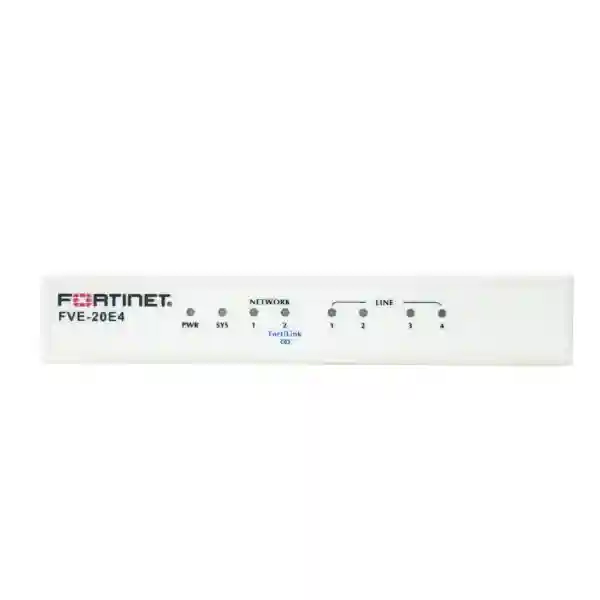
FortiVoice FVE-20E4 Tanzania
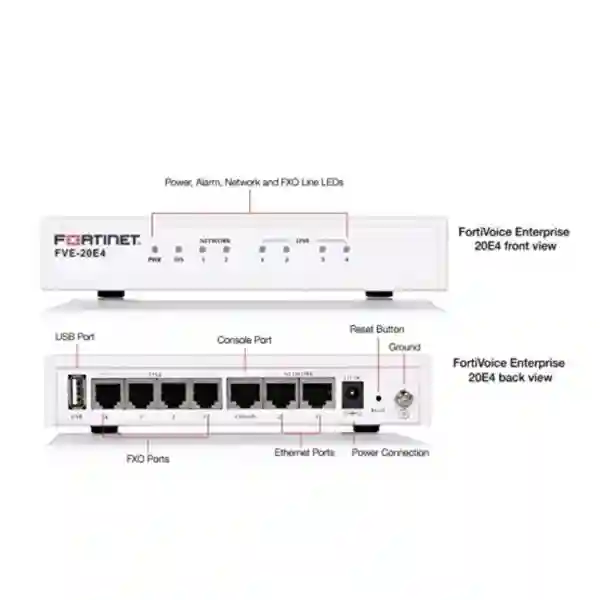
FortiVoice FVE-20E4 is a compact Fortinet business phone-system appliance built for organizations that need a manageable on-premises communications platform for up to 20 extensions. Fortinet specifies four FXO ports for traditional telephone lines, four VoIP trunks, up to 10 concurrent calls, five auto attendants and two conference bridges. This combination makes the FVE-20E4 relevant to small offices, branch locations, professional practices, retail operations and growing businesses that want structured call handling without selecting an oversized enterprise PBX.
FortiVoice FVE-20E4 Overview
The FVE-20E4 sits in Fortinet’s FortiVoice hardware family for smaller offices. Its purpose is not simply to connect desk phones; it provides a centralized platform for business calling, call routing and administration. Fortinet describes FortiVoice as a unified communications solution with voice, conferencing and fax capabilities, supported by centralized management for configuration and monitoring. For a buyer, the important planning question is whether the organization’s extension count, simultaneous-call demand, carrier interfaces and future growth remain within the appliance’s published capacity.
Supports up to 20 extensions and 10 concurrent calls, providing a clear sizing baseline for smaller deployments.
Four FXO interfaces support traditional telephone-line connectivity while four VoIP trunks support IP-based calling arrangements.
The desktop form factor measures 29 × 116 × 172 mm and uses an external power supply, helping it fit smaller communications environments.
Verified FortiVoice FVE-20E4 Specifications
| Extensions | 20 | Concurrent calls | 10 |
| Traditional lines | 4 FXO | VoIP trunks | 4 |
| Network interfaces | 2 × RJ45 | Storage | 8 GB |
| Auto attendants | 5 | Conference bridges | 2 |
| Attendees per bridge | 5 | Form factor | Desktop |
Fortinet’s current data sheet lists audio codec support including G.711 μ-law/A-law, G.729a, G.722 and Opus, plus H.263 and H.264 video codec support. Exact endpoint, carrier and feature compatibility should still be checked against the FortiVoice software version and deployment design before procurement.
Planning a FortiVoice FVE-20E4 Deployment
A successful phone-system purchase starts with call-flow design rather than appliance selection alone. Document every user who needs an extension, shared reception positions, meeting rooms, analog lines, inbound numbers, hunt groups, business hours and after-hours routing. Estimate peak simultaneous calls rather than using employee count as the only sizing metric. An office with 15 users may fit comfortably when only a few people call at once, while a sales-heavy organization can reach a concurrent-call limit much sooner.
Network readiness is equally important. IP telephony depends on stable LAN switching, sensible segmentation, power planning for endpoints, WAN quality where SIP services or remote connectivity are involved, and coordinated firewall policies. Before quotation, buyers should identify their existing carrier arrangement, whether analog lines will remain, whether SIP trunks are planned, and which FortiFone or compatible endpoints are required. Where a broader security refresh is planned, FourTeck’s Tanzania technology portfolio can be reviewed alongside the voice project, while Fortinet solution resources provide context for Fortinet-focused infrastructure planning.
FortiVoice FVE-20E4 Tanzania
Tanzanian organizations evaluating the FortiVoice FVE-20E4 should begin by matching the published 20-extension and 10-concurrent-call limits to their real communication pattern. This appliance can suit a small headquarters, branch office, clinic, professional firm, shop, school administration office or hospitality back office where centralized call handling is needed without the capacity of a larger FortiVoice model. The four FXO ports are especially relevant when a deployment must retain traditional telephone circuits while the four VoIP trunks provide a path for IP-based carrier connectivity. The final design should be based on the carrier services actually available to the customer and on confirmed compatibility, rather than assuming every line or SIP service behaves identically.
For procurement in Tanzania, prepare a concise bill of requirements before requesting a quotation. Include the number of extensions required now, expected growth, maximum simultaneous calls, existing telephone numbers, current analog lines, proposed SIP services, desk-phone quantities, reception requirements, conference needs, voicemail expectations and any remote-user requirement. This information helps determine whether the FVE-20E4 is appropriately sized or whether another FortiVoice platform should be considered. It also prevents an appliance-only quotation from overlooking phones, switching, power, cabling, carrier work or configuration tasks that may be necessary for a usable deployment.
Business continuity should be part of the Tanzanian design conversation. Voice availability depends on more than the PBX itself: local power, switching, internet connectivity for IP trunks, carrier availability and configuration backups all affect service. Organizations should decide which calls must continue during an ISP disruption and whether traditional lines provide a useful alternate path. Fortinet documentation also identifies the FVE-20E4 as a supported local-survivability branch model in applicable larger FortiVoice architectures, although that is a specific design scenario and should not be confused with standalone redundancy. For broader regional technology sourcing, the FourTeck Africa technology site can complement Tanzania-focused planning.
FortiVoice FVE-20E4 Dar es Salaam
In Dar es Salaam, the FVE-20E4 can be considered by offices that want a compact business PBX with a defined capacity envelope. Professional services firms, trading companies, small corporate branches, clinics and customer-facing offices often need more structured calling than a collection of independent mobile phones can provide. The appliance’s 20-extension capacity can organize individual users and shared functions, while five auto attendants can support planned call-routing scenarios. Two conference bridges, with up to five attendees per bridge according to Fortinet’s data sheet, provide an additional built-in collaboration capability for suitable use cases.
A Dar es Salaam buyer should map telecom connectivity before hardware is finalized. If four or fewer traditional lines need to terminate directly on the appliance, the four FXO interfaces may be relevant. If the organization is moving toward SIP, confirm provider settings, numbering, authentication, codecs and network requirements. The presence of four VoIP trunks should not be interpreted as unlimited call capacity: Fortinet separately specifies up to 10 concurrent calls for this model. Peak inbound and outbound demand therefore remains a core sizing question.
The physical deployment deserves the same attention as call features. The FVE-20E4 is a small desktop appliance, but it still belongs in a controlled network environment with dependable power and appropriate switching. If IP phones are powered through PoE, confirm the switch power budget and port count. Where the office uses voice and business data over the same network, consider VLAN design, QoS and firewall policy as part of implementation. A quotation request should therefore identify not only the PBX but also endpoint counts, network readiness, carrier connectivity and configuration scope. That creates a clearer basis for comparing a FortiVoice solution with the organization’s operational requirements.
FortiVoice FVE-20E4 Mwanza
Mwanza organizations looking for a small-office phone system can evaluate the FVE-20E4 where the expected deployment remains within 20 extensions. A practical starting point is to separate named users from functional extensions: reception, accounts, security desks, meeting rooms and shared work areas may all consume extensions even when they do not correspond to a single employee. This makes a detailed extension schedule more useful than a simple staff headcount. Growth should also be considered; a business already close to 20 required extensions may benefit from assessing a larger model before committing to the smaller platform.
The mix of four FXO interfaces and four VoIP trunks gives planners options for connecting legacy and IP calling services, subject to provider compatibility and configuration. For a Mwanza branch that still depends on analog telephone lines, documenting each line and its purpose is important. For SIP deployments, record the provider, numbers, expected channels and internet dependency. Organizations should also review call routing: which number reaches reception, how unanswered calls are handled, whether departments require ring groups, and what callers hear outside business hours.
Network and power resilience can be particularly important for business communications. The PBX, network switch, router/firewall and phones form a chain; loss of a critical component can affect calling even when the FortiVoice appliance itself remains healthy. Buyers should therefore discuss UPS sizing, switch design and connectivity dependencies during planning. The FVE-20E4’s two RJ45 network interfaces are a published hardware characteristic, but the correct topology depends on the deployment. FourTeck quotation preparation should include the appliance, endpoint requirements, installation expectations and any related LAN or security work so the final scope reflects the complete communications environment rather than one device.
FortiVoice FVE-20E4 Arusha
For Arusha businesses, the FortiVoice FVE-20E4 can fit smaller communication environments that need a centralized call system with predictable capacity. Tourism-support businesses, professional offices, property operations, clinics and branch locations may value a phone system that can organize inbound calls, extensions and business-hour routing. The right choice depends on measured requirements: Fortinet publishes 20 extensions, 10 concurrent calls, four VoIP trunks and four FXO ports for this model. Those limits should be compared with both current demand and expected expansion.
Hospitality and service-oriented organizations should pay particular attention to peak call periods. A modest employee count does not automatically mean low concurrency when reservations, suppliers and customers call at the same time. Document the busiest hour, estimate simultaneous inbound and outbound conversations, and allow operational headroom. If the requirement includes specialized hotel-management or call-center capabilities, verify model-specific feature availability rather than assuming capabilities published for larger FortiVoice appliances apply to the FVE-20E4.
Endpoint selection is another important Arusha procurement step. Determine whether users need basic desk phones, programmable keys, speakerphone functions, headset support or softclient workflows. Fortinet lists FortiFone Softclient among add-on options for the FVE-20E4, but licensing and version requirements should be confirmed for the proposed deployment. Network readiness, PoE capacity and internet quality for SIP services should be reviewed at the same time. A well-prepared request for quotation should state the number of users, endpoint preferences, carrier type, desired call flow and installation scope, allowing the solution to be designed around actual operations instead of generic assumptions.
FortiVoice FVE-20E4 Dodoma
Dodoma offices considering FortiVoice FVE-20E4 can use its published limits as a straightforward qualification framework. If the requirement is no more than 20 extensions and the expected busy-hour demand remains within 10 concurrent calls, the appliance may warrant closer evaluation. Government-adjacent businesses, consultancies, education offices, NGOs and commercial branches can benefit from documenting a professional call-routing plan that includes reception, departmental destinations, after-hours treatment and voicemail expectations.
Where existing analog lines are part of the environment, the FVE-20E4’s four FXO ports are a notable hardware characteristic. These interfaces can be relevant during phased migration, where an organization retains traditional lines while also considering VoIP trunks. The carrier design must still be confirmed before purchase. Numbers, line presentation, failover expectations and any SIP service should be reviewed with the relevant provider. Fortinet’s published codec support includes G.711, G.729a, G.722 and Opus for audio, but end-to-end voice quality also depends on network conditions and compatible service configuration.
Procurement teams in Dodoma should avoid evaluating the appliance in isolation. Phones, PoE switching, cabling, firewall configuration, UPS protection, carrier services, installation and administrator training may influence the overall project. A structured quotation checklist helps expose these dependencies early. If the business expects rapid growth beyond 20 extensions, compare a higher-capacity FortiVoice model before deployment to avoid unnecessary migration later. FourTeck can use the customer’s extension plan and call-volume assumptions as the basis for solution scoping, while final licensing, software compatibility and accessory requirements should be confirmed against current Fortinet documentation at the time of order.
FortiVoice FVE-20E4 UAE
UAE organizations evaluating the FVE-20E4 should focus on office size, carrier architecture and regulatory/provider requirements. The appliance is positioned by Fortinet for smaller offices and provides 20 extensions, four FXO ports and four VoIP trunks. It can be relevant to a branch, boutique office, clinic or professional-services environment where centralized call handling is needed. However, telephone-service design in the UAE should be coordinated with the chosen licensed telecom provider, and buyers should not assume that a generic SIP configuration is appropriate for every service.
A useful procurement brief includes extension count, concurrent-call estimates, existing numbers, analog-line requirements, endpoint quantities and network details. Businesses with multiple sites should also explain whether the FVE-20E4 is intended as an independent branch PBX or part of a broader FortiVoice architecture. Fortinet documentation lists this model as a supported survivability branch in applicable deployments managed by larger FortiVoice systems, which may matter to distributed organizations, but the architecture needs proper design.
The FourTeck UAE technology site provides a regional route for broader infrastructure discussions, while IP PBX resources for Dubai can help buyers frame telephony requirements. For FVE-20E4 planning, confirm endpoint and software compatibility against the current FortiVoice release, assess network QoS and power protection, and request a quotation that clearly distinguishes hardware, licensing, endpoints, configuration and carrier-side responsibilities. This reduces ambiguity and makes the proposed communications solution easier to evaluate.
FortiVoice FVE-20E4 Uganda
Ugandan businesses can evaluate the FVE-20E4 for smaller offices that require a defined extension plan and a combination of traditional and IP telephony connectivity. Its 20-extension capacity is suitable only when all user and functional extensions fit within that limit, so reception, shared areas and future hires should be included during sizing. The 10-concurrent-call ceiling is equally important for sales, service and coordination teams where simultaneous calling can be high relative to staff count.
The four FXO ports can support designs that retain traditional telephone circuits, while four VoIP trunks allow IP-based trunk planning. Carrier compatibility and service availability must be verified for the actual location. Buyers should document whether internet connectivity is single-provider or redundant because SIP-dependent calling can be affected by WAN outages. A voice project may therefore involve router/firewall, switching, UPS and QoS decisions in addition to the PBX.
For regional context, FourTeck Uganda can be used for Uganda-focused technology requirements. When requesting an FVE-20E4 quotation, provide the current number of staff, extension map, expected growth, existing telephone lines, SIP plans, desired phone models and call-flow requirements. If the organization is likely to exceed 20 extensions soon, compare larger FortiVoice appliances before committing. A correctly sized system is easier to operate and gives procurement teams a more defensible basis for lifecycle planning.
FortiVoice FVE-20E4 Kampala
Kampala is a strong fit for structured small-office communications use cases: professional firms, branch offices, clinics, education providers and growing commercial teams often need a central business number, reception routing and controlled extensions. The FVE-20E4 offers a compact Fortinet platform for up to 20 extensions. Its value should be assessed against actual call patterns rather than simply the number of desks.
A Kampala deployment should begin with a call-flow workshop. Identify the main published number, direct numbers where applicable, departments, ring groups, voicemail destinations, business hours and escalation paths. Then compare peak demand with the model’s 10 concurrent-call capacity. If analog lines remain, map them to the four available FXO interfaces. If SIP is planned, confirm the provider’s technical requirements and internet dependency. This planning avoids late changes when the appliance and endpoints are being configured.
LAN readiness should also be checked. Voice endpoints may require PoE switching, suitable cabling and traffic prioritization. Firewall rules should be designed carefully for the selected carrier and remote-access requirements rather than opening broad services unnecessarily. Power protection for the PBX, switching and internet equipment can reduce avoidable outages. Procurement teams should ask for a scope that states what is included: appliance, phones, licenses or subscriptions where applicable, configuration, installation, user onboarding and post-deployment support. Clear scope is particularly valuable when comparing quotations that may otherwise contain different assumptions.
FortiVoice FVE-20E4 Arua
In Arua, a compact phone system can be useful for branch operations that need consistent internal extensions and professional inbound call handling. The FVE-20E4 should be considered where the total extension requirement remains within 20 and peak concurrent calling remains within the published limit of 10 calls. Branch managers should include shared phones and operational positions in the count, not only permanent office staff.
Connectivity planning deserves special attention. If a branch uses traditional telephone lines, the four FXO ports may support an appropriate design. If it relies on SIP trunks, the quality and resilience of the internet path become important parts of voice availability. A hybrid approach may also be considered where technically and commercially appropriate, but carrier services and routing behavior need confirmation. The presence of both FXO and VoIP trunk capabilities provides options; it does not eliminate the need for a documented telephony architecture.
For an Arua quotation, list extension requirements, existing line types, phone quantities, network switch details, UPS availability and any need to connect with a central office. Fortinet documents the FVE-20E4 as a supported local-survivability branch model in specific larger FortiVoice deployments, which can be relevant to distributed organizations, although such a design requires a compatible central architecture. Smaller standalone buyers can instead focus on call handling, endpoint choice, administrator access and backup practices. Planning these details before ordering helps avoid under-sizing and makes installation requirements easier to define.
FortiVoice FVE-20E4 Mbarara
Mbarara businesses considering the FortiVoice FVE-20E4 should treat it as a complete communications project rather than a single-box purchase. The appliance supplies the central PBX function, but users also need endpoints, suitable network connectivity and a carrier service. Its four FXO ports are relevant for traditional lines, and its four VoIP trunks support IP trunk arrangements. The correct mix depends on the organization’s current numbers and migration plan.
Capacity planning should account for the busiest period of the day. Fortinet publishes support for 20 extensions and 10 concurrent calls. A company with many inbound customer calls may need more simultaneous-call headroom than another business with the same number of employees. Conference usage should also be reviewed: the model provides two conference bridges with up to five attendees per bridge according to the current Fortinet data sheet. If requirements exceed these limits, another model or collaboration approach may be more appropriate.
Before procurement, inspect switching and power. IP phones can increase PoE demand, and the voice platform depends on the availability of network equipment. A UPS strategy should consider the PBX, switches and internet edge, not only the server or appliance. Businesses should also decide who will administer extensions, greetings and call routes after handover. A clear operational owner reduces dependency for routine changes. Providing this information to FourTeck allows a quotation to reflect the actual environment and helps the buyer understand which items are hardware, which are services and which depend on the telecom provider.
FortiVoice FVE-20E4 Gulu
For Gulu offices, the FVE-20E4 offers a defined small-business capacity profile that is straightforward to evaluate. Up to 20 extensions can cover individual users and shared positions, while 10 concurrent calls establish the upper bound for simultaneous conversations. Businesses should leave reasonable growth margin instead of designing exactly to the limit on day one. A fast-growing organization may be better served by comparing a larger FortiVoice appliance during the initial procurement process.
The four analog FXO interfaces can matter where existing telephone lines remain important. Organizations considering SIP should identify their provider and confirm service requirements before configuration. Voice quality over IP is influenced by WAN and LAN conditions, so bandwidth, latency, packet loss and contention should be considered in network planning. The FVE-20E4 supports commonly used audio codecs published by Fortinet, but codec support alone cannot compensate for poor network quality.
Gulu buyers should also plan user experience. Receptionists may need different phone features from ordinary users, while managers may value programmable keys or softclient options. Fortinet lists FortiFone Softclient as an add-on for the FVE-20E4; exact licensing and compatibility should be confirmed for the current release. Include endpoint types, headset needs, call-routing preferences, business hours and voicemail policy in the project brief. These details turn a generic PBX request into a deployable specification and give the procurement team a clearer way to compare proposed solutions.
FortiVoice FVE-20E4 Kenya
Kenyan organizations can consider the FVE-20E4 for a compact office or branch requiring up to 20 extensions. The appliance combines analog-line connectivity through four FXO ports with four VoIP trunks, making it relevant to organizations balancing legacy telephony and IP migration. The carrier environment should be validated before procurement, including number presentation, SIP requirements where used and any dependence on the business internet connection.
A Nairobi or regional branch may have different traffic patterns from its head office, so size each location independently. Ten concurrent calls can be sufficient for many small offices but may be restrictive for outbound sales or customer-service teams. Include peak-call estimates and growth forecasts in the design. Fortinet’s larger FortiVoice family provides higher extension and call capacities, so buyers do not need to force a growing requirement into the FVE-20E4 merely because it is compact.
The FourTeck Kenya technology site provides a regional reference point for related infrastructure discussions. A complete quotation should define PBX hardware, phone quantities, network readiness, configuration scope and support expectations. If existing switching cannot provide sufficient PoE or VLAN capability, include that requirement early. If SIP calling is central to the design, review WAN resilience and firewall policy. The result should be a communications solution sized around real users and real call demand rather than an isolated appliance specification.
FortiVoice FVE-20E4 Kuwait
Kuwait businesses evaluating FortiVoice FVE-20E4 should first establish whether the appliance’s small-office scale aligns with the planned deployment. Fortinet specifies 20 extensions and 10 concurrent calls, which can work for a branch or professional office but may be insufficient for a larger customer-facing operation. The four FXO ports and four VoIP trunks provide connectivity choices, subject to the services and technical conditions supported by the organization’s telecom provider.
Procurement should include a carrier and endpoint checklist. Record current numbers, analog circuits, SIP services if applicable, desk-phone requirements, softclient expectations and call-routing rules. Confirm software and phone compatibility with the current FortiVoice release before ordering. Fortinet’s documentation continues to list the FVE-20E4 among supported FortiVoice 7.4 platforms, but deployment-specific compatibility should still be checked rather than inferred from platform support alone.
For Kuwait-focused technology requirements, buyers can also review FourTeck Kuwait. Network quality, PoE switching and UPS protection should be included in planning because a phone system is only as available as its supporting infrastructure. Businesses with multiple offices should explain whether they require independent PBXs, centralized management or survivability behavior. That architectural choice can change model selection significantly. A detailed quotation request helps separate essential components from optional features and gives stakeholders a clearer understanding of the deployment scope.
FortiVoice FVE-20E4 Ghana
Ghanaian SMEs and branch offices can evaluate the FVE-20E4 where a 20-extension system provides adequate capacity. The appliance can organize business calling through extensions, auto attendants and conferencing while supporting both traditional telephone-line and VoIP trunk connectivity. Buyers should translate these features into an operational call plan: how callers reach departments, how calls overflow, who receives voicemail and how after-hours calls are handled.
The four FXO interfaces may be useful where analog lines remain part of the communications design. SIP deployments should be planned around the selected provider and WAN connection. Because Fortinet specifies 10 concurrent calls, a company with intensive customer calling should calculate expected peak usage. This is especially important when several departments share the same system. If growth or call volume could exceed the published capacity, compare larger FortiVoice models before finalizing the bill of materials.
Regional technology requirements can also be explored through FourTeck Ghana. For an FVE-20E4 quotation, include the extension schedule, endpoint count, carrier type, existing network equipment and required installation services. Consider PoE, VLANs, QoS and backup power where IP phones are deployed. Administrative requirements matter too: determine who will maintain users and call routes after installation and what documentation or training is expected. A clear ownership model helps the phone system remain manageable after project handover.
FortiVoice FVE-20E4 Nigeria
Nigerian businesses assessing the FVE-20E4 should pay close attention to power and connectivity resilience as well as call capacity. The appliance supports up to 20 extensions and 10 concurrent calls, but voice availability also depends on switches, routers, carrier services and power. A UPS or broader backup-power strategy should therefore cover the supporting communications stack according to the organization’s continuity requirements.
The model’s four FXO ports can support traditional telephone-line connections, while four VoIP trunks support IP calling designs. The appropriate balance depends on available provider services and business continuity goals. If SIP trunks are used, consider whether the WAN design provides sufficient resilience for critical calling. Organizations should also document how inbound calls are distributed and whether the five available auto attendants are relevant to the planned call flow. Published capacity should be treated as a design boundary, not a target to fill without growth margin.
For related regional sourcing, FourTeck Nigeria provides a country-focused technology route. An FVE-20E4 request should state the office size, number of required phones, expected simultaneous calls, analog and SIP connectivity, network switch details and installation scope. Where the requirement is likely to expand, comparing higher-capacity FortiVoice models at the start can reduce future migration work. Endpoint and FortiVoice software compatibility should be validated against current Fortinet documentation before final procurement.
FortiVoice FVE-20E4 Seychelles
Seychelles businesses can consider the FVE-20E4 for smaller offices, hospitality support functions and professional environments that need a central business phone system. The appliance’s compact desktop format is useful where space is limited, while its 20-extension capacity gives buyers a clear upper boundary for user planning. Hotels and larger hospitality operations should be careful not to assume this small model provides specialized capabilities associated with higher-capacity FortiVoice products; requirements should be matched to the specific appliance and software features.
Connectivity planning should distinguish local analog lines from IP trunks. Four FXO ports provide direct interfaces for traditional telephone lines, and four VoIP trunks support IP-based services. Provider compatibility, numbering and internet dependency should be verified. In island environments where external connectivity is business-critical, the voice continuity plan should consider how SIP calling behaves during WAN disruption and whether alternative communication paths are required.
A quotation brief should identify every extension, expected concurrent calls, phone type, reception workflow, business hours and conference needs. Network switching, PoE, cabling and backup power should be reviewed with the telephony design. If the organization has several properties or offices, describe whether calls need to be centralized or whether each site operates independently. These architectural requirements can affect model selection. FourTeck can use this information to frame a suitable proposal without assuming stock, delivery timing or carrier availability; those commercial and service details should be confirmed specifically for the requested project.
Compatibility, Integration and Network Readiness
FortiVoice deployments combine PBX software, phones, trunks and network infrastructure. Before ordering, confirm the intended FortiVoice software version, supported endpoints and any softclient requirements using current Fortinet documentation. Fortinet currently lists the FVE-20E4 as a supported platform for FortiVoice 7.4.0. Platform support does not mean every historical phone, third-party SIP device or carrier service is automatically compatible, so model-specific validation remains important.
On the LAN, assess Ethernet port availability, PoE budget for IP phones, VLAN strategy and QoS. At the internet edge, coordinate firewall policy with the chosen SIP provider and avoid generic configurations that expose unnecessary services. Remote calling, VPN use and NAT behavior should be designed for the actual deployment. Organizations refreshing their security environment can review Fortinet infrastructure solutions alongside the voice project, but security hardware selection should be sized independently from the PBX.
FortiVoice FVE-20E4 Buying and Sizing Guidance
Choose the FVE-20E4 when its published capacity leaves enough room for real users and near-term growth. Count extensions carefully and estimate concurrent calls during peak periods. Then verify that four FXO ports and four VoIP trunks align with the carrier design. If the office requires substantially more than 20 extensions, heavier call concurrency or specialized functions not published for this model, evaluate another FortiVoice platform rather than stretching the FVE-20E4 beyond its intended role.
Also separate mandatory and optional components. Mandatory items may include the PBX appliance, phones, carrier service, network switching and configuration. Optional or environment-specific items can include headsets, softclient licensing, UPS upgrades and network remediation. Ask suppliers to state assumptions clearly. A lower appliance-only price is not directly comparable with a proposal that includes endpoints, configuration and deployment services.
Quotation Checklist
✓ Peak concurrent calls
✓ Reception and ring-group requirements
✓ Business-hours and after-hours routing
✓ SIP provider and trunk requirements
✓ Existing telephone numbers
✓ Internet/WAN resilience expectations
✓ PoE switch capacity
✓ UPS requirements
✓ Installation, training and support scope
FortiVoice FVE-20E4 FAQs
How many extensions does the FVE-20E4 support?
Fortinet publishes a capacity of up to 20 extensions for the FVE-20E4. Include shared and functional extensions when calculating the requirement.
How many simultaneous calls can it handle?
The current Fortinet data sheet specifies up to 10 concurrent calls. Busy-hour call demand should be estimated before selecting the model.
Does the FVE-20E4 connect to analog telephone lines?
Yes. Fortinet specifies four FXO ports on the FVE-20E4 for traditional telephone-line connectivity. Actual carrier service and line behavior should be confirmed for the deployment.
Does it support VoIP trunks?
Yes. Fortinet lists four VoIP trunks for the model. SIP/provider compatibility and configuration requirements should be validated before procurement.
Is the FVE-20E4 supported by current FortiVoice software?
Fortinet’s FortiVoice 7.4.0 release notes list FVE-20E4 among supported appliance platforms. Always check the latest release notes and upgrade guidance for the exact software version planned.
What should I provide for a quotation?
Provide extension count, simultaneous-call estimate, analog and SIP requirements, phone quantities, network details, desired call flow, growth plans and installation/support expectations.
Decision Recap and Consultation
FortiVoice FVE-20E4 is a compact Fortinet phone-system appliance with a clearly defined small-office profile: 20 extensions, four FXO ports, four VoIP trunks and up to 10 concurrent calls. It is best evaluated as part of a complete communications design covering endpoints, carrier services, LAN readiness, power resilience and future growth. FourTeck can use your call-flow and infrastructure requirements to prepare a project-specific quotation without relying on unsupported assumptions about stock, delivery or carrier availability.


Reviews
There are no reviews yet.