
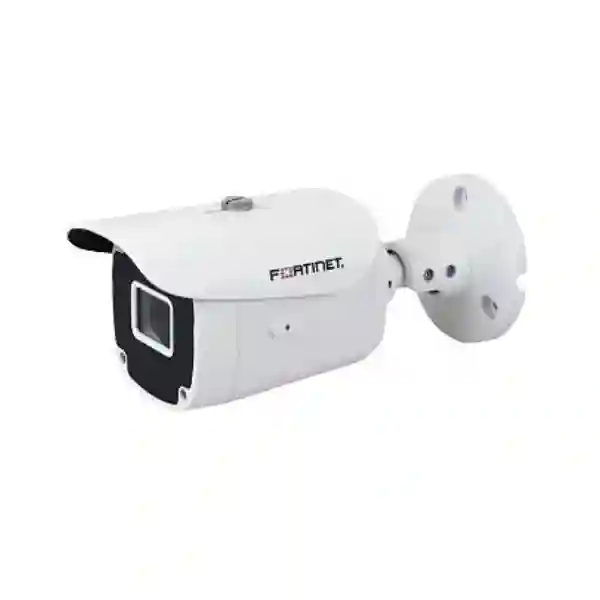
FortiCamera FCM-FB50H Tanzania
FortiCamera FCM-FB50H is a Fortinet bullet IP camera for organizations planning professionally managed video surveillance. The model combines a 5 MP image sensor, 30 m infrared illumination, a motorized 2.7–13.5 mm lens, 10/100 Ethernet, IEEE 802.3af PoE, audio support, IP66 weather protection and IK10 vandal resistance. For Tanzanian organizations, the practical value is not simply camera resolution: procurement should also consider scene coverage, night visibility, PoE switching, recording capacity, retention targets, network design and how the camera will be managed with the wider Fortinet video-security environment.
Detailed IP video for security monitoring where useful scene identification matters.
Integrated IR supports surveillance in low-light and night-time conditions.
The 2.7–13.5 mm motorized lens helps installers tune framing for the target scene.
Weather and vandal-resistant construction supports demanding indoor or outdoor placement.
FortiCamera FCM-FB50H Overview
The FCM-FB50H is positioned in Fortinet’s FortiCamera family as a bullet camera. Its combination of a 5 MP sensor and adjustable motorized lens suits entrances, perimeter approaches, loading areas, parking zones, corridors and other scenes where a fixed camera needs a carefully selected field of view. Power over Ethernet can simplify cabling because compatible network infrastructure can deliver data and power over the Ethernet run. That convenience still requires correct PoE budgeting, cable-distance planning, surge protection and network segmentation.
A surveillance purchase should be engineered as a system rather than treated as an isolated camera order. Recording duration, motion profile, image settings, number of cameras and operational review procedures all influence the final architecture. Fortinet’s broader video-surveillance portfolio includes FortiRecorder network video recorders and FortiCentral video management, giving customers a path toward centralized monitoring. Buyers should confirm the intended recorder, software version and required support arrangement before procurement.
| Specification | FCM-FB50H |
|---|---|
| Camera format | Bullet IP camera |
| Resolution | 5 megapixel |
| Lens | 2.7–13.5 mm motorized |
| Infrared | 30 m |
| Network | 1 × 10/100 Ethernet |
| Power | 802.3af PoE, DC 12 V |
| Environmental protection | IP66 / IK10 |
| Operating temperature | -30°C to 60°C |
Planning a Fortinet Video-Surveillance Deployment
Start with the scene. Determine whether the objective is general situational awareness, observation of entrances, perimeter coverage, vehicle-area monitoring or another defined security requirement. Lens position and mounting height affect usable detail, while night lighting, reflective surfaces and backlighting can influence image quality. The motorized lens gives the installer flexibility, but it does not replace a site survey. For outdoor work, mounting, weather exposure, cable entry, grounding and surge protection deserve attention.
Next consider network and recording design. Each camera adds traffic and recording demand, so the project team should estimate aggregate bandwidth and storage from the chosen resolution, frame rate, compression settings, activity level and retention policy. PoE switches must have sufficient per-port capability and total power budget. VLANs and access controls can help separate surveillance traffic from ordinary user devices. For multi-site environments, central visibility and WAN capacity become additional design factors.
FourTeck can also help customers examine adjacent infrastructure. Explore FourTeck Tanzania technology solutions for the local product portfolio, FourTeck enterprise infrastructure for wider solution context, FourTeck Africa for regional projects, FourTeck Uganda for Ugandan requirements, FourTeck Kenya for Kenyan projects, FourTeck Ghana and FourTeck Nigeria for West African requirements.
FortiCamera FCM-FB50H Tanzania
Organizations evaluating FortiCamera FCM-FB50H in Tanzania commonly need more than a model number and a unit price. A useful quotation begins with the number of cameras, mounting locations, indoor or outdoor placement, expected night conditions, required recording retention and the network infrastructure already available. The FCM-FB50H’s 5 MP imaging, 30 m IR illumination and motorized 2.7–13.5 mm lens make it relevant to projects that need adjustable fixed-camera coverage. IP66 and IK10 ratings are important considerations for exposed or accessible positions, while PoE can reduce the need for separate local power cabling where a suitable Ethernet path and PoE switch are available.
For Tanzanian deployments, project planning should account for environmental exposure, cable routes, equipment-room conditions and power continuity. A camera can be well specified yet still perform poorly if the mounting angle is wrong, the scene is strongly backlit, the lens is framed too broadly, or recording storage is undersized. Businesses should document what each camera must see and how long recordings need to remain available. This creates a stronger basis for recorder sizing and avoids buying storage from guesswork.
Network teams should also decide how surveillance traffic will be separated and administered. Where the project uses FortiRecorder and FortiCentral, management can be planned around the broader Fortinet video-security architecture. The correct recorder and software design depends on camera count, site topology and operational requirements. Requesting a quote with a simple site schedule—location, viewing objective, cable distance, lighting, retention and monitoring point—helps produce a more useful bill of materials than asking for cameras alone.
FortiCamera FCM-FB50H Dar es Salaam
Dar es Salaam businesses may evaluate the FCM-FB50H for offices, commercial premises, warehouses, logistics facilities, hospitality sites and other environments where network video must be integrated with existing IT infrastructure. Dense business sites often have a mix of indoor and outdoor scenes, so camera selection should begin with the security objective for each position. A gate approach has different framing requirements from a loading area or reception entrance. The motorized lens can assist commissioning by allowing the installer to tune the view after mounting, while 30 m infrared illumination supports low-light monitoring within the camera’s design limits.
Coastal conditions make installation discipline important. IP66 protection helps with environmental exposure, but installers should still use appropriate mounting practice, sealed cable entries and suitable network protection. Equipment rooms need reliable power and ventilation, and PoE switch capacity should be calculated for the complete camera count rather than one port at a time. Where business continuity is important, UPS capacity for switches, recorders and core network devices should be considered as part of the surveillance design.
Procurement teams in Dar es Salaam can speed quotation work by providing floor plans or camera schedules, the intended retention period and information about existing switching and recording infrastructure. If the system will expand later, state the expected final camera count so the recorder and switching design can leave sensible headroom. This approach turns the FCM-FB50H from an isolated hardware purchase into a planned physical-security component with clearer installation, storage and management requirements.
FortiCamera FCM-FB50H Mwanza
For Mwanza projects, the FCM-FB50H can be assessed for business premises that need durable fixed bullet-camera coverage and centralized IP surveillance. Sites such as offices, warehouses, retail compounds, education facilities and operational yards should map camera positions to actual risk areas before selecting quantities. The 5 MP sensor provides detailed video, but useful security outcomes depend on field of view and scene design. A camera covering too wide an area may provide less actionable detail than a carefully framed view focused on an entrance or transaction zone.
The camera’s 2.7–13.5 mm motorized lens is useful where installers need flexibility during commissioning. For low-light areas, the 30 m IR capability can support night monitoring, while site lighting can still materially affect the scene. Outdoor installations should be assessed for direct weather exposure, mounting stability and cable protection. The IP66 and IK10 ratings support demanding placement, yet proper installation remains necessary to preserve reliability.
Mwanza buyers should include recording and network requirements in the same procurement conversation. Retention targets determine storage, and camera settings influence bandwidth. If cameras connect through PoE switches, confirm both port availability and total power budget. For organizations with multiple buildings, define whether monitoring is local, centralized or shared between sites. A structured requirement makes it easier to select FortiRecorder capacity, management options and network components without relying on assumptions.
FortiCamera FCM-FB50H Arusha
Arusha organizations considering FortiCamera FCM-FB50H may include hospitality properties, offices, education sites, compounds and commercial facilities with a mix of visitor-facing and perimeter-security requirements. Camera placement should distinguish between broad awareness and detailed observation. The FCM-FB50H’s adjustable motorized lens supports precise framing, which is valuable when a project contains different scene depths. Rather than specifying identical settings everywhere, commissioning should optimize each view for its intended purpose.
Outdoor cameras benefit from IP66 weather protection and IK10 vandal resistance, but mounting height and physical access should still be considered. Infrared performance can assist at night, while reflective walls, glass, vegetation and vehicle lights may affect the scene. A survey performed during both daylight and low-light conditions can reveal issues that are easy to miss from a drawing alone. Network cabling should follow structured-cabling practice and remain within Ethernet design limits.
For quotation planning in Arusha, buyers can document the camera count, viewing objectives, retention period, available PoE ports and monitoring locations. Projects that may expand should disclose future phases so switching and recording capacity can be sized with appropriate growth in mind. Fortinet’s FortiRecorder and FortiCentral ecosystem provides a route to integrated management; compatibility and software requirements should be confirmed for the final architecture before purchase.
FortiCamera FCM-FB50H Dodoma
In Dodoma, the FCM-FB50H may suit organizations seeking a fixed bullet IP camera for controlled entrances, building perimeters, parking approaches and operational spaces. Security teams should define the evidence or visibility they expect from each camera. Resolution alone is not a guarantee of useful identification; distance, lens framing, lighting and mounting angle all contribute. The motorized lens allows practical adjustment after installation, helping the installer balance scene width against subject detail.
PoE is useful for centralized power design because compatible switches can power cameras over Ethernet, but the total system must be engineered. Check switch wattage, uplink capacity, rack space, UPS runtime and cable paths. For outdoor routes, use suitable containment and protection. The camera’s IP66 and IK10 ratings support challenging placement, while installers should still follow good practice around sealing, grounding and physical security.
Procurement teams can reduce redesign by specifying recording retention and access requirements early. Decide who needs live viewing, who can export footage, how incidents are reviewed and whether monitoring occurs at one or several sites. Those operational decisions influence recorder sizing and management architecture. When requesting a FortiCamera FCM-FB50H quotation for Dodoma, include current infrastructure details and expected future camera growth so the proposed system can be evaluated as a complete solution.
FortiCamera FCM-FB50H UAE
UAE buyers evaluating FCM-FB50H typically need clear confirmation of model, support options and system compatibility before procurement. The camera provides 5 MP imaging, 30 m IR, a motorized 2.7–13.5 mm lens, PoE and robust IP66/IK10 construction. These attributes make it suitable for many fixed surveillance positions, but project design should still be based on site conditions. Bright exterior scenes, shaded entrances and night-time areas can each require different framing and image settings.
For enterprise projects, consider the camera alongside switching, recording and centralized management. Bandwidth and storage should be calculated from real configuration targets rather than generic assumptions. Organizations with several sites should define whether video is retained locally, centrally accessed or managed through a broader architecture. Fortinet’s video-security portfolio includes FortiRecorder and FortiCentral, enabling an integrated approach where compatibility is confirmed.
UAE procurement teams can consult FourTeck UAE for regional technology requirements. A useful request should state quantity, installation environment, desired retention, current PoE switching and any recorder already in use. This information helps separate a straightforward camera requirement from a larger surveillance refresh and supports a more accurate technical discussion.
FortiCamera FCM-FB50H Uganda
Ugandan organizations can evaluate the FCM-FB50H where a robust bullet camera is needed for business premises, institutions, warehouses or distributed sites. Its motorized lens provides flexibility for scene setup, while 30 m IR supports low-light surveillance. The IP66 and IK10 ratings are useful for outdoor or accessible positions, but correct brackets, cable protection and mounting remain essential. A site plan should identify the purpose of every view before quantities are finalized.
Recording requirements deserve equal attention. Camera count, frame rate, image settings, activity level and retention duration all affect storage. PoE infrastructure should be checked for available ports and aggregate power. For remote sites, network availability and monitoring procedures should be documented so the architecture reflects actual operations rather than theoretical connectivity.
Buyers can use FourTeck Uganda for regional project context. When requesting pricing, include whether the requirement is camera-only or includes recorder, storage, switching, UPS, cabling and installation planning. That distinction helps procurement compare complete project scope rather than comparing hardware unit prices that may exclude essential system components.
FortiCamera FCM-FB50H Kampala
Kampala deployments often combine office, retail, hospitality and compound-security requirements. The FCM-FB50H can be considered where a fixed bullet form factor and adjustable lens are appropriate. Before installation, map entrances, vehicle routes, cash-handling areas or other critical scenes and decide the detail needed from each. The motorized lens can then be commissioned for those targets rather than left at a generic wide view.
Network design should account for surveillance as a continuous operational workload. Provide adequate PoE power, switching capacity and recorder storage, and isolate camera traffic where appropriate. UPS planning can keep core surveillance equipment operating through short power interruptions. For outdoor cameras, cable routes and termination points should be protected from environmental exposure even when the camera enclosure itself carries an IP66 rating.
A Kampala quotation request is more useful when it includes a site list, camera quantity, retention objective and any existing Fortinet video equipment. If monitoring will be shared across branches, explain WAN connectivity and who needs access. These details allow the camera, recorder and management components to be discussed as one operational system rather than separate line items.
FortiCamera FCM-FB50H Arua
For Arua sites, surveillance design may need to prioritize dependable local recording and straightforward network architecture. The FCM-FB50H provides a 5 MP bullet-camera platform with adjustable motorized optics, infrared illumination and PoE. A site survey should confirm camera distance from the target, available mounting surfaces and the condition of existing Ethernet cabling. Where new cabling is required, plan routes with maintenance access in mind.
Retention policy is a practical procurement driver. Organizations should decide how many days of footage they require and whether all cameras need identical settings. High-activity scenes can generate different recording demand from quieter areas. The recorder and storage plan should therefore be based on the complete camera profile. Network and power resilience should also be reviewed for locations where technical access may not be immediate.
When requesting the FCM-FB50H for Arua, provide information about existing switches, recorder platform and future expansion. If the system will grow in phases, designing the backbone for the eventual camera count can reduce later replacement. Clear project documentation also helps installers test each camera against its intended viewing objective during handover.
FortiCamera FCM-FB50H Mbarara
Mbarara businesses assessing FCM-FB50H can focus on whether the camera’s bullet form factor, 5 MP resolution and motorized lens match their security scenes. Perimeters, gates, warehouse approaches and building exteriors often benefit from deliberate directional coverage. The 30 m IR capability supports night monitoring, but final performance depends on the scene, ambient light and camera setup. Testing after dark is a valuable part of commissioning.
The network layer should be planned with the same care as camera placement. Confirm Ethernet distances, PoE power budgets and uplink capacity. If surveillance traffic shares switching infrastructure with business applications, segmentation and access policy should be considered. Recorder storage should be calculated against retention requirements, not selected only by disk size.
For procurement, specify whether mounting hardware, PoE switching, recording, UPS and installation services are part of the scope. A complete bill of materials makes commercial comparison more meaningful. If the organization expects more cameras later, include that roadmap in the initial discussion so the core infrastructure can be chosen with growth in mind.
FortiCamera FCM-FB50H Gulu
Gulu organizations may consider FCM-FB50H for premises where outdoor resilience and adjustable fixed-camera coverage are priorities. The camera’s IP66 enclosure and IK10 vandal resistance support exposed deployments, while its motorized lens allows installers to tune the field of view. Site design should identify critical approaches and avoid relying on one very wide camera view where several focused views would better support incident review.
Low-light design should include more than the camera’s IR distance. Surfaces, obstructions and existing lighting influence usable images. During commissioning, verify both daytime and night scenes and adjust framing as required. Network cabling should be protected, labeled and documented so maintenance teams can trace each endpoint. PoE capacity and UPS runtime should be assessed at the switch level.
A procurement request for Gulu should state the camera quantity, mounting conditions, retention target and monitoring method. If FortiRecorder or FortiCentral is part of the plan, include existing software and hardware information so compatibility can be confirmed. This reduces the risk of treating surveillance as a camera-only purchase when recording and operations are equally important.
FortiCamera FCM-FB50H Kenya
Kenyan organizations evaluating the FCM-FB50H can use its 5 MP imaging and adjustable motorized lens for planned fixed-camera coverage across commercial and institutional sites. The correct quantity depends on scene objectives, not simply floor area. Entrances, corridors, parking approaches and perimeters each have different focal and lighting requirements. The 30 m IR system can assist with night scenes, while IP66 and IK10 construction supports demanding locations.
Enterprise buyers should assess recorder capacity, storage retention, PoE switching and network segmentation alongside the camera. For multi-branch operations, management and access design can become as important as the camera specification itself. Fortinet’s broader video-security portfolio provides FortiRecorder and FortiCentral options that can be considered where an integrated Fortinet environment is desired.
For Kenya-specific project discussions, visit FourTeck Kenya. Include camera count, site type, expected retention and existing infrastructure in the enquiry. If the project includes several phases, identify future sites or quantities so switching and recording capacity can be reviewed for expansion rather than only immediate demand.
FortiCamera FCM-FB50H Kuwait
Kuwait projects can evaluate FCM-FB50H for indoor and outdoor surveillance positions requiring a bullet camera with motorized framing. Outdoor installations should consider heat, direct exposure, dust and cable protection as part of the complete design. The published operating range supports demanding conditions, but installers should still select locations and mounting methods that protect equipment and preserve image quality.
The 5 MP sensor and 30 m IR capability provide a strong basis for fixed surveillance, while the 2.7–13.5 mm motorized lens allows the field of view to be adjusted for the target scene. Network planners should confirm PoE availability, switch power budgets and recording bandwidth. Storage calculations should follow the required retention period and actual camera configuration.
Regional customers can consult FourTeck Kuwait for project requirements. A complete enquiry should include quantities, installation environment, recorder requirements and support expectations. This helps distinguish a replacement camera request from a new surveillance deployment requiring switching, storage and management components.
FortiCamera FCM-FB50H Ghana
Ghanaian organizations can assess FCM-FB50H for fixed IP surveillance where adjustable optics and weather-resistant construction are important. The camera’s bullet design is suited to directional views, while its motorized lens provides flexibility during setup. Security teams should identify the event or activity each camera must capture and then select mounting height and framing accordingly. A documented objective makes acceptance testing more meaningful.
Outdoor environments require careful sealing, cable routing and power protection. PoE can simplify installation, but total switch capacity must be checked. Recording retention should be agreed before recorder sizing because storage needs can vary significantly with configuration and activity. Multi-site organizations should also define how video is accessed and who is authorized to review or export footage.
For regional requirements, FourTeck Ghana provides a relevant project route. Include existing Fortinet equipment, desired retention and future expansion plans in the request. This allows the FCM-FB50H to be considered within the wider surveillance and network architecture rather than as an isolated endpoint.
FortiCamera FCM-FB50H Nigeria
Nigerian businesses evaluating FCM-FB50H may need surveillance across offices, compounds, warehouses, retail environments and distributed operational sites. The 5 MP camera combines a motorized lens, 30 m IR and rugged IP66/IK10 construction. Those specifications support a range of fixed views, but camera planning should still begin with scene objectives, lighting and expected subject distance.
For larger sites, network architecture becomes central to reliability. PoE switch budgets, uplinks, VLAN design, UPS capacity and recording storage should be reviewed together. Where several branches require centralized visibility, WAN capacity and access policy need to be included in the design. FortiRecorder and FortiCentral can be considered as part of a Fortinet-oriented surveillance architecture where compatibility is verified.
Customers can use FourTeck Nigeria for regional enquiries. Providing a camera schedule and retention target helps the technical team discuss an appropriate system scope. Procurement should compare the complete solution, including recording and network dependencies, rather than only the camera unit cost.
FortiCamera FCM-FB50H Seychelles
Seychelles deployments can place particular emphasis on outdoor mounting quality, environmental exposure and network resilience. The FCM-FB50H’s IP66 and IK10 ratings make it relevant to protected outdoor surveillance positions, while installation teams should still use appropriate cable sealing, corrosion-aware mounting practice and surge protection. Camera locations should avoid unnecessary direct exposure where a sheltered position can achieve the same security objective.
The motorized lens supports flexible commissioning across entrances, perimeter approaches and operational areas. Night-time performance should be verified after installation because IR reflections and local lighting can change the usable scene. PoE simplifies endpoint power where compatible switching is available, but UPS capacity and total switch wattage should be considered for continuous surveillance.
For island environments, maintainability can be a significant design factor. Standardized camera models, clear labeling, documented configurations and sensible spare strategy can simplify support. Buyers should provide camera count, retention targets, existing recorder details and network topology when requesting a quotation. A well-documented system is easier to expand and troubleshoot than a collection of independently installed cameras.
Related Fortinet and FourTeck Planning
Network security
Surveillance networks benefit from deliberate segmentation and access control. Review Fortinet solution resources from FourTeck when planning a broader Fortinet environment.
IT services
Projects that combine cameras, switching and server-side services may need wider infrastructure planning. See FourTeck IT services for broader deployment context.
Tanzania enquiries
Use the FourTeck Tanzania contact page to send quantities, site details and recording requirements for quotation guidance.
Quotation Checklist
For a more useful FortiCamera FCM-FB50H quotation, prepare the camera quantity, site or branch names, indoor/outdoor positions, approximate viewing distances, day/night lighting conditions, required recording retention, existing PoE switch details, recorder model if already installed, UPS requirements, cable status and expected future expansion. Also state whether the requirement is supply only or whether design and deployment guidance is required. This information helps identify dependencies before commercial comparison.
FortiCamera FCM-FB50H FAQ
What resolution does the FCM-FB50H provide?
The FortiCamera FCM-FB50H is a 5-megapixel bullet IP camera. Final usable detail depends on lens framing, distance, lighting and configuration.
Does it support PoE?
Yes. Published product information specifies IEEE 802.3af PoE. Confirm the switch’s per-port support and total PoE budget for the complete deployment.
Can the FCM-FB50H be installed outdoors?
The model is specified for indoor/outdoor use and carries an IP66 rating plus IK10 vandal resistance. Proper mounting, cable sealing and environmental planning are still required.
How far does its infrared illumination reach?
Published specifications state 30 metres. Real scene performance depends on surfaces, framing, ambient light and installation conditions.
What should I provide for a Tanzania quotation?
Provide quantity, camera locations, retention requirement, existing PoE switching, recorder information, cable status and whether installation planning is part of the scope.
Decision Recap
FortiCamera FCM-FB50H is a strong fit to evaluate when a project calls for a 5 MP Fortinet bullet IP camera with adjustable motorized optics, 30 m infrared illumination, PoE and rugged IP66/IK10 construction. The purchasing decision should be made together with scene design, recording retention, PoE switching, network architecture and management requirements. Send FourTeck a camera schedule or site requirement to turn the model selection into a complete quotation.




Reviews
There are no reviews yet.