
FortiRecorder VM Tanzania
FortiRecorder VM is Fortinet’s virtual network video recorder for businesses, institutions and multi-site organizations that want to run surveillance recording as a virtual workload rather than depend only on a dedicated recorder appliance. It combines Fortinet video-surveillance management with a stackable camera licensing model, giving infrastructure teams a practical route to grow recording capacity as camera requirements expand. For Tanzania buyers, the important planning questions are not limited to the license itself: camera count, video resolution, frame rate, retention period, storage architecture, virtualization platform, network bandwidth, user access and future expansion all influence a successful design.
What is FortiRecorder VM?
FortiRecorder VM is the virtual-machine edition of Fortinet’s FortiRecorder network video recording platform. Fortinet positions the broader FortiCamera and FortiRecorder portfolio as an integrated surveillance environment that can provide centralized camera management, live viewing, recording, footage access and video-security workflows. The VM edition is useful where an organization already operates virtualization infrastructure, prefers software-defined deployment, needs a scalable camera count, or wants to align surveillance recording with established server, storage and data-center practices.
Current Fortinet documentation lists FortiRecorder-VM as a 64-bit virtual system supported on VMware vSphere/ESXi, Microsoft Hyper-V, Citrix XenServer, KVM, AWS EC2 in pay-as-you-go form and Microsoft Azure with bring-your-own-license deployment. Platform versions should always be checked against the release notes for the FortiRecorder software version being deployed because compatibility can change between releases. This page therefore avoids treating an old hypervisor matrix as permanent and recommends validating the intended host platform during quotation and implementation planning.
Stackable licensing
The FortiRecorder-VM base license includes 10 camera licenses. Fortinet documents add-on licenses for 10, 50 and 100 cameras, allowing capacity to be assembled around the required enabled-camera count.
Virtual deployment
Deploy on supported virtualization or cloud platforms rather than installing a dedicated FortiRecorder appliance, subject to current Fortinet compatibility and deployment guidance.
Surveillance planning
Camera quantity alone does not determine the design. Storage retention, bitrate, resolution, analytics, network paths and operator workflows should be planned before the VM and licenses are sized.
FortiRecorder VM licensing and sizing
Fortinet’s current administration guidance describes FRC-VM-Base as the base license with 10 enabled-camera licenses. FRC-VM-10 adds 10 cameras, FRC-VM-50 adds 50 cameras and FRC-VM-100 adds 100 cameras. Because these licenses are stackable, procurement can be aligned with the number of active cameras required for the project. Fortinet documentation also describes trial and evaluation options, but commercial buyers should confirm current entitlement, support and regional ordering details before relying on any evaluation arrangement for production use.
Camera licensing is only one part of sizing. Video storage can be substantial, especially where high resolutions, higher frame rates, long retention windows or continuous recording are required. A quotation request should therefore include the number of cameras, expected resolution, recording mode, approximate retention target, whether analytics are required, and the intended virtualization or cloud platform. Existing storage should be assessed for capacity and sustained write performance rather than assumed to be suitable because free disk space is available.
| License | Documented purpose | Planning use |
|---|---|---|
| FRC-VM-Base | Base with 10 camera licenses | Starting point for FortiRecorder VM licensing |
| FRC-VM-10 | Adds 10 cameras | Smaller increments |
| FRC-VM-50 | Adds 50 cameras | Medium expansion blocks |
| FRC-VM-100 | Adds 100 cameras | Larger deployments |
Deployment, integration and procurement guidance
A FortiRecorder VM project should begin with the surveillance objective. Identify what each camera must achieve, where footage is viewed, how long recordings need to be retained, which users need access and whether the system must integrate with existing Fortinet or third-party cameras. Fortinet documentation supports third-party ONVIF cameras with licensing conditions, so projects that mix camera vendors should validate compatibility and required channel licensing before purchase. Do not assume that ONVIF support alone guarantees every camera feature will behave identically.
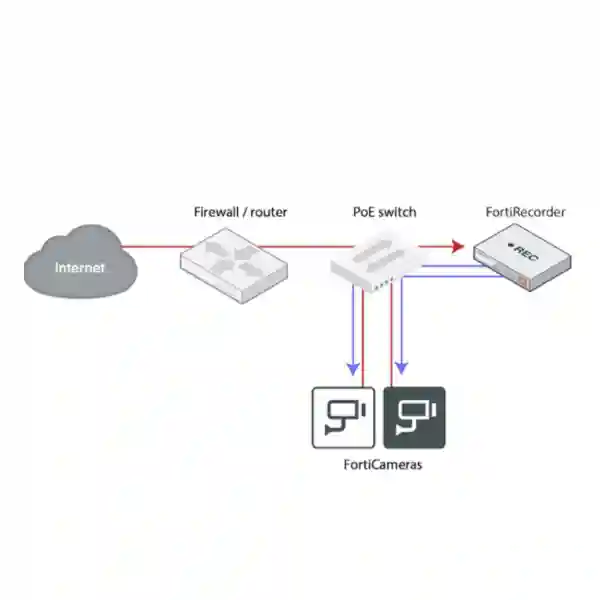
Network architecture matters because every camera is an IP endpoint generating traffic toward the recorder and, in some designs, toward operator stations or cloud services. Managed switching, appropriate PoE capacity for cameras, VLAN segmentation, secure routing, resilient uplinks and documented addressing can improve maintainability. Recording traffic should be considered when sizing inter-switch links and virtual-host connectivity. For remote sites, WAN capacity and the location of recording resources can determine whether centralized recording is practical or whether a distributed architecture is preferable.
Virtualization teams should also define compute and storage ownership. The surveillance workload competes for host resources just like other VMs, while video recording can produce sustained storage activity. Capacity planning should include expected growth instead of sizing only for day-one cameras. Backup policy requires careful thought: recording archives can be very large, and organizations may need a retention or export strategy rather than treating all video like ordinary file-server data.
Related FourTeck technology resources
FortiRecorder VM normally sits inside a wider infrastructure. Review FourTeck Tanzania integrated IT and surveillance solutions when the project also needs cameras, PoE switching, servers, storage, UPS, firewalling or structured cabling. For regional deployments, FourTeck Uganda CCTV and networking solutions can support planning discussions for Uganda requirements, while FourTeck Kenya IT and network-security solutions provides a regional route for Kenya enquiries. UAE projects can reference FourTeck UAE IT and CCTV solutions. These links are included because FortiRecorder VM depends on surrounding network, virtualization, storage and physical-security design rather than operating as an isolated license.
FortiRecorder VM Tanzania
Organizations evaluating FortiRecorder VM in Tanzania are often looking for a surveillance platform that can scale without adding a separate recorder appliance for every expansion. The virtual format is especially relevant to businesses that already maintain VMware, Hyper-V, KVM or supported cloud infrastructure and want video recording to follow familiar IT governance. A Tanzania project should begin with a camera schedule: list each camera location, expected resolution, recording mode, approximate bitrate, retention requirement and whether analytics or third-party camera support is needed. This creates a defensible basis for licensing and storage sizing instead of purchasing only from a headline channel count.
Infrastructure conditions should be assessed at the same time. Camera networks may cross multiple switches, floors, buildings or branches, so uplink capacity, PoE budgets, VLANs and resilient power can be as important as the recorder software. If the VM will run in a central data room, verify that camera traffic can reach it reliably without congesting business applications. If sites depend on WAN links, test whether centralized recording is operationally sensible. Retention expectations should be converted into storage capacity using realistic stream assumptions, with headroom for growth and operational overhead.
For procurement in Tanzania, request a quotation that clearly separates the FortiRecorder VM base license, camera expansion licenses, any required FortiCare or FortiGuard services, third-party camera licensing where applicable, virtualization resources, storage and implementation scope. Buyers should also identify whether existing cameras are FortiCamera models or third-party ONVIF devices and provide model details for compatibility review. FourTeck Tanzania’s contact page supports CCTV, IP camera, server, firewall and networking enquiries, making it appropriate to submit the complete surveillance architecture rather than only a license code. This reduces the risk of overlooking switching, storage, UPS or access requirements that affect the final deployment.
FortiRecorder VM Dar es Salaam
FortiRecorder VM in Dar es Salaam can suit corporate offices, retail groups, logistics facilities, hospitality sites, educational campuses and organizations consolidating CCTV management into a virtual infrastructure environment. In dense business environments, surveillance projects frequently share the same network backbone used by data, voice, Wi-Fi and building systems. The design should therefore reserve sufficient switching and uplink capacity for camera streams and avoid treating CCTV as background traffic that can simply be added to an already busy LAN.
For a Dar es Salaam head office with many cameras, first decide where the VM and storage will reside. A server room deployment can simplify local recording, but it still needs resilient power, cooling, host resources and storage performance. Multi-building sites should review fiber or high-capacity uplinks. Branches sending streams back to a central recorder should be assessed for WAN stability and bandwidth. Where remote viewing is required, access should be controlled through secure architecture rather than exposing management interfaces unnecessarily.
A useful quotation brief includes the camera count today and after expected expansion, camera brands and models, resolution and frame rate targets, days of retention, continuous or event recording preference, virtualization platform and version, available storage, network topology and number of operators. FortiRecorder VM’s stackable licensing makes it possible to plan capacity in increments, but licensing should follow a complete system design. Buyers in Dar es Salaam should also identify whether they need new FortiCameras, PoE switches, rack upgrades, UPS capacity or operator displays. Combining these details allows the proposal to address the full recording workflow instead of producing a license-only quote that leaves infrastructure gaps unresolved.
FortiRecorder VM Mwanza
Businesses considering FortiRecorder VM in Mwanza may be planning surveillance for offices, warehouses, trading operations, institutions or sites where a virtual server environment already supports other business applications. The main advantage of evaluating a VM-based recorder is architectural flexibility: the recording service can be planned around existing compute and storage standards while camera licensing grows in stackable increments. This does not remove the need for surveillance engineering. Camera placement, stream quality, retention and network paths still determine how useful and reliable the finished system will be.
Mwanza projects with several buildings or operational zones should map where camera traffic enters the network and how it reaches the recorder. PoE access switches need sufficient power budgets, uplinks need capacity, and VLAN design can keep surveillance endpoints logically organized. If the recorder is virtualized on shared infrastructure, administrators should monitor storage latency and host utilization because continuous video recording has different I/O characteristics from many office workloads. Growth should be included from the beginning so additional cameras do not unexpectedly exhaust storage or network capacity.
Procurement teams should request exact licensing based on enabled cameras and verify any third-party ONVIF requirements. A good bill of materials can include the base VM license, appropriate 10/50/100-camera add-ons, relevant support services, cameras, PoE switching, storage and implementation where required. Include a retention target and realistic stream profile so storage can be estimated. If the organization already owns cameras, provide their models and firmware information for compatibility review. The result should be a solution that can be administered, expanded and documented rather than a collection of cameras and licenses purchased separately.
FortiRecorder VM Arusha
FortiRecorder VM in Arusha can be evaluated for hospitality properties, offices, campuses, warehouses and organizations that need centralized video recording while retaining the operational benefits of a virtual infrastructure platform. Hospitality and multi-building environments can have distributed cameras, guest networks, staff networks and business systems sharing physical switching, so segmentation and capacity planning are essential. The recorder should be placed where it has dependable connectivity to the required camera streams and where storage can be managed predictably.
For an Arusha deployment, document the surveillance objective by zone. Entrances may prioritize identification, perimeter cameras may need continuous coverage, internal areas may use different retention rules, and back-of-house locations can have separate access permissions. These choices influence resolution, frame rate, bitrate and storage. If analytics or face-recognition functions are under consideration, licensing and compute implications should be checked against current Fortinet documentation rather than assumed from a basic recording design.
Virtual deployment also makes coordination between security and IT teams important. Security users define what must be seen and retained; IT teams control hypervisors, storage, VLANs, backups, identity and remote access. A successful quotation should bring these requirements together. State the current camera count, planned growth, camera vendor mix, hypervisor or cloud target, retention period and operator requirements. Include related infrastructure such as PoE switching, UPS, rack space and monitoring displays when needed. This approach helps Arusha buyers compare a complete project scope and avoids underestimating the infrastructure behind a scalable virtual NVR.
FortiRecorder VM Dodoma
FortiRecorder VM in Dodoma is relevant to organizations that want to align video surveillance recording with virtual server operations and structured IT governance. Government-facing offices, enterprises, institutions and distributed facilities may need clear control of camera access, retention and expansion. The design should start with operational requirements rather than simply choosing the largest license block. Determine how many cameras will be enabled, what each camera records, how long footage must remain available and who needs live or historical access.
A Dodoma deployment can benefit from standardized naming, VLANs, IP addressing and documented camera-to-switch mappings. These practices make troubleshooting easier when a camera goes offline or a stream becomes unstable. The virtual host and storage should be sized for sustained recording activity, and critical infrastructure should be protected by appropriate UPS and environmental controls. Where cameras are located across separate buildings, assess uplink capacity and resilience. For remote sites, evaluate whether the WAN is dependable enough for continuous central recording or whether architecture should be distributed.
Procurement should also separate mandatory licensing from optional services and project components. Fortinet documents the FRC-VM-Base license with 10 camera licenses and stackable expansion options. Third-party camera support, analytics and cloud-related features can have separate licensing considerations, so include those requirements explicitly. Buyers should request confirmation of current compatibility and subscription terms at quotation time. Providing a complete site and camera schedule allows FourTeck to discuss licensing, storage, switching and implementation as one coordinated requirement instead of treating FortiRecorder VM as a standalone software item.
FortiRecorder VM UAE
FortiRecorder VM in the UAE can be considered by organizations with mature virtualization estates, multi-site surveillance requirements and centralized infrastructure standards. The virtual format allows the recording platform to be deployed on supported hypervisors or cloud environments, subject to current Fortinet compatibility. For enterprise projects, the decision should include data-center architecture, storage performance, camera network segmentation, operator access and business-continuity expectations rather than focusing only on camera license quantity.
UAE buyers often manage facilities across offices, warehouses, retail sites or hospitality environments, making consistency important. A standard camera naming convention, VLAN structure, retention policy and license plan can simplify expansion across locations. Where cameras traverse WAN or SD-WAN links to a centralized recorder, calculate stream bandwidth and consider link failure behavior. If recording remains local while management is centralized, define how operators retrieve footage and how access is secured. Virtual resources should be monitored and reserved appropriately so other workloads do not unexpectedly affect recording performance.
For quotation preparation, specify camera count by site, anticipated growth, camera models, recording resolution and frame rate, retention target, virtualization platform, storage design and required support term. Fortinet’s stackable licensing can then be matched to the enabled-camera requirement. If third-party ONVIF cameras, face recognition or FortiCamera Cloud integration are planned, request explicit confirmation of current licensing and compatibility. FourTeck UAE’s broader CCTV, networking and IT infrastructure resources can be useful when the recorder is part of a larger security or data-center project that also needs switching, firewalling, servers, storage or structured cabling.
FortiRecorder VM Uganda
FortiRecorder VM in Uganda can support organizations that want a scalable virtual recording platform for business surveillance and already operate, or plan to operate, suitable server infrastructure. The licensing model is straightforward to plan around enabled-camera counts, but a complete deployment still depends on stream design and storage. Start by grouping cameras by site and purpose, then document expected resolution, recording schedule, retention and growth. This gives technical and procurement teams a common baseline.
Uganda projects may span a headquarters and branches, so the location of the recorder matters. Continuous recording across WAN links can consume significant bandwidth, while distributed recording can increase the number of systems to manage. The right approach depends on connectivity, camera count and operational priorities. Managed PoE switching, VLAN segmentation, reliable power and documented network paths help keep camera traffic stable. Virtual host capacity and storage performance should be reviewed as deliberately as the camera network.
When requesting a quotation, include whether cameras are FortiCamera or third-party ONVIF models and identify any analytics or cloud-management requirements. Ask for the base license and camera add-ons to be shown clearly, along with support and implementation items. Existing infrastructure can be reused where it meets the technical requirement, but it should not be assumed suitable without checking capacity. FourTeck Uganda’s CCTV and networking focus makes it useful to discuss the recorder together with cameras, switching and site connectivity, especially when the project must remain scalable across several business locations.
FortiRecorder VM Kampala
FortiRecorder VM in Kampala is a practical consideration for corporate offices, retail operations, institutions and multi-site organizations seeking to virtualize their network video recording layer. Kampala deployments can involve high camera density in offices or commercial facilities, so the design should calculate both aggregate recording bandwidth and storage. Camera count is the licensing trigger, but stream characteristics determine infrastructure demand. A project with fewer high-bitrate cameras can require more storage than a larger deployment using lower bitrates and event recording.
The VM should be integrated with the existing data-center or server-room standards. Confirm the supported hypervisor release, allocate resources according to current Fortinet guidance, and design storage for sustained writes. Network teams should identify camera VLANs, PoE access switches, uplinks and secure operator access. If remote branches send footage to Kampala, assess WAN capacity and outage behavior. Recording architecture should remain usable when a link is degraded, not only when all connectivity is ideal.
A Kampala quotation request should include present and future camera quantities, retention days, recording mode, camera vendor mix, virtualization platform, storage availability and number of security operators. If integration with FortiCamera Cloud or advanced analytics is required, call this out so licensing can be validated. Organizations replacing an appliance NVR should also document existing camera compatibility and export or migration expectations. This structured approach makes the FortiRecorder VM purchase easier to compare and reduces the chance that licensing is correct while storage, networking or operational requirements remain underspecified.
FortiRecorder VM Arua
FortiRecorder VM in Arua may be appropriate for organizations that want centralized surveillance management while retaining flexibility in where the recording workload runs. Sites outside major data-center environments should give extra attention to power resilience, connectivity and remote administration. A virtual recorder is still dependent on physical hosts, storage and networks, so the reliability of those supporting systems determines the reliability of video recording.
For an Arua site, first decide whether recording should occur locally or across a WAN to another location. Local recording can reduce continuous WAN dependence, while centralized recording may simplify management if connectivity and bandwidth are strong enough. Camera streams should use managed switching and clear VLAN policies, and PoE budgets should include margin for the actual camera models. UPS planning should cover switches, hosts and storage where continued recording during short interruptions is important.
Licensing can then be matched to the enabled-camera requirement using the FortiRecorder VM base and stackable add-ons. Buyers should not order expansion licenses before confirming the final channel count and third-party camera needs. A complete request should list cameras, retention, resolution, hypervisor, storage and network conditions. If a site will expand later, include the expected second-phase count so storage and host resources are not designed too narrowly. For Arua projects connected to a wider Uganda deployment, standardizing camera naming, user roles and configuration practices can make remote support and future branch rollout considerably easier.
FortiRecorder VM Mbarara
FortiRecorder VM in Mbarara can fit organizations that need surveillance recording for offices, education, healthcare, retail, warehousing or other business environments and prefer a virtualized recorder. The first design task is to define what footage must accomplish. General situational awareness, entrance identification, transaction review and perimeter monitoring can require different camera settings, which then affect bandwidth and storage. Recording policy should therefore be tied to operational outcomes rather than a single default profile for every camera.
Virtual infrastructure planning should cover CPU, memory, storage and network interfaces according to the current Fortinet deployment documentation and the intended scale. Storage deserves particular attention because retention targets can quickly multiply capacity requirements. The camera LAN should use managed switches with sufficient PoE, stable uplinks and logical segmentation. For buildings connected by fiber or wireless bridges, validate the throughput and resilience of those links before relying on them for continuous streams.
Mbarara procurement teams can simplify quotation by providing a camera schedule and infrastructure summary. State the number of enabled cameras, models, retention days, resolution, recording mode, existing hypervisor and available storage. Identify whether third-party ONVIF cameras, analytics or cloud access are required. The supplier can then map the base and add-on licenses to the requirement and identify any supporting components. This method also creates a useful reference for future expansion because the organization knows why the original license and storage quantities were selected.
FortiRecorder VM Gulu
FortiRecorder VM in Gulu can be evaluated where organizations need an IP video recording platform that can scale with camera growth and fit within virtual server operations. A successful deployment depends on coordinating security requirements with IT capacity. Security teams should define coverage, retention and user workflows, while IT teams validate hypervisor support, network segmentation, storage performance, access control and monitoring. Bringing both groups into the design early reduces later changes.
If the Gulu deployment is part of a multi-site Uganda network, decide whether footage remains at each site or is sent to a central FortiRecorder VM. Continuous cross-site recording can place steady demand on WAN circuits, so use realistic stream calculations. Local switching must also provide sufficient PoE and uplink capacity. Cameras should be named and addressed consistently so operators can locate faults quickly. Where power interruptions are a concern, include UPS protection for the network and recording infrastructure according to the business’s continuity requirement.
For licensing, begin with the enabled-camera total and map it to the documented base and expansion options. Do not assume that every third-party camera feature is supported simply because a device uses ONVIF; compatibility and licensing should be checked. A quotation request should include the camera list, growth plan, retention, recording settings, VM platform and storage approach. If new cameras or switches are also required, include them in the same project scope so the final solution is sized as one system rather than assembled from unrelated purchases.
FortiRecorder VM Kenya
FortiRecorder VM in Kenya can support businesses that want to consolidate surveillance recording into a virtualized infrastructure model. Corporate campuses, logistics operations, retail groups and institutions can benefit from a scalable license structure, particularly when camera counts are expected to grow. The procurement process should begin with a site-by-site inventory because camera quantity, stream quality and retention requirements vary significantly between environments.
Kenya deployments spanning Nairobi and other locations should evaluate whether centralized recording is appropriate for the available WAN. Camera video is sustained traffic, so link utilization and failure behavior need to be considered. Where recording is hosted centrally, storage and host capacity should include future camera growth. Where recording is distributed, management and user access need consistent policies. In both cases, VLAN segmentation, PoE switching and secure remote access form part of the surveillance architecture.
A useful quotation includes FRC-VM-Base and the required stackable camera increments, current support options, any third-party camera licensing and related infrastructure. Provide exact camera models where possible and identify analytics requirements. Buyers should also state the virtualization platform and version so current Fortinet compatibility can be checked. FourTeck Kenya covers networking and security solutions, which is relevant because the recorder depends on switches, servers, storage and secure connectivity. Treating these components as one design helps ensure that a correctly licensed VM also has the network and storage resources necessary for dependable recording.
FortiRecorder VM Kuwait
FortiRecorder VM in Kuwait can be considered for enterprises and institutions that prefer virtual infrastructure for surveillance recording and want camera capacity that can be expanded through stackable licensing. Data-center-oriented buyers should evaluate the recorder as a sustained video workload rather than a lightweight management VM. Storage throughput, capacity, network interfaces and resource reservation can influence performance, especially as camera counts and retention periods increase.
The project should define camera zones, stream settings, recording schedules and user access. Where many cameras are connected across large facilities, switching architecture and fiber uplinks can become important. Virtualization administrators should verify the supported platform version in current Fortinet release notes before deployment. If cloud infrastructure is being considered, review the specific FortiRecorder VM deployment and licensing model for that platform rather than assuming on-premises terms apply unchanged.
Kuwait procurement requests should list enabled cameras, planned expansion, retention days, resolution, camera vendors, analytics requirements, host platform and storage design. This allows licensing and infrastructure to be discussed together. Third-party ONVIF support can require additional licensing, and optional services should be confirmed in the quotation. Organizations with existing CCTV should also identify which components they intend to retain. A migration plan can then focus on compatibility, network readiness and operational continuity rather than replacing equipment unnecessarily.
FortiRecorder VM Ghana
FortiRecorder VM in Ghana can suit organizations modernizing IP surveillance while consolidating server workloads onto virtual infrastructure. The scalable license model is useful for projects where the initial camera count may grow, but expansion planning should include storage and network headroom from the start. A license can enable more cameras, yet the underlying host, storage and LAN must also support the additional recording traffic.
For Ghana projects with multiple branches, map camera streams to their recording destination and calculate WAN impact. Centralized recording can simplify administration but may create dependence on connectivity; local recording can reduce WAN load but introduces distributed infrastructure. The right choice depends on business priorities. Managed PoE switching, segmentation and UPS protection should be planned according to site conditions. Operator access should follow role-based practices and secure remote connectivity.
Quotation preparation should include the base license, expansion blocks, support term and any third-party camera or analytics requirements. Buyers should provide camera models and quantities, retention goals, stream settings and virtualization details. If existing storage is proposed, include its type and available capacity so suitability can be reviewed. This approach gives procurement teams a clearer comparison between license cost and total solution scope, while technical teams receive a design that can be operated and expanded without avoidable rework.
FortiRecorder VM Nigeria
FortiRecorder VM in Nigeria can be evaluated for large offices, retail networks, industrial sites, institutions and multi-location businesses that require scalable IP video recording. The virtual form factor can align well with centralized IT operations, but surveillance scale should be assessed carefully. Camera counts can become large, and each stream contributes to storage and network demand. A phased license plan should therefore be paired with a phased infrastructure plan.
Multi-site Nigerian organizations should determine whether recording is centralized, regional or local. The answer depends on WAN bandwidth, latency, outage tolerance, security operations and where footage is most frequently reviewed. If a central VM receives streams from many sites, design redundant connectivity where justified and monitor aggregate throughput. If sites record locally, standardize configuration, user roles and retention policies so operations remain consistent. In either model, secure management and documented network segmentation are important.
Procurement should request current Fortinet licensing and support details rather than relying on old price lists. Provide the exact enabled-camera requirement and future growth, then map this to FRC-VM-Base and suitable 10/50/100-camera additions. Third-party ONVIF cameras, analytics and cloud features should be identified explicitly. A complete bill of materials may also include cameras, PoE switches, storage, servers, UPS and implementation. This gives decision-makers a realistic total project view and helps avoid a situation where the recorder license is available but the surrounding infrastructure is undersized.
FortiRecorder VM Seychelles
FortiRecorder VM in Seychelles can be useful for hospitality, commercial, institutional and multi-property environments that want virtualized surveillance recording. Island and multi-property deployments may place extra emphasis on remote administration and reliable local recording, particularly where WAN links connect separate sites. The architecture should be chosen around operational continuity: decide what must keep recording if external connectivity is unavailable and where security staff need to review footage.
Hospitality environments can have cameras across entrances, public areas, back-of-house zones, loading areas and perimeter locations. Each zone may have different retention and access requirements. Network design should separate surveillance appropriately and ensure PoE switches and uplinks can carry the expected streams. Virtual hosts and storage need capacity for continuous recording, while UPS and environmental controls should protect the infrastructure supporting the recorder.
For Seychelles procurement, provide camera quantities by property, retention targets, camera models, virtualization platform and storage plan. If sites are linked, include WAN capacity and whether recording is local or centralized. FortiRecorder VM licensing can then be matched to enabled cameras, with third-party camera and optional service requirements confirmed separately. Planning growth from the beginning is particularly useful where equipment changes require logistics coordination. A well-defined quotation should therefore cover the license, supporting infrastructure and implementation assumptions in one document.
FortiRecorder VM FAQ
How is FortiRecorder VM licensed?
Fortinet documents a stackable enabled-camera model. FRC-VM-Base includes 10 camera licenses, while FRC-VM-10, FRC-VM-50 and FRC-VM-100 add 10, 50 and 100 cameras respectively. Confirm current ordering and support terms when requesting a quotation.
Which virtualization platforms support FortiRecorder VM?
Current Fortinet compatibility documentation lists VMware ESXi, Microsoft Hyper-V, Citrix XenServer, KVM, AWS EC2 PAYG and Microsoft Azure BYOL. Exact supported versions can change, so validate the release notes for the FortiRecorder version you plan to deploy.
Can FortiRecorder VM work with third-party cameras?
Fortinet supports third-party ONVIF cameras under licensing conditions. Compatibility and feature behavior should be validated for the exact camera models, and additional third-party camera licensing may be required.
What information is needed for a FortiRecorder VM quote?
Provide camera count, camera models, planned growth, resolution and frame rate, recording mode, retention period, hypervisor or cloud platform, storage availability, analytics needs, third-party camera requirements and the sites where cameras will operate.
Quotation checklist
✓ Expected camera growth
✓ Camera make and model
✓ Resolution and frame rate
✓ Retention days
✓ Hypervisor/cloud platform
✓ Storage capacity and architecture
✓ Analytics requirements
✓ Network topology
✓ Support and implementation scope
Decision recap and consultation
FortiRecorder VM is best evaluated as a complete virtual surveillance recording platform, not simply as a software license. Confirm the enabled-camera count, select the appropriate stackable licensing, validate the supported virtualization platform, size storage from real recording assumptions and review the camera network. For Tanzania and regional projects, send FourTeck the camera schedule and infrastructure details so the discussion can cover licensing, compatibility, storage, switching and deployment together.


Reviews
There are no reviews yet.