
FortiGate 700G Series Tanzania
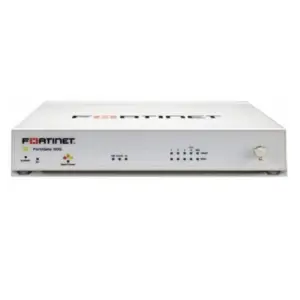
FortiGate 700G Series brings high-throughput secure networking to modern campus, enterprise edge and distributed environments that need strong inspection capacity without treating networking and security as separate projects. Fortinet positions the series for modern campus use and specifies 164 Gbps firewall throughput, 55 Gbps IPsec VPN throughput, 26 Gbps threat protection, 16 million concurrent sessions and 700,000 new connections per second. The family includes FortiGate 700G and FortiGate 701G, with the 701G identified by Fortinet as the storage-equipped option. Buyers should size the platform against real inspected traffic, encrypted traffic, VPN usage, segmentation, availability requirements and expected growth rather than selecting only from headline firewall throughput.
Fortinet-rated firewall throughput for the 700G series.
IPsec VPN throughput for demanding site connectivity.
Threat-protection throughput with security services enabled under Fortinet test conditions.
What the FortiGate 700G Series is designed to solve
A growing enterprise network can reach a point where a basic perimeter firewall becomes a bottleneck. More users, SaaS applications, branch VPNs, encrypted sessions, Wi-Fi traffic, server workloads and segmentation policies all increase the amount of work performed at the security edge. The FortiGate 700G Series is designed for organisations that need substantial throughput while consolidating next-generation firewall functions, secure networking, SD-WAN and Fortinet Security Fabric integration. Its value is not simply speed: the platform provides room to build policies around users, applications, devices, network zones and remote connectivity while supporting higher-speed access and uplink interfaces.
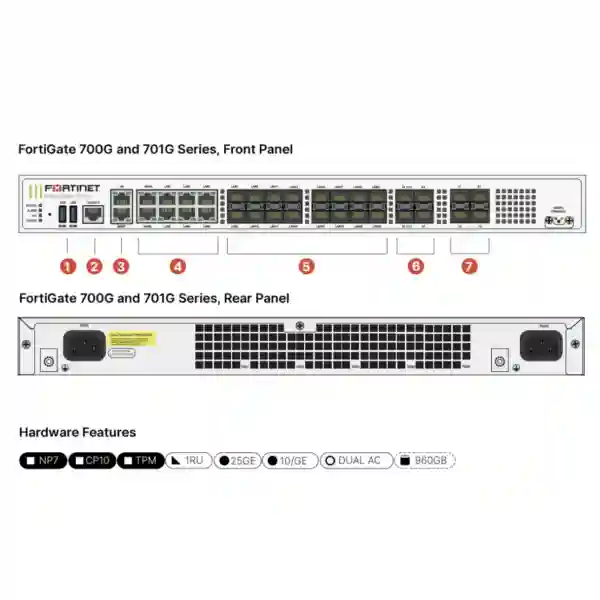
Fortinet documents one NP7 network processor and one CP10 content processor in both the FortiGate 700G and 701G. Front-panel connectivity includes eight multi-gigabit RJ45 data interfaces supporting up to 5G, sixteen 1GE SFP interfaces, four 10/1GE SFP+/SFP interfaces and four 25/10GE SFP28/SFP+ interfaces, plus dedicated management and HA connectivity. This mix can suit campus aggregation, enterprise internet edges and environments where copper access, fiber distribution and faster uplinks must coexist.
FortiGate 700G and 701G buying guidance
The two principal models share the security and networking platform, while Fortinet’s ordering material identifies FortiGate 701G as the model with storage. That distinction matters when a design calls for local storage capabilities. Procurement should confirm the exact appliance, FortiGuard service bundle, support term, optics, transceivers, rack and power requirements, high-availability quantity and any central management or logging components before a quotation is finalised. Subscription selection should reflect the security services the organisation intends to operate rather than treating licensing as an afterthought.
For a broader security design, review FourTeck Tanzania’s integrated IT and security portfolio, the technology services overview, the business technology shop and the Tanzania quotation and consultation page. These pages help connect firewall procurement with switching, Wi-Fi, servers, cabling and deployment requirements rather than isolating the appliance from the rest of the network.
FortiGate 700G Series Tanzania
Organisations evaluating FortiGate 700G Series in Tanzania commonly need to protect a mixture of internet access, cloud applications, internal systems, Wi-Fi, branch links and remote users. The most useful starting point is a traffic and risk profile: current and planned ISP bandwidth, number of users and endpoints, expected encrypted traffic, applications that require inspection, public services, VPN topology and whether the firewall will also participate in SD-WAN. A 700G purchase should therefore be treated as an architecture decision rather than a box replacement. Fortinet’s published 26 Gbps threat-protection figure is especially relevant because real deployments usually enable more than stateful firewalling. Buyers should map required services to the performance metrics that represent those services.
Tanzania deployments can range from corporate headquarters and campuses to multi-branch organisations, education environments, hospitality groups, financial operations, logistics networks and data-intensive businesses. Interface planning matters when existing switches use fiber, when internet handoffs are multi-gigabit, or when an organisation expects to move toward 10G or 25G aggregation. The 700G family’s varied copper and fiber interfaces can reduce unnecessary media conversion, but the exact transceiver and cabling design still needs validation.
Resilience should be discussed before ordering. If downtime is unacceptable, ask whether the design needs two appliances in high availability, dual ISP circuits, redundant switch paths and independent power protection. Configuration backups, firmware policy, monitoring, logging and change control should also be part of the operating plan. FourTeck Tanzania’s site describes firewall projects in terms of user count, internet speed, VPN requirements, branch connectivity and enabled security services; supplying those details helps turn a generic product enquiry into a meaningful bill of materials. For regional expertise beyond Tanzania, FourTeck’s Africa technology network provides a broader regional reference.
FortiGate 700G Series Dar es Salaam
For businesses in Dar es Salaam, FortiGate 700G Series can be considered where a headquarters, campus, large office, logistics operation, hospitality property or multi-site organisation needs substantial secure internet and inter-site capacity. Dar es Salaam projects often bring together several network layers: ISP handoffs, core switching, server or cloud access, corporate Wi-Fi, guest networks, IP telephony, surveillance and branch VPNs. The firewall design should define which traffic crosses security boundaries and which services need deep inspection. Separating employee, guest, server, management, voice, CCTV and IoT zones can make policy clearer and reduce unnecessary lateral access.
A procurement request should state the current ISP speed and any planned upgrade, because a firewall that is comfortable today should not become the limiting component after a circuit change. Include the approximate number of users, concurrent sessions, site-to-site tunnels, remote users and public applications. If the organisation intends to inspect TLS-encrypted traffic, this should be included in sizing and certificate-deployment planning. The FortiGate 700G’s 10G and 25G interface options are particularly relevant where the firewall connects to faster campus cores or aggregation switches.
Operational planning is equally important. Define who will administer policies, how logs will be retained, how configuration changes are approved and how firmware upgrades will be tested. If high availability is required, procure and cable the design accordingly from the beginning rather than attempting to retrofit resilience after deployment. FourTeck’s verified Tanzania contact page lists Dar es Salaam among its office locations and invites firewall enquiries to include internet bandwidth, users, VPN requirements and expected security services. Buyers can use the FourTeck Tanzania contact page to provide those details for model and quotation review.
FortiGate 700G Series Mwanza
A FortiGate 700G Series requirement in Mwanza may arise from an organisation consolidating network security for a regional office, industrial site, education campus, healthcare environment, hospitality operation or business with branches connected back to a central location. The first design question is not the city but the traffic profile: what must be protected, where applications live, how users reach them and what happens when a primary connection fails. For a site serving many internal segments, the firewall can act as a controlled policy boundary between networks as well as the internet perimeter.
Where Mwanza sites connect to headquarters or cloud resources, IPsec VPN and SD-WAN planning can be central to the design. Fortinet publishes up to 55 Gbps IPsec VPN throughput for the series, but practical sizing should account for the number of tunnels, traffic mix, inspection features, routing design and failover behaviour. If two WAN services are available, define whether the requirement is active-passive failover, application-aware path selection or load distribution. The network team should also document addressing, VLANs and route ownership so that a firewall migration does not introduce unexpected reachability problems.
Procurement should include the complete operating requirement. Confirm whether local storage is needed, which FortiGuard services are required, the desired support duration, appropriate optics for fiber links and whether two units are needed for HA. Check rack depth, power feeds, UPS capacity and cooling in the communications room. If remote administration is expected, management access should be restricted and protected rather than exposed casually. A structured pre-deployment worksheet covering interfaces, WAN details, VPN peers, existing policies, objects and dependencies can reduce migration risk. FourTeck Tanzania’s services overview is useful for customers considering the firewall as part of a wider network upgrade.
FortiGate 700G Series Arusha
Businesses researching FortiGate 700G Series in Arusha may be planning secure connectivity for offices, hospitality environments, education, tourism operations, professional services or distributed organisations that need reliable access to central and cloud applications. A modern firewall project should begin by identifying critical workflows. Reservations, ERP, payment systems, collaboration tools, cloud applications, guest internet, surveillance and staff access can have very different security and availability requirements. The design should prevent a less-trusted network, such as guest Wi-Fi or unmanaged devices, from receiving unnecessary access to business systems.
The 700G Series provides a broad interface mix that can support multi-gigabit copper connections, 1G fiber access and faster 10G/25G uplinks. This is useful when a site has multiple network zones or connects to a high-capacity core, but port count alone should not determine the architecture. Decide which interfaces will be physical, which networks will use VLANs and how redundancy will be implemented. If FortiLink-managed switching is part of the intended architecture, validate the topology and supported design before installation.
For Arusha procurement, provide a clear statement of quantities and service expectations. A complete quotation may need the appliance, subscription bundle, FortiCare support, transceivers, HA peer, management or logging options and professional configuration work. Avoid comparing quotations only on the base hardware price when the included service terms differ. FourTeck Tanzania’s verified contact page lists Arusha as an office location, and the site encourages buyers to share capacity, compatibility and model-selection information. The Arusha and Tanzania sales enquiry route can therefore be used to describe the network and request a scoped quotation rather than a generic price-only response.
FortiGate 700G Series Dodoma
FortiGate 700G Series in Dodoma can suit organisations that need an enterprise-class security gateway for a headquarters, institutional campus, distributed branch environment or network with substantial VPN and inspection demand. Procurement teams should distinguish between raw firewall throughput and performance when security controls are active. Fortinet publishes separate figures for firewall, IPsec VPN and threat protection because these workloads are different. When an organisation plans IPS, application control, malware protection, logging and encrypted traffic inspection, sizing should focus on the combined operational profile.
Dodoma projects may also require clear separation between departments, server networks, wireless users, guests, building systems and management infrastructure. Segmentation is most useful when policy reflects business need: users should receive the access required for their roles without broad trust between every VLAN. Before migration, identify services that rely on fixed addresses, inbound NAT, partner VPNs or unusual ports. These dependencies should be documented and tested so the new firewall does not interrupt critical applications.
Availability planning can include dual internet links, HA firewalls, redundant uplinks and UPS-backed power. The exact combination depends on business impact and budget. A resilient firewall pair cannot compensate for a single upstream switch or unprotected power path, so the surrounding architecture deserves the same attention. FourTeck Tanzania’s contact page lists Dodoma among its office locations and specifically requests firewall information such as internet speed, branch connectivity, remote users and security services. Buyers can also review the FourTeck Tanzania solution portfolio when the 700G deployment needs switching, Wi-Fi, servers, racks or structured cabling as part of the same project.
FortiGate 700G Series UAE
Organisations sourcing FortiGate 700G Series for UAE environments may be designing a secure campus edge, enterprise perimeter, multi-branch WAN or high-capacity VPN hub. The platform’s combination of 5GE, 10GE and 25GE connectivity can align with faster internet and campus networks, but the design should still be based on inspected traffic rather than link speed alone. Define whether the firewall will protect north-south internet traffic, east-west segmentation, data-center resources, remote access, branch VPNs or several of these roles at once.
A UAE quotation should clearly separate hardware from recurring security and support services. Confirm the FortiGuard bundle, support term, local storage requirement, HA quantity and optical interfaces. If the firewall is replacing another vendor or an older FortiGate, migration planning should include policy review rather than blindly copying years of accumulated rules. Remove obsolete objects, validate NAT, identify VPN dependencies and define a rollback plan. This creates a cleaner security baseline and can reduce troubleshooting after cutover.
Central management and logging should be discussed for organisations with multiple firewalls or compliance-driven operational processes. The appropriate design depends on scale and retention needs. Teams should also establish administrator roles, MFA, configuration backup, firmware governance and periodic rule review. FourTeck’s UAE technology site, Fortinet UAE specialist site and firewall solutions resource provide relevant regional paths for UAE enquiries. When comparing offers, ensure every supplier is quoting equivalent hardware, subscription duration and support scope.
FortiGate 700G Series Uganda
For FortiGate 700G Series Uganda projects, the platform may be considered for organisations consolidating secure internet access, branch connectivity and segmentation at a central site. A distributed enterprise should map branch traffic before choosing the hub firewall: how many sites terminate VPNs, whether branch internet breaks out locally, which applications are centralized, and what happens when a WAN circuit is degraded. The 700G’s high IPsec capacity gives substantial headroom on paper, but the final design must include inspection, routing, session growth and availability requirements.
Security policy should be designed around zones and application needs. Branch users may need access to ERP or file services while guest and IoT networks should remain isolated. Administrators can reduce risk by limiting management interfaces, using strong authentication, maintaining configuration backups and reviewing exposed services. Where dual links are available, SD-WAN policies can be designed around application performance and failover objectives rather than simple round-robin traffic distribution.
Uganda procurement should specify appliance model, service bundle, support duration, optics, HA requirement and any central logging or management components. If the 701G’s storage capability is required, state that explicitly so quotations do not substitute the 700G. Installation planning should include rack, power, UPS, fiber type and existing switch interfaces. FourTeck’s Uganda IT solutions site provides a regional route for related network and security enquiries. A well-prepared request that includes bandwidth, users, branches, VPNs and desired security services will produce a more useful technical response than asking only for the lowest appliance price.
FortiGate 700G Series Kampala
A Kampala organisation considering FortiGate 700G Series may need to secure a headquarters that aggregates internet access and traffic from multiple offices. This role places different demands on the firewall than a small branch. In addition to perimeter inspection, the appliance may terminate site-to-site VPNs, enforce segmentation, publish selected services and provide secure access to cloud or data-center applications. Capacity planning should therefore model peak periods, not only average bandwidth.
The physical interface plan deserves early attention. The 700G family provides multi-gigabit RJ45, 1GE SFP, 10GE SFP+ and 25GE SFP28 options, allowing it to connect to diverse carrier and campus infrastructure. Confirm optical standards and transceiver compatibility before ordering. If the core uses redundant switches, determine how firewall links will be distributed and how failure scenarios behave. HA designs should be tested for link, device and upstream failures rather than assuming a pair of appliances automatically eliminates every single point of failure.
Kampala buyers should also define the lifecycle of the security services. Threat intelligence and security subscriptions affect the functionality expected from an NGFW, so renewal planning belongs in the total cost discussion. Logging capacity, reporting, alerting and administrative access should be included in operating procedures. When migrating from an existing firewall, catalogue active policies, VPN peers, NAT rules, certificates and routes. Schedule testing for critical applications and keep a rollback plan. Regional procurement and integration discussions can begin through FourTeck Uganda, while Tanzania-based multi-country projects can be coordinated from the verified FourTeck Tanzania contact page.
FortiGate 700G Series Arua
For an Arua deployment, FortiGate 700G Series should be evaluated against the role of the site in the wider organisation. If Arua is a regional hub serving smaller locations, VPN concentration, routing and application availability may be more important than the number of local users alone. If it is an independent large site, internet security, segmentation and local services may dominate. Documenting these roles prevents oversizing one metric while overlooking another.
Connectivity resilience can be particularly important for operations that depend on centralized applications. Where multiple WAN options exist, define the failover objective and which applications receive priority during reduced capacity. SD-WAN policy should reflect business importance, latency and loss sensitivity. A backup link may have less bandwidth than the primary circuit, so policies should prevent nonessential traffic from consuming the remaining capacity during an outage. VPN routing must also be tested when paths change.
The 700G’s interface flexibility can support fiber uplinks and multi-gigabit access, but the surrounding switches, optics and cabling must match. Procurement should request the exact FortiGate model and license term and should state whether local storage, HA or centralized management is required. For installation, prepare a port map, IP plan, VLAN list, VPN peer list, policy matrix and acceptance tests. This makes handover easier for internal teams and future support providers. FourTeck Uganda’s regional IT and networking resource is relevant for Uganda enquiries, while cross-border standardization can use the same security policy principles across sites without forcing every location into an identical physical design.
FortiGate 700G Series Mbarara
Mbarara organisations assessing FortiGate 700G Series can begin by defining which security functions will be enabled continuously. Stateful firewalling, IPS, malware protection, application control, web controls, VPN and TLS inspection consume different resources, which is why Fortinet publishes multiple performance metrics. A sizing exercise should match the enabled feature set and traffic profile. Future bandwidth upgrades and growth in encrypted applications should be considered so the appliance remains useful through the intended lifecycle.
For a campus or multi-building environment, segmentation can help separate administrative users, operational devices, guests, servers, cameras and management systems. The objective is not to create complexity for its own sake; it is to create understandable trust boundaries. Policies should be named and documented, and unused rules should be removed after validation. If the firewall participates in routing between many internal networks, maintenance windows and migration sequencing become important because a change can affect more than internet access.
A complete Mbarara bill of materials can include the firewall, subscription, support, optics, HA peer and any logging or management components. Power protection and rack conditions should be checked before delivery. If a second appliance is planned later, confirm that the intended HA design and licensing approach are understood from the start. Teams should keep secure configuration backups and document recovery procedures. FourTeck’s Uganda solutions site can support regional enquiry routing, while the Fortinet specification should remain the authority for final product capabilities. Procurement teams should ask for a configuration matched to their environment rather than assuming every 700G quotation includes the same services and accessories.
FortiGate 700G Series Gulu
A FortiGate 700G Series project in Gulu may support a substantial standalone site or a regional node in a distributed organisation. Start by identifying critical applications, users, devices and remote dependencies. If the site must continue operating during a primary ISP outage, define what level of service the backup connection must sustain. If business applications are centralized elsewhere, test VPN failover and routing behavior as carefully as internet browsing.
The firewall can enforce policies between network segments, but effective segmentation requires a clean inventory. Identify servers, staff devices, guest Wi-Fi, voice, cameras, access control, printers and management interfaces. Decide which systems genuinely need to communicate. This approach can reduce lateral exposure and make troubleshooting more predictable. For remote access, user authentication, endpoint posture requirements and access scope should be planned rather than providing broad network access by default.
Gulu procurement should also account for physical infrastructure. Verify rack space, UPS capacity, grounding, cooling, carrier handoff type and fiber requirements. FortiGate 700G and 701G support a wide interface range, but correct transceivers and cabling remain essential. A quotation should state the exact model, subscription and support term, plus whether HA is included. For multi-site organizations, standardized templates for naming, VLANs, VPNs, logging and administrator roles can simplify operations while still allowing local differences. The FourTeck Uganda site is a relevant regional resource for network-security enquiries. Buyers should provide their topology and operational goals so the discussion can focus on fit, resilience and maintainability rather than only the appliance specification.
FortiGate 700G Series Kenya
FortiGate 700G Series Kenya requirements may come from enterprise campuses, regional headquarters, financial and professional services, education, logistics, hospitality or organizations operating several branches. The series offers substantial performance for environments where secure networking and firewall inspection must scale together. Fortinet’s published figures provide a reference point, but a design should translate them into actual workloads: internet bandwidth, east-west traffic, VPN tunnels, inspected TLS sessions, application mix and expected growth.
Kenya deployments with multiple carriers can use SD-WAN capabilities to apply path selection and resilience policies. The design should define what constitutes a failed or degraded link and which applications should prefer each path. For branches, decide whether internet traffic exits locally or returns to a central firewall. These choices affect bandwidth, latency and security policy. Where the 700G acts as a hub, tunnel count and aggregate encrypted traffic should be included in sizing.
Procurement should verify whether FortiGate 700G or storage-equipped 701G is required and specify the desired FortiGuard and support term. Include transceivers, redundant power considerations, HA quantity and central management or logging requirements as applicable. If the project replaces an existing firewall, build time for rule cleanup and application testing. FourTeck’s Kenya IT solutions site offers a relevant regional route for security and networking discussions. Cross-border organisations can also use a common FortiGate policy framework across Kenya, Tanzania and Uganda while tailoring WAN connectivity, addressing and physical interfaces to each site. Consistent documentation and administrator practices are often as valuable as using the same hardware family.
FortiGate 700G Series Kuwait
For Kuwait organisations evaluating FortiGate 700G Series, a common objective is to combine high-capacity perimeter security with secure branch and cloud connectivity. The platform’s 10G and 25G interface support can fit networks where the security edge must connect to faster switching or carrier services. Before selecting a model, identify whether the firewall is expected to handle only internet traffic or also internal segmentation, VPN concentration and published services. These roles influence interface allocation, routing and operational risk.
Encrypted traffic is now a major part of enterprise networking, so inspection policy should be considered during design. Determine which categories require TLS inspection, which applications need exceptions and how certificates will be deployed to managed endpoints. This is both a technical and governance question. Security teams should also define IPS, malware, application and web controls according to risk rather than enabling every possible function without an operating plan.
Kuwait procurement should compare like-for-like quotations. The base appliance, storage option, FortiGuard bundle, FortiCare term, optics and HA quantity can materially change scope. Centralized logging or management may be appropriate for multiple devices. Migration projects should include configuration review, testing and rollback. FourTeck’s Kuwait technology site provides a regional path for enquiries, while FourTeck’s Fortinet specialist resource can provide broader product context. Final capability claims should always be checked against the current Fortinet datasheet and ordering documentation for the exact model and software release.
FortiGate 700G Series Ghana
FortiGate 700G Series Ghana deployments can address organisations that need a strong enterprise edge for secure internet, campus segmentation and branch connectivity. Start by creating a simple traffic matrix: internet, branch-to-headquarters, user-to-server, guest, cloud and management traffic. Mark which flows require inspection and which are business critical. This turns product sizing into a measurable exercise and helps identify where redundancy is worth the investment.
The 700G Series offers a mix of copper and fiber interfaces from 1G through 25G, making it adaptable to different campus designs. Interface flexibility does not remove the need for topology planning. Confirm whether the firewall connects directly to carriers, to edge routers or to core switches; define VLAN tagging; and document how HA links and redundant uplinks will be cabled. If the network uses fiber, specify optic type and distance instead of leaving transceiver selection until installation day.
For Ghana procurement, confirm the exact appliance and subscription bundle, support duration, storage need and HA quantity. If the organization has several locations, centralized policy management and logging may simplify governance. Establish administrator roles, MFA, configuration backups and firmware maintenance procedures. FourTeck’s Ghana IT product and solutions site is a relevant regional resource. A useful quotation request should include current firewall details, internet capacity, user and branch counts, VPN needs, security services and growth expectations. This allows the supplier and technical team to evaluate whether the 700G is appropriately sized and which accessories and services belong in the complete solution.
FortiGate 700G Series Nigeria
Nigeria organisations considering FortiGate 700G Series may need to protect high-volume enterprise networks, campuses, headquarters or distributed operations with many branches. At this scale, firewall design should be tied to business continuity and operational visibility. Identify critical applications, peak traffic, VPN concentration, remote-access demand and internal security zones. A single headline throughput figure is insufficient because threat inspection and encrypted traffic can become the practical sizing constraints.
Where several WAN links are used, secure SD-WAN policies can help align connectivity with application requirements. Define preferred paths for critical services and acceptable behavior during degradation. If a backup link has lower capacity, rate limiting or application priorities may be needed so essential systems remain usable. For organizations with many branches, consistent VPN and routing templates can reduce configuration drift, but each site should still be tested against its actual carrier and addressing environment.
Nigeria procurement should request an itemized scope: FortiGate 700G or 701G, FortiGuard bundle, FortiCare term, optics, HA peer and management/logging components where required. Migration services should include discovery, policy cleanup, configuration, testing and handover documentation. The FourTeck Nigeria IT services site is a relevant regional path for project enquiries. For organisations operating across West and East Africa, common firewall standards can simplify governance, but connectivity, regulatory requirements and support logistics should be validated for each country. The aim should be a maintainable security architecture with clear ownership, not simply the largest appliance that fits the budget.
FortiGate 700G Series Seychelles
FortiGate 700G Series Seychelles projects may be relevant to hospitality groups, financial and professional organisations, government or institutional networks, and multi-site businesses that need secure connectivity between island locations, data centers or cloud services. Connectivity characteristics can make resilience planning especially important. Document primary and secondary WAN services, expected bandwidth and which business functions must continue during a link problem. The firewall and SD-WAN policy should support that continuity plan rather than being configured independently of it.
For hospitality or mixed-use networks, segmentation can separate corporate systems, guest access, payment environments, cameras, building systems and management interfaces. Policies should grant only necessary communication between zones. Where remote vendors need access to operational systems, use controlled authentication and narrowly scoped permissions. Logging and alerting should be designed so unusual access can be investigated rather than simply stored without review.
Seychelles procurement should include logistics and lifecycle considerations as well as appliance performance. Confirm the exact model, license and support duration, optics, spare strategy, HA requirement and power protection. If remote support is expected, secure management access and documented recovery procedures become important. A preconfigured replacement process may be worth considering for critical environments, subject to the organisation’s support model. Regional discussions can begin through FourTeck’s Africa technology resource. For multi-country groups, maintaining consistent naming, policy templates and documentation across Seychelles and mainland offices can simplify administration while still allowing each site’s connectivity and operational requirements to determine the final physical design.
Technical specification highlights
| Area | Fortinet-published 700G Series information |
|---|---|
| Firewall throughput | Up to 164 Gbps |
| IPsec VPN throughput | Up to 55 Gbps |
| Threat protection | Up to 26 Gbps under Fortinet test methodology |
| Sessions | Up to 16 million concurrent sessions; 700,000 connections per second |
| Interfaces | Multi-gigabit RJ45 plus 1GE SFP, 10GE SFP+ and 25GE SFP28 connectivity; dedicated management and HA ports |
Compatibility, deployment and integration checklist
Before ordering, confirm ISP handoff type, core-switch interfaces, VLAN design, routing protocol requirements, VPN peers, public IP addresses, NAT dependencies, authentication sources, certificate requirements and logging destinations. For high availability, document heartbeat links, monitored interfaces, upstream/downstream redundancy and expected failover behavior. If FortiGate will manage FortiSwitch or integrate with other Security Fabric components, verify supported versions and topology in current Fortinet documentation.
For related infrastructure, FourTeck Tanzania’s home and service pages cover network switching, Wi-Fi, servers, UPS and structured cabling, while the Tanzania business technology shop provides a product-oriented starting point. The firewall should be planned alongside these dependencies because an enterprise security appliance cannot compensate for an undersized core, unstable power or undocumented cabling.
FortiGate 700G Series FAQs
What models are in the FortiGate 700G Series?
Fortinet documentation identifies FortiGate 700G and FortiGate 701G. Fortinet’s ordering guide identifies 701G as the storage-equipped model. Confirm current ordering codes and service bundles when requesting a quotation.
Is FortiGate 700G suitable for a campus or headquarters?
Fortinet positions the 700G Series for modern campus and midsize/distributed enterprise use. Suitability for a specific headquarters depends on inspected throughput, users, sessions, VPNs, interfaces, HA and growth.
Does the FortiGate 700G support 25G interfaces?
Yes. Fortinet documents four 25/10 GigE SFP28/SFP+ front-panel interfaces, along with 10G, 1G and multi-gigabit copper connectivity.
What should I provide for a FortiGate 700G quotation?
Provide internet bandwidth, user/device count, branch and VPN requirements, desired security services, HA requirement, switch/uplink speeds, fiber needs, storage requirement, support term and expected growth. Existing firewall details are useful for migrations.
Should I choose 700G or 701G?
The decision depends in part on whether the deployment needs the storage-equipped model. Confirm the logging/storage design, subscription scope and current Fortinet ordering information before purchase.
Quotation checklist and decision recap
For a useful FortiGate 700G Series quotation, send the target country and site, exact model preference if known, quantity, internet circuits and speeds, approximate users and devices, branch/VPN count, remote-access requirement, enabled security services, HA requirement, desired subscription/support term, core-switch interface speeds, optical transceiver requirements and whether local storage is needed. Also mention existing firewall migration requirements and any deadline that affects project planning.
The key decision is fit: select the appliance and service bundle that support the real inspected workload and operational model. Fortinet’s 700G Series provides high published throughput, a flexible interface set and integration with FortiOS security and networking capabilities. A successful deployment also requires policy design, resilient connectivity, clean migration, logging, administrator controls and lifecycle planning.

Reviews
There are no reviews yet.